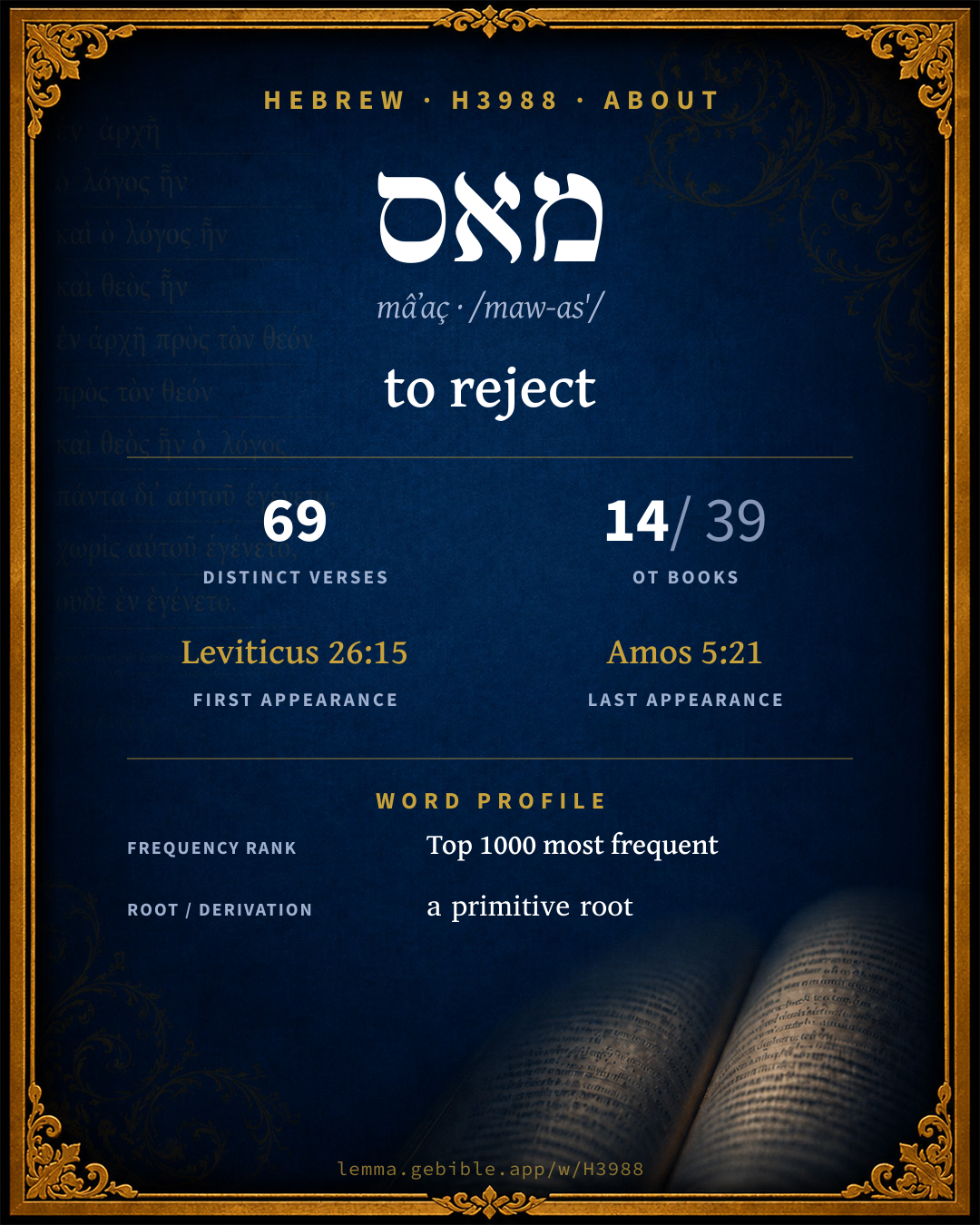
מָאַס
to reject
also: despise, refuse fuller range ↓
Full lexicon entry — Brown-Driver-Briggs (BDB)
From Brown-Driver-Briggs (BDB)
Where this word appears
See every Qal verb in the Hebrew Bible →
Grammar key — what these labels mean
Part of speech
- Verb
- An action or state-of-being word.
Stem
- Qal
- The basic, simple active stem — the plain form of the verb (“he wrote”). Here: ‘reject’
- Niphal
- Usually the simple passive or reflexive of the Qal (“he was written”). Here: ‘be rejected’
Form
- Perfect
- A completed action or state — Hebrew marks aspect (completeness) more than strict tense (“he wrote”).
- Imperfect
- An incomplete, ongoing, or future action (“he will / would write”).
- Sequential Imperfect
- An imperfect with prefixed waw — the standard past-narrative form (waw-consecutive imperfect).
- Infinitive Absolute
- An unbound verbal noun, often intensifying or standing in for a finite verb.
- Participle Active
- A verbal adjective expressing ongoing or characteristic action (“writing / one who writes”).
- Jussive
- A third- or second-person volitional form expressing wish or command (“let him write”).
- Sequential Perfect
- A perfect with prefixed waw continuing a preceding imperfect or command (waw-consecutive perfect).
- Infinitive Construct
- A bound verbal noun, frequently with prepositions (“to write / in writing”).
State
- Absolute
- The independent form of a noun, not bound to a following word.
- Construct
- A noun bound to a following noun in a possessive / “of” relationship (the construct chain).
Person
- 3rd Person
- The one spoken about (“he / she / it / they”).
- 2nd Person
- The one addressed (“you”).
- 1st Person
- The speaker (“I / we”).
Gender
- Common
- Either gender — not distinguished for this form.
- Masculine
- Grammatically masculine.
- Feminine
- Grammatically feminine.
Number
- Plural
- More than one (in Hebrew, generally three or more).
- Singular
- One.
Grammatical forms 24 distinct
- Verb, Qal, Perfect, 3rd Person, Common, Plural 12 times (16%)
- Verb, Qal, Perfect, 2nd Person, Masculine, Singular 7 times (9%)
- Verb, Qal, Perfect, 1st Person, Common, Singular 7 times (9%)
- Verb, Qal, Imperfect, 1st Person, Common, Singular 6 times (8%)
- Verb, Qal, Perfect, 3rd Person, Masculine, Singular 6 times (8%)
- Verb, Qal, Sequential Imperfect, 3rd Person, Masculine, Singular 6 times (8%)
- Verb, Qal, Infinitive Absolute 4 times (5%)
- Verb, Qal, Imperfect, 3rd Person, Masculine, Singular 4 times (5%)
+16 more forms (24 occurrences)
Parsed forms decoded from the imported morphology (morphhb / Westminster Leningrad Codex — WLC text public domain, morphhb tagging CC BY 4.0), counted across 76 parsed occurrences — not distinct verses.
Every verse where H3988 appears — 69 distinct verses across 14 books. Click any verse to open its interlinear word-by-word view. Verse text shown in the World English Bible for context — . Each verse’s Hebrew form is shown with its reference; the English is not keyword-highlighted, since the data carries no word-level English alignment. Use “Compare translations” on any verse to read it across multiple English versions. This concordance covers the Hebrew Bible; Septuagint (Greek Old Testament) occurrences are not indexed here.
Leviticus 3 verses
- Leviticus 26:15 תִּמְאָ֔סוּ Qal impf 2mp and if you shall reject my statutes, and if your soul abhors my ordinances, so that you will not do all my commandments, but break my covenant;
- Leviticus 26:43 מָאָ֔סוּ Qal pf 3cp The land also will be left by them, and will enjoy its sabbaths while it lies desolate without them: and they will accept the punishment of their iniquity; because, even because they rejected my ordinances, and their soul abhorred my statutes.
- Leviticus 26:44 מְאַסְתִּ֤י/ם Qal pf 1cs + sfx pers 3mp Yet for all that, when they are in the land of their enemies, I will not reject them, neither will I abhor them, to destroy them utterly, and to break my covenant with them; for I am Yahweh their God;
Numbers 2 verses
- Numbers 11:20 מְאַסְתֶּ֤ם Qal pf 2mp but a whole month, until it come out at your nostrils, and it be loathsome to you; because that you have rejected Yahweh who is among you, and have wept before him, saying, Why came we forth out of Egypt?
- Numbers 14:31 מְאַסְתֶּ֖ם Qal pf 2mp But your little ones, that you said should be a prey, them will I bring in, and they shall know the land which you have rejected.
Judges 1 verse
1 Samuel 6 verses
- 1 Samuel 8:7 מָאָ֔סוּ מָאֲס֖וּ Qal pf 3cp Qal pf 3cp Yahweh said to Samuel, Listen to the voice of the people in all that they tell you; for they have not rejected you, but they have rejected me, that I should not be king over them.
- 1 Samuel 10:19 מְאַסְתֶּ֣ם Qal pf 2mp but you have this day rejected your God, who himself saves you out of all your calamities and your distresses; and you have said to him, [No], but set a king over us. Now therefore present yourselves before Yahweh by your tribes, and by your thousands.
- 1 Samuel 15:23 מָאַ֨סְתָּ֙ וַ/יִּמְאָסְ/ךָ֖ Qal pf 2ms conj + Qal wimpf 3ms + sfx pers 2ms For rebellion is as the sin of witchcraft, and stubbornness is as idolatry and teraphim. Because you have rejected the word of Yahweh, he has also rejected you from being king.
- 1 Samuel 15:26 מָאַ֨סְתָּה֙ וַ/יִּמְאָסְ/ךָ֣ Qal pf 2ms conj + Qal wimpf 3ms + sfx pers 2ms Samuel said to Saul, I will not return with you; for you have rejected the word of Yahweh, and Yahweh has rejected you from being king over Israel.
- 1 Samuel 16:1 מְאַסְתִּ֔י/ו Qal pf 1cs + sfx pers 3ms Yahweh said to Samuel, How long will you mourn for Saul, seeing I have rejected him from being king over Israel? fill your horn with oil, and go: I will send you to Jesse the Bethlehemite; for I have provided me a king among his sons.
- 1 Samuel 16:7 מְאַסְתִּ֑י/הוּ Qal pf 1cs + sfx pers 3ms But Yahweh said to Samuel, "Don't look on his face, or on the height of his stature; because I have rejected him: for [Yahweh sees] not as man sees; for man looks at the outward appearance, but Yahweh looks at the heart."
2 Kings 3 verses
- 2 Kings 17:15 וַ/יִּמְאֲס֣וּ conj + Qal wimpf 3mp They rejected his statutes, and his covenant that he made with their fathers, and his testimonies which he testified to them; and they followed vanity, and became vain, and [went] after the nations that were round about them, concerning whom Yahweh had charged those who they should not do like them.
- 2 Kings 17:20 וַ/יִּמְאַ֨ס conj + Qal wimpf 3ms Yahweh rejected all the seed of Israel, and afflicted them, and delivered them into the hand of spoilers, until he had cast them out of his sight.
- 2 Kings 23:27 וּ֠/מָאַסְתִּי conj + Qal wpf 1cs Yahweh said, I will remove Judah also out of my sight, as I have removed Israel, and I will cast off this city which I have chosen, even Jerusalem, and the house of which I said, My name shall be there.
Job 12 verses
- Job 5:17 תִּמְאָֽס Qal juss 2ms "Behold, happy is the man whom God corrects: Therefore do not despise the chastening of the Almighty.
- Job 7:5 וַ/יִּמָּאֵֽס conj + Niphal wimpf 3ms My flesh is clothed with worms and clods of dust. My skin closes up, and breaks out afresh.
- Job 7:16 מָ֭אַסְתִּי Qal pf 1cs I loathe my life. I don't want to live forever. Leave me alone; for my days are but a breath.
- Job 8:20 יִמְאַס Qal impf 3ms "Behold, God will not cast away a blameless man, Neither will he uphold the evil-doers.
- Job 9:21 אֶמְאַ֥ס Qal impf 1cs I am blameless. I don't regard myself. I despise my life.
- Job 10:3 תִ֭מְאַס Qal impf 2ms Is it good to you that you should oppress, That you should despise the work of your hands, And smile on the counsel of the wicked?
- Job 19:18 מָ֣אֲסוּ Qal pf 3cp Even young children despise me. If I arise, they speak against me.
- Job 30:1 מָאַ֥סְתִּי Qal pf 1cs "But now those who are younger than I, have me in derision, Whose fathers I would have disdained to put with my sheep dogs.
- Job 31:13 אֶמְאַ֗ס Qal impf 1cs "If I have despised the cause of my man-servant Or of my maid-servant, When they contended with me;
- Job 34:33 מָאַ֗סְתָּ Qal pf 2ms Shall his recompense be as you desire, that you refuse it? For you must choose, and not I. Therefore speak what you know.
- Job 36:5 יִמְאָ֑ס Qal impf 3ms "Behold, God is mighty, and doesn't despise anyone. He is mighty in strength of understanding.
- Job 42:6 אֶמְאַ֣ס Qal impf 1cs Therefore I abhor myself, And repent in dust and ashes."
Psalms 9 verses
- Psalms 15:4 נִמְאָ֗ס Niphal ptcp.act ms In whose eyes a vile man is despised, But who honors those who fear Yahweh; He who keeps an oath even when it hurts, and doesn't change;
- Psalms 36:4 יִמְאָֽס Qal impf 3ms He plots iniquity on his bed. He sets himself in a way that is not good; He doesn't abhor evil.
- Psalms 53:5 מְאָסָֽ/ם Qal pf 3ms + sfx pers 3mp There they were in great fear, where no fear was, For God has scattered the bones of him who encamps against you. You have put them to shame, Because God has rejected them.
- Psalms 58:7 יִמָּאֲס֣וּ Niphal impf 3mp Let them vanish as water that flows away. When they draw the bow, let their arrows be made blunt.
- Psalms 78:59 וַ/יִּמְאַ֥ס conj + Qal wimpf 3ms When God heard this, he was angry, And greatly abhorred Israel;
- Psalms 78:67 וַ֭/יִּמְאַס conj + Qal wimpf 3ms Moreover he rejected the tent of Joseph, And didn't choose the tribe of Ephraim,
- Psalms 89:38 וַ/תִּמְאָ֑ס conj + Qal wimpf 2ms But you have rejected and spurned. You have been angry with your anointed.
- Psalms 106:24 וַֽ֭/יִּמְאֲסוּ conj + Qal wimpf 3mp Yes, they despised the pleasant land. They didn't believe his word,
- Psalms 118:22 מָאֲס֣וּ Qal pf 3cp The stone which the builders rejected has become the head of the corner.
Proverbs 2 verses
Isaiah 10 verses
- Isaiah 5:24 מָאֲס֗וּ Qal pf 3cp Therefore as the tongue of fire devours the stubble, And as the dry grass sinks down in the flame, So their root shall be as rottenness, And their blossom shall go up as dust; Because they have rejected the law of Yahweh of Hosts, And despised the word of the Holy One of Israel.
- Isaiah 7:15 מָא֥וֹס Qal inf.abs He shall eat butter and honey when he knows to refuse the evil, and choose the good.
- Isaiah 7:16 מָאֹ֥ס Qal inf.abs For before the child knows to refuse the evil, and choose the good, the land whose two kings you abhor shall be forsaken.
- Isaiah 8:6 מָאַס֙ Qal pf 3ms Because this people have refused the waters of Shiloah that go softly, and rejoice in Rezin and Remaliah's son;
- Isaiah 30:12 מָֽאָסְ/כֶ֖ם Qal inf.cs + sfx pers 2mp Therefore thus says the Holy One of Israel, "Because you despise this word, and trust in oppression and perverseness, and rely thereon;
- Isaiah 31:7 יִמְאָס֗וּ/ן Qal impf 3mp + sfx n For in that day they shall cast away every man his idols of silver, and his idols of gold, which your own hands have made to you for a sin.
- Isaiah 33:8 מָאַ֣ס Qal pf 3ms The highways lie waste, the wayfaring man ceases: [the enemy] has broken the covenant, he has despised the cities, he doesn't regard man.
- Isaiah 33:15 מֹאֵ֞ס Qal ptcp.act ms He who walks righteously, and speaks blamelessly; he who despises the gain of oppressions, who shakes his hands from taking a bribe, who stops his ears from hearing of blood, and shuts his eyes from looking on evil:
- Isaiah 41:9 מְאַסְתִּֽי/ךָ Qal pf 1cs + sfx pers 2ms you whom I have taken hold of from the ends of the earth, and called from the corners of it, and said to you, You are my servant, I have chosen you and not cast you away;
- Isaiah 54:6 תִמָּאֵ֖ס Niphal impf 3fs For Yahweh has called you as a wife forsaken and grieved in spirit, even a wife of youth, when she is cast off, says your God.
Jeremiah 10 verses
- Jeremiah 2:37 מָאַ֤ס Qal pf 3ms From there also shall you go forth, with your hands on your head: for Yahweh has rejected those in whom you trust, and you shall not prosper with them.
- Jeremiah 4:30 מָאֲסוּ Qal pf 3cp You, when you are made desolate, what will you do? Though you clothe yourself with scarlet, though you deck you with ornaments of gold, though you enlarge your eyes with paint, in vain do you make yourself beautiful; [your] lovers despise you, they seek your life.
- Jeremiah 6:19 וַ/יִּמְאֲסוּ conj + Qal wimpf 3mp Hear, earth: behold, I will bring evil on this people, even the fruit of their thoughts, because they have not listened to my words; and as for my law, they have rejected it.
- Jeremiah 6:30 נִמְאָ֔ס מָאַ֥ס Niphal ptcp.act ms Qal pf 3ms Refuse silver shall men them, because Yahweh has rejected them.
- Jeremiah 7:29 מָאַ֣ס Qal pf 3ms Cut off your hair, [Jerusalem], and cast it away, and take up a lamentation on the bare heights; for Yahweh has rejected and forsaken the generation of his wrath.
- Jeremiah 8:9 מָאָ֔סוּ Qal pf 3cp The wise men are disappointed, they are dismayed and taken: behold, they have rejected the word of Yahweh; and what manner of wisdom is in them?
- Jeremiah 14:19 הֲ/מָאֹ֨ס מָאַ֜סְתָּ ptcl inter + Qal inf.abs Qal pf 2ms Have you utterly rejected Judah? has your soul loathed Zion? why have you struck us, and there is no healing for us? We looked for peace, but no good came; and for a time of healing, and, behold, dismay!
- Jeremiah 31:37 אֶמְאַ֨ס Qal impf 1cs Thus says Yahweh: If heaven above can be measured, and the foundations of the earth searched out beneath, then will I also cast off all the seed of Israel for all that they have done, says Yahweh.
- Jeremiah 33:24 וַ/יִּמְאָסֵ֑/ם conj + Qal wimpf 3ms + sfx pers 3mp Don't you consider what this people has spoken, saying, The two families which Yahweh did choose, he has cast them off? thus do they despise my people, that they should be no more a nation before them.
- Jeremiah 33:26 אֶמְאַ֗ס Qal impf 1cs then will I also cast away the seed of Jacob, and of David my servant, so that I will not take of his seed to be rulers over the seed of Abraham, Isaac, and Jacob: for I will cause their captivity to return, and will have mercy on them.
Lamentations 1 verse
Ezekiel 6 verses
- Ezekiel 5:6 מָאָ֔סוּ Qal pf 3cp She has rebelled against my ordinances in doing wickedness more than the nations, and against my statutes more than the countries that are round about her; for they have rejected my ordinances, and as for my statutes, they have not walked in them.
- Ezekiel 20:13 מָאָ֗סוּ Qal pf 3cp But the house of Israel rebelled against me in the wilderness: they didn't walk in my statutes, and they rejected my ordinances, which if a man keep, he shall live in them; and my Sabbaths they greatly profaned. Then I said I would pour out my wrath on them in the wilderness, to consume them.
- Ezekiel 20:16 מָאָ֗סוּ Qal pf 3cp because they rejected my ordinances, and didn't walk in my statutes, and profaned my Sabbaths: for their heart went after their idols.
- Ezekiel 20:24 מָאָ֔סוּ Qal pf 3cp because they had not executed my ordinances, but had rejected my statutes, and had profaned my Sabbaths, and their eyes were after their fathers' idols.
- Ezekiel 21:10 מֹאֶ֥סֶת Qal ptcp.act fs cs it is sharpened that it may make a slaughter; it is furbished that it may be as lightning: shall we then make mirth? the rod of my son, it condemns every tree.
- Ezekiel 21:13 מֹאֶ֖סֶת Qal ptcp.act fs For there is a trial; and what if even the rod that condemns shall be no more? says the Lord Yahweh.
Hosea 2 verses
- Hosea 4:6 מָאַ֗סְתָּ וְ/אֶמְאָֽסְא/ךָ֙ Qal pf 2ms conj + Qal impf 1cs + sfx pers 2ms My people are destroyed for lack of knowledge. Because you have rejected knowledge, I will also reject you, That you may be no priest to me. Because you have your God's law, I will also forget your children.
- Hosea 9:17 יִמְאָסֵ֣/ם Qal impf 3ms + sfx pers 3mp My God will cast them away, because they did not listen to him; And they will be wanderers among the nations.
Amos 2 verses
- Amos 2:4 מָאֳסָ֞/ם Qal inf.cs + sfx pers 3mp Thus says Yahweh: "For three transgressions of Judah, yes, for four, I will not turn away its punishment; Because they have rejected Yahweh's law, And have not kept his statutes, And their lies have led them astray, After which their fathers walked;
- Amos 5:21 מָאַ֖סְתִּי Qal pf 1cs I hate, I despise your feasts, And I can't stand your solemn assemblies.
About this entry
At a glance — auto-summarized from this page’s data, not written by a person. Every figure links to its source below. This summary describes the numbers; it doesn’t interpret them.
“to reject” is the headline sense of the Hebrew word מאס (mâʼaç). Older and newer Bibles part ways — “rejected” in the King James Version, “reject” (Berean Standard Bible) in modern versions. See the renderings breakdown. It appears 69 verses across 14 books of the Hebrew Bible, among its moderately common vocabulary. Scripture first uses it in Leviticus 26:15. Not a single-sense word: its full sense range also takes in “despise” and “refuse”. See the sense tree, 69-verse concordance, and the renderings breakdown below.
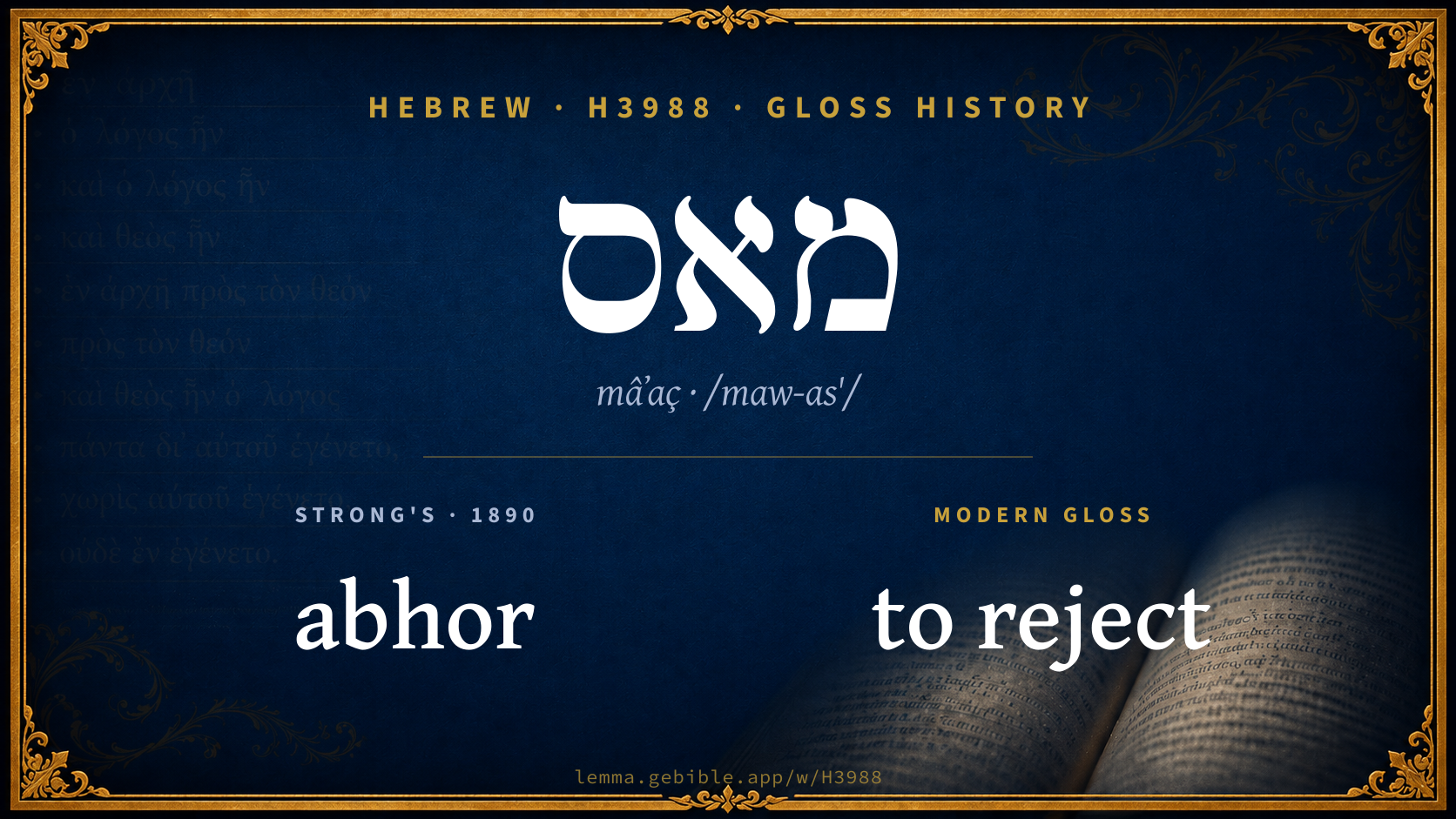
Gloss history
Strong's 1890 vs modern scholarship
About this word
Strong's H3988 catalogs a Hebrew word from the Hebrew Old Testament.
These counts are not copied from any lexicon or concordance. They are computed here, from the morphology-tagged Hebrew Old Testament. What Lemma adds →
- 69
- distinct verses
- The word appears in 69 distinct verses.
- 14 / 39
- OT books
- The word appears in 14 of 39 Old Testament books.
- #523
- by frequency
- Top 1000 most frequent Hebrew words (rank 523 of 8,640 Hebrew words by occurrence).
View all 69 occurrences in the concordance →
By section of the Old Testament
By traditional corpus
Conventional, traditional groupings — biblical authorship is debated, so this is a traditional corpus grouping, not an authorship claim. Each share is this word’s portion of its verses in that division of the Hebrew canon. Each figure is a share of the word’s 69 distinct verses.
- Prophets (Nevi'im) 40 verses · 58%
- Writings (Ketuvim) 24 verses · 35%
- Torah (Pentateuch) 5 verses · 7%
How translations render this word
Counts come from each version’s own published word-to-Strong’s tagging or interlinear alignment — an approximate guide to how each version renders this word, not a word-level alignment the data otherwise carries. Because each total is that version’s own tagged count, the per-version totals vary from one another and need not match the appearance or distinct-verse counts above. These counts may also differ from a printed concordance because Lemma counts each distinctly tagged rendering and does not collapse phrase taggings into a single head-word total. This is a fixed set of word-tagged versions (KJV, ASV, BSB, ULT) and does not change with the reading translation you choose elsewhere. Each version’s license is shown beside its name below (and on Sources).
BDB lists this Strong’s number as 2 distinct words (homographs). Each count above pools all of them and is not split by sense — see the Senses section below. A low-frequency rendering may belong to a different one of those words, not the primary meaning.
- King James Version†: Rejected 5×, Hath rejected 4×, They despised 3×
- American Standard Version†: Rejected 6×, They rejected 4×, Despise 3×
- Berean Standard Bible†: Reject 9×, Has rejected 5×, Rejected 5×
- unfoldingWord Literal Text†: Reject 5×, Rejected 5×, Has rejected 4×
King James Version Public Domain
Renders H3988 across 75† tagged occurrences — most commonly:
Plus 53 renderings that appear only once — usually multi-word phrases or single function words the recovered tagging swept in, not distinct renderings. Not rendered by a distinct English word in 1 further occurrence.
American Standard Version Public Domain
Renders H3988 across 75† tagged occurrences — most commonly:
Plus 44 renderings that appear only once — usually multi-word phrases or single function words the recovered tagging swept in, not distinct renderings.
Berean Standard Bible Public Domain
Renders H3988 across 75† tagged occurrences — most commonly:
Plus 32 renderings that appear only once — usually multi-word phrases or single function words the recovered tagging swept in, not distinct renderings. Not rendered by a distinct English word in 1 further occurrence.
unfoldingWord Literal Text CC BY-SA 4.0
Renders H3988 across 86† tagged occurrences — most commonly:
Plus other, less common renderings. Plus 40 renderings that appear only once — usually multi-word phrases or single function words the recovered tagging swept in, not distinct renderings.
7 senses and sub-senses in the full BDB
Hebrew verbs can shift meaning by stem (binyan): Qal is the basic action, Niphal is often passive or reflexive, Piel often intensifies or makes it factitive, and Hiphil is typically causative. The senses below are grouped under the stem BDB assigns to each.
What do BDB’s symbols mean?
BDB uses these scholarly abbreviations:
| Symbol | Meaning |
|---|---|
| 𝔊 | the Septuagint (the ancient Greek translation, LXX) |
| 𝔙 | the Vulgate (the Latin translation) |
| 𝔖 | the Syriac version (the Peshitta) |
| 𝔗 | the Targum (the Aramaic translation) |
| ψ | the Psalms |
| √ | root (the underlying root or stem) |
| ‖ | parallel passage (a synonymous or contrasted parallel) |
| † | the dagger: every passage where the word occurs is cited |
The 7 senses and sub-senses the full Brown-Driver-Briggs lexicon distinguishes for this word, in lexicon order (not ranked by frequency), with BDB’s own verbatim wording and sub-sense lettering. Shown in Hebrew script with BDB’s own scholarly abbreviations. The condensed entry is in the Lexicon Entry tab. See also the Forms in the corpus table below.
מאס I reject (NH id.
Qal
- Pf. 3 ms. מָאַס Is 8:6 + 4 times; sf. מְאָסָם ψ 53:6; 2 ms. מָאַסְתָּ Je 14:19 + 3 times; מָאַסְתָּה Ju 9:38 1 S 15:26 + 22 times Pf.; Impf. יִמְאַס Jb 8:20 + 3 times; יִמְאָ֑ס ψ 36:5 Jb 36:5; sf. וַיּמְאָֽסְךָ 1 S 15:23, 26; for וְאֶמְאָֽסְאךָ Ho 4:6 (so Baer, cf. DeComplut. Var. 18 f.; not וָא׳ Van d. H.) read וְאֶמְאָֽסְךָ; 3 mpl. יִמְאֲסוּ Je 6:19 + 2 times; יִמְאָס֑וּן Is 31:7; + 12 times Impf.; Inf. abs. מָאוֹס Is 7:15, 16 מָאֹס Je 14:19 La 5:22; cstr. מָֽאָסְכֶם Is 30:12; מָאֳסָם Am 2:4; Pt. מוֹאֵס Pr 15:32; מֹאֵס Is 33:15, f. מֹאֶסֶת Ez 21:15 (text dub., Co מוֹאֲסֵי; Berthol וּמְאַסֵּף), v 18 (also dub., Co מִטֻּמְאָתָם; Berthol מְאַסֵּף);— e.g. Isaiah 8:6
- 1. reject, refuse,
- a. c. acc.: God rejects men Ho 4:6; 9:17; 1 S 15:23, 26; 16:1, 7; 2 K 23:27; Is 41:9; Je 7:29; 14:19(×2); 33:24, 26; Lv 26:44 (H), ψ 53:6 Jb 8:20; 10:3 La 5:22(×2); זָנַחְתָּ וַתִּמְאָם ψ 89:39; men reject God Nu 11:20 (J), 1 S 8:7; 10:19; men 1 S 8:7; Jb 30:1; idols Is 31:7, evil ψ 36:5, knowledge Ho 4:6, divine תורה Am 2:4; Is 5:24; דבר 1 S 15:23, 26, חקות Ez 20:24, חקים 2 K 17:15; מוסר Jb 5:17; Pr 3:11; var. things Is 8:6 Ez 21:15 ψ 118:22; Jb 31:13. e.g. Hosea 4:6
- b. c. בְ God rejects men 2 K 17:20 Je 6:30; 31:37 ψ 78:59, 67 that in which man confides Je 2:37; men reject evil Is 7:15, 16 divine תורה Je 6:19, דבר Is 30:12; Je 8:9, חקות Lv 26:15 (H); משׁפטים v 43 (H), Ez 5:6; 20:13, 16; var. things, Nu 14:31 (J) Is 33:15; Je 4:30 ψ 106:24. e.g. 2 Kings 17:20
- 2. despise, c. acc., God subj. שׂנאתי מאסתי חגיכם Am 5:21 I hate, I despise your feasts; elsewhere men subj. גם עוילים מ׳ בי Jb 19:18 even young children despise me; אמ׳ חיי 9:21 I despise my life, cf. מואס נפשׁוֹ Pr 15:32; הלא זה העם אשׁר מ׳ בוֹ Ju 9:38 is not this the people that thou despisedst? מ׳ עָרִים Is 33:8; obj. om. Jb 7:16 (34:33; 36:5; 42:6 (𝔖 Siegf אֶשְׁתֹּק; 𝔊 𝔙 Symm Bö אֶמָּאֵס) Ez 21:18 (but v. supr.).— e.g. Amos 5:21
Niphal
- be rejected: Impf. תִּמָּאֵס Is 54:6 (wife); Pt. נִמְאָס Je 6:30; (silver), ψ 15:4 (= reprobate; opp. יִרְאֵי י׳); + f. נִמְאָסָה, נִמְאֶסֶת 1 S 15:9 rejected, i.e. worthless (for ℌ נָמֵס) according to We Klo Dr Kit Bu HPS (‖ נמבזה, read נִבְזָה; cf. מסס, בזה Niph.) e.g. Isaiah 54:6
מאס II
Niphal
- flow, run (Aramaic id., but rare and dub.;—secondary form of מסס q.v.);—Impf. 3 ms. וַיִּמָּאֵס Jb 7:5 my skin hath hardened and run (i.e. again, afresh; > GHoffm Du read וַיִּמַּס, Bu וַיִּמָּאס, √ מסס); 3 mpl. יִמָּֽאֲסוּ כְּמוֹ מַיִם ψ 58:8 (fig. of annihilation of wicked). e.g. Job 7:5
Senses from the full Brown-Driver-Briggs lexicon (Brown, Driver, Briggs; Oxford 1906 — public domain), digitized via Sefaria, supplemented by the OpenScriptures HebrewLexicon (CC BY 4.0). Full attribution on Sources.
Word origin
vb. reject (NH id.; Aramaic מְאַס reject, despise; BAES 15 comp. (dub.) Arabic مَعَسَ lightly esteem (Ḳam.; Assyrian ma’âsu is perhaps destroy MeissnSuppl. 55);—
— Brown-Driver-Briggs (Oxford 1906, public domain), digitized via Sefaria, supplemented by the OpenScriptures HebrewLexicon (CC BY 4.0). See Sources.
Origin: a primitive root
Jastrow Dictionary
A second Hebrew/Aramaic lexicon for comparison, covering Aramaic and post-biblical (Talmudic, Targumic, Midrashic) usage that the biblical-Hebrew BDB does not. Matched by lemma rather than by Strong’s number, so a lemma may carry more than one Jastrow headword (shown separately below), and the entries cover usage well beyond the Bible.
מָאַס
- [to melt, faint,] (with ב) to be tired of, loathe; (with accus.) to cast away, reject. Ber. 8ᵃ אין הקב"ה מוֹאֵס בתפלתו וכ׳ the Lord never tires of the prayer of assemblies. Sifra B’ḥuck. ch. III, Par. 2 מואס באחרים despises others (for being his betters); (ib. מואס אחרים, corr. acc.). Tanḥ. Mishp. 11 כבר מָאֲסָן וכ׳ their god has rejected them; Ex. R. s. 31. Ib. אמת שמָאַסְתָּ וכ׳ is it true that thou hast rejected thy son?; a. fr.—Part. pass. מָאוּס, f. מְאוּסָה; pl. מְאוּסִים, מְאוּסִין; מְאוּסוֹת. Midr. Till. to Ps. LXXV, 9 (play on כמס, Deut. XXXII, 34) כמוס למאוסים reserved for the rejected (nations; differ. in Sifré Deut. 324). Der. Er. ch. II המ׳ בעיניהם those who are despised in their own eyes (think little of themselves); a. e. e.g. Deuteronomy 32:34
- to be repulsive, loathsome; to be rejected. Sifra B’ḥuck. Par. 2, ch. VIII (ref. to Lev. XXVI, 44) וכי … שלא נִמְאֲסוּ ושלא נגעלו what has been left to them so that (it might be said) they were not cast away and loathed?; Yalk. Lev. 675 (corr. acc.). Ḥag. 5ᵃ ונ׳ and becomes loathsome (creates aversion to his neighbor).—V. מִיאוּס. e.g. Leviticus 26:44
מְאַס
- Targ. Y. Lev. XXVI, 44; a. e.—V. מְאִיס.
- to melt, faint. Targ. Ps. LVIII, 8 Ms. (ed. יתמסון).
- , v. מְאִיס
מָאָס
- (preced.) rejection, contempt. Lam. R. introd. (R. Abba 2) מָאֲסָהּ של תורה the contempt of the Law; (Y. Ḥag. I, 76ᶜ על מאסם בתורה).
A Dictionary of the Targumim, the Talmud Babli and Yerushalmi, and the Midrashic Literature (Marcus Jastrow; London, Luzac, 1903) — Public Domain. Digitized via Sefaria. Digitized via Sefaria. Full attribution on Sources.
Forms in the corpus
The 68 distinct written forms H3988 takes in the Hebrew Bible, most frequent first — each parse links to that stem’s occurrences in the concordance. Hebrew forms include their vowel points and cantillation, so a single lemma takes many written forms.
The 60 most common forms are shown; 8 rarer forms follow in the full concordance.
Same root — word family
Other BDB entries built from the same root as H3988, grouped by Strong’s listed origin. These share a root / origin per the lexicon — not necessarily a shared meaning. Each links to that word’s own entry.
Derived from this word
Compare all same-root words → They share a root, not necessarily a meaning.
Septuagint verse parallels
This word appears in 65 verses that also exist in the Greek Old Testament (Septuagint), out of the 69 Hebrew verses it occurs in. You can read those verses in Greek by switching the Old Testament edition to the Septuagint.
Read these verses in the Septuagint
- Leviticus 26:15
- Numbers 11:20
- Judges 9:38
- 1 Samuel 8:7
- 2 Kings 17:15
- Job 5:17
- Psalms 15:4
- Proverbs 3:11
- Isaiah 5:24
- Jeremiah 2:37
- Lamentations 5:22
- Ezekiel 5:6
This is a verse-level parallel only — the same verses exist in both the Hebrew and Greek Old Testaments. No word-level Hebrew↔Greek correspondence is claimed: the data carries no such alignment, so no Greek word is shown as this Hebrew word’s translation. Coverage is not total — the Septuagint omits the deuterocanon and renumbers the Psalms, so some Hebrew verses have no direct Greek parallel.