
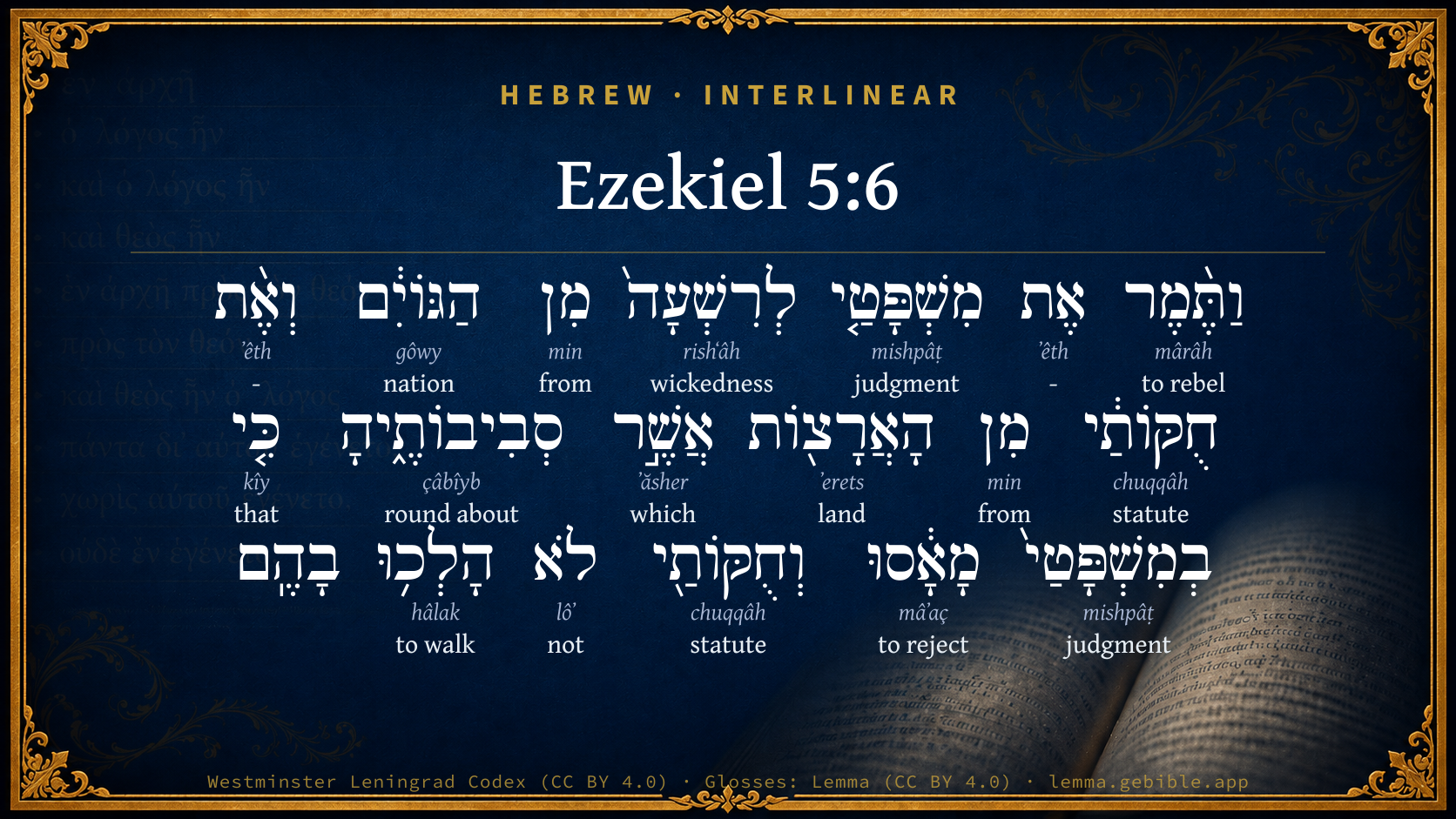
Ezekiel 5:6

Hebrew (Westminster Leningrad Codex) Ezekiel 5:6 appears in the Hebrew Old Testament. The text above is from the Westminster Leningrad Codex. Each word links to its Strong’s number, a concise gloss, and parsing drawn from the Open Scriptures Hebrew Bible morphology. Click any word for its full Brown-Driver-Briggs (BDB) entry.
Download image
Cite this verse

Ezekiel 5:6 (World English Bible). Public Domain. Lemma interlinear Bible study tool, https://lemma.gebible.app/v/ezekiel/5/6.

Show BibTeX & RIS
BibTeX
RIS
English Translation
She has rebelled against my ordinances in doing wickedness more than the nations, and against my statutes more than the countries that are round about her; for they have rejected my ordinances, and as for my statutes, they have not walked in them.
World English Bible · Public Domain
Download a study sheet

One document with this verse’s original text, its word-by-word gloss line, the meaning frame, cross-references with their text, attributed commentary, and full source and license credits — printable, and it pastes into notes with its structure intact.

This verse Autodidact and up

Study sheet (.html) Plain text (.txt)

A passage Seminary Student

Up to 50 verses in one chapter. A passage sheet keeps up to 6 commentary sources and 12 cross-references per verse, in the order this page ranks them, and says so on the sheet whenever that leaves anything out. Ask for a single verse and you get the Autodidact verse sheet above.

Everything on this page stays free to read, with no account — the sheet is a download of what is already on screen, not access to it.

Want to remove ads? Support Godless Engineer
Compare translations 3

The same verse in 3 English versions, stacked beneath the original-language interlinear above. Click any original word for its lexicon entry.

Each is an independent rendering of the whole verse — the interlinear is not word-aligned to these translations.

Highlighted words mark where these versions differ — a whole-verse word diff, not a word-by-word alignment.

  • World English Bible Public Domain
    She has rebelled against my ordinances in doing wickedness more than the nations, and against my statutes more than the countries that are round about her; for they have rejected my ordinances, and as for my statutes, they have not walked in them.
  • King James Version Public Domain
    And she hath changed my judgments into wickedness more than the nations, and my statutes more than the countries that are round about her: for they have refused my judgments and my statutes, they have not walked in them.
  • unfoldingWord Literal Text CC BY-SA 4.0
    But she has in wickedness rejected my decrees more than the nations have, and my statutes more than the countries that surround her. The people have rejected my judgments and have not walked in my statutes.”

unfoldingWord Literal Text — © unfoldingWord, licensed CC BY-SA 4.0. Word-aligned USFM3 via Door43 (git.door43.org/unfoldingWord/en_ult).

Versions to compare (up to 4)

3 of 4 selected

Show all 18 translations

Every available English version of this verse, each an independent rendering of the whole verse.

  • World English Bible Public Domain
    She has rebelled against my ordinances in doing wickedness more than the nations, and against my statutes more than the countries that are round about her; for they have rejected my ordinances, and as for my statutes, they have not walked in them.
  • Berean Standard Bible Public Domain
    But she has rebelled against My ordinances more wickedly than the nations, and against My statutes worse than the countries around her. For her people have rejected My ordinances and have not walked in My statutes.’
  • Majority Standard Bible Public Domain
    But she has rebelled against My ordinances more wickedly than the nations, and against My statutes worse than the countries around her. For her people have rejected My ordinances and have not walked in My statutes.’
  • King James Version Public Domain
    And she hath changed my judgments into wickedness more than the nations, and my statutes more than the countries that are round about her: for they have refused my judgments and my statutes, they have not walked in them.
  • American Standard Version (1901) Public Domain
    And she hath rebelled against mine ordinances in doing wickedness more than the nations, and against my statutes more than the countries that are round about her; for they have rejected mine ordinances, and as for my statutes, they have not walked in them.
  • Revised Version (1885) Public Domain
    And she hath rebelled against my judgments in doing wickedness more than the nations, and against my statutes more than the countries that are round about her: for they have rejected my judgments, and as for my statutes, they have not walked in them.
  • Geneva Bible (1599) Public Domain
    And she hath changed my iudgements into wickednes more then the nations, and my statutes more then the countreis, that are round about her: for they haue refused my iudgemets and my statutes, and they haue not walked in them.
  • Douay-Rheims (1899) Public Domain
    And she hath despised my judgments, so as to be more wicked than the Gentiles; and my commandments, more than the countries that are round about her: for they have cast off my judgments, and have not walked in my commandments.
  • Young's Literal Translation Public Domain
    And she changeth My judgments into wickedness more than the nations, And My statutes more than the lands that `are' round about her, For against My judgments they have kicked, And My statutes -- they have not walked in them.
  • Literal Standard Version CC BY-SA 4.0
    And she changes My judgments into wickedness more than the nations, || And My statutes more than the lands that [are] around her, || For they have kicked against My judgments, || And My statutes—they have not walked in them.”
  • Unlocked Literal Bible CC BY-SA 4.0
    But she has in wickedness rejected my decrees more than the nations have, and my statutes more than the countries that surround her. The people have rejected my judgments and have not walked in my statutes.”
  • unfoldingWord Literal Text CC BY-SA 4.0
    But she has in wickedness rejected my decrees more than the nations have, and my statutes more than the countries that surround her. The people have rejected my judgments and have not walked in my statutes.”
  • Darby Bible Public Domain
    And she hath rebelled against my judgments in wickedness more than the nations, and against my statutes more than the countries that are round about her: for mine ordinances have they refused; and my statutes, they have not walked in them.
  • World Messianic Bible Public Domain
    She has rebelled against my ordinances in doing wickedness more than the nations, and against my statutes more than the countries that are around her; for they have rejected my ordinances, and as for my statutes, they have not walked in them.’
  • Webster's Bible Public Domain
    And she hath changed my judgments into wickedness more than the nations, and my statutes more than the countries that are around her: for they have refused my judgments and my statutes, they have not walked in them.
  • Free Bible Version CC BY-SA 4.0
    But she rebelled against my rules, acting more wickedly than the nations, and she defied my regulations more than the countries surrounding her. Her people rejected my rules and refused to follow my regulations.
  • Bible in Basic English Public Domain
    And she has gone against my orders by doing evil more than the nations, and against my rules more than the countries round her: for they have given up my orders, and as for my rules, they have not gone in the way of them.
  • JPS Tanakh (1917) Public Domain
    And she hath rebelled against Mine ordinances in doing wickedness more than the nations, and against My statutes more than the countries that are round about her; for they have rejected Mine ordinances, and as for My statutes, they have not walked in them.

Literal Standard Version (2020), Covenant Press — licensed CC BY-SA 4.0. Text via the HelloAO Bible API (eBible.org). Unlocked Literal Bible (unfoldingWord) — licensed CC BY-SA 4.0. Text via the HelloAO Bible API (eBible.org). unfoldingWord Literal Text — © unfoldingWord, licensed CC BY-SA 4.0. Word-aligned USFM3 via Door43 (git.door43.org/unfoldingWord/en_ult). Free Bible Version, Dr. Jonathan Gallagher — licensed CC BY-SA 4.0. Text via the HelloAO Bible API (eBible.org).

Word by word

More ways to search: Search by grammar → Find every occurrence → Compare this word →

Practice this passage: Drill this verse → Learn its vocabulary →

לְרִשְׁעָה֙
rishʻâh
H7564
“to/for · wickedness”
Preposition + Noun, Common, Feminine, Singular, Absolute
Part of Speech
Preposition + Noun
Type
Common
Gender
Feminine
Number
Singular
State
Absolute
Full BDB Definition

Origin: from H7562

TWOT: 2222c

wickedness, guilt - wickedness (in civil relations) - wickedness (of enemies) - wickedness (ethical and religious)
  1. וַתֶּ֨מֶר mârâh H4784 “and · to rebel” Conjunction + Verb, Hiphil, Sequential Imperfect, 3rd Person, Feminine, Singular
  2. אֶת ʼêth H853 “-” Particle, Direct Object
  3. מִשְׁפָּטַ֤י mishpâṭ H4941 “judgments · my” Noun, Common, Masculine, Plural, Construct + Suffix, Personal, 1st Person, Common, Singular
  4. מִן min H4480 “from” Preposition
  5. הַגּוֹיִ֔ם gôwy H1471 “the · nations” Particle, Definite Article + Noun, Common, Masculine, Plural, Absolute
  6. וְאֶ֨ת ʼêth H853 “and · -” Conjunction + Particle, Direct Object
  7. חֻקּוֹתַ֔י chuqqâh H2708 “statutes · my” Noun, Common, Both, Plural, Construct + Suffix, Personal, 1st Person, Common, Singular
  8. מִן min H4480 “from” Preposition
  9. הָאֲרָצ֖וֹת ʼerets H776 “the · lands” Particle, Definite Article + Noun, Common, Both, Plural, Absolute
  10. אֲשֶׁ֣ר ʼăsher H834 “which” Particle, Relative
  11. סְבִיבוֹתֶ֑יהָ çâbîyb H5439 “surroundings · her” Noun, Common, Both, Plural, Construct + Suffix, Personal, 3rd Person, Feminine, Singular
  12. כִּ֤י kîy H3588 “that” Conjunction
  13. בְמִשְׁפָּטַי֙ mishpâṭ H4941 “in/at · judgments · my” Preposition + Noun, Common, Masculine, Plural, Construct + Suffix, Personal, 1st Person, Common, Singular
  14. מָאָ֔סוּ mâʼaç H3988 “to reject” Verb, Qal, Perfect, 3rd Person, Common, Plural
  15. וְחֻקּוֹתַ֖י chuqqâh H2708 “and · statutes · my” Conjunction + Noun, Common, Both, Plural, Construct + Suffix, Personal, 1st Person, Common, Singular
  16. לֹא lôʼ H3808 “not” Particle, Negative
  17. הָלְכ֥וּ hâlak H1980 “to walk” Verb, Qal, Perfect, 3rd Person, Common, Plural

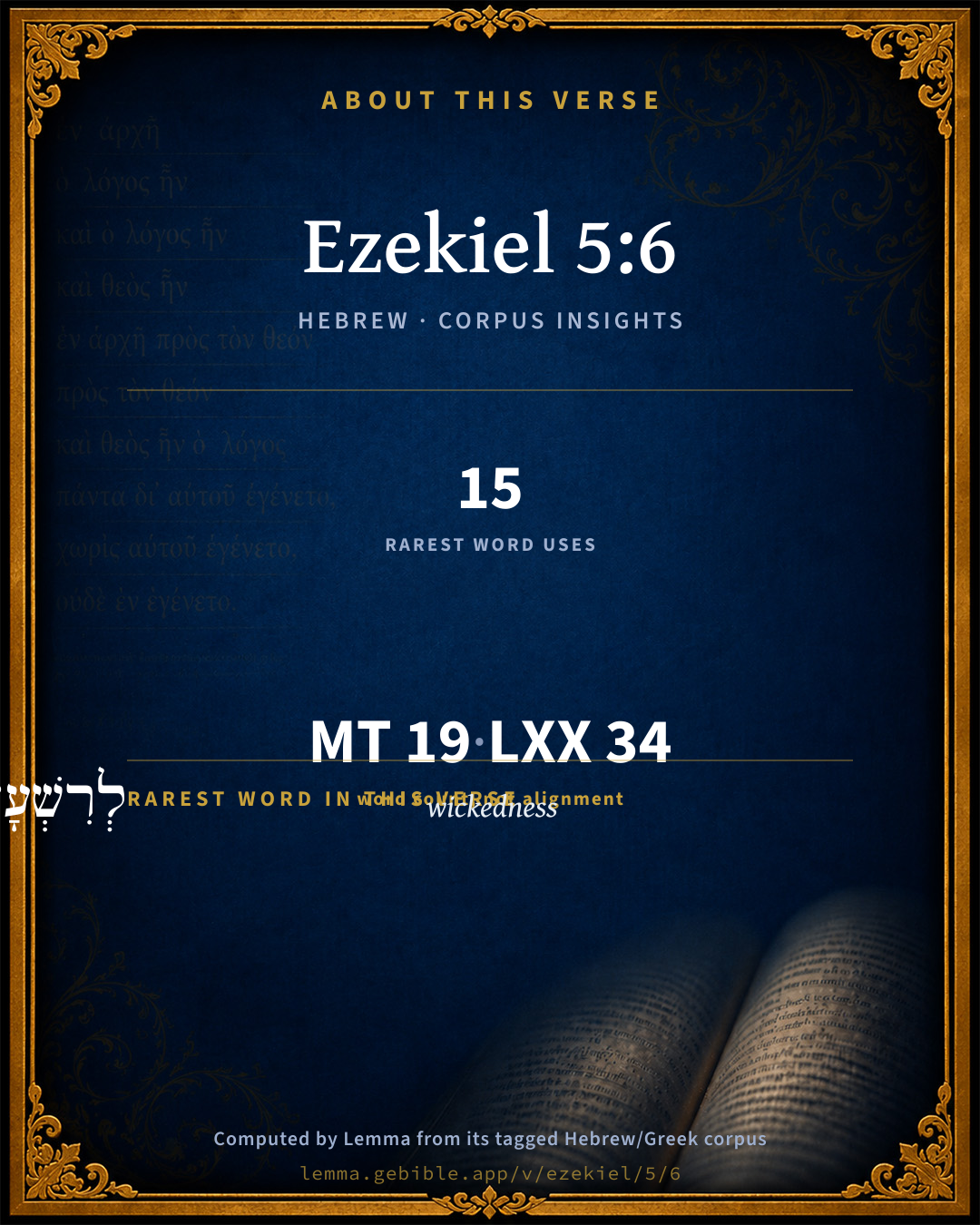
About this verse

These counts appear in no published source. They are computed here, from the morphology-tagged text and Lemma’s own curated glosses. What Lemma adds →

19
words
14
distinct lemmas
Prophets
section

Notable vocabulary

The rarest word here is לְרִשְׁעָה֙ wickedness H7564 — appearing just 15 times in the whole Hebrew Bible.

Shared distinctive vocabulary

לְרִשְׁעָה֙ wickedness H7564 occurs in 15 verses of the Hebrew Bible. Also found in:

Grammatical profile

  • 3 verbs
  • 8 nouns
  • 3 prepositions
  • 1 conjunction
  • 4 particles

Verb forms

  • וַתֶּ֨מֶר Hiphil · Sequential Imperfect
  • מָאָ֔סוּ Qal · Perfect
  • הָלְכ֥וּ Qal · Perfect

Repetition

Words recur within this verse — often emphatic in Hebrew:

  • מִשְׁפָּטַ֤י judgment H4941 ×2
  • חֻקּוֹתַ֔י statute H2708 ×2
  • מִן from H4480 ×2

Hebrew & Septuagint length

In English translation the verse runs 43 words from the Hebrew and 41 from the Septuagint (LXX English) — closely comparable.

A rough comparison of the two English renderings, which tokenize alike — not a word-level alignment.

Word counts can differ between the Hebrew and the Greek without any difference in meaning — e.g. the Hebrew direct-object marker אֵת has no separate Greek word, and Greek often adds the article ὁ.

In the original languages it is 19 Hebrew tokens and 34 Greek tokens — but the two are counted differently (Hebrew bundles its prefixes and suffixes into one token; the Greek is in lemma form), so that isn’t a like-for-like length.

Cross-references

15

Topical passages linked to Ezekiel 5:6 in the Treasury of Scripture Knowledge — connected by theme and wording, ordered by reader-vote popularity; previews shown in the World English Bible.

  • Jeremiah 11:10 They are turned back to the iniquities of their forefathers, who refused to hear my words; and they are gone after other gods to serve them: the house of Israel and the house of Judah have broken my covenant which I made with their fathers.
  • Ezekiel 16:47–48 Yet have you not walked in their ways, nor done after their abominations; but, as [if that were] a very little [thing], you were more corrupt than they in all your ways.
  • 2 Kings 17:8–20 and walked in the statutes of the nations, whom Yahweh cast out from before the children of Israel, and of the kings of Israel, which they made.
  • Nehemiah 9:16–17 But they and our fathers dealt proudly and hardened their neck, and didn't listen to your commandments,
  • Zechariah 7:11 But they refused to listen, and turned their backs, and stopped their ears, that they might not hear.
  • Psalms 78:10 They didn't keep God's covenant, And refused to walk in his law.
  • Jeremiah 5:3 O Yahweh, don't your eyes look on truth? you have stricken them, but they were not grieved; you have consumed them, but they have refused to receive correction: they have made their faces harder than a rock; they have refused to return.
  • Jeremiah 8:5 Why then is this people of Jerusalem slidden back by a perpetual backsliding? they hold fast deceit, they refuse to return.
  • Ezekiel 16:51 Neither has Samaria committed half of your sins; but you have multiplied your abominations more than they, and have justified your sisters by all your abominations which you have done.
  • Deuteronomy 32:15–21 But Jeshurun grew fat, and kicked: You have grown fat, you are grown thick, you are become sleek; Then he forsook God who made him, Lightly esteemed the Rock of his salvation.
  • Psalms 106:20 Thus they exchanged their glory For an image of a bull that eats grass.
  • Jeremiah 9:6 Your habitation is in the midst of deceit; through deceit they refuse to know me, says Yahweh.
  • Romans 1:23–25 and traded the glory of the incorruptible God for the likeness of an image of corruptible man, and of birds, and four-footed animals, and creeping things.
  • 1 Corinthians 5:1 It is actually reported that there is sexual immorality among you, and such sexual immorality as is not even named among the Gentiles, that one has his father's wife.
  • Jude 1:4 For there are certain men who crept in secretly, even those who were long ago written about for this condemnation: ungodly men, turning the grace of our God into lasciviousness, and denying our only Master, God, and Lord, Jesus Christ.

Cross-references courtesy of OpenBible.info (CC BY 4.0).

Hebrew and Greek witnesses Masoretic Hebrew ↔ Greek Septuagint

The same verse in the two great witnesses to the Old Testament, shown verse-for-verse.

These are two independent witnesses, not word-aligned to each other, and the Septuagint is shown in lemma (dictionary) form.

Hebrew Ezekiel 5:6 Masoretic · Westminster Leningrad Codex

וַתֶּ֨מֶר אֶת מִשְׁפָּטַ֤י לְרִשְׁעָה֙ מִן הַגּוֹיִ֔ם וְאֶ֨ת חֻקּוֹתַ֔י מִן הָאֲרָצ֖וֹת אֲשֶׁ֣ר סְבִיבוֹתֶ֑יהָ כִּ֤י בְמִשְׁפָּטַי֙ מָאָ֔סוּ וְחֻקּוֹתַ֖י לֹא הָלְכ֥וּ בָהֶֽם

She has rebelled against my ordinances in doing wickedness more than the nations, and against my statutes more than the countries that are round about her; for they have rejected my ordinances, and as for my statutes, they have not walked in them.

World English Bible · Public Domain

Greek LXX Ezekiel 5:6 Septuagint · lemma form

καί εἶπον ὁ δικαίωμα ἐγώ ὁ ἄνομος ἐκ ὁ ἔθνος καί ὁ νόμιμος ἐγώ ἐκ ὁ χώρα ὁ κύκλος αὐτός διότι ὁ δικαίωμα ἐγώ ἀποὠθέω καί ἐν ὁ νόμιμος ἐγώ οὐ πορεύομαι ἐν αὐτός

And you shall declare my ordinances to the lawless one from out of the nations; and my statutes to the sinful one of the countries round about her: because they have rejected my ordinances, and have not walked in my statutes.

LXX2012 (modern English Septuagint) · Public Domain

Hebrew: Westminster Leningrad Codex (CC BY 4.0). Greek: Septuagint (public domain); English from LXX2012 (modern English Septuagint) (Public Domain). How the Septuagint differs from the Hebrew →

Targum (Aramaic paraphrase)

1

The Targum is the ancient Jewish Aramaic paraphrase of the Hebrew Scriptures — an interpretive translation, not the Hebrew text itself. Onkelos (literal) and Pseudo-Jonathan (expansive) render the Torah, and Jonathan the Prophets. Coverage is partial: where no permissively-licensed English translation exists for a verse, only the Aramaic is shown. This is verse-level text, not a word-by-word alignment to the Hebrew.

  1. Targum Jonathan Prophets (Joshua–Malachi)
    וְאַשְׁנִיאַת יַת דִינִי לִמְחַבְּבֵיהוֹן מִן עַמְמַיָא וְיַת קְיָמִי מִן מְדִינָתָא דִי בְּסֶחֱרָנָהָא אֲרֵי בְּדִינַי קָצוּ וּקְיָמַי לָא הֲלִיכוּ בְהוֹן:

    (no public-domain English translation for this verse)

    Targum Jonathan — Aramaic: “Mikraot Gedolot” (public domain). English: “Sefaria Community Translation” (CC0 1.0 (public-domain dedication)); “London "Chaldee Paraphrase," 1871” (public domain). Text via Sefaria.

Commentary

Notes on Ezekiel 5:6 from classic Christian and Jewish commentators (each source and its license shown beneath its notes). The classic Christian expositions comment on the surrounding passage and are grouped to its opening verse, so a note may address several verses; the Jewish commentaries on the Tanakh (Rashi and others) are per-verse, so they appear only where the commentator wrote on this verse.

Lemma curates 59 commentaries, every one of them public domain or Creative Commons licensed, each selected and text-cleaned for this edition rather than reprinted as found. About our sources →

Trapp's Complete Commentary

John Trapp

Eze 5:6 And she hath changed my judgments into wickedness more than the nations, and my statutes more than the countries that [are] round about her: for they have refused my judgments and my statutes, they have not walked in them.

Ver. 6. And she hath changed my judgments into wickedness.] This was a foul change; this was to do evil as she could; {Jer 3:5} this was ingratitude of the worst sort, such as Socrates called ειλικρινη αδικιαν, manifest injustice. Such a wretched change is complained of, Jer 2:11 Rom 1:23; Rom 1:25 Jdg 1:4, but nowhere in so high an expression as this, as one observeth.

More than the nations.] Because the Jews had better laws but worse dispositions than they.

John Trapp, A Commentary or Exposition upon All the Books of the Old and New Testament (1647–1656) — public domain. Text from a community e-Sword module.

Geneva Bible (1599)

Geneva Bible translators

My word and law into idolatry and superstitions.

Geneva Bible (1599) marginal notes — public domain. Text via Bolls.life.

Jamieson, Fausset & Brown

Robert Jamieson, A. R. Fausset & David Brown

changed . . . into--rather, "hath resisted My judgments wickedly"; "hath rebelled against My ordinances for wickedness" [BUXTORF]. But see on Eze 5:7, end.

Jamieson, Fausset & Brown — Commentary Critical and Explanatory on the Whole Bible (1871) — public domain (CC PDM 1.0). Text via the HelloAO Bible API.

Adam Clarke's Commentary

Verse 6. She hath changed my judgments] God shows the reason why he deals with Jerusalem in greater severity than with the surrounding nations; because she was more wicked than they. Bad and idolatrous as they were, they had a greater degree of morality among them than the Jews had. Having fallen from the true God, they became more abominable than others in proportion to the height, eminence, and glory from which they had fallen. This is the common case of backsliders; they frequently, in their fall, become tenfold more the children of wrath than they were before.

Adam Clarke's Commentary on the Bible (1810–1826) — public domain. Text from a community e-Sword/MySword module.

John Calvin's Commentaries

He now adds, My judgments are changed concerning the word מרה, mereh, I said that it signifies sometimes to change, but oftener to transgress or to reject, and there the sense suits very well, because the Jews were rebellious against the judgments of God even to impiety. But he enlarges upon their wickedness when he says, my statutes have been despised since they so addicted themselves to impiety. For if there had been any pretext of virtue, their fault might have been extenuated, but when they cast themselves into gross impiety, and thus despise God’s commandments, this is inexcusable. Let us learn from this passage, that unless we use God’s blessings with purity the charge of ingratitude will always lie against us: for whatever God bestows upon us, he sanctifies as well to our salvation as to the glory of his name. We are then sacrilegious when we corrupt those things which were destined for his glory; then are we utterly perverse when we convert to our destruction what God has appointed for our salvation. Now we must consider the ingratitude of Jerusalem as flagrant, because they rejected the commandments of God. When therefore God deposits among us the treasure of celestial doctrine, we must diligently take care that we do not turn aside to impiety, because there is no excuse for error when once we have been taught what is right, and that from the mouth of God himself. Then he declares the same sentiment in other words, and says, beyond all nations and all lands which were round about; by which sentence he signifies that the Jews; were worse than all the rest, because knowingly and willingly they had shaken off God’s yoke. Other nations had not conducted themselves better, for we know that the worship of God was then everywhere vitiated: but the impiety of the elect people was fouler, for they turned light into darkness, while the Gentiles wandered in darkness for they were blind, but the conduct of this people was different whom God had familiarly instructed. Since therefore the teaching of the law was conspicuous among the Jews, the Prophet deservedly says, that they were impious beyond all nations and countries Then he explains how they had either changed the judgment of God, or were themselves rebellious, because they had despised, says he, my judgments, and had not walked in my statutes First, he says, they had not fallen through ignorance but through pride and contempt; for when the will of God is made known to us, there is no place for ignorance. We do not sin lightly therefore, but our minds are necessarily infected with pride and contempt of God. Now he adds, that they did not walk in his precepts, by which words he signifies that the contempt just mentioned appeared openly, because in truth the fruit showed itself in their whole life. It follows —

John Calvin's Commentaries (1540-1563) — public domain. Text from the Calvin Translation Society English edition (1840s-50s) via the Christian Classics Ethereal Library (ccel.org). Calvin's coverage is partial (roughly two-thirds of the Bible); uncommented books and verses are honest gaps, never fabricated. The 19th-century editor's footnotes and remarks are omitted so the notes are faithfully Calvin's own voice.

Ellicott's Commentary for English Readers

(6) Changed my judgments into wickedness.—Better, hath wickedly resisted my judgments, the sense adopted by most modern expositors.

More than the nations.—Not, of course, absolutely, but in proportion to the knowledge and the privileges given them. It would be an exaggeration to say that the Israelites were actually more evil in their life than the surrounding heathen; for they were, no doubt, far better. Even of those cities which our Lord, at a later day, so strongly upbraided, it would be absurd to suppose that they equalled Sodom and Gomorrah in their iniquity. God’s judgments are always relative and proportioned to the opportunities He has granted to men. The point is that the Israelites had resisted His judgments more than the heathen; they had sinned against greater light. The pronoun they in the last clause refers, of course, to the Israelites, not to the heathen.

A Bible Commentary for English Readers, edited by Charles John Ellicott (1878–1897) — public domain. Text from a community e-Sword module.

The Cambridge Bible for Schools and Colleges

gen. ed. J. J. S. Perowne

6. Read: And she hath rebelled against my Judgments to do wickedness more than the nations, and against my statutes. “Judgments” is ordinances; and “they” refers to the people, who compose Jerusalem.

The Cambridge Bible for Schools and Colleges (gen. ed. J. J. S. Perowne; Cambridge University Press, 1878–1918) — public domain. Text from a community e-Sword module.

John Gill's Exposition

And she hath changed my judgments into wickedness more than the nations,.... So they changed their glory for that which did not profit; and the glory of the incorruptible God into an image made like to corruptible man; and the truth of God into a lie, Jer 2:11; or, "for wickedness" (q); for judgments and laws that were not good, and which to observe was wickedness. The word rendered "changed" signifies to "rebel against" or to "transgress": and the may be, she, that is, Jerusalem, has "rebelled" against my judgments, and "transgressed" (r) them in a wicked manner, even to a greater degree than the nations of the world. The Targum and Jarchi interpret it changed as we do:

and my statutes more than the countries that are round about her. "Judgments" and "statutes", are the same laws and ordinances of worship, being just and righteous, and firm and unalterable; unless it should rather be thought that "judgments" belong to the moral law, being given forth by the Lord as a judge, and founded upon judgment and righteousness; and "statutes" to the ceremonial law, being of positive institution and appointment, and to last so long as it was the pleasure of the lawgiver:

for they have refused my judgments and my statutes; they refused to comply with them, and to yield an obedience to them, and that with loathing, disdain, and contempt, as the word (s) signifies,

they have not walked in them; they did not make them the role of their walk and conversation; they showed no regard to them; they went out of the way of them, into crooked paths, with the workers of iniquity.

(q) "ut improbe ageret", Cocceius. (r) "transgressa est, vel rebellis fuit", Calvin; "refractaria (s) "Verbum" "significat spernere, reprobare, rejicere, idque ex contemptu et fastidio", Polanus.

John Gill's Exposition of the Whole Bible (1746–1763) — public domain (CC PDM 1.0). Text via the HelloAO Bible API.

Albert Barnes' Notes on the Bible

They - The inhabitants of Jerusalem.

Albert Barnes' Notes on the Bible (1834–1885) — public domain. Text from a community e-Sword/MySword module.

Matthew Poole's English Annotations

She; Jerusalem, the metropolis, where the temple and the solemn feasts and sacrifices were, which in likelihood was forwardest, fullest, and most expensive on other invented modes of worship; she who was most obliged to me.

Hath changed: the Hebrew includes a rebellion and contumacy; and these were cause of her changing, as rebels change the laws of a kingdom.

My judgments; the laws of holy, righteous, and sober living; the exact rules of manners. Into wickedness; improbity and injustice toward each other, and impiety and irreligion against God himself.

More than the nations; there is more honesty, truth, and righteousness among the nations than among the Jews.

My statutes; the precepts and rules of religious observances which I gave them they have less valued, been less constant to, than the nations have been to theirs, received from men, and invented by man. So Jer 2:9-11.

They, the Jews, have refused, with scorn and abhorrence, as what their mind abominated. So vile were they grown, that they loathed the excellent law of God, and were weary of it, as the Hebrew implieth.

My statutes; as for my statutes in matters of religion, they have refused to walk in them, and have modelled religion to their own fancy, built altars, adopted new gods, and appointed new worship, more gay or easy, as their humour was.

Matthew Poole's English Annotations on the Holy Bible (1683–1685) — public domain. Text from a community e-Sword/MySword module.

Whedon's Commentary on the Bible

Daniel D. Whedon

6. Changed my judgments into wickedness… and my statutes — Literally, rebelled against my judgments in doing wickedness… and against my statutes. “Judgments” are not here Jehovah’s afflictive penalties, but his judicial decrees.

Daniel D. Whedon (gen. ed.), Commentary on the Old and New Testaments (1874–1909) — public domain. Text from a community e-Sword module.

The Pulpit Commentary

She hath changed, etc. To that calling Jerusalem had been unfaithful. Corruptio optimi pessima, and she had sunk to a lower level than the nations round about her. For changed my judgments into wickedness, read, with the Revised Version, hath rebelled against my judgments in doing wickedness. The pronoun refers, not to the nations, but to the inhabitants of Jerusalem, and so in the next clause.

The Pulpit Commentary (1880–1919), ed. H.D.M. Spence-Jones & Joseph S. Exell — public domain. Text from a community e-Sword module.

John Wesley's Explanatory Notes

More - More than the heathen.

John Wesley, Explanatory Notes Upon the Whole Bible (1754–1765) — public domain. Text via the GEBible commentary corpus.

Rashi

Rabbi Shlomo Yitzchaki (Rashi)

But she exchanged My judgments Heb. וַתֶּמֶר, she exchanged My judgments.

more than the nations For so it is written concerning Manasseh (II Chron. 33:9): “And Manasseh misled Judah and the inhabitants of Jerusalem to do evil more than the nations that the Lord had destroyed from before the children of Israel.” Some interpret this to mean that the nations did not accept His Torah, but they [Israel] did accept it upon themselves, and transgressed it.

Rashi on the Tanakh — English translations: “The Judaica Press complete Tanach with Rashi, translated by A. J. Rosenberg” (CC BY 4.0); “Pentateuch with Rashi's commentary by M. Rosenbaum and A.M. Silbermann, 1929-1934” (public domain); “The Metsudah Tanach series, Lakewood, N.J” (CC BY 4.0); and “The Book of Joshua, Metsudah Publications, 1997” (CC BY 4.0). Text via Sefaria.

Lesson kit

Teaching starters — assembled from the data on this page, not authored interpretation. Every prompt links to the verse data it draws on. Edit before teaching.

Ezekiel, in the Prophets, opens this verse with 19 words (14 distinct Hebrew lemmas). Its most distinctive word is rishʻâh (“wickedness”). A historical commentator’s framing appears above. Read the whole chapter for the surrounding context.

Discussion questions

  1. What does “wickedness” (rishʻâh) contribute to the verse as a whole?
  2. Deuteronomy 9:4 shares the word «wickedness» with this verse. How do the two illuminate each other?
  3. “judgment” occurs 2× in this one verse. What is the effect of the repetition?
  4. The translations on this page render this verse differently — a whole-verse word diff, not a word-by-word alignment. What might account for the different wordings?
  5. The verb «וַתֶּ֨מֶר» is Hiphil Sequential Imperfect. How does its form color the action?
  6. Reading how Trapp's Complete Commentary and Geneva Bible (1599) read this verse, where do the two commentators agree and where do they part?

Things to notice

Reading settings

Reading text

Shown beneath each verse's original-language words.

Old Testament
Old Testament edition

Read the OT as the Masoretic Hebrew (MT) or the Greek Septuagint (LXX).

English shown for the Greek Septuagint (in the Hebrew ↔ Greek comparison).

Comparing translations? Open the Compare panel on any verse page to stack up to four side by side.