Psalms 15:4

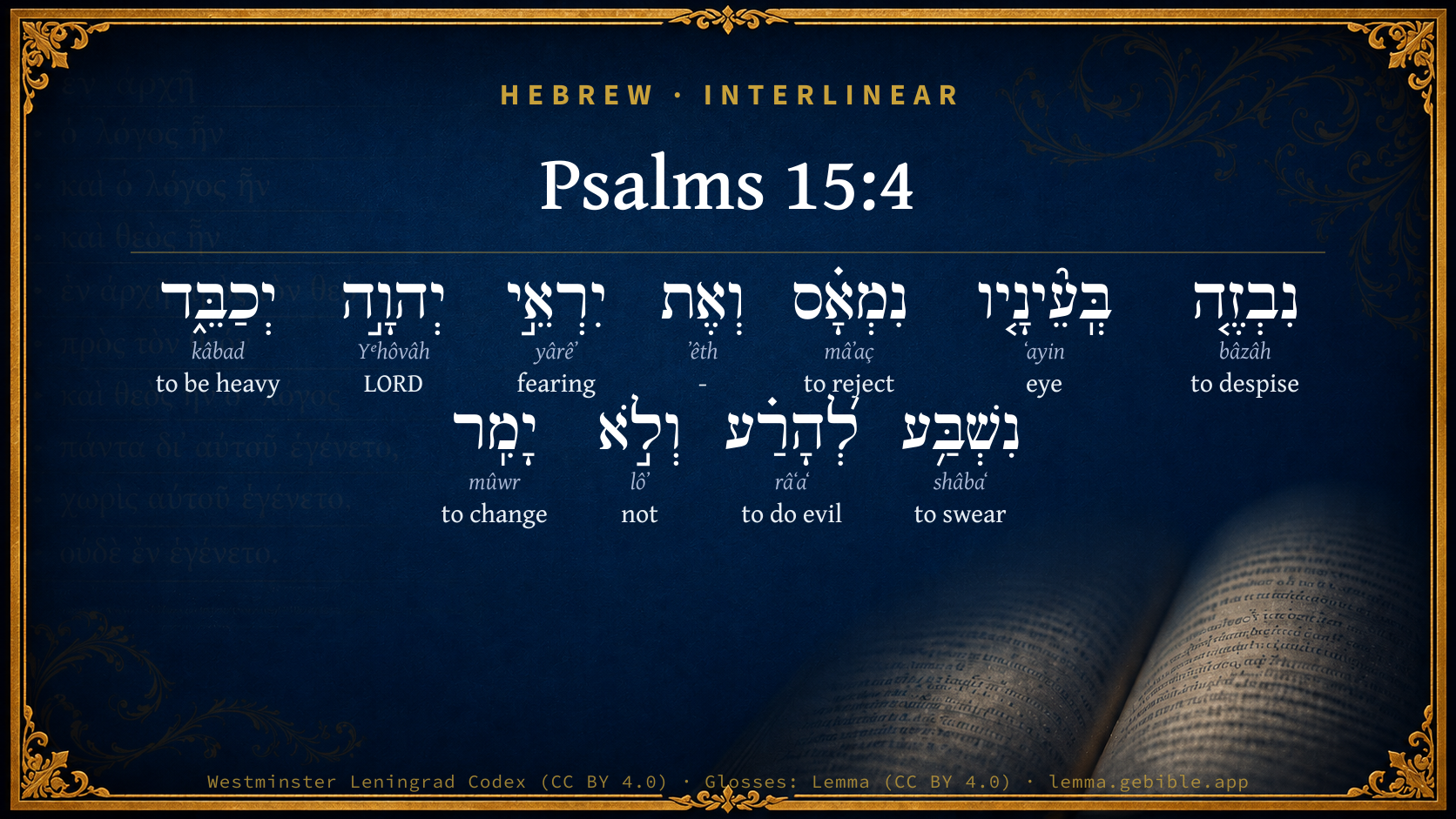
Hebrew (Westminster Leningrad Codex) Psalms 15:4 appears in the Hebrew Old Testament. The text above is from the Westminster Leningrad Codex. Each word links to its Strong’s number, a concise gloss, and parsing drawn from the Open Scriptures Hebrew Bible morphology. Click any word for its full Brown-Driver-Briggs (BDB) entry.
Download image
Cite this verse

Psalms 15:4 (World English Bible). Public Domain. Lemma interlinear Bible study tool, https://lemma.gebible.app/v/psalms/15/4.

Show BibTeX & RIS
BibTeX
RIS
English Translation
In whose eyes a vile man is despised, But who honors those who fear Yahweh; He who keeps an oath even when it hurts, and doesn't change;
World English Bible · Public Domain
Download a study sheet

One document with this verse’s original text, its word-by-word gloss line, the meaning frame, cross-references with their text, attributed commentary, and full source and license credits — printable, and it pastes into notes with its structure intact.

This verse Autodidact and up

Study sheet (.html) Plain text (.txt)

A passage Seminary Student

Up to 50 verses in one chapter. A passage sheet keeps up to 6 commentary sources and 12 cross-references per verse, in the order this page ranks them, and says so on the sheet whenever that leaves anything out. Ask for a single verse and you get the Autodidact verse sheet above.

Everything on this page stays free to read, with no account — the sheet is a download of what is already on screen, not access to it.

Want to remove ads? Support Godless Engineer
Compare translations 3

The same verse in 3 English versions, stacked beneath the original-language interlinear above. Click any original word for its lexicon entry.

Each is an independent rendering of the whole verse — the interlinear is not word-aligned to these translations.

Highlighted words mark where these versions differ — a whole-verse word diff, not a word-by-word alignment.

  • World English Bible Public Domain
    In whose eyes a vile man is despised, But who honors those who fear Yahweh; He who keeps an oath even when it hurts, and doesn't change;
  • King James Version Public Domain
    In whose eyes a vile person is contemned; but he honoureth them that fear the LORD. He that sweareth to his own hurt, and changeth not.
  • unfoldingWord Literal Text CC BY-SA 4.0
    In whose eyes one being rejected is despised, but those who fear Yahweh he honors. He swears to his own hurt, and does not change.

unfoldingWord Literal Text — © unfoldingWord, licensed CC BY-SA 4.0. Word-aligned USFM3 via Door43 (git.door43.org/unfoldingWord/en_ult).

Versions to compare (up to 4)

3 of 4 selected

Show all 18 translations

Every available English version of this verse, each an independent rendering of the whole verse.

  • World English Bible Public Domain
    In whose eyes a vile man is despised, But who honors those who fear Yahweh; He who keeps an oath even when it hurts, and doesn't change;
  • Berean Standard Bible Public Domain
    who despises the vile but honors those who fear the LORD, who does not revise a costly oath,
  • Majority Standard Bible Public Domain
    who despises the vile but honors those who fear the LORD, who does not revise a costly oath,
  • King James Version Public Domain
    In whose eyes a vile person is contemned; but he honoureth them that fear the LORD. He that sweareth to his own hurt, and changeth not.
  • American Standard Version (1901) Public Domain
    In whose eyes a reprobate is despised, But who honoreth them that fear Jehovah; He that sweareth to his own hurt, and changeth not;
  • Revised Version (1885) Public Domain
    In whose eyes a reprobate is despised; but he honoureth them that fear the LORD. He that sweareth to his own hurt, and changeth not.
  • Geneva Bible (1599) Public Domain
    In whose eyes a vile person is contemned, but he honoureth them that feare the Lord: he that sweareth to his owne hinderance and changeth not.
  • Douay-Rheims (1899) Public Domain
    In his sight the malignant is brought to nothing: but he glorifieth them that fear the Lord. He that sweareth to his neighbour, and deceiveth not;
  • Young's Literal Translation Public Domain
    Despised in his eyes `is' a rejected one, And those fearing Jehovah he doth honour. He hath sworn to suffer evil, and changeth not;
  • Literal Standard Version CC BY-SA 4.0
    A rejected one [is] despised in his eyes, || And he honors those fearing YHWH. He has sworn to endure evil, and does not change;
  • Unlocked Literal Bible CC BY-SA 4.0
    The worthless person is despised in his eyes, but he honors those who fear Yahweh. He swears to his own disadvantage and does not take back his promises.
  • unfoldingWord Literal Text CC BY-SA 4.0
    In whose eyes one being rejected is despised, but those who fear Yahweh he honors. He swears to his own hurt, and does not change.
  • Darby Bible Public Domain
    In whose eyes the depraved person is contemned, and who honoureth them that fear Jehovah; who, if he have sworn to his own hurt, changeth it not;
  • World Messianic Bible Public Domain
    in whose eyes a vile man is despised, but who honors those who fear the LORD; he who keeps an oath even when it hurts, and doesn’t change;
  • Webster's Bible Public Domain
    In whose eyes a vile person is contemned; but he honoreth them that fear the LORD. He that sweareth to his own hurt, and changeth not.
  • Free Bible Version CC BY-SA 4.0
    They reject people the Lord has rejected, but honor those who follow the Lord. They keep their promises even when it's hard to do. They don't change their minds.
  • Bible in Basic English Public Domain
    Who gives honour to those who have the fear of the Lord, turning away from him who has not the Lord's approval. He who takes an oath against himself, and makes no change.
  • JPS Tanakh (1917) Public Domain
    In whose eyes a vile person is despised, but he honoureth them that fear the LORD; he that sweareth to his own hurt, and changeth not;

Literal Standard Version (2020), Covenant Press — licensed CC BY-SA 4.0. Text via the HelloAO Bible API (eBible.org). Unlocked Literal Bible (unfoldingWord) — licensed CC BY-SA 4.0. Text via the HelloAO Bible API (eBible.org). unfoldingWord Literal Text — © unfoldingWord, licensed CC BY-SA 4.0. Word-aligned USFM3 via Door43 (git.door43.org/unfoldingWord/en_ult). Free Bible Version, Dr. Jonathan Gallagher — licensed CC BY-SA 4.0. Text via the HelloAO Bible API (eBible.org).

Word by word

More ways to search: Search by grammar → Find every occurrence → Compare this word →

Practice this passage: Drill this verse → Learn its vocabulary →

יָמִֽר
mûwr
H4171
“to change”
Verb, Hiphil, Imperfect, 3rd Person, Masculine, Singular
Part of Speech
Verb
Stem
Hiphil
Form
Imperfect
Person
3rd Person
Gender
Masculine
Number
Singular
Full BDB Definition

Origin: a primitive root

TWOT: 1164

to change, exchange - (Niphal) to be changed - (Hiphil) - to change, alter - to exchange
  1. נִבְזֶ֤ה bâzâh H959 “despising” Verb, Niphal, Participle Active, Masculine, Singular, Absolute
  2. בְּֽעֵ֘ינָ֤יו ʻayin H5869 “in/at · eyes · his” Preposition + Noun, Common, Both, Dual, Construct + Suffix, Personal, 3rd Person, Masculine, Singular
  3. נִמְאָ֗ס mâʼaç H3988 “rejecting” Verb, Niphal, Participle Active, Masculine, Singular, Absolute
  4. וְאֶת ʼêth H853 “and · -” Conjunction + Particle, Direct Object
  5. יִרְאֵ֣י yârêʼ H3373 “fearing of” Adjective, Adjective, Masculine, Plural, Construct
  6. יְהוָ֣ה Yᵉhôvâh H3068 “LORD” Noun, Proper
  7. יְכַבֵּ֑ד kâbad H3513 “to be heavy” Verb, Piel, Imperfect, 3rd Person, Masculine, Singular
  8. נִשְׁבַּ֥ע shâbaʻ H7650 “to swear” Verb, Niphal, Perfect, 3rd Person, Masculine, Singular
  9. לְ֝הָרַ֗ע râʻaʻ H7489 “to do evil” Preposition + Verb, Hiphil, Infinitive Construct
  10. וְלֹ֣א lôʼ H3808 “and · not” Conjunction + Particle, Negative

About this verse

These counts appear in no published source. They are computed here, from the morphology-tagged text and Lemma’s own curated glosses. What Lemma adds →

11
words
11
distinct lemmas
Wisdom
section

Notable vocabulary

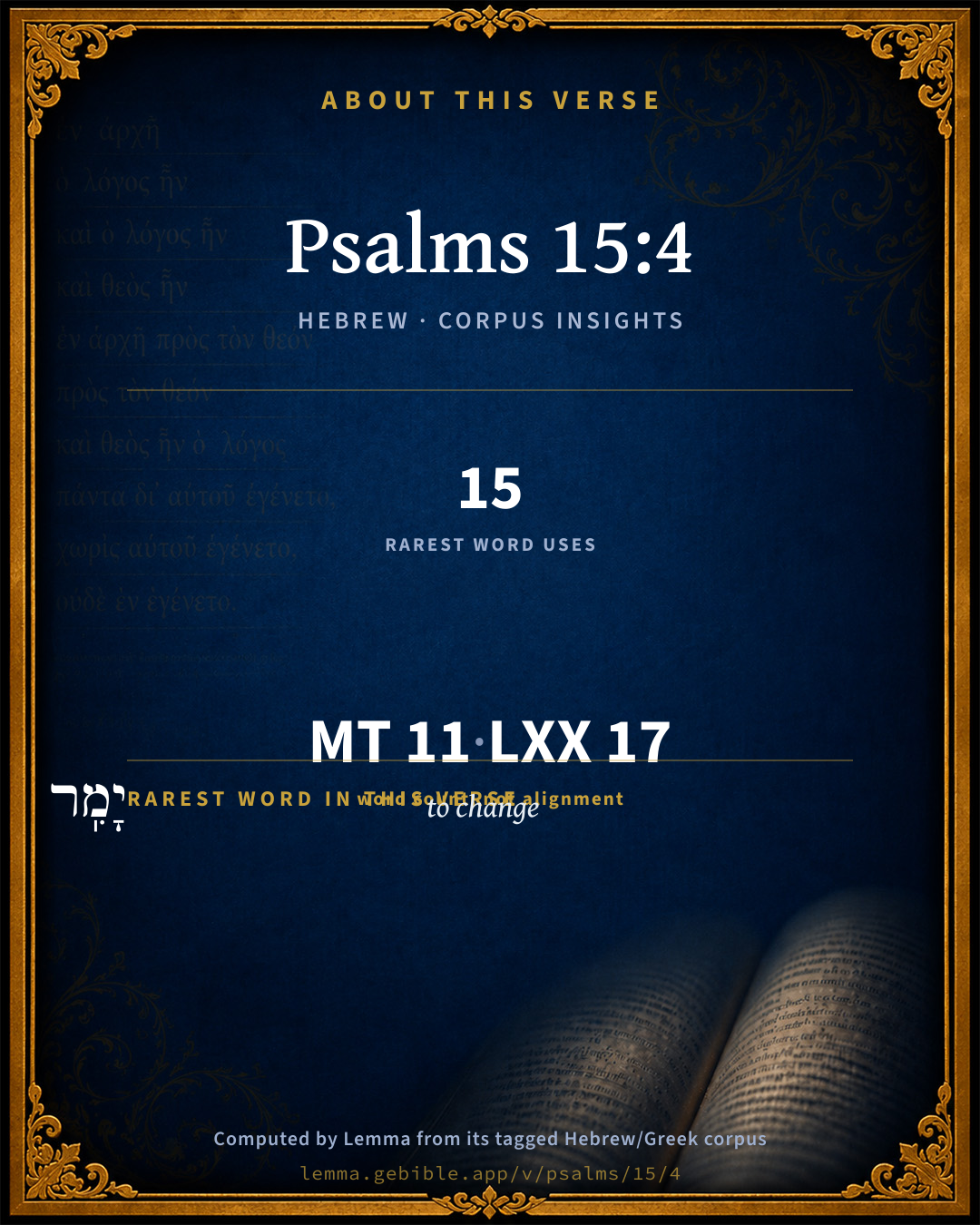
The rarest word here is יָמִֽר to change H4171 — appearing just 15 times in the whole Hebrew Bible.

Shared distinctive vocabulary

יָמִֽר to change H4171 occurs in 10 verses of the Hebrew Bible. Also found in:

Grammatical profile

  • 6 verbs
  • 2 nouns
  • 1 adjective
  • 2 particles

Verb forms

  • נִבְזֶ֤ה Niphal · Participle Active
  • נִמְאָ֗ס Niphal · Participle Active
  • יְכַבֵּ֑ד Piel · Imperfect
  • נִשְׁבַּ֥ע Niphal · Perfect
  • לְ֝הָרַ֗ע Hiphil · Infinitive Construct
  • יָמִֽר Hiphil · Imperfect

Hebrew & Septuagint length

In English translation the verse runs 27 words from the Hebrew and 26 from the Septuagint (LXX English) — closely comparable.

A rough comparison of the two English renderings, which tokenize alike — not a word-level alignment.

Word counts can differ between the Hebrew and the Greek without any difference in meaning — e.g. the Hebrew direct-object marker אֵת has no separate Greek word, and Greek often adds the article ὁ.

In the original languages it is 11 Hebrew tokens and 17 Greek tokens — but the two are counted differently (Hebrew bundles its prefixes and suffixes into one token; the Greek is in lemma form), so that isn’t a like-for-like length.

Cross-references

18

Topical passages linked to Psalms 15:4 in the Treasury of Scripture Knowledge — connected by theme and wording, ordered by reader-vote popularity; previews shown in the World English Bible.

  • Judges 11:35 It happened, when he saw her, that he tore his clothes, and said, Alas, my daughter! you have brought me very low, and you are one of those who trouble me; for I have opened my mouth to Yahweh, and I can't go back.
  • Matthew 5:33 "Again you have heard that it was said to them of old time, 'You shall not make false vows, but shall perform to the Lord your vows,'
  • Psalms 101:6 My eyes will be on the faithful of the land, That they may dwell with me. He who walks in a perfect way, He will serve me.
  • Psalms 101:4 A perverse heart will be far from me. I will have nothing to do with evil.
  • Psalms 16:3 As for the saints who are in the earth, They are the excellent ones in whom is all my delight.
  • Isaiah 32:5–6 The fool shall be no more called noble, nor the scoundrel be highly respected.
  • 1 John 3:14 We know that we have passed out of death into life, because we love the brothers. He who doesn't love his brother remains in death.
  • Job 32:21–22 Please don't let me respect any man's person, Neither will I give flattering titles to any man.
  • Psalms 119:63 I am a friend of all those who fear you, Of those who observe your precepts.
  • Joshua 9:18–20 The children of Israel didn't strike them, because the princes of the congregation had sworn to them by Yahweh, the God of Israel. All the congregation murmured against the princes.
  • 2 Samuel 21:1–2 There was a famine in the days of David three years, year after year; and David sought the face of Yahweh. Yahweh said, It is for Saul, and for his bloody house, because he put to death the Gibeonites.
  • 2 Kings 3:13–14 Elisha said to the king of Israel, What have I to do with you? get you to the prophets of your father, and to the prophets of your mother. The king of Israel said to him, No; for Yahweh has called these three kings together to deliver them into the hand of Moab.
  • Esther 3:2 All the king's servants, who were in the king's gate, bowed down, and did reverence to Haman; for the king had so commanded concerning him. But Mordecai didn't bow down, nor did him reverence.
  • Daniel 5:17–31 Then Daniel answered before the king, Let your gifts be to yourself, and give your rewards to another; nevertheless I will read the writing to the king, and make known to him the interpretation.
  • Matthew 12:49–50 He stretched out his hand towards his disciples, and said, "Behold, my mother and my brothers!
  • Acts 24:2–3 When he was called, Tertullus began to accuse him, saying, "Seeing that by you we enjoy much peace, and that excellent measures are coming to this nation,
  • Acts 24:25 As he reasoned about righteousness, self-control, and the judgment to come, Felix was terrified, and answered, "Go your way for this time, and when it is convenient for me, I will summon you."
  • Acts 28:10 They also honored us with many honors, and when we sailed, they put on board the things that we needed.

Cross-references courtesy of OpenBible.info (CC BY 4.0).

Hebrew and Greek witnesses Masoretic Hebrew ↔ Greek Septuagint

The same verse in the two great witnesses to the Old Testament, shown verse-for-verse.

You’re reading Greek Psalm 14 (Hebrew Psalm 15). The Septuagint counts the superscription, so verse numbers can differ from the Hebrew — chapter-level alignment, not verse-by-verse. Numbering follows Rahlfs.

These are two independent witnesses, not word-aligned to each other, and the Septuagint is shown in lemma (dictionary) form.

Hebrew Psalms 15:4 Masoretic · Westminster Leningrad Codex

נִבְזֶ֤ה בְּֽעֵ֘ינָ֤יו נִמְאָ֗ס וְאֶת יִרְאֵ֣י יְהוָ֣ה יְכַבֵּ֑ד נִשְׁבַּ֥ע לְ֝הָרַ֗ע וְלֹ֣א יָמִֽר

In whose eyes a vile man is despised, But who honors those who fear Yahweh; He who keeps an oath even when it hurts, and doesn't change;

World English Bible · Public Domain

Greek LXX Greek Psalm 14:4 Septuagint · lemma form

ἐξουδενόω ἐνώπιον αὐτός πονηρεύομαι ὁ δέ φοβέω κύριος δοξάζω ὁ ὄμνυμι ὁ πλησίον αὐτός καί οὐ ἀθετέω

In his sight an evil-worker is set at nothing, but he honors them that fear the Lord. He swears to his neighbor, and disappoints him not.

LXX2012 (modern English Septuagint) · Public Domain

On this verse, J. A. Alexander on Psalms discusses the Septuagint’s reading. Read the note in Commentary ↓

Hebrew: Westminster Leningrad Codex (CC BY 4.0). Greek: Septuagint (public domain); English from LXX2012 (modern English Septuagint) (Public Domain). How the Septuagint differs from the Hebrew →

Commentary

Notes on Psalms 15:4 from classic Christian and Jewish commentators (each source and its license shown beneath its notes). The classic Christian expositions comment on the surrounding passage and are grouped to its opening verse, so a note may address several verses; the Jewish commentaries on the Tanakh (Rashi and others) are per-verse, so they appear only where the commentator wrote on this verse.

Lemma curates 59 commentaries, every one of them public domain or Creative Commons licensed, each selected and text-cleaned for this edition rather than reprinted as found. About our sources →

Trapp's Complete Commentary

John Trapp

Psa 15:4 In whose eyes a vile person is contemned; but he honoureth them that fear the LORD. [He that] sweareth to [his own] hurt, and changeth not.

Ver. 4. In whose eyes a vile person is contemned] An abject, a reprobate, as one rendereth it; be he as high as Haman; see Esther’s character of him, Est 7:6, and Mordecai’s slighting of him, Est 3:2 (Josephus). Be he as great as Antiochus Epiphanes, to whom the Samaritans, excusing themselves that they were no Jews, wrote thus, To Antiochus, the great god. Daniel counted and called him a vile person, Dan 11:21. So Elisha despised Jehoram the king, 2Ki 3:14; we also must despise the wicked; yet non virum, sed vitium, et salvo cuique loci sui honore, giving honour, befitting their places, to whom honour is due, Rom 13:7., but shunning that partiality taxed by St James, Jas 2:3-4. The burgess of the New Jerusalem, reprobos reprobat, et probes probat, he cannot flatter any man, nor fancy such as in whom he findeth not aliquid Christi, something of the image of God. A golden colosse, stuffed with rubbish, he cannot stoop to.

But he honoureth them that fear the Lord] As the only earthly angels, though never so mean and despicable in the world’s eye. Mr Fox, being asked whether he remembered not such a poor servant of God who had received help from him in time of trouble? answered, I remember him well; I tell you I forget lords and ladies to remember such. Ingo, an ancient king of Draves and Veneds, set his pagan nobles, at a feast, in his hall below, and a company of poor Christians with himself in his presence chamber, entertaining them with the royalest cheer and kingliest attendance that might be. At which when his nobles wondered, he told them, this he did not as he was king of the Draves, but as he was king of another world, wherein these should be his companions and fellow princes (Aeneas Sylv. cap. 20).

He that sweareth to his own hurt, and changeth not] Covetousness he so hateth that, first, he will rather suffer loss than be worse than his oath or honest word; secondly, he lendeth, looking for nothing again; thirdly, he taketh no reward against the innocent, either as a judge or as a pleader. Of many swearers it may be said, that they can play with oaths as children do with nuts; or as monkeys do with their collars, which they can slip off at their pleasure. And of many promisers, that they are like the peacock, all in changeable colours, as often changed as moved; but this is not the guise of God’s people. The Jews at this day keep no oath unless they swear upon their own Torah, or law, brought out of their synagogues (Tertul.). The Turks keep no oath further than may stand with their own convenience. The Papists hold that faith is not to be kept with heretics; and they practise accordingly. But the old Romans had a great care always to perform their word, whatever it cost them; insomuch that the first temple built in Rome was dedicated to the goddess Fidelity. In after times indeed, Romanis promittere promptum erat, promissis autem, quanquam iuramento firmarls, minime stare: The Romans were forward to promise and swear, but careless to perform, if Mirrhanes, the Persian general, may be believed (Procop. de Bel. Persic. lib. 1). But an oath was ever held among all nations a sacred bond, and obligatory, unless it were contra bones mores, against good morals, as the lawyers speak. Joshua and the elders kept their oath to the Gibeonites, though to their inconvenience. Zedekiah was punished for not keeping touch with the king of Babylon. And one of the laws of the knights of the band in Spain was, that if any of them broke his promise he went alone by himself, and nobody spake to him, nor he to any.

John Trapp, A Commentary or Exposition upon All the Books of the Old and New Testament (1647–1656) — public domain. Text from a community e-Sword module.

The Biblical Illustrator

Joseph S. Exell

Psa_15:4

In whose eyes a vile person is contemned.

Second moral appreciations

In whose eyes a vile person is contemned; but he honoureth them that fear the Lord. Then he is a man of sound moral appreciations. He does not pay respect where no respect is deserved. He does not withhold respect where it is merited. Says an old Puritan, We must be as honest in paying respect as in paying our bills. But let us pay them in the right quarter. Do not let us call the vile person honourable because he is clothed in purple and fine linen, and fareth sumptuously every day. And do not let us esteem the honourable man as vile because his equipage is poor and his nobility is clothed in rags. Let us call villainy vile wherever we find it, and let us esteem nobility as noble in whatever guise it may appear. This is one of the great characteristics of the friend of God; to whom the sweet is sweet and the sour is sour; evil is evil and good is good. Nothing is allowed to interfere with the soundness and sobriety of his judgment, and no verbal jugglery is permitted to destroy the healthiness of his discriminating vocabulary. He knows the superlative, and loves it! As for the saints that are in the earth, they are the excellent in whom is all My delight. (J. H. Jowett, M. A.)

The believers regard for those who fear God

Mr. Fox being asked whether he remembered not such a poor servant of God who had received succour from him in time of trouble answered, I remember him well; I tell you, I forget the lords and ladies to remember such. (John Trapp.)

He that sweareth to his own hurt, and changeth not.

The obligation of an oath

Among the duties mentioned in this Psalm we find this of constancy and faithfulness in keeping those promises which we have confirmed by an oath. Because the greatest temptation to the breaking of oaths proceeds from fear of some temporal damage, or prospect of some worldly advantage, therefore it is said, He that sweareth to his own hurt, and changeth not.

I. In what cases an oath doth oblige. No oath can oblige to that which is impossible; or to that which is unlawful; for justice requires that we do not invade the rights and privileges of other men. Oaths contrary to charity or mercy or humanity are void. No oath can oblige when it hinders a greater good. What if the matter be purely indifferent? There can be here no occasion of difficulty, except the matter be also of no moment. He is undoubtedly guilty of great irreverence towards God, that will cite His name to a trifle. If the matter of the oath be such as causeth a man to doubt whether it be lawful or no, in that case he had better perform it. There are cases relating to the person that swears. Here, whensoever we shall determine that an oath doth not bind, it will be for the want of the persons rightly understanding that he made one. A man may not know what an oath is; or he may swear when affected by anger, or by drink, or by fear; or by any other passion; or if a man swears to save his life, as from robbers.

II. In what sense an oath ought to be taken. That sense is to be taken which is most suitable to the business men are about. We may not precisely, without limitation, accept the sense of the swearer, or of the imposer, or that which the words of the oath will bear. The swearer may equivocate, or use mental reservations. What if a man swears and doth not intend to swear? Something of intention is always required to an oath. It would be a frivolous excuse for a man to say, he intended to swear, but did not intend to be obliged.

III. How great the obligation of an oath is. It is a solemn invocation of God to witness what we say, by His favour and mercy to us, if it be true; or by His vengeance upon us if it be false. It is a high advantage and privilege which God vouchsafeth to us, in that He gives us leave, upon urgent and weighty causes, to make use of His glorious Name as a seal to confirm the truth of what we assent. If, therefore, we take it up to avouch a falsehood, we are exceedingly ungrateful, we falsify that seal, we profane that dreadful name, we apply that which is most sacred to the worst of uses . . . For these and the like causes an oath hath generally been looked upon as a sufficient assurance and confirmation of the truth of any matter. He that seriously considers what an oath is cannot surely believe that any man is above the obligation of it. And as no man can be too great for such an obligation himself, so neither can he dispense with it in others. (Henry Hellier, M. A.)

Immutable in covenant

He that sweareth to his own hurt, and changeth not. Then he is immutable in covenant. His word is his bond. He is dependable. When he promises he redeems. And he does it even to his own hurt! If it necessitates bleeding, he still redeems it. He is faithful even unto death. He is grandly consistent, consistent not in the sense of never changing his opinion, but in the grander sense of never altering his loyalty to truth and his relationship to God. His word is a tower in which the weak and defenceless have a strong defence. (J. H. Jowett, M. A.)

The Biblical Illustrator, edited by Joseph S. Exell (c. 1880s–1900s) — public domain. Text from a community e-Sword module.

Joseph Benson's Commentary

Psa 15:4. In whose eyes — In whose judgment and estimation; a vile person — An ungodly or wicked man, (as appears from the next clause, in which he that feareth God is opposed to him,) is contemned — Or, thought meanly of, notwithstanding his wealth, or honour, or greatness, or even his learning and knowledge: who does not admire the person of such a one, or envy his condition, or court him with flatteries, or value his company and conversation, or approve of, or comply with, his course of life; but judges him a miserable man, and a great object of pity; abhors his practices, and labours to make such ways contemptible to all men, as far as lies in his power. It must be observed, however, that this contemning or thinking meanly of ungodly men, does not imply a contempt of just authority, which, if it be lodged even in a wicked man’s hand, claims not only obedience, but also honour and reverence, as is manifest from the precepts and examples of Christ and his apostles. But he honoureth them that fear the Lord — He highly esteems and cordially loves them, and shows them great respect and kindness, even though they be mean and obscure as to their worldly condition, and though they may differ from him in some opinions or practices of lesser moment. That sweareth to his own hurt — Promises and engages upon oath to do something which may be beneficial to his neighbour, but apparently will be to his own damage. As if a man solemnly swear that he will sell his neighbour such an estate at a price below the full worth; or that he will give a poor man such a sum of money, to give which afterward he finds inconvenient to him. And changeth not — His purpose, but continues firm, and resolved to perform his promise.

Joseph Benson's Commentary on the Old and New Testaments (1811–1818) — public domain. Text from a community e-Sword module.

J. A. Alexander on Psalms

Joseph Addison Alexander

4. (Psa 15:4) Despised in his eyes (is) a reprobate, and the fearers of Jehovah he will honour; he hath sworn to his own hurt, and will not change The Chaldee Paraphrase, followed by the Prayer Book version, makes the first clause descriptive of humility. He is despised in his own eyes (and) rejected. But the parallelism with the next clause shews that a contrast was designed between his estimation of two opposite classes, and as one of these is those who fear Jehovah, the other must be represented by rejected, i.e.. by Jehovah, reprobate. The future form, as usual, suggests the idea of a present act repeated or continued in the future. He honours, and will still persist in honouring, the fearers of Jehovah. The Septuagint and Vulgate explain "to the neighbour", and some modern versions to the bad (man). But the sense is determined by the obvious allusion to Lev 5:4 : "if a soul swear to do evil or to do good," i.e. whether to his own advantage or the contrary. So here the phrase must mean "he hath sworn to injure (himself)" not designedly, but so as to produce that effect. He will not change, literally, exchange, i.e. substitute something else for what he has promised.

Joseph Addison Alexander, The Psalms Translated and Explained (1850) — public domain. Text from a community e-Sword module.

Geneva Bible (1599)

Geneva Bible translators

He that flattereth not the ungodly in their wickedness.

Geneva Bible (1599) marginal notes — public domain. Text via Bolls.life.

Jamieson, Fausset & Brown

Robert Jamieson, A. R. Fausset & David Brown

Love and hate are regulated by a regard to God.

sweareth . . . hurt--or what so results (compare Lev 5:4).

Jamieson, Fausset & Brown — Commentary Critical and Explanatory on the Whole Bible (1871) — public domain (CC PDM 1.0). Text via the HelloAO Bible API.

Adam Clarke's Commentary

Verse 4. In whose eves a vile person is contemned]

7. This man judges of others by their conduct; he tries no man's heart. He knows men only by the fruits they bear; and thus he gains knowledge of the principle from which they proceed. A vile person, נמאס nimas, the reprobate, one abandoned to sin; is despised, נבזה nibzeh, is loathsome, as if he were covered with the elephantiasis or leprosy, for so the word implies. He may be rich, he may be learned, he may be a great man and honourable with his master, in high offices in the state; but if he be a spiritual leper, an infidel, a profligate, the righteous man must despise him, and hold him, because he is an enemy to God and to man, in sovereign contempt. If he be in power, he will not treat him as if worthy of his dignity; while he respects the office he will detest the man. And this is quite right; for the popular odium should ever be pointed against vice.

Aben Ezra gives a curious turn to this clause, which he translates thus: "He is mean and contemptible in his own eyes;" and it is certain that the original, נבזה בעיניו נמאס nibzeh beeynaiv nimas, will bear this translation. His paraphrase on it is beautiful: "A pious man, whatever good he may have done, and however concordant to the Divine law he may have walked, considers all this of no worth, compared with what it was his duty to do for the glory of his Creator." A sentiment very like that of our Lord, Lu 17:10: "So likewise ye, when ye shall have done all those things which are commanded you, say, We are unprofitable servants; we have done that which was our duty to do."

Taken in this sense, the words intimate, that the man who is truly pious, who is a proper member of the Church militant, and is going straight to the Church triumphant, is truly humble; he knows he has nothing but what he has received, he has no merit, he trusts not in himself, but in the living God. He renounces his own righteousness, and trusts in the eternal mercy of God through the infinitely meritorious atonement made by Jesus Christ. The language of his heart is, -

"I loathe myself when God I see,

And into nothing fall;

Content that thou exalted be,

And Christ be all in all."

He honoureth them that fear the Lord]

8. This cause is a proof, however just the sentiment, that Aben Ezra has mistaken the meaning of the preceding clause. The truly pious man, while he has in contempt the honourable and right honourable profligate, yet honours them that fear the Lord, though found in the most abject poverty; though, with Job, on the dunghill, or, with Lazarus, covered with sores at the rich man's gate. Character is the object of his attention; persons and circumstances are of minor importance.

The fear of the Lord is often taken for the whole of religion; and sometimes for that reverence which a man feels for the majesty and holiness of God, that induces him to hate and depart from evil. Here it may signify the lowest degree of religion, repentance whereby we forsake sin.

Sweareth to his own hurt, and changeth not.]

9. If at any time he have bound himself by a solemn engagement to do so and so, and he finds afterwards that to keep his oath will be greatly to his damage; yet such reverence has he for God and for truth, that he will not change, be the consequences what they may. He is faithful also to his promises; his bare word will bind him equally with an oath. He that will not be honest without an oath will not be honest with one.

The Hebrew might be thus translated: "He sweareth to afflict himself, and does not change;" and thus the Chaldee has rendered this clause. He has promised to the Lord to keep his body under, and bring it into subjection; to deny himself that he may not pamper the flesh, and have the more to give to the poor.

Adam Clarke's Commentary on the Bible (1810–1826) — public domain. Text from a community e-Sword/MySword module.

John Calvin's Commentaries

The first part of this verse is explained in different ways. Some draw from it this meaning, that the true servants of God are contemptible and worthless in their own estimation. If we adopt this interpretation, the copula and, which David does not express, must be supplied, making the reading thus, He is vile and despised in his own eyes. But besides the consideration, that, if this had been the sense, the words would probably have been joined together by the copula and, I have another reason which leads me to think that David had a different meaning, He compares together two opposite things, namely, to despise perverse and worthless characters, and to honor the righteous and those who fear God. In order that these two clauses may correspond with each other, the only sense in which I can understand what is here said about being despised is this, that the children of God despise the ungodly, and form that low and contemptuous estimate of them which their character deserves. The godly, it is true, although living a praiseworthy and virtuous life, are not inflated with presumption, but, on the contrary, are rather dissatisfied with themselves, because they feel how far short they are as yet of the perfection which is required. When, however, I consider what the scope of the passage demands, I do not think that we are here to view the Psalmist as commending humility or modesty, but rather a free and upright judgment of human character, by which the wicked, on the one hand, are not spared, while virtue, on the other, receives the honor which belongs to it; for flattery, which nourishes vices by covering them, is an evil not less pernicious than it is common. I indeed admit, that if the wicked are in authority, we ought not to carry our contempt of them the length of refusing to obey them in so far as a regard to our duty will permit; but, at the same time, we must beware of flattery and of accommodating ourselves to them, which would be to involve us in the same condemnation with them. He who not only seems to regard their wicked actions with indifference, but also honors them, shows that he approves of them as much as it is in his power. Paul therefore teaches us, (Ephesians 5:11,) that it is a species of fellowship with the unfruitful works of darkness when we do not reprove them. It is certainly a very perverse way of acting, when persons, for the sake of obtaining the favor of men, will indirectly mock God; and all are chargeable with doing this who make it their business to please the wicked. David, however, has a respect, not so much to persons as to wicked works. The man who sees the wicked honored, and by the applause of the world rendered more obstinate in their wickedness, and who willingly gives his consent or approbation to this, does he not, by so doing, exalt vice to authority, and invest it with sovereign power? “But woe,” says the prophet Isaiah, (Isaiah 5:20,) “unto them that call evil good, and good evil; that put darkness for light, and light for darkness.”

Nor ought it to be regarded as a rude or violent manner of speaking, when David calls base and wicked persons reprobates, although they may be placed in an exalted and honorable station. If (as Cicero affirms, in his book entitled The Responses of the Aruspices) the inspectors of the entrails of the sacrifices, and other heathen soothsayers, applied to worthless and abandoned characters the term rejected, although they excelled in dignity and riches, why should not a prophet of God be permitted to apply the name of degraded outcasts to all who are rejected by God? The meaning of the Psalmist, to express it in a few words, is, that the children of God freely judge of every man’s doings, and that for the purpose of obtaining the favor of men, they will not stoop to vile flattery, and thereby encourage the wicked in their wickedness.

What follows immediately after, namely, to honor the righteous and those who fear God, is no mean virtue. As they are often, as it were, the filth and the offscouring of all things in the estimation of the world, so it frequently happens that those who show them favor and sympathy, excite against themselves every where the hatred of the world. The greater part of mankind, therefore, refuse the friendship of good men, and leave them to be despised, which cannot be done without grievous and heinous injury to God. Let us learn then not to value men by their estate or their money, or their transitory honors, but to hold in estimation godliness, or the fear of God. And certainly no man will ever truly apply his mind to the study of godliness who does not, at the same time, reverence the servants of God; as, on the other hand, the love we bear to them incites us to imitate them in sanctity of life.

When he hath sworn to his own hurt. The translation of the LXX. would agree very well with the scope of the passage, were it not that the points which are under the words in the Hebrew text will not bear such a sense. “The LXX., instead of להרע, [lehara,] to hurt, seem to have read להרע, [leharea,] to his fellow, for they render it, τῷ πλησίον αὐτου, to his neighbor, and so the Syriac, and Latin, and Arabic, and Ethiopic.” — Hammond. This rendering agrees very well with the scope of the Psalm, which relates to our dealing justly with our fellow-men; and it represents the good man as scrupulously performing the promissory oaths which he makes to his neighbor. But the ordinary reading, he sweareth to his own hurt, and changeth not, sets forth the moral integrity of the good man in a still more striking light, by describing him as performing his oath in the face of the greatest temptations to break it, when the performance of it may prove detrimental to his own interests; and this is no mean trial of a man’s virtue.

John Calvin's Commentaries (1540-1563) — public domain. Text from the Calvin Translation Society English edition (1840s-50s) via the Christian Classics Ethereal Library (ccel.org). Calvin's coverage is partial (roughly two-thirds of the Bible); uncommented books and verses are honest gaps, never fabricated. The 19th-century editor's footnotes and remarks are omitted so the notes are faithfully Calvin's own voice.

Ellicott's Commentary for English Readers

(4) In whose eyes.—The first clause is obscure. The subject and predicate are not clearly marked; but the Authorised Version gives the right sense. It is quite out of keeping with the context to make both verbs predicates, and to translate, “He is despised and rejected in his own eyes,” i.e., thinks humbly of himself. The meaning is, “Those deserving contempt are contemned; but the good who fear Jehovah are honoured.”

To his own hurt.—Literally, to do evil, i.e., to him-self (see Lev_5:4). The LXX., by transposing the letters, read, “to his neighbour;” and the English Prayer Book version has apparently combined the two thoughts: “Who sweareth to his neighbour, and dis-appointeth him not, even though it were to his own hindrance.”

“His words are bonds, his oaths are oracles,

His love sincere, his thoughts immaculate;

His tears pure messengers sent from his heart,

His heart is far from fraud as heaven from earth.”

SHAKSPEARE: Two Gentlemen of Verona.

A Bible Commentary for English Readers, edited by Charles John Ellicott (1878–1897) — public domain. Text from a community e-Sword module.

The Cambridge Bible for Schools and Colleges

gen. ed. J. J. S. Perowne

4. Render with R.V.,

In whose eyes a reprobate is despised.

The truthfulness of his character is shewn in his estimate of men. The world’s false estimates are one of the evils which will disappear in the Messianic age (Isa_32:5 ff.). A reprobate, one who is not good metal but worthless dross (Jer_6:30), he treats with well-merited contempt, while ‘he honoureth those that fear Jehovah.’

By the Targum and some commentators, ancient and modern, the clause is rendered, despised is he in his own eyes, rejected, which is well paraphrased in P.B.V. “He that setteth not by himself, but is lowly in his own eyes;” cp. 2Sa_6:22. But (1) the words ‘despicable reprobate’ are such as David could hardly use to express humility and self-abasement; and (2) the contrast required by the parallelism is not ‘he despises himself and honours others,’ but ‘he abhors the base and honours the godly,’ i.e. shews right discernment in his regard for men. Cp. Psa_16:3; 1Sa_2:30.

He that sweareth &c] Though he hath sworn to his own hurt, he changeth not. He performs his oaths and vows without modification or rebatement, even though they may have been rashly made and prove to be to his own disadvantage. Comp. the phrase in the Law for the expiation of rash oaths (Lev_5:4), “if any one swear rashly with his lips to do evil or to do good.” Any ‘changing’ of animals devoted by vows (which were of the nature of oaths) was expressly forbidden (Lev_27:10). Here the reference is quite general.

The LXX, Vulg., and Syr. render, by a slight change of vocalisation, to his fellow (cp. Psa_15:3): and P.B.V. (as in Psa_84:7) combines both renderings in its paraphrase, ‘He that sweareth unto his neighbour and disappointeth him not, though it were to his own hindrance.’

The Cambridge Bible for Schools and Colleges (gen. ed. J. J. S. Perowne; Cambridge University Press, 1878–1918) — public domain. Text from a community e-Sword module.

John Gill's Exposition

In whose eyes a vile person is contemned,.... A "vile" man is a very wicked, profligate, and abandoned creature, one that is to every good work reprobate; and such sometimes are in high places, Psa 12:8; and are greatly caressed and esteemed by the men of the world; but then, as they are an abomination to God, they should be despised by his people, let them be what they will as to their riches, honours, and wisdom among men; as Haman was by Mordecai, Est 3:2; and Ahab by Elisha, Kg2 3:14; and such who keep company with, and express a delight and pleasure in such sort of persons, ought by no means to have a place in the house of God. Some understand this of a good man being "despised in his own eyes", as it may be rendered (f); on account of his vileness, and the imperfection of his obedience, and as expressive of his great humility, esteeming others better than himself; and who renounces himself, and is rejected by himself, having a very mean opinion of himself; which is the sense of the Targum, Aben Ezra, and Kimchi; and which is no bad sense, though the former is countenanced by what follows;

but he honoureth them that fear the Lord; who have the covenant grace of fear wrought in their hearts, and serve the Lord with reverence and godly fear; that is, who are truly religious and godly persons; these such who are fit members of the church of Christ love heartily, esteem of highly, and honour them by thinking and speaking well of them, and behaving with great respect and decency to them; see Rom 12:10;

he that sweareth to his own hurt, and changeth not; having taken a solemn oath, so sacred is it with him, and such a regard has he to the name of God, by whom he swears, that though it is to his civil loss and detriment, yet he will not break it and depart from it, but punctually observe it: some render it, "he that swears to his neighbour, and changeth not" (g); he that is just to his word, faithful to his promises, that exactly fulfils all the obligations he lays himself under unto others; he that is honest and upright in all his dealings. The Jewish writers interpret this clause of a man's vowing and swearing to afflict himself by fasting, which, though it is to the emaciating of his body, yet he strictly observes his vow or oath; but this is foreign from the scope of the place: it might be rendered, "he that swears to do evil, and does not recompense or perform" (h), it being better to break through such an oath than to keep it; see Lev 5:4.

(f) "qui despicit se in oculis suis", so some in Vatablus; "ille est despectus in propriis oculis, reprobatus", Gussetius, p. 453. (g) , Sept. "proximo suo", V. L. Sic. Syr. Ar. Aethiop. (h) So Ainsworth.

John Gill's Exposition of the Whole Bible (1746–1763) — public domain (CC PDM 1.0). Text via the HelloAO Bible API.

Albert Barnes' Notes on the Bible

In whose eyes a vile person is contemned - That is, who does not show respect to a man of base or bad character on account of his wealth, his position, or his rank in life. He estimates character as it is in itself, and not as derived from rank, relationship, or station. While, as stated in the previous verse, he is not disposed to take up a false or evil report against another, he is at the same time disposed to do justice to all, and does not honor those who do not deserve to be honored, or apologise for base conduct because it is committed by one of exalted station or rank. Loving virtue and piety for their own sake, he hates all that is opposite; and where conduct deserves reprobation, no matter where found, he does not hesitate to avow his conviction in regard to it. The sentiment here is substantially the same as in Psa 1:1. See the notes at that verse.

But he honoreth them that fear the Lord - No matter in what rank or condition of life they may be found. Where there is true piety he honors it. He is willing to be known as one that honors it, and is willing to bear all the reproach that may be connected with such a deeply cherished respect, and with such an avowal. Compare Psa 1:1.

He that sweareth to his own hurt, and changeth not - Who has made a promise, or entered into a contract, that is likely to turn out contrary to his expectations, to his own disadvantage; but who still adheres to his engagement. If the thing itself is wrong; if he has made a promise, or pledged himself to do a wicked thing, he cannot be under obligation to execute it; he should at once abandon it (compare the notes at Mat 14:9); but he is not at liberty to violate an agreement simply because it will be a loss to him, or because he ascertains that it will not be, as he supposed, to his advantage. The principles here laid down will extend to all contracts or agreements, pecuniary or otherwise, and should be a general principle regulating all our transactions with our fellow-men. The only limitation in the rule is that above stated, when the promise or the contract would involve that which is morally wrong.

Albert Barnes' Notes on the Bible (1834–1885) — public domain. Text from a community e-Sword/MySword module.

Matthew Poole's English Annotations

In whose eyes, i.e. in whose judgment and estimation,

a vile person, i.e. one, that deserves contempt, an ungodly or wicked man, as appears from the next clause, where he that feareth God is opposed to him,

is contemned or despised, notwithstanding all his wealth, and glory, and greatness. He doth not admire his person, nor envy his condition, nor court him with flatteries, nor value his company and conversation, nor approve of or comply with his courses; but he thinks meanly of him; he judgeth him a most miserable man, and a great object of pity; he abhors his wicked practices, and labours to make such ways contemptible and hateful to all men as far as it lies in his power. But this contempt of wicked men must be so managed as not to cause a contempt of just authority, which if it be lodged in a wicked hand, doth challenge not only obedience, but also honour and reverence; as is manifest from the precepts and examples of Christ and of his apostles, who charge this upon the Christians every where, although the magistrates of those times were unquestionably vile and wicked men. See Act 23:5; Ro 13; 1Pe 5:13, &c. He honoureth, i.e. he highly esteemeth and heartily loveth them, and showeth great respect and kindness to them, though they be mean and obscure as to their worldly condition, and though they may differ from him in some opinions or practices of lesser moment. He that sweareth, to wit, a promissory oath, engaging himself by solemn oath to do something which may be beneficial to his neighbour.

To his own hurt, i.e. to his own damage or prejudice. As if a man solemnly swear by the name of the great God, that he will sell him such an estate at a price below the full worth, or that he will give a poor man such a sum of money, which when afterwards he comes to review and consider, he finds it very inconvenient and burdensome to him, where he is tempted to break his oath.

Changeth not, to wit, his purpose or course, but continues firm and resolved to perform his promise, and sacrificeth his interest and profit to his conscience, and the reverence of God and of an oath. See Eze 17:18,19.

Matthew Poole's English Annotations on the Holy Bible (1683–1685) — public domain. Text from a community e-Sword/MySword module.

The Treasury of David

Charles H. Spurgeon

Ver. 4. In whose eyes a vile person is contemned; but he honoureth them that fear the Lord. We must be as honest in paying respect as in paying our bills. Honour to whom honour is due. To all good men we owe a debt of honour, and we have no right to hand over what is their due to vile persons who happen to be in high places. When base men are in office, it is our duty to respect the office; but we cannot so violate our consciences as to do otherwise than contemn the men; and on the other hand, when true saints are in poverty and distress, we must sympathize with their afflictions and honour the men none the less. We may honour the roughest cabinet for the sake of the jewels, but we must not prize false gems because of their setting. A sinner in a gold chain and silken robes is no more to be compared with a saint in rags than a rush light in a silver candlestick with the sun behind a cloud. The proverb says, that "ugly women, finely dressed, are the uglier for it, "and so mean men in high estate are the more mean because of it.

He that sweareth to his own hurt, and changeth not. Scriptural saints under the New Testament rule "swear not at all, "but their word is as good as an oath: those men of God who think it right to swear, are careful and prayerful lest they should even seem to overshoot the mark. When engagements have been entered into which turn out to be unprofitable, "the saints are men of honour still." Our blessed Surety swore to his own hurt, but how gloriously he stood to his suretyship! what a comfort to us that he changeth not, and what an example to us to be scrupulously and precisely exact in fulfilling our covenants with others! The most far seeing trader may enter into engagements which turn out to be serious losses, but whatsoever else he loses, if he keeps his honour, his losses will be bearable; if that be lost all is lost.

Ver. 4. In whose eyes a vile person is contemned, etc. When wicked Jehoram, king of Israel, came to Eliseus, the prophet, to ask counsel of the Lord, and to entreat for waters, having in company Jehoshaphat, the king of Judah, being virtuous; the prophet showeth his contempt to the one, being wicked, and his reverence to the other, being godly, faithful and virtuous, said, "As the Lord of hosts liveth, before whom I stand, were it not that I regard the presence of Jehoshaphat, the king of Judah, I would not look toward thee, nor see thee." 2Ki 3:14. Thus was the wicked vile in his sight; thus did he not flatter the ungodly. In like manner godly Mordecai, the Jew, having Haman the ambitious and proud Agagite in contempt, would in no wise bow the knee unto him in sign of honour, as the rest of the people did; for which cause he was extremely hated, menaced, and molested of proud and wicked Haman. To wink at their wickedness, to uphold them in their iniquity, to fawn upon them and flatter them, to praise them when they deserve just reproof, is, as it were, an honouring of them; to which, as to a most grievous sin, the prophet denounces a most bitter curse: "Woe unto them that call evil good, and good evil; that put darkness for light, and light for darkness; that put bitter for sweet, and sweet for bitter!" Isa 5:20. Richard Turnbull.

Ver. 4. In whose eyes a vile person is contemned. To contemn the wicked and honour the godly, are opposite the one to the other. But the former may seem not to be sufficiently beseeming to a godly man. For why should he contemn or despise others, who is commanded by all means to care for the credit of others, as we heard even now? Nay, a godly man, letting others go, ought to search into himself, and to accuse himself, but not to judge of others. But this saying of the prophet is to be understood rather of the faults than of the person. As every man therefore is to be loved, so are the faults of every man to ne hated of the godly. For so is God himself, whom we desire to be like unto, that we might dwell with him, affected and disposed. For why? he hateth no man, nay, he hateth nothing at all in this whole universal world, but only sin. For he is the author and preserver of all things that be; and therefore doth good and wisheth well to all; only of sin he is not the author, but the free and unconstrained will of man and Satan. Notwithstanding God doth so greatly hate sin, that by reason thereof he doth sometimes neglect and forsake men, yea, and have them in contempt. So then a godly man, nor contemneth any; but yet notwithstanding he dislikes sin in sinful men, and that he sticketh not to let them perceive either by reproving them, or shunning their company, or by doing of some other thing, whereby they may know they are misliked of good men for their enormities, and see themselves to be contemned of others for their wicked and ungodly life. A good man therefore must not flatter the ungodly in their ungracious attempts, but must freely declare that he disallows their course and conversation. Peter Baro.

Ver. 4. In whose eyes a vile person is contemned. Augustine, as Posidonius writeth, showing what hatred he had to tale bearers and false reporters of others, had two verses written over his table; by translation these:

"He that doth love with bitter speech the absent to defame, Must surely know that at this board no place is for the same."

Richard Turnbull.

Ver. 4. In whose eyes a vile person is contemned. The burgess of the New Jerusalem, reprobos reprobat, et probos probat; he cannot flatter any man, nor fancy such as in whom he findeth not aliquid Christi, something of the image of God. A golden Colosse, stuffed with rubbish, he cannot stoop to, But he honoureth them that fear the Lord, as the only earthly angels, though never so mean and despicable in the world's eye. Mr. Fox, being asked whether he remembered not such a poor servant of God who had received succour from him in time of trouble? answered, "I remember him well; I tell you, I forget the lords and ladies, to remember such." John Trapp.

Ver. 4. He honoureth them that fear the Lord. Though the godly some way or other be injurious unto us, we ought nevertheless to honour and not to despise them. So Joseph did Mary, though he supposed her to have dealt injuriously with him; and she had done so, indeed, if it had been with her as he imagined. Calvin's resolution concerning Luther was very admirable in this respect. They differed much about the presence of Christ in the sacrament; and Luther being of a vehement spirit, wrote bitterly against those who did hold otherwise in that point than himself did. This enforced some, who were more nearly concerned in the business, to prepare to answer Luther; which Calvin understanding, and fearing lest they being provoked by Luther's tartness, should deal with him in the like kind, he wrote unto Bullinger, a prime man among them, persuading and exhorting him to carry the business so as to show all due respect unto Luther, considering what worth and excellency there was in him, however he had demeaned himself in that particular. And he adds, that he often used to say, that although Luther should call him devil, yet he would do him that honour, to acknowledge him a choice servant of God. Christopher Cartwright.

Ver. 4. He honoureth them that fear the Lord. I have read of one that said, If he should meet a preacher and an angel together, he would first salute the preacher and then the angel. Charles Bradbury's "Cabinet of Jewels, "1785.

Ver. 4. He that sweareth to his own hurt, and changeth not.

"His words are bonds, his oaths are oracles; His love sincere, his thoughts immaculate;

His tears pure messengers, sent from his heart; His heart as far from fraud as heaven from earth."

William Shakespeare.

Ver. 4. The duty of practically honouring those who fear the Lord. Commendation, deference, assistance, imitation, etc.

Ver. 4. The sin of estimating persons other than by their practical characters.

Ver. 4. (last clause). The Lord Jesus as our unchanging Surety, his oath and his hurt.

Psalms 15:5*

Charles H. Spurgeon's The Treasury of David (1869–1885) — public domain. Psalms only. Text from a community e-Sword/MySword module.

Whedon's Commentary on the Bible

Daniel D. Whedon

4. A vile person is contemned—This clause relates to the moral estimate given of a worthless character. The true, or ideal, man described in the text despises a “vile” person. He hates the hateful because he loves the lovely. He esteems as reprobate that which ought to be rejected, because his own moral sensibilities and perceptions are just and holy.

Honoureth them that fear the Lord—Here is the rule by which his judgments and conduct are governed. Because his own aim is to honour God, he honoureth them that fear God.

Sweareth to his own hurt, and changeth not—Not that a promise to do a wrong thing is binding either in equity or conscience, of which character is Herod’s oath, (Mat_14:9;) but that a vow or engagement to do that which in itself is lawful and right must be kept, though the performance should involve pecuniary loss or personal suffering. Fidelity to just contracts is fundamental justice. See Num_30:2; Jdg_11:35

Daniel D. Whedon (gen. ed.), Commentary on the Old and New Testaments (1874–1909) — public domain. Text from a community e-Sword module.

The Pulpit Commentary

In whose eyes a vile person is contemned. So the LXX, the Vulgate, Ewald, Hupfeld, Hengstenberg, and the Revised Version. Others prefer to translate, "He is despised in his own eyes, and worthless" (Abort Ezra, Hitzig, Delitzsch, Kay, "Speaker"s Commentary"). Either rendering furnishes a good sense; but the law of parallelism is very decidedly in favour of the former. As the righteous man honors those who fear God, so he contemns those who are vile or worthless. He is no respecter of persons. Men"s outward circumstances are nothing to him. He awards honour or contempt according to men"s moral qualities. But he honoreth them that fear the Lord. "It is no common virtue," says Calvin, "to honour pious and godly men, since in the opinion of the world they are often as the offscouring of all things? (1Co_4:13) He that sweareth to his own hurt, and changeth not. The righteous man, if he happens to have sworn to do something which it turns out will be to his own hurt, nevertheless keeps his engagement. (comp Lev_5:4, where rhl is used in the same sense)

The Pulpit Commentary (1880–1919), ed. H.D.M. Spence-Jones & Joseph S. Exell — public domain. Text from a community e-Sword module.

John Wesley's Explanatory Notes

Vile - An ungodly man. honoureth - He highly esteems and loves them, though they be mean as to their worldly condition, and though they may differ from him in some opinions or practices of lesser moment. Sweareth - A promissory oath. Hurt - To his own damage. As if a man solemnly swear, that he will sell him such an estate at a price below the full worth; or that, he will give a poor man such a sum of money, which afterwards he finds inconvenient to him. Changeth not - His purpose, but continues firm and resolved to perform his promise.

John Wesley, Explanatory Notes Upon the Whole Bible (1754–1765) — public domain. Text via the GEBible commentary corpus.

Scofield Reference Notes

C. I. Scofield

fear

(See Scofield "Psa 19:9")

The Scofield Reference Bible (1917 edition), notes by C. I. Scofield — public domain. Text from a community e-Sword module.

unfoldingWord translationNotes

Door43 World Missions Community

The worthless person is despised in his eyes, but he honors those who fear Yahweh

"Righteous people hate those who have rejected God, but they honor those who respect God"

The worthless person

"The wicked person" or "The person who has rejected Yahweh"

will never be shaken

Here "to be shaken" represents not living safely any longer. This can be stated in positive form. AT: "will live in safety" (See: Metaphor)

translationWords

honor

fear

oath

promise

bribe

testimony

innocent

unfoldingWord translationNotes — © Distant Shores Media and the Door43 World Missions Community, licensed CC BY-SA 4.0. Source: git.door43.org/Door43/en_tn.

Rashi

Rabbi Shlomo Yitzchaki (Rashi)

A base person is despised in his eyes One who is base with his wickedness is despised in the eyes of the righteous man, e.g. Hezekiah, who dragged his father’s remains in disgrace.

he swears to hurt himself.

and does not retract his oath. How much more does he not retract it if it concerns something that is not to his hurt!

Rashi on the Tanakh — English translations: “The Judaica Press complete Tanach with Rashi, translated by A. J. Rosenberg” (CC BY 4.0); “Pentateuch with Rashi's commentary by M. Rosenbaum and A.M. Silbermann, 1929-1934” (public domain); “The Metsudah Tanach series, Lakewood, N.J” (CC BY 4.0); and “The Book of Joshua, Metsudah Publications, 1997” (CC BY 4.0). Text via Sefaria.

Radak

Rabbi David Kimhi (Radak)

Despised is he in his own eyes, rejected: – He recounts further some of his good qualities. For although he walketh perfectly and worketh righteousness and speaketh truth, he does not pride himself upon this, but is despised in his own eyes and rejected, thinking in his heart that he cannot perform one-thousandth part of what it is his duty to do for the honour of his Creator.

But he honoureth them that fear the Lord: – He is despised in his own eyes, but he honoureth them that fear the Lord; for all the good things he has done he counts as nothing compared with what he considers he ought to do, while the good (works) another does he holds to be great things. He feels too that there are others among those who fear the Lord in a superior degree to himself, and that they fear the Name more than he, and so he imputes to them superiority over himself, and honours them. And he makes a further enumeration of his good qualities:

He sweareth to his own hurt: – The interpretation of להרע (to his hurt) is to the hurt of his body in fasting, and in abstinence from pleasures; and so to be in want of clothing even for the sake of righteousness and the mitzvoth.

and changeth not – what he has sworn, although it be to the injury of his person. He will not change, but carry it out as he has promised. And as regards the expression he uses, sweareth, (it is) because when he has spoken a hard thing against himself, he sweareth so that the evil impulse shall not distract him from the performance of it. And so David says (Ps. 119:106): “I have sworn and have confirmed it, that I will observe Thy righteous judgments.”

Radak on the Tanakh — English translations: “Sefaria Community Translation” (CC0 1.0 (public-domain dedication)); “Eliyahu Munk, HaChut Hameshulash” (CC BY 4.0); “Rabbi Mike Feuer, Jerusalem Anthology” (CC BY 4.0); and “R. David Kimhi on the first book of Psalms, Translated by R.G. Finch, London, 1919” (public domain). Text via Sefaria.

Lesson kit

Teaching starters — assembled from the data on this page, not authored interpretation. Every prompt links to the verse data it draws on. Edit before teaching.

Psalms, in the Wisdom, opens this verse with 11 words (11 distinct Hebrew lemmas). Its most distinctive word is mûwr (“to change”). A historical commentator’s framing appears above. Read the whole chapter for the surrounding context.

Discussion questions

  1. The word mûwr carries the sense “to change.” How does it shape the verse?
  2. Leviticus 27:10 shares the word «to change» with this verse. How do the two illuminate each other?
  3. These translations render this verse differently. What is at stake in choosing one wording over another?
  4. The verb «נִבְזֶ֤ה» is Niphal Participle Active. How does its form color the action?
  5. Reading how Trapp's Complete Commentary and The Biblical Illustrator read this verse, where do the two commentators agree and where do they part?

Things to notice

Reading settings

Reading text

Shown beneath each verse's original-language words.

Old Testament
Old Testament edition

Read the OT as the Masoretic Hebrew (MT) or the Greek Septuagint (LXX).

English shown for the Greek Septuagint (in the Hebrew ↔ Greek comparison).

Comparing translations? Open the Compare panel on any verse page to stack up to four side by side.