
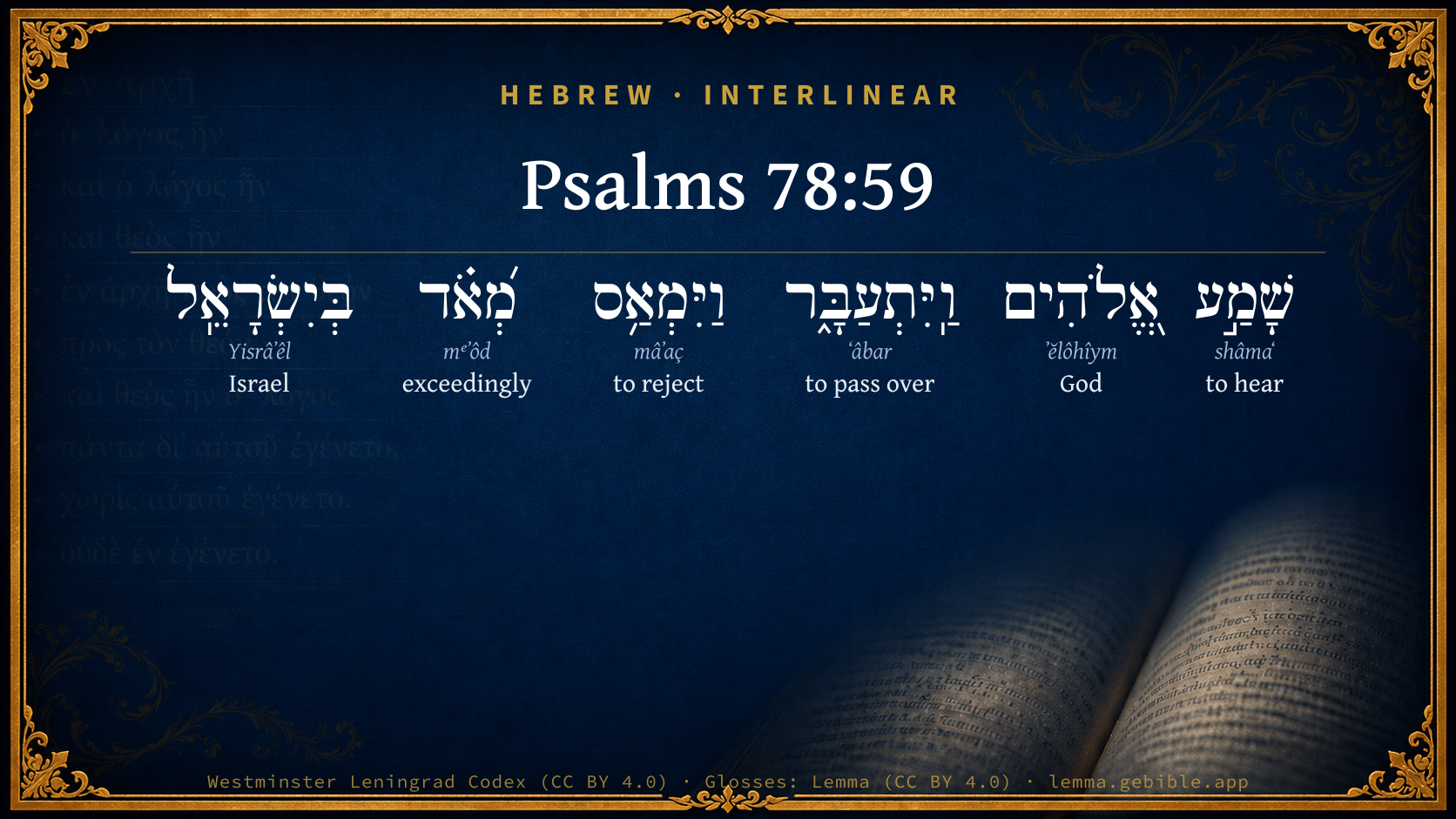
Psalms 78:59

Hebrew (Westminster Leningrad Codex) Psalms 78:59 appears in the Hebrew Old Testament. The text above is from the Westminster Leningrad Codex. Each word links to its Strong’s number, a concise gloss, and parsing drawn from the Open Scriptures Hebrew Bible morphology. Click any word for its full Brown-Driver-Briggs (BDB) entry.
Download image
Cite this verse

Psalms 78:59 (World English Bible). Public Domain. Lemma interlinear Bible study tool, https://lemma.gebible.app/v/psalms/78/59.

Show BibTeX & RIS
BibTeX
RIS
English Translation
When God heard this, he was angry, And greatly abhorred Israel;
World English Bible · Public Domain
Download a study sheet

One document with this verse’s original text, its word-by-word gloss line, the meaning frame, cross-references with their text, attributed commentary, and full source and license credits — printable, and it pastes into notes with its structure intact.

This verse Autodidact and up

Study sheet (.html) Plain text (.txt)

A passage Seminary Student

Up to 50 verses in one chapter. A passage sheet keeps up to 6 commentary sources and 12 cross-references per verse, in the order this page ranks them, and says so on the sheet whenever that leaves anything out. Ask for a single verse and you get the Autodidact verse sheet above.

Everything on this page stays free to read, with no account — the sheet is a download of what is already on screen, not access to it.

Want to remove ads? Support Godless Engineer
Compare translations 3

The same verse in 3 English versions, stacked beneath the original-language interlinear above. Click any original word for its lexicon entry.

Each is an independent rendering of the whole verse — the interlinear is not word-aligned to these translations.

Highlighted words mark where these versions differ — a whole-verse word diff, not a word-by-word alignment.

  • World English Bible Public Domain
    When God heard this, he was angry, And greatly abhorred Israel;
  • King James Version Public Domain
    When God heard this, he was wroth, and greatly abhorred Israel:
  • unfoldingWord Literal Text CC BY-SA 4.0
    God heard and was furious, and he rejected Israel greatly.

unfoldingWord Literal Text — © unfoldingWord, licensed CC BY-SA 4.0. Word-aligned USFM3 via Door43 (git.door43.org/unfoldingWord/en_ult).

Versions to compare (up to 4)

3 of 4 selected

Show all 18 translations

Every available English version of this verse, each an independent rendering of the whole verse.

  • World English Bible Public Domain
    When God heard this, he was angry, And greatly abhorred Israel;
  • Berean Standard Bible Public Domain
    On hearing it, God was furious and rejected Israel completely.
  • Majority Standard Bible Public Domain
    On hearing it, God was furious and rejected Israel completely.
  • King James Version Public Domain
    When God heard this, he was wroth, and greatly abhorred Israel:
  • American Standard Version (1901) Public Domain
    When God heard `this', he was wroth, And greatly abhorred Israel;
  • Revised Version (1885) Public Domain
    When God heard this, he was wroth, and greatly abhorred Israel:
  • Geneva Bible (1599) Public Domain
    God heard this and was wroth, and greatly abhorred Israel,
  • Douay-Rheims (1899) Public Domain
    God heard, and despised them, and he reduced Israel exceedingly as it were to nothing.
  • Young's Literal Translation Public Domain
    God hath heard, and sheweth Himself wroth. And kicketh exceedingly against Israel.
  • Literal Standard Version CC BY-SA 4.0
    God has heard, and shows Himself angry. And kicks exceedingly against Israel.
  • Unlocked Literal Bible CC BY-SA 4.0
    When God heard this, he was angry and completely rejected Israel.
  • unfoldingWord Literal Text CC BY-SA 4.0
    God heard and was furious, and he rejected Israel greatly.
  • Darby Bible Public Domain
    God heard, and was wroth, and greatly abhorred Israel:
  • World Messianic Bible Public Domain
    When God heard this, he was angry, and greatly abhorred Israel,
  • Webster's Bible Public Domain
    When God heard this, he was wroth, and greatly abhorred Israel:
  • Free Bible Version CC BY-SA 4.0
    When God heard their worship he became furious and he totally rejected Israel.
  • Bible in Basic English Public Domain
    When this came to God's ears he was very angry, and gave up Israel completely;
  • JPS Tanakh (1917) Public Domain
    God heard, and was wroth, and He greatly abhorred Israel;

Literal Standard Version (2020), Covenant Press — licensed CC BY-SA 4.0. Text via the HelloAO Bible API (eBible.org). Unlocked Literal Bible (unfoldingWord) — licensed CC BY-SA 4.0. Text via the HelloAO Bible API (eBible.org). unfoldingWord Literal Text — © unfoldingWord, licensed CC BY-SA 4.0. Word-aligned USFM3 via Door43 (git.door43.org/unfoldingWord/en_ult). Free Bible Version, Dr. Jonathan Gallagher — licensed CC BY-SA 4.0. Text via the HelloAO Bible API (eBible.org).

Word by word

More ways to search: Search by grammar → Find every occurrence → Compare this word →

Practice this passage: Drill this verse → Learn its vocabulary →

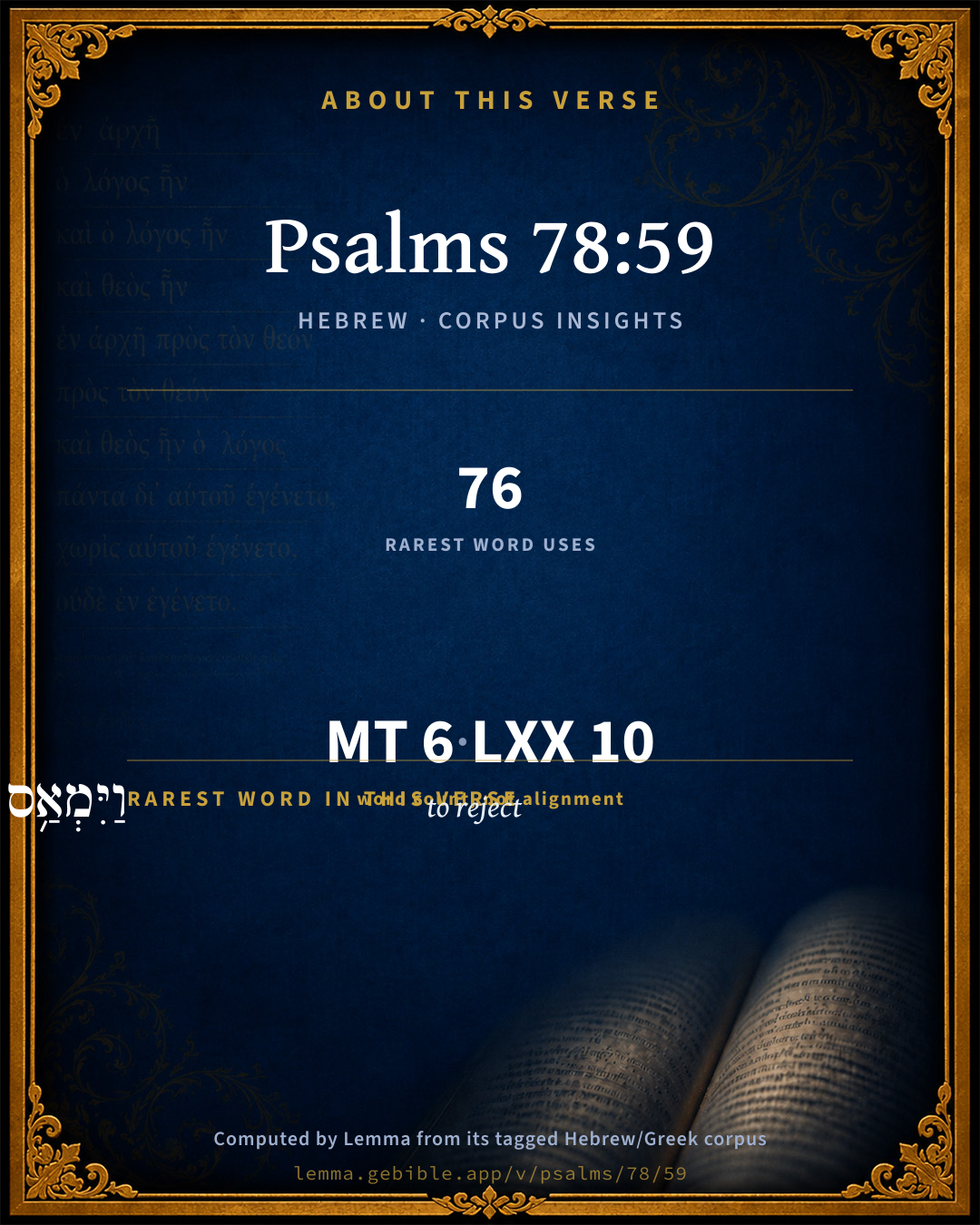
About this verse

These counts appear in no published source. They are computed here, from the morphology-tagged text and Lemma’s own curated glosses. What Lemma adds →

6
words
6
distinct lemmas
Wisdom
section

Grammatical profile

  • 3 verbs
  • 2 nouns
  • 1 adverb

Verb forms

  • שָׁמַ֣ע Qal · Perfect
  • וַֽיִּתְעַבָּ֑ר Hithpael · Sequential Imperfect
  • וַיִּמְאַ֥ס Qal · Sequential Imperfect

Hebrew & Septuagint length

In English translation the verse runs 11 words from the Hebrew and 10 from the Septuagint (LXX English) — closely comparable.

A rough comparison of the two English renderings, which tokenize alike — not a word-level alignment.

Word counts can differ between the Hebrew and the Greek without any difference in meaning — e.g. the Hebrew direct-object marker אֵת has no separate Greek word, and Greek often adds the article ὁ.

In the original languages it is 6 Hebrew tokens and 10 Greek tokens — but the two are counted differently (Hebrew bundles its prefixes and suffixes into one token; the Greek is in lemma form), so that isn’t a like-for-like length.

Cross-references

9

Topical passages linked to Psalms 78:59 in the Treasury of Scripture Knowledge — connected by theme and wording, ordered by reader-vote popularity; previews shown in the World English Bible.

  • Psalms 106:40 Therefore Yahweh burned with anger against his people. He abhorred his inheritance.
  • Lamentations 2:7 The Lord has cast off his altar, he has abhorred his sanctuary; He has given up into the hand of the enemy the walls of her palaces: They have made a noise in the house of Yahweh, as in the day of a solemn assembly.
  • Genesis 18:20–21 Yahweh said, "Because the cry of Sodom and Gomorrah is great, and because their sin is very grievous,
  • Leviticus 20:23 You shall not walk in the customs of the nation, which I am casting out before you: for they did all these things, and therefore I abhorred them.
  • Leviticus 26:44 Yet for all that, when they are in the land of their enemies, I will not reject them, neither will I abhor them, to destroy them utterly, and to break my covenant with them; for I am Yahweh their God;
  • Deuteronomy 32:19 Yahweh saw [it], and abhorred [them], Because of the provocation of his sons and his daughters.
  • Psalms 11:4 Yahweh is in his holy temple. Yahweh is on his throne in heaven. His eyes observe. His eyes examine the children of men.
  • Psalms 14:2–5 Yahweh looked down from heaven on the children of men, To see if there were any who did understand, Who did seek after God.
  • Zechariah 11:8 I cut off the three shepherds in one month; for my soul was weary of them, and their soul also loathed me.

Cross-references courtesy of OpenBible.info (CC BY 4.0).

Hebrew and Greek witnesses Masoretic Hebrew ↔ Greek Septuagint

The same verse in the two great witnesses to the Old Testament, shown verse-for-verse.

You’re reading Greek Psalm 77 (Hebrew Psalm 78). The Septuagint counts the superscription, so verse numbers can differ from the Hebrew — chapter-level alignment, not verse-by-verse. Numbering follows Rahlfs.

These are two independent witnesses, not word-aligned to each other, and the Septuagint is shown in lemma (dictionary) form.

Hebrew Psalms 78:59 Masoretic · Westminster Leningrad Codex

שָׁמַ֣ע אֱ֭לֹהִים וַֽיִּתְעַבָּ֑ר וַיִּמְאַ֥ס מְ֝אֹ֗ד בְּיִשְׂרָאֵֽל

When God heard this, he was angry, And greatly abhorred Israel;

World English Bible · Public Domain

Greek LXX Greek Psalm 77:59 Septuagint · lemma form

ἀκούω ὁ θεός καί ὑπερὁράω καί ἐκοὐδενόω σφόδρα ὁ ἰσραήλ

God heard and lightly regarded them, and greatly despised Israel.

LXX2012 (modern English Septuagint) · Public Domain

Hebrew: Westminster Leningrad Codex (CC BY 4.0). Greek: Septuagint (public domain); English from LXX2012 (modern English Septuagint) (Public Domain). How the Septuagint differs from the Hebrew →

Commentary

Notes on Psalms 78:59 from classic Christian and Jewish commentators (each source and its license shown beneath its notes). The classic Christian expositions comment on the surrounding passage and are grouped to its opening verse, so a note may address several verses; the Jewish commentaries on the Tanakh (Rashi and others) are per-verse, so they appear only where the commentator wrote on this verse.

Lemma curates 59 commentaries, every one of them public domain or Creative Commons licensed, each selected and text-cleaned for this edition rather than reprinted as found. About our sources →

Trapp's Complete Commentary

John Trapp

Psa 78:59 When God heard [this], he was wroth, and greatly abhorred Israel:

Ver. 59. When God heard this] Sin crieth aloud in God’s ears, though it be never so closely and cunningly carried.

And greatly abhorred Israel] As appeareth all along the Book of Judges, whereof this verse is a summary.

John Trapp, A Commentary or Exposition upon All the Books of the Old and New Testament (1647–1656) — public domain. Text from a community e-Sword module.

The Treasury of David

Charles H. Spurgeon

Ver. 59. When God heard this, he was wroth. The mere report of it filled him with indignation; he could not bear it, he was incensed to the uttermost, and most justly so.

And greatly abhorred Israel. He cast his idolatrous people from his favour, and left them to themselves, and their own devices. How could he have fellowship with idols? What concord hath Christ with Belial? Sin is in itself so offensive that it makes the sinner offensive too. Idols of any sort are highly abhorrent to God, and we must see to it that we keep ourselves from them through divine grace, for rest assured idolatry is not consistent with true grace in the heart. If Dagon sit aloft in any soul, the ark of God is not there. Where the Lord dwells no image of jealousy will be tolerated. A visible church will soon become a visible curse if idols be set up in it, and then the pruning knife will remove it as a dead branch from the vine.

Note that God did not utterly cast away his people Israel even when he greatly abhorred them, for he returned in mercy to them, so the subsequent verses tell us: so now the seed of Abraham, though for awhile under a heavy cloud, will be gathered yet again, for the covenant of salt shall not be broken. As for the spiritual seed, the Lord hath not despised nor abhorred them; they are his peculiar treasure and lie for ever near his heart.

Ver. 59. When God heard this. The psalmist represents the noise of the ill deeds of the people ascending to the ears of the Eternal. Armand de Mestral, in "Commentaire sur le Livre de Psaumes." 1856.

Ver. 59-72.

1. A gloomy sunset, Ps 78:59-60.

2. A baleful might, Ps 78:60-64.

3. A blessed sunrise, Ps 78:65-72. C. D.

Ver. 59-72.

1. A gloomy sunset, Ps 78:59-60.

2. A baleful might, Ps 78:60-64.

3. A blessed sunrise, Ps 78:65-72. C. D.

Ver. 59-72.

1. A gloomy sunset, Ps 78:59-60.

2. A baleful might, Ps 78:60-64.

3. A blessed sunrise, Ps 78:65-72. C. D.

Ver. 59-72.

1. A gloomy sunset, Ps 78:59-60.

2. A baleful might, Ps 60-64.

3. A blessed sunrise, Ps 78:65-72. C. D.

Ver. 59-72.

1. A gloomy sunset, Ps 78:59-60.

2. A baleful might, Ps 78:60-64.

3. A blessed sunrise, Ps 78:65-72. C. D.

Ver. 59-72.

1. A gloomy sunset, Ps 78:59-60.

2. A baleful might, Ps 78:60-64.

3. A blessed sunrise, Ps 78:65-72. C. D.

Ver. 59-72.

1. A gloomy sunset, Ps 78:59-60.

2. A baleful might, Ps 78:60-64.

3. A blessed sunrise, Ps 78:65-72. C. D.

Ver. 59-72.

1. A gloomy sunset, Ps 78:59-60.

2. A baleful might, Ps 78:60-64.

3. A blessed sunrise, Ps 78:65-72. C. D.

Ver. 59-72.

1. A gloomy sunset, Ps 78:59-60.

2. A baleful might, Ps 78:60-64.

3. A blessed sunrise, Ps 78:65-72. C. D.

Ver. 59-72.

1. A gloomy sunset, Ps 78:59-60.

2. A baleful might, Ps 78:60-64.

3. A blessed sunrise, Ps 78:65-72. C. D.

Ver. 59-72.

1. A gloomy sunset, Ps 78:59-60.

2. A baleful might, Ps 78:60-64.

3. A blessed sunrise, Ps 78:65-72. C. D.

Ver. 59-72.

1. A gloomy sunset, Ps 78:59-60.

2. A baleful might, Ps 78:60-64.

3. A blessed sunrise, Ps 78:65-72. C. D.

Ver. 59-72.

1. A gloomy sunset, Ps 78:59-60.

2. A baleful might, Ps 59:60-64.

3. A blessed sunrise, Ps 78:65-72. C. D.

Ver. 70-72. Spiritual promotions. See Psalms on "Ps 78:70" for further information.

Charles H. Spurgeon's The Treasury of David (1869–1885) — public domain. Psalms only. Text from a community e-Sword/MySword module.

J. A. Alexander on Psalms

Joseph Addison Alexander

59. (Psa 78:59) God heard and wets indignant, and rejected Israel exceedingly. The same sin is followed by the same retribution as in Psa 78:21. Abhorred is an inadequate translation of the last verb, which denotes not merely an internal feeling, but the outward exhibition of it. It means not merely to abhor, but to reject with abhorrence. See above, on Psa 15:4. The addition of the intensive adverb, very or exceedingly, serves at the same time to enhance and to restrict the meaning of the verb which it qualifies. He abhorred them, not a little but exceedingly, and as a token of his doing so, rejected them exceedingly, yet not utterly or altogether. As there is nothing to restrict the application of this statement, we must understand it in its widest sense, as meaning that the whole people was regarded with displeasure, and punished on account of its transgressions during the ascendancy of Ephraim.

Joseph Addison Alexander, The Psalms Translated and Explained (1850) — public domain. Text from a community e-Sword module.

John Calvin's Commentaries

59 God heard it, and was wroth. The prophet again shows that God, when he found that no good resulted from his long-suffering, which the people abused, yea, even treated with mockery, and perverted as an encouragement to greater excess in sinning, at length proceeded to inflict severe punishments upon them. The metaphor, which he borrows from earthly judges, is frequently to be met with in the Scriptures. When God is said to hear, it is not meant that it is necessary for him to make inquisition, but it is intended to teach us that he does not rush forth inconsiderately to execute his judgments, and thus to prevent any from supposing that he ever acts precipitately. The amount of what is stated is, that the people continued so pertinaciously in their wickedness, that at length the cry of it ascended to heaven; and the very weight of the punishment demonstrated the aggravated nature of the offense.

John Calvin's Commentaries (1540-1563) — public domain. Text from the Calvin Translation Society English edition (1840s-50s) via the Christian Classics Ethereal Library (ccel.org). Calvin's coverage is partial (roughly two-thirds of the Bible); uncommented books and verses are honest gaps, never fabricated. The 19th-century editor's footnotes and remarks are omitted so the notes are faithfully Calvin's own voice.

The Cambridge Bible for Schools and Colleges

gen. ed. J. J. S. Perowne

59. Cp. Psa_78:21. and greatly abhorred Israel] Better, and utterly rejected Israel. Israel here can hardly mean Ephraim only, as some commentators hold; for neither sin nor punishment was limited to Ephraim, and the sanctuary of Shiloh, though in Ephraimite territory, was the sanctuary of all Israel.

59–64. Once more therefore God punished them for their sins, abandoning them to their enemies and even suffering the Ark to be captured.

The Cambridge Bible for Schools and Colleges (gen. ed. J. J. S. Perowne; Cambridge University Press, 1878–1918) — public domain. Text from a community e-Sword module.

John Gill's Exposition

So that he forsook the tabernacle of Shiloh.... The tabernacle which Moses built in the wilderness by the command of the Lord, and according to the pattern showed him; and which, when the Israelites were settled in the land of Canaan, was set up in Shiloh; see Jos 18:1, and here it was in the times of Eli and Samuel, which are here referred to:

the tent which he placed among men; it was as a tent moveable from place to place, and was to continue at longest but for a while, as the whole tabernacle worship and service was to do; here the divine Majesty dwelt, and among men, vile, sinful, wicked, and ungrateful men; which was a wonderful instance of his condescension and goodness, Kg1 8:27, but when their iniquities grew to such a degree as were intolerable, he forsook it and removed it elsewhere; see Jer 7:12, rather the words may be rendered, "the tent", or "tabernacle, which he had fixed in Adam"; as they are by Doctor Lightfoot (q); that is, in the city Adam, which was in the centre of the parting of the waters of Jordan, and where was the station of the tabernacle and ark of the covenant, when Israel entered into them, and passed through them; which is mentioned as a wonderful circumstance, both with respect to the tabernacle and to the people of Israel.

(q) See his Works, vol. 2. p. 82.

John Gill's Exposition of the Whole Bible (1746–1763) — public domain (CC PDM 1.0). Text via the HelloAO Bible API.

Albert Barnes' Notes on the Bible

When God heard this - literally, “God heard;” that is, he understood this; he was acquainted with it. He heard their prayers addressed to false gods; he heard their praises sung in honor of idols.

He was wroth - This is language taken from the common manner of speaking among people, for language derived from human conceptions and usages must be employed when we speak of God, though it may be difficult to say what is its exact meaning. The general sense is that his conduct toward them was as if he was angry; or was that which is used by a man who is displeased.

And greatly abhorred Israel - The idea in the word rendered abhorred is that of rejecting them with abhorrence; that is, the reference is not merely to the internal feeling or emotion, but to the act which is the proper accompaniment of such an internal feeling. He cast them off; he treated them as not his own. The addition of the word “greatly” shows how intense this feeling was; how decided was his aversion to their conduct.

Albert Barnes' Notes on the Bible (1834–1885) — public domain. Text from a community e-Sword/MySword module.

Matthew Poole's English Annotations

Heard, i.e. perceived or understood, as hearing is oft used, as Gen 11:7; 41:15, &c. It is spoken of God after the manner of men.

Matthew Poole's English Annotations on the Holy Bible (1683–1685) — public domain. Text from a community e-Sword/MySword module.

Whedon's Commentary on the Bible

Daniel D. Whedon

59. When God heard—A judicial hearing is intended. The cry of their sins had come before him, and judgment could no longer be delayed. See 1Sa_2:12-36

Daniel D. Whedon (gen. ed.), Commentary on the Old and New Testaments (1874–1909) — public domain. Text from a community e-Sword module.

The Pulpit Commentary

When God heard this, he was wroth (comp. above, ver. 21). And greatly abhorred Israel. Not Israel, as distinct from Judah, but Israel in the broadest sense, the entire nation, as in ver. 55.

God turned against his people.

I THIS AN AWFUL POSSIBILITY. We have an instance here told of. And the history of nations, Churches, individuals, furnish many more.

II BUT GREATLY DISBELIEVED. The devil will do his bad best to make men not believe it. Therefore uses:

1. False theology, wresting the Scriptures. There were people in St. John"s day (see 1Jo 1) who said they had no sin. Some trusted in their Abrahamic descent; others did not believe in sin at all, they counted it to be but infirmity; others talked of the imputed righteousness of Christ, and affirmed that whatever sin they might commit, they, being in Christ, were guiltless; others, as today, believed that God was too merciful to condemn any one.

2. The deceitfulness of sin.

3. The ill example of others.

III MUCH NEEDING, THEREFORE, TO BE INSISTED ON. Slight views of sin lie at the root of well nigh all departures from God, hut such views are impossible when it is seen to what they lead.

IV BUT NEVER TO BE FEARED BY THOSE WHO WILL LIVE IN THE LOVE OF GOD. S.C.

The Pulpit Commentary (1880–1919), ed. H.D.M. Spence-Jones & Joseph S. Exell — public domain. Text from a community e-Sword module.

John Wesley's Explanatory Notes

Heard - Perceived or understood, it is spoken of God after the manner of men.

John Wesley, Explanatory Notes Upon the Whole Bible (1754–1765) — public domain. Text via the GEBible commentary corpus.

Lesson kit

Teaching starters — assembled from the data on this page, not authored interpretation. Every prompt links to the verse data it draws on. Edit before teaching.

Psalms, in the Wisdom, opens this verse with 6 words (6 distinct Hebrew lemmas). Its most distinctive word is mâʼaç (“to reject”). A historical commentator’s framing appears above. Read the whole chapter for the surrounding context.

Discussion questions

  1. The word mâʼaç carries the sense “to reject.” How does it shape the verse?
  2. How does Psalms 106:40, which shares this passage’s theme, read alongside this verse?
  3. These translations render this verse differently; the difference is in the English rendering, not the original. What questions does that raise?
  4. «שָׁמַ֣ע» is a Qal Perfect verb. How does that grammatical form shape the action described?
  5. Compare how Trapp's Complete Commentary and The Treasury of David read this verse. Where do they agree or differ?

Things to notice

Reading settings

Reading text

Shown beneath each verse's original-language words.

Old Testament
Old Testament edition

Read the OT as the Masoretic Hebrew (MT) or the Greek Septuagint (LXX).

English shown for the Greek Septuagint (in the Hebrew ↔ Greek comparison).

Comparing translations? Open the Compare panel on any verse page to stack up to four side by side.