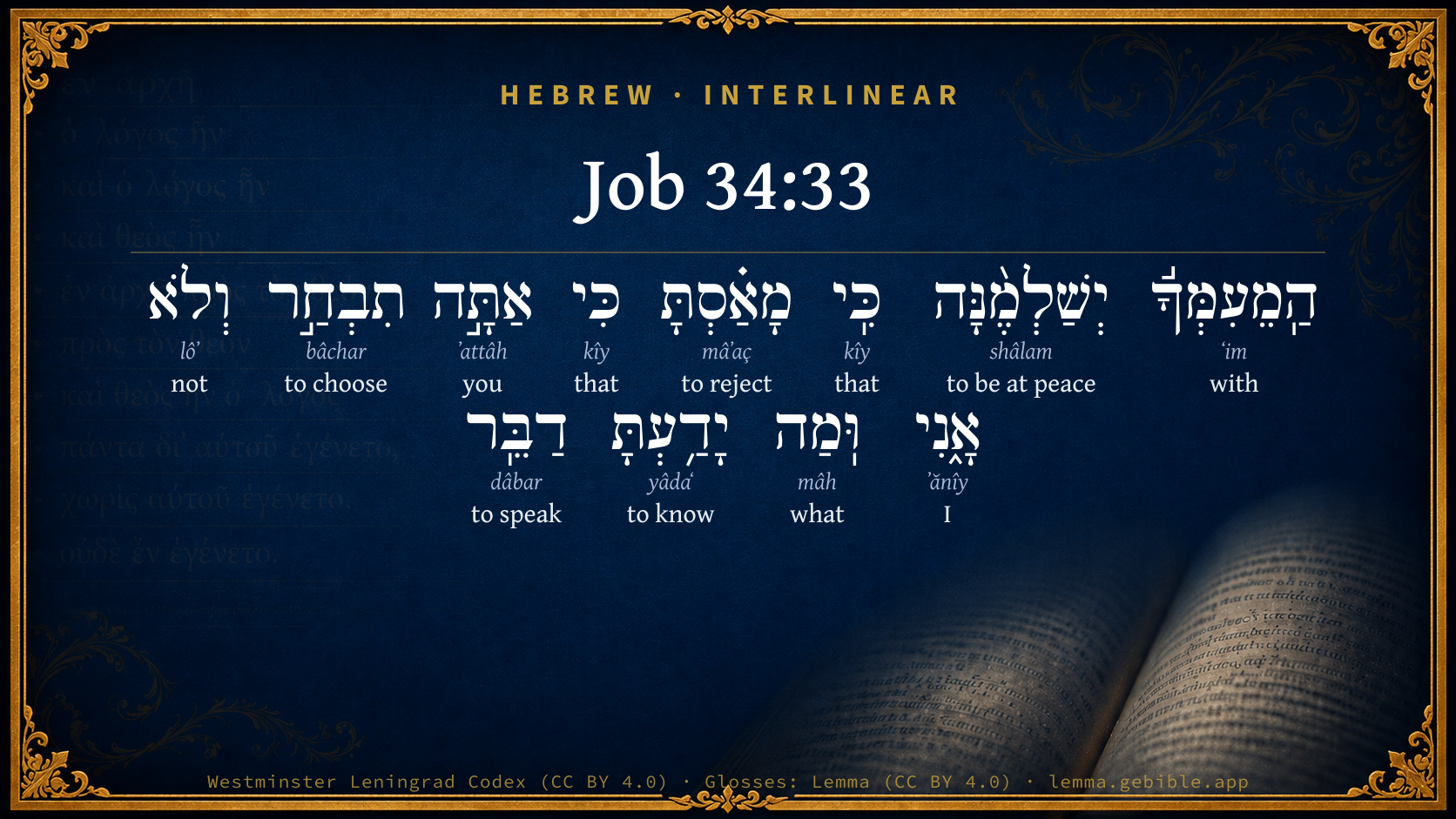
Job 34:33

Hebrew (Westminster Leningrad Codex) Job 34:33 appears in the Hebrew Old Testament. The text above is from the Westminster Leningrad Codex. Each word links to its Strong’s number, a concise gloss, and parsing drawn from the Open Scriptures Hebrew Bible morphology. Click any word for its full Brown-Driver-Briggs (BDB) entry.
Download image
Cite this verse

Job 34:33 (World English Bible). Public Domain. Lemma interlinear Bible study tool, https://lemma.gebible.app/v/job/34/33.

Show BibTeX & RIS
BibTeX
RIS
English Translation
Shall his recompense be as you desire, that you refuse it? For you must choose, and not I. Therefore speak what you know.
World English Bible · Public Domain
Download a study sheet

One document with this verse’s original text, its word-by-word gloss line, the meaning frame, cross-references with their text, attributed commentary, and full source and license credits — printable, and it pastes into notes with its structure intact.

This verse Autodidact and up

Study sheet (.html) Plain text (.txt)

A passage Seminary Student

Up to 50 verses in one chapter. A passage sheet keeps up to 6 commentary sources and 12 cross-references per verse, in the order this page ranks them, and says so on the sheet whenever that leaves anything out. Ask for a single verse and you get the Autodidact verse sheet above.

Everything on this page stays free to read, with no account — the sheet is a download of what is already on screen, not access to it.

Want to remove ads? Support Godless Engineer
Compare translations 3

The same verse in 3 English versions, stacked beneath the original-language interlinear above. Click any original word for its lexicon entry.

Each is an independent rendering of the whole verse — the interlinear is not word-aligned to these translations.

Highlighted words mark where these versions differ — a whole-verse word diff, not a word-by-word alignment.

  • World English Bible Public Domain
    Shall his recompense be as you desire, that you refuse it? For you must choose, and not I. Therefore speak what you know.
  • King James Version Public Domain
    Should it be according to thy mind? he will recompense it, whether thou refuse, or whether thou choose; and not I: therefore speak what thou knowest.
  • unfoldingWord Literal Text CC BY-SA 4.0
    from with you will he repay it? Since you despise, then you will choose and not I. So what you know, speak.

unfoldingWord Literal Text — © unfoldingWord, licensed CC BY-SA 4.0. Word-aligned USFM3 via Door43 (git.door43.org/unfoldingWord/en_ult).

Versions to compare (up to 4)

3 of 4 selected

Show all 18 translations

Every available English version of this verse, each an independent rendering of the whole verse.

  • World English Bible Public Domain
    Shall his recompense be as you desire, that you refuse it? For you must choose, and not I. Therefore speak what you know.
  • Berean Standard Bible Public Domain
    Should God repay you on your own terms when you have disavowed His? You must choose, not I; so tell me what you know.
  • Majority Standard Bible Public Domain
    Should God repay you on your own terms when you have disavowed Him? You must choose, not I; so tell me what you know.
  • King James Version Public Domain
    Should it be according to thy mind? he will recompense it, whether thou refuse, or whether thou choose; and not I: therefore speak what thou knowest.
  • American Standard Version (1901) Public Domain
    Shall his recompense be as thou wilt, that thou refusest it? For thou must choose, and not I: Therefore speak what thou knowest.
  • Revised Version (1885) Public Domain
    Shall his recompence be as thou wilt, that thou refusest it? for thou must choose, and not I: therefore speak what thou knowest.
  • Geneva Bible (1599) Public Domain
    Wil he performe the thing through thee? for thou hast reproued it, because that thou hast chosen, and not I. now speake what thou knowest.
  • Douay-Rheims (1899) Public Domain
    Doth God require it of thee, because it hath displeased thee? for thou begannest to speak, and not I.: but if thou know any thing better, speak.
  • Young's Literal Translation Public Domain
    By thee doth He recompense, That thou hast refused -- That thou dost choose, and not I? And what thou hast known, speak.
  • Literal Standard Version CC BY-SA 4.0
    Does He repay by you, that you have refused—That you choose, and not I? And what you have known, speak.
  • Unlocked Literal Bible CC BY-SA 4.0
    Do you think that God will punish that person's sin, since you dislike what God does? You must choose, not I. So say what it is that you know.
  • unfoldingWord Literal Text CC BY-SA 4.0
    from with you will he repay it? Since you despise, then you will choose and not I. So what you know, speak.
  • Darby Bible Public Domain
    Shall he recompense according to thy mind? for thou hast refused [his judgment]; for thou so choosest, and not I; speak then what thou knowest.
  • World Messianic Bible Public Domain
    Shall his recompense be as you desire, that you refuse it? For you must choose, and not I. Therefore speak what you know.
  • Webster's Bible Public Domain
    Should it be according to thy mind? he will recompense it, whether thou shalt refuse, or whether thou shalt choose; and not I: therefore speak what thou knowest.
  • Free Bible Version CC BY-SA 4.0
    then should God reward you for following your own opinions since you have rejected his? You're the one who has to choose, not me! Tell us what you think.
  • Bible in Basic English Public Domain
    ...
  • JPS Tanakh (1917) Public Domain
    Shall His recompense be as thou wilt? For thou loathest it, so that thou must choose, and not I; therefore speak what thou knowest.

Literal Standard Version (2020), Covenant Press — licensed CC BY-SA 4.0. Text via the HelloAO Bible API (eBible.org). Unlocked Literal Bible (unfoldingWord) — licensed CC BY-SA 4.0. Text via the HelloAO Bible API (eBible.org). unfoldingWord Literal Text — © unfoldingWord, licensed CC BY-SA 4.0. Word-aligned USFM3 via Door43 (git.door43.org/unfoldingWord/en_ult). Free Bible Version, Dr. Jonathan Gallagher — licensed CC BY-SA 4.0. Text via the HelloAO Bible API (eBible.org).

Word by word

More ways to search: Search by grammar → Find every occurrence → Compare this word →

Practice this passage: Drill this verse → Learn its vocabulary →

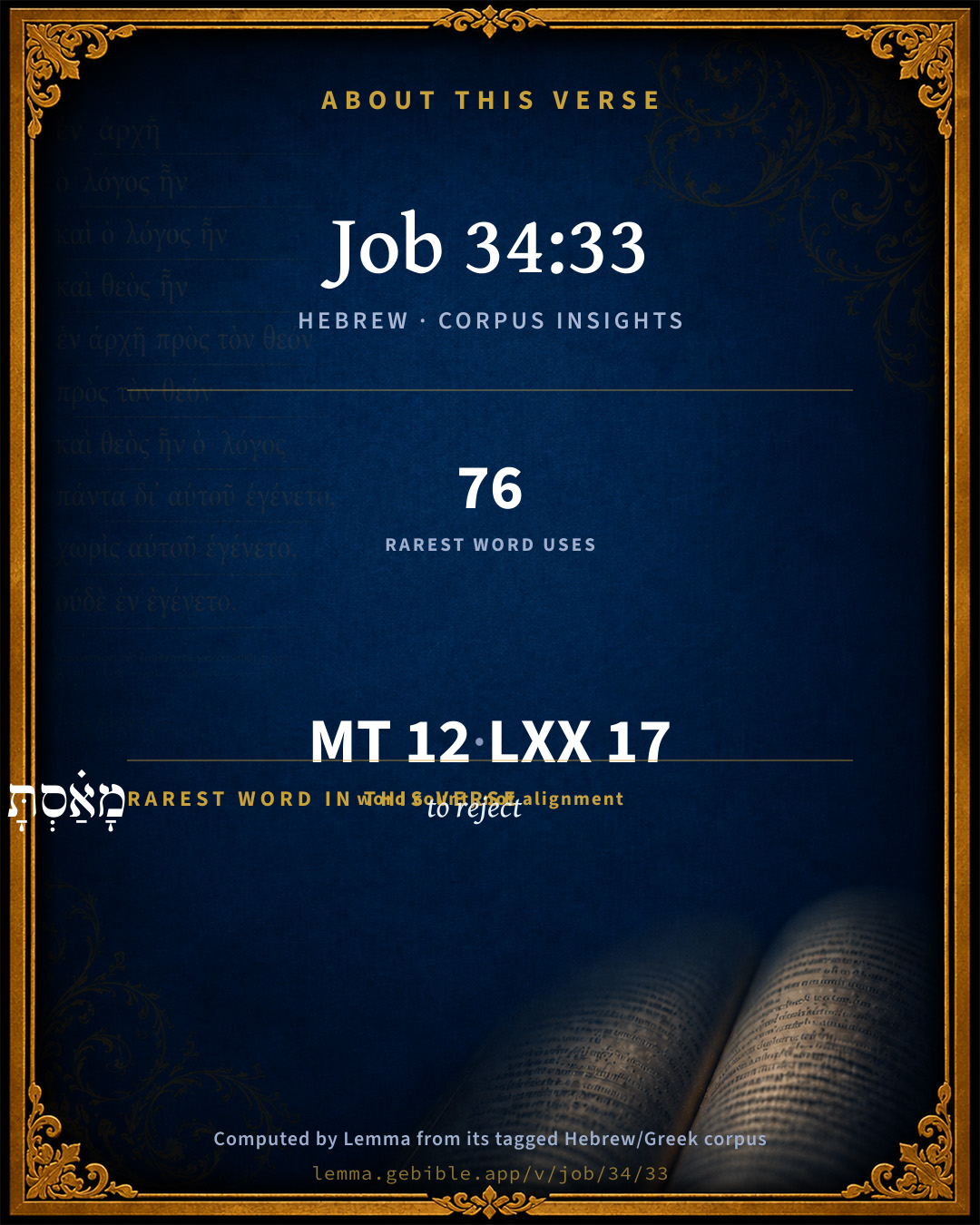
מָאַ֗סְתָּ
mâʼaç
H3988
“to reject”
Verb, Qal, Perfect, 2nd Person, Masculine, Singular
Part of Speech
Verb
Stem
Qal
Form
Perfect
Person
2nd Person
Gender
Masculine
Number
Singular
Full BDB Definition

Origin: a primitive root

TWOT: 1139 , 1140

to reject, despise, refuse - (Qal) - to reject, refuse - to despise - (Niphal) to be rejected - (Niphal) to flow, run
  1. הַֽמֵעִמְּךָ֬ ʻim H5973 “from · with · you” Particle, Interrogative + Preposition + Preposition + Suffix, Personal, 2nd Person, Masculine, Singular
  2. יְשַׁלְמֶ֨נָּה shâlam H7999 “to be at peace · her” Verb, Piel, Imperfect, 3rd Person, Masculine, Singular + Suffix, Personal, 3rd Person, Feminine, Singular
  3. כִּֽי kîy H3588 “that” Conjunction
  4. כִּי kîy H3588 “that” Conjunction
  5. אַתָּ֣ה ʼattâh H859 “you” Pronoun, Personal, 2nd Person, Masculine, Singular
  6. תִבְחַ֣ר bâchar H977 “to choose” Verb, Qal, Imperfect, 2nd Person, Masculine, Singular
  7. וְלֹא lôʼ H3808 “and · not” Conjunction + Particle, Negative
  8. אָ֑נִי ʼănîy H589 “I” Pronoun, Personal, 1st Person, Common, Singular
  9. וּֽמַה mâh H4100 “and · what” Conjunction + Particle, Interrogative
  10. יָדַ֥עְתָּ yâdaʻ H3045 “to know” Verb, Qal, Perfect, 2nd Person, Masculine, Singular
  11. דַבֵּֽר dâbar H1696 “speak” Verb, Piel, Imperative, 2nd Person, Masculine, Singular

About this verse

These counts appear in no published source. They are computed here, from the morphology-tagged text and Lemma’s own curated glosses. What Lemma adds →

12
words
11
distinct lemmas
Wisdom
section

Grammatical profile

  • 5 verbs
  • 2 pronouns
  • 1 preposition
  • 2 conjunctions
  • 2 particles

Verb forms

  • יְשַׁלְמֶ֨נָּה Piel · Imperfect
  • מָאַ֗סְתָּ Qal · Perfect
  • תִבְחַ֣ר Qal · Imperfect
  • יָדַ֥עְתָּ Qal · Perfect
  • דַבֵּֽר Piel · Imperative

Repetition

A word recurs within this verse — often emphatic in Hebrew:

  • כִּֽי that H3588 ×2

Hebrew & Septuagint length

In English translation the verse runs 23 words from the Hebrew and 29 from the Septuagint (LXX English) — closely comparable.

A rough comparison of the two English renderings, which tokenize alike — not a word-level alignment.

Word counts can differ between the Hebrew and the Greek without any difference in meaning — e.g. the Hebrew direct-object marker אֵת has no separate Greek word, and Greek often adds the article ὁ.

In the original languages it is 12 Hebrew tokens and 17 Greek tokens — but the two are counted differently (Hebrew bundles its prefixes and suffixes into one token; the Greek is in lemma form), so that isn’t a like-for-like length.

Cross-references

17

Topical passages linked to Job 34:33 in the Treasury of Scripture Knowledge — connected by theme and wording, ordered by reader-vote popularity; previews shown in the World English Bible.

  • Job 33:32 If you have anything to say, answer me: Speak, for I desire to justify you.
  • Job 34:11 For the work of a man will he render to him, And cause every man to find according to his ways.
  • Psalms 135:6 Whatever Yahweh pleased, that he has done, In heaven and in earth, in the seas and in all deeps;
  • Proverbs 11:31 Behold, the righteous shall be repaid in the earth; How much more the wicked and the sinner!
  • Isaiah 45:9 Woe to him who strives with his Maker--a potsherd among the potsherds of the earth! Shall the clay ask him who fashions it, "What are you making?" or your work, "He has no hands?"
  • Job 9:12 Behold, he snatches away; who can hinder him? Who will ask him, 'What are you doing?'
  • Job 15:31 Let him not trust in emptiness, deceiving himself; For emptiness shall be his reward.
  • Job 18:4 You who tear yourself in your anger, Shall the earth be forsaken for you? Or shall the rock be removed out of its place?
  • Job 33:5 If you can, answer me; Set your words in order before me, and stand forth.
  • Job 41:11 Who has first given to me, that I should repay him? Everything under the heavens is mine.
  • Psalms 89:30–32 If his children forsake my law, And don't walk in my ordinances;
  • Matthew 20:12–15 saying, 'These last have spent one hour, and you have made them equal to us, who have borne the burden of the day and the scorching heat!'
  • Romans 9:20 But indeed, O man, who are you to reply against God? Will the thing formed ask him who formed it, "Why did you make me like this?"
  • Romans 11:35 "Or who has first given to him, And it will be repaid to him again?"
  • 2 Thessalonians 1:6–7 Since it is a righteous thing with God to repay affliction to those who afflict you,
  • Hebrews 2:2 For if the word spoken through angels proved steadfast, and every transgression and disobedience received a just recompense;
  • Hebrews 11:26 accounting the reproach of Christ greater riches than the treasures of Egypt; for he looked to the reward.

Cross-references courtesy of OpenBible.info (CC BY 4.0).

Hebrew and Greek witnesses Masoretic Hebrew ↔ Greek Septuagint

The same verse in the two great witnesses to the Old Testament, shown verse-for-verse.

These are two independent witnesses, not word-aligned to each other, and the Septuagint is shown in lemma (dictionary) form.

Hebrew Job 34:33 Masoretic · Westminster Leningrad Codex

הַֽמֵעִמְּךָ֬ יְשַׁלְמֶ֨נָּה כִּֽי מָאַ֗סְתָּ כִּי אַתָּ֣ה תִבְחַ֣ר וְלֹא אָ֑נִי וּֽמַה יָדַ֥עְתָּ דַבֵּֽר

Shall his recompense be as you desire, that you refuse it? For you must choose, and not I. Therefore speak what you know.

World English Bible · Public Domain

Greek LXX Job 34:33 Septuagint · lemma form

μή παρά σύ ἀποτίνω αὐτός ὅτι ἀποὠθέω ὅτι σύ ἐκλέγω καί οὐ ἐγώ καί τίς γιγνώσκω λαλέω

Will he take vengeance for it on you, whereas you will put it far from you? for you shall choose, and not I; and what you know, speak you.

LXX2012 (modern English Septuagint) · Public Domain

Hebrew: Westminster Leningrad Codex (CC BY 4.0). Greek: Septuagint (public domain); English from LXX2012 (modern English Septuagint) (Public Domain). How the Septuagint differs from the Hebrew →

Commentary

Notes on Job 34:33 from classic Christian and Jewish commentators (each source and its license shown beneath its notes). The classic Christian expositions comment on the surrounding passage and are grouped to its opening verse, so a note may address several verses; the Jewish commentaries on the Tanakh (Rashi and others) are per-verse, so they appear only where the commentator wrote on this verse.

Lemma curates 59 commentaries, every one of them public domain or Creative Commons licensed, each selected and text-cleaned for this edition rather than reprinted as found. About our sources →

The Cambridge Bible for Schools and Colleges

gen. ed. J. J. S. Perowne

33. Elihu’s answer to this complaint is that it is a claim to regulate the government of God, to give laws to Him how He shall act, and to decide how He shall recompense. Such a position the complainer takes—but for himself Elihu repudiates it: Thou must choose, not I. In the concluding words, speak that which thou knowest, Elihu invites Job to state that method of “recompense” which shall be “according to his mind” and better than that observed in God’s rule of the world.

The above seems the most natural interpretation to put on this difficult passage. The A.V., in rendering surely it is meet to be said (Job_34:31), assumes an irregularity of punctuation which is very improbable. And to regard Job_34:31-32 as a serious confession and example of how a right-minded man would speak greatly impairs the vigour of the passage, and gives a much looser connexion with Job_34:33.

The Cambridge Bible for Schools and Colleges (gen. ed. J. J. S. Perowne; Cambridge University Press, 1878–1918) — public domain. Text from a community e-Sword module.

Trapp's Complete Commentary

John Trapp

Job 34:33 [Should it be] according to thy mind? he will recompense it, whether thou refuse, or whether thou choose; and not I: therefore speak what thou knowest.

Ver. 33. Should it be according to thy mind] Heb. From with thee; q.d. Must things be as thou wilt? And is it fit for thee to prescribe to the Almighty? {Hos 8:4} to set the sun by thy dial?

He will recompense it, whether thou refuse, &c.] He will have his pennyworths of thee, whether thou be pleased or displeased.

And not I] Though I foretell thee this, yet it is God that will effect it; therefore think not the worse of me, no more than a people should of a herald or the trumpet as the cause of their war.

Therefore speak what thou knowest] viz. In thine one behalf, but speak the word of truth and soberness, he was no fool who said, It hath often repented me to have spoken, but seldom to have held my peace. There are many other readings and expositions of the words. Let every man (for me) take his choice, and abound in his own sense, so it dissent not from the analogy of faith.

John Trapp, A Commentary or Exposition upon All the Books of the Old and New Testament (1647–1656) — public domain. Text from a community e-Sword module.

The Biblical Illustrator

Joseph S. Exell

Job_34:33

Should it be according to thy mind?

Conceit rebuked

The verse is written in language of the most ancient kind, which is but little understood. Moreover, it is extremely pithy and sententious, and hence it is obscure. The sense given in our version is, however, that which sums up the other translations, and we prefer to adhere to it.

I. Do men really think that things should be according to their mind?

1. Concerning God. Their ideas of Him are according to what they think He should be; but could He be God at all if He were such as the human mind would have Him to be?

2. Concerning Providence on a large scale, would men rewrite history? Do they imagine that their arrangements would be an improvement upon infinite wisdom? In their own case they would arrange all matters selfishly. Should it be so?

3. Concerning the Gospel, its doctrines, its precepts, its results, should men have their own way? Should the atonement be left out, or the statement of it be modified to suit them?

4. Concerning the Church. Should they be head and lord? Should their liberal ideas erase inspiration? Should Baptism and the Lords Supper be distorted to gratify them? Should taste override Divine commands? Should the ministry exist only for their special consolation, and be moulded at their bidding?

II. What leads them to think so?

1. Self-importance and selfishness.

2. Self-conceit and pride.

3. A murmuring spirit which must needs grumble at everything.

4. Want of faith in Christ leading to a doubt of the power of His Gospel.

5. Want of love to God, souring the mind and leading it to kick at a thing simply because the Lord prescribes it.

III. What a mercy that things are not according to their mind!

1. Gods glory would be obscured.

2. Many would suffer to enable one man to play the dictator.

3. We should, any one of us, have an awful responsibility resting upon us if our own mind had the regulation of affairs.

4. Our temptations would be increased. We should be proud if we succeeded, and despairing if we met with failure.

5. Our desires would become more greedy.

6. Our sins would he uncorrected; for we should never allow a rod or a rebuke to come at us.

7. There would be universal strife; for every man would want to rule and command (Jam_4:5).

If it ought to be according to your mind, why not according to mine?

IV. Let us check the spirit which suggests such conceit.

1. It is impracticable; for things can never be, as so many different minds would have them.

2. It is unreasonable; for things ought not so to be.

3. It is unchristian; for even Christ Jesus pleased not Himself, but cried, Not as I will (Mat_26:39).

4. It is atheistic; for it dethrones God to set up puny man. Pray God to bring your mind to His will. Cultivate admiration for the arrangements of the Divine mind. Above all, accept the Gospel as it is, and accept it now. (C. H. Spurgeon.)

A word to the God-criticising man

I. Should the arrangements of life be according to thy mind? Those who are constantly murmuring under the dispensations of Providence should remember--

1. The circumscribed sphere of their observation.

2. The limitation of human faculties.

3. The brevity of mans mortal existence.

4. The narrowness of human sympathies.

II. Should the method of redemption be according to thy mind? There are many who raise objections to Christianity. Many who imagine that they could have constructed a better system of spiritual redemption. Two facts convince us that the human mind is utterly incompetent to form a scheme for spiritual restoration.

1. The mistakes it has made on the subject in interpreting nature.

2. The mistakes it has made on the subject in interpreting Christianity. The perverters of the Gospel plan of salvation may be divided into two grand classes.

(1) Those that infer from Christianity that they can be saved by a mere intellectual faith in certain theological propositions.

(2) Those that infer that they can be saved by an external observance of certain ceremonies--the intervention of priests, the invocation of saints, the observance of sacraments, etc. Thus we say to the captious sceptic, we cannot have a system of religion according to thy mind. Thy mind is utterly unsuited to construct a religion redemptive to man and acceptable to God. Eye hath not seen, ear hath not heard, etc. (Homilist.)

The condemnation of self-will

The speaker is Elihu. The meaning of the question is obvious. Shall the Supreme Being do nothing without thy consent? Should He ask counsel of thee? Job would instantly have answered, No.

I. To have things according to our mind is a very common wish. Man is naturally self-willed. The disposition appears very early in our children. All sin is a contention against the will of God. It began in Paradise. Enter the world of grace. Behold the revelation which God has given us. One deems it unnecessary; for a second it is too simple; for a third it is too mysterious. We seek to be justified by our own works, while the Gospel assures us we must be justified by the faith of Christ. The same is seen in the world of providence. Who is content with such things as he has? Who does not covet what is denied him? Who does not long to be at his own disposal? But is not this disposition crushed in conversion? Alas, too much of self-will remains even in the choicest saints. We are far from saying that they would have nothing done according to Gods mind, but they are often solicitous to have too many things done according to their own.

II. The desire is unreasonable. For we are wholly unqualified to govern; while God is in every way adequate to the work in which He is engaged. Nothing can be more absurd than to labour to displease Him, and substitute ourselves as the creators of destiny, the regulators of events. Have you not often found yourselves mistaken where you thought yourselves most sure? Have you not frequently erred in judging yourselves, and generally erred in judging others? And hove can we decide on the means which the Supreme Being employs, while we are ignorant of the reasons which move Him, and the plan which He holds in view?

III. The desire is criminal. The sources are bad.

1. It argues ingratitude. It is infinite condescension in God to be mindful of us. For all this He surely deserves our thankful acknowledgments, and we insult Him with murmuring complaints.

2. It springs from discontent. It shows that we are dissatisfied with His dealings, for if we were not dissatisfied why do we desire a change?

3. It betrays earthly-mindedness. The soul feels it when cleaving to the dust. According to our attachments will be, all through life, our afflictions and our perplexities. More attached are we to our fleshy interests than to our spiritual concerns.

4. It is the produce of impatience. This will suffer no delay, and bear no denial.

5. It is the offspring of pride and independence. It is a presumptuous invasion of the authority and prerogative of God. Your place is the footstool, not the throne. Maintain your distance here, and do not encroach on the Divine rights.

IV. The desire is dangerous. If it were accomplished, all parties would suffer,--God, our fellow creatures, and ourselves. In a word, you would be too ignorant to choose well. In order to determine what will promote our happiness, it is necessary for us to know the things themselves from among which we are to make our choice. Nor is it less needful to understand ourselves, For a man must be adapted to his condition, or he will never be happy in it. Here another difficulty occurs. It is impossible for us to judge of ourselves in untried circumstances and connections. We are not only liable to err on the side of our hopes, but also of our fears.

V. The desire is impracticable.

1. The desires of mankind are often opposite to each other; hence they cannot all be accomplished.

2. The plan of Divine government is already fixed. Learn--

(1) Not to think ourselves guilty of the disposition to censure, when we only indulge allowed desire.

(2) The subject preaches submission.

(3) It inspires with consolation. (Willlam Jay.)

Gods providence

Gods work of providence is His most holy, wise, and powerful, preserving and governing all His creatures and all their actions. The truth is, we must either bring God into all, or keep God out of all. To Him, and to His presiding providence, all must be attributed--all or nothing. If the great events of life are brought about by the hand of God, so also must the little; for, in the web of human destiny, the two are inseparably interwoven. There are some who reject this view of Gods providence. It is not consistent with their notions of the dignity and greatness of God, to think of Him as taking notice of our race in its feebleness and insignificance. What is the reply? We argue too much from ourselves up to the Almighty. We know only a few things: we know nothing thoroughly. It is only the outside of things we see. It is one of the sad entails of scientific exploration, that we have got, in these latter days, into a labyrinthine maze of second causes The belief in Providence is too happy to be parted with. God is watching all our fortune, guarding all our welfare, guiding all our way. The mysterious and fearful dispensations of His providence may seem inscrutable and past finding out. Alas! we are all very apt to believe in Providence when we get our own way, but when things go awry, we think, if there is a God, He is in heaven, and not on the earth. (A. B. Jack, D. D.)

God judges better than man

When we consider that there is a God of infinite perfection at the head of the universe, extending His providence to every event, and making it the expression of His will, it seems to be the plainest of all truths that such creatures as we are, ought to be cheerfully subject to His disposal. Time was when submission to God on the part of man was not deemed grievous. Then the will of man and the will of his God were one. But man would be wiser than his Maker, and vainly imagined that, in consulting his own will, higher satisfaction was to be found than in according with the holy will of a perfect God: in the same path of miserable adventure have gone, ever since, his blind and unhappy offspring. To develop this form of human selfishness, and to show how unbecoming it is in such a creature as man, let us consider it--

I. As highly presumptuous. Look at the lesson of experience. In all their estimates men are not merely liable to mistakes, but they constantly fall into them. The very events to which men are chiefly indebted for their happiness are not of their own contriving. It is the testimony of experience, that we neither understand well how to choose events, nor how to control them. The presumption is still more strikingly apparent if we reflect on our own incompetence to govern. Can we even look through time? Can we cast an eye over immensity and through eternity? The presumption is still more striking when we reflect on our inability by comparison or contrast. What is man, and what is God?

II. This desire, if accomplished would be fatal to the highest and best interests. What would become of the glory of God? The effects would not be less fatal to the interests of any community. It would be equally fatal to the individual interests of lash. And still more fatal to their spiritual interests. How differently we should order events from the manner in which God orders them, if things might be according to our mind.

III. This state of mind is highly offensive to God. It betrays almost every evil temper and disposition. It shows a sordid attachment to our own selfish interests. This desire betrays also dissatisfaction with God. It bespeaks ingratitude to God. It is in direct rebellion against God. To govern the world is the prerogative of God. To wish to change the administration at all is an invasion of that prerogative, and high treason against the King of kings. It is distrust of God. Remarks--

1. Submission to the Divine will is necessary to secure the blessings which we need.

2. Acquiescence in the Divine will is a duty which respects a/l events.

3. Let this subject support us under the trials of this world, and animate us in our way to a better. (N. W. Taylor, D. D.)

Presumption reproved

This was a very proper question to be put to Job, whose danger was, to challenge and arraign the ways of God. But the principle reproved in him is largely diffused among men. Our proneness to oppose our judgments to the Divine determinations sometimes appears.

I. With respect to the extent of the Divine law. We allow His right to govern. God claims to govern the opinions of men; to regulate the will, by a wise adjustment of its degrees of choice to the degrees of moral goodness.

II. With respect to religion as a matter of experience. If it were according to thy mind, what would be the system of experimental piety set before us?

III. With reference to the method of our pardon as sinners. That beings who have so greatly offended should ever stand upon being pardoned in a way prescribed by themselves to their greatly-offended God, though a strange fact, is yet established. And here man claims, proudly and petulantly claims, that it shall be according to his mind.

IV. The principle is illustrated in another, but not an uninstructive manner by that tendency there is in us to wrestle with the appointments of God in the choice of our lot and portion in life. Here, indeed, we not unfrequently think that it ought to be according to our mind: and we as often find ourselves very painfully crossed in our endeavours to make it so.

V. This principle is apt to show itself, even in good men, in what we may call the circumstances of their experience. Far better take religion as described in the Scriptures. To take our providential lot, and extract good from it. And to leave the process of our recovery from sin to holiness in the hands of God. (R. Watson.)

The mind of God

The mind of man is not the mind of God. Suppose man had the ordering of things, what an alteration would he make in the Lords counsels and arrangements. Is the mind of the spiritual man opposite to that of God? Through the abounding grace of his Redeemer it is in great measure otherwise. But in him, yea, even in him, there is a frame of mind, at times, which rises, or which strives to rise, against the mind of God. There are certain dispensations of Gods providence which even he is often under strong temptations to wish otherwise. When affliction comes upon him, he sometimes thinks Gods hand presses too sore, and beyond what the case asks for. Even the mind of the believer is not, in many points, conformed to the mind of God. Consider a comparison of God and His creatures.

1. In point of rank and eminency.

2. In point of wisdom.

3. Think of the Lords graciousness and goodness.

The experience of all ages is enough to teach us how ill it has been when things have been according to mens own minds, and how well it has been when they have submitted to the mind of God. The Lord has sometimes let men have their own way; and sad has been the consequence. A last reason why the believer ought not to desire that things should be according to his mind, is that such was not the spirit of Christ his Saviour. Even Christ pleased not Himself. And yet how much reason there is to fear that this is the secret wish of too many of us. Else why so much of fretfulness and discontent when things are not according to our mind? (A. Roberts, M. A.)

Submission to the Divine will

Man is so imperfect in his views, so weak in his faith, so worldly in his spirit, and so selfish in his actions, as to be incapable of wisely directing his own affairs; how much more then is he incapable of suggesting anything to Him, who is wonderful in counsel and excellent in working!

I. Explain the nature of this submission. It is the yielding of the heart to God in all the dispensations of His providence, and in the administration of His government. It is a state entirely remote from apathy or stoicism. It cherishes, rather than destroys, the best sensibilities of our nature. Some have distinguished between submission and resignation. This state of mind is the subjection of our reason to the supreme authority in reference to various truths which we cannot comprehend. It is the surrender of the will to His gracious arrangements.

II. Urge the importance of this subject. To submit ourselves unto God is a duty founded on the most solid principles, and urged by the most cogent and feasible considerations. Consider--

1. The state of man. As a creature, it is that of subjection to God, and entire dependence upon Him. As a sinner, man has fallen into the lowest degradation--abject poverty and complete vassalage.

2. The character of God. He has a right to dispense His favours as He may please.

3. The nature of Gods moral government. The whole of the Divine procedure to man is founded on the most sacred principles, the everlasting principles of moral justice, the essential principles of moral goodness, and the unalterable principles of moral rectitude. Can such a being do wrong?

4. The state of mind evinced in some of the most distinguished characters. Example is of great consequence and of great influence. Take the prophets, who have spoken in the name of the Lord, for an example of suffering affliction, and patience--such as Aaron, Eli, Job, etc.

III. Illustrate the advantages of this state of mind. Our duty and our happiness are closely united; in keeping of Gods commands there is great reward.

1. Submission is the effect of Divine influence, and thus becomes an evidence of grace.

2. It is the operation of sacred principle, and accordingly prepares the mind for future trials. Religion does not exempt from suffering; but it ensures adequate support.

3. It is a blessing of the New Covenant, and, as such, is an earnest of heaven.

IV. Suggest motives to its exercise.

1. Reflect much on your own moral guilt. Wherefore doth a living man complain, a man for the punishment of his sins?

2. Contemplate the sufferings of Christ; these were numerous, direful, overwhelming. He suffered in His person, in His circumstances, in His character. He suffered in His soul. He suffered as a substitute.

3. Contrast present sufferings with future glories.

4. Consider the great inconsistency of the want of submission with your own character as creatures, with your state as sinners, and with your profession and prayers and obligations as Christians. (John Arundel.)

Whose way shall it be

The theology of Jobs friends was, that success waits on a right character and sorrow attends a wrong one. With this theology, if a man has sorrow, misfortune, and pain, it is certain his character is amiss. Like many other of later times, they never once thought of revising their theology when they found it did not fit the facts. They take a short cut; they revise the facts. The fact is, that the good are not free from suffering, and the bad are not given up to it. Becoming a Christian does not exempt a person from trial, or give him what he wants. He can have what he wants, if he wants what God wants him to have; He can have his way if his way is Gods way. To become Christians is, in general, to give up our plans to Him, our will to His. Religion is self-surrender. What is the freedom of the will? Freedom is not an absolute but a relative term. There is no such thing as unqualified freedom. Freedom of the will does not mean freedom from all restraints; it does not mean licence; but freedom from some particular kind of restraint or inducement to which other beings are subject. Freedom is nor freedom from the influence of motives, but freedom to make choice of motives. Mans will is subject to motives. Here is what we mean when we speak of forming a character, To form a character is to induce a probability that a man under given conditions will act in a manner which can be foreseen. Man can see where he is weak, and when he sees a motive coming to assail him which he thinks too strong for him, he can interpose another to shut out the first. The education of a man is for a man to come under the controlling influence of certain motives; a right education is to come under the easy and permanent control of the best motives. We see, then, that not the man most obedient to determined motives is the slave, but he whose conduct can be the least foreseen. The slave is one who is subject to the impulse of the moment, given over to the whim and caprice of any passion that may strike him. The strong man, the free man, the large, hopeful, intelligent, brave man, is he who has made the most perfect surrender to the best motives. We have the paradox, striking but true, that the man who possesses this freedom of will in its most valuable form is the one whose will is the most nearly a slave to the best motives, and who therefore obeys them easily and without rebellion. It comes to this, that when we speak of religion as being self-surrender to God, we mean that human freedom consists in the frank, conscious, total, irreversible, glad surrender to Him in whom all the highest motives which actuate humanity reside, and from whom they take their origin. The Lord Jesus represents this central character to the world. This self-surrender to the will of God is wisdom. We are starting out with the end in view to make something of ourselves which shall stand the shock of death and the wear of eternity. Now it is wise to give the conduct of this process into the hands of God. And for two very simple reasons.

1. Because we do not know the elements which would work into the character we desire. And,

2. We have not the power to combine them if we did. (Henry Elliot Mort.)

Should it be according to our mind

No one has all he wishes. Many have a great deal in the life lot which they deprecate, object to, resent, and strive against with all their might, albeit in vain. Much depends on the mind a man has. How much mind has he to begin with? Of what nature is it? How is it ordered and kept? If the temper is keen, and the will strong, and the view of life and duty defined and decisive, then between the soul and events there will be continual collision. Things will not take their right shape;--all this will be, unless there shall come in, happily, the explanation and corrective of a trustful faith, of true religion. The only answer we can give to the question of the text is in the negative. It should not be according to our mind.

1. Because our knowledge is so limited. Our judgment of things is quite as imperfect as our knowledge of them.

2. We mistake the nature of what we do see. The forms of things are not the things themselves.

3. If this were granted in one case, it must be granted in all.

4. The very thing we seek by self-will is not attained by it. No self-willed man is happy. Not even when in a large measure he gets what he seeks.

5. There is one moral Governor of this world, and only one, who governs and keeps us all. His will is sufficiently made known to each to be to him rule of practical, guidance in everything he has to do. The providence of natural law contemplates and provides for only one plan of life for each--the best. The failure of that must bring penalty, and, indeed, irretrievable disaster. Well may it be according to the mind of God, and ill must it be with any who still insist that it shall be according to their own. (Alex. Raleigh, D. D.)

Justice requires government by an unerring mind

Judgment must be shaped according to knowledge, and where ignorance prevails, how can the judgment be just? A railroad engineer was arrested and tried for manslaughter because his train ran into another, passing half-way through one carriage before it stopped. In the trial the defendant deposed that he was running on schedule time, only fifteen miles an hour, and so was not responsible for the disaster. The prosecution charged that he was running thirty miles an hour, and was, therefore, entirely to blame. It was a question of the rate of speed, and an accurate knowledge of this one fact was essential to a just decision. With certain figures at his command, a professor in the Massachusetts Institute of Technology carefully calculated the momentum of the moving train and the inertia of the ill-fated carriage, and found that the result was in perfect accord with the statement of the engineer. Had the rate of speed been thirty miles an hour it was clearly shown that the increased momentum would have forced his engine four times as far. And the engineer was at once set at liberty. Now, without this knowledge of mathematics, who would presume to sit in just judgment upon such a case? Shall men of less experience, and much more limited understanding, affirm that justice must be according to their mind? Before presuming thus much, it might be well to make at least one honest attempt to answer the wonderful questions which the Lord asked Job out of the whirlwind, and then confess that our knowledge is as the rivulet, our ignorance as the sea. (R. Cox, D. D.)

Our own way preposterous

We are all very apt to believe in Providence when we get our own way; but when things go awry, we think, if there is a God, He is in heaven and not upon earth. The cricket, in the spring, builds his house in the meadow, and chirps for joy because all is going so well with him. But when he hears the sound of the plough a few furrows off, and the thunder of the oxens tread, then his sky begins to darken, and his young heart fails him. By and by the plough comes craunching along, turns his dwelling bottom-side up, and as he goes rolling over and over, without a house and without a home, Oh, he says, the foundations of the world are breaking up, and everything is hastening to destruction. But the husbandman, as he walks behind the plough, does he think the foundations of the world are breaking up? No. He is thinking only of the harvest that is to follow in the wake of the plough; and the cricket, if it will but wait, will see the husbandmans purpose, My hearers, we are all like crickets. When we get our own way we are happy and contented. When we are subjected to disappointment we become the victims of despair. (A. B. Jack.)

Our mind should be in harmony with Gods mind

There is a way by which you may get everything according to your own mind. Men have been labouring to discover the philosophers stone--the secret by which they could transmute iron, copper, tin, all their possessions into gold. Now, there is a way--and I will show it in one word--there is a way by which we may get everything according to our own mind. They tell me, if you take two instruments and tune them into perfect harmony, and lay your finger on one and sound it, that the other, though in a fainter tone, sends forth the same note, as though an invisible musician stood by the harp and touched it with the light finger of a spirit. Be that true or not, of all instruments, I know that if the Holy Spirit tune your discordant soul into perfect harmony with God; I know that if there be a holy harmony between heaven and earth, your mind and God, then you have everything according to your own mind, because your mind is according to the mind of God. (A. B. Jack.)

Pride catechised

I. To begin at the beginning, here is, first, a question: Should it be according to thy mind? You say that you are willing to find mercy, and that you are very teachable; but you object to the plan of salvation as it is revealed in the Scriptures. First, then, what is it to which you object? Do you object to the very basis of the plan, namely, that God will forgive sin through the atoning sacrifice of Jesus Christ, His Son? But, possibly, you do not object to the doctrine of substitution, but your objection is to the way of salvation by faith. But if you object to this doctrine, how would you like to have it altered? Oh, well! I would like to have some good feelings put in with faith. And how, then, would any man be saved? Can he command his own feelings? Oh, but! say some, we object to the requirements of the Gospel, especially to that verse where Christ says, Ye must be born again. Well, sirs, as you say that Christs requirements are not according to your mind, what would you like them to be? What sin is there, in the whole world, that would be put to death if men were left to pick and choose the Agag which each one wished to save? Should it be according to thy mind? No, certainly not; for, putting all reasons into one, it is not the slightest use for you to make any objection to the Gospel, for you will be lost if you do not accept it just as it is revealed in the Scriptures. I have thus tried to mention a few of the objections which men make to Gods plan of salvation. Now let me ask two or three questions. First, should not God have His way? You know that when we give even a trifling charity, we like to do it in our own way. O Lord, if Thou wilt but save me, save me anyhow! Further, is not Gods way the best? The mind of God is so infinitely great, and good, and wise, that it cannot be supposed that, even if He left the plan of salvation to our option, we could choose anything half as good as what He decrees and appoints. Suppose the plan of salvation should be according to any human mind, whose mind is to decide what it shall be? Yours? Nay, mine. And another says, No, mine.

II. Now, secondly, here is a warning: He will recompense it, whether thou refuse, or whether thou choose. By this I understand that, whatever our will may be, God will carry out His own purpose. I would also remind you that, though you cavil at Gods way of salvation, God will punish sin just the same. And further, though you may object to Gods way of salvation, others will be saved by it. Christ did not die in vain. Just once more, upon this point, let me say that God will certainly magnify His own name, whoever may oppose Him,

III. This brings us to the third part of our subject, on which I desire to say exactly what Elihu said: and not I. We cannot be absolutely sure what these three words mean; but if they mean what I think they do, they teach us a lesson, which I have called a protest. Whenever you find anyone opposing God, say to yourself, and not I. When there is any wrong thing being done, and it comes under your notice, say, and not I. Take care that you go not with a multitude to do evil. What Elihu did mean, I think, was this. Whoever opposes God should know that he is not dealing with a man like himself. Elihu also means, I think, I will not be responsible for the man who refuses Gods Word. I will not stand in his place, or take the blame which is due to him. And, once more, Elihu means, If you refuse Gods Word, it is not I. I will not share in your rebellion against Him.

IV. Our last head is, a challenge and an invitation. If there are any who refuse the Gospel of our Lord Jesus Christ, for any reason known only to themselves, we venture to ask them to say what it is: Therefore speak what thou knowest. It was not in Elihus mind to tell Job to be silent, and never open his mouth again. Speech is the glory of man, and freedom of speech, as far as concerns his fellow creatures, is the right of every man. It is far better that, when there is a difficulty or an objection, it should be fairly stated, than that it should lie smothered up within the soul to breed untold mischief. Therefore, if thou hast an objection to Gods Word, write it out, and look at it. But at the same time, when thou art speaking, speak what thou knowest. Now, what dost thou really know of God? Little enough do the most of us know; but, still, I think we know enough to know that He is not the god of modern times whom some preach. It is well for us to speak of God as we have found Him. He has dealt kindly and graciously with us: He lath not dealt with us after our sins; nor rewarded us according to our iniquities; else had we been cast away forever. (C. H. Spurgeon.)

The Biblical Illustrator, edited by Joseph S. Exell (c. 1880s–1900s) — public domain. Text from a community e-Sword module.

Joseph Benson's Commentary

Job 34:33. Should it be according to thy mind? — Having advised and directed Job how to conduct himself, and what to say to God in his afflicted state, he now proceeds to enforce his advice with solid arguments; should it — Namely, God’s chastening of thee, about which the great controversy was; be according to thy mind? — Or, as thou wouldst have it? Shall thy opinion or affection give laws and measures to God, that he shall afflict only such persons, and in such a manner and measure, and so long, as thou choosest? Does God need, or should he seek for, thy advice how to govern the world, and whom and when to reward or punish? Dost thou quarrel with him because he chastises thee more severely and longer than thou expectedst? He will recompense it — Namely, thy iniquity, expressed Job 34:32; whether thou choose, or whether thou refuse — Whether thou art satisfied with his dispensations, and patiently submittest thereto, or whether thou art offended with them, and rebellest against them; and not I — It is not I nor thou, that must prescribe to God, but he will do what he pleaseth. Or, the Hebrew, ולא אני, velo ani, may be rendered, But not I, and then the sense of the clause will be, Do thou choose or refuse as thou pleasest, and contend with God for acting otherwise with thee than according to thy opinion he ought to act; but so would not I do, if it were my case; and I can say nothing for such a course: but do thou speak what thou knowest, or what thou canst say for it, as it follows. The reader will observe, that the preceding exposition of this obscure verse is given according to our present translation, some of the first words of which, however, namely, those in Italic letters, are not in the Hebrew, and are thought by some learned men to be improperly supplied. Heath, Dodd, and many others, leaving out those words, propose to read the verse thus: It is he will recompense that which proceedeth from thee, whether thou refusest or whether thou choosest, and not I. The words, they think, were intended to induce Job to make confession of his sins, and, in order thereto, include this argument: It is God who is to punish thy sins, and not man: as he, therefore, is perfectly acquainted with them, there is no reason why thou shouldst not make an ample confession of them, since, whether thou comply or refuse, thou wilt receive the same retribution of thy actions.

Joseph Benson's Commentary on the Old and New Testaments (1811–1818) — public domain. Text from a community e-Sword module.

Keil & Delitzsch

C. F. Keil & F. Delitzsch

33 Shall He recompense it as thou wilt? For thou hast found fault,

So that thou hast to determine, not I,

And what thou knowest speak out!

34 Men of understanding will say to me,

And a wise man who listeneth to me:

35 "Job speaketh without knowledge,

"And his words are without intelligence."

36 O would that Job were proved to the extreme

On account of his answers after the manner of evil men;

37 For he addeth transgression to his sin,

Among us he clappeth

And multiplieth his speeches against God.

The question put to Job, whether then from him or according to his idea (עם in מעמּך as Job 23:10; Job 27:11, which see) shall God recompense it (viz., as this "it" is to be understood according to Job 34:32: man's evil-doing and actions in general), Elihu proves from this, that Job has despised (shown himself discontented with it) the divine mode of recompense, so that therefore (this second כּי signifies also nam, but is, because extending further on account of the first, according to the sense equivalent to ita ut) he has to choose (seek out) another mode of recompense, not Elihu (who is perfectly satisfied with the mode with which history furnishes us); which is then followed by the challenge (דּבּר not infin., but as Job 33:32): what (more corresponding to just retribution) thou knowest, speak out then! Elihu on his part knows that he does not stand alone against Job, the censurer of the divine government of the world, but that men of heart (understanding) and (every) wise man who listens to him will coincide with him in the opinion that Job's talk is devoid of knowledge and intelligence (on the form of writing השׂכּיל as Jer 3:15, vid., Ges. 53, rem. 2).

In Job 34:36 we will for the present leave the meaning of אבי undecided; יבּחן is certainly intended as optative: let Job be tried to the extreme or last, i.e., let his trial by affliction continue until the matter is decided (comp. Hab 1:4), on account of the opposition among men of iniquity, i.e., after the manner of such (on this Beth of association comp. בּקּשׁשׁים, Job 36:14), for to חטּאת, by which the purpose of his affliction is to be cleared up, he adds פּשׁע, viz., the wickedness of blasphemous speeches: among us (therefore without fear) he claps (viz., his hands scornfully together, יספּוק only here thus absolute instead of ישׂפּק כּפּיו fo dae, Job 27:23, comp. בשׂפק Job 36:18 with ספקו Job 20:22)

(Note: The mode of writing with ס instead of שׂ is limited in the book of Job, according to the Masora, to Job 34:26, Job 34:37.)

and multiplies (ירב, fut. apoc. Hiph. as Job 10:17, and instead of the full fut., as ישׂר, Job 33:27) his speeches against God, i.e., exceeds himself in speeches which irreverently dictate to and challenge God.

But we now ask, what does that אבי, Job 34:36, signify? According to the accentuation with Rebia, it appears to be intended to signify pater mi (Jer.), according to which Saad. (jâ rabbı̂) and Gecat. (munchiı̂, my Creator) translate it. This would be the only passage where an Old Testament saint calls God אבי; elsewhere God is called the Father of Israel, and Israel as a people, or the individual comprehending himself with the nation, calls Him אבינו. Nevertheless this pater mi for Elihu would not be inappropriate, for what the writer of the Epistle to the Hebrews, Heb 12:7, says to believers on the ground of Pro 3:11 : εἰς παιδείαν ὑπομένετε, ye suffer for the purpose of paternal discipline, is Elihu's fundamental thought; he also calls God in Job 32:22; Job 36:3, which a like reference to himself, עשׂני and פעלי - this ejaculatory "my Father!" especially in conjunction with the following wish, remains none the less objectionable, and only in the absence of a more agreeable interpretation should we, with Hirz., decide in its favour. It would be disproportionately repulsive if Job 34:36 still belonged to the assenting language of another, and Elihu represented himself as addressed by אבי (Wolfson, Maur.). Thus, therefore, אבי must be taken somehow or other interjectionally. It is untenable to compare it with אבוי, Pro 23:29, for אוי ואבוי (Arab. âh wa-âwâh) is "ah! and alas!" The Aramaic בייא בייא, vae vae (Buxtorf, col. 294), compared by Ges. to בּי, signifies just the same. The Targ. translates צבינא, I wish; after which Kimchi, among moderns, Umbr., Schlottm., Carey, and others derive אבי from אבה, a wish (after the form קצה, הזה), but the participial substantival-form badly suits this signification, which is at once improbable according to the usage of the language so far as we at present know it. This interpretation also does not well suit the בי, which is to be explained at the same time. Ewald, 358, a, regards אבי as the fuller form of בּי, and thinks אבי is dialectic = לבי = לוי = לוּ, but this is an etymological leger-demain. The two Schultens (died 1750 and 1793) were on the right track when they traced back אבי to בוא, but their interpretation: rem eo adducam ut (אבי = אביא, as it is certainly not unfrequently written, e.g., Kg1 21:29, with the assumption of a root בי cognate with בא), is artificial and without support in the usage of the language and in the syntax. Krber and Simonis opened up the right way, but with inadequate means for following it out, by referring (vid., Ges. Thes. s.v. בּי) to the formula of a wish and of respect, bawwâk allah, which, however, also is bajjâk. The Kamus interprets bajjâk, though waveringly, by bawwâk, the meaning of which (may he give thee a resting-place) is more transparent. In an annotated Codex of Zamachschari hajjâk allah wa-bajjâk is explained: God preserve thy life and grant thee to come to a place of rest, bawwaaka (therefore Arab. bawâ = bawa'a) menzilan. That אבי (as also בּי) is connected with this bajjâk since the latter is the Piel-form of an old verb bajja (vid., supra, p. 559), which with the forms Arab. bâ'a (whence Arab. bı̂‛at, a sheltering house) and Arab. bw' (bwâ) has one root similar in signification with בוא, the following contributions of Wetzstein will show.

In elucidation of the present passage he observes: The expressions abı̂ tebı̂, jebı̂; nebı̂, tebû, jebû, are so frequent in Damascus, that they very soon struck me, and on my first inquiry I always received the same answer, that they are a mutilation of Arab. 'bgy, abghi, I desire, etc. [vid. supra, p. 580], until one day a fugitive came into the consulate, and with these words, abı̂ wâlidêk, seized me in that part of the body where the Arabs wear the girdle (zunnâr), a symbolic action by which one seeks some one's protection. Since the word here could not be equivalent to abghi ("I desire" thy parents), I turned to the person best acquainted with the idiom of the country, the scribe Abderrahmn el-Mdni, which father had been a wandering minstrel in the camps for twenty years; and he explained to me that abghi only signifies "I desire;" on the contrary, abı̂, "I implore importunately, I pray for God's sake," and the latter belongs to a defective verb, Arab. bayya, from which, except the forms mentioned, only the part. anâ bâj, "I come as a suppliant," and its plur. nahn bâjin, is used. The poet Musa Rr from Krje in the south of Hauran, who lived with me six months in Damascus in order to instruct me in the dialect of his district, assured me that among the Beduins also the perf. forms bı̂t, bı̂nâ (I have, we have entreated), and the fut. forms tabı̂n (thou, woman ... ), jaben (they, the women ... ), and taben (ye women ... ), are used. In the year 1858, in the course of a journey in his native country, I came to Dms, whither they had brought two strange Beduins who had been robbed of their horses in that desert (Sahra Dms), and one of them had at the same time received a mortal gunshot-wound. As I can to these men, who were totally forsaken, the wounded man began to express his importunate desire for a surgeon with the words jâ shêch nebı̂ ‛arabak, "Sir, we claim the protection of thy Arabs," i.e., we adjure thee by thy family. Naturally abı̂ occurs most frequently. It generally has its obj. in the acc., often also with the praepos. Arab. ‛ly, exactly like Arab. dchl (to enter, to flee anywhere and hide), which is its correct synonym and usual substitute in common life. It is often used without an obj., and, indeed, very variously. With women it is chiefly the introduction to a question prompted by curiosity, as: abı̂ (ah, tell me), have you really betrothed your daughter? Or the word is accompanied by a gesture by the five fingers of the right hand, with the tips united, being stretched out towards the hasty or impatient listener, as if one wished to show some costly object, when abı̂ signifies as much as: I pray thee wait till I have shown thee this precious thing, i.e., allow me to make one more remark to thee in reference to the matter. Moreover, בּי (probably not corrupted from אבי, but a derived nomen concretum in the sense of dachı̂l or mustagı̂r, one seeking protection, protg, after the form אי, צי, from בוה = בוא) still exists unaltered in Hauran and in the steppe. The Beduin introduces an important request with the words anâ bı̂ ahlak, I am a protg of thy family, or anâ bı̂ ‛irdak, I trust to thine honour, etc.; while in Damascus they say, anâ dachı̂l ahlak, harı̂mak, aulâdak, etc. The Beduin women make use of this bı̂ in a weakened signification, in order to beg a piece of soap or sugar, and anâ bı̂ lihjetak, I pray by thy beard, etc., is often heard.

If now we combine that אבי of Elihu with abghi (from Arab. bgâ, Hebr. בּעה, Aram. בּעא, fut. יבעי, as בּי with בּעי) or with ab = אבא, from the verb bajja = בוא (בי),

(Note: We cannot in any case, with Wetzst., explain the אבי אבי, Kg2 2:12; Kg2 13:14, according to the above, so that the king of Israel adjured the dying prophet by the national army and army of the faithful not to forsake him, as an Arab is now and then adjured in most urgent and straitened circumstances "by the army of Islam;" vid., on the other hand, Kg2 6:21, comp. Job 5:13; Job 8:9 (בּנך). Here rather, if an Arabian parallel be needed, the usual death wail, bi-abı̂ anta (thou wast dear as a father to me), e.g., in Kosegarten, Chrestom. p. 140, 3, is to be compared. אבי, Sa1 24:12, might more readily, with Ew. 101, c, be brought in here and regarded as belonging to the North Palestine peculiarities of the book of Kings; but by a comparison of the passages cited, this is also improbable.)

it always remains a remarkable instance in favour of the Arabic colouring of the Elihu section similar to the rest of the book, - a colouring, so to speak, dialectically Hauranitish; while, on the other hand, even by this second speech, one cannot avoid the impression of a great distance between it and the rest of the book: the language has a lofty tone, without its special harshness, as there, being the necessary consequence of a carefully concentrated fulness of thought; moreover, here in general the usual regularity of the strophe-lines no longer prevails, and also the usual symmetrical balance of thought in them.

If we confine our attention to the real substance of the speech, apart from the emotional and rough accessories, Elihu casts back the reproach of injustice which Job has raised, first as being contradictory to the being of God, Job 34:10.; then he seeks to refute it as contradicting God's government, and this he does (1) apagogically from the unselfish love with which God's protecting care preserves the breath of every living thing, while He who has created all things might bring back all created things to the former non-existence, Job 34:12-15; (2) by induction from the impartial judgment which He exercises over princes and peoples, and from which it is inferred that the Ruler of the world is also all-just, Job 34:16-20. From this Elihu proves that God can exercise justice, and from that, that He is omniscient, and sees into man's inmost nature without any judicial investigation, Job 34:21-28; inaccessible to human accusation and human defiance, He rules over peoples and individuals, even over kings, and nothing turns His just punishment aside but lowly penitence blended with the prayer for the disclosure of unperceived sin, Job 34:29-32. For in His retributive rule God does not follow the discontented demands of men arrogant and yet devoid of counsel, Job 34:33. It is worthy of recognition, that Elihu does not here coincide with what has been already said (especially Job 12:15), without applying it to another purpose; and that his theodicy differs essentially from that proclaimed by the friends. It is not derived from mere appearance, but lays hold of the very principles. It does not attempt the explanation of the many apparent contradictions to retributive justice which outward events manifest, as agreeing with it; it does not solve the question by mere empiricism, but from the idea of the Godhead and its relation to the world, and by such inner necessity guarantees to the mysteries still remaining to human shortsightedness, their future solution.

Keil & Delitzsch — Biblical Commentary on the Old Testament (1861–1891) — public domain (CC PDM 1.0). Text via the HelloAO Bible API. (Old Testament only.)

Geneva Bible (1599)

Geneva Bible translators

Thus he speaketh in the person of God, as though Job should choose and refuse affliction at his pleasure.

Will God use thy counsel in doing his works?

Geneva Bible (1599) marginal notes — public domain. Text via Bolls.life.

Jamieson, Fausset & Brown

Robert Jamieson, A. R. Fausset & David Brown

Rather, "should God recompense (sinners) according to thy mind? Then it is for thee to reject and to choose, and not me" [UMBREIT]; or as MAURER, "For thou hast rejected God's way of recompensing; state therefore thy way, for thou must choose, not I," that is, it is thy part, not mine, to show a better way than God's.

Jamieson, Fausset & Brown — Commentary Critical and Explanatory on the Whole Bible (1871) — public domain (CC PDM 1.0). Text via the HelloAO Bible API.

Adam Clarke's Commentary

Verse 33. According to thy mind? he will recompense it] Mr. Good renders the whole passage thus: -

"Then in the presence of thy tribes

According as thou art bruised shall he make it whole.

But it is thine to choose, and not mine;

So, what thou determinest, say."

This may at least be considered a paraphrase on the very obscure original. If thou wilt not thus come unto him, he will act according to justice, whether that be for or against thee. Choose what part thou wilt take, to humble thyself under the mighty hand of God, or still persist in thy supposed integrity. Speak, therefore; the matter concerns thee, not me; but let me know what thou art determined to do.

Adam Clarke's Commentary on the Bible (1810–1826) — public domain. Text from a community e-Sword/MySword module.

Ellicott's Commentary for English Readers

(33) Should it be according to thy mind? is obscure from its abruptness. We understand it thus: “Should he recompense it (i.e., a man’s conduct) according to thy mind, with thy concurrence, whether thou refusest or whether thou choosest?”

And not I—i.e., “Then why not according as I refuse or choose? If thou art to influence and direct His dealing and government, why may not I? why may not any one? And if so, He is no longer supreme or absolute. What knowest thou, then? Speak, if thou hast anything to say to this reasoning.”

A Bible Commentary for English Readers, edited by Charles John Ellicott (1878–1897) — public domain. Text from a community e-Sword module.

John Gill's Exposition

Job hath spoken without knowledge,.... Not that Job was an ignorant man, either in things natural or divine; but in this point, about the chastening hand of God upon him, he had said some things which betrayed lack of knowledge, as in Job 34:5;

and his words were without wisdom; Job was not destitute of human wisdom, nor of spiritual wisdom, but no man is wise at all times; some things had dropped from him which savoured of folly and ignorance, and which he afterwards was convinced of, and confessed with shame, Job 40:4; being charged by the Lord himself with what he is here by Elihu, Job 38:2; and it may be observed, that Elihu does not charge Job with being a wicked man, as his three friends did, but as having spoken unadvisedly with lips, under his chastening circumstances, and which he labours to convince him of.

John Gill's Exposition of the Whole Bible (1746–1763) — public domain (CC PDM 1.0). Text via the HelloAO Bible API.

Albert Barnes' Notes on the Bible

Should it be according to thy mind? - Margin, as in Hebrew “from with thee” - המעמך hamē‛imekā. There has been much diversity of opinion in regard to the meaning of this verse. It is exceedingly obscure in the original, and has the appearance of being a proverbial expression. The general sense seems to be, that God will not be regulated in his dealings by what may be the views of man, or by what man might be disposed to choose or refuse. He will act according to his own views of what is right and proper to be done. The phrase, “should it be according to thy mind,” means that it is not to be expected that God will consult the views and feelings of man rather than his own.

He will recompense it - He will visit with good or evil, prosperity or adversity, according as he shall judge to be right.

Whether thou refuse, or whether thou choose - Whatever may be your preferenccs or wishes. He will act according to his own views of right. The idea is, that God is absolute and independent, and does according to his own pleasure. He is a just Sovereign, dispensing his favors and appointing calamity, not according to the will of individual people, but holding the scales impartially, and doing what “he” esteems to be right.

And not I - Rosenmuller, Drusius, DeWette, and Noyes, render this, “And not he,” supposing that it refers to God, and means that the arrangements which are to affect people should be as “he” pleases, and not such as “man” would prefer. Umbreit explains it as meaning, “It is for you to determine in this matter, not for me. You are the person most interested. I am not particularly concerned. Do you, therefore, speak and determine the matter, if you know what is the truth.” The Vulgate renders it, “Will God seek that from thee because it displeases thee? For thou hast begun to speak, not I: for if thou knowest anything better, speak.” So Coverdale, “Wilt thou not give a reasonable answer? Art thou afraid of anything, seeing thou begannest first to speak, and not I?” The great difficulty of the whole verse may be seen by consulting Schultens, who gives no less than “seventeen” different interpretations, which have been proposed - his own being different from all others. He renders it,” Lo, he will repay you in your own way; for thou art full of sores - ”namquesubulceratus es:” which, indeed, thou hast chosen, and not I - and what dost thou know? speak.” I confess that I cannot understand the passage, nor do any of the interpretations proposed seem to be free from objections. I would submit the following, however, as a paraphrase made from the Hebrew, and differing somewhat from any interpretation which I have seen, as possibly expressing the true sense of the whole verse. “Shall it be from thee that God will send retribution on it (that is, on human conduct), because thou refusest or art reluctant, or because it is not in accordance with thy views? For thou must choose, and not I. Settle this matter, for it pertains particularly to you, and not to me, and what thou knowest, speak. If thou hast any views in regard to this, let them be expressed, for it is important to know on what principles God deals with men.”

Albert Barnes' Notes on the Bible (1834–1885) — public domain. Text from a community e-Sword/MySword module.

Haydock's Catholic Bible Commentary

It, my iniquity. (Menochius) --- Will God make thee accountable for it? (Haydock) --- Yea, if thou keep silence, (Calmet) thou wilt seem to connive at it. (Haydock) --- He wishes to engage Job to speak. Hebrew may be translated many ways. (Calmet) --- Protestants, "Should it be according to thy mind? He will recompense it whether thou refuse, or whether thou choose; and not I. Therefore speak what thou knowest." (Haydock)

George Leo Haydock (1774–1849), Haydock's Catholic Family Bible and Commentary, 1859 edition — public domain. Excludes Psalms (Douay-Rheims chapter numbering differs from Protestant) and Deuterocanonical books (Catholic canon only).

Matthew Poole's English Annotations

Having advised and directed Job how to behave himself, and what to say to God in his case, he now proceedeth to enforce his advice by solid arguments.

Should it (to wit, God’s chastening of thee, about which the great controversy was)

be according to thy mind? Heb. from with thee, as thou wouldst have it? Shall thy opinion or affection give laws and measures to God that he shall afflict only such persons, and in such a manner and measure, and so long, as thou wouldst have him. Doth God need, or should he seek for, thy advice how to govern the world, and whom and when to reward or punish? Dost thou quarrel with God, because he punisheth thee worse and longer than thou expectest or desirest?

He will recompence it, to wit, thy iniquity, expressed Job 34:32. Whether thou art satisfied or offended with his proceedings, he regards not, as not being obliged to give thee an account of his matters, whether thou would refuse his punishments or accept of them. It is not I, nor thou, that must prescribe to God, but he will do what he pleaseth. Or, but not I, i.e. do thou refuse or choose as thou pleasest, and contend with God for doing with thee otherwise than according to thy opinion or good will; but so would not I do, if it were my case; and I can say nothing for this course which thou takest, and therefore do thou

speak what thou knowest, or what thou canst say for it, as it here follows. If thou cans, say any thing for this practice, here I am ready to hear thy defence, and to justify thee as far as I can truly and righteously do. But this verse is and may well be otherwise rendered, and that very agreeably to the Hebrew, though still the sense will be the same, Shall he, i.e. God, render or recompense it (to wit, thy iniquity) according to thy mind, (i.e. no further than thou dost like and consent,) because thou refusest? (to wit, his chastisement. Is he obliged to forbear punishing thee because thou art not pleased with it? Shall not he dispense either favours or afflictions as he sees fit without thy consent?) shalt thou choose, and not I? (so Elihu speaks this in the name and person of God; such sudden changes of persons being not unusual in this book. Shalt thou, O Job, choose for me, and not I for myself?)

therefore speak what thou knowest. If this be thy opinion, speak what thou cans, in defence of it; and here am I ready to plead for God against thee. So here Elihu returns to speak in his own person.

Matthew Poole's English Annotations on the Holy Bible (1683–1685) — public domain. Text from a community e-Sword/MySword module.

Whedon's Commentary on the Bible

Daniel D. Whedon

33. According to thy mind — This verse is exceedingly obscure. It may be read: Shall he repay it (thy doings) according to thy mind, that thou dost refuse. But thou must choose, and not I; then what thou knowest, speak. In murmuring at his lot, Job has complained of the ordering of God’s providence. If he is not satisfied with the divine scheme, let him take the responsibility of proposing a better one. A pertinent rebuke to grumblers of every grade.

Refuse — מאסת. The sense will be made more intelligible by the insertion either of the words “thy lot,” “fate,” or “suffering.” See the same verb in Job_7:16; Job_42:6.

Daniel D. Whedon (gen. ed.), Commentary on the Old and New Testaments (1874–1909) — public domain. Text from a community e-Sword module.

The Pulpit Commentary

Should it be according to thy mind? he will recompense it. The two clauses should be taken together, and the translation should run, "Should God recompense" (i.e. make his awards) "according to thy pleasure or "as thou wiliest?" Elihu turns to Job and directly addresses him, "Can he expect that God will make his decrees condemn and absolve men just as Job thinks right?" Whether thou refuse; rather, since thou refusest them. Job had refused to acknowledge the justice of God"s awards and decisions. Or whether thou choose; and not I; rather, but thou must choose, and not I It is Job who must determine how he will act. Elihu, a friend, can only point out and recommend a course, as he had done in vers. 31, 32. It is for Job himself to determine what course he will take. Therefore speak what thou knowest; i.e. "Say what thou hast determined on.

The limits of private judgment.

Elihu has been appealing to private judgment, saying, "The ear trieth words, as the mouth tasteth meat" (ver. 3). Now he seems to turn round on this principle and repudiate it. Yet he is not inconsistent, for there must be limits to private judgment. We cannot sit in judgment on Providence. Let us, then, consider in what respect the decision as to truth is to be removed from the court of our own reason and judgment. What are the limits to private judgment? We may consider these from two points of view from that of our own imperfection, and from that of God"s greatness.

I THE LIMITS THAT RESULT FROM OUR OWN IMPERFECTION.

1. Ignorance. The best judge cannot decide aright till all the facts are laid before him. We know but a few of the circumstances that determine the action of Providence; and we do not know the laws and principles that have to be applied.

2. Prejudice. We are not impartial judges; our justice is not blindfold; our scales are not even. Pride, self-interest, and passion blind our eyes and warp our judgment.

3. Sin. This is worse than prejudice; it is a directly deceiving influence. It leads us to ignore moral distinctions, and even to call evil good. We are unjust judges concerning truth when we are the enemies of the highest truth and justice.

4. Natural weakness. Apart from all these defective conditions, there are natural conditions that limit our powers of judgment. With all possible enlightenment and moral rectification we should still remain human, i.e. we should still be creatures of very small capacity in regard to the great problems of the universe. These problems are too high for us; we cannot attain unto them. They baffle thought.

II THE LIMITS THAT RESULT FROM THE GREATNESS OF GOD. Our imperfection limits us in judging all questions; but more especially does it limit us in estimating the action of God. The special idea of Elihu is that we cannot judge of God"s providential dealings with us. The three friends were wrong in their defence of it as Job said, "speaking wickedly for God;" and Job was wrong in thinking hardly of it. For neither party was in a position to decide about it. We cannot choose our own course in the world wisely, much less can we decide how God shall act. The greatness of God and of his works far exceeds the range of our view.

1. Supreme wisdom. Ideas quite above our comprehension rule in the purposes of God.

2. Large designs. God is not confined to the consideration of a single individual or a little circle; he administers a universe. Therefore his schemes and purposes must far exceed our view in the extent of their range as well as in the character of their aim.

3. Perfect goodness. God must decide aright, for in him is no evil. His holiness and love should make us feel that we dare not sit in judgment on his actions. If they are dark to us, they are so from excess of light. W.F.A.

The Pulpit Commentary (1880–1919), ed. H.D.M. Spence-Jones & Joseph S. Exell — public domain. Text from a community e-Sword module.

John Wesley's Explanatory Notes

Should it be - Doth God need thy advice how to govern the world, and whom, and when to reward or punish? Refuse - To submit as is expressed, ver. 32. Therefore - If thou canst say any thing for thyself, I am ready to hear thy defense.

John Wesley, Explanatory Notes Upon the Whole Bible (1754–1765) — public domain. Text via the GEBible commentary corpus.

Rashi

Rabbi Shlomo Yitzchaki (Rashi)

From you should He pay it, for you despised etc. so did Elihu say to Job, “Should the Holy One, blessed be He, have taken counsel from you about repaying you?”

for you despised saying (above 7: 16), “I despised [my life]; I will not live forever”; (above 6:9) “enlarge His hand and finish me off.” Do you think that He would collect from you according to your thoughts and your desire, and you would choose the payment—not I? Elihu spoke instead of the Holy One, blessed be He, with a question.

Rashi on the Tanakh — English translations: “The Judaica Press complete Tanach with Rashi, translated by A. J. Rosenberg” (CC BY 4.0); “Pentateuch with Rashi's commentary by M. Rosenbaum and A.M. Silbermann, 1929-1934” (public domain); “The Metsudah Tanach series, Lakewood, N.J” (CC BY 4.0); and “The Book of Joshua, Metsudah Publications, 1997” (CC BY 4.0). Text via Sefaria.

Lesson kit

Teaching starters — assembled from the data on this page, not authored interpretation. Every prompt links to the verse data it draws on. Edit before teaching.

Job, in the Wisdom, opens this verse with 12 words (11 distinct Hebrew lemmas). Its most distinctive word is mâʼaç (“to reject”). A historical commentator’s framing appears above. Read the whole chapter for the surrounding context.

Discussion questions

  1. What does “to reject” (mâʼaç) contribute to the verse as a whole?
  2. Job 33:32 shares this passage’s theme. How do the two illuminate each other?
  3. “that” occurs 2× in this one verse. What is the effect of the repetition?
  4. These translations render this verse differently. What is at stake in choosing one wording over another?
  5. The verb «יְשַׁלְמֶ֨נָּה» is Piel Imperfect. How does its form color the action?
  6. Reading how The Cambridge Bible for Schools and Colleges and Trapp's Complete Commentary read this verse, where do the two commentators agree and where do they part?

Things to notice

Reading settings

Reading text

Shown beneath each verse's original-language words.

Old Testament
Old Testament edition

Read the OT as the Masoretic Hebrew (MT) or the Greek Septuagint (LXX).

English shown for the Greek Septuagint (in the Hebrew ↔ Greek comparison).

Comparing translations? Open the Compare panel on any verse page to stack up to four side by side.