Jeremiah 2:37

Hebrew (Westminster Leningrad Codex) Jeremiah 2:37 appears in the Hebrew Old Testament. The text above is from the Westminster Leningrad Codex. Each word links to its Strong’s number, a concise gloss, and parsing drawn from the Open Scriptures Hebrew Bible morphology. Click any word for its full Brown-Driver-Briggs (BDB) entry.
Download image
Cite this verse

Jeremiah 2:37 (World English Bible). Public Domain. Lemma interlinear Bible study tool, https://lemma.gebible.app/v/jeremiah/2/37.

Show BibTeX & RIS
BibTeX
RIS
English Translation
From there also shall you go forth, with your hands on your head: for Yahweh has rejected those in whom you trust, and you shall not prosper with them.
World English Bible · Public Domain
Download a study sheet

One document with this verse’s original text, its word-by-word gloss line, the meaning frame, cross-references with their text, attributed commentary, and full source and license credits — printable, and it pastes into notes with its structure intact.

This verse Autodidact and up

Study sheet (.html) Plain text (.txt)

A passage Seminary Student

Up to 50 verses in one chapter. A passage sheet keeps up to 6 commentary sources and 12 cross-references per verse, in the order this page ranks them, and says so on the sheet whenever that leaves anything out. Ask for a single verse and you get the Autodidact verse sheet above.

Everything on this page stays free to read, with no account — the sheet is a download of what is already on screen, not access to it.

Want to remove ads? Support Godless Engineer
Compare translations 3

The same verse in 3 English versions, stacked beneath the original-language interlinear above. Click any original word for its lexicon entry.

Each is an independent rendering of the whole verse — the interlinear is not word-aligned to these translations.

Highlighted words mark where these versions differ — a whole-verse word diff, not a word-by-word alignment.

  • World English Bible Public Domain
    From there also shall you go forth, with your hands on your head: for Yahweh has rejected those in whom you trust, and you shall not prosper with them.
  • King James Version Public Domain
    Yea, thou shalt go forth from him, and thine hands upon thine head: for the LORD hath rejected thy confidences, and thou shalt not prosper in them.
  • unfoldingWord Literal Text CC BY-SA 4.0
    You will also go out from this, and your hands on your head, for Yahweh has rejected the ones you trusted, and you will not be successful by them.”

unfoldingWord Literal Text — © unfoldingWord, licensed CC BY-SA 4.0. Word-aligned USFM3 via Door43 (git.door43.org/unfoldingWord/en_ult).

Versions to compare (up to 4)

3 of 4 selected

Show all 18 translations

Every available English version of this verse, each an independent rendering of the whole verse.

  • World English Bible Public Domain
    From there also shall you go forth, with your hands on your head: for Yahweh has rejected those in whom you trust, and you shall not prosper with them.
  • Berean Standard Bible Public Domain
    Moreover, you will leave that place with your hands on your head, for the LORD has rejected those you trust; you will not prosper by their help.”
  • Majority Standard Bible Public Domain
    Moreover, you will leave that place with your hands on your head, for the LORD has rejected those you trust; you will not prosper by their help.”
  • King James Version Public Domain
    Yea, thou shalt go forth from him, and thine hands upon thine head: for the LORD hath rejected thy confidences, and thou shalt not prosper in them.
  • American Standard Version (1901) Public Domain
    From thence also shalt thou go forth, with thy hands upon thy head: for Jehovah hath rejected those in whom thou trustest, and thou shalt not prosper with them.
  • Revised Version (1885) Public Domain
    From him also shalt thou go forth, with thine hands upon thine head: for the LORD hath rejected thy confidences, and thou shalt not prosper in them.
  • Geneva Bible (1599) Public Domain
    For thou shalt goe foorth from thence, and thine hands vpon thine head, because the Lord hath reiected thy confidence, and thou shalt not prosper thereby.
  • Douay-Rheims (1899) Public Domain
    For from thence thou shalt go, and thy hand shall be upon thy head: for the Lord hath destroyed thy trust, and thou shalt have nothing prosperous therein.
  • Young's Literal Translation Public Domain
    Also from this thou goest out, And thy hands on thy head, For Jehovah hath kicked at thy confidences, And thou dost not give prosperity to them!
  • Literal Standard Version CC BY-SA 4.0
    Also you go out from this, || And your hands on your head, || For YHWH has kicked at your confidences, || And you do not give prosperity to them!”
  • Unlocked Literal Bible CC BY-SA 4.0
    You will also go out from there dejected, with your hands on your head, for Yahweh has rejected the ones whom you trusted, so you will not be helped by them.”
  • unfoldingWord Literal Text CC BY-SA 4.0
    You will also go out from this, and your hands on your head, for Yahweh has rejected the ones you trusted, and you will not be successful by them.”
  • Darby Bible Public Domain
    Thou shalt indeed go forth from her with thy hands upon thy head; for Jehovah hath rejected those thou confidest in, and thou shalt not prosper by them.
  • World Messianic Bible Public Domain
    You will also leave that place with your hands on your head; for the LORD has rejected those in whom you trust, and you won’t prosper with them.
  • Webster's Bible Public Domain
    Yes, thou shalt go forth from him, and thy hands upon thy head: for the LORD hath rejected thy confidences, and thou shalt not prosper in them.
  • Free Bible Version CC BY-SA 4.0
    In fact you will go into exile with your hands on your head as prisoners, because the Lord will have nothing to do with those you trust; they will be no help to you.
  • Bible in Basic English Public Domain
    Truly, you will go out from him with your hands on your head: for the Lord has given up those in whom you have put your faith, and they will be of no help to you.
  • JPS Tanakh (1917) Public Domain
    From him also shalt thou go forth, with thy hands upon thy head; for the LORD hath rejected them in whom thou didst trust, and thou shalt not prosper in them.

Literal Standard Version (2020), Covenant Press — licensed CC BY-SA 4.0. Text via the HelloAO Bible API (eBible.org). Unlocked Literal Bible (unfoldingWord) — licensed CC BY-SA 4.0. Text via the HelloAO Bible API (eBible.org). unfoldingWord Literal Text — © unfoldingWord, licensed CC BY-SA 4.0. Word-aligned USFM3 via Door43 (git.door43.org/unfoldingWord/en_ult). Free Bible Version, Dr. Jonathan Gallagher — licensed CC BY-SA 4.0. Text via the HelloAO Bible API (eBible.org).

Word by word

More ways to search: Search by grammar → Find every occurrence → Compare this word →

Practice this passage: Drill this verse → Learn its vocabulary →

בְּמִבְטַחַ֔יִךְ
mibṭâch
H4009
“in/at · trusts · your”
Preposition + Noun, Common, Masculine, Plural, Construct + Suffix, Personal, 2nd Person, Feminine, Singular
Part of Speech
Preposition + Noun
Type
Common
Gender
Masculine
Number
Plural
State
Construct
Full BDB Definition

Origin: from H982

TWOT: 233e

trust, confidence, refuge - act of confiding - object of confidence - state of confidence, security
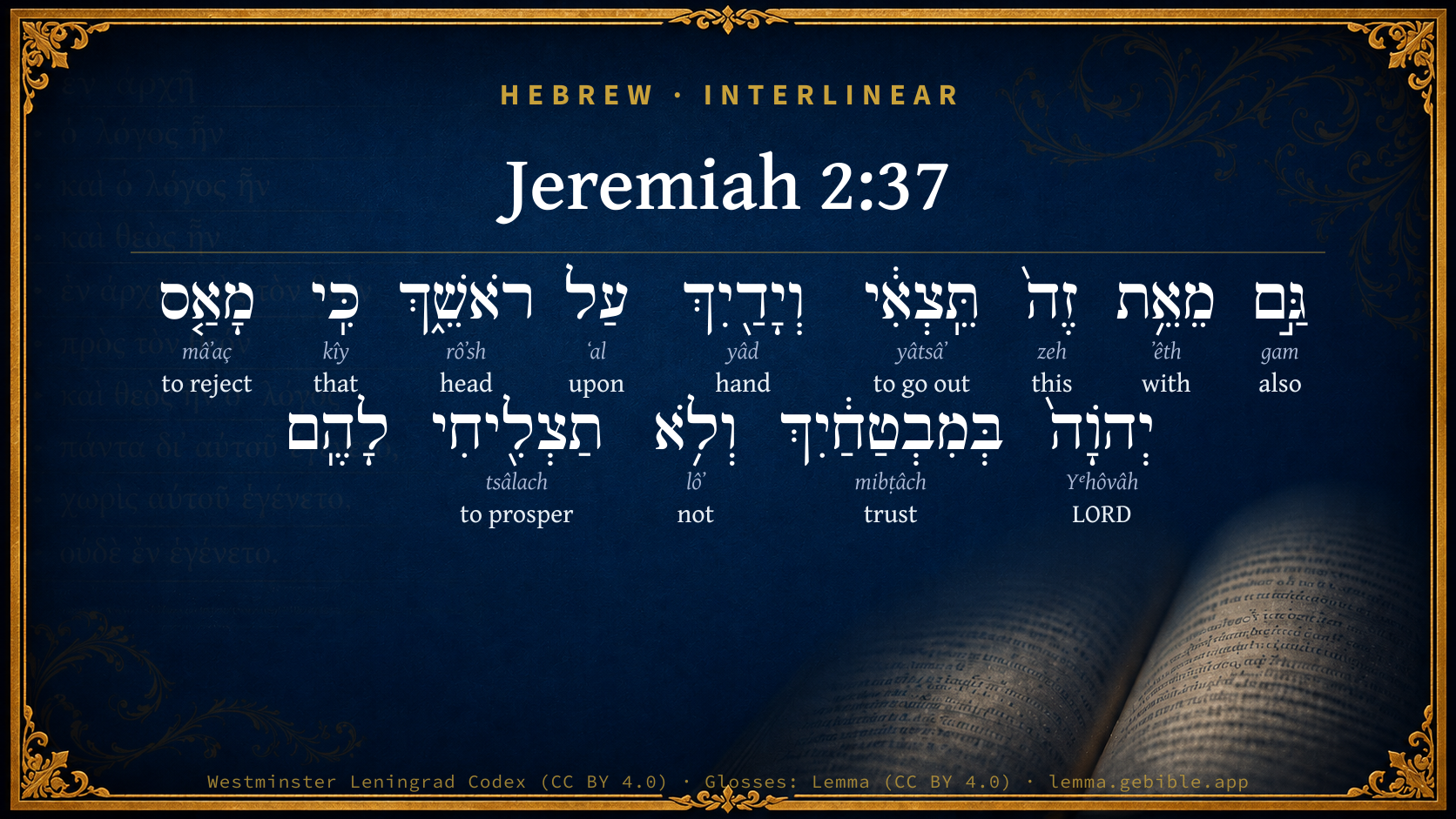
  1. גַּ֣ם gam H1571 “also” Particle, Accusative
  2. מֵאֵ֥ת ʼêth H854 “from · with” Preposition + Preposition
  3. זֶה֙ zeh H2088 “this” Pronoun, Demonstrative, Masculine, Singular
  4. תֵּֽצְאִ֔י yâtsâʼ H3318 “to go out” Verb, Qal, Imperfect, 2nd Person, Feminine, Singular
  5. וְיָדַ֖יִךְ yâd H3027 “and · hands · your” Conjunction + Noun, Common, Both, Dual, Construct + Suffix, Personal, 2nd Person, Feminine, Singular
  6. עַל ʻal H5921 “upon” Preposition
  7. רֹאשֵׁ֑ךְ rôʼsh H7218 “head · your” Noun, Common, Masculine, Singular, Construct + Suffix, Personal, 2nd Person, Feminine, Singular
  8. כִּֽי kîy H3588 “that” Conjunction
  9. מָאַ֤ס mâʼaç H3988 “to reject” Verb, Qal, Perfect, 3rd Person, Masculine, Singular
  10. יְהֹוָה֙ Yᵉhôvâh H3068 “LORD” Noun, Proper
  11. וְלֹ֥א lôʼ H3808 “and · not” Conjunction + Particle, Negative
  12. תַצְלִ֖יחִי tsâlach H6743 “to prosper” Verb, Hiphil, Imperfect, 2nd Person, Feminine, Singular

About this verse

These counts appear in no published source. They are computed here, from the morphology-tagged text and Lemma’s own curated glosses. What Lemma adds →

14
words
13
distinct lemmas
Prophets
section

Notable vocabulary

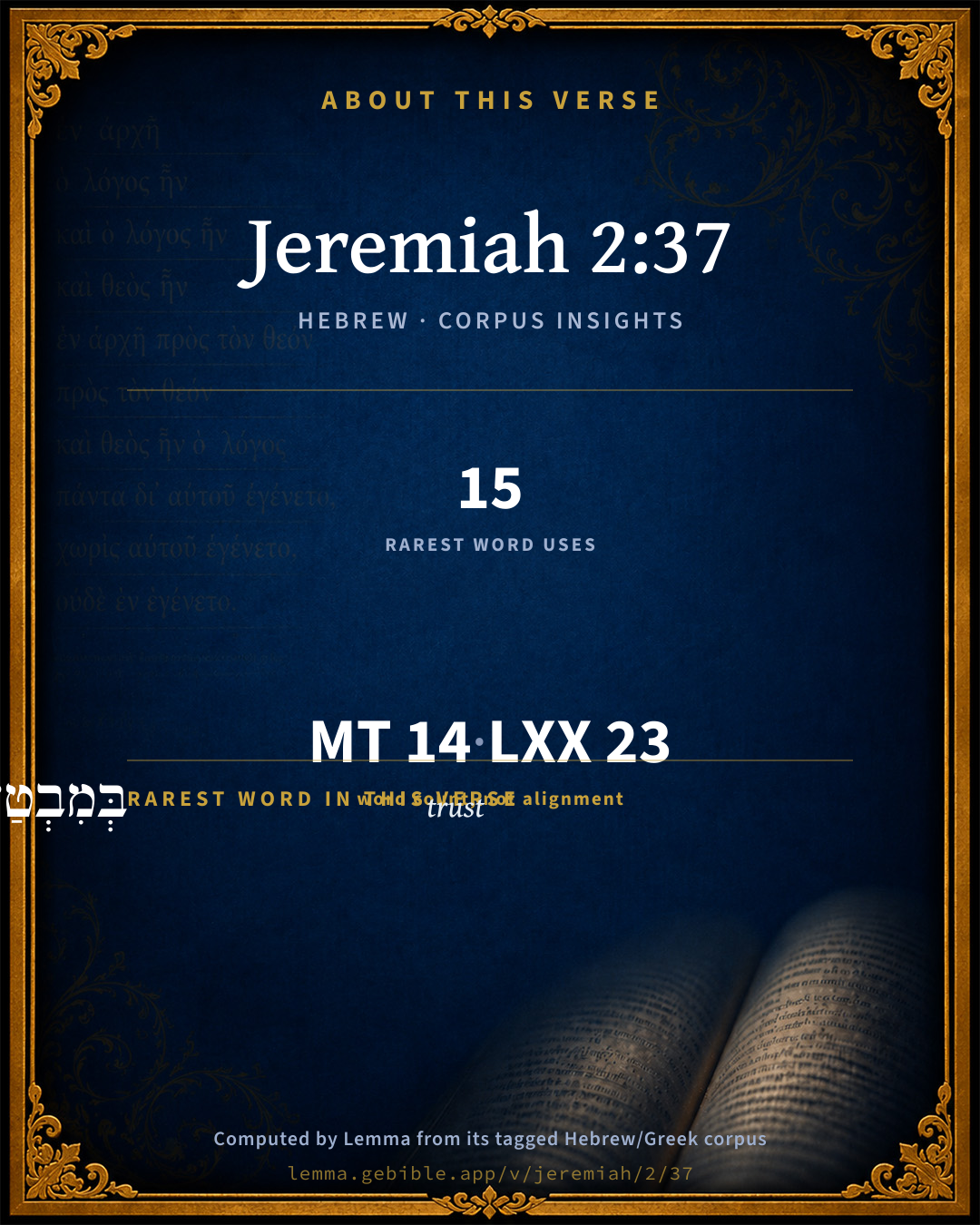
The rarest word here is בְּמִבְטַחַ֔יִךְ trust H4009 — appearing just 15 times in the whole Hebrew Bible.

Shared distinctive vocabulary

בְּמִבְטַחַ֔יִךְ trust H4009 occurs in 15 verses of the Hebrew Bible. Also found in:

Grammatical profile

  • 3 verbs
  • 4 nouns
  • 1 pronoun
  • 3 prepositions
  • 1 conjunction
  • 2 particles

Verb forms

  • תֵּֽצְאִ֔י Qal · Imperfect
  • מָאַ֤ס Qal · Perfect
  • תַצְלִ֖יחִי Hiphil · Imperfect

Hebrew & Septuagint length

In the original languages it is 14 Hebrew tokens and 23 Greek tokens — but the two are counted differently (Hebrew bundles its prefixes and suffixes into one token; the Greek is in lemma form), so that isn’t a like-for-like length.

Cross-references

9

Topical passages linked to Jeremiah 2:37 in the Treasury of Scripture Knowledge — connected by theme and wording, ordered by reader-vote popularity; previews shown in the World English Bible.

  • 2 Samuel 13:19 Tamar put ashes on her head, and tore her garment of various colors that was on her; and she laid her hand on her head, and went her way, crying aloud as she went.
  • Jeremiah 17:5 Thus says Yahweh: Cursed is the man who trusts in man, and makes flesh his arm, and whose heart departs from Yahweh.
  • Jeremiah 37:7–10 Thus says Yahweh, the God of Israel, Thus shall you tell the king of Judah, who sent you to me to inquire of me: Behold, Pharaoh's army, which is come forth to help you, shall return to Egypt into their own land.
  • Ezekiel 17:15–20 But he rebelled against him in sending his ambassadors into Egypt, that they might give him horses and much people. Shall he prosper? shall he escape who does such things? shall he break the covenant, and yet escape?
  • Numbers 14:41 Moses said, Why now do you disobey the commandment of Yahweh, seeing it shall not prosper?
  • 2 Chronicles 13:12 Behold, God is with us at our head, and his priests with the trumpets of alarm to sound an alarm against you. Children of Israel, don't you fight against Yahweh, the God of your fathers; for you shall not prosper.
  • Isaiah 10:4 They shall only bow down under the prisoners, and shall fall under the slain. For all this his anger is not turned away, but his hand is stretched out still.
  • Jeremiah 2:36 Why go you about so much to change your way? you shall be ashamed of Egypt also, as you were ashamed of Assyria.
  • Jeremiah 32:5 and he shall bring Zedekiah to Babylon, and there shall he be until I visit him, says Yahweh: though you fight with the Chaldeans, you shall not prosper?

Cross-references courtesy of OpenBible.info (CC BY 4.0).

Hebrew and Greek witnesses Masoretic Hebrew ↔ Greek Septuagint

The same verse in the two great witnesses to the Old Testament, shown verse-for-verse.

These are two independent witnesses, not word-aligned to each other, and the Septuagint is shown in lemma (dictionary) form.

Hebrew Jeremiah 2:37 Masoretic · Westminster Leningrad Codex

גַּ֣ם מֵאֵ֥ת זֶה֙ תֵּֽצְאִ֔י וְיָדַ֖יִךְ עַל רֹאשֵׁ֑ךְ כִּֽי מָאַ֤ס יְהֹוָה֙ בְּמִבְטַחַ֔יִךְ וְלֹ֥א תַצְלִ֖יחִי לָהֶֽם

From there also shall you go forth, with your hands on your head: for Yahweh has rejected those in whom you trust, and you shall not prosper with them.

World English Bible · Public Domain

Greek LXX Structure differs

In the Septuagint, Jeremiah is about an eighth shorter than the Hebrew and arranges its material differently — the Oracles Against the Nations (Hebrew chapters 46–51) appear in the middle of the Greek book, after 25:13. Because the chapter and verse boundaries do not line up, a verse-for-verse comparison with the Hebrew is not shown.

A verse-for-verse comparison isn’t shown here because the chapters and verses don’t line up. Switch to the LXX edition with the MT / LXX toggle above to read the Greek directly.

Hebrew: Westminster Leningrad Codex (CC BY 4.0). Greek: Septuagint (public domain); English from a public-domain English Septuagint. How the Septuagint differs from the Hebrew →

Targum (Aramaic paraphrase)

1

The Targum is the ancient Jewish Aramaic paraphrase of the Hebrew Scriptures — an interpretive translation, not the Hebrew text itself. Onkelos (literal) and Pseudo-Jonathan (expansive) render the Torah, and Jonathan the Prophets. Coverage is partial: where no permissively-licensed English translation exists for a verse, only the Aramaic is shown. This is verse-level text, not a word-by-word alignment to the Hebrew.

  1. Targum Jonathan Prophets (Joshua–Malachi)
    אַף מִלְוַת דֵין תִּפְקִין וּבְהַתַת חוֹבִיךְ עַל רֵישֵׁיךְ אֲרֵי רָחִיק יְיָ רוֹחְצְנָיִךְ וְלָא וְלָא תִצְלְחִין לְהוֹן:

    (no public-domain English translation for this verse)

    Targum Jonathan — Aramaic: “Mikraot Gedolot” (public domain). English: “Sefaria Community Translation” (CC0 1.0 (public-domain dedication)); “London "Chaldee Paraphrase," 1871” (public domain). Text via Sefaria.

Commentary

Notes on Jeremiah 2:37 from classic Christian and Jewish commentators (each source and its license shown beneath its notes). The classic Christian expositions comment on the surrounding passage and are grouped to its opening verse, so a note may address several verses; the Jewish commentaries on the Tanakh (Rashi and others) are per-verse, so they appear only where the commentator wrote on this verse.

Lemma curates 59 commentaries, every one of them public domain or Creative Commons licensed, each selected and text-cleaned for this edition rather than reprinted as found. About our sources →

Trapp's Complete Commentary

John Trapp

Jer 2:37 Yea, thou shalt go forth from him, and thine hands upon thine head: for the LORD hath rejected thy confidences, and thou shalt not prosper in them.

Ver. 37. Yea, thou shalt go from him.] Or, From hence, into captivity.

With thine hands.] Lamenting, as did Tamar. {2Sa 13:19}

For the Lord hath rejected thy confidence.] Where the beginning is carnal confidence, the end is shame, of any business, even of this life.

John Trapp, A Commentary or Exposition upon All the Books of the Old and New Testament (1647–1656) — public domain. Text from a community e-Sword module.

The Biblical Illustrator

Joseph S. Exell

Jer_2:37

The Lord hath rejected thy confidences, and thou shalt not prosper in them.

The danger of false confidences

In the state and conduct of Judah we have a picture of the state and conduct of the world, in religious matters, at the present day; and as that nation, by their distrust of God and want of reliance on His power and goodness, wrought for themselves the degradation and the miseries of a long captivity, so those who are seeking for themselves present and eternal peace by any other means than those which God has appointed, and are lulling their souls into security by false confidences, are heaping up for themselves wrath against the day of wrath and revelation of the righteous judgment of God.

I. The general mercy of God is the ground of confidence with many, but this is a confidence which the Lord hath rejected. The Scriptures are full of declarations which show the utter fallacy of this trust. We may assure ourselves that those who hold to it have ideas of sin very different from those given us in that sure Word of Prophecy unto which we do well that we take heed. Let us ponder the fact, that if man, as the Scriptures tell us, was formed in the image of God, by every act of transgression we must be effacing that image, and spoiling Gods most glorious workmanship; and if God can look upon such a thing with indifference, and allow it to pass with impunity, He must be reckoned as altogether heedless of the grossest interference with His wise purposes which we can possibly, suppose. Now, is such a thing at all countenanced in the Scriptures? No. God is of purer eyes than to behold iniquity. Evil cannot dwell with Him, nor fools stand in His sight. And so jealous is He of His glory, that in His dealing with the first of our race He annexed the penalty of death to transgression. Adam transgressed, and he died, spiritually and temporally. And where in this is the evidence of a God all mercy? Why did not paradise smile on our first parents as before? Why did the sword of the cherubim keep them out from their first and most beauteous habitation? It was because God is a God of justice, and His veracity stood pledged for the fulfilment of His righteous threatening. And He stands as pledged still with regard to all but those who, being in Christ Jesus, have escaped condemnation. Upon the wicked He shall rain snares, fire and brimstone, and an horrible tempest; this shall he the portion of their cup. And hath He said it, and will He not do it; hath He spoken, and shall He not make it good?

II. Many trust to their own righteousness for acceptance with God, but this also is a confidence which the Lord hath rejected. Do and live is the motto of the religion of such persons. They purpose to get to life, and their way to it is by keeping the commandments. God, say they, has annexed the promise of future felicity to obedience, and we obey that that felicity may be ours for a reward. Now, this would do very well, did we retain our original standing with God; but whether man be now that holy being he was when God pronounced him to be very good, let the state of the world, let your own hearts witness. The conscience of every man who knows aught of the law of God, and is at all accustomed to compare his conduct and his feelings with its requirements, will testify, that it is as true now as on the day when it was written that all have sinned, and come short of the glory of God: But many, who trust to themselves that they are righteous, will endeavour to get rid of these considerations, by saying, that though they have sinned, they have repented: that is, they have felt sorry for their sin, and that God will receive penitence as an atonement. This is trifling with the character of God, and with that righteous government which it is His immutable purpose to maintain throughout the whole of His dominions. Even human legislators have not failed to see how subversive such a principle would be of the good of civil society if put in practice in the world. Would it be right--would it be consistent with good government, that crime should go unpunished, if the criminal, when brought to the bar of justice, should express sorrow for his offence? All know that it would not. And will God fail to vindicate His law, His justice, His veracity because of a few sorrowing tears and sighs? But it is said that Jesus, by His obedience and suffering, has obtained an abatement of the law; that He has softened it down in order to fit it to human infirmity; that it is not a perfect, but a sincere obedience that is required; and that if we fall short in any thing, the merit of Christ comes in to supply the deficiency.

1. We observe that Christ came for no such purpose as to temper the law to our infirm circumstances; for if the law was originally right, if that wisdom which enacted it, and which cannot err, saw it to be fit and necessary, it must be immutably so. What! did Christ die that we should not be obliged to love God and our neighbour, so much as we were originally bound to do? Did He give Himself to procure for us a liberty to sin with impunity? No one in soberness of spirit will say so.

2. But, with regard to the merit of Christ supplying only for the little that we may have fallen short, we observe, that it is altogether at variance with every dictate of Scripture on the subject of the sinners salvation. Was not the sacrifice of Christ a full satisfaction to Divine justice? Did He not magnify the law, and make it honourable? And can it be necessary that to His infinite satisfaction and merit we should add our obedience, soiled and imperfect as it must be at best, in order to obtain pardon and acceptance with God? What an unhallowed mixing of the clean and unclean; what a confounding of Christ and Belial would be here! Besides, why will men be so perverse as to seek justification by the law, whether it be abated, as it is not, or whether it stands in its original force, as it does to those who are under it, and as a rule of life to all? Why will men be so perverse, when it is said so pointedly, that by the deeds of the law no living flesh shall be justified? We apprehend that, to every candid person, the foregoing considerations are sufficient to show how unsafe a foundation, on which to build for eternity, are our own righteousness, and those things connected with it which we have noticed. What, then, is the confidence, by depending on which we may look forward securely to eternity? It is the righteousness of Jesus, made ours by imputation, and received by that faith which is of the operation of God.

III. Too many content themselves with a bare speculative knowledge of the true way of salvation and this is a confidence which the Lord hath rejected. There is a form of godliness without the power. In order to a real saving knowledge of the subject of redemption, we must have a deep impression of the truths which the subject involves: the deep depravity of our nature; our alienation from God; the hatefulness and repugnancy of sin to the Divine nature; our inability to rescue ourselves from perdition; the love, the wisdom, the condescension, all infinitely displayed in the plan and the execution of our redemption, and the readiness and ability of Christ to save. (P. MGuffie.)

.

The Biblical Illustrator, edited by Joseph S. Exell (c. 1880s–1900s) — public domain. Text from a community e-Sword module.

Joseph Benson's Commentary

Jer 2:37. Yea, thou shalt go forth from him — The ambassadors thou sendest to Egypt shall return with disappointment and confusion; and their hands on their heads — Condoling the desperate condition of their people. Or, Thou shalt go forth from hence, namely, into captivity, in a strange land. And thy hands upon thy head — As Tamar went forth from her brother Amnon, her garments torn, and her hands upon her head, insulted and despised, and in the greatest grief and misery; and Egypt, on which thou reliedst, shall not be able to prevent it, or to rescue thee out of captivity. For the Lord hath rejected thy confidences — Hath refused to give success to them, or hath rejected thee for thy confidences; or he disapproves thy confidences, namely, all thy dependances and refuges, which thou seekest out of him. And thou shalt not prosper in them — They shall not stand thee in any stead, nor give thee any satisfaction. As there is no counsel or wisdom that can prevail against the Lord, so there is none that can prevail without the Lord. Some read it, The Lord hath rejected thee for thy confidences; that is, because thou hast dealt so unfaithfully with him as to trust in his creatures, nay, in his enemies, when thou shouldest have trusted in him only, he has abandoned thee to that destruction from which thou thoughtest thus to have sheltered thyself; and then thou canst not prosper, for none ever either hardened himself against God, or estranged himself from God, and prospered.

Joseph Benson's Commentary on the Old and New Testaments (1811–1818) — public domain. Text from a community e-Sword module.

Geneva Bible (1599)

Geneva Bible translators

In sign of lamentation, as 2 Sam. 13:19.

Geneva Bible (1599) marginal notes — public domain. Text via Bolls.life.

Jamieson, Fausset & Brown

Robert Jamieson, A. R. Fausset & David Brown

him--Egypt.

hands upon . . . head--expressive of mourning (Sa2 13:19).

in them--in those stays in which thou trustest.

Contrary to all precedent in the case of adultery, Jehovah offers a return to Judah, the spiritual adulteress (Jer 3:1-5). A new portion of the book, ending with the sixth chapter. Judah worse than Israel; yet both shall be restored in the last days (Jer. 3:6-25).

Next: Jeremiah Chapter 3

Jamieson, Fausset & Brown — Commentary Critical and Explanatory on the Whole Bible (1871) — public domain (CC PDM 1.0). Text via the HelloAO Bible API.

Adam Clarke's Commentary

Verse 37. Thou shalt go forth from him, and thine hands upon thine head] Thou shalt find all thy confidence in vain, - thy hope disappointed; - and thy state reduced to desperation. The hand being placed on the head was the evidence of deep sorrow, occasioned by utter desolation. See the case of Tamar, when ruined and abandoned by her brother Amnon, 2Sa 13:19.

Thou shalt not prosper in them.] They shall all turn to thy disadvantage; and this as we shall see in the history of this people, was literally fulfilled. O what a grievous and bitter thing it is to sin against the Lord, and have him for an enemy!

Adam Clarke's Commentary on the Bible (1810–1826) — public domain. Text from a community e-Sword/MySword module.

John Calvin's Commentaries

He expresses more clearly what he had said of the shameful character of his own nation, — that the Jews, who thought that their safety would be secured by the Egyptians, were seeking their own entire ruin. This seemed to them indeed incredible; for as the Egyptians were neighbors, and as the Jews then only feared the Assyrians and Chaldeans, who were afar off, they thought that they had the best prospect: “What! our enemies are distant from us twenty or thirty days’ journey; and those who are prepared to help us will be soon with us at the shortest warning.” Hence the Jews thought, as we have said, that they were quite safe. But the Prophet here declares, that they were greatly mistaken; for on account of this wickedness, that is, because they trusted in their unlawful and accursed treaty, and promised themselves peace from their enemies, or thought that they could easily overcome them; on this account, he says, thou shalt go forth: but nothing could have been less credible to the Jews than what the Prophet said; for as the Egyptians opposed themselves as a wall against the Chaldeans, and were deemed unassailable, who could have otherwise thought but that the Jews would be preserved quiet in their own country? But he says, Go forth shalt thou, and thine hands on thy head

By this gesture he means extreme despair; for women did either strike or extend their arms when any great calamity happened, as we see it done often in the present day; for when a woman, not able to keep within due bounds, either loses a husband, or expects some very great calamity, she beats her breast, or raises up her hands, according to what is said here. Jeremiah then mentions this gesture as an evidence of extreme despair; as though he had said, “The treaty which fills the Jews with so much confidence shall be so far from being advantageous to them, that it will, on the contrary, bring on them utter ruin and disgrace. But the reason which follows ought especially to be observed, because abhor does Jehovah thy confidences The Prophet here shews why he had spoken so severely. It might have appeared that he spoke hyperbolically when he said, that the people were like an abandoned harlot, who rambled here and there in all directions: but the reason here given ought to have been sufficient to take away all evasions, and that is, that they foolishly trusted in those fallacious helps which they knew were condemned by God. Had this been permitted by God, they would not have been so severely reprimanded; but as God had forbidden them to flee to the Egyptians, it was in the first place a disallowed confidence; and in the second place, they thus despised the aid of God, and cast aside, as it were, all his promises: for as their hearts were fixed on the Egyptians, and as they thought that their safety would be secured by them; so their prayer to God became not only cold, but almost wholly extinguished.

We hence see that the Prophet did not exceed due limits when he spoke against the Jews with so much displeasure, and condemned them in such reproachful terms; for they had transferred the glory due to God to the Egyptians, when they considered them to be the authors of their safety; and they had thus despised the promises of God, so that there was no attention given to prayer: Abhor, then, does Jehovah thy confidences

He then adds, Thou shalt not prosper in them. It ought to be carefully observed, that whatever we resolve to do that is not approved by God, cannot possibly succeed; for God will subvert all our hopes. Let us then know that here is set before us the punishment of all unbelievers, who, being not content with God’s protection, wander after vain and false objects of trust, and prefer to have men propitious to them rather than God himself. Now follows —

John Calvin's Commentaries (1540-1563) — public domain. Text from the Calvin Translation Society English edition (1840s-50s) via the Christian Classics Ethereal Library (ccel.org). Calvin's coverage is partial (roughly two-thirds of the Bible); uncommented books and verses are honest gaps, never fabricated. The 19th-century editor's footnotes and remarks are omitted so the notes are faithfully Calvin's own voice.

Ellicott's Commentary for English Readers

(37) From him.—Better, from it, sc., from Egypt as a people.

Thine hands upon thine head.—The outward sign of depression and despair (2Sa_13:19).

Thy confidences.—i.e., the grounds or objects of thy confidence.

A Bible Commentary for English Readers, edited by Charles John Ellicott (1878–1897) — public domain. Text from a community e-Sword module.

The Cambridge Bible for Schools and Colleges

gen. ed. J. J. S. Perowne

37. From him also shalt thou go forth] The king of Egypt shall repulse thy advances, and thou shalt return mourning.

thine hands upon thine head] in disgrace and disappointment; cp. 2Sa_13:19.

thy confidences] those in whom thou confidest, Egypt and Assyria.

The Cambridge Bible for Schools and Colleges (gen. ed. J. J. S. Perowne; Cambridge University Press, 1878–1918) — public domain. Text from a community e-Sword module.

Albert Barnes' Notes on the Bible

From him - From it, from this Egypt, which though fem. as a land, yet as a people may be used as a masc. (compare Jer 46:8). Now that Nineveh is trembling before the armies of Cyaxares and Nabopalassar, thou hastenest to Egypt, hoping to rest upon her strength: but thou shalt retrace thy steps, with thy hands clasped upon thy head, disgraced and discarded.

Confidences - Those in whom thou confidest.

In them - literally, “with respect to them.”

Albert Barnes' Notes on the Bible (1834–1885) — public domain. Text from a community e-Sword/MySword module.

Haydock's Catholic Bible Commentary

Head, like the violated Thamar, 2 Kings xiii. 19. The king of Egypt was routed, when coming to assist Sedecias, chap. xxxvii. 3, 10. (Calmet)

George Leo Haydock (1774–1849), Haydock's Catholic Family Bible and Commentary, 1859 edition — public domain. Excludes Psalms (Douay-Rheims chapter numbering differs from Protestant) and Deuterocanonical books (Catholic canon only).

Matthew Poole's English Annotations

Thou shalt go forth from him: some apply it to the sad and ineffectual return of the ambassadors, being disappointed in their expectation from the king of Egypt; but rather, All the help thou canst procure from abroad shall not prevent thy captivity, but from hence thou shalt go.

Thine hands upon thine head; a usual posture of sadness and mourning, 2Sa 13:19, suited here to her going into captivity.

Rejected thy confidences; refused to give success unto them, 2Ch 16:7. Or, rejected thee for thy confidences; or, he disapproves thy confidences, viz. all thy refuges which thou seekest out of God.

Thou shalt not prosper in them, viz. in thy refuges and dependencies.

Matthew Poole's English Annotations on the Holy Bible (1683–1685) — public domain. Text from a community e-Sword/MySword module.

Whedon's Commentary on the Bible

Daniel D. Whedon

37. From him — Namely, Egypt. As thou didst turn to Egypt from Assyria, so shalt thou turn from him, clasping thy head with thy hands in grief and dismay. The might of Egypt will surely be overthrown, and all who make it a covert shall be dislodged.

Daniel D. Whedon (gen. ed.), Commentary on the Old and New Testaments (1874–1909) — public domain. Text from a community e-Sword module.

The Pulpit Commentary

From him; i.e. from Egypt, personified as a man (so whenever a people is referred to; a laud is represented as a woman). Egypt was, in fact, the only great power capable of assisting Judah at this time (see Introduction); yet even Egypt, the prophet says, shall disappoint her Jewish allies, for Jehovah has rejected thy confidences (i.e. the objects of thy confidence). As a matter of fact, "the King of Egypt came not again any more out of his laud" after Necho"s crushing defeat at Carehemish. (2Ki_24:7; comp. Jer_37:5)

Why the confidences of men do not prosper.

The people of Israel are set forth, even within the limits of this one chapter, as having multiplied and extended their confidences; and yet it could not be said that they were prospering. Men with the religious element in their nature strongly clamoring for satisfaction, had turned to the gods of neighboring nations, and multiplied these objects of worship until it could be said, "According to the number of thy cities are thy gods, O Judah." God compares them to thirsty people who, with a copious fountain in their midst, work and toil to make cisterns, only to find that the end of their labor is in broken cisterns which can hold no water. And then, when their broken cisterns had proved quite unavailing, they fly to drink of Nile and of Euphrates. Evidently their confidence had not prospered, and a continuance and increase of adversity was threatened, the cause of it all being that their confidences were such as God, in his righteousness and majesty, must inevitably reject. Consider

I WHY THIS QUESTION AS TO THE SUFFICIENCY OF HUMAN CONFIDENCES IS SO IMPORTANT. The answer is that men cannot do without confidences. The events of a single day of life might be registered in such an aspect as to show what a confiding creature man is. Faith has become so much a habit with him as to be almost a second nature. Hence, even in the great concerns of life, we find many reposing trust with very little inquiry. Looking at others, we find their lives proving the need of confidence by the very frequency of doubt and irresolution in them. They are ever asking the question, yet never quite able to answer it, "What is the best thing for me to do?" And then, as so often happens, the end of hesitation and perplexity is, that they seem to have no choice at all, and go submissively towards the confidence that happens to be most inviting at the moment. Seeing, therefore, that we are compelled to have confidences, it is of the first importance to discover in what sort of confidences prosperity will alone be found.

II MANY ACTUAL CONFIDENCES OF MEN PROVE FAILURES IN THE END. They approach men invitingly, they seem to stand well in the judgment of past generations, they may be the objects of very general approval, and yet, when they are searched into, when the truth concerning them is got from the bottom of the proverbial well, that truth is seen to Be well expressed in the words which say men have not prospered in them. There is, for instance, a very plausible appearance of prosperity in worldly wealth. Many fail to acquire it, and when they acquire it, fail to keep it; but this is held to come in the majority of cases from some fault in the man, and not in the stability of his possessions. To say that a possession is as safe as the Bank of England is to utter the strongest conviction as to its stability and security; and yet such confidences fail because they are not enough for the whole man. It is just one of the perils of wealth that man should let his whole heart rest upon it; should come to let the comforts, occupations, and hopes of life depend upon external possessions. There is failure also when men put confidence in self, confidence in present views of life, present feelings, present vigor of body and mind, in natural qualities, such as shrewdness, self-control, presence of mind, and in habits of attention, industry, and promptitude, that have been cultivated. What manifest failure also often comes from too much confidence in the judgment of man! The counsels of the wisest, most experienced, most successful of men, must be listened to with discretion.

III THE REASON WHY SUCH CONFIDENCES DO NOT BRING PROSPERITY IS MADE PLAIN. They are not confidences after God"s own heart. They are an ungodly waste of affections and energies given for higher purposes and more durable occupations. The practical lesson is that we should reject all confidences if we are not made quite certain that God approves them. Blessed is that man who has found his way, it may be through many losses and agonizing pains, to the truth that the unseen is more trustworthy than the seen, the eternal than the temporal. One who has thus risen into the sphere of Divine realities may have his confidences rejected and despised of men. What do these rejections matter? He who has firm hold of God himself need not to care for contemptuous words. The hard words of worldly men cannot destroy spiritual prosperity. Y.

The Pulpit Commentary (1880–1919), ed. H.D.M. Spence-Jones & Joseph S. Exell — public domain. Text from a community e-Sword module.

John Wesley's Explanatory Notes

Yea - All the help thou canst procure shall not prevent thy captivity, but from hence thou shalt go. Thy hands - An usual posture of mourning.

John Wesley, Explanatory Notes Upon the Whole Bible (1754–1765) — public domain. Text via the GEBible commentary corpus.

Keil & Delitzsch

C. F. Keil & F. Delitzsch

Also from this, i.e., Egypt, shalt thou go away (come back), thy hands upon thy head, i.e., beating them on thy head in grief and dismay (cf. for this gesture Sa2 13:19). זה refers to Egypt, thought of as a people as in Jer 46:8; Isa 19:16, Isa 19:25; and thus is removed Hitz.'s objection, that in that case we must have מבטחים .זאת, objects of confidence. The expression refers equally to Egypt and to Assyria. As God has broken the power of Assyria, so will He also overthrow Egypt's might, thus making all trust in it a shame. להם, in reference to them.

Keil & Delitzsch — Biblical Commentary on the Old Testament (1861–1891) — public domain (CC PDM 1.0). Text via the HelloAO Bible API. (Old Testament only.)

Lesson kit

Teaching starters — assembled from the data on this page, not authored interpretation. Every prompt links to the verse data it draws on. Edit before teaching.

Jeremiah, in the Prophets, opens this verse with 14 words (13 distinct Hebrew lemmas). Its most distinctive word is mibṭâch (“trust”). A historical commentator’s framing appears above. Read the whole chapter for the surrounding context.

Discussion questions

  1. What does “trust” (mibṭâch) contribute to the verse as a whole?
  2. How does Job 8:14, which shares the word «trust», read alongside this verse?
  3. The translations on this page render this verse differently — a whole-verse word diff, not a word-by-word alignment. What might account for the different wordings?
  4. «תֵּֽצְאִ֔י» is a Qal Imperfect verb. How does that grammatical form shape the action described?
  5. Compare how Trapp's Complete Commentary and The Biblical Illustrator read this verse. Where do they agree or differ?

Things to notice

Reading settings

Reading text

Shown beneath each verse's original-language words.

Old Testament
Old Testament edition

Read the OT as the Masoretic Hebrew (MT) or the Greek Septuagint (LXX).

English shown for the Greek Septuagint (in the Hebrew ↔ Greek comparison).

Comparing translations? Open the Compare panel on any verse page to stack up to four side by side.