
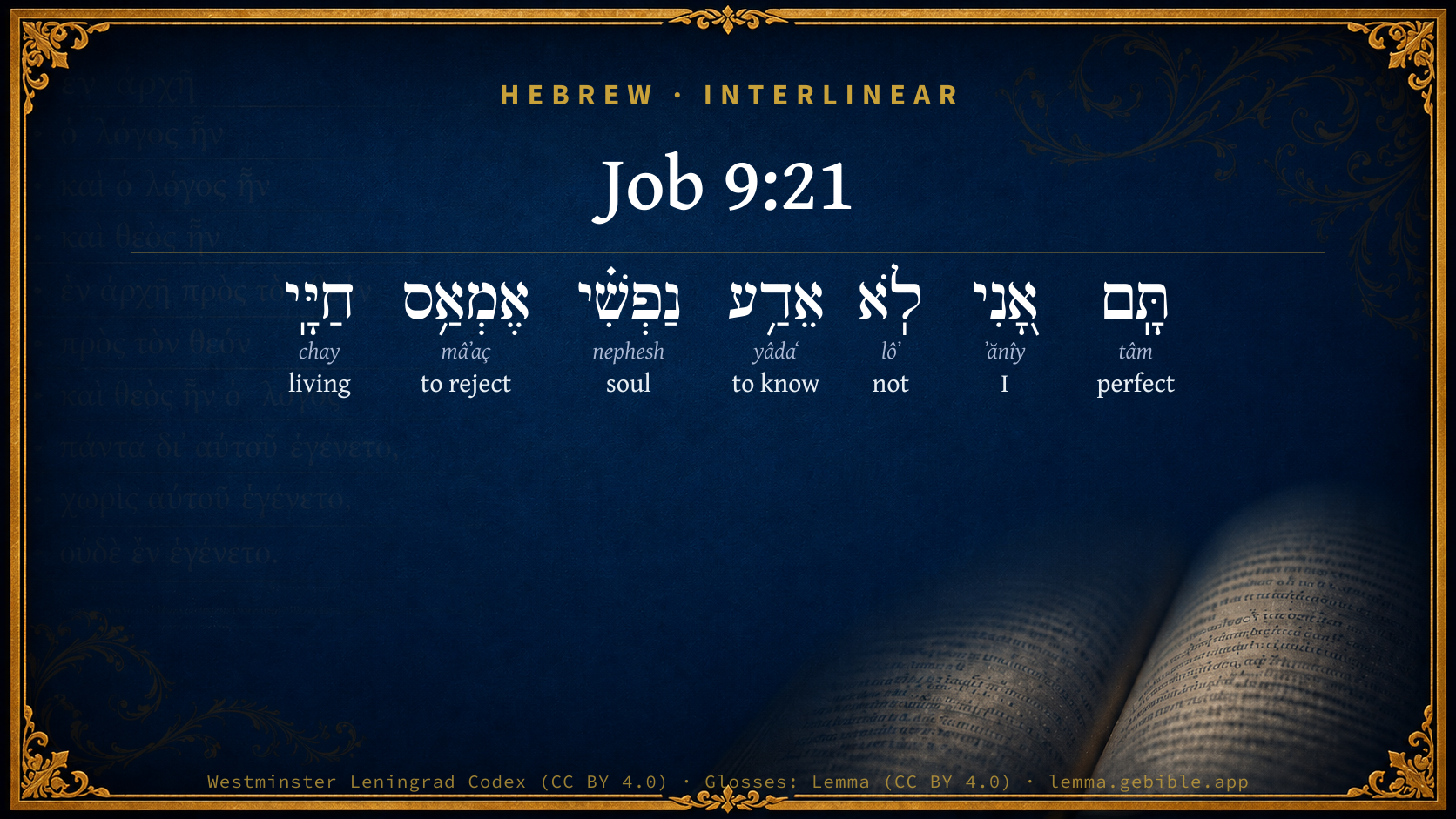
Job 9:21

Hebrew (Westminster Leningrad Codex) Job 9:21 appears in the Hebrew Old Testament. The text above is from the Westminster Leningrad Codex. Each word links to its Strong’s number, a concise gloss, and parsing drawn from the Open Scriptures Hebrew Bible morphology. Click any word for its full Brown-Driver-Briggs (BDB) entry.
Download image
Cite this verse

Job 9:21 (World English Bible). Public Domain. Lemma interlinear Bible study tool, https://lemma.gebible.app/v/job/9/21.

Show BibTeX & RIS
BibTeX
RIS
English Translation
I am blameless. I don't regard myself. I despise my life.
World English Bible · Public Domain
Download a study sheet

One document with this verse’s original text, its word-by-word gloss line, the meaning frame, cross-references with their text, attributed commentary, and full source and license credits — printable, and it pastes into notes with its structure intact.

This verse Autodidact and up

Study sheet (.html) Plain text (.txt)

A passage Seminary Student

Up to 50 verses in one chapter. A passage sheet keeps up to 6 commentary sources and 12 cross-references per verse, in the order this page ranks them, and says so on the sheet whenever that leaves anything out. Ask for a single verse and you get the Autodidact verse sheet above.

Everything on this page stays free to read, with no account — the sheet is a download of what is already on screen, not access to it.

Want to remove ads? Support Godless Engineer
Compare translations 3

The same verse in 3 English versions, stacked beneath the original-language interlinear above. Click any original word for its lexicon entry.

Each is an independent rendering of the whole verse — the interlinear is not word-aligned to these translations.

Highlighted words mark where these versions differ — a whole-verse word diff, not a word-by-word alignment.

  • World English Bible Public Domain
    I am blameless. I don't regard myself. I despise my life.
  • King James Version Public Domain
    Though I were perfect, yet would I not know my soul: I would despise my life.
  • unfoldingWord Literal Text CC BY-SA 4.0
    I blameless. I do not know my soul; I loathe my life.

unfoldingWord Literal Text — © unfoldingWord, licensed CC BY-SA 4.0. Word-aligned USFM3 via Door43 (git.door43.org/unfoldingWord/en_ult).

Versions to compare (up to 4)

3 of 4 selected

Show all 18 translations

Every available English version of this verse, each an independent rendering of the whole verse.

  • World English Bible Public Domain
    I am blameless. I don't regard myself. I despise my life.
  • Berean Standard Bible Public Domain
    Though I am blameless, I have no concern for myself; I despise my own life.
  • Majority Standard Bible Public Domain
    Though I am blameless, I have no concern for myself; I despise my own life.
  • King James Version Public Domain
    Though I were perfect, yet would I not know my soul: I would despise my life.
  • American Standard Version (1901) Public Domain
    I am perfect; I regard not myself; I despise my life.
  • Revised Version (1885) Public Domain
    I am perfect; I regard not myself; I despise my life.
  • Geneva Bible (1599) Public Domain
    Though I were perfite, yet I knowe not my soule: therefore abhorre I my life.
  • Douay-Rheims (1899) Public Domain
    Although I should be simple, even this my soul shall be ignorant of, and I shall be weary of my life.
  • Young's Literal Translation Public Domain
    Perfect I am! -- I know not my soul, I despise my life.
  • Literal Standard Version CC BY-SA 4.0
    I am perfect; I do not know my soul, I despise my life.
  • Unlocked Literal Bible CC BY-SA 4.0
    I am blameless, but I do not care any more about myself; I despise my own life.
  • unfoldingWord Literal Text CC BY-SA 4.0
    I blameless. I do not know my soul; I loathe my life.
  • Darby Bible Public Domain
    Were I perfect, [yet] would I not know my soul: I would despise my life.
  • World Messianic Bible Public Domain
    I am blameless. I don’t respect myself. I despise my life.
  • Webster's Bible Public Domain
    Though I were perfect, yet would I not know my soul: I would despise my life.
  • Free Bible Version CC BY-SA 4.0
    I am innocent! I don't care what happens to me. I hate my life!
  • Bible in Basic English Public Domain
    I have done no wrong; I give no thought to what becomes of me; I have no desire for life.
  • JPS Tanakh (1917) Public Domain
    I am innocent — I regard not myself, I despise my life.

Literal Standard Version (2020), Covenant Press — licensed CC BY-SA 4.0. Text via the HelloAO Bible API (eBible.org). Unlocked Literal Bible (unfoldingWord) — licensed CC BY-SA 4.0. Text via the HelloAO Bible API (eBible.org). unfoldingWord Literal Text — © unfoldingWord, licensed CC BY-SA 4.0. Word-aligned USFM3 via Door43 (git.door43.org/unfoldingWord/en_ult). Free Bible Version, Dr. Jonathan Gallagher — licensed CC BY-SA 4.0. Text via the HelloAO Bible API (eBible.org).

Word by word

More ways to search: Search by grammar → Find every occurrence → Compare this word →

Practice this passage: Drill this verse → Learn its vocabulary →

About this verse

These counts appear in no published source. They are computed here, from the morphology-tagged text and Lemma’s own curated glosses. What Lemma adds →

7
words
7
distinct lemmas
Wisdom
section

Notable vocabulary

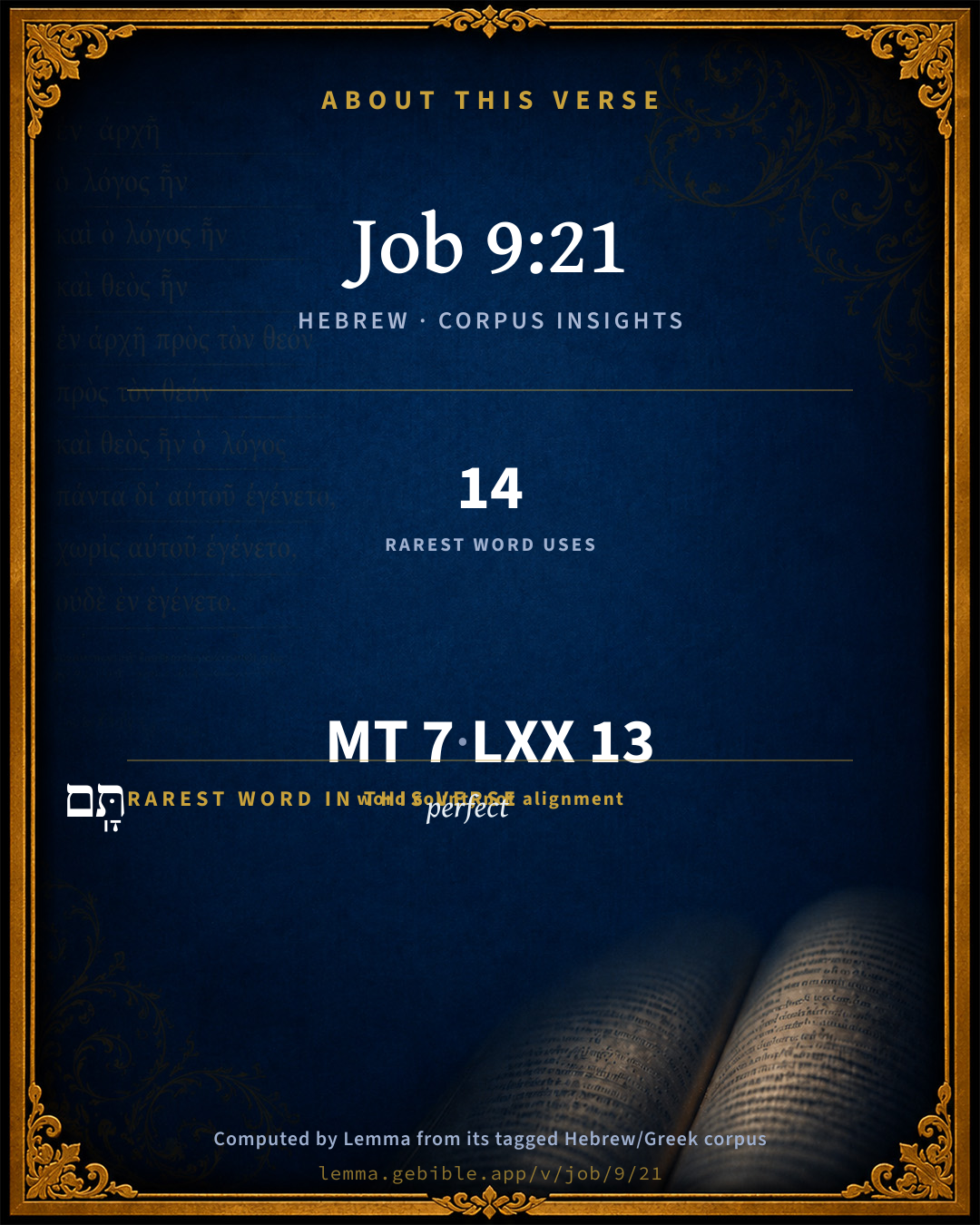
The rarest word here is תָּֽם perfect H8535 — appearing just 14 times in the whole Hebrew Bible.

Shared distinctive vocabulary

תָּֽם perfect H8535 occurs in 14 verses of the Hebrew Bible. Also found in:

Grammatical profile

  • 2 verbs
  • 2 nouns
  • 1 adjective
  • 1 pronoun
  • 1 particle

Verb forms

  • אֵדַ֥ע Qal · Imperfect
  • אֶמְאַ֥ס Qal · Imperfect

Hebrew & Septuagint length

In English translation the verse runs 11 words from the Hebrew and 19 from the Septuagint (LXX English) — the Septuagint runs noticeably longer here. See the side-by-side →

A rough comparison of the two English renderings, which tokenize alike — not a word-level alignment.

Word counts can differ between the Hebrew and the Greek without any difference in meaning — e.g. the Hebrew direct-object marker אֵת has no separate Greek word, and Greek often adds the article ὁ.

In the original languages it is 7 Hebrew tokens and 13 Greek tokens — but the two are counted differently (Hebrew bundles its prefixes and suffixes into one token; the Greek is in lemma form), so that isn’t a like-for-like length.

Cross-references

8

Topical passages linked to Job 9:21 in the Treasury of Scripture Knowledge — connected by theme and wording, ordered by reader-vote popularity; previews shown in the World English Bible.

  • Job 1:1 There was a man in the land of Uz, whose name was Job. That man was blameless and upright, and one who feared God, and turned away from evil.
  • Psalms 139:23–24 Search me, God, and know my heart. Try me, and know my thoughts.
  • Job 7:21 Why do you not pardon my disobedience, and take away my iniquity? For now shall I lie down in the dust. You will seek me diligently, but I shall not be."
  • Proverbs 28:26 One who trusts in himself is a fool; But one who walks in wisdom, he is kept safe.
  • 1 Corinthians 4:4 For I know nothing against myself. Yet I am not justified by this, but he who judges me is the Lord.
  • Job 7:15–16 So that my soul chooses strangling, Death rather than my bones.
  • Jeremiah 17:9–10 The heart is deceitful above all things, and it is exceedingly corrupt: who can know it?
  • 1 John 3:20 because if our heart condemns us, God is greater than our heart, and knows all things.

Cross-references courtesy of OpenBible.info (CC BY 4.0).

Hebrew and Greek witnesses Masoretic Hebrew ↔ Greek Septuagint

The same verse in the two great witnesses to the Old Testament, shown verse-for-verse.

Here the Septuagint runs noticeably longer than the Hebrew — LXX2012 (modern English Septuagint) 19 words vs World English Bible 11. A rough length comparison of the two English translations, not a word-level alignment — read both below.

These are two independent witnesses, not word-aligned to each other, and the Septuagint is shown in lemma (dictionary) form.

Hebrew Job 9:21 Masoretic · Westminster Leningrad Codex

תָּֽם אָ֭נִי לֹֽא אֵדַ֥ע נַפְשִׁ֗י אֶמְאַ֥ס חַיָּֽי

I am blameless. I don't regard myself. I despise my life.

World English Bible · Public Domain

Greek LXX Job 9:21 Septuagint · lemma form

εἴτε γάρ ἀσεβέω οὐ οἶδα ὁ ψυχή πλήν ὅτι ἀποαἱρέω ἐγώ ὁ ζωή

For even if I have sinned, I know it not in my soul: but my life is taken away.

LXX2012 (modern English Septuagint) · Public Domain

On this verse, The Pulpit Commentary discusses the Septuagint’s reading. Read the note in Commentary ↓

Hebrew: Westminster Leningrad Codex (CC BY 4.0). Greek: Septuagint (public domain); English from LXX2012 (modern English Septuagint) (Public Domain). How the Septuagint differs from the Hebrew →

Commentary

Notes on Job 9:21 from classic Christian and Jewish commentators (each source and its license shown beneath its notes). The classic Christian expositions comment on the surrounding passage and are grouped to its opening verse, so a note may address several verses; the Jewish commentaries on the Tanakh (Rashi and others) are per-verse, so they appear only where the commentator wrote on this verse.

Lemma curates 59 commentaries, every one of them public domain or Creative Commons licensed, each selected and text-cleaned for this edition rather than reprinted as found. About our sources →

Trapp's Complete Commentary

John Trapp

Job 9:21 [Though] I [were] perfect, [yet] would I not know my soul: I would despise my life.

Ver. 21. Though I were perfect] That is, of an unblameable conversation, yet could not I know mine own soul, that is, those secret sins, Psa 19:12, those litters of lusts that lurk therein; therefore I despise my life, I have no joy at all of it, but could wish to be out of the world to be rid of these evil inmates, that will not out of doors till the house fall upon the heads of them, till the earthly tabernacle that harboureth them be at once dissolved. Others read and sense the words thus: I am perfect or upright, neither do I know mine own soul, i.e. quicquam perversi anima mea, they allowed sin in my soul; yet I am so afflicted, that I despise my life, as being but a continued death. Aben Ezra reads the verse with an admiration, thus, Perfect I am; and think you that I know not mine own soul! that I am so great a stranger to myself! or that I have so little care of mine own good, as that I despise my life, and walk at all adventures! Tremellius thus, I am upright, whatever you my friends may make of me, neither value I my life or soul in comparison of mine integrity; my life is but a trifle to my conscience, &c.

John Trapp, A Commentary or Exposition upon All the Books of the Old and New Testament (1647–1656) — public domain. Text from a community e-Sword module.

Joseph Benson's Commentary

Job 9:21. Though I were perfect, &c. — Hebrew, תם אני, tam ani, the perfect I, would not know my soul — Namely, myself as the word נפשׁ, nephesh, is rendered, Est 4:13; or, my heart, or spirit. That is, my thinking myself perfect, or completely innocent and faultless, would be an evidence that I did not know myself. Or, the meaning of the verse is, Were I to be tried by infinite justice, however perfect I may now think myself, I should then be astonished at finding how little I knew myself, and what a multitude of faults God had taken notice of, which I had not perceived in myself; so that, when they were set before me, I should no longer insist upon, nor trust to, the integrity, either of my soul and heart, or of my life, so as any longer to attempt to justify myself before the pure eyes of the all- seeing God; but I would condemn myself and despise my life; would put no value upon it, nor be in any care about prolonging it, while it is loaded with these miseries. And, therefore, I abhor the thoughts of contending with my Maker, whereof you accuse me.

Joseph Benson's Commentary on the Old and New Testaments (1811–1818) — public domain. Text from a community e-Sword module.

Whedon's Commentary on the Bible

Daniel D. Whedon

Strophe c — The consciousness of his innocence not only leads him to self-assertion, but to a most violent arraignment of God as an unjust judge. The arraignment involves a twofold count — the destruction of the innocent and guilty together, and the consignment of the world into the hands of the wicked, Job_9:21-24.

21. I [am] perfect — Innocent. Hebrew same as above. What he had hesitated in the preceding verse to speak, from fear of the divine power, Job will now declare at all hazards. This is one of the many extraordinary revulsions of feeling in this book, to be accounted for only by extreme agony of soul and body. Job asserts his innocence recklessly and defiantly. “I know not my soul,” he says; I value it not. or, I care not for it; (similar use of verb “know” to Gen_39:6 :) “I despise my life.” Others, (Conant and Lewis,) with less reason, take the expression “I perfect” to be used hypothetically, in the same manner as in the preceding verse. Job would not esteem himself “perfect,” because of his vivid knowledge of his own soul, or because of true humility, which may be regarded as an inseparable element of perfection.

Daniel D. Whedon (gen. ed.), Commentary on the Old and New Testaments (1874–1909) — public domain. Text from a community e-Sword module.

Keil & Delitzsch

C. F. Keil & F. Delitzsch

21 Whether I am innocent, I know not myself,

My life is offensive to me.

22 There is one thing-therefore I maintain - :

The innocent and wicked He destroyeth.

23 If the scourge slay suddenly,

He laugheth at the melting away of the innocent.

24 Countries are given into the hand of the wicked;

The countenance of its rulers He veileth -

Is it not so, who else doeth it?

Job 9:21 is usually considered to be an affirmation of innocence on the part of Job, though without effect, and even at the peril of his own destruction: "I am innocent, I boldly say it even with scorn of my life" (Schnurr., Hirz., Ewald, Schlottm.). But although נפשׁי אדע לא may mean: I care nothing for my soul, i.e., my life (comp. Gen 39:6), its first meaning would be: I know not my soul, i.e., myself; and this sense is also quite in accordance with the context. He is innocent, but the contradiction between his lot and his innocence seems to show that his self-consciousness is deceptive, and makes him a mystery to himself, leads him astray respecting himself; and having thus become a stranger to himself, he abhors this life of seeming contradictions, for which he desires nothing less than its long continuance (vid., Job 7:16). The היא אחת which follows we do not explain: "it is all the same to me whether I live or not," but: it is all one whether man is innocent or not. He himself is a proof of this; therefore he maintains, etc. It is, however, also possible that this expression, which is similar in meaning to Ecc 9:2 (there is one event, אחד מקרה, to the righteous and to the wicked), and is well translated in the Targ. by היא מכילא חדא (there is one measure of retribution, מכילא = מדּה, μέτρον, Mat 7:2), refers to what follows, and that "therefore I maintain" is parenthetical (like אמרתי, Psa 119:57; אמר לי, Isa 45:24), and we have translated it accordingly. There is certainly a kind of suspense, and על־כן d introduces an assertion of Job, which is founded upon the fact of the continuance of his own misfortune, - an assertion which he advances in direct contradiction to the friends, and which is expressly censured by Elihu.

In Job 9:23., by some striking examples, he completes the description of that which seems to be supported by the conflict he is called to endure. שׁוט, a scourge, signifies a judgment which passes over a nation (Isa 28:15). It swept off the guiltless as well, and therefore Job concludes that God delights in מסּה, πειρασμός, trial, or perhaps more correctly the melting away (from מסס, as Job 6:14) of the guiltless, i.e., their dissolution in anguish and dismay, their wearing away and despondency. Jerome rightly remarks that in the whole book Job says nihil asperius than what he says in Job 9:23. Another example in favour of his disconsolate היא אחת is that whole lands are given into the hand of the wicked: the monarch is an evil man, and the countenance of their judges He (God) covers, so that they do not distinguish between right and wrong, nor decide in favour of the former rather than of the latter. God himself is the final cause of the whole: if not, i.e., if it is not so, who can it then be that causes it? אפו (four times in the book of Job instead of the usual form אפוא) is, according to the current opinion, placed per hyperbaton in the conditional instead of the interrogative clause; and מי אפו are certainly not, with Hirzel, to be taken together. There is, however, not a proper hyperbaton, but אפו here gives intensity to the question; though not directly as Job 17:15 (Ges. 153, 2), but only indirectly, by giving intensity to that which introduces the question, as Job 24:25 and Gen 27:37; translate therefore: if it really is not so (comp. the Homeric expression ει ̓ δ ̓ ἄγε). It is indisputable that God, and no one else, is the final cause of this misery, apparently so full of contradiction, which meets us in the history of mankind, and which Job now experiences for himself.

Keil & Delitzsch — Biblical Commentary on the Old Testament (1861–1891) — public domain (CC PDM 1.0). Text via the HelloAO Bible API. (Old Testament only.)

Tyndale Open Study Notes

Tyndale Open Resources

9:21 Job was indeed innocent (1:1, 7; 2:3), and he maintained this claim throughout the debate (23:11-12; 27:5; 31:1-40).

Tyndale Open Study Notes — © Tyndale Open Resources, licensed CC BY-SA 4.0. Text via the HelloAO Bible API.

Jamieson, Fausset & Brown

Robert Jamieson, A. R. Fausset & David Brown

Literally, here (and in Job 9:20), "I perfect! I should not know my soul! I would despise," [that is], "disown my life"; that is, Though conscious of innocence, I should be compelled, in contending with the infinite God, to ignore my own soul and despise my past life as if it were guilty [ROSENMULLER].

Jamieson, Fausset & Brown — Commentary Critical and Explanatory on the Whole Bible (1871) — public domain (CC PDM 1.0). Text via the HelloAO Bible API.

Adam Clarke's Commentary

Verse 21. Though I were perfect] Had I the fullest conviction that, in every thought, word, and deed, I were blameless before him, yet I would not plead this; nor would I think it any security for a life of ease and prosperity, or any proof that my days should be prolonged.

Adam Clarke's Commentary on the Bible (1810–1826) — public domain. Text from a community e-Sword/MySword module.

The Cambridge Bible for Schools and Colleges

gen. ed. J. J. S. Perowne

21. I am perfect! I regard not myself,

I despise my life.

The speaker in Job_9:19 is God, at least it is He who uses the words, “Here I am,” and “Who will set me a time?” The rest may be words of Job, in which case the words “saith He” must be supplied to these two phrases alone. It gives a more vigorous sense to suppose the whole verse spoken by God. The frightened imagination of Job with much dramatic force represents God as suddenly flinging Himself into, the arena before all, with a consciousness of irresistible might and irresponsibility, ready for any encounter of strength and defying any to bring Him to law. The action of “appointing one a time” or ordaining a day, is of course not the action of the plaintiff but of a judge, and the words imply the irresponsibility and superiority to all law of the speaker.

21. This feeling of being helpless in the hands of an overmastering might, which has no regard to his innocence, drives Job on to a reckless defiance of his adversary, and he will assert his innocence in His face though it should cost him his life. Going back upon the words, “if I were perfect,” he cries, I am perfect, I regard not myself, I despise my life. The phrase, I regard not, care not for, myself, is lit. I know not myself, cf. Gen_39:6, Psa_1:6. On the last words cf. ch. Job_7:20. The speaker feels that his bold assertion of his innocence may provoke his adversary altogether to destroy him, but he proclaims his indifference.

The Cambridge Bible for Schools and Colleges (gen. ed. J. J. S. Perowne; Cambridge University Press, 1878–1918) — public domain. Text from a community e-Sword module.

John Gill's Exposition

This is one thing,.... Or "one thing there is" (x) in the world, as Jarchi adds; or "one measure", as the Targum, to good and bad men; one event alike to the righteous, and to the wicked, Ecc 9:2; so that, as others render it, "it is all one" (y), whether a man righteous and perfect, or whether he is not, he is equally liable to be afflicted and distressed: and "this is one thing, very singular" (z), amazing and astonishing, and very unaccountable; but so it is, and which he differed from his three friends about; as to the justice of God, he agreed with them in that; yea, he believed he was righteous in whatever he did, and even in this, which was so strange and surprising, though he could not account for it: and "this is uniform", as Mr. Broughton translates it; either God acts uniformly in what he does, treating all men alike, good and bad men; or Job was uniform in his sentiments, he was all of a piece, steady and constant, retaining the same sense of things, from which he had not departed, nor could he depart:

therefore I said it; with the greatest confidence and assurance, because he believed it, and would say it again, seeing no reason at all to alter his judgment; the thing was quite clear to him, of which he had, at least as he thought, unquestionable evidence; and the thing he has respect to is as follows:

he destroyeth the perfect and the wicked; this is thought by some to be a very bad expression, bordering on blasphemy, and contrary to the nature and perfections of God, and to the methods of his providence, Gen 18:23; and that Job speaks in the person of one destitute of the grace of God: but nothing is more certain than that this was the real sentiment of his mind, his firm belief, nor could he be persuaded to the contrary; indeed it may be understood in a good sense: by a "perfect" man we are to understand a truly good man, one that has received the grace of God in truth, and is perfectly justified and pardoned through the blood and righteousness of Christ; and by a "wicked" man one that is under the influence of his lusts, is abandoned to them, and never easy but while he is serving them, which he is continually doing. Now the destruction of these is not to be interpreted of everlasting destruction; this indeed will be the case of wicked men, but not of perfect and good men: God by his grace has made a difference between them in this world, and so he will in the next; the one will go into everlasting punishment, the other into everlasting life, and will never come together in the same place or state; nor will the perfect man be destroyed at all in such sense; the grace of God within him, and the righteousness of Christ upon him, will eternally secure him from everlasting wrath and ruin: but it is meant of temporal destruction; sometimes indeed a remarkable distinction is made between the one and the other in a time of general calamity, as Noah, a perfect man, was saved, when the world of the ungodly were destroyed by water, Gen 7:23; and Lot, a righteous man, when Sodom and Gomorrah were consumed by fire, Gen 19:29; but frequently they fall together in the same common distress; good and bad men, among the Jews were alike carried captive into Babylon, signified by Jeremiah's good and bad figs, Jer 24:2; of good men, Ezekiel, Daniel, Shadrach, Meshech, and Abednego, are instances; though indeed it is on different accounts, and with different views, that the one and the other are destroyed with a temporal destruction, in their persons, their health, their families, or in their estates; such calamities upon good men are not as punishments for their sins, as on the wicked; but as fatherly chastisements, and for the trial of their graces, for their spiritual and eternal good, and that they might not be condemned with the world. Job's view in saying this is to observe, that a man's state God-ward is not to be judged of by his outward circumstances, whether he is a good man or a bad man, since they may both be in the same afflictions and distress, and which he opposes to the sentiments and sayings of Eliphaz and Bildad, Job 4:7.

(x) "unum est", Munster, Mercerus, Schmidt. (y) "Perinde est", Cocceius. (z) "Singulare enimvero id!", Schultens.

John Gill's Exposition of the Whole Bible (1746–1763) — public domain (CC PDM 1.0). Text via the HelloAO Bible API.

Albert Barnes' Notes on the Bible

Though I were perfect - The same mode of expression occurs here again. “I perfect! I would not know it, or recognize it. If this were my view, and God judged otherwise, I would seem to be ignorant of it. I would not mention it.”

Yet would I not know my soul - Or, “I could not know my soul. If I should advance such a claim, it must be from my ignorance of myself.” Is not this true of all the claims to perfection which have ever been set up by man? Do they not demonstrate that he is ignorant of his own nature and character? So clear does this seem to me, that I have no doubt that Job expressed more than three thousand years ago what will be found true to the end of time - that if a man advances the claim to absolute perfection, it is conclusive proof that he does not know his own heart. A superficial view of ourselves, mingled with pride and vanity, may lead us to think that we are wholly free from sin. But who can tell what he would be if placed in other circumstances? Who knows what latent depravity would be developed if he were thrown into temptations?

I would despise my life - Dr. Good, I think, has well expressed the sense of this. According to his interpretation, it means that the claim of perfection would be in fact disowning all the consciousness which he had of sinfulness; all the arguments and convictions pressed on him by his reason and conscience, that he was a guilty man. Schultens, however, has given an interpretation which slightly differs from this, and one which Rosenmuller prefers. “Although I should be wholly conscious of innocence, yet that clear consciousness could not sustain me against the infinite splendor of the divine glory and majesty; but I should be compelled to appear ignorant of my own soul, and to reprobate, condemn, and despise my life passed with integrity and virtue.” This interpretation is in accordance with the connection, and may be sustained by the Hebrew.

Albert Barnes' Notes on the Bible (1834–1885) — public domain. Text from a community e-Sword/MySword module.

Haydock's Catholic Bible Commentary

CHAPTER IX.

Life, under this uncertainty and affliction. (Menochius)

George Leo Haydock (1774–1849), Haydock's Catholic Family Bible and Commentary, 1859 edition — public domain. Excludes Psalms (Douay-Rheims chapter numbering differs from Protestant) and Deuterocanonical books (Catholic canon only).

Matthew Poole's English Annotations

i.e. Though God should acquit me in judgment, and pronounce me perfect or righteous,

yet would I not know, i.e. regard or value, (as that word is oft used,) my soul, i.e. my life; as the soul frequently signifies, as Gen 19:17; Job 2:6; Joh 10:15,17; and as it is explained in the following branch, where life is put for soul, and despising for not knowing: and so the same thing is repeated in differing words, and the latter clause explains the former, which was more dark and doubtful, according to the usage of sacred Scripture. So the sense is, Though God should give sentence for me, yet I should be so overwhelmed with the dread and terror of the Divine Majesty, that I should be weary of my life. And therefore I abhor the thoughts of contending with my Maker, whereof you accuse me; and yet I have reason to be weary of my life, and to desire death. Or thus, If I say, I am perfect, as the very same Hebrew words are rendered, Job 9:20, i.e. if I should think myself perfect,

yet I would not know, i.e. not acknowledge,

my soul; I could not own nor plead before God the perfection and integrity of my soul, but would only make supplication to my Judge, as he said, Job 9:15, and flee to his grace and mercy; I would abhor, or reject, or condemn my life, i.e. my conversation. So the sense is, I would not insist upon nor trust to the integrity, either of my soul and heart, or of my life, so as to justify myself before the pure and piercing eyes of the all-seeing God.

Matthew Poole's English Annotations on the Holy Bible (1683–1685) — public domain. Text from a community e-Sword/MySword module.

The Pulpit Commentary

Though I were perfect, yet would I not know my soul: I would despise my life. The original is very elliptical and very obscure. The words run, I perfect I know not myself I abhor my life" which some explain as meaning, "Were I perfect, I should not know it myself; I despise my life under such conditions" (Stanley Loathes); others, "I am perfect" (i.e. guiltless of any plain offence), "but do not understand myself, and care not what becomes of me" (Canon Cook); others again, "Were I perfect, should I not know myself, and, knowing myself, despise my own life?" (Professor Lee). The Septuagint gives us no help, as it plainly follows a different reading. Probably our present text is a corrupt one.

Vers. 21-35. Job to Bildad: 4. The cries of a desparing soul.

I MAINTAINING HIS INNOCENCE.

1. Attested by his conscience. "Though I were perfect;" or, better, "I am guiltless" (ver. 21). Before God Job did not claim to be absolutely spotless, but merely to be free from such transgressions of the moral law as his friends insinuated he must have committed to render him obnoxious to those palpable tokens of Divine displeasure which had overtaken him. Against this, however, he protested as a wholly baseless aspersion of his character, declaring his determination to maintain his integrity at all hazards, ay, even should it cost him his life. Yet would I not know literally, "I know not, i.e. I value not, care not for my soul. I would despise or, I despise my life" (ver 21). Vehement asseveration such as this would, of course, have been out of place, and altogether unjustifiable, unless Job had had the clearest and most irrefragable evidence of his own innocence behind it. But this Job professed to have in the inner testimony of his conscience, which declared him to be what Jehovah himself had already affirmed him to be perfect man and an upright, one that feared God and eschewed evil". (Job_1:8) It is by no means impossible tot a good man to have a conscience void of offence both towards God and towards men. (Act_23:1 Act_24:16) Decisions registered before the court of conscience are always in accordance with truth. Conscience may be stupefied through sin, and prevented from delivering its testimony. (Eph_4:19) It may even be perverted and constrained to call evil. (Act_26:9) But where enlightened and free, it never fails to indicate the moral standing of the soul. Scripture distinctly recognizes the validity of the inner witness of conscience. (Rom_8:16) And not unfrequently this witness is all that a good man can lean upon in times of adversity. (e.g. Joseph, Gen_39:21 Dan_1:8; St. Peter and John, Act_4:19; St. Paul, Tit_2:1-7; cf. Shakespeare, "Henry VIII," Ac 3. sc. 2) When it is so, the evidence of circumstance and appearance being all against him, he is fully warranted to rest upon it. If he trust it, it will support him.

2. Not disproved by his sufferings. The sole ground possessed by Eliphaz and Bildad for their calumnies was that Job had been overtaken by evil fortunes. But, besides repelling the charges themselves as contradicted by the clear verdict of his own conscience, he likewise repudiates the foundation on which they were based as diametrically opposed to the plain facts of history. So far from appearances being against Job, rightly interrogated they were rather in his favour. So far from God"s dealings with men being strictly retributive, so that Job"s guilt might warrantably be inferred from his misery, they were as nearly as possible the opposite. All experience showed:

(1) That God frequently confounded the righteous and the wicked in one indiscriminate overthrow. "This is one thing literally, "it is all one, therefore I said or, "will say it, he destroyeth the perfect and the wicked" (ver. 22). An incontrovertible fact, which wars, famines, pestilences, earthquakes, tempests, and other disastrous occurrences, sufficiently attest, which thoughtful observers in all ages have noted, (Ecc_9:2-3) and which has frequently perplexed the good; (Gen_18:24) but which, while it is not an injustice to the creature, even the righteous themselves being sinful, is as little an inequality on the part of the Creator, who, though not bound to justify his ways to sinful man, may yet have adopted this method of Divine government as best suited to meet the moral and spiritual improvement of mankind generally, to exercise the faith and develop the graces of the righteous, and to awaken within the soul a conviction of the necessity and certainty of a future state. (Mal_3:18; cf. Butler"s. Analogy," ch. 3)

(2) That God was indifferent to the miseries of the righteous. "If the scourge slay suddenly, he will laugh at the trial of the righteous" (ver. 23); first at their sufferings, and then at the inward temptations to unbelief and despair that these sufferings occasion. This, however, is inconceivable. God cautions men against judging one another simply by appearances. Much more is it necessary to avoid this mistake in judging of God. God doth not afflict the children of men," much less his own children, willingly". (Lam_3:33) "Behind a frowning providence He hides a smiling face. God laughs at the wicked and their machinations; (Psa_2:4) never at his people and their sorrows. (Exo_3:7 Mat_23:37 Joh_11:35)

(3) That God seemingly extended favour to the wicked; first, generally, by promoting wicked men to positions of worldly influence and power: The earth is given into the hand of the wicked" (ver. 24); and second, particularly, by committing the administration of justice to the ungodly: "He covereth the faces of the judges thereof" (ver. 24); i.e. so that, through ignorance and corruption, being unable to discern between right and wrong, they legalize oppression and robbery, framing mischief by a law." That such anomalies exist is undeniable. (Psa_12:8) And Job means to say that he holds God responsible for them. "If it is not he that is the Author of them, then who is it?" God is the moral Governor of the universe. (Exo_9:29 Psa_47:2, 7 83:18) The civil magistracy is a Divine institution. (Pro_8:15, Pro_8:16) God alone has power to prevent the perversion of his own ordinance. (Psa_75:7 Dan_2:21) God is not in ignorance that his people are oppressed. (Ecc_5:8) And God has distinctly promised to exercise righteousness and judgment for all that are oppressed. (Psa_103:6) Hence nobody is to blame but God, says Job. The logic is good, but the theology is bad.

II BEMOANING HIS LOT.

1. The impossibility of attaining to happiness.

(1) The fleetness of his days had rendered this beyond his ability. His past life had vanished with incredible velocity:

(a) like a quick-footed courier: "My days are literally, "were swifter than a post" (ver. 25), or state-runner carrying letters and despatches, sometimes able, when mounted on dromedaries, to travel a hundred and fifty miles a day;

(b) like a fast-sailing ship, literally, "ships of reed," skiffs constructed of the papyros Nilotica"and celebrated for their swiftness, "a little pinnacle that may serve to make sport and pastime on the water, which turneth nimbly here and there, and goeth away apace" (Calvin); and

(c) like a swift-flying eagle: "As the eagle that hasteth to the prey" (ver. 26); three images conveying an impressive picture of the brevity of man"s existence on the earth.

(2) The vanity of his life was another cause of failure in reaching mundane felicity. His days had rushed by "without seeing good" (ver. 25), or, "having seen no good;" which in Job"s case was not correct, as prior to his affliction he had attained to a high degree of both temporal and spiritual prosperity. Men are prone to forget past mercies. "Out of sight, out of mind," is frequently exemplified among saints. Perhaps no lives exist that never see good. Yet the noblest thing in God"s world is not to see, but to do, good. A life that does good may be short; it can never be wholly vain.

2. The impossibility of surmounting his sorrow. This also had. a double cause.

(1) The immovability of his misery. However frequently he might resolve to brighten up, the recollection of his pains made him shudder (ver. 28). Nothing is more certain than that the burden of sorrow cannot be removed by simple resolution. No man can really brighten up in the midst of affliction unless he casts his burden on the Lord. But to the doing of this in Job"s ease there seemed an insuperable barrier, viz.:

(2) The unchangeable determination of God to count him guilty. Reasoning from the standpoint of sense, Job regarded this as the natural deduction from his continued sufferings. Hence the hopelessness of trying to look bright. Had Job adopted David"s resolution, (Psa_42:5, 11 43:5) he might have overcome this tremendous heart-sinking of which he was conscious. How immensely more advantageous the position of Christians than that of Job or even David! Not only have they the clear consciousness of acceptance with God for Christ"s sake to support them, but they have the plainest Scripture declarations that affliction is a proof of love and friendship rather than of hatred and enmity and the most earnest exhortations to rejoice in tribulation; yea, to rejoice in the Lord always. (Php_4:4 Jam_1:2)

3. The impossibility of establishing his innocence. Because of:

(1) God"s determination to make him guilty: "I have to be guilty" (ver. 29). Same thought as above. It is certain that God is shut up by the necessities of his Godhead, His immaculate purity and incorruptible justice, to hold every man on earth, even the purest and most upright saint that lives, as guilty, (Rom_3:19) but not in the sense here intended by Job. It is no pleasure to God to find men guilty. Certainly, he never makes an innocent man guilty; though, thanks to his mercy, he often treats a guilty man as innocent.

(2) Job"s inability to overcome this determination. Plaints were useless: "Why do I labour in vain" (ver. 29), in protesting my innocence, or trying to make it good? "If I wash myself with snow-water," supposed to be purer than common water, "and make my hands never so clean literally, "clean with lye or potash, yet shalt thou plunge me in the ditch, and mine own clothes should abhor me" (vers. 30, 31); i.e. the best attempts at self-justification would be useless.

III YEARNING FOR A DAYSMAN.

1. The necessity of such a daysman. Job craved an arbiter or umpire between himself and God, because of the unequal terms on which they stood. "He is not a man, as I am, that I should answer him, and we should come together in judgment "( ver. 32). For the same reason man requires a Mediator between himself, the feeble, sinning creature, and Jehovah, the infinitely powerful and immaculately pure Creator. And this want which Job so powerfully felt has been supplied by Christ, the one Mediator between God and man. (1Ti_2:5)

2. The work of such a daysman. Described as twofold:

(1) To act authoritatively for both parties in the contest. "There is not a daysman," or arbiter between us, "that might lay his hand upon us both" (ver. 33); i.e. that might impose conditions upon both by the imposition of hands. This Christ is able to do in virtue of his twofold nature, being the Fellow of the Most High as well as the Son of man. Thus representing both parties, he can lay his hands on both. He can speak and act with authority for both.

(2) To remove the obstacles to man"s coming into converse with God. These were, in Job"s case, two the terror of God"s rod, and the terror of God"s face: "Let him take away his rod from me, and let not his fear i.e. his terrible majesty terrify me" (ver. 34). The same things prevent the free access of sinful man to God, viz. God"s rod not his providential afflictions, but his legal condemnations; and God"s majesty, or the ineffable glory of his holy Godhead. And these have been removed by Christ; the latter by big incarnation, the former by his sacrifice.

3. The benefit of such a daysman.

(1) Man is able to approach God not perhaps as Job, with conscious integrity: "Then would I speak, and not fear him; for not thus do I stand with myself," i.e. I am not conscious of anything to make me afraid (ver. 35); but certainly, without alarm and with hopeful confidence; and

(2) God is able to enter into treaty with man. Learn:

1. There is a clear difference between maintaining one"s blamelessness before men and asserting one"s righteousness before God.

2. The character of God"s heart is not always to be inferred from the dealings of God"s hand.

3. Many things are permitted to occur in God"s universe of which he doe snot approve.

4. The science of numbering our days is one that all mortals should learn.

5. The true value of life is not to be estimated by its length.

6. The best consolation in human sorrow is the enjoyment of Divine favour.

7. The finest and purest morality will not enable a man to do without a mediator.

8. No man can come to God except through Jesus Christ.

9. But in him and through him we have access by one Spirit to the Father.

Vers. 21-24. Rebellion of the conscience against this picture of terror.

A reaction comes; for the clear testimony of consciousness may be obscured for a time, but cannot be denied. In that clear consciousness, it seems that Job will turn against the injustice (as he thinks) of God, and boldly denounce it.

I A GOOD CONSCIENCE LIFTS THE MIND ABOVE ABJECT FEAR. (We take ver. 21 as a declaration of innocence renewed.)

II IT IMPARTS CONTEMPT OF DEATH. (Ver. 21)

III IT STIMULATES TO BOLDNESS IN PLEADING ONE"S CAUSE. We must think of Job, according to a leading conception of the book, as within his right in pleading against his (supposed) adversary as in a court. He argues, as again showing that God is merely an absolute Tyrant, that the innocent are punished along with the guilty (ver. 22). There are two examples of this:

1. The scourge, or pest, which quickly sweeps away whole populations, making no discrimination between the good and evil, the hoary sinner and the helpless babe (ver. 23).

2. The dominion of the wicked in the world. Their faces are covered; they do not distinguish between right and wrong. And who else can be the Cause of this but God (ver. 24)? J.

The Pulpit Commentary (1880–1919), ed. H.D.M. Spence-Jones & Joseph S. Exell — public domain. Text from a community e-Sword module.

John Wesley's Explanatory Notes

Perfect - If I should think myself perfect, yet I would not know, not acknowledge, my soul; I could not own nor plead before God the integrity of my soul, but would only make supplication to my judge, I would abhor, or condemn my life, I would not trust to the integrity either of my soul and heart, or of my life, so as to justify myself before the pure and piercing eyes of the all-seeing God.

John Wesley, Explanatory Notes Upon the Whole Bible (1754–1765) — public domain. Text via the GEBible commentary corpus.

unfoldingWord translationNotes

Door43 World Missions Community

I am blameless

"I am faultless"

about myself

"what happens to me"

It makes no difference

"It is all the same" or "It does not matter"

he destroys blameless people and wicked people together

Here "blameless" and "wicked" are two extremes for a merism that include everything in between. AT: "he brings everyone to an end, whether they are blameless or wicked" (See: Merism)

When a whip suddenly kills

The word "whip" here is a metaphor for any kind of disaster. AT: "When a disaster suddenly happens and people die"

the despair of the innocent

The word "despair" is an abstract noun that can be translated by the verb "despair." Here it is a metonym for the innocent who are despairing. AT: "the innocent who are despairing" or "the innocent who have lost all hope"

innocent

This is a nominalized adjective. AT: "innocent people".

The earth is given

This can be stated in active form. AT: "God gives the earth" (See: Active or Passive)

The earth is

Here "the earth" is used to represent the people on the earth. AT: "The people of the world are" (See: Metonymy)

into the hand of

Here "hand" is a metonym for "control." AT: "into the control of" (See: Metonymy)

God covers the faces of its judges

This idiom means God keeps the judges of the earth from being able to judge the difference between right and wrong. AT: "God makes its judges blind" or "God keeps its judges from judging rightly" (See: Idiom)

If it is not he who does it, then who is it?

"If it is not God who does these things, then who does them?"

translationWords

blameless

life

evil

plague

afflicted

innocent

earth

hand

God

face

judge, judges

unfoldingWord translationNotes — © Distant Shores Media and the Door43 World Missions Community, licensed CC BY-SA 4.0. Source: git.door43.org/Door43/en_tn.

Rashi

Rabbi Shlomo Yitzchaki (Rashi)

I am blameless I know of myself that I am blameless; nonetheless, I do not know my rest, how I will find rest.

Rashi on the Tanakh — English translations: “The Judaica Press complete Tanach with Rashi, translated by A. J. Rosenberg” (CC BY 4.0); “Pentateuch with Rashi's commentary by M. Rosenbaum and A.M. Silbermann, 1929-1934” (public domain); “The Metsudah Tanach series, Lakewood, N.J” (CC BY 4.0); and “The Book of Joshua, Metsudah Publications, 1997” (CC BY 4.0). Text via Sefaria.

Lesson kit

Teaching starters — assembled from the data on this page, not authored interpretation. Every prompt links to the verse data it draws on. Edit before teaching.

Job, in the Wisdom, opens this verse with 7 words (7 distinct Hebrew lemmas). Its most distinctive word is tâm (“perfect”). The Greek Septuagint runs longer here. A historical commentator’s framing appears above. Read the whole chapter for the surrounding context.

Discussion questions

  1. What does “perfect” (tâm) contribute to the verse as a whole?
  2. How does Genesis 25:27, which shares the word «perfect», read alongside this verse?
  3. The Septuagint runs longer here than the Hebrew. What might account for the difference?
  4. These translations render this verse differently. What is at stake in choosing one wording over another?
  5. «אֵדַ֥ע» is a Qal Imperfect verb. How does that grammatical form shape the action described?
  6. Compare how Trapp's Complete Commentary and Joseph Benson's Commentary read this verse. Where do they agree or differ?

Things to notice

Reading settings

Reading text

Shown beneath each verse's original-language words.

Old Testament
Old Testament edition

Read the OT as the Masoretic Hebrew (MT) or the Greek Septuagint (LXX).

English shown for the Greek Septuagint (in the Hebrew ↔ Greek comparison).

Comparing translations? Open the Compare panel on any verse page to stack up to four side by side.