
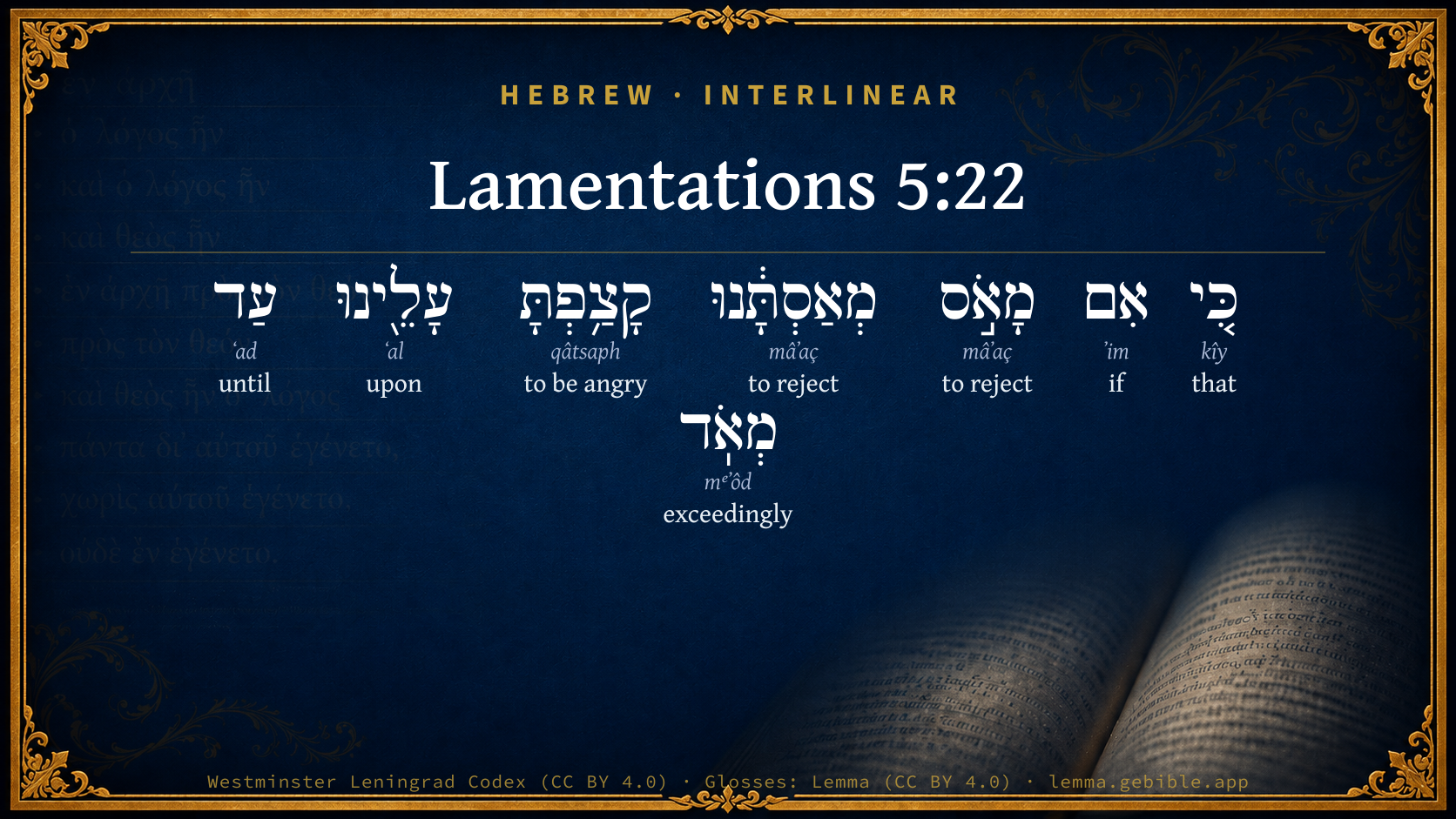
Lamentations 5:22

Hebrew (Westminster Leningrad Codex) Lamentations 5:22 appears in the Hebrew Old Testament. The text above is from the Westminster Leningrad Codex. Each word links to its Strong’s number, a concise gloss, and parsing drawn from the Open Scriptures Hebrew Bible morphology. Click any word for its full Brown-Driver-Briggs (BDB) entry.
Download image
Cite this verse

Lamentations 5:22 (World English Bible). Public Domain. Lemma interlinear Bible study tool, https://lemma.gebible.app/v/lamentations/5/22.

Show BibTeX & RIS
BibTeX
RIS
English Translation
But you have utterly rejected us; You are very angry against us.
World English Bible · Public Domain
Download a study sheet

One document with this verse’s original text, its word-by-word gloss line, the meaning frame, cross-references with their text, attributed commentary, and full source and license credits — printable, and it pastes into notes with its structure intact.

This verse Autodidact and up

Study sheet (.html) Plain text (.txt)

A passage Seminary Student

Up to 50 verses in one chapter. A passage sheet keeps up to 6 commentary sources and 12 cross-references per verse, in the order this page ranks them, and says so on the sheet whenever that leaves anything out. Ask for a single verse and you get the Autodidact verse sheet above.

Everything on this page stays free to read, with no account — the sheet is a download of what is already on screen, not access to it.

Want to remove ads? Support Godless Engineer
Compare translations 3

The same verse in 3 English versions, stacked beneath the original-language interlinear above. Click any original word for its lexicon entry.

Each is an independent rendering of the whole verse — the interlinear is not word-aligned to these translations.

Highlighted words mark where these versions differ — a whole-verse word diff, not a word-by-word alignment.

  • World English Bible Public Domain
    But you have utterly rejected us; You are very angry against us.
  • King James Version Public Domain
    But thou hast utterly rejected us; thou art very wroth against us.
  • unfoldingWord Literal Text CC BY-SA 4.0
    For have you rejecting, rejected us? Have you been angry against us beyond measure?

unfoldingWord Literal Text — © unfoldingWord, licensed CC BY-SA 4.0. Word-aligned USFM3 via Door43 (git.door43.org/unfoldingWord/en_ult).

Versions to compare (up to 4)

3 of 4 selected

Show all 18 translations

Every available English version of this verse, each an independent rendering of the whole verse.

  • World English Bible Public Domain
    But you have utterly rejected us; You are very angry against us.
  • Berean Standard Bible Public Domain
    unless You have utterly rejected us and remain angry with us beyond measure.
  • Majority Standard Bible Public Domain
    unless You have utterly rejected us and remain angry with us beyond measure.
  • King James Version Public Domain
    But thou hast utterly rejected us; thou art very wroth against us.
  • American Standard Version (1901) Public Domain
    But thou hast utterly rejected us; Thou art very wroth against us.
  • Revised Version (1885) Public Domain
    But thou hast utterly rejected us, thou art very wroth against us.
  • Geneva Bible (1599) Public Domain
    But thou hast vtterly reiected vs: thou art exceedingly angry against vs.
  • Douay-Rheims (1899) Public Domain
    But thou hast utterly rejected us, thou art exceedingly angry against us.
  • Young's Literal Translation Public Domain
    For hast Thou utterly rejected us? Thou hast been wroth against us -- exceedingly?
  • Literal Standard Version CC BY-SA 4.0
    For have You utterly rejected us? You have been angry against us—exceedingly?
  • Unlocked Literal Bible CC BY-SA 4.0
    unless you have utterly rejected us and you are angry with us beyond measure.
  • unfoldingWord Literal Text CC BY-SA 4.0
    For have you rejecting, rejected us? Have you been angry against us beyond measure?
  • Darby Bible Public Domain
    Or is it that thou hast utterly rejected us? Wouldest thou be exceeding wroth against us?
  • World Messianic Bible Public Domain
    But you have utterly rejected us. You are very angry against us.
  • Webster's Bible Public Domain
    But thou hast utterly rejected us; thou art very wroth against us.
  • Free Bible Version CC BY-SA 4.0
    Or have you have completely rejected us? Are you still really furious with us?
  • Bible in Basic English Public Domain
    But you have quite given us up; you are full of wrath against us.
  • JPS Tanakh (1917) Public Domain
    Thou canst not have utterly rejected us, and be exceeding wroth against us!

Literal Standard Version (2020), Covenant Press — licensed CC BY-SA 4.0. Text via the HelloAO Bible API (eBible.org). Unlocked Literal Bible (unfoldingWord) — licensed CC BY-SA 4.0. Text via the HelloAO Bible API (eBible.org). unfoldingWord Literal Text — © unfoldingWord, licensed CC BY-SA 4.0. Word-aligned USFM3 via Door43 (git.door43.org/unfoldingWord/en_ult). Free Bible Version, Dr. Jonathan Gallagher — licensed CC BY-SA 4.0. Text via the HelloAO Bible API (eBible.org).

Word by word

More ways to search: Search by grammar → Find every occurrence → Compare this word →

Practice this passage: Drill this verse → Learn its vocabulary →

About this verse

These counts appear in no published source. They are computed here, from the morphology-tagged text and Lemma’s own curated glosses. What Lemma adds →

8
words
7
distinct lemmas
Prophets
section

Shared distinctive vocabulary

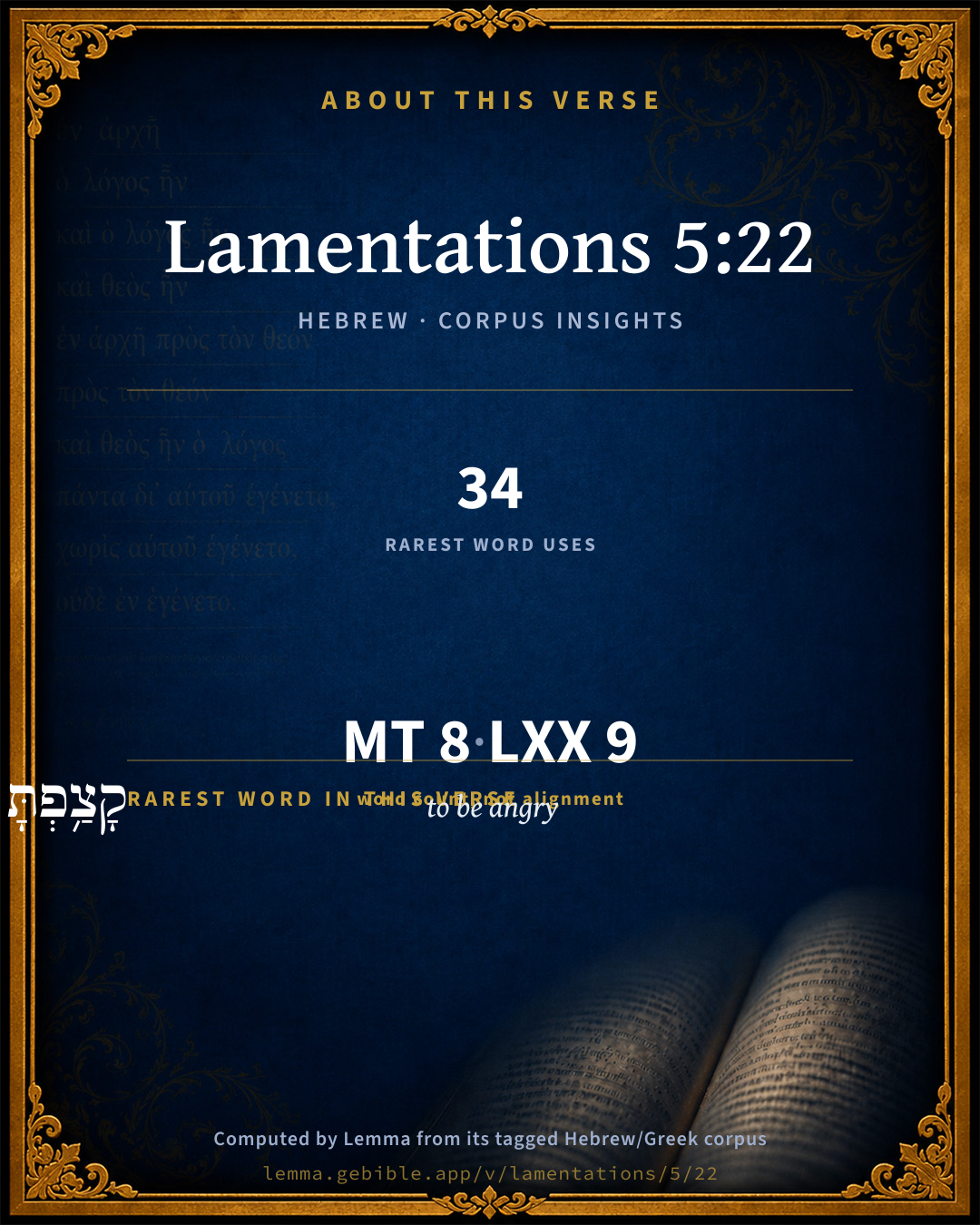
קָצַ֥פְתָּ to be angry H7107 occurs in 32 verses of the Hebrew Bible. Also found in:

Grammatical profile

  • 3 verbs
  • 2 prepositions
  • 2 conjunctions
  • 1 adverb

Verb forms

  • מָאֹ֣ס Qal · Infinitive Absolute
  • מְאַסְתָּ֔נוּ Qal · Perfect
  • קָצַ֥פְתָּ Qal · Perfect

Repetition

A word recurs within this verse — often emphatic in Hebrew:

  • מָאֹ֣ס to reject H3988 ×2

Hebrew & Septuagint length

In English translation the verse runs 12 words from the Hebrew and 13 from the Septuagint (LXX English) — closely comparable.

A rough comparison of the two English renderings, which tokenize alike — not a word-level alignment.

Word counts can differ between the Hebrew and the Greek without any difference in meaning — e.g. the Hebrew direct-object marker אֵת has no separate Greek word, and Greek often adds the article ὁ.

In the original languages it is 8 Hebrew tokens and 9 Greek tokens — but the two are counted differently (Hebrew bundles its prefixes and suffixes into one token; the Greek is in lemma form), so that isn’t a like-for-like length.

Cross-references

6

Topical passages linked to Lamentations 5:22 in the Treasury of Scripture Knowledge — connected by theme and wording, ordered by reader-vote popularity; previews shown in the World English Bible.

  • Psalms 60:1–2 God, you have rejected us. You have broken us down. You have been angry. Restore us, again.
  • Hosea 1:6 She conceived again, and bore a daughter. Then he said to him, "Call her name Lo-Ruhamah; for I will no longer have mercy on the house of Israel, that I should in any way pardon them.
  • Psalms 44:9 But now you rejected us, and brought us to dishonor, And don't go out with our armies.
  • Isaiah 64:9 Don't be angry very sore, Yahweh, neither remember iniquity forever: see, look, we beg you, we are all your people.
  • Jeremiah 15:1–5 Then said Yahweh to me, Though Moses and Samuel stood before me, yet my mind would not be toward this people: cast them out of my sight, and let them go forth.
  • Ezekiel 37:11 Then he said to me, Son of man, these bones are the whole house of Israel: behold, they say, Our bones are dried up, and our hope is lost; we are clean cut off.

Cross-references courtesy of OpenBible.info (CC BY 4.0).

Hebrew and Greek witnesses Masoretic Hebrew ↔ Greek Septuagint

The same verse in the two great witnesses to the Old Testament, shown verse-for-verse.

These are two independent witnesses, not word-aligned to each other, and the Septuagint is shown in lemma (dictionary) form.

Hebrew Lamentations 5:22 Masoretic · Westminster Leningrad Codex

כִּ֚י אִם מָאֹ֣ס מְאַסְתָּ֔נוּ קָצַ֥פְתָּ עָלֵ֖ינוּ עַד מְאֹֽד

But you have utterly rejected us; You are very angry against us.

World English Bible · Public Domain

Greek LXX Lamentations 5:22 Septuagint · lemma form

ὅτι ἀποὠθέω ἀποὠθέω ἐγώ ὀργίζω ἐπί ἐγώ ἕως σφόδρα

For you have indeed rejected us; you have been very angry against us.

LXX2012 (modern English Septuagint) · Public Domain

Hebrew: Westminster Leningrad Codex (CC BY 4.0). Greek: Septuagint (public domain); English from LXX2012 (modern English Septuagint) (Public Domain). How the Septuagint differs from the Hebrew →

Commentary

Notes on Lamentations 5:22 from classic Christian and Jewish commentators (each source and its license shown beneath its notes). The classic Christian expositions comment on the surrounding passage and are grouped to its opening verse, so a note may address several verses; the Jewish commentaries on the Tanakh (Rashi and others) are per-verse, so they appear only where the commentator wrote on this verse.

Lemma curates 59 commentaries, every one of them public domain or Creative Commons licensed, each selected and text-cleaned for this edition rather than reprinted as found. About our sources →

Ellicott's Commentary for English Readers

(22) But thou hast . . .—The Authorised version represents the mourner as falling back from the hopeful prayer into the depths of despair. For “but” we should, however, read unless. The hypothesis of utter rejection is just stated as the only thing that could prevent renewal and restoration, and it is stated as per impossible; God has not rejected, and therefore He will renew.

It may be noted that in Synagogue use, and in many MSS., Lam_5:21 is repeated after Lam_5:22, so that the book may not end with words of so terrible a significance. The same practice obtained in the case of the last verse of Isaiah, Ecclesiastes, and Malachi.

A Bible Commentary for English Readers, edited by Charles John Ellicott (1878–1897) — public domain. Text from a community e-Sword module.

Trapp's Complete Commentary

John Trapp

Lam 5:22 But thou hast utterly rejected us; thou art very wroth against us.

Ver. 22. But thou hast utterly rejected us.] This is a sad catastrophe, or close of this doleful ditty, {a} Sometimes God’s suppliants are put hard to it in the course of their prayers; the last grain of their faith and patience seemeth to be put into the scale. When the Son of man cometh with deliverance to his praying people, shall he find faith in the earth? Hard and scarce; and yet he comes oft when they have even done looking for him. He is seen in the mount; he helpeth those that are forsaken of their hopes: hallelujah. Sure it is that God cannot utterly reject his people whom he hath chosen. {Rom 11:2-5} Tremellius rendereth it - and so the margin of our Bibles hath it, and I think better - For wilt thou utterly reject us, or be extremely wroth with us - scil., supra modulum nostrum - according to thine infinite power, and above all that we are able to bear? I cannot think it, neither doth it consist with thy covenant.

Here (as also at the end of Ecclesiastes, Isaiah, and Malachi) many of the Hebrew Bibles repeat the foregoing verse, Turn thou us unto thee, O Lord, &c., yet without points, lest anything should seem added thereby to the holy Scriptures. {Hebrew Text Note} The reason hereof read in the end of the prophecy of Isaiah. {See Trapp on "Isa 66:24"} This is also here observed by the most renowned Mr Thomas Gataker, whom, for honour’s sake, I name, and to whose most accurate and elaborate annotations upon Isaiah and Jeremiah I have been not a little beholden all along. These he finished not long before his death, to the great glory of God and good of his Church. And of him, and this worthy work of his, I may fitly say, as a learned man doth of Magellan of Portugal (that great navigator), that the strait or sea now called by his name - Fretum Magellanicum - una navigatione simul et immortalem gloriam et mortem ei attulerit - was both his death and his never dying monument. {b}

“Hitherto hath the Lord helped us.” - {1Sa 7:12}

{a} Est aposiopesis ad pathos.

{b} Boxhorn Histor. Universal.

John Trapp, A Commentary or Exposition upon All the Books of the Old and New Testament (1647–1656) — public domain. Text from a community e-Sword module.

Tyndale Open Study Notes

Tyndale Open Resources

5:22 have you utterly rejected us? The tragedy of the Exile raised the question of whether God would forgive sin and restore his people. God answered clearly through the prophets (Isa 40:27-31; 41:8-20) and by sending Christ (Matt 9:2-6; 26:28; Luke 24:47).

Tyndale Open Study Notes — © Tyndale Open Resources, licensed CC BY-SA 4.0. Text via the HelloAO Bible API.

Jamieson, Fausset & Brown

Robert Jamieson, A. R. Fausset & David Brown

Rather, "Unless haply Thou hast utterly rejected us, and art beyond measure wroth against us," that is, Unless Thou art implacable, which is impossible, hear our prayer [CALVIN]. Or, as Margin, "For wouldest Thou utterly reject us?" &c.--No; that cannot be. The Jews, in this book, and in Isaiah and Malachi, to avoid the ill-omen of a mournful closing sentence, repeat the verse immediately preceding the last [CALVIN].

Next: Ezekiel Introduction

Jamieson, Fausset & Brown — Commentary Critical and Explanatory on the Whole Bible (1871) — public domain (CC PDM 1.0). Text via the HelloAO Bible API.

Adam Clarke's Commentary

Verse 22. But thou hast utterly rejected us] It appears as if thou hadst sealed our final reprobation, because thou showest against us exceeding great wrath. But convert us, O Lord, unto thee, and we shall be converted. We are now greatly humbled, feel our sin, and see our folly: once more restore us, and we shall never again forsake thee! He heard the prayer; and at the end of seventy years they were restored to their own land.

This last verse is well rendered in the first printed edition of our Bible, 1535: - Renue our daies as in olde tyme, for thou hast now banished us longe ynough, and bene sore displeased at us.

My old MS. Bible is not less nervous: Newe thou our dais as fro the begynnyng: bot castand aweie thou put us out: thou wrathedist ugein us hugely.

Dr. Blayney translates, "For surely thou hast cast us off altogether:" and adds, "כי ki ought certainly to be rendered as causal; God's having rejected his people, and expressed great indignation against them, being the cause and ground of the preceding application, in which they pray to be restored to his favour, and the enjoyment of their ancient privileges."

Pareau thinks no good sense can be made of this place unless we translate interrogatively, as in Jer 14:19: -

"Hast thou utterly rejected Judah?

Hath thy soul loathed Sion?"

On this ground he translates here,

An enim prorsus nos rejecisses?

Nobis iratus esses usque adeo?

"Hast thou indeed utterly cast us off?

Wilt thou be angry with us for ever?"

Wilt thou extend thy wrath against us so as to show us no more mercy? This agrees well with the state and feelings of the complainants.

MASORETIC NOTES

Number of verses in this Book, 154.

Middle verse, La 3:34.

In one of my oldest MSS., the twenty-first verse is repeated at the conclusion of the twenty-second verse. In another, yet older, there is only the first word of it, השיבנו hashibenu, Convert us!

Having given in the preceding preface and notes what I judge necessary to explain the principal difficulties in this very fine and affecting poem, very fitly termed THE LAMENTATIONS, as it justly stands at the head of every composition of the kind, I shall add but a few words, and these shall be by way of recapitulation chiefly.

The Hebrews were accustomed to make lamentations or mourning songs upon the death of great men, princes, and heroes, who had distinguished themselves in arms; and upon any occasion of public miseries and calamities. Calmet thinks they had collections of these sorts of Lamentations: and refers in proof to 2Ch 35:25: "And Jeremiah lamented for Josiah; and all the singing men and the singing women spake of Josiah in their lamentations, to this day; and made them an ordinance in Israel: and, behold, they are written in the Lamentations."

From this verse it is evident, that Jeremiah had composed a funeral elegy on Josiah: but, from the complexion of this Book, it is most evident that it was not composed on the death of Josiah, but upon the desolations of Jerusalem, c., as has already been noted. His lamentation for Josiah is therefore lost. It appears also, that on particular occasions, perhaps anniversaries, these lamentations were sung by men and women singers, who performed their several parts for these were all alternate or responsive songs. And it is very likely, that this book was sung in the same way; the men commencing with aleph, the women responding with beth and so on. Several of this sort of songs are still extant. We have those which David composed on the death of his son Absalom, and on the death of his friend Jonathan. And we have those made by Isaiah, Jeremiah, and Ezekiel, on the desolation of Egypt, Tyre, Sidon, and Babylon. See Isa 14:4-5; Isa 15:1-9; Isa 16:1-14; Jer 7:29; Jer 9:10; Jer 48:32; Eze 19:1; Eze 28:11; Eze 32:2; Jer 9:17. Besides these, we have fragments of others in different places; and references to some, which are now finally lost.

In the two first chapters of this book, the prophet describes, principally, the calamities of the siege of Jerusalem.

In the third, he deplores the persecutions which he himself had suffered; though he may in this be personifying the city and state; many of his own sufferings being illustrative of the calamities that fell generally upon the city and people at large.

The fourth chapter is employed chiefly on the ruin and desolation of the city and temple; and upon the misfortunes of Zedekiah, of whom he speaks in a most respectful, tender, and affecting manner: -

"The anointed of Jehovah, the breadth of our

nostrils, was taken in their toils,

Under whose shadow we said, We shall live

among the nations."

At the end he speaks of the cruelty of the Edomites, who had insulted Jerusalem in her miseries, and contributed to its demolition. These he threatens with the wrath of God.

The fifth chapter is a kind of form of prayer for the Jews, in their dispersions and captivity. In the conclusion of it, he speaks of their fallen royalty; attributes all their calamities to their rebellion and wickedness; and acknowledges that there can be no end to their misery, but in their restoration to the Divine favour.

This last chapter was probably written some considerable time after the rest: for it supposes the temple to be so deserted, that the foxes walked undisturbed among its ruins, and that the people were already in captivity.

The poem is a monument of the people's iniquity and rebellion; of the displeasure and judgment of GOD against them; and of the piety, eloquence, and incomparable ability of the poet.

Adam Clarke's Commentary on the Bible (1810–1826) — public domain. Text from a community e-Sword/MySword module.

John Calvin's Commentaries

The two words כי אם, ki am, are differently explained: some render them, “but if,” or “certainly if,” and thus separate the verse into two parts, “Surely if thou hast rejected us, thou art very angry;” but this is a forced meaning, not intended, as I think, by the Prophet. And these seem to have been compelled by necessity to pervert the Prophet’s words; because it appears hard simply to declare that the people had been wholly rejected by God. As, then, this harshness offended them, they contrived this comment, “If thou hast rejected us, thou art very angry.” But as I have said, this exposition I do not approve of, because it is a very forced one; and the greater part of interpreters follow what I stated in the first place, for they take כי אם, ki am, adversatively. The two particles are often connected together, and rendered, “though” or although, — “Though thou hast rejected us:” and hence the last verse has been repeated.

For the Jews labor under this superstition, that when a book ends with a hard and severe sentence, or one containing a dreadful threatening, grating to the ears, in order to avoid the sad omen, they repeat the last verse but one. So they do at the end of Isaiah, and at the end of Malachi. As Isaiah says, “It shall be a horror (or abomination) to all flesh;” they therefore repeat the previous verse. So in Malachi; as he says, “Lest I come and smite the earth with a curse — חרם, cherem,” they think that as he pronounces there an anathema, it is a sort of charm that may absorb this curse, to have the previous verse repeated after it. There is, then, no doubt but that they took this passage in the same sense, “Though thou hast rejected us,” etc.

If this explanation be approved, we must hold that the Prophet here exceeded due limits, as also the faithful, in their prayers, do not always so restrain themselves, but that some heat bubbles up; for we see how David, in the Psalms, too often shewed this kind of feeling; and it is hence evident, that his mind was not always sufficiently calm. We must then say, that the Prophet was impelled by a turbulent feeling when he uttered these words.

But כי אם, ki am, may also be rendered, “Unless,” or except’ and it is singular that no one has perceived this, though it be not an unsuitable meaning, “Except it may be thou rejecting hast rejected us, and hast become very angry with us,” or above measure angry; for עד מאד, od mad in Hebrew, means the same as above measure (supra modum) in Latin. Though the Prophet seems to speak doubtingly, by laying down t, his condition, there is vet no doubt but that he struggled against all unbelief, when he said, Except it may be; for he reasons from what is impossible, “Turn thou us to thee and we shall be turned, renew our days as formerly; except it may be thou hast rejected us:” but this was impossible. Then, as I have said, the Prophet here strengthens himself by setting up a shield against all the assaults of temptations when he says, Except it may be thou hast rejected us

But it cannot be that God will reject his people, and be so angry with them, as never to be reconciled. We hence see that the Prophet does not simply set down the condition, as though he said, “O God, if thou art to be perpetually angry with us, and wilt never be reconciled, it is there all over with our salvation; but if thou wilt be reconciled to us, we shall then entertain good hope.” No, the Prophet did not thus keep his own mind and the minds of others in suspense, but had a sure confidence as to God’s favor; for it cannot be that God will ever forsake those whom he has chosen, as Paul also shews in the eleventh chapter of the Epistle to the Romans.

As it has so seemed good to the brethren, I will begin tomorrow the explanation of Ezekiel.

John Calvin's Commentaries (1540-1563) — public domain. Text from the Calvin Translation Society English edition (1840s-50s) via the Christian Classics Ethereal Library (ccel.org). Calvin's coverage is partial (roughly two-thirds of the Bible); uncommented books and verses are honest gaps, never fabricated. The 19th-century editor's footnotes and remarks are omitted so the notes are faithfully Calvin's own voice.

The Cambridge Bible for Schools and Colleges

gen. ed. J. J. S. Perowne

22. But, etc.] better as mg., Unless thou … and art, etc. The whole sentence is an hypothesis not to be accepted as fact. God’s anger cannot last for ever, and thus there is yet hope.

Although the Book does in fact close with the language of hope, that is so little apparent on the first reading that in the synagogues Lam_5:21 was repeated at the end, that its words might thus be the last to fall upon the ear. A similar expedient is used in the case of Ecclesiastes, Isaiah, Malachi. See note on Jer_52:34.

The Cambridge Bible for Schools and Colleges (gen. ed. J. J. S. Perowne; Cambridge University Press, 1878–1918) — public domain. Text from a community e-Sword module.

John Gill's Exposition

But thou hast utterly rejected us,.... That looks as if they had no hope, and were in despair of having their petitions granted; since God had entirely rejected them from being his people, and would never more have mercy on them; but the words may be rendered, "though thou hast in rejecting rejected us" (e); or else, "unless thou hast utterly rejected us" (f); or rather by an interrogation, "for wilt thou utterly reject", or "despise us?" (g) surely thou wilt not; such is thy grace and goodness:

thou art very wroth against us; thou hast been, and still continuest to be: or, "wilt thou be exceeding wroth against us?" (h) or continue thy wrath to extremity, and for ever? thou wait not; it is not consistent with, thy mercy and grace, truth and faithfulness; and so it is an argument of faith in prayer, and not an expression of despondency; though the Jews, because they would not have the book end in what is sorrowful and distressing, repeat the foregoing verse; and the like method they take at the end of Ecclesiastes, and the prophecies of Isaiah and Malachi, as Jarchi observes.

(e) "quamvis detestatione detestatus es nos", Targ. (f) "Nisi forte repudiando repudiasti nos", Calvin. (g) "Nam an omnino sperneres nos?" Junius & Tremellius. (h) "effervesceres contra nos admodum?" Junius & Tremellius.

Next: Ezekiel Introduction

John Gill's Exposition of the Whole Bible (1746–1763) — public domain (CC PDM 1.0). Text via the HelloAO Bible API.

Albert Barnes' Notes on the Bible

Literally, “Unless thou hast utterly rejected us,” unless “thou art very wroth against us.” This is stated as a virtual impossibility. God’s anger can be but temporary Psa 30:5, and therefore the very supposition is an indirect expression of hope.

This verse speaks of the possibility of an utter rejection through God’s wrath. Therefore, to remove so painful a thought, and to make the book more suited for public reading, Lam 5:21 is repeated in many manuscripts intended for use in the synagogue. The same rule is observed in the synagogue with the two last verses of Ecclesiastes, Isaiah, and Malachi.

Albert Barnes' Notes on the Bible (1834–1885) — public domain. Text from a community e-Sword/MySword module.

Haydock's Catholic Bible Commentary

CHAPTER V.

Thou hast. We might read with an interrogation, (Haydock) in Hebrew, "Hast thou?" &c. The Jews superstitiously repeat the last verse, for fear of ending the book in an ominous manner, as they do at the end of Isaias and Malachias. (Calmet) --- Having treated us so severely, stop thy hand. (Worthington) --- But I perceive it will be in vain to beg for redress till the seventy years be expired. (Menochius)

George Leo Haydock (1774–1849), Haydock's Catholic Family Bible and Commentary, 1859 edition — public domain. Excludes Psalms (Douay-Rheims chapter numbering differs from Protestant) and Deuterocanonical books (Catholic canon only).

Matthew Poole's English Annotations

Our translators have here so rendered the particle כי that the words seem to express some diffidence in the prophet of God’s mercy in restoring the people to their former state, some expressions of which nature we find falling from the most eminent servants of God in an hour of great temptation; but where such a sense is not necessary, it is hard to put it upon a text. Some therefore expound כי אם in this place by But if. Others translate them, Although thou hast, &c. Mr. Calvin preferreth the translation of them by Nisi, Unless thou hast utterly rejected us, and thinks that by this expression the prophet confirmeth himself against temptations of diffidence, because it was impossible God should utterly cast off his people, Rom 11:2. Others read it interrogatively, Hast thou utterly rejected us? which doth not suppose that the prophet believed he had, though his present providence showed him very angry with them.

Matthew Poole's English Annotations on the Holy Bible (1683–1685) — public domain. Text from a community e-Sword/MySword module.

The Pulpit Commentary

But; rather, unless. The poet wishes to suggest that the idea seems to him inconsistent with the covenant relationship of Jehovah towards Israel. May we not compare a striking passage in Isaiah which should probably be rendered thus: "A wife of one"s youth, can she be rejected? saith thy God"? (Isa_54:6) Both passages express, in a most delicate way, the incredulity of the writers with regard to the absolute rejection of Israel. And thus this melancholy Book of Lamentations concludes with a hope, "faint, yet pursuing," of the final realization of the promises to Israel. The interpretation adopted admits of no reasonable doubt, in spite of the fact that ancient doctors of the synagogue thought otherwise when they established the custom of repeating ver. 21 after ver. 22 had been read, in order to soften the supposed gloomy impression of ver. 22.

The Pulpit Commentary (1880–1919), ed. H.D.M. Spence-Jones & Joseph S. Exell — public domain. Text from a community e-Sword module.

Rashi

Rabbi Shlomo Yitzchaki (Rashi)

For if You have utterly rejected us because we have sinned, You should not have been exceedingly wroth as much as You were wroth.

Restore us...O Lord Since he concludes with words of reproof, he had to repeat the preceding verse again, and so it is in Isaiah, the Twelve Prophets, and Ecclesiastes.

Rashi on the Tanakh — English translations: “The Judaica Press complete Tanach with Rashi, translated by A. J. Rosenberg” (CC BY 4.0); “Pentateuch with Rashi's commentary by M. Rosenbaum and A.M. Silbermann, 1929-1934” (public domain); “The Metsudah Tanach series, Lakewood, N.J” (CC BY 4.0); and “The Book of Joshua, Metsudah Publications, 1997” (CC BY 4.0). Text via Sefaria.

Lesson kit

Teaching starters — assembled from the data on this page, not authored interpretation. Every prompt links to the verse data it draws on. Edit before teaching.

Lamentations, in the Prophets, opens this verse with 8 words (7 distinct Hebrew lemmas). Its most distinctive word is qâtsaph (“to be angry”). A historical commentator’s framing appears above. Read the whole chapter for the surrounding context.

Discussion questions

  1. The word qâtsaph carries the sense “to be angry.” How does it shape the verse?
  2. Genesis 40:2 shares the word «to be angry» with this verse. How do the two illuminate each other?
  3. “to reject” occurs 2× in this one verse. What is the effect of the repetition?
  4. These translations render this verse differently; the difference is in the English rendering, not the original. What questions does that raise?
  5. The verb «מָאֹ֣ס» is Qal Infinitive Absolute. How does its form color the action?
  6. Reading how Ellicott's Commentary for English Readers and Trapp's Complete Commentary read this verse, where do the two commentators agree and where do they part?

Things to notice

Reading settings

Reading text

Shown beneath each verse's original-language words.

Old Testament
Old Testament edition

Read the OT as the Masoretic Hebrew (MT) or the Greek Septuagint (LXX).

English shown for the Greek Septuagint (in the Hebrew ↔ Greek comparison).

Comparing translations? Open the Compare panel on any verse page to stack up to four side by side.