
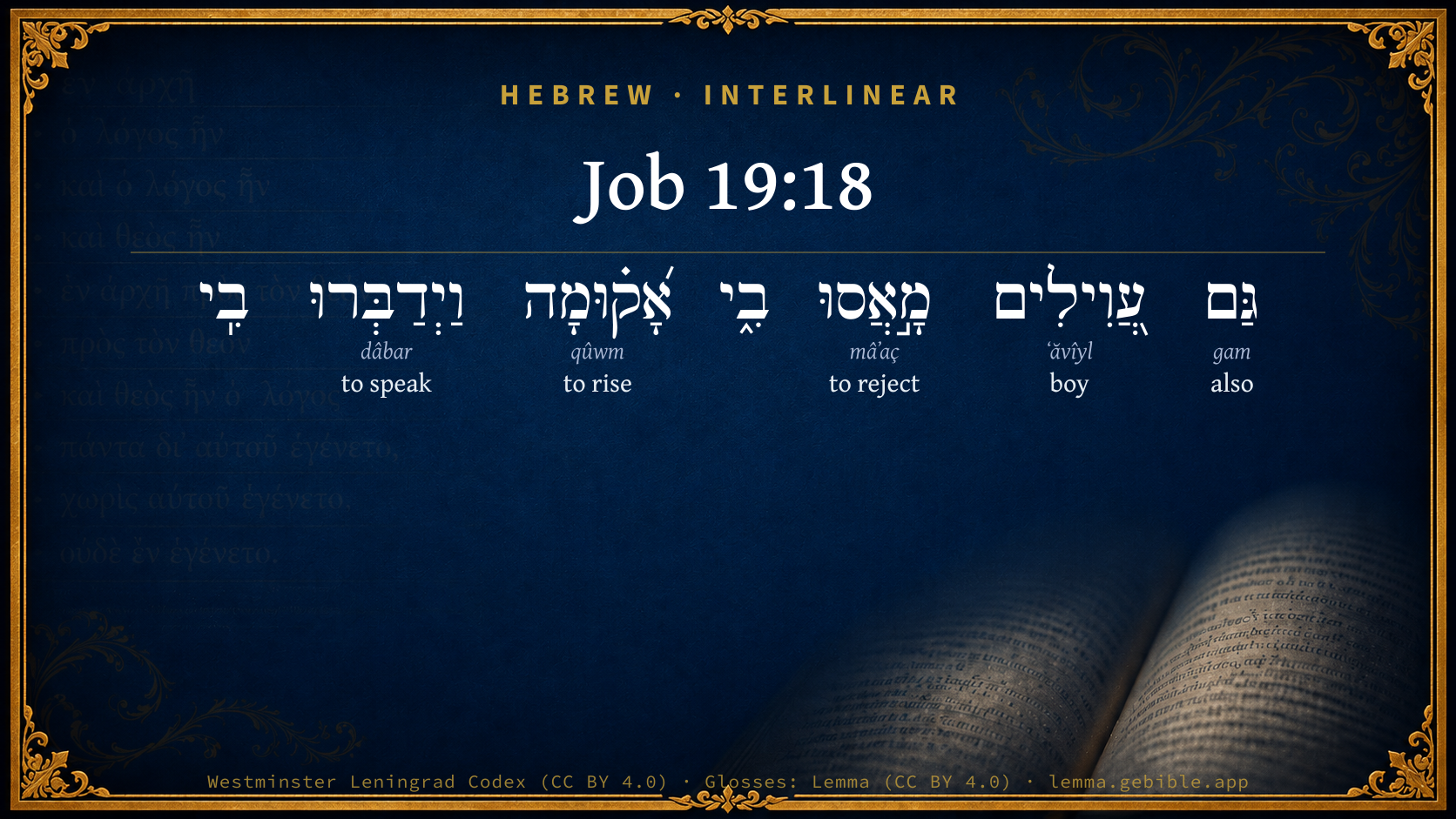
Job 19:18

Hebrew (Westminster Leningrad Codex) Job 19:18 appears in the Hebrew Old Testament. The text above is from the Westminster Leningrad Codex. Each word links to its Strong’s number, a concise gloss, and parsing drawn from the Open Scriptures Hebrew Bible morphology. Click any word for its full Brown-Driver-Briggs (BDB) entry.
Download image
Cite this verse

Job 19:18 (World English Bible). Public Domain. Lemma interlinear Bible study tool, https://lemma.gebible.app/v/job/19/18.

Show BibTeX & RIS
BibTeX
RIS
English Translation
Even young children despise me. If I arise, they speak against me.
World English Bible · Public Domain
Highlights
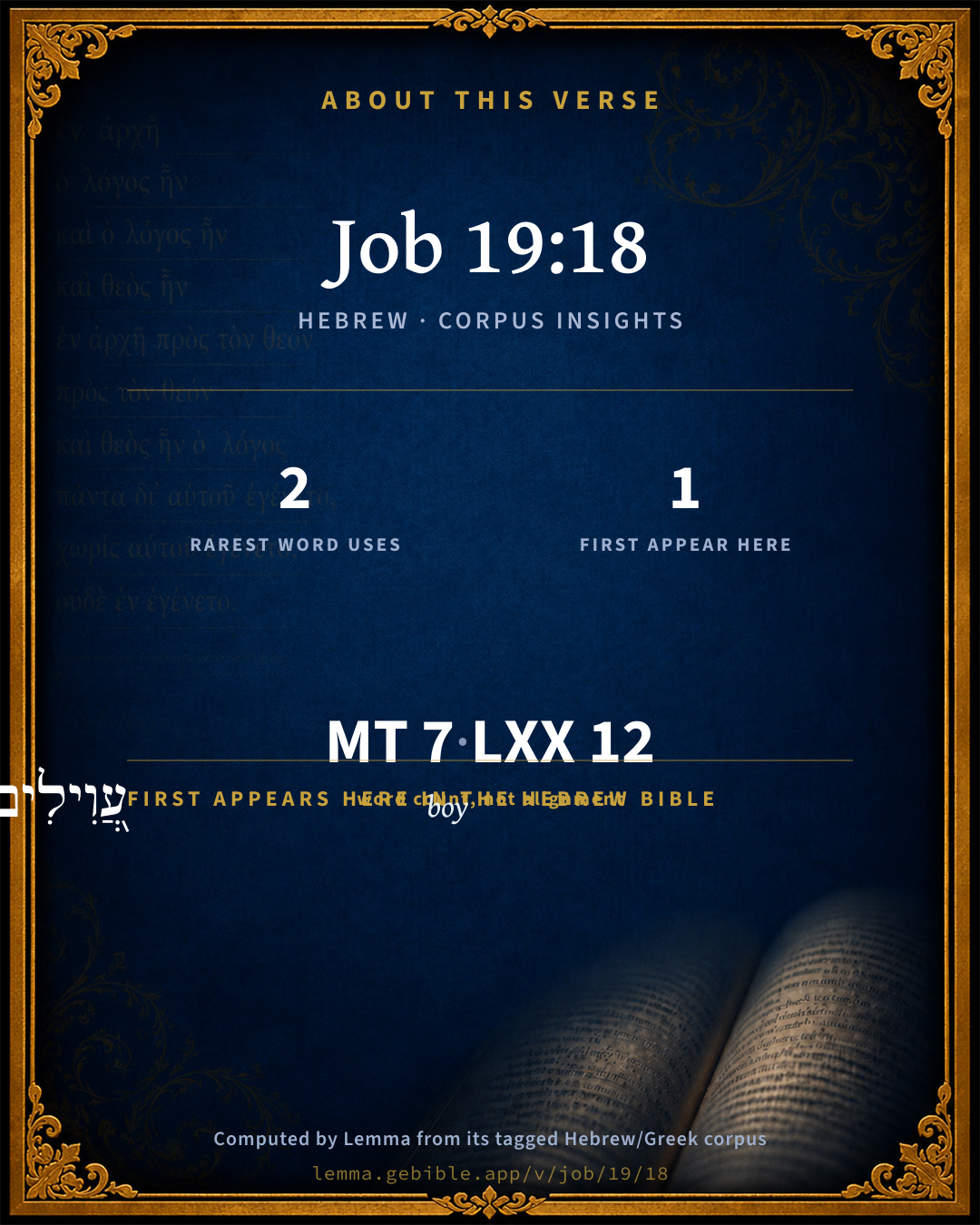
  • 1 first appearance in the Hebrew Bible
Full analysis ↓
Download a study sheet

One document with this verse’s original text, its word-by-word gloss line, the meaning frame, cross-references with their text, attributed commentary, and full source and license credits — printable, and it pastes into notes with its structure intact.

This verse Autodidact and up

Study sheet (.html) Plain text (.txt)

A passage Seminary Student

Up to 50 verses in one chapter. A passage sheet keeps up to 6 commentary sources and 12 cross-references per verse, in the order this page ranks them, and says so on the sheet whenever that leaves anything out. Ask for a single verse and you get the Autodidact verse sheet above.

Everything on this page stays free to read, with no account — the sheet is a download of what is already on screen, not access to it.

Want to remove ads? Support Godless Engineer
Compare translations 3

The same verse in 3 English versions, stacked beneath the original-language interlinear above. Click any original word for its lexicon entry.

Each is an independent rendering of the whole verse — the interlinear is not word-aligned to these translations.

Highlighted words mark where these versions differ — a whole-verse word diff, not a word-by-word alignment.

  • World English Bible Public Domain
    Even young children despise me. If I arise, they speak against me.
  • King James Version Public Domain
    Yea, young children despised me; I arose, and they spake against me.
  • unfoldingWord Literal Text CC BY-SA 4.0
    Even young children despise me; let me arise, and they speak against me.

unfoldingWord Literal Text — © unfoldingWord, licensed CC BY-SA 4.0. Word-aligned USFM3 via Door43 (git.door43.org/unfoldingWord/en_ult).

Versions to compare (up to 4)

3 of 4 selected

Show all 18 translations

Every available English version of this verse, each an independent rendering of the whole verse.

  • World English Bible Public Domain
    Even young children despise me. If I arise, they speak against me.
  • Berean Standard Bible Public Domain
    Even little boys scorn me; when I appear, they deride me.
  • Majority Standard Bible Public Domain
    Even little boys scorn me; when I appear, they deride me.
  • King James Version Public Domain
    Yea, young children despised me; I arose, and they spake against me.
  • American Standard Version (1901) Public Domain
    Even young children despise me; If I arise, they speak against me.
  • Revised Version (1885) Public Domain
    Even young children despise me; if I arise, they speak against me.
  • Geneva Bible (1599) Public Domain
    The wicked also despised mee, and when I rose, they spake against me.
  • Douay-Rheims (1899) Public Domain
    Even fools despise me; and when I gone from them, they spoke against me.
  • Young's Literal Translation Public Domain
    Also sucklings have despised me, I rise, and they speak against me.
  • Literal Standard Version CC BY-SA 4.0
    Also sucklings have despised me, I rise, and they speak against me.
  • Unlocked Literal Bible CC BY-SA 4.0
    Even young children despise me; if I rise to speak, they speak against me.
  • unfoldingWord Literal Text CC BY-SA 4.0
    Even young children despise me; let me arise, and they speak against me.
  • Darby Bible Public Domain
    Even young children despise me; I rise up, and they speak against me.
  • World Messianic Bible Public Domain
    Even young children despise me. If I arise, they speak against me.
  • Webster's Bible Public Domain
    Yes, young children despised me; I arose, and they spoke against me.
  • Free Bible Version CC BY-SA 4.0
    Even young children despise me; when I stand up they ridicule me.
  • Bible in Basic English Public Domain
    Even young children have no respect for me; when I get up their backs are turned on me.
  • JPS Tanakh (1917) Public Domain
    Even urchins despised me; if I arise, they speak against me.

Literal Standard Version (2020), Covenant Press — licensed CC BY-SA 4.0. Text via the HelloAO Bible API (eBible.org). Unlocked Literal Bible (unfoldingWord) — licensed CC BY-SA 4.0. Text via the HelloAO Bible API (eBible.org). unfoldingWord Literal Text — © unfoldingWord, licensed CC BY-SA 4.0. Word-aligned USFM3 via Door43 (git.door43.org/unfoldingWord/en_ult). Free Bible Version, Dr. Jonathan Gallagher — licensed CC BY-SA 4.0. Text via the HelloAO Bible API (eBible.org).

Word by word

More ways to search: Search by grammar → Find every occurrence → Compare this word →

Practice this passage: Drill this verse → Learn its vocabulary →

About this verse

These counts appear in no published source. They are computed here, from the morphology-tagged text and Lemma’s own curated glosses. What Lemma adds →

7
words
5
distinct lemmas
Wisdom
section

Notable vocabulary

The rarest word here is עֲ֭וִילִים boy H5759 — appearing just 2 times in the whole Hebrew Bible.

First appearance in Scripture

This word makes its first canonical appearance in the Hebrew Bible here:

  • עֲ֭וִילִים boy H5759

Shared distinctive vocabulary

עֲ֭וִילִים boy H5759 occurs in 2 verses of the Hebrew Bible. Also found in:

Grammatical profile

  • 3 verbs
  • 1 noun
  • 2 prepositions
  • 1 particle

Verb forms

  • מָ֣אֲסוּ Qal · Perfect
  • אָ֝ק֗וּמָה Qal · Cohortative
  • וַיְדַבְּרוּ Piel · Sequential Imperfect

Hebrew & Septuagint length

In English translation the verse runs 12 words from the Hebrew and 14 from the Septuagint (LXX English) — closely comparable.

A rough comparison of the two English renderings, which tokenize alike — not a word-level alignment.

Word counts can differ between the Hebrew and the Greek without any difference in meaning — e.g. the Hebrew direct-object marker אֵת has no separate Greek word, and Greek often adds the article ὁ.

In the original languages it is 7 Hebrew tokens and 12 Greek tokens — but the two are counted differently (Hebrew bundles its prefixes and suffixes into one token; the Greek is in lemma form), so that isn’t a like-for-like length.

Cross-references

4

Topical passages linked to Job 19:18 in the Treasury of Scripture Knowledge — connected by theme and wording, ordered by reader-vote popularity; previews shown in the World English Bible.

  • 2 Kings 2:23 He went up from there to Bethel; and as he was going up by the way, there came forth young lads out of the city, and mocked him, and said to him, Go up, you baldy; go up, you baldhead.
  • Job 30:1 "But now those who are younger than I, have me in derision, Whose fathers I would have disdained to put with my sheep dogs.
  • Job 30:12 On my right hand rise the rabble. They thrust aside my feet, They cast up against me their ways of destruction.
  • Isaiah 3:5 The people will be oppressed, Everyone by another, And everyone by his neighbor. The child will behave himself proudly against the old man, And the base against the honorable.

Cross-references courtesy of OpenBible.info (CC BY 4.0).

Hebrew and Greek witnesses Masoretic Hebrew ↔ Greek Septuagint

The same verse in the two great witnesses to the Old Testament, shown verse-for-verse.

These are two independent witnesses, not word-aligned to each other, and the Septuagint is shown in lemma (dictionary) form.

Hebrew Job 19:18 Masoretic · Westminster Leningrad Codex

גַּם עֲ֭וִילִים מָ֣אֲסוּ בִ֑י אָ֝ק֗וּמָה וַיְדַבְּרוּ בִֽי

Even young children despise me. If I arise, they speak against me.

World English Bible · Public Domain

Greek LXX Job 19:18 Septuagint · lemma form

ὁ δέ εἰς ὁ αἰών ἐγώ ἀποποιέω ὅταν ἀναἵστημι κατά ἐγώ λαλέω

But they rejected me for ever; whenever I rise up, they speak against me.

LXX2012 (modern English Septuagint) · Public Domain

On this verse, Albert Barnes' Notes on the Bible discusses the Septuagint’s reading. Read the note in Commentary ↓

Hebrew: Westminster Leningrad Codex (CC BY 4.0). Greek: Septuagint (public domain); English from LXX2012 (modern English Septuagint) (Public Domain). How the Septuagint differs from the Hebrew →

Commentary

Notes on Job 19:18 from classic Christian and Jewish commentators (each source and its license shown beneath its notes). The classic Christian expositions comment on the surrounding passage and are grouped to its opening verse, so a note may address several verses; the Jewish commentaries on the Tanakh (Rashi and others) are per-verse, so they appear only where the commentator wrote on this verse.

Lemma curates 59 commentaries, every one of them public domain or Creative Commons licensed, each selected and text-cleaned for this edition rather than reprinted as found. About our sources →

Trapp's Complete Commentary

John Trapp

Job 19:18 Yea, young children despised me; I arose, and they spake against me.

Ver. 18. Yea, young children despised me] Fools, saith the Vulgate, who are never more pleasant than when they play the buffoons at my expense. Ungodly men, some render it, as Job 16:11. Others, the baser sort of people. And surely none so base as they that deride virtue, especially because forsaken of fortune, as one phraseth it. What a bitter jeer was that of Tobiah, the servant, or slave, the Ammonite! Neh 4:3. The basest can mock, as the abjects did David, Psa 44:15-16, and the alestakes also, Psa 69:12. But it is a happiness to do well, and yet hear ill. All God’s people must be ready to pass through good report and evil report, 2Co 6:8. And every Job must reckon, that as the reproacher is homine peior, a more worse man, not so much as a man (saith Chrysostom); so the reproached, that bears it well, is Angelis par, equal to the angels.

I arose, and they spake against me] I arose, sc. to rebuke them, or to pacify them, or to pass away from them, and my back is no sooner turned, but they reviled me. Some render it, Sto coram illis, I stand before them; that is, they stay not till I am gone past, but reproach me to my face, such is their boldness and baseness. See Isa 3:5.

John Trapp, A Commentary or Exposition upon All the Books of the Old and New Testament (1647–1656) — public domain. Text from a community e-Sword module.

Joseph Benson's Commentary

Job 19:18. Yea, young children despised me — Or, the wicked, as in the margin; and as the word עויליםalso signifies, being derived from עול, gniv-vel, inique egit, he acted unjustly. Some render it, fools, reading

אוילים, evilim, from אול. If we take the word in any of these senses, we must think that Job had good reason to complain, whether he was despised by children, by wicked men, or by fools. I arose, and they spake against we — To show my respect to them, though they were my inferiors, I rose from my seat, or I stood up, as the word אקומה, akumah, means. I did not disoblige, or provoke them, by any uncivil behaviour toward them; but was very courteous and condescending to them, and yet they made it their business to speak against me, and give me abusive words in return for my courtesy.

Joseph Benson's Commentary on the Old and New Testaments (1811–1818) — public domain. Text from a community e-Sword module.

Jamieson, Fausset & Brown

Robert Jamieson, A. R. Fausset & David Brown

young children--So the Hebrew means (Job 21:11). Reverence for age is a chief duty in the East. The word means "wicked" (Job 16:11). So UMBREIT has it here, not so well.

I arose--Rather, supply "if," as Job was no more in a state to stand up. "If I stood up (arose), they would speak against (abuse) me" [UMBREIT].

Jamieson, Fausset & Brown — Commentary Critical and Explanatory on the Whole Bible (1871) — public domain (CC PDM 1.0). Text via the HelloAO Bible API.

The Cambridge Bible for Schools and Colleges

gen. ed. J. J. S. Perowne

18. Another affecting touch—the little children mock his ineffectual attempts to rise from the ground.

children despised] Better, despise.

I arose, and they spake] Better, if I would arise they speak—they jeer at his painful efforts to rise.

The Cambridge Bible for Schools and Colleges (gen. ed. J. J. S. Perowne; Cambridge University Press, 1878–1918) — public domain. Text from a community e-Sword module.

John Gill's Exposition

All my inward friends abhorred me,.... Or "the men of my secret" (m); who were so very familiar with him, that he imparted the secrets of his heart, and the most private affairs of life, unto them, placing so much confidence in them, and treating them as his bosom friends; for this is always reckoned a great instance of friendship, Job 15:15; and yet their minds were set against him; their affections were alienated from him; they abhorred the sight of him, and declined all conversation with him, even all of them; not one showed respect unto him:

and they whom I loved; or "this whom I loved" (n); this and that and the other particular friend, that he loved more than others: though all men are to be loved as the creatures of God, and as fellow creatures, and especially good men, even all the saints; yet there are some that engross a greater share of love than others, among natural and spiritual relations; as Joseph was more loved by his father than the rest of his children; and, even by our Lord, John was loved more than the other disciples: and so Job, he had some particular friends that he loved above others; and yet these not only turned away from him in the time of his adversity, and turned their backs on him, and would have nothing to say to him for his comfort, nor afford him any relief of any kind in his distress, but

are turned against men; were turned against him, and became his enemies; and, as David says of some that he had a love for, for my love, "they are my adversaries", Psa 109:4.

(m) "viri secreti mei", Montanus; "homines secreti mei", Cocceius, Schmidt; "viri arcani mei", Beza, Mercerus; "homines arcani mei consilii", Michaelis. (n) "et quem", V. L. "et hie seu is quem", Mercerus, Drusius.

John Gill's Exposition of the Whole Bible (1746–1763) — public domain (CC PDM 1.0). Text via the HelloAO Bible API.

Albert Barnes' Notes on the Bible

Yea, young children - Margin, or “the wicked.” This difference between the text and the margin arises from the ambiguity of the original word - עוילים ‛ăvı̂ylı̂ym. The word עויל ‛ăvı̂yl (whence our word “evil”) means sometimes the wicked, or the ungodly, as in Job 16:11. It may also mean a child, or suckling, (from עוּל ‛ûl - to give milk, to suckle, 1Sa 7:7-10; Gen 22:13 : Ps. 77:71; Isa 40:11; compare Isa 49:15; Isa 65:20,) and is doubtless used in this sense here. Jerome, however, renders it “stulti - fools.” The Septuagint, strangely enough, “They renounced me forever.” Dr. Good renders it, “Even the dependents.” So Schultens, Etiam clientes egentissimi - “even the most needy clients.” But the reference is probably to children who are represented as withholding from him the respect which was due to age.

I arose, and they spake against me - “When I rise up, instead of regarding and treating me with respect, they make me an object of contempt and sport.” Compare the account of the respect which had formerly been shown him in Job 29:8.

Albert Barnes' Notes on the Bible (1834–1885) — public domain. Text from a community e-Sword/MySword module.

Haydock's Catholic Bible Commentary

Fools; wicked men, (Menochius) or the meanest of the people, (Calmet) whom (Haydock) these unnatural children (Calmet) resembled. Hebrew, "young children." (Protestants) (Haydock)

George Leo Haydock (1774–1849), Haydock's Catholic Family Bible and Commentary, 1859 edition — public domain. Excludes Psalms (Douay-Rheims chapter numbering differs from Protestant) and Deuterocanonical books (Catholic canon only).

Matthew Poole's English Annotations

Young children; or, fools; the most contemptible persons. I arose, to wit, from my seat, to show my respect to them, though they were my inferiors; to show my readiness to comply with that mean and low condition, into which God had now brought me. Or, I stood up; for so this word sometimes signifies. I did not disoblige or provoke them by any uncivil and uncomely carriage towards them, but was very courteous to them; and yet they make it their business to rail against me, as you also do.

Matthew Poole's English Annotations on the Holy Bible (1683–1685) — public domain. Text from a community e-Sword/MySword module.

Whedon's Commentary on the Bible

Daniel D. Whedon

18. I arose — The original intimates difficulty in so doing. The boys ridicule the efforts he makes to arise.

Daniel D. Whedon (gen. ed.), Commentary on the Old and New Testaments (1874–1909) — public domain. Text from a community e-Sword module.

The Pulpit Commentary

Yea, young children despised me. (So Rosenmuller, Canon Cook, and the Revised Version.) Others translate, "the vile," or "the perverse". (comp. Job_16:11) But the rendering of the Authorized Version receives support from Job_21:11. The forwardness of rude and ill-trained children to take part against God"s saints appears later in the history of Elisha. (2Ki_2:23, 2Ki_2:24) I arose, and they spake against me; or, when I arisethey speak against me (compare. the Revised Version).

The Pulpit Commentary (1880–1919), ed. H.D.M. Spence-Jones & Joseph S. Exell — public domain. Text from a community e-Sword module.

John Wesley's Explanatory Notes

Arose - From my seat, to shew my respect to them, though they were my inferiors.

John Wesley, Explanatory Notes Upon the Whole Bible (1754–1765) — public domain. Text via the GEBible commentary corpus.

Rashi

Rabbi Shlomo Yitzchaki (Rashi)

children despised me I was despised in the eyes of children, all the more so in the eyes of princes.

Rashi on the Tanakh — English translations: “The Judaica Press complete Tanach with Rashi, translated by A. J. Rosenberg” (CC BY 4.0); “Pentateuch with Rashi's commentary by M. Rosenbaum and A.M. Silbermann, 1929-1934” (public domain); “The Metsudah Tanach series, Lakewood, N.J” (CC BY 4.0); and “The Book of Joshua, Metsudah Publications, 1997” (CC BY 4.0). Text via Sefaria.

Lesson kit

Teaching starters — assembled from the data on this page, not authored interpretation. Every prompt links to the verse data it draws on. Edit before teaching.

Job, in the Wisdom, opens this verse with 7 words (5 distinct Hebrew lemmas). Its most distinctive word is ʻăvîyl (“boy”). A historical commentator’s framing appears above. Read the whole chapter for the surrounding context.

Discussion questions

  1. How does “boy” (ʻăvîyl) shape what this verse is saying?
  2. The word “boy” first appears here in Scripture. What is being introduced at this debut?
  3. Job 21:11 shares the word «boy» with this verse. How do the two illuminate each other?
  4. The translations on this page render this verse differently — a whole-verse word diff, not a word-by-word alignment. What might account for the different wordings?
  5. The verb «מָ֣אֲסוּ» is Qal Perfect. How does its form color the action?
  6. Reading how Trapp's Complete Commentary and Joseph Benson's Commentary read this verse, where do the two commentators agree and where do they part?

Things to notice

Reading settings

Reading text

Shown beneath each verse's original-language words.

Old Testament
Old Testament edition

Read the OT as the Masoretic Hebrew (MT) or the Greek Septuagint (LXX).

English shown for the Greek Septuagint (in the Hebrew ↔ Greek comparison).

Comparing translations? Open the Compare panel on any verse page to stack up to four side by side.