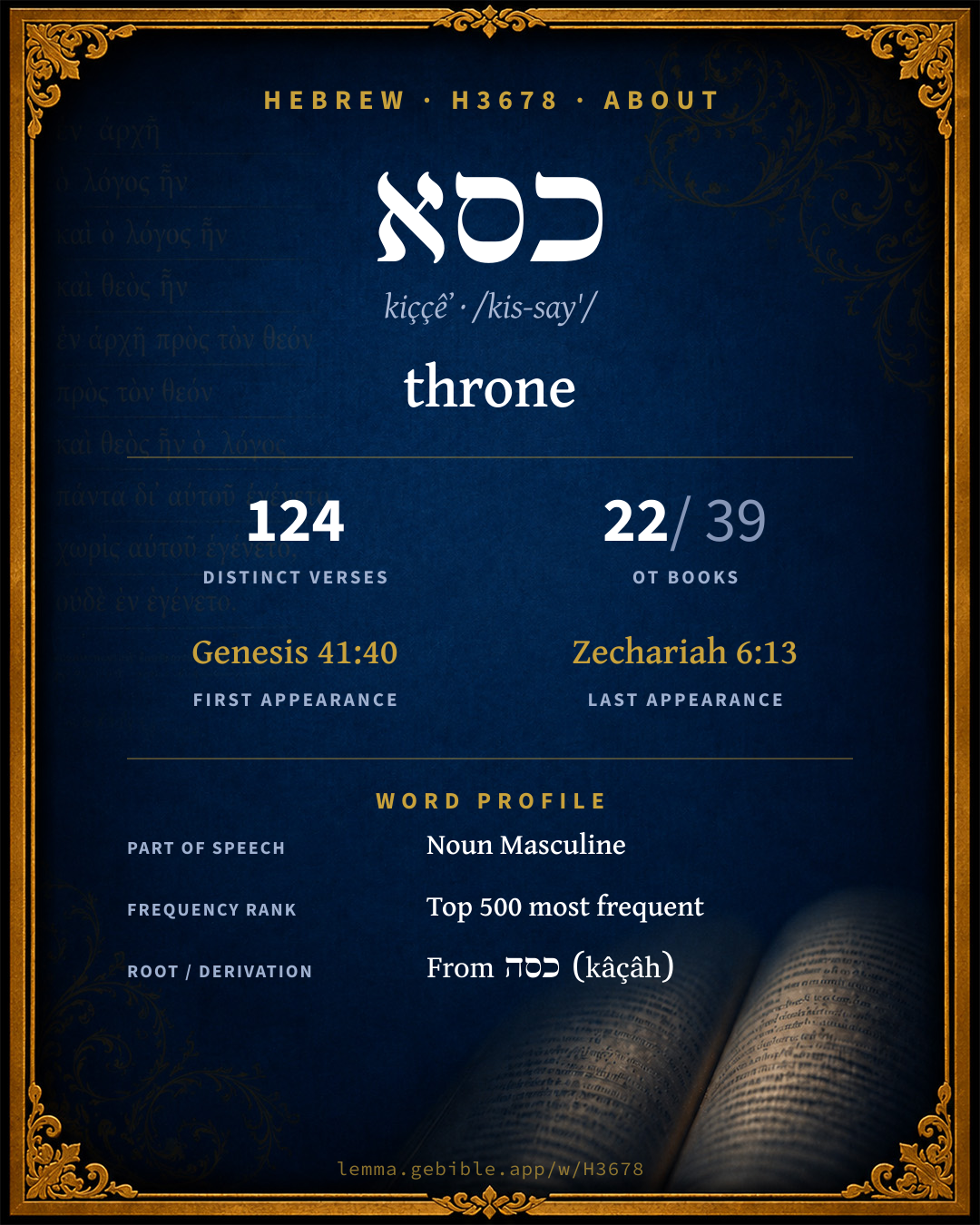
כִּסֵּא
throne
also: seat, stool fuller range ↓
Full lexicon entry — Brown-Driver-Briggs (BDB)
From Brown-Driver-Briggs (BDB)
Where this word appears
See every Construct-state word in the Hebrew Bible →
Grammar key — what these labels mean
Part of speech
- Noun
- A naming word — a person, place, thing, or idea.
Noun type
- Common
- A common noun — a general class of person, place, or thing (“king,” “city,” “water”), not a specific name.
State
- Construct
- A noun bound to a following noun in a possessive / “of” relationship (the construct chain).
- Absolute
- The independent form of a noun, not bound to a following word.
Gender
- Masculine
- Grammatically masculine.
Number
- Singular
- One.
- Plural
- More than one (in Hebrew, generally three or more).
Every verse where H3678 appears in the Book of Psalms — 17 distinct verses. Click any verse to open its interlinear word-by-word view. Verse text shown in the World English Bible for context — . Each verse’s Hebrew form is shown with its reference; the English is not keyword-highlighted, since the data carries no word-level English alignment. Use “Compare translations” on any verse to read it across multiple English versions. This concordance covers the Hebrew Bible; Septuagint (Greek Old Testament) occurrences are not indexed here.
Psalms
- Psalms 9:4 לְ֝/כִסֵּ֗א prep + n c ms For you have maintained my just cause. You sit on the throne judging righteously.
- Psalms 9:7 כִּסְאֽ/וֹ n c ms cs + sfx pers 3ms But Yahweh reigns forever. He has prepared his throne for judgment.
- Psalms 11:4 כִּ֫סְא֥/וֹ n c ms cs + sfx pers 3ms Yahweh is in his holy temple. Yahweh is on his throne in heaven. His eyes observe. His eyes examine the children of men.
- Psalms 45:6 כִּסְאֲ/ךָ֣ n c ms cs + sfx pers 2ms Your throne, God, is forever and ever. A scepter of equity is the scepter of your kingdom.
- Psalms 47:8 כִּסֵּ֬א n c ms cs God reigns over the nations. God sits on his holy throne.
- Psalms 89:4 כִּסְאֲ/ךָ֣ n c ms cs + sfx pers 2ms 'I will establish your seed forever, And build up your throne to all generations.'" Selah.
- Psalms 89:14 כִּסְאֶ֑/ךָ n c ms cs + sfx pers 2ms Righteousness and justice are the foundation of your throne. Loving kindness and truth go before your face.
- Psalms 89:29 וְ֝/כִסְא֗/וֹ conj + n c ms cs + sfx pers 3ms I will also make his seed endure forever, And his throne as the days of heaven.
- Psalms 89:36 וְ/כִסְא֖/וֹ conj + n c ms cs + sfx pers 3ms His seed will endure forever, His throne like the sun before me.
- Psalms 89:44 וְ֝/כִסְא֗/וֹ conj + n c ms cs + sfx pers 3ms You have ended his splendor, And thrown his throne down to the ground.
- Psalms 93:2 כִּסְאֲ/ךָ֣ n c ms cs + sfx pers 2ms Your throne is established from long ago. You are from everlasting.
- Psalms 94:20 כִּסֵּ֣א n c ms cs Shall the throne of wickedness have fellowship with you, Which brings about mischief by statute?
- Psalms 97:2 כִּסְאֽ/וֹ n c ms cs + sfx pers 3ms Clouds and darkness are around him. Righteousness and justice are the foundation of his throne.
- Psalms 103:19 כִּסְא֑/וֹ n c ms cs + sfx pers 3ms Yahweh has established his throne in the heavens. His kingdom rules over all.
- Psalms 122:5 כִסְא֣וֹת כִּ֝סְא֗וֹת n c mp n c mp For there are set thrones for judgment, The thrones of David's house.
- Psalms 132:11 לְ/כִסֵּא prep + n c ms Yahweh has sworn to David in truth. He will not turn from it: "I will set the fruit of your body on your throne.
- Psalms 132:12 לְ/כִסֵּא prep + n c ms If your children will keep my covenant, My testimony that I will teach them, Their children also will sit on your throne forevermore."
About this entry
At a glance — auto-summarized from this page’s data, not written by a person. Every figure links to its source below. This summary describes the numbers; it doesn’t interpret them.
The Hebrew noun כסא centers on the idea of “throne.” Its earliest occurrence is Genesis 41:40. It turns up in 124 verses across 22 books, a common footprint. Alongside “throne” the lexicon also lists “seat” and “stool” — part of its full sense range. It shares a root with כסה, כסא and כסוי. Dig into 124-verse concordance and the renderings breakdown below.
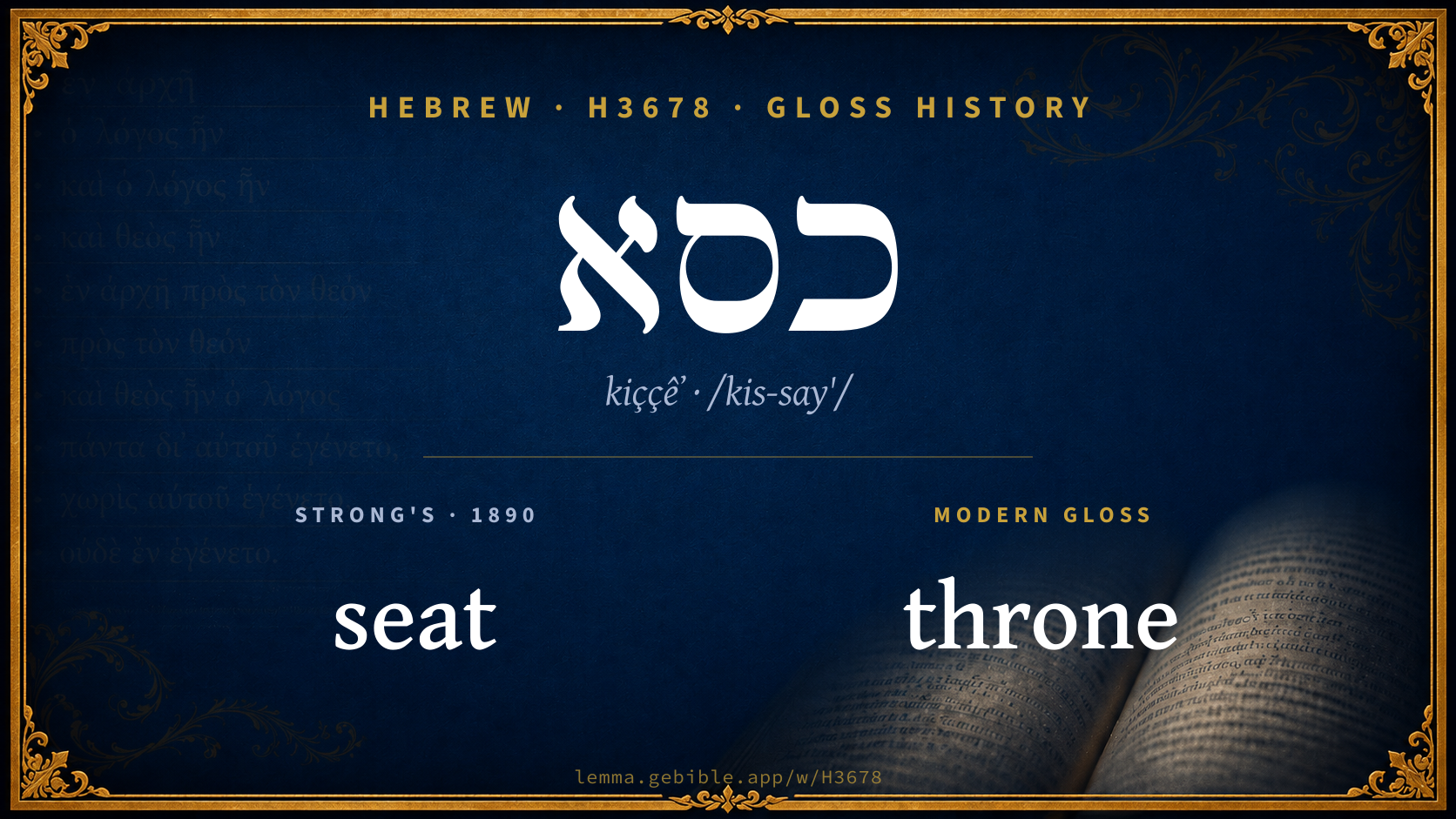
Gloss history
Strong's 1890 vs modern scholarship
About this word
Strong's H3678 catalogs a Hebrew word from the Hebrew Old Testament.
These counts are not copied from any lexicon or concordance. They are computed here, from the morphology-tagged Hebrew Old Testament. What Lemma adds →
- 124
- distinct verses
- The word appears in 124 distinct verses.
- 22 / 39
- OT books
- The word appears in 22 of 39 Old Testament books.
- #329
- by frequency
- Top 500 most frequent Hebrew words (rank 329 of 8,640 Hebrew words by occurrence).
View all 124 occurrences in the concordance →
By section of the Old Testament
By traditional corpus
Conventional, traditional groupings — biblical authorship is debated, so this is a traditional corpus grouping, not an authorship claim. Each share is this word’s portion of its verses in that division of the Hebrew canon. Each figure is a share of the word’s 124 distinct verses.
- Prophets (Nevi'im) 76 verses · 61%
- Writings (Ketuvim) 44 verses · 35%
- Torah (Pentateuch) 4 verses · 3%
How translations render this word
Counts come from each version’s own published word-to-Strong’s tagging or interlinear alignment — an approximate guide to how each version renders this word, not a word-level alignment the data otherwise carries. Because each total is that version’s own tagged count, the per-version totals vary from one another and need not match the appearance or distinct-verse counts above. These counts may also differ from a printed concordance because Lemma counts each distinctly tagged rendering and does not collapse phrase taggings into a single head-word total. This is a fixed set of word-tagged versions (KJV, ASV, BSB, ULT) and does not change with the reading translation you choose elsewhere. Each version’s license is shown beside its name below (and on Sources).
- King James Version: Throne 111×, Seat 5×, Thrones 4×
- American Standard Version: Throne 97×, He shall sit upon my throne 4×, Seat 4×
- Berean Standard Bible: Throne 105×, Thrones 10×, Chair 4×
- unfoldingWord Literal Text: Throne 68×, Throne of 38×, Seat 5×
King James Version Public Domain
Renders H3678 across 135 tagged occurrences — most commonly:
Plus 13 renderings that appear only once — usually multi-word phrases or single function words the recovered tagging swept in, not distinct renderings.
American Standard Version Public Domain
Renders H3678 across 135 tagged occurrences — most commonly:
Plus 22 renderings that appear only once — usually multi-word phrases or single function words the recovered tagging swept in, not distinct renderings.
Berean Standard Bible Public Domain
Renders H3678 across 133 tagged occurrences — most commonly:
Plus 12 renderings that appear only once — usually multi-word phrases or single function words the recovered tagging swept in, not distinct renderings. Not rendered by a distinct English word in 1 further occurrence.
unfoldingWord Literal Text CC BY-SA 4.0
Renders H3678 across 130 tagged occurrences — most commonly:
Plus 11 renderings that appear only once — usually multi-word phrases or single function words the recovered tagging swept in, not distinct renderings.
5 senses and sub-senses in the full BDB
What do BDB’s symbols mean?
BDB uses these scholarly abbreviations:
| Symbol | Meaning |
|---|---|
| 𝔊 | the Septuagint (the ancient Greek translation, LXX) |
| 𝔙 | the Vulgate (the Latin translation) |
| 𝔖 | the Syriac version (the Peshitta) |
| 𝔗 | the Targum (the Aramaic translation) |
| ψ | the Psalms |
| √ | root (the underlying root or stem) |
| ‖ | parallel passage (a synonymous or contrasted parallel) |
| † | the dagger: every passage where the word occurs is cited |
The 5 senses and sub-senses the full Brown-Driver-Briggs lexicon distinguishes for this word, in lexicon order (not ranked by frequency), with BDB’s own verbatim wording and sub-sense lettering. Shown in Hebrew script with BDB’s own scholarly abbreviations. The condensed entry is in the Lexicon Entry tab. See also the Forms in the corpus table below.
- 1.
- a. of king = throne Gn 41:40 (E), Ex 11:5; 12:29 (both J) 1 K 2:19 Is 47:1 Ez 26:16; of queen-mother 1 K 2:19b; כ׳ מַלְכוּתוֹ Est 5:1 his royal throne; of future (Messianic) prince Zc 6:13a (in v b read על־ימינו 𝔊 StaZAW 1881, 10); of dead kings in Sheʾôl Is 14:9; נָתַן כ׳, in, or against a place, said of king himself, (only Je) is a sign of conquest (Je 1:15); so שִׂים כ׳ 43:10, and (of י׳) 49:38; in Ju 3:20, though of king, not seat of office; 12 times elsewhere, lit. e.g. Genesis 41:40
- b. throne of י׳ (אלהים) as heavenly king, Is 6:1 Ez 1:26(×2); 10:1 1 K 22:19 = 2 Ch 18:18; Jb 26:9 ψ 11:4 Is 66:1 heaven is my throne; as seat of judgment ψ 9:5, 8; in oath יָד עַל־כֵּס יָהּ Ex 17:16 (cf. Di; > Cler JDMich Ges Buhl SS נֵס banner; 𝔊 κρυφαία √ כסה, favours כס); Jerusalem called throne of י׳ Je 3:17, so the sanctuary 17:12 (כ׳ כָּבוֹד מָרוֹם), Ez 43:7. e.g. Isaiah 6:1
- 2. of high priest 1 S 1:9; 4:13, 18; of honoured guest 2 K 4:10; of governor Ne 3:7; of (unjust) judge כ׳ הַוּוֹת ψ 94:20; = conspicuous seat (lit.) Pr 9:14; = seat of distinction, explicitly כ׳ כָּבוֹד Is 22:23; כ׳ alone 2 K 25:28(×2) = Je 52:32(×2) Est 3:1. e.g. 1 Samuel 1:9
- 3.
- a. fig. = royal dignity, authority, power, הַמֶּלֶךְ וְכִסְאוֹ נָקִי 2 S 14:9; לְדָוִד וּלְזַרְעוֹ וּלְבֵיתוֹ וּלְכ׳ 1 K 2:33; especially kingdom, c. vbs. of setting up, establishing, י׳ subj., הֵקִים כ׳ דָוִד 2 S 3:10, וּבָנִיתִי בִסְאֲךָ ψ 89:5, so c. שִׂים v 30; king subj., סָעַד בַּחֶסֶד כִּסְאוֹ Pr 20:28; pass. כ׳ דָוִד יִהְיֶה נכון 1 K 2:45 the throne of David shall be established, cf. 2 S 7:16 = 1 Ch 17:14; וְתוּכַן בַּחֶסֶד כ׳ Is 16:5 (of Mess. reign); so (in gen.) בִּצְדָקָה יִכּוֹן כ׳ Pr 16:12, cf. 25:5; 29:14; intrans. (c. הָיָה ψ 89:37; more fully, י׳ subj., וְכֹנַנְתִּי אֶת־כ׳ מַמְלַכְתּוֹ 2 S 7:13 (כֹּנֵן כסאו in ‖ 1 Ch 17:12), וַהֲקִמֹתִי אֶת־כ׳ מַמְלַכְתְּךָ עַל ־יִשְׂרָאֵל 1 K 9:5, cf. ‖ 2 Ch 7:18 and וַהֲכִינוֹתִי כ׳ מַלְכוּתוֹ עַל־יִשְׂרָאֵל 1 Ch 22:10; also מגּר כ׳ ψ 89:45 cast down throne, of Gentile nations וְהָפַכְתִּי כ׳ מַמְלָכוֹת Hg 2:22; יָשַׁב על־כ׳ sit on the throne of any one (especially David) = be his successor 1 K 1:13, 17, 20, 24, 27, 30, 35, 48; 2:12; 3:6 2 K 13:13, especially Je 13:13; 17:25; 22:2 + 5 times Je; יֵֽשְׁבוּ לְכ׳ לָ֑ךְ ψ 132:12; more fully 1 Ch 29:23; †caus. הוֹשִׁיב על־כ׳ 1 K 2:24; 5:19 2 K 10:3; חֹשִׁיב לַכּ׳ fig. Jb 36:7, of placing in honour; מִפְּרִי בִטְנְךָ אָשִׁית לְכ׳ לָ֑ךְ ψ 132:11; †ישׁב על־כ׳ also = take one’s seat as king, become actual king, possess royalty 1 K 16:11, often sit on the throne of Isr. 1 K 8:20, 25 = 2 Ch 6:10, 16, 1 K 10:9 2 K 10:30; 15:12, Je 33:17; without ישׁב 1 K 2:4; 9:5, cf. also Is 9:6 (Mess.); ישׁב על־כסא מַמְלַכְתּוֹ Dt 17:18, על־כסא הַמְּלוּכָה 1 K 1:46, and even לָשֶׁבֶת עַל־כִּסֵּא מַלְכוּת י׳ עַל־יִשְׂרָאֵל 1 Ch 28:5; also ישׁב עַל־כ׳ הַמְּלָכִים 2 K 11:19, ‖ כ׳ הַמַּמְלָכָה 2 Ch 23:20; of (royal) throne as judgment seat Pr 20:8, cf. also ψ 122:5; set one upon the throne of Isr. נתן פ׳ על־כ׳ ישׂ׳ 1 K 10:9 cf. ‖ 2 Ch 9:8; in compar. sentence יְגַדֵּל אֶת־כִּסְאוֹ מִכּ׳, i.e. make him a more powerful king than, 1 K 1:37, cf. v 47; of king of Babylon, מִמַּעַל לְכוֹכְבֵי־אֵל אָרִים כִּסְאִי Is 14:13. In ψ 45:7 כִּסְאֲךָ אלהים וגו׳ the text is prob. corrupt: AE Hi Ew Bae read thy throne is (a throne) of God; Bi Che insert נכונה יסודתו הקימו thy throne [its foundation is firmly fixed], God [has established it]; v. further Dr§ 194, Obs.. e.g. 2 Samuel 14:9
- b. throne of י׳ (אלהים) = his royal dignity, sovereignty, La 5:19 ψ 93:2; 103:19 (הֵכִין כ׳; ‖ מַלְכוּת); כ׳ כְבוֹדֶ֑ךָ Je 14:21; יָשַׁב עַל־כ׳ קָדְשׁוֹ ψ 47:9; צֶדֶק וּמִשְׁפָּט מְכוֹן כִּסְאֶ֑ךָ ψ 89:15 cf. 97:2. e.g. Lamentations 5:19
Senses from the full Brown-Driver-Briggs lexicon (Brown, Driver, Briggs; Oxford 1906 — public domain), digitized via Sefaria, supplemented by the OpenScriptures HebrewLexicon (CC BY 4.0). Full attribution on Sources.
Word origin
n.m. 2 S 7:16 seat of honour, throne (NH id.; Ph. (pl.) כרסים; Aramaic כּוּרְסְיָא, ܟܽܘܪܣܝܳܐ; Biblical Aramaic כָּרְסֵא, Zinj. כרסא DHMSendsch. 58. 44; Arabic كُرْسِىٌّ; but Assyrian kussu; perhaps Akkad. loan-word; ideogr. iṣ GU. ZA, cf. DlHWB 343);—abs. כִּסֵּא Gn 41:40 +; כִּסֵּה 1 K 10:19(×2) Jb 26:9, הַכִּסֶּא Ez 1:26; cstr. כִּסֵּא 2 S 3:10 +, כֵּס Ex 17:16 (si vera l.; v. infr.); sf. כִּסְאִי 1 K 1:13 +, כִּסְאֲךָ 2 S 7:16 +, כִּסְאֶ֑ךָ 1 K 5:19 +, כִּסְאוֹ Ex 11:5 +; pl. כִּסְאוֹת ψ 122:5(×2); sf. כִּסְאוֹתָם Ez 26:16 Is 14:9;—seat of honour, usually
— Brown-Driver-Briggs (Oxford 1906, public domain), digitized via Sefaria, supplemented by the OpenScriptures HebrewLexicon (CC BY 4.0). See Sources.
Derived from כסה (kâçâh) (H3680) — to cover.
Jastrow Dictionary
A second Hebrew/Aramaic lexicon for comparison, covering Aramaic and post-biblical (Talmudic, Targumic, Midrashic) usage that the biblical-Hebrew BDB does not. Matched by lemma rather than by Strong’s number, so a lemma may carry more than one Jastrow headword (shown separately below), and the entries cover usage well beyond the Bible.
כְּסָא I
- to cover, v. כְּסֵי II.
כְּסָא II
- to reprehend, v. כְּסַס a. כְּסַן.
כַּסָּא I
- , cup, calyx. Targ. Gen. XL, 11; a. fr.—Targ. I Kings VII, 26; a. fr.—Targ. II Sam. XII, 3 כָּסֵיה ed. Lag. (oth. כּוֹסֵיה).—Ber. 28ᵃ, v. יְקָרָא. Ib. 51ᵇ, v. בִּרְכְתָא. Y. Ḥag. II, 78ᵃ bot., v. בִּשְׂרוּתָה. Ib. כ׳ דקיסא וכ׳ out of a cup of sharp-edged glass drink quickly (ere it cut your lip); [Y. Bets. II, 61ᶜ top סמא; Y. Maas. Sh. V, 56ᶜ top סבא, Meïri to Bets. 20ᵇ ססא]; a. fr.—Pl. כַּסִּין, כַּסַּיָּיא, כַּסֵּי, כָּס׳. Targ. Jer. XXXV, 5.—Y. Nidd. II, end, 50ᵇ כ׳ טיברייאי (not … אה) Tiberian glass cups (transparent). Pes. 110ᵃ; a. fr.—(בּית) בּי כַּסַּיָּא = h. בית הכוסות, v. כּוֹס. Lev. R. s. 3; [Koh. R. to VII, 19 (of the human body) בית כסא, by mistake borrowed from Lev. R. l. c.; v. Yalk. Koh. 976].
כַּסָּא II
- (כְּסַס)
- 1. fodder, v. כִּיסְתָא II.
- 2. hash. כ׳ דהרסנא, v. הַרְסָנָא.—Pl. כַּסֵּי. Ab. Zar. 38ᵃ ed.
כִּסֵּא
- bolsters, chair, throne. Tosef. Bets. III, 11. Ib. 17 אין יוצאין בכִּסֵּה ed. Zuck. (Var. בכסא) you must not be carried out on a sedan chair (on Holy Days); Bets. 25ᵇ. Ib. כ׳ מה אתון ביה what is your opinion about carrying a person on a chair &c.?—Kel. XXII, 3 הכ׳ שלפני קתידרא the bolster in front of the cathedra (a kind of footstool). Ib. 4, v. חִפּוּי; a. fr.—כ׳ הכבוד the throne of Divine Majesty. Ḥag. 13ᵃ; a. fr.—כ׳ הדין the throne of Divine judgment; כ׳ רחמים mercy-seat. Lev. R. s. 29 אני עומד מכ׳ הדין וכ׳ I rise from the throne of judgment and seat myself on the throne of mercy; a. fr.—Euphem. בית הכ׳ privy. Tam. I, 1 בית הכ׳ של כבוד a chaste privy. Ber. 25ᵃ; a. fr.—Pl. כִּסָּאוֹת, כִּסָּיוֹת, כִּי׳; with suff. כִּסְאֵי־. Ex. R. s. 31; a. fr.—Tosef. Kel. B. Mets. X, 6 הכיסיות שבבימה (not הכו׳) the (stationary) seats in public courts. Pesik. R. s. 23-24 עמדו מכִּסְאֵיהֶם arose from their thrones.—[Zab. IV, 4 כסאות, v. כֶּסֶת.]
כֶּסֶא
- (כָּסָה I) mark, distinction; marked, appointed time. Lev. R. s. 29; Pesik. Baḥod., p. 153ᵃ (ref. to Ps. LXXXI, 4) וכי כל החדשים אינן חדש אלא בכ׳ ‘on the New Moon’, are all other new moons no New Moons (festive days)?; but (therefore is added) bakkesé, on the distinguished (month), v. כָּסָה I. [Pirké d’R. El. ch. VII, end, a. Bets. 16ᵃ our w. is taken in the sense of cover.] e.g. Psalms 81:4
כְּסֵי
- , v. כְּסַן
כְּסֵי ²
- , Part. pass. כְּסִי, f. כַּסְיָא hidden. Targ. I Sam. III, 1 כְּסִי Bxt. (ed. כַּסִּי, כַּסֵּי; h. text יקר). Targ. II Kings VI, 8 (h. text פלני). Targ. Job XXVIII, 21. Targ. II Kings VI, 9 כָּסָן (h. text נְחִתִּים).
- to cover, hide, conceal. Targ. O. Gen. XXXVIII, 15 (Y. כעיסת). Ib. XLVII, 18; a. fr.—Part. pass. מְכַסָּא unknown, remote. Targ. II Kings XIX, 2. Targ. O. Lev. IV, 13. Targ. II Sam. XIII, 2 (h. text ויפלא); a. e.—Sabb. 156ᵇ כַּסִּי רישיך וכ׳ keep thy head covered in order that the fear of the Lord may rest upon thee. Ib. 125ᵃ לכַסּוּיֵי בהו וכ׳ to cover a nuisance with it. Gen. R. s. 52, [read as:] Yalk. ib. 91 וכסי עיניך מינאי and close thine eye from upon me, i.e. take the indulgence money. Taan. 25ᵃ רקיע … כסי פניך ולא אִיכַּסִי ‘cover thy face, O sky,’ but the sky was not covered. Ḥull. 87ᵃ אפשר … ומְכַסֵּי בחדא he may kill with one hand and cover (the blood) with the other; a. fr.
- to be covered, hidden; to cover one’s self; to conceal one’s self, withdraw. Targ. Y. Gen. XX, 16. Targ. Y. Lev. IV, 13. Targ. Gen. XVIII, 14 (h. text יפלא, v. supra); a. fr.—Targ. Ps. CXXXIX, 6 מִכַּסְיָא.—Taan. l. c., v. supra. Ib. 23ᵃ א׳ מעינא ונים וכ׳ he disappeared and slept seventy years. Keth. 63ᵃ שאילי … ואִיכַּסָּאִי borrow some garments and dress thyself; a. fr.
A Dictionary of the Targumim, the Talmud Babli and Yerushalmi, and the Midrashic Literature (Marcus Jastrow; London, Luzac, 1903) — Public Domain. Digitized via Sefaria. Digitized via Sefaria. Full attribution on Sources.
Forms in the corpus
The 65 distinct written forms H3678 takes in the Hebrew Bible, most frequent first — each parse links to that state’s occurrences in the concordance. Hebrew forms include their vowel points and cantillation, so a single lemma takes many written forms.
The 60 most common forms are shown; 5 rarer forms follow in the full concordance.
Same root — word family
Other BDB entries built from the same root as H3678, grouped by Strong’s listed origin. These share a root / origin per the lexicon — not necessarily a shared meaning. Each links to that word’s own entry.
Derives from
Shares the same root
- כסא keçeʼ H3677 full moon
- כסוי kâçûwy H3681 covering
- כסות kᵉçûwth H3682 covering
- כסת keçeth H3704 band
- מכסה mikçeh H4372 covering
- מכסה mᵉkaççeh H4374 covering
Derived from this word
Compare all same-root words → Showing 4 of 10 — not the complete family. They share a root, not necessarily a meaning.
Septuagint verse parallels
This word appears in 111 verses that also exist in the Greek Old Testament (Septuagint), out of the 124 Hebrew verses it occurs in. You can read those verses in Greek by switching the Old Testament edition to the Septuagint.
Read these verses in the Septuagint
- Genesis 41:40
- Exodus 11:5
- Deuteronomy 17:18
- Judges 3:20
- 1 Samuel 1:9
- 2 Samuel 3:10
- 1 Kings 1:13
- 2 Kings 4:10
- 1 Chronicles 17:12
- 2 Chronicles 6:10
- Esther 1:2
- Job 26:9
This is a verse-level parallel only — the same verses exist in both the Hebrew and Greek Old Testaments. No word-level Hebrew↔Greek correspondence is claimed: the data carries no such alignment, so no Greek word is shown as this Hebrew word’s translation. Coverage is not total — the Septuagint omits the deuterocanon and renumbers the Psalms, so some Hebrew verses have no direct Greek parallel.