Psalms 132:12

Hebrew (Westminster Leningrad Codex) Psalms 132:12 appears in the Hebrew Old Testament. The text above is from the Westminster Leningrad Codex. Each word links to its Strong’s number, a concise gloss, and parsing drawn from the Open Scriptures Hebrew Bible morphology. Click any word for its full Brown-Driver-Briggs (BDB) entry.
Download image
Cite this verse

Psalms 132:12 (World English Bible). Public Domain. Lemma interlinear Bible study tool, https://lemma.gebible.app/v/psalms/132/12.

Show BibTeX & RIS
BibTeX
RIS
English Translation
If your children will keep my covenant, My testimony that I will teach them, Their children also will sit on your throne forevermore."
World English Bible · Public Domain
Download a study sheet

One document with this verse’s original text, its word-by-word gloss line, the meaning frame, cross-references with their text, attributed commentary, and full source and license credits — printable, and it pastes into notes with its structure intact.

This verse Autodidact and up

Study sheet (.html) Plain text (.txt)

A passage Seminary Student

Up to 50 verses in one chapter. A passage sheet keeps up to 6 commentary sources and 12 cross-references per verse, in the order this page ranks them, and says so on the sheet whenever that leaves anything out. Ask for a single verse and you get the Autodidact verse sheet above.

Everything on this page stays free to read, with no account — the sheet is a download of what is already on screen, not access to it.

Want to remove ads? Support Godless Engineer
Compare translations 3

The same verse in 3 English versions, stacked beneath the original-language interlinear above. Click any original word for its lexicon entry.

Each is an independent rendering of the whole verse — the interlinear is not word-aligned to these translations.

Highlighted words mark where these versions differ — a whole-verse word diff, not a word-by-word alignment.

  • World English Bible Public Domain
    If your children will keep my covenant, My testimony that I will teach them, Their children also will sit on your throne forevermore."
  • King James Version Public Domain
    If thy children will keep my covenant and my testimony that I shall teach them, their children shall also sit upon thy throne for evermore.
  • unfoldingWord Literal Text CC BY-SA 4.0
    If your sons keep my covenant and my testimonies that I will teach them, then also their sons, unto perpetuity, will sit on the throne for you.”

unfoldingWord Literal Text — © unfoldingWord, licensed CC BY-SA 4.0. Word-aligned USFM3 via Door43 (git.door43.org/unfoldingWord/en_ult).

Versions to compare (up to 4)

3 of 4 selected

Show all 17 translations

Every available English version of this verse, each an independent rendering of the whole verse.

  • World English Bible Public Domain
    If your children will keep my covenant, My testimony that I will teach them, Their children also will sit on your throne forevermore."
  • Berean Standard Bible Public Domain
    If your sons keep My covenant and the testimony I will teach them, then their sons will also sit on your throne forever and ever.”
  • Majority Standard Bible Public Domain
    If your sons keep My covenant and the testimony I will teach them, then their sons will also sit on your throne forever and ever.”
  • King James Version Public Domain
    If thy children will keep my covenant and my testimony that I shall teach them, their children shall also sit upon thy throne for evermore.
  • American Standard Version (1901) Public Domain
    If thy children will keep my covenant And my testimony that I shall teach them, Their children also shall sit upon thy throne for evermore.
  • Revised Version (1885) Public Domain
    If thy children will keep my covenant and my testimony that I shall teach them, their children also shall sit upon thy throne for evermore.
  • Geneva Bible (1599) Public Domain
    If thy sonnes keepe my couenant, and my testimonies, that I shall teach them, their sonnes also shall sit vpon thy throne for euer.
  • Young's Literal Translation Public Domain
    If thy sons keep My covenant, And My testimonies that I teach them, Their sons also for ever and ever, Do sit on the throne for thee.
  • Literal Standard Version CC BY-SA 4.0
    If your sons keep My covenant, || And My testimonies that I teach them, || Their sons also forever and ever || Sit on the throne for you.”
  • Unlocked Literal Bible CC BY-SA 4.0
    If your sons keep my covenant and the laws that I will teach them, their children also will sit on your throne forevermore.”
  • unfoldingWord Literal Text CC BY-SA 4.0
    If your sons keep my covenant and my testimonies that I will teach them, then also their sons, unto perpetuity, will sit on the throne for you.”
  • Darby Bible Public Domain
    If thy children keep my covenant, and my testimonies which I will teach them, their children also for evermore shall sit upon thy throne.
  • World Messianic Bible Public Domain
    If your children will keep my covenant, my testimony that I will teach them, their children also will sit on your throne forever more.”
  • Webster's Bible Public Domain
    If thy children will keep my covenant and my testimony that I shall teach them; their children also shall sit upon thy throne for ever.
  • Free Bible Version CC BY-SA 4.0
    If your sons keep to my agreement and my laws that I will teach them, then their sons will always occupy your throne.”
  • Bible in Basic English Public Domain
    If your children keep my word, and the teachings which I will give them, their children will be rulers of your kingdom for ever.
  • JPS Tanakh (1917) Public Domain
    If thy children keep My covenant and My testimony that I shall teach them, their children also for ever shall sit upon thy throne.'

Literal Standard Version (2020), Covenant Press — licensed CC BY-SA 4.0. Text via the HelloAO Bible API (eBible.org). Unlocked Literal Bible (unfoldingWord) — licensed CC BY-SA 4.0. Text via the HelloAO Bible API (eBible.org). unfoldingWord Literal Text — © unfoldingWord, licensed CC BY-SA 4.0. Word-aligned USFM3 via Door43 (git.door43.org/unfoldingWord/en_ult). Free Bible Version, Dr. Jonathan Gallagher — licensed CC BY-SA 4.0. Text via the HelloAO Bible API (eBible.org).

Word by word

More ways to search: Search by grammar → Find every occurrence → Compare this word →

Practice this passage: Drill this verse → Learn its vocabulary →

ז֗וֹ
zôh
H2090
“this”
Pronoun, Demonstrative, Feminine, Singular
Part of Speech
Pronoun
Type
Demonstrative
Gender
Feminine
Number
Singular
Full BDB Definition

Origin: for H2088

TWOT: None

this
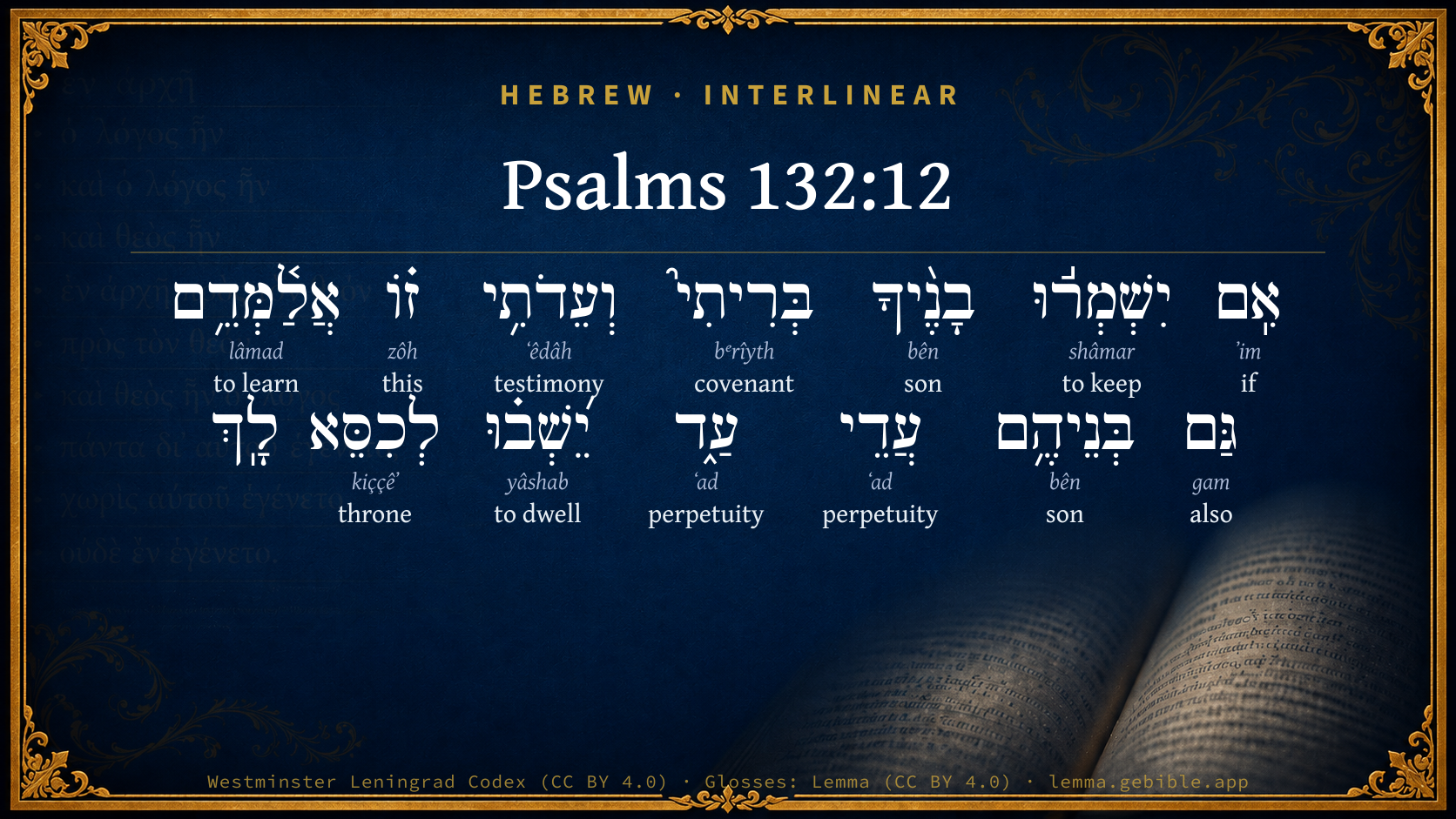
  1. אִֽם ʼim H518 “if” Conjunction
  2. יִשְׁמְר֬וּ shâmar H8104 “to keep” Verb, Qal, Imperfect, 3rd Person, Masculine, Plural
  3. בָנֶ֨יךָ bên H1121 “sons · your” Noun, Common, Masculine, Plural, Construct + Suffix, Personal, 2nd Person, Masculine, Singular
  4. בְּרִיתִי֮ bᵉrîyth H1285 “covenant · my” Noun, Common, Feminine, Singular, Construct + Suffix, Personal, 1st Person, Common, Singular
  5. וְעֵדֹתִ֥י ʻêdâh H5713 “and · testimonies · my” Conjunction + Noun, Common, Feminine, Plural, Construct + Suffix, Personal, 1st Person, Common, Singular
  6. אֲלַ֫מְּדֵ֥ם lâmad H3925 “to learn · them” Verb, Piel, Imperfect, 1st Person, Common, Singular + Suffix, Personal, 3rd Person, Masculine, Plural
  7. גַּם gam H1571 “also” Particle, Accusative
  8. בְּנֵיהֶ֥ם bên H1121 “sons · their” Noun, Common, Masculine, Plural, Construct + Suffix, Personal, 3rd Person, Masculine, Plural
  9. עֲדֵי ʻad H5703 “perpetuity” Preposition
  10. עַ֑ד ʻad H5703 “perpetuity” Noun, Common, Masculine, Singular, Absolute
  11. יֵ֝שְׁב֗וּ yâshab H3427 “to dwell” Verb, Qal, Imperfect, 3rd Person, Masculine, Plural
  12. לְכִסֵּא kiççêʼ H3678 “to/for · throne” Preposition + Noun, Common, Masculine, Singular, Absolute

About this verse

These counts appear in no published source. They are computed here, from the morphology-tagged text and Lemma’s own curated glosses. What Lemma adds →

14
words
11
distinct lemmas
Wisdom
section

Notable vocabulary

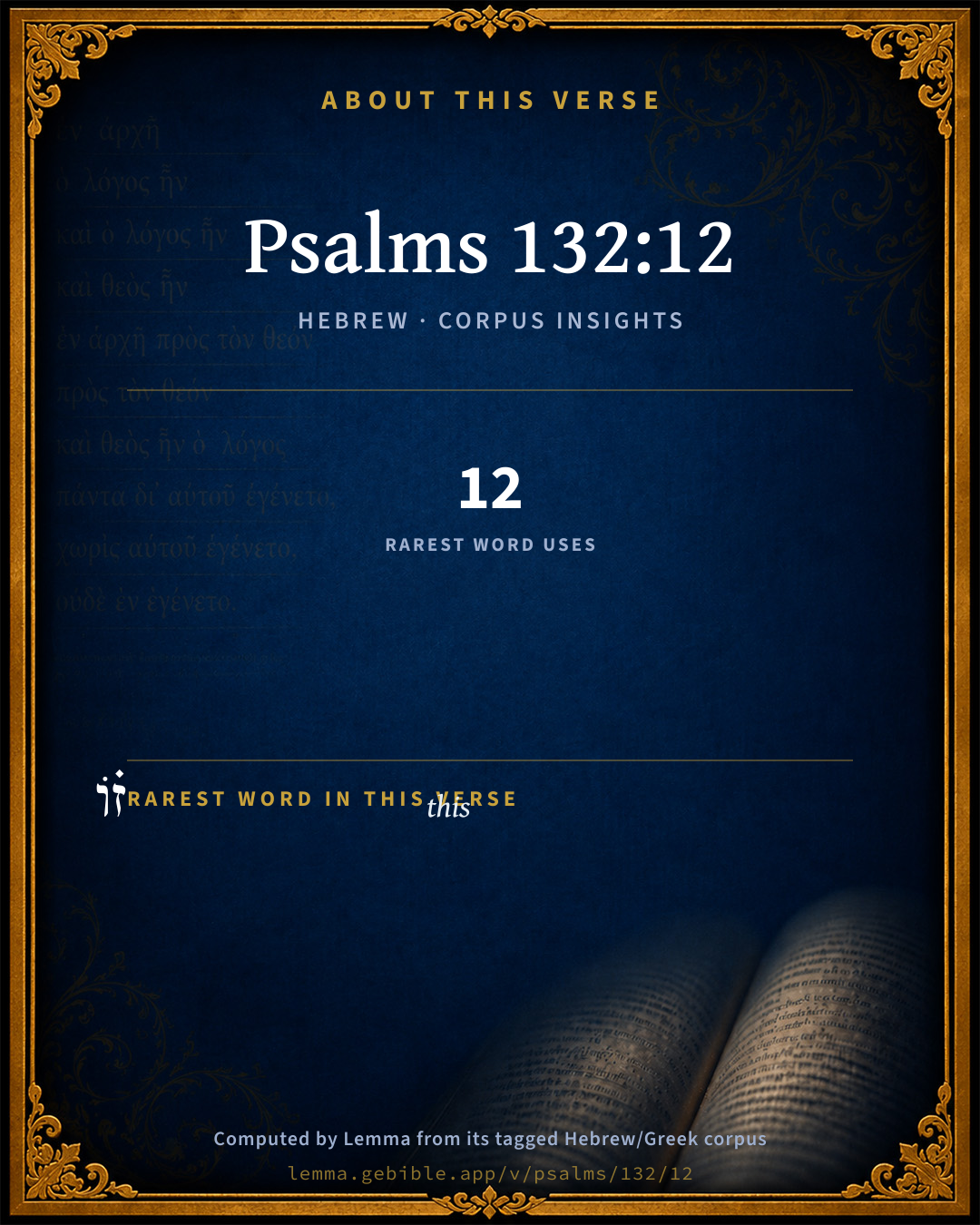
The rarest word here is ז֗וֹ this H2090 — appearing just 12 times in the whole Hebrew Bible.

Shared distinctive vocabulary

ז֗וֹ this H2090 occurs in 12 verses of the Hebrew Bible. Also found in:

Grammatical profile

  • 3 verbs
  • 6 nouns
  • 1 pronoun
  • 2 prepositions
  • 1 conjunction
  • 1 particle

Verb forms

  • יִשְׁמְר֬וּ Qal · Imperfect
  • אֲלַ֫מְּדֵ֥ם Piel · Imperfect
  • יֵ֝שְׁב֗וּ Qal · Imperfect

Repetition

Words recur within this verse — often emphatic in Hebrew:

  • בָנֶ֨יךָ son H1121 ×2
  • עֲדֵי perpetuity H5703 ×2

Hebrew & Septuagint length

In English translation the verse runs 23 words from the Hebrew and 26 from the Septuagint (LXX English) — closely comparable.

A rough comparison of the two English renderings, which tokenize alike — not a word-level alignment.

Word counts can differ between the Hebrew and the Greek without any difference in meaning — e.g. the Hebrew direct-object marker אֵת has no separate Greek word, and Greek often adds the article ὁ.

Cross-references

7

Topical passages linked to Psalms 132:12 in the Treasury of Scripture Knowledge — connected by theme and wording, ordered by reader-vote popularity; previews shown in the World English Bible.

  • Psalms 89:30–35 If his children forsake my law, And don't walk in my ordinances;
  • Isaiah 59:21 As for me, this is my covenant with them, says Yahweh: my Spirit who is on you, and my words which I have put in your mouth, shall not depart out of your mouth, nor out of the mouth of your seed, nor out of the mouth of your seed's seed, says Yahweh, from henceforth and forever.
  • Luke 1:32–33 He will be great, and will be called the Son of the Most High. The Lord God will give him the throne of his father, David,
  • Acts 2:30 Therefore, being a prophet, and knowing that God had sworn with an oath to him that of the fruit of his body, according to the flesh, he would raise up the Christ to sit on his throne,
  • Psalms 102:28 The children of your servants will continue. Their seed will be established before you."
  • Psalms 115:14 May Yahweh increase you more and more, You and your children.
  • Isaiah 9:7 Of the increase of his government and of peace there shall be no end, on the throne of David, and on his kingdom, to establish it, and to uphold it with justice and with righteousness from henceforth even forever. The zeal of Yahweh of Hosts will perform this.

Cross-references courtesy of OpenBible.info (CC BY 4.0).

Hebrew and Greek witnesses Masoretic Hebrew ↔ Greek Septuagint

The same verse in the two great witnesses to the Old Testament, shown verse-for-verse.

You’re reading Greek Psalm 131 (Hebrew Psalm 132). The Septuagint counts the superscription, so verse numbers can differ from the Hebrew — chapter-level alignment, not verse-by-verse. Numbering follows Rahlfs.

These are two independent witnesses, not word-aligned to each other, and the Septuagint is shown in lemma (dictionary) form.

Hebrew Psalms 132:12 Masoretic · Westminster Leningrad Codex

אִֽם יִשְׁמְר֬וּ בָנֶ֨יךָ בְּרִיתִי֮ וְעֵדֹתִ֥י ז֗וֹ אֲלַ֫מְּדֵ֥ם גַּם בְּנֵיהֶ֥ם עֲדֵי עַ֑ד יֵ֝שְׁב֗וּ לְכִסֵּא לָֽךְ

If your children will keep my covenant, My testimony that I will teach them, Their children also will sit on your throne forevermore."

World English Bible · Public Domain

Greek LXX Greek Psalm 131:12 Septuagint · lemma form

ἐάν φυλάσσω ὁ υἱός σύ ὁ διαθήκη ἐγώ καί ὁ μαρτύριον ἐγώ οὗτος ὅς διδάσκω αὐτός καί ὁ υἱός αὐτός ἕως ὁ αἰών καταἵζω ἐπί ὁ θρόνος σύ

If your children will keep my covenant, and these my testimonies which I shall teach them, their children also shall sit upon your throne for ever.

LXX2012 (modern English Septuagint) · Public Domain

Hebrew: Westminster Leningrad Codex (CC BY 4.0). Greek: Septuagint (public domain); English from LXX2012 (modern English Septuagint) (Public Domain). How the Septuagint differs from the Hebrew →

Commentary

Notes on Psalms 132:12 from classic Christian and Jewish commentators (each source and its license shown beneath its notes). The classic Christian expositions comment on the surrounding passage and are grouped to its opening verse, so a note may address several verses; the Jewish commentaries on the Tanakh (Rashi and others) are per-verse, so they appear only where the commentator wrote on this verse.

Lemma curates 59 commentaries, every one of them public domain or Creative Commons licensed, each selected and text-cleaned for this edition rather than reprinted as found. About our sources →

Trapp's Complete Commentary

John Trapp

Psa 132:12 If thy children will keep my covenant and my testimony that I shall teach them, their children shall also sit upon thy throne for evermore.

Ver. 12. If thy children will keep my covenant] Although God’s covenant is free, yet it is delivered under certain conditions on our part to be observed; which are as an oar in a boat, or stern in a ship, turning it this way or that, &c.

For evermore] For a long season; and Christ, for all eternity.

John Trapp, A Commentary or Exposition upon All the Books of the Old and New Testament (1647–1656) — public domain. Text from a community e-Sword module.

J. A. Alexander on Psalms

Joseph Addison Alexander

12. (Psa 132:12) If thy sons will observe my covenant and my testimonies which I teach them, (then) likewise their sons unto perpetuity shall sit upon the throne for thee. This is the condition of the promise, the breach of which accounts for the apparent violation of the promise itself. Such a suspension of the promise was not only just in itself, but foreseen and provided for (2Sa 7:14-15), as something perfectly consistent with the perpetuity of the engagement. I teach you refers not only to external legislation,lbut to spiritual guidance and illumination.

Joseph Addison Alexander, The Psalms Translated and Explained (1850) — public domain. Text from a community e-Sword module.

Geneva Bible (1599)

Geneva Bible translators

Because this cannot be accomplished but in Christ, it followeth, that the promise was spiritual.

Geneva Bible (1599) marginal notes — public domain. Text via Bolls.life.

Adam Clarke's Commentary

Verse 12. If thy children will keep my covenant] This was conditional with respect to the posterity of David. They have been driven from the throne, because they did not keep the Lord's covenant, but the true David is on the throne, and his posterity forms the genuine Israelites.

Adam Clarke's Commentary on the Bible (1810–1826) — public domain. Text from a community e-Sword/MySword module.

John Calvin's Commentaries

12. If thy sons keep my covenant. More distinct notice is now taken of the descending line, by which the perpetuity of the succession, as I have already shown, is pointed out. Sons of princes commonly succeed them in this world by right of inheritance, but there was this undoubted peculiarity of privilege in the case of David’s kingdom, that God expressly declared that he would always have a descendant from his body upon the throne, not for one age merely, but for ever. For though that kingdom was for a time destroyed, it was restored again, and had its everlasting establishment in Christ. Here the question occurs — Did the continuance of the kingdom rest upon good conduct, or human merit? for the terms of this agreement would seem to suggest that God’s covenant would not be made good, unless men faithfully performed their part, and that thus the effect of the grace promised was suspended upon obedience. We must remember, in the first place, that the covenant was perfectly gratuitous, so far as related to God’s promise of sending a Savior and Redeemer, because this stood connected with the original adoption of those to whom the promise was made, which was itself free. Indeed the treachery and rebellion of the nation did not prevent God from sending forth his Son, and this was a public proof that he was not influenced by the consideration of their good conduct. Hence Paul says, (Romans 3:3,)

“What if some did not believe is therefore the truth of God of none effect?”

intimating that God had not withdrawn his favor from the Jews, having chosen them freely of his grace. We know, too, that notwithstanding their efforts, as if it had been of set purpose, to destroy the promises, God met their malicious opposition with displays of his marvellous love, made his truth and faithfulness to emerge in a most triumphant manner, and showed that he stood firm to his own purpose, independently of any merit of theirs. This may serve to show in what sense the covenant was not conditional; but as there were other things which were accessories to the covenant, “Sed quia secum trahebat alias accessiones.” — Lat.

“Remove the diadem; reversed, reversed, reversed shall it be, till he come whose it is;”

where the Prophet might seem to cancel what God had written with his own hand, and nullify his promise, for the safety of the people stood intimately connected with the throne, according to the expression we find in the Lamentations,

“The breath of our nostrils, the anointed of the Lord, was taken in their pits.” (Lamentations 4:20)

The Prophet, we say, might seem to strike directly against the covenant made by God, when he speaks of the crown being taken away, and yet what he adds in the subsequent part of the sentence, proves that covenant, in so far as it was gratuitous, to have been everlasting and inviolable, since he holds out the promise of the Redeemer, notwithstanding the conduct of the Jews, which was such as to exclude them temporarily from the divine, favor. God, on the one hand, took vengeance upon the people for their ingratitude, so as to show that the terms of the covenant did not run conditionally to no purpose; while on the other, at the coming of Christ there was a free performance of what had been freely promised, the crown being set upon Christ’s head. The obedience which God demands is particularly stated to be the obedience of his covenant, to teach us that we must not serve him by human inventions, but confine ourselves within the prescription of his word.

John Calvin's Commentaries (1540-1563) — public domain. Text from the Calvin Translation Society English edition (1840s-50s) via the Christian Classics Ethereal Library (ccel.org). Calvin's coverage is partial (roughly two-thirds of the Bible); uncommented books and verses are honest gaps, never fabricated. The 19th-century editor's footnotes and remarks are omitted so the notes are faithfully Calvin's own voice.

The Cambridge Bible for Schools and Colleges

gen. ed. J. J. S. Perowne

12. If thy sons will keep] The condition of the literal fulfilment of the promise is implied in 2Sa_7:14, and explicitly stated in 1Ki_8:25. In Psa_89:30 ff. the thought is developed, that man’s faithlessness cannot finally defeat God’s purpose.

my testimony] Or, as P.B.V., my testimonies. See p. 704.

their children &c.] Their sons also for ever shall sit upon thy throne, lit. upon a throne for thee, as thy representatives.

The Cambridge Bible for Schools and Colleges (gen. ed. J. J. S. Perowne; Cambridge University Press, 1878–1918) — public domain. Text from a community e-Sword module.

John Gill's Exposition

This is my rest for ever,.... The rest of my majesty, as the Targum; the place of his rest: and this being for ever shows that not Mount Zion literally, nor the temple, are meant; but the church and people of God, in whom he rests in his love, and rejoices over with joy; who are the objects of his delight, and with whom he abides for ever; for this phrase is expressive of pleasure and delight, and of permanency and perpetuity;

here will I dwell, for I have desired it; not merely by his omnipresence, in which sense he dwells everywhere, both in heaven and in earth; nor only by his omnipotence, by which he upholds all creatures in their being, and so is present with them all; and they all live and move, and have their being, in him: but by his Spirit and grace reviving and refreshing the hearts of his people with his gracious presence; which is enjoyed in his house and ordinances, and makes them lovely and delightful; and may be expected there, since he has promised it, and it is so desirable and agreeable to himself to dwell there.

John Gill's Exposition of the Whole Bible (1746–1763) — public domain (CC PDM 1.0). Text via the HelloAO Bible API.

Albert Barnes' Notes on the Bible

If thy children will keep my covenant ... - This was the condition implied in the promise - that they were to keep the law of God, and to serve and obey him. If they did not, they could not, of course, plead the promise. This principle is universal. We cannot plead any promise of God in our behalf, or in behalf of our children, unless we obey his commands, and are ourselves faithful to him. See the sentiment in this verse illustrated in the notes at Psa 89:30-37.

Albert Barnes' Notes on the Bible (1834–1885) — public domain. Text from a community e-Sword/MySword module.

The Treasury of David

Charles H. Spurgeon

Ver. 12. If thy children will keep my covenant and my testimony that I shall teach them. There is a condition to the covenant so far as it concerned kings of David's line before the coming of the true Seed; but he has fulfilled that condition, and made the covenant indefeasible henceforth and for ever as to himself and the spiritual seed in him. Considered as it related to temporal things it was no small blessing for David's dynasty to be secured the throne upon good behaviour. These monarchs held their crowns from God upon the terms of loyalty to their superior Sovereign, the Lord who had elevated them to their high position. They were to be faithful to the covenant by obedience to the divine law, and by belief of divine truth, they were to accept Jehovah as their Lord and their Teacher, regarding him in both relations as in covenant with them. What a condescension on God's part to be their teacher! How gladly ought they to render intelligent obedience! What a proper, righteous, and needful stipulation for God to make that they should be true to him when the reward was the promise, Their children shall also sit upon thy throne for evermore. If they will sit at his feet God will make them sit on a throne; if they will keep the covenant they shall keep the crown from generation to generation.

The kingdom of Judah might have stood to this day had its kings been faithful to the Lord. No internal revolt or external attack could have overthrown the royal house of David: it fell by its own sin, and by nothing else. The Lord was continually provoked, but he was amazingly long suffering, for long after seceding Israel had gone into captivity, Judah still remained. Miracles of mercy were shown to her. Divine patience exceeded all limits, for the Lord's regard for David was exceeding great. The princes of David's house seemed set on ruining themselves, and nothing could save them; justice waited long, but it was bound at last to unsheathe the sword and strike. Still, if in the letter man's breach of promise caused the covenant to fail, yet in spirit and essence the Lord has been true to it, for Jesus reigns, and holds the throne for ever. David's seed is still royal, for he was the progenitor according to the flesh of him who is King of kings and Lord of lords.

This verse shows us the need of family piety. Parents must see to it that their children know the fear of the Lord, and they must beg the Lord himself to teach them his truth. We have no hereditary right to the divine favour: the Lord keeps up his friendship to families from generation to generation, for he is loath to leave the descendants of his servants, and never does so except under grievous and long continued provocation. As believers, we are all in a measure under some such covenant as that of David: certain of us can look backward for four generations of saintly ancestors, and we are now glad to look forward and to see our children, and our children's children, walking in the truth. Yet we know that grace does not run in the blood, and we are filled with holy fear lest in any of our seed there should be an evil heart of unbelief in departing from the living God.

Ver. 12. If thy children will keep my covenant, etc. Lest David's sons, if they be left without law, should live without care, they must know that the succession shall be perpetual; but the promise is conditional; if David's sons conform themselves to God, "if they keep my covenant", whereof they cannot pretend ignorance. And they have an authentic record: the record, "my testimonies"; authentic, "I myself will teach them." You see the king's blessing, it is rely great; but lest the promise thereof be thought too good to be true, God secures the king with a most unchangeable warrant. The warrant is his oath, "The Lord sware"; and this warrant is, 1. Unchangeable, because sincere; he swore in truth. 2. Stable, he will not turn from it. And what could king David desire more for his own house than a promise of such a blessing, and such a warrant of that promise? Yes he might, and no doubt he did desire more; and God also intended to him more than the letter of this promise doth express, even the accomplishment of the truth whereof this was but a type. And what is that? The establishment of the kingdom of Jesus Christ. Arthur Lake.

Ver. 12. That I shall teach them. Here is to be noted that he addeth, "which I will teach them"; for he will be the teacher and will be heard. He wills not that church councils should be heard, or such as teach that which he hath not taught...God giveth no authority unto man above the word. So should he set man, that is to say, dust and dung, above himself; for what is the word, but God himself? This word they that honour, obey, and keep, are the true church indeed, be they never so contemptible in the world; but they which do not, are the church of Satan, and accursed of God. And this is the cause why it is expressly set down in the text, "The testimonies which I will teach them." For so will God use the ministry of teachers and pastors in the church, that he notwithstanding will be their chief Pastor, and all other ministers and pastors whatsoever, yea, the church itself, shall be ruled and governed by the word. Martin Luther.

Ver. 12. Their children shall also sit upon thy throne for evermore. As if he had said, this promise as touching Christ will I accomplish, and will undoubtedly establish the throne unto my servant David; but do not ye, which in the meantime sit on this throne, and govern this kingdom, presume upon the promise, and think that you cannot err, or that I will wink at your errors, and not rather condemn and severely punish them. Therefore either govern your kingdom according to my word, or else I will root you out and destroy you for ever. This promise he now amplifies, and setteth forth more at large. Martin Luther.

Ver. 12. Family favour may be perpetual, but the conditions must be observed.

Psalms 132:13*

Charles H. Spurgeon's The Treasury of David (1869–1885) — public domain. Psalms only. Text from a community e-Sword/MySword module.

The Pulpit Commentary

If thy children will keep my covenant and my testimony that I shall teach them, their children shall also sit upon thy throne forevermore. (comp. 2Sa_7:14-16, where the conditional character of the promises made to David is also apparent)

Conditional promises.

"If thy children will keep my covenant." Is an unconditional promise, either human or Divine, conceivable? And if conceivable, is it reasonable, and could it ever be wise? It certainly could never be, as the promise of a man , who could never see all round a thing and all through it, and so never have a sufficient basis on which to make the promise. And we cannot think of an unconditional promise as ever befitting for God to make, because he must make it to moral beings, whose continuance in the same mood can never be guaranteed. The folly, and possible mischief of all unconditioned promises is indicated in the promise of excited and half-drunken Herod to the dancing-girl Salome, which tricked him into taking the life of Christ"s forerunner. It may seem as if, by removing the unconditional element from God"s promises, we removed our confidence, and brought in the possibility of his breaking his word. But his doing the very best for us is more important than his keeping any particular promise; and doing his best may mean not keeping his word; only we must clearly see that the ground of his change is change in us is our falling to meet his appointed conditions. That conditions, affixed to promises, are a blessing to us may be readily shown.

I CONDITIONS TEST OBEDIENCE. While we are here on earth we never transcend the dependent child-spheres. We are under what is represented by family rule; and that always tests obedience by putting conditions to promises. "If ye be willing and obedient, ye shall eat the good of the land.

II CONDITIONS CULTURE TRUST. Because they keep up relations with the promise-maker, and preserve our sense of dependence on his good will. If a promise were absolute, it would tend to separate us from the promiser. It would be something distinct from him. And it would be fatal to our trust in God if we could rely upon his word as distinct from himself. We must trust the "Faithful Promiser.

III CONDITIONS ACT AS WARNINGS. Illustrate from the constancy with which the nation Israel was warned of the covenant-conditions of its promises. The Divine "if" stands ever before us. We lose all claim on the promises if we fail to meet the conditions; and the loss is our own. R.T.

The Pulpit Commentary (1880–1919), ed. H.D.M. Spence-Jones & Joseph S. Exell — public domain. Text from a community e-Sword module.

Rashi

Rabbi Shlomo Yitzchaki (Rashi)

and this, My testimony, which I shall teach them This which I shall teach them.

Rashi on the Tanakh — English translations: “The Judaica Press complete Tanach with Rashi, translated by A. J. Rosenberg” (CC BY 4.0); “Pentateuch with Rashi's commentary by M. Rosenbaum and A.M. Silbermann, 1929-1934” (public domain); “The Metsudah Tanach series, Lakewood, N.J” (CC BY 4.0); and “The Book of Joshua, Metsudah Publications, 1997” (CC BY 4.0). Text via Sefaria.

Lesson kit

Teaching starters — assembled from the data on this page, not authored interpretation. Every prompt links to the verse data it draws on. Edit before teaching.

Psalms, in the Wisdom, opens this verse with 14 words (11 distinct Hebrew lemmas). Its most distinctive word is zôh (“this”). A historical commentator’s framing appears above. Read the whole chapter for the surrounding context.

Discussion questions

  1. The word zôh carries the sense “this.” How does it shape the verse?
  2. How does Judges 18:4, which shares the word «this», read alongside this verse?
  3. What does the repetition of “son” (2× in this one verse) do in this verse?
  4. The translations on this page render this verse differently — a whole-verse word diff, not a word-by-word alignment. What might account for the different wordings?
  5. «יִשְׁמְר֬וּ» is a Qal Imperfect verb. How does that grammatical form shape the action described?
  6. Compare how Trapp's Complete Commentary and J. A. Alexander on Psalms read this verse. Where do they agree or differ?

Things to notice

Reading settings

Reading text

Shown beneath each verse's original-language words.

Old Testament
Old Testament edition

Read the OT as the Masoretic Hebrew (MT) or the Greek Septuagint (LXX).

English shown for the Greek Septuagint (in the Hebrew ↔ Greek comparison).

Comparing translations? Open the Compare panel on any verse page to stack up to four side by side.