
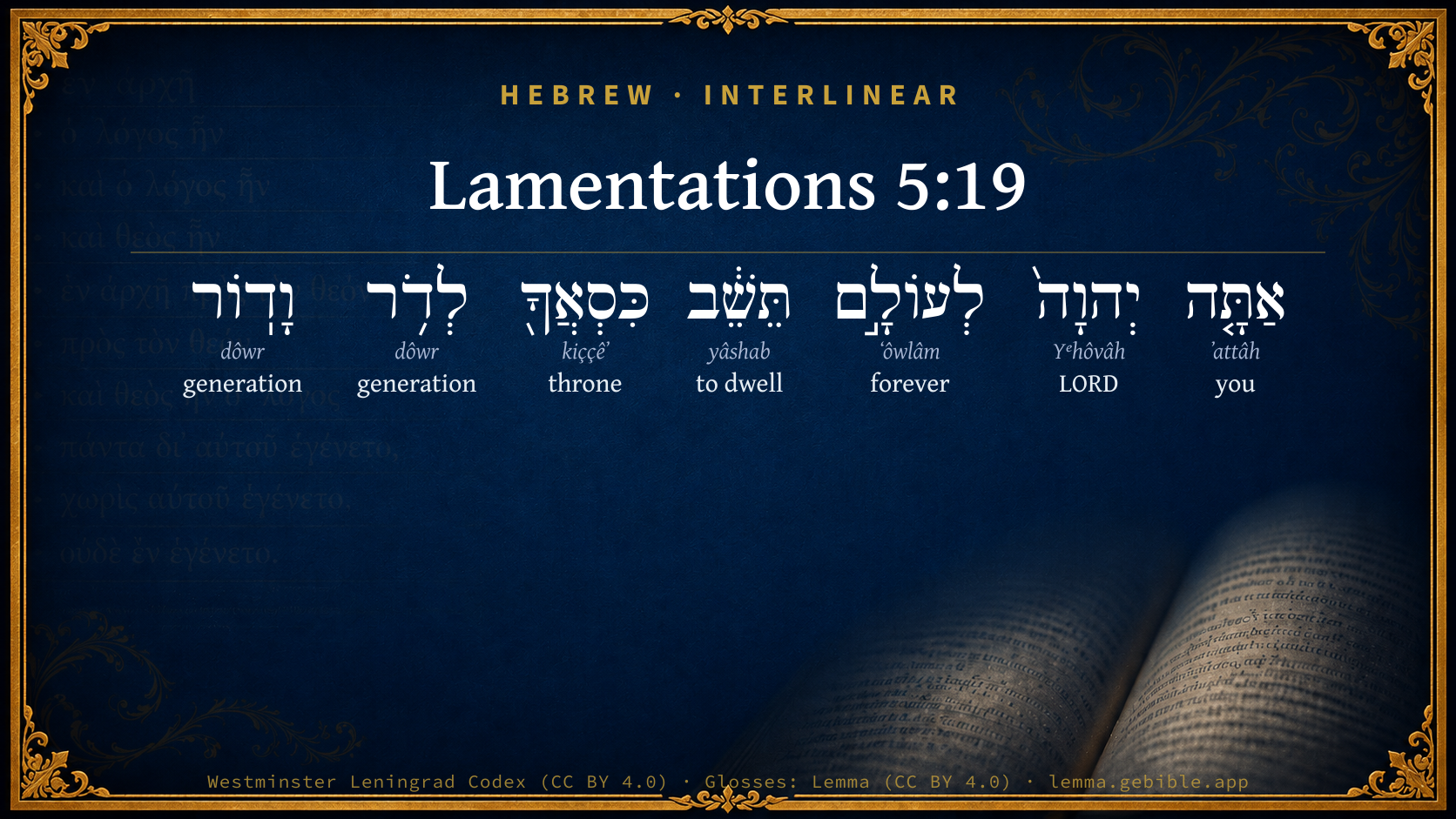
Lamentations 5:19

Hebrew (Westminster Leningrad Codex) Lamentations 5:19 appears in the Hebrew Old Testament. The text above is from the Westminster Leningrad Codex. Each word links to its Strong’s number, a concise gloss, and parsing drawn from the Open Scriptures Hebrew Bible morphology. Click any word for its full Brown-Driver-Briggs (BDB) entry.
Download image
Cite this verse

Lamentations 5:19 (World English Bible). Public Domain. Lemma interlinear Bible study tool, https://lemma.gebible.app/v/lamentations/5/19.

Show BibTeX & RIS
BibTeX
RIS
English Translation
You, Yahweh, abide forever; Your throne is from generation to generation.
World English Bible · Public Domain
Download a study sheet

One document with this verse’s original text, its word-by-word gloss line, the meaning frame, cross-references with their text, attributed commentary, and full source and license credits — printable, and it pastes into notes with its structure intact.

This verse Autodidact and up

Study sheet (.html) Plain text (.txt)

A passage Seminary Student

Up to 50 verses in one chapter. A passage sheet keeps up to 6 commentary sources and 12 cross-references per verse, in the order this page ranks them, and says so on the sheet whenever that leaves anything out. Ask for a single verse and you get the Autodidact verse sheet above.

Everything on this page stays free to read, with no account — the sheet is a download of what is already on screen, not access to it.

Want to remove ads? Support Godless Engineer
Compare translations 3

The same verse in 3 English versions, stacked beneath the original-language interlinear above. Click any original word for its lexicon entry.

Each is an independent rendering of the whole verse — the interlinear is not word-aligned to these translations.

Highlighted words mark where these versions differ — a whole-verse word diff, not a word-by-word alignment.

  • World English Bible Public Domain
    You, Yahweh, abide forever; Your throne is from generation to generation.
  • King James Version Public Domain
    Thou, O LORD, remainest for ever; thy throne from generation to generation.
  • unfoldingWord Literal Text CC BY-SA 4.0
    You, Yahweh, sit forever; your throne to generation and generation.

unfoldingWord Literal Text — © unfoldingWord, licensed CC BY-SA 4.0. Word-aligned USFM3 via Door43 (git.door43.org/unfoldingWord/en_ult).

Versions to compare (up to 4)

3 of 4 selected

Show all 18 translations

Every available English version of this verse, each an independent rendering of the whole verse.

  • World English Bible Public Domain
    You, Yahweh, abide forever; Your throne is from generation to generation.
  • Berean Standard Bible Public Domain
    You, O LORD, reign forever; Your throne endures from generation to generation.
  • Majority Standard Bible Public Domain
    You, O LORD, reign forever; Your throne endures from generation to generation.
  • King James Version Public Domain
    Thou, O LORD, remainest for ever; thy throne from generation to generation.
  • American Standard Version (1901) Public Domain
    Thou, O Jehovah, abidest for ever; Thy throne is from generation to generation.
  • Revised Version (1885) Public Domain
    Thou, O LORD, abidest for ever; thy throne is from generation to generation.
  • Geneva Bible (1599) Public Domain
    But thou, O Lord, remainest for euer: thy throne is from generation to generation.
  • Douay-Rheims (1899) Public Domain
    But thou, O Lord, shalt remain for ever, thy throne from generation to generation.
  • Young's Literal Translation Public Domain
    Thou, O Jehovah, to the age remainest, Thy throne to generation and generation.
  • Literal Standard Version CC BY-SA 4.0
    You, O YHWH, remain for all time, || Your throne to generation and generation.
  • Unlocked Literal Bible CC BY-SA 4.0
    But you, Yahweh, reign forever, and you will sit upon your throne from generation to generation.
  • unfoldingWord Literal Text CC BY-SA 4.0
    You, Yahweh, sit forever; your throne to generation and generation.
  • Darby Bible Public Domain
    Thou, Jehovah, dwellest for ever; thy throne is from generation to generation.
  • World Messianic Bible Public Domain
    You, LORD, remain forever. Your throne is from generation to generation.
  • Webster's Bible Public Domain
    Thou, O LORD, remainest for ever; thy throne from generation to generation.
  • Free Bible Version CC BY-SA 4.0
    But you, Lord, live forever! You rule for all generations!
  • Bible in Basic English Public Domain
    You, O Lord, are seated as King for ever; the seat of your power is eternal.
  • JPS Tanakh (1917) Public Domain
    Thou, O LORD, art enthroned for ever, Thy throne is from generation to generation.

Literal Standard Version (2020), Covenant Press — licensed CC BY-SA 4.0. Text via the HelloAO Bible API (eBible.org). Unlocked Literal Bible (unfoldingWord) — licensed CC BY-SA 4.0. Text via the HelloAO Bible API (eBible.org). unfoldingWord Literal Text — © unfoldingWord, licensed CC BY-SA 4.0. Word-aligned USFM3 via Door43 (git.door43.org/unfoldingWord/en_ult). Free Bible Version, Dr. Jonathan Gallagher — licensed CC BY-SA 4.0. Text via the HelloAO Bible API (eBible.org).

Word by word

More ways to search: Search by grammar → Find every occurrence → Compare this word →

Practice this passage: Drill this verse → Learn its vocabulary →

About this verse

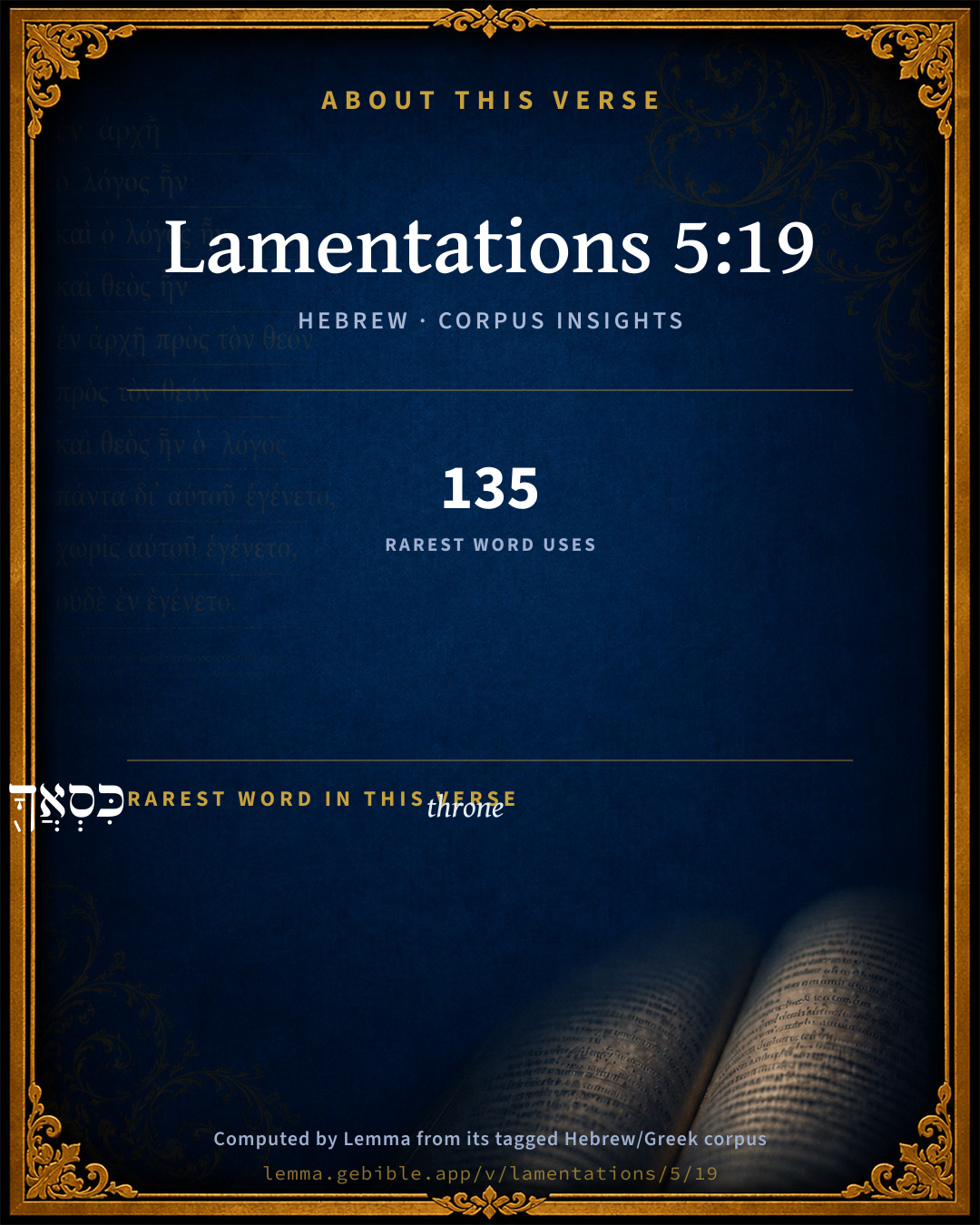
These counts appear in no published source. They are computed here, from the morphology-tagged text and Lemma’s own curated glosses. What Lemma adds →

7
words
6
distinct lemmas
Prophets
section

Grammatical profile

  • 1 verb
  • 5 nouns
  • 1 pronoun

Verb forms

  • תֵּשֵׁ֔ב Qal · Imperfect

Repetition

A word recurs within this verse — often emphatic in Hebrew:

  • לְדֹ֥ר generation H1755 ×2

Hebrew & Septuagint length

In English translation the verse runs 11 words from the Hebrew and 16 from the Septuagint (LXX English) — the Septuagint runs noticeably longer here. See the side-by-side →

A rough comparison of the two English renderings, which tokenize alike — not a word-level alignment.

Word counts can differ between the Hebrew and the Greek without any difference in meaning — e.g. the Hebrew direct-object marker אֵת has no separate Greek word, and Greek often adds the article ὁ.

Cross-references

21

Topical passages linked to Lamentations 5:19 in the Treasury of Scripture Knowledge — connected by theme and wording, ordered by reader-vote popularity; previews shown in the World English Bible.

  • Psalms 102:12 But you, Yahweh, will abide forever; Your renown endures to all generations.
  • Psalms 45:6 Your throne, God, is forever and ever. A scepter of equity is the scepter of your kingdom.
  • Hebrews 1:8–12 but of the Son he says, "Your throne, O God, is forever and ever; The scepter of uprightness is the scepter of your Kingdom.
  • Psalms 102:25–27 Of old, you laid the foundation of the earth. The heavens are the work of your hands.
  • Psalms 145:13 Your kingdom is an everlasting kingdom. Your dominion endures throughout all generations.
  • Psalms 9:7 But Yahweh reigns forever. He has prepared his throne for judgment.
  • 1 Timothy 1:17 Now to the King eternal, immortal, invisible, to God who alone is wise, be honor and glory forever and ever. Amen.
  • Revelation 1:8 "I am the Alpha and the Omega," says the Lord God, "who is and who was and who is to come, the Almighty."
  • Psalms 90:2 Before the mountains were brought forth, Or ever you had formed the earth and the world, Even from everlasting to everlasting, you are God.
  • Psalms 146:10 Yahweh will reign forever; Your God, O Zion, to all generations. Praise Yah!
  • Habakkuk 1:12 Aren't you from everlasting, Yahweh my God, my Holy One? We will not die. Yahweh, you have appointed him for judgment. You, Rock, have established him to punish.
  • Hebrews 13:8 Jesus Christ is the same yesterday, today, and forever.
  • Deuteronomy 33:27 The eternal God is [your] dwelling-place, Underneath are the everlasting arms. He thrust out the enemy from before you, Said, Destroy.
  • Psalms 10:16 Yahweh is King forever and ever! The nations will perish out of his land.
  • Psalms 29:10 Yahweh sat enthroned at the Flood. Yes, Yahweh sits as King forever.
  • Daniel 2:44 In the days of those kings shall the God of heaven set up a kingdom which shall never be destroyed, nor shall the sovereignty of it be left to another people; but it shall break in pieces and consume all these kingdoms, and it shall stand forever.
  • Daniel 7:14 There was given him dominion, and glory, and a kingdom, that all the peoples, nations, and languages should serve him: his dominion is an everlasting dominion, which shall not pass away, and his kingdom that which shall not be destroyed.
  • Daniel 7:27 The kingdom and the dominion, and the greatness of the kingdoms under the whole the sky, shall be given to the people of the saints of the Most High: his kingdom is an everlasting kingdom, and all dominions shall serve and obey him.
  • 1 Timothy 6:15–16 which in its own times he will show, who is the blessed and only Ruler, the King of kings, and Lord of lords;
  • Revelation 1:17–18 When I saw him, I fell at his feet like a dead man. He laid his right hand on me, saying, "Don't be afraid. I am the first and the last,
  • Revelation 1:4 John, to the seven assemblies that are in Asia: Grace to you and peace, from God, who is and who was and who is to come; and from the seven Spirits who are before his throne;

Cross-references courtesy of OpenBible.info (CC BY 4.0).

Hebrew and Greek witnesses Masoretic Hebrew ↔ Greek Septuagint

The same verse in the two great witnesses to the Old Testament, shown verse-for-verse.

Here the Septuagint runs noticeably longer than the Hebrew — LXX2012 (modern English Septuagint) 16 words vs World English Bible 11. A rough length comparison of the two English translations, not a word-level alignment — read both below.

These are two independent witnesses, not word-aligned to each other, and the Septuagint is shown in lemma (dictionary) form.

Hebrew Lamentations 5:19 Masoretic · Westminster Leningrad Codex

אַתָּ֤ה יְהוָה֙ לְעוֹלָ֣ם תֵּשֵׁ֔ב כִּסְאֲךָ֖ לְדֹ֥ר וָדֽוֹר

You, Yahweh, abide forever; Your throne is from generation to generation.

World English Bible · Public Domain

Greek LXX Lamentations 5:19 Septuagint · lemma form

σύ δέ κύριος εἰς ὁ αἰών καταοἰκέω ὁ θρόνος σύ εἰς γενεά καί γενεά

But you, O Lord, shall dwell for ever; your throne shall endure to generation and generation.

LXX2012 (modern English Septuagint) · Public Domain

Hebrew: Westminster Leningrad Codex (CC BY 4.0). Greek: Septuagint (public domain); English from LXX2012 (modern English Septuagint) (Public Domain). How the Septuagint differs from the Hebrew →

Commentary

Notes on Lamentations 5:19 from classic Christian and Jewish commentators (each source and its license shown beneath its notes). The classic Christian expositions comment on the surrounding passage and are grouped to its opening verse, so a note may address several verses; the Jewish commentaries on the Tanakh (Rashi and others) are per-verse, so they appear only where the commentator wrote on this verse.

Lemma curates 59 commentaries, every one of them public domain or Creative Commons licensed, each selected and text-cleaned for this edition rather than reprinted as found. About our sources →

Trapp's Complete Commentary

John Trapp

Lam 5:19 Thou, O LORD, remainest for ever; thy throne from generation to generation.

Ver. 19. Thou, O Lord, remainest for ever.] Alioqui totus totus desperassem, as that good man said once in like ease, Otherwise I should have but small joy of my life. But thou art everlasting, and invariable in essence, truth, will, and promises. This is mine anchor hold.

Thy throne from generation to generation,] i.e., Thy most equal and righteous ordering of all things, utut nobis quaedam confusiuscule currere videantur, though some things may seem to us to be somewhat confusedly carried, and even to run on wheels, yet it shall one day appear that there was a wheel within a wheel, {Eze 1:15-16} that is, an overruling and all disposing Providence.

John Trapp, A Commentary or Exposition upon All the Books of the Old and New Testament (1647–1656) — public domain. Text from a community e-Sword module.

The Biblical Illustrator

Joseph S. Exell

Lam_5:19-22

Thou, O Lord, remainest forever; Thy throne from generation to generation.

The everlasting throne

Thus at last our attention is turned from earth to heaven, from man to God. In this change of vision the mood which gave rise to the Lamentations disappears. Since earthly things lose their value in view of the treasures in heaven, the ruin of them also becomes of less account. For the moment the poet forgets himself and his surroundings in a rapt contemplation of God. This is the glory of adoration, the very highest form of prayer, that prayer in which a man comes nearest to the condition ascribed to angels and the spirits of the blessed who surround the throne and gaze on the eternal light. The continuance of the throne of God is the idea that now lays hold of the elegist as he turns his thoughts from the miserable scenes of the ruined city to the glory above. This is brought home to his consciousness by the fleeting nature of all things earthly. God only remains, eternal, unchangeable. His is the only throne that stands secure above every revolution. The unwavering faith of our poet is apparent at this point after it has been tried by the most severe tests. Jerusalem has been destroyed, her king has fallen into the hands of the enemy, her people have been scattered; and yet the elegist has not the faintest doubt that her God remains and that His throne is steadfast, immovable, everlasting. The fall of Israel in no way affects the throne of God; it is even brought about by His will; it could not have occurred if He had been pleased to hinder it. This idea of the elegist is in line with a familiar stream of Hebrew thought, and his very words have many an echo in the language of prophet and psalmist, as, for example, in the forty-fifth Psalm, where we read, Thy throne, O God, is forever and ever. The grand Messianic hope is founded on the conviction that the ultimate establishment of Gods reign throughout the world will be the best blessing imaginable for all mankind. Sometimes this is associated with the advent of a Divinely anointed earthly monarch of the line of David. At other times Gods direct sovereignty is expected to be manifested in the day of the Lord. For Christians, at least as much as for Jews, the eternal sovereignty of God should be a source of profound confidence, inspiring hope and joy. Now the elegist ventures to expostulate with God on the ground of the eternity of His throne. A long time had passed since the siege, and still the Jews were in distress. It was as though God had forgotten them or voluntarily forsaken them. This is a dilemma to which we are often driven. If God is almighty can He be also all-merciful? If what we knew furnished all the possible data of the problem this would be indeed a serious position. But our ignorance silences us. Some hint of an explanation is given in the next phrase of the poets prayer. God is besought to turn the people to Himself. The language of the elegy here points to a personal and spiritual change. We cannot water it down to the expression of a desire to be restored to Palestine. Nor is it enough to take it as a prayer to be restored to Gods favour. The double expression, Turn Thou us unto Thee, O Lord, and we shall be turned, points to a deeper longing, a longing for real conversion, the turning round of the heart and life to God, the return of the prodigal to his Father. In the next place, it is to be observed that the turning here contemplated is positive in its aims, not merely a flight from the wrong way. To turn from sin to blank vacancy and nothingness is an impossibility. The great motive must be the attraction of a better course rather than revulsion from the old life. This is the reason why the preaching of the Gospel of Christ succeeds where pure appeals to conscience fail. Then we may notice, further, that the particular aim of the change here indicated is to turn back to God. As sin is forsaking God, so the commencement of a better life must consist in a return to Him. But this is not to be regarded as a means towards some other end. We must not have the homecoming made use of as a mere convenience. It must be an end in itself, and the chief end of the prayer and effort of the soul, or it can be nothing at all. The poet is perfectly confident that when God takes His people in hand to lead them round to Himself He will surely do so. If He turns them they will be turned. The words suggest that previous efforts had been made from other quarters, and had failed. The prophets, speaking from God, had urged repentance, but their words had been ineffectual. It is only when God undertakes the work that there is any chance of success. Next, we see that the return is to be a renewal of a previous condition. The poet prays, Renew our days as of old--a phrase which suggests the recovery of apostates. Possibly here we have some reference to more external conditions. There is a hope that the prosperity of the former times may be brought back. And yet the previous line, which is concerned with the spiritual return to God, should lead us to take this one also in a spiritual sense. The memory of a lost blessing makes the prayer for restoration the more intense. In some respects restoration is more difficult than a new beginning. The past will not come back. The innocence of childhood, when once it is lost, can never be restored. That first, fresh bloom of youth is irrecoverable. On the other hand, what the restoration lacks in one respect may be more than made up in other directions. Though the old paradise will not be regained, though it has withered long since, and the site of it has become a desert, God will create new heavens and a new earth which shall be better than the lost past. In our English Bible the last verse of the chapter reads like a final outburst of the language of despair. It seems to say that the prayer is all in vain, for God has utterly forsaken His people. But another rendering is now generally accepted, though our revisers have only placed it in the margin. According to this we read, Unless Thou hast utterly rejected us, etc. There is still a melancholy tone in the sentence, as there is throughout the book that it concludes; but this is softened, and now it by no means breathes the spirit of despair. Turn it round, and the phrase will even contain an encouragement. If God has not utterly rejected His people assuredly He will attend to their prayer to be restored to Him. But it cannot be that He has quite cast them off. Then it must be that He will respond and turn them back to Himself. Thus we are led even by this most melancholy book in the Bible to see, as with eyes purged by tears, that the love of God is greater than the sorrow of man, and His redeeming power more mighty than the sin which lies at the root of the worst of that sorrow, the eternity of His throne, in spite of the present havoc of evil in the universe, assuring us that the end of all will be not a mournful elegy, but a paean of victory. (W. F. Adeney, M. A.)

Thou, O Lord, remainest forever, Thy throne from generation to generation

1. Gods unchangeableness a support in troubles.

(1) Look upon the choicest things that the world affords as mutable, this will take off thine affections from them, they perish, but the Lord endures, they all wax old like a garment, but God is the same forever (Psa_102:26-27). This will make their loss to thee, thy deprivation of them to be no sore affliction, for who will breathe out sighs, at the breaking of an earthen vessel, at the scattering of a vapour, at the withering of a flower, or the vanishing of a shadow?

(2) In your worst condition, when you are afflicted and tossed with the waves of sorrow, stay, and still yourselves with the thoughts of the unchangeableness of your God, He is immutable as well in His mercy as in His holiness, He is that Sun that shineth always with a like brightness, and remember that as this is the way to bring serenity in your hearts, so also your safety at all times depends upon Gods immutability (Mal_3:6; Psa_73:23-26).

(3) Hold out alacrity, be cheerful, let not your souls faint, and your hearts die within you, though your lovers have forsaken you, your friends turn enemies, and your adversaries set up their ensigns for banners, your God is unchangeable in His love, neither life, nor death, principalities, nor powers shall take you out of His thoughts, He thinks as well of you when you are black with persecution, as when you are fair, and shine in a prosperous condition; for the Church is His beloved, though a lily among thorns (Son_2:2). And the immutability of His rule will terminate the worst of your sorrows (Psa_7:9; Jer_29:11).

(4) Lastly, remember what God is, and that in a degree it is your duties to assimilate Himself, therefore humble yourselves for your fickleness in your purposes, and for your changeableness in your resolves for holiness, have not hereafter a heart loving to wander (Jer_14:10). Be not soon removed (Gal_1:6). Keep close to your determinations for the things of heaven, let not the blasts of seducers take your spirits from their hinges, either in relation to principles or duties (Eph_4:14). You must imitate your Father, and you see He is a God that is immutable.

2. God is eternal as well as immutable.

(1) Look upon this attribute of God which, like a golden thread, runs through all the rest, and admire it; let thy soul echo out the praises of Divine eternity upon all occasions (1Ti_1:17). And well mayest thou, for this the eternity of God exceeds that of the most glorious creatures: theirs is but an half eternity, it is to everlasting, not like the Lords from everlasting; theirs is not intrinsical in themselves, they receive it, but Gods is independent; they cannot communicate to others, or extend it beyond themselves as the Lord can, therefore now extol Gods eternity, and let it be matter of wonder to thy soul.

(2) Be not dismayed when the rage and fury of your adversaries speaks a stripping, a deprivation of all enjoyments, when they tell you they will enter upon your houses, seize upon your lands, take away your food, and deprive you of the delight of your eyes, tell them you know these things are but mutable, and they may take them, but they cannot take away your God, who is eternal in the heavens.

(3) Rest not upon creatures, Solomon gives you to know that their strength, their help is vanity, put your trust in this the eternal God, He hath said He will never fail you nor forsake you, He is not as man that He should repent, He is faithful as well as eternal, and cannot deny Himself (2Ti_2:13). (D. Swift.)

Wherefore dost Thou forget us forever, and forsake us so long time?--

Helps for time of desertion

For the ship doth not more naturally arise with the flowing in of the waters, than doubts in the soul with the coming in of troubles. For all this while God is but either trying thy disposition, and the frame and temper of thy spirit towards Himself, He is but seeing whether thou wilt love Him frowning as well as smiling upon thy soul (Isa_8:17), or ransacking of thine heart, and making discovery to thee of the filth and guilt of sin that is within thee, for man feels his sins with most hatred and sorrow in the times of Gods withdrawings (1Sa_21:1-2), or He is but putting thee into that most excellent life of His most precious saints. Thou wouldest live by sense, but He will now teach thee with David to live by faith (Psa_27:13), or else the Lord is preparing thee for greater apprehensions of His love and favour for the time to come. Yet still, for all that hath been spoken, methinks I see you, O ye captived Jews, like Rachel, weeping and refusing consolation; what, are you like the marigold, which opens and shuts with the sun? are you as court favourites, whose comforts and discomforts depend upon the countenance or discountenance of their prince? I must needs acknowledge, that heavens frowning, Gods neglecting, or the Lords deserting, wounds deep, and pierceth through a Christians heart. And this hath been the cause why in an expostulatory way they have breathed out these, or the like complaints; if the Lord be with us, why is all this befallen us? Will the Lord cast off forever, will He not again show favour? hath He forgotten to be gracious, and doth His promise fail for evermore (Psa_77:7-9)? Neither do I marvel if, in this pang those have been the expresses of their souls. For where is a believers love concentrate, as it were, and gathered together, but in the Lord its God? and therefore it languisheth in His absence, and is ill at ease, until it enjoy His presence (Son_5:8). Hath not the saints rejoicing ever been principally in Divine communion (Psa_4:7)? Is not the assurance of His love the very day and joy of a Christian heart? (D. Swift.)

Turn Thou us unto Thee, O Lord, and we shall be turned; renew our days as of old.

Genuine conversion

I. It is a turning of the soul to the Lord. Not to creeds, not to churches, but to the Lord Himself, as the object of supreme love. The centreing of the whole soul upon Him. If the Lord is loved supremely, He will be the dominant subject of thought, the leading theme of conversation, the paramount sovereign of life.

II. It is a turning of the soul to the Lord by the Lord. No one can turn the human soul to God but Himself. A man may as well endeavour to roll back the Mississippi to its mountain springs as to turn back the soul to the Lord; He alone can do it, and He does it by the influence of nature, historic events, Gospel truths, and Christly ministries. (Homilist.)

Zions sufferings

1. Afflictions send the saints unto their God. O happy sorrows, O blessed troubles that thus bring poor souls nearer to their God. Now, having been thus doctrinated in the school of the Cross, thou mayest experimentally say with the sweet singer of Israel, it is good for me that I have been afflicted, thereby I have learned to know Thy statutes.

2. Troubles no discouragements to Gods precious servants.

3. Repentance the work of the great God.

4. Pressures put not Gods children besides their prayers.

5. Deliverances are only perfected by the Lord. (D. Swift.)

The Biblical Illustrator, edited by Joseph S. Exell (c. 1880s–1900s) — public domain. Text from a community e-Sword module.

Joseph Benson's Commentary

Lam 5:19-22. Thou, O Lord, remainest for ever — Though, for our sins, thou hast suffered these calamities to befall us, and our throne, through thy righteous providence, is thrown down; yet thou art still the same God that thou ever wast: thy power is not diminished, nor thy goodness abated. Thou still governest the world, and orderest all the events of it, and shalt rule it, and superintend its affairs, for ever and ever. Thou art, therefore, always able to help us, and art thou not as willing as able? Is it possible thou shouldest be unmindful of the promises which thou hast made to thy people? Our hope, therefore, is still in thee, unto whom we look for mercy and deliverance. Wherefore dost thou forget us, &c. — Wherefore dost thou act toward us, in the dispensations of thy providence, as if thou hadst forgotten us, and forsaken us, and that for a long time? Turn thou us unto thee, O Lord — Turn us unto thyself from our sins and idols, by a sincere repentance and thorough conversion; and we shall be turned — Effectually and lastingly turned to thee, so as to turn from thee no more. Renew our days as of old — Restore us to that happiness and prosperity which we formerly enjoyed. But thou hast utterly rejected us — Hebrew, כיאם מאס מאסתנו, which, it seems, should rather be rendered, For surely thou hast cast us off, &c., the prophet, in this verse, assigning the reason of the preceding application. For God’s having rejected his people, and expressed great indignation against them, was the cause and ground of their pleading with him, and praying thus earnestly to be restored to his favour and the enjoyment of their ancient privileges. The Jewish rabbins, because they would not have the book to conclude with the melancholy words of this verse, repeat after them the prayer of the preceding verse, namely, Turn thou us unto thee, &c., a prayer which we cannot too frequently, or too fervently, address to God, for ourselves and others. And surely the fervent zeal with which the prophet beseeches the Lord to have compassion on his people, should excite us, at all times, to pray earnestly to him, especially for the protection, safety, and prosperity of his church, and the supply of all its wants, whether it be exposed to persecutions and sufferings on the one hand, or the assaults of infidelity, impiety, and vice on the other. We may learn also, from this humble and earnest prayer of the prophet for the restoration of the Jewish nation, that, when God corrects us, and afflicts us, even with the greatest severity, we must not despond or restrain prayer before him, but have recourse to him by true repentance and faith, and implore his pardoning mercy and renewing grace, as the only way to obtain the light of his countenance, and a restoration to our former state of peace, tranquillity, and comfort.

Joseph Benson's Commentary on the Old and New Testaments (1811–1818) — public domain. Text from a community e-Sword module.

Whedon's Commentary on the Bible

Daniel D. Whedon

THE PRAYER, Lam_5:19-22.

19. Thou… remainest for ever — Nothing could be more fitting or more impressive than this pathetic appeal to the immutable sovereignty of Jehovah. Men may die, institutions may fail, kingdoms may come to a perpetual end, but the resources of God are unfailing. His throne standeth forever, from generation to generation. And if God lives his people cannot die. If the head is above the water the body cannot be drowned.

“Under the shadow of his throne,

Still may we dwell secure.”

He who sitteth eternally enthroned will not forget for ever his own people. And yet this hope and confidence does not “rise to the heights of joyful victory, but, as Gerlach expresses himself, ‘merely glimmers from afar, like the morning star through the clouds, which does not, indeed, itself dispel the shadows of the night, though it announces that the rising of the sun is near, and that it shall obtain the victory.’” — Keil.

Daniel D. Whedon (gen. ed.), Commentary on the Old and New Testaments (1874–1909) — public domain. Text from a community e-Sword module.

The Preacher's Complete Homiletical Commentary

Joseph S. Exell (gen. ed.)

EXEGETICAL NOTES.—

Lam_5:19. Nevertheless, whatever be the low estate of His sanctuary and people, the living God is and reigns. Thou, O Jehovah, abidest for ever. Not only is His continual existence denoted, but also that Jehovah sitteth as king for ever (Psa_29:10), the same verb being used in this clause as in the Psalm quoted, and the next clause carries on the thought, Thy throne from generation to generation. Enemies may destroy the temple made with hands; they are powerless to injure the kingdom of Him who inhabits eternity. Generations come and go with their rises and falls, but Thou art the same, and Thy years shall not fail.

Lam_5:20. The perpetuity of God’s rule, amid all earthly changes, frames an appealing prayer. Reigning supreme over the army of heaven, it is impossible that He can renounce authority over the things of earth and man; then, Why dost Thou forget us for ever, forsakest us for so long? Is it not time for Thee to pluck Thy right hand out of Thy bosom and bring relief in the lifetime even of this generation? How bluntly petitioners address God when troubles press upon them! How ready to suppose His thoughts and ways must be like their own! How prone to fancy that, because their observation does not perceive His working, God can hardly care so much for His kingdom’s honour as they do!

Lam_5:21. Turn us, O Jehovah, unto Thee, and we shall be turned; a prayer which proves that a new heart has been given to those in whose name the writer speaks. Affliction has been a means of showing the blunders and sins of the past, and that the only remedy for them is in Jehovah Himself. They see that the reconciling power does not originate with themselves, but with Him; that He must draw them by a continual influence if they are to walk in the light of His countenance. We do not consider this request as merely for the restoration of their native land; we need to put a deeper meaning into it, which will, at least, indicate that they wanted to become true worshippers of the Lord God of their deliverances. The succeeding clause, however, seems to imply that they did not expect to attain to their desires unless they were repossessed with their former national organisation. Renew our days as of old; re-establish the gracious relations in which thou stoodest to us; let us again have country, city, and temple, priest, prophet, and king. Cause every man to sit under his vine and under his fig-tree, and none make them afraid.

Lam_5:22. The two initial Hebrew particles of this verse signify that it is not a fact which is stated, but the elements of a hope, and may be introduced with, This will come to pass, unless Thou hast utterly rejected us; art wroth against us exceedingly. The under-thought is, But this cannot be the case. Thou wouldst not so disgrace the throne of Thy glory. Thou wouldst not so falsify the promises made to our fathers. Thou wouldst not always give occasion for the mocking heathen to say, Where is now your God?

“This conclusion entirely agrees with the character of the Lamentations, in which complaint and supplication continue to the end, not without an element of hope, which, as Gerlach says, ‘merely glimmers from afar, like the morning star through the clouds, which does not indeed itself dispel the shadows of the night, though it announces that the rising of the sun is near, and that it shall obtain the victory’ ” (Keil).

HOMILETICS

AN EARNEST PRAYER FOR RESTORATION

(Lam_5:19-22)

I. Acknowledges the eternal sovereignty of Jehovah. “Thou, O Lord, remainest for ever; Thy throne from generation to generation” (Lam_5:19). The throne of Judah is fallen, but not so the throne of God. Egypt, Assyria, Babylon, Israel, and all the nations of the earth may rise and fall, but God is unchanged. The fact of the perpetuity of the Divine government of the world forms the basis of a hope that, however desperate may be the condition of His people, God can restore them. If the throne of God was like the fickle governments of earth, there would be no prospect of recovery. All true prayer has the assurance of being heard and answered in the fact of the righteousness of an unchangeable God.

II. Deprecates the continued absence of the Divine favour. “Wherefore dost Thou forget us for ever, and forsake us so long time?” (Lam_5:20). If Thy government is continuous, why are we forgotten and abandoned? If Thy throne in heaven is immovable, why is Thy throne in our earthly Zion overthrown? Thou didst once care for us and love us, and the memory of that happy time still keeps our hope alive. Thy favour was the joy and the sunshine of our lives; its absence is at the root of all our misery. Low as we have sunk, it cannot be that Thou hast utterly and for ever given us up., Cast us not away from Thy presence, and take not Thy Holy Spirit from us. Restore unto us the joy of Thy salvation. The soul that yearns in prayer for the Divine favour is on the brink of a glorious vision.

III. Supplicates the grace of genuine repentance. “Turn Thou us unto Thee, O Lord, and we shall be turned; renew our days as of old” (Lam_5:21). Repentance is a turning about. For some time the course of Judah had been in one direction—wandering from God, and sinking into ever lower depths of sin and misery. Now there is a thoughtful pause, an arrest of the downward career. What has brought this about? Prayer; and that prayer becomes more eager and earnest as it becomes more evident that rescue is at hand. True prayer recognises that God alone can give repentance and renew the glory of the golden days of old. When the heart is changed, our outward circumstances soon alter for the better. When Judah regained the favour of God, she also regained lost temporal blessings.

IV. Is urged with the assurance that God cannot utterly reject the truly penitent. “But Thou hast utterly rejected us; Thou art very wroth against us.” Unless Thou hast utterly rejected us, unless Thou art very wroth against us. This is stated as a virtual impossibility. Geikie translates the verse, “Thou wilt not surely wholly forget us? Thou wilt not be angry with us beyond measure?” The miserable results of their repudiation by Jehovah become the ground of a confident appeal to Him. He heard the prayer, and at the end of seventy years the Jews were restored to their own land. The Book of Lamentations ends, as it begins, with a wail; but the concluding wail, unlike the first, has in it a joyous strain of hope. In many ancient MSS. the twenty-first verse is repeated after the twenty-second, to make a more agreeable finish when the book was read in the Synagogue; but Jeremiah did not think this arrangement necessary. He concludes with the refrain of what had been the burden of his sorrowful monologue, because he is so confident of help and restoration. “The message of God to the soul, even in threatenings, is ever in truth one of comfort.” The darkest night of suffering and sorrow is followed by the tranquillising hope of the golden daybreak.

LESSONS.—

1. When the Church begins to pray there is hope of revival.

2. True prayer is ever accompanied with repentance.

3. God not only hears, but answers the prayer of the contrite.

GERM NOTES ON THE VERSES

Lam_5:19-20. The unchangeable God. I. His government is in perpetual activity. “Thou remainest for ever, Thy throne from generation to generation” (Lam_5:19). II. He cannot forget His people. “Wherefore dost Thou forget us for ever?” (Lam_5:20). III. He will not for ever stand aloof from His people. “Wherefore dost Thou forsake us for so long time?” (Lam_5:20).

Lam_5:21-22. A prayer for repentance. I. Recognises that repentance is a Divine act. “Turn Thou us unto Thee, O Lord; renew our days as of old” (Lam_5:21). II. When God gives repentance it is effectual. “And we shall be turned” (Lam_5:21). III. When God gives repentance it is evident His wrath is withdrawn, and He again accepts us. “Unless Thou hast utterly rejected us; unless Thou art very wroth against us” (Lam_5:22). But this cannot be, for He gives repentance. He “renews our days as of old.”

ILLUSTRATIONS.—The eternity of God. Would you gain some idea of the eternity past of God’s existence? Go to the astronomer and bid him lead you with him in one of his walks through space; and as he sweeps outward from object to object, from universe to universe, remember that the light from those filmy stains on the deep pure blue of heaven now falling on your eye has been travelling space for a million of years.—Mitchell.

Prayer the melody of misery.

“Oh, hearts that break and give no sign,

Save whitening lip and fading tresses,

Till death pours out his cordial wine,

Slow-dropped from misery’s crushing presses:

If singing breath or echoing chord

To every hidden pain were given,

What endless melodies were poured,

As sad as earth, as sweet as heaven!”

—O. W. Holmes.

Suffering prompts prayer. Afflictions make us most frequent and fervent in pouring forth our supplications unto God. In our prosperity we either utterly neglect this duty, or perform it carelessly and slothfully; but when we are brought into calamities, we flee to Him by earnest prayer, craving His aid and help. And as the child, fearing nothing, is so fond of his play that he strays and wanders from his mother, not so much as thinking of her, but if he be scared or frighted with the sight or apprehension of some apparent or approaching danger, presently runs to her, casts himself into her arms, and cries out to be saved and shielded by her, so we, securely enjoying the childish sports of worldly prosperity, do so fondly dote on them that we scarce think of our Heavenly Father; but when perils approach and are ready to seize upon us, then we flee to Him and cast ourselves into the arms of His protection, crying to Him by earnest prayer for help in our extremity.—Downame.

The value of prayer. If the whole world in which we live is but a continual temptation, if all around appears to agree with our inward corruptions to weaken and seduce us, if riches bribe and indigence sours, if prosperity elevates and afflictions abase us, if business dissipates and rest enervates, if the sciences exalt and ignorance bewilders us, if commerce exposes us too much and solitude leaves us too much to ourselves, if pleasure seduce us and holy works make us proud, if health awakens the passions and sickness produces murmurings—in a word, if since the fall of man all that surrounds us and all that is in us is perilous, in so deplorable a situation, O my God, what hope of salvation remains for us? If our sighs do not incessantly ascend from the depth of our misery towards the throne of Thy mercy, until Thou deignest to assist us and to rescue us from our fallen state.—Massillon.

God answers prayer. When poor men make requests to us, we usually answer them as the echo does the voice—the answer cuts off half the petition. We shall seldom find among men Jael’s courtesy, giving milk to those that ask water, except it be as this was, an entangling benefit, the better to introduce a mischief. There are not many Naamans among us that, when you beg of them one talent, will force you to take two. But God’s answer to our prayers is like a multiplying glass, which renders the request much greater in the answer than it was in the prayer.—Bishop Reynolds.

“More things are wrought by prayer

Than the world dreams of.”

—Tennyson.

The Preacher's Complete Homiletical Commentary (gen. ed. Joseph S. Exell; Funk & Wagnalls, c. 1892) — public domain (pre-1929). A full-Bible homiletical/sermon-outline anthology covering 65 of 66 books (2 John is absent from the source module). Text from a community e-Sword module.

The Expositor's Bible

THE EVERLASTING THRONE

Lam_5:19-22

WE have lingered long in the valley of humiliation. At the eleventh hour we are directed to look up from this scene of weary gloom to heavenly heights, radiant with sunlight. It is not by accident that the new attitude is suggested only at the very end of the last elegy. The course of the thought and the course of experience that underlies it have been preparing for the change. On entering the valley the traveller must look well to his feet; it is not till he has been a denizen of it for some time that he is able to lift up his eyes to other and brighter realms.

Thus at last our attention is turned from earth to heaven, from man to God. In this change of vision the mood which gave rise to the Lamentations disappears. Since earthly things lose their value in view of the treasures in heaven, the ruin of them also becomes of less account. Thus we read in the "Imitatio":

"The life of man is always looking on the things of time,

Pleased with the pelf of earth,

Gloomy at loss,

Pricked by the least injurious word;

Life touched by God looks on the eternal, -

With it no cleaving unto time,

No frown when property is lost,

No sneer when words are harsh, -

Because it puts its treasure and its joy in heaven,

Where nothing fades."

The explanation of this sudden turn is to be found in the fact that for the moment the poet forgets himself and his surroundings in a rapt contemplation of God. This is the glory of adoration, the very highest form of prayer, that prayer in which a man comes nearest to the condition ascribed to angels and the spirits of the blessed who surround the throne and gaze on the eternal light. It is not to be thought of as an idle dreaming like the dreary abstraction of the Indian fanatic who has drilled himself to forget the outside world by reducing, his mind to a state of vacancy while he repeats the meaningless syllable Om, or the senseless ecstasy of the monk of Mount Athos, who has attained the highest object of his ambition when he thinks he has beheld the sacred light within his own body. It is self-forgetful, not self-centred; and it is occupied with the contemplation of those great truths of the being of God, absorption in which is an inspiration. Here the worshipper is at the river of the water of life, from which if he drinks he will go away refreshed for the battle like the Red-cross knight restored at the healing fountain. It is the misfortune of our own age that it is impractical in the excess of its practicalness when it has not patience for those quiet, calm experiences of pure worship which are the very food of the soul.

The continuance of the throne of God is the idea that now lays hold of the elegist as he turns his thoughts from the miserable scenes of the ruined city to the glory above. This is brought home to his consciousness by the fleeting nature of all things earthly. He has experienced what the author of the Epistle to the Hebrews describes as "the removing of those things that are shaken, as of things that have been made, that those things which are not shaken may remain." {Heb_12:27} The throne of David has been swept away; but above the earthly wreck the throne of God stands firm, all the more clearly visible now that the distracting influence of the lower object has vanished, all the more valuable now that no other refuge can be found. Men fall like leaves in autumn; one generation follows another in the swift march to death; dynasties which outlive many generations have their day, to be succeeded by others of an equally temporary character; kingdoms reach their zenith, decline, and fall. God only remains, eternal, unchangeable. His is the only throne that stands secure above every revolution.

The unwavering faith of our poet is apparent at this point after it has been tried by the most severe tests. Jerusalem has been destroyed, her king has fallen into the hands of the enemy, her:people have been scattered; and yet the elegist has not the faintest doubt that her God remains and that His throne is steadfast, immovable, everlasting. This faith reveals a conviction far in advance of that of the surrounding heathen. The common idea was that the defeat of a people was also the defeat of their gods. If the national divinities were not exterminated they were flung down from their thrones, and reduced to the condition of fins-demons who avenged themselves on their conquerors by annoying them whenever an opportunity for doing so arose, but with greatly crippled resources. No such notion is ever entertained by the author of these poems nor by any of the Hebrew prophets. The fall of Israel in no way affects the throne of God; it is even brought about by His will; it could not have occurred if He had been pleased to hinder it.

Thus the poet was led to find his hope and refuge in the throne of God, the circumstances of his time concurring to turn his thoughts in this direction, since the disappearance of the national throne, the chaos of the sacked city, and the establishment of a new government under the galling yoke of slaves from Babylon, invited the man of faith to look above the shifting powers of earth to the everlasting supremacy of heaven.

This idea of the elegist is in line with a familiar stream of Hebrew thought, and his very words have many an echo in the language of prophet and psalmist, as, for example, in the forty-fifth psalm, where we read, "Thy throne, O God, is forever and ever."

The grand Messianic hope is founded on the conviction that the ultimate establishment of Gods reign throughout the world will be the best blessing imaginable for all mankind. Sometimes this is associated with the advent of a Divinely anointed earthly monarch of the line of David. At other times Gods direct sovereignty is expected to be manifested in the "Day of the Lord." The failure of the feeble Zedekiah seems to have discredited the national hopes centred in the royal family. For two generations they slumbered, to be awakened in connection with another disappointing descendant of David, Zerubbabel, the leader of the return. No king was ever equal to the satisfaction of these hopes until the Promised One appeared in the fulness of the times, until Jesus was born into the world to come forth as the Lords Christ. Meanwhile, since the royal house is under a cloud, the essential Messianic hope turns to God alone. He can deliver His people, and He only. Even apart from personal hopes of rescue, the very idea of the eternal, just reign of God above the transitory thrones of men is a calming, reassuring thought.

It is strange that this idea should ever have lost its fascination among Christian people, who have so much more gracious a revelation of God than was given to the Jews under the old covenant; and yet our Lord's teachings concerning the Fatherhood of God have been set forth as the direct antithesis of the Divine sovereignty, while the latter has been treated as a stern and dreadful function from which it was natural to shrink with fear and trembling. But the truth is the two attributes are mutually illustrative; for he is a very imperfect father who does not rule his own house, and he is a very inadequate sovereign who does not seek to exercise parental functions towards his people. Accordingly, the gospel of Christ is the gospel of the kingdom. Thus the good news declared by the first evangelists was due to the effect that the kingdom of God was at hand, and our Lord taught us to pray, "Thy kingdom come." For Christians, at least as much as for Jews, the eternal sovereignty of God should be a source of profound confidence, inspiring hope and joy.

Now the elegist ventures to expostulate with God on the ground of the eternity of His throne. God had not abdicated, though the earthly monarch had been driven from his kingdom. The overthrow of Zedekiah had left the throne of God untouched. Then it was not owing to inability to come to the aid of the suffering people that the eternal King did not intervene to put an end to their miseries. A long time had passed since the siege, and still the Jews were in distress. It was as though God had forgotten them or voluntarily forsaken them. This is a dilemma to which we are often driven. If God is almighty can He be also all-merciful? If what we knew furnished all the possible data of the problem this would be indeed a serious position. But our ignorance silences us.

Some hint of an explanation is given in the next phrase of the poets prayer. God is besought to turn the people to Himself. Then they had been moving away from Him. It is like the old popular ideas of sunset. People thought the sun had forsaken the earth, when, in fact, their part of the earth had forsaken the sun. But if the wrong is on mans side, on mans side must be the amendment. Under these circumstances it is needless and unjust to speculate as to the cause of Gods supposed neglect or forgetfulness.

There can be no reasonable doubt that the language of the elegy here points to a personal and spiritual change. We cannot water it down to the expression of a desire to be restored to Palestine. Nor is it enough to take it as a prayer to be restored to Gods favour. The double expression,

"Turn Thou us unto Thee, O Lord, and we shall be turned."

points to a deeper longing, a longing for real conversion, the turning round of the heart and life to God, the return of the prodigal to his Father. We think of the education of the race, the development of mankind, the culture of the soul; and in so thinking we direct our attention to important truths which were not so well within the reach of our forefathers. On the other hand, are we not in danger of overlooking another series of reflections on which they dwelt more persistently? It is not the fact that the world is marching straight on to perfection in an unbroken line of evolution. There are breaks in the progress and long halts, deviations from the course and retrogade movements. We err and go astray, and then continuance in an evil way does not bring us out to any position of advance; it only plunges us down deeper falls of ruin. Under such circumstances, a more radical change than anything progress or education can produce is called for if ever we are even to recover our lost ground, not to speak of advancing to higher attainments. In the case of Israel it was clear that there could be no hope until the nation made a complete moral and religious evolution. The same necessity lies before every soul that has drifted into the wrong way. This subject has been discredited by being treated too much in the abstract, with too little regard for the actual condition of men and women. The first question is, What is the tendency of the life? If that is away from God, it is needless to discuss theories of conversion: the fact is plain that in the present instance some conversion is needed: There is no reason to retain a technical term, and perhaps it would be as well to abandon it if it were found to be degenerating into a mere cant phrase. This is not a question of words. The urgent necessity is concerned with the actual turning round of the leading pursuits of life.

In the next place, it is to be observed that the turning here contemplated is positive in its aims, not merely a flight from the wrong way. It is not enough to cast out the evil spirit, and leave the house swept and garnished, but without a tenant to take care of it. Evil can only be overcome by good. To turn from sin to blank vacancy and nothingness is an impossibility. The great motive power must be the attraction of a better course rather than revulsion from the old life. This is the reason why the preaching of the gospel of Christ succeeds where pure appeals to conscience fail.

By his "Serious Call to the Unconverted" William Law started a few earnest men thinking; but he could not anticipate the Methodist revival, although he prepared the way for it. The reason seems to be that appeals to conscience are depressing, necessarily and rightly so; but some cheering encouragement is called for if energy is to be found for the tremendous effort of turning the whole life upon its axle. Therefore it is not the threat of wrath but the gospel of mercy that leads to what may be truly called conversion.

Then we may notice, further, that the particular aim of the change here indicated is to turn back to God. As sin is forsaking God, so the commencement of a better life must consist in a return to Him. But this is not to be regarded as a means towards some other end. We must not have the home-coming made use of as a mere convenience. It must be an end in itself, and the chief end of the prayer and effort of the soul, or it can be nothing at all. It appears as such in the passage now under consideration. The elegist writes as though he and the people whom he represents had arrived at the conviction that their supreme need was to be brought back into near and happy relations with God. The hunger for God breathes through these words. This is the truest, deepest, most Divine longing of the soul. When once it is awakened we may be sure that it will be satisfied. The hopelessness of the condition of so many people is not only that they are estranged from God, but that they have no desire to be reconciled to Him. Then the kindling of this desire is itself a great step towards the reconciliation.

And yet the good wish is not enough by itself to attain its object. The prayer is for God to turn the people back to Himself. We see here the mutual relations of the human and the Divine in the process of the recovery of souls. So long as there is no willingness to return to God nothing can be done to force that action on the wanderer. The first necessity, therefore, is to awaken the prayer which seeks restoration. But this prayer must be for the action of God. The poet knows that it is useless simply to resolve to turn. Such a resolution may be repeated a thousand times without any result following, because the fatal poison of sin is like a snake bite that paralyses its victims. Thus we read in the "Theologia Germanica," "And in this bringing back and healing, I can, or may, or shall do nothing of myself, but simply yield to God, so that He alone may do all things in me and work, and I may suffer Him and all His work and His Divine will." The real difficulty is not to change our own hearts and lives; that is impossible. And it is not expected of us. The real difficulty is rather to reach a consciousness of our own disability. It takes the form of unwillingness to trust ourselves entirely to God for Him to do for us and in us just whatever He will.

The poet is perfectly confident that when God takes His people in hand to lead them round to Himself He will surely do so. If He turns them they will be turned. The words suggest that previous efforts had been made from other quarters, and had failed. The prophets, speaking from God, had urged repentance, but their words had been ineffectual. It is only when God undertakes the work that there is any chance of success. But then success is certain. This truth was illustrated in the preaching of the cross by St. Paul at Corinth, where it was found to be the power of God. It is seen repeatedly in the fact that the worst, the oldest, the most hardened are brought round to a new life by the miracle of redeeming power. Herein we have the root principle of Calvinism, the secret of the marvellous vigour of a system which, at the first blush of it, would seem to be depressing rather than encouraging. Calvinism directed the thoughts of its disciples away from self, and man, and the world, for the inspiration of all life and energy. It bade them confess their own impotence and Gods almightiness. All who could trust themselves to such a faith would find the secret of victory.

Next, we see that the return is to be a renewal of a previous condition. The poet prays, "Renew our days as of old"-a phrase which suggests the recovery of apostates. Possibly here we have some reference to more external conditions. There is a hope that the prosperity of the former times may be brought back. And yet the previous line, which is concerned with the spiritual return to God, should lead us to take this one also in a spiritual sense. We think of Cowpers melancholy regret-

"Where is the blessedness I knew

When first I saw the Lord?"

The memory of a lost blessing makes the prayer for restoration the more intense. It is of Gods exceeding lovingkindness that His compassions fail not, so that He does not refuse another opportunity to those who have proved faithless in the past. In some respects restoration is more difficult than a new beginning. The past will not come back. The innocence of childhood, when once it is lost, can never be restored. That first, fresh bloom of youth is irrecoverable. On the other hand, what the restoration lacks in one respect may be more than made up in other directions. Though the old paradise will not be regained, though it has withered long since, and the site of it has become a desert, God will create new heavens and a new earth which shall be better than the lost past. And this new state will be a real redemption, a genuine recovery of what was essential to the old condition. The vision of God had been enjoyed in the old, simple days, and though to weary watchers sobered by a sad experience, the vision of God will be restored in the more blessed future.

In our English Bible the last verse of the chapter reads like a final outburst of the language of despair. It seems to say that the prayer is all in vain, for God has utterly forsaken His people. So it was understood by the Jewish critics who arranged to repeat the previous verse at the end of the chapter to save the omen, that the Book should not conclude with so gloomy a thought. But another rendering is now generally accepted, though our Revisers have only placed it in the margin. According to this we read, "Unless Thou hast utterly rejected us," etc. There is still a melancholy tone in the sentence, as there is throughout the Book that it concludes; but this is softened, and now it by no means breathes the spirit of despair. Turn it round, and the phrase will even contain an encouragement. If God has not utterly rejected His people, assuredly He will attend to their prayer to be restored to Him. But it cannot be that He has quite cast them off. Then it must be that He will respond and turn them back to Himself. If our hope is only conditioned by the question whether God has utterly forsaken us it is perfectly safe, because the one imaginable cause of shipwreck can never arise. There is but one thing that might make our trust in God vain and fruitless; and that one thing is impossible, nay, inconceivable. So wide and deep is our Fathers love, so firm is the adamantine strength of His eternal fidelity, we may he absolutely confident that, though the mountains be removed and cast into the sea, and though the solid earth melt away beneath our feet, He will still abide as the Eternal Refuge of His children, and therefore that He will never fail to welcome all who seek His grace to help them return to Him in true penitence and filial trust. Thus we are led even by this most melancholy book in the Bible to see, as with eyes purged by tears, that the love of God is greater than the sorrow of man, and His redeeming power more mighty than the sin which lies at the root of the worst of that sorrow; the eternity of His throne, in spite of the present havoc of evil in the universe, assuring us that the end of all will be not a mournful elegy, but a paean of victory.

William Robertson Nicoll, ed., The Expositor's Bible (London: Hodder & Stoughton, 1887–1910) — public domain. 65 of 66 books (1 Corinthians is not separately keyed, as that volume carries no machine-parseable verse references); section-level commentary keyed to the opening verse. Introductory and overview sections not keyed to a specific passage are excluded.

Geneva Bible (1599)

Geneva Bible translators

And therefore thy covenant and mercies can never fail.

Geneva Bible (1599) marginal notes — public domain. Text via Bolls.life.

Jamieson, Fausset & Brown

Robert Jamieson, A. R. Fausset & David Brown

(Psa 102:12). The perpetuity of God's rule over human affairs, however He may seem to let His people be oppressed for a time, is their ground of hope of restoration.

Jamieson, Fausset & Brown — Commentary Critical and Explanatory on the Whole Bible (1871) — public domain (CC PDM 1.0). Text via the HelloAO Bible API.

Adam Clarke's Commentary

Verse 19. Thou, O Lord, remainest for ever] THOU sufferest no change. Thou didst once love us, O let that love be renewed towards us!

Adam Clarke's Commentary on the Bible (1810–1826) — public domain. Text from a community e-Sword/MySword module.

John Calvin's Commentaries

The Prophet here raises up his eyes to God, and, by his example, he encourages all the godly, that they might not cease, notwithstanding their extreme calamities, to look to God, as we find in the hundred and second Psalm, where the Psalmist speaks of the destruction of the city of Jerusalem. Indeed the subject of that psalm is similar to that of this chapter; nor is there a doubt but that it was composed when the people, as it clearly appears, were in exile in Babylon. There the Psalmist, after having spoken of the ruin of the city, and calamities of the people, says, that the heavens were growing old and wasting as it were with rottenness, together with the whole world; but he afterwards adds,

“But thou, O Lord, remainest perpetually.” (Psalm 102:26-28.)

At the same time he speaks more clearly than Jeremiah, for he applies his doctrine to the consolation of the Church, “Children’s children,” he says, “shall inhabit it.” Hence, from the perpetuity and immutability of God, he infers the perpetuity of the Church. This is not done by Jeremiah, though it is implied; and for this reason, no doubt, he exclaims, that God dwells for ever, and that his throne remains fixed in all ages, or through all ages.

For when we fix our eyes on present things, we must necessarily vacillate, as there is nothing permanent hi the world; and when adversities bring a cloud over our eyes, then faith in a manner vanishes, at least we are troubled and stand amazed. Now the remedy is, to raise up our eyes to God, for however confounded things may be in the world, yet he remains always the same. His truth may indeed be hidden from us, yet it remains in him. In short, were the world to change and perish a hundred times, nothing could ever affect the immutability of God. There is, then, no doubt but that the Prophet wished to take courage and to raise himself up to a firm hope, when he exclaimed, “Thou, O God, remainest for ever.” By the word sitting or remaining, he doubtless meant that the world is governed by God. We know that God has no body, but the word sitting is to be taken metaphorically, for He is no God except he be the judge of the world.

This, also, he expresses more clearly, when he says, that God’s throne remains through all ages. The throne of God designates the government of the world. But if God be the judge of the world, then he doeth nothing,, or suffereth nothing to be done, but according to his supreme wisdom and justice. We hence see, that inasmuch as the state of present things, as thick darkness, took away all distinction, the Prophet raises up his eyes to God and acknowledges him as remaining the same perpetually, though things in the world continually change. Then the throne of God is set in opposition to chance or uncertain changes which ungodly men dream of; for when they see things in great confusion in the world, they say that it is the wheel of fortune, they say that all things happen through blind fate. Then the Prophet, that he might not be cast down with the unbelieving, refers to the throne of God, and strengthens himself in this doctrine of true religion, — that God nevertheless sits on this throne, though things are thus confounded, though all things fluctuate; yea, even though storms and tempests mingle as it were heaven and earth together, yet God sits on his throne amidst all such disturbances. However turbulent, then, all the elements may be, this derogates nothing from the righteous and perpetual judgment of God. This is the meaning of the words; and hence fruit and benefit may be easily gathered. It. follows, —

John Calvin's Commentaries (1540-1563) — public domain. Text from the Calvin Translation Society English edition (1840s-50s) via the Christian Classics Ethereal Library (ccel.org). Calvin's coverage is partial (roughly two-thirds of the Bible); uncommented books and verses are honest gaps, never fabricated. The 19th-century editor's footnotes and remarks are omitted so the notes are faithfully Calvin's own voice.

Ellicott's Commentary for English Readers

(19) Thou, O Lord, remainest.—Literally, Thou sittest: i.e., as the next clause shows, upon a throne. The lamentation is drawing to its close, and the mourner finds comfort in the thought of the eternity of God (Psa_102:12), and therefore the unchangeableness of His purpose of love towards His people.

A Bible Commentary for English Readers, edited by Charles John Ellicott (1878–1897) — public domain. Text from a community e-Sword module.

The Cambridge Bible for Schools and Colleges

gen. ed. J. J. S. Perowne

19. abidest] mg. sittest as king. Cp. Psa_102:12.

19–22. See intr. note to ch.

The Cambridge Bible for Schools and Colleges (gen. ed. J. J. S. Perowne; Cambridge University Press, 1878–1918) — public domain. Text from a community e-Sword module.

John Gill's Exposition

Thou, O Lord, remainest for ever,.... The same in his nature and perfections; in his grace and goodness; in his power and faithfulness; in his purposes and promises; though all things else change, are fickle and inconstant, he changes not, but abides the same, without any variableness or shallow of turning; whatever revolutions there are in the world, or alterations in the course of Providence, yet he remains firm and unalterable in his counsel and covenant; though all material things are subject to decay, and even his own sanctuary lay in ruins, yet he himself continued just as he ever was. The eternity and unchangeableness of God are of great use and comfort to his people in times of distress, and to be regarded and observed:

thy throne from generation to generation; though his throne on earth, in Jerusalem, in the temple, was thrown down, yet his throne in heaven remained unshaken; there he sits, and reigns, and rules, and overrules all things here below to his own glory and the good of his people; and this is the saints' comfort in the worst of times, that Zion's King reigns; he has reigned, and will reign, throughout all generations. The Targum is,

"the house of thine habitation in the high heavens; the throne of thy glory to the generations of generations?''

John Gill's Exposition of the Whole Bible (1746–1763) — public domain (CC PDM 1.0). Text via the HelloAO Bible API.

Albert Barnes' Notes on the Bible

Remainest - Or, reignest. The earthly sanctuary is in ruins, but the heavenly throne in unchangeable glory.

Albert Barnes' Notes on the Bible (1834–1885) — public domain. Text from a community e-Sword/MySword module.

Matthew Poole's English Annotations

That is, Lord, though for our sins thou sufferest these things to be done unto us, and our throne be through thy righteous providence thrown down, and thy throne in thy sanctuary amongst us be thrown down; yet thou art still the same God, thy power is not diminished, nor thy goodness abated. Thou rulest the world, and shalt rule it for ever and for ever.

Matthew Poole's English Annotations on the Holy Bible (1683–1685) — public domain. Text from a community e-Sword/MySword module.

The Pulpit Commentary

Vers. 19-22. FINAL APPEAL TO GOD FOR THE REVERSAL OF THE JUDGMENT.

Remainest; better, art enthroned.

Consolation in the supremacy of God.

The Divine supremacy is often regarded as a topic of dread rather than as one of comfort. The awful throne towers above poor humanity, sublime and majestic, and men turn from it to seek refuge at the humbler footstool of mercy. But the writer of this elegy finds deep satisfaction in contemplating the supreme and eternal government of God.

I THERE IS CONSOLATION IN THE FACT THAT GOD IS ENTHRONED. Above the tumult, above the darkness, stands the throne of God. God is King over all, not only reigning in majesty, but also ruling in might.

1. Evil is not supreme. It rears its head in boasts and threats. It dwells in high places. But it does not reach to the highest.

2. Evil is under government. Not only is it not supreme, but in the lower domain where it seems to rove at will it is not really free. It is chained, checked, and overruled. The kingdom of God extends over the rebellious haunts of iniquity.

3. Justice is above all. Wrong must give place to righteousness. Law must triumph over disorder. The fair order that is the image of God"s equitable and righteous will is ultimately to supersede the hideous confusion of man"s lawlessness. Even now God is reigning and working through the chaos to the development of life and beauty.

4. Goodness controls everything. He who is enthroned supreme is our Father, the kind and merciful God. His rule must reflect his character. For such a Lord to be supreme is for all the law and government of his kingdom to be inspired with love.

II THERE IS CONSOLATION IN THE FACT THAT GOD"S THRONE IS ETERNAL. The eternal is always of first moment. Whatever be the force, or size, or character of any temporal thing, its transitoriness makes it as an unsubstantial dream compared with the solid endurance of what is eternal. God"s eternal throne renders the petty thrones of evil, so hastily set up and so swiftly cast down, like mere passing shadows.

1. Nothing can overthrow the throne of God. We see good causes frustrated, good men crushed and bad powers apparently victorious; but they cannot take the citadel. The throne above looks down upon their petty victories with scorn.

2. Goodness will outlive evil. The temporary phase of darkness cannot endure like the everlasting kingdom of light. Generation after generation comes and goes; still the grand old throne stands above all, immovable. In one age, wild dreams of new religions possess the minds of men. In another, lethargy and degeneration of character are prevalent. But all these shadows pass, and the throne still abides. Like the rock about which the surf fumes and frets, the throne of God dwells firm and calm in the midst of all earthly changes.

3. Evil will be made to work for good. The everlasting throne will draw all transitory things into subjection to itself. We can endure our passing troubles if we are children of God and citizens of the kingdom of heaven, because these very troubles must do the will of our gracious Lord.

The eternal throne.

The believer in God has this great advantage over the atheist and the agnostic he has a firm conviction that all things are under the control and rule of a wise, righteous, and benevolent King, who reigns both in heaven and on earth. Afflictions, personal and relative, may distress his mind; calamities may overwhelm his imagination and baffle his reason; but he has this consolation he knows that the Lord remains forever on his throne.

I GOD"S ETERNAL THRONE CONTRASTS WITH THE PERISHING THRONES or EARTH. The King of Judah, defeated and carried captive, was torn by a foreign hand from the throne of his power and glory. All earthly monarchies are transitory and all earthly monarchs are mortal. They perish, but God endureth.

II THE STABILITY OF GOD"S THRONE RESTS UPON THE RIGHTEOUSNESS OF HIS DOMINION. "A sceptre of righteousness is the sceptre of thy kingdom." Injustice and oppression may prevail for a season, but only right is indestructible and immortal. Even in his mercy the Supreme has regard to the claims of justice and to the maintenance of rightful authority.

III THE DEFEAT OF GOD"S ENEMIES IS ASSURED. They may rage and they may take counsel together, but the Lord has them in derision. All their assaults upon his kingdom must fail, and those who lead those assaults must come to shame and misery. No weapon that is formed against God and his people shall prosper.

IV THE VICTORY OF GOD"S CAUSE IS CERTAIN. Kingdoms rise and fall, princes are elevated and dethroned; but the King of kings goes conquering and to conquer. All his foes are put beneath his feet, and on his head are many crowns. T.

Vers. 19-22. The only resource acknowledged to be in God.

It will be felt that this prayer is a fitting conclusion to the book. What could be more proper than that these people, having looked all around with an ever-deepening sense of loss and humiliation, should now look above? Upon earth, in strength or skill of man, there is nothing to be looked for; if anything is to be got, it is by looking to heaven.

I AMID ALL THESE CHANGES THE CONTINUANCE OF JEHOVAH IS PERCEIVED. Zion has become desolate, but the true throne of God is not there. That God lives, unchangeable, unaffected by our lapses and losses, is the last safeguard of hope, and it is an impregnable one. Much is it to be desired that, amid all the vicissitudes of life, we should have this sense of something unchanging.

II THE SENSE OF SEPARATION FROM GOD. This was the crown of troubles to some of the people, that God seemed to have forgotten them and forsaken them. But when God remembered them and manifested his presence, all that the people in general did was to take his gifts and think nothing of the Giver"s will and purpose. God, of course, had neither forgotten nor forsaken. What the people called forgetting was only a different kind of remembering. What they called forsaking was only a closer presence.

III THE UNQUENCHABLE HOPE OF THOSE WHO TAKE THE RIGHT VIEW OF GOD. This chapter has had in it the tones of penitence and contrition. It is admitted that the cause of all this desolation is the people"s turning away from God. And now there is the petition which results from a full self-discovery. Inward weakness is discovered. The last cry of the book indicates that the turning of men to God is the great thing to be desired, Not a restoration to external possessions and comforts, but a turning to God consequent on his turning to us. The results that come from our being turned to God by his power will one day be seen to justify all the loss and pain needed to bring them about. Y.

The Pulpit Commentary (1880–1919), ed. H.D.M. Spence-Jones & Joseph S. Exell — public domain. Text from a community e-Sword module.

John Wesley's Explanatory Notes

Thy throne - Altho' for our sins thou sufferest our throne to be cast down, yet thou art the same, thy power is not diminished, nor thy goodness abated.

John Wesley, Explanatory Notes Upon the Whole Bible (1754–1765) — public domain. Text via the GEBible commentary corpus.

Keil & Delitzsch

C. F. Keil & F. Delitzsch

The glory of Zion, the earthly habitation of the Lord, is at an end, but the throne of the Lord endures eternally. Through this thought, the lamentation rises to the prayer that the Lord may not forsake His people for ever, but re-establish His kingdom on the earth. "Thou, O Jahveh, art enthroned eternally." This thought is expressed as the ground of hope, in nearly the same words as are found in Psa 102:13. Jahveh is the God of salvation. Since His throne endures eternally in heaven, He cannot let His kingdom perish on the earth. On this is founded the request, "Why wilt Thou forget us for ever, forsake us for a length of days (i.e., through life, always, Psa 23:6)?" This the Lord cannot do, because of His grace. From this is developed the further request (Lam 5:21), "Lead us back to Thyself, that we may return." We must not restrict השׁיב and שׁוּב to conversion to the Lord (Kalkschmidt, Ewald, Vaihinger, Gerlach); they signify the re-establishment of the gracious relation, which is, of course, impossible without repentance and conversion on the part of Israel. It is wrong to refer the words to the restoration of the people to their native land, or to the re-establishment of the theocracy (Dathe, Thenius), because it is not the exiles who address this petition to the Lord. The mode in which we are to understand the "bringing back to Jahveh" is shown in the second hemistich, "renew our days, as they were in former times," i.e., vouchsafe to us again the life (or state of grace) which we enjoyed in former times. In Lam 5:22 this request is based on an argument introduced in a negative form. כּי אם, after a negative clause, signifies nisi, but (Ger. sondern). This meaning developed into that of a strong limitation (cf. Ewald, 356), unless = provided that. Thus literally here: "unless Thou hast utterly rejected us, - art very wroth against us." This case, however, is merely stated as a possibility, the actual occurrence of which is out of the question. The idea is the same as that expressed by Jeremiah (Jer 14:19) in the form of a question, in order to give greater emphasis to his intercession for his nation. The Lord cannot have utterly rejected His people Israel, because He would thereby make His name to be despised in the eyes of the nations (Jer 14:21). Thus terminates this lamentation, with a request for whose fulfilment faith can hope with confidence.

Keil & Delitzsch — Biblical Commentary on the Old Testament (1861–1891) — public domain (CC PDM 1.0). Text via the HelloAO Bible API. (Old Testament only.)

unfoldingWord translationNotes

Door43 World Missions Community

sit upon your throne

Here sitting on the throne represents ruling as king. AT: "rule as king" (See: Metonymy)

from generation to generation

This is an idiom. AT: "always" (See: Idiom)

Why do you forget us forever? Why do you forsake us for so many days?

The author uses these rhetorical questions to express his feelings that Yahweh has forgotten them. These questions can be written as a statement. AT: "It is as though you will forget us forever or not come back to us for a very long time!" (See: Rhetorical Question)

Restore us to yourself

"Bring us back to yourself"

Renew our days as they were long ago

Here "days" represents their lives. AT: "Make our lives good, like they used to be" or "Make us as great as we used to be" (See: Metonymy)

unless you have utterly rejected us and you are angry with us beyond measure

Possible meanings are 1) that the writer is afraid that Yahweh might be too angry to restore them or 2) that he is saying that Yahweh is too angry to restore them.

are angry with us beyond measure

This speaks of Yahweh being very angry as if his anger cannot be measured. This is an exaggeration. AT: "are extremely angry with us" (See: Hypothetical Situations)

translationWords

Yahweh

reign

eternity

throne

generation

forsake

restore

reject

anger

unfoldingWord translationNotes — © Distant Shores Media and the Door43 World Missions Community, licensed CC BY-SA 4.0. Source: git.door43.org/Door43/en_tn.

Rashi

Rabbi Shlomo Yitzchaki (Rashi)

[But] You, O Lord we know that You will remain forever. Now since that is so...

Rashi on the Tanakh — English translations: “The Judaica Press complete Tanach with Rashi, translated by A. J. Rosenberg” (CC BY 4.0); “Pentateuch with Rashi's commentary by M. Rosenbaum and A.M. Silbermann, 1929-1934” (public domain); “The Metsudah Tanach series, Lakewood, N.J” (CC BY 4.0); and “The Book of Joshua, Metsudah Publications, 1997” (CC BY 4.0). Text via Sefaria.

Lesson kit

Teaching starters — assembled from the data on this page, not authored interpretation. Every prompt links to the verse data it draws on. Edit before teaching.

Lamentations, in the Prophets, opens this verse with 7 words (6 distinct Hebrew lemmas). Its most distinctive word is kiççêʼ (“throne”). The Greek Septuagint runs longer here. A historical commentator’s framing appears above. Read the whole chapter for the surrounding context.

Discussion questions

  1. The word kiççêʼ carries the sense “throne.” How does it shape the verse?
  2. Psalms 102:12 shares this passage’s theme. How do the two illuminate each other?
  3. “generation” occurs 2× in this one verse. What is the effect of the repetition?
  4. Compared with the Hebrew, the Septuagint runs longer here. What questions does that raise?
  5. These translations render this verse differently. What is at stake in choosing one wording over another?
  6. The verb «תֵּשֵׁ֔ב» is Qal Imperfect. How does its form color the action?
  7. Reading how Trapp's Complete Commentary and The Biblical Illustrator read this verse, where do the two commentators agree and where do they part?

Things to notice

  • These translations choose different wording for 9 words in this verse.
  • “generation” occurs 2× in this single verse.
  • 6 distinct Hebrew lemmas span 7 words in this verse.

Reading settings

Reading text

Shown beneath each verse's original-language words.

Old Testament
Old Testament edition

Read the OT as the Masoretic Hebrew (MT) or the Greek Septuagint (LXX).

English shown for the Greek Septuagint (in the Hebrew ↔ Greek comparison).

Comparing translations? Open the Compare panel on any verse page to stack up to four side by side.