
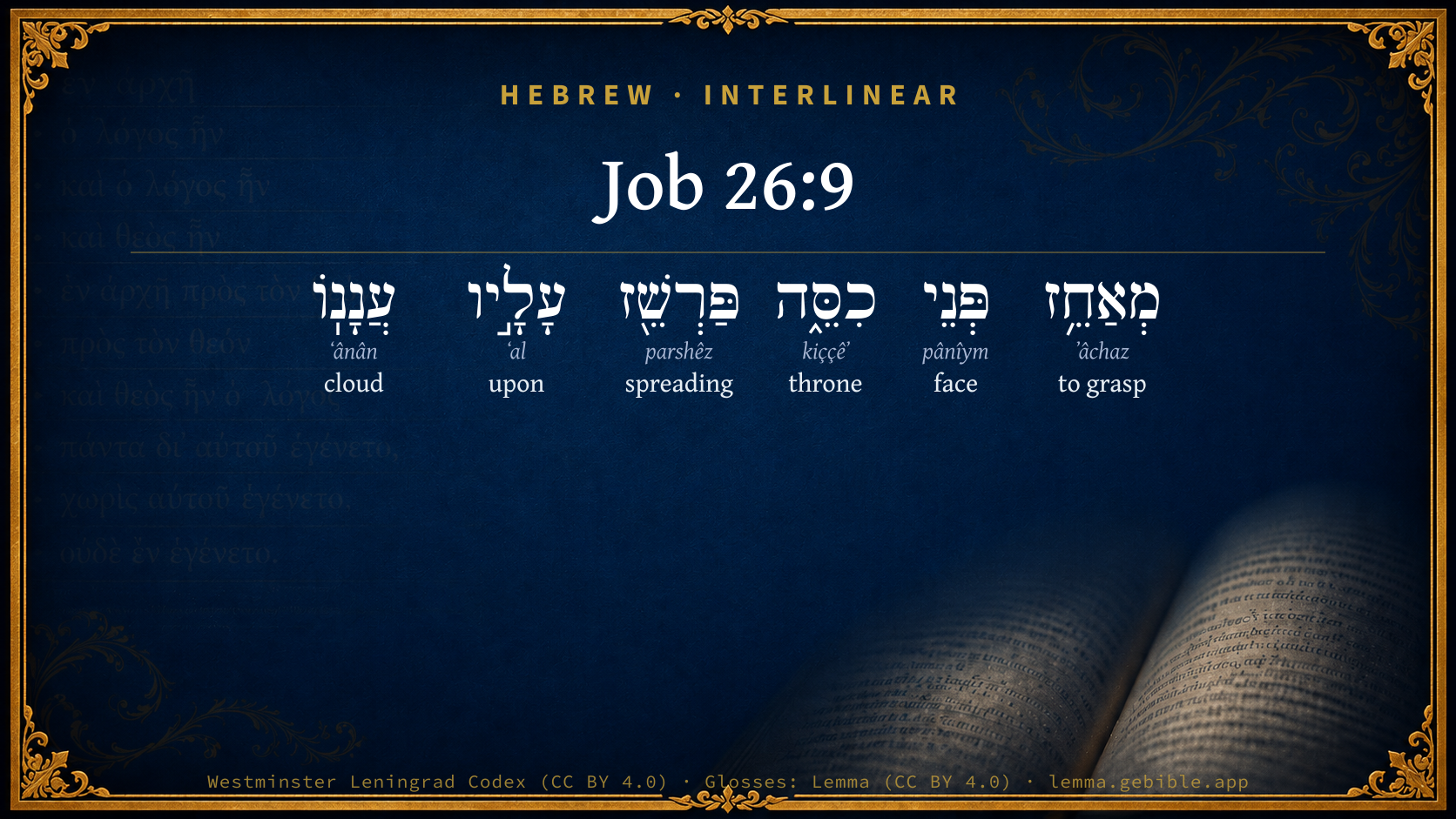
Job 26:9

Hebrew (Westminster Leningrad Codex) Job 26:9 appears in the Hebrew Old Testament. The text above is from the Westminster Leningrad Codex. Each word links to its Strong’s number, a concise gloss, and parsing drawn from the Open Scriptures Hebrew Bible morphology. Click any word for its full Brown-Driver-Briggs (BDB) entry.
Download image
Cite this verse

Job 26:9 (World English Bible). Public Domain. Lemma interlinear Bible study tool, https://lemma.gebible.app/v/job/26/9.

Show BibTeX & RIS
BibTeX
RIS
English Translation
He encloses the face of his throne, And spreads his cloud on it.
World English Bible · Public Domain
Highlights
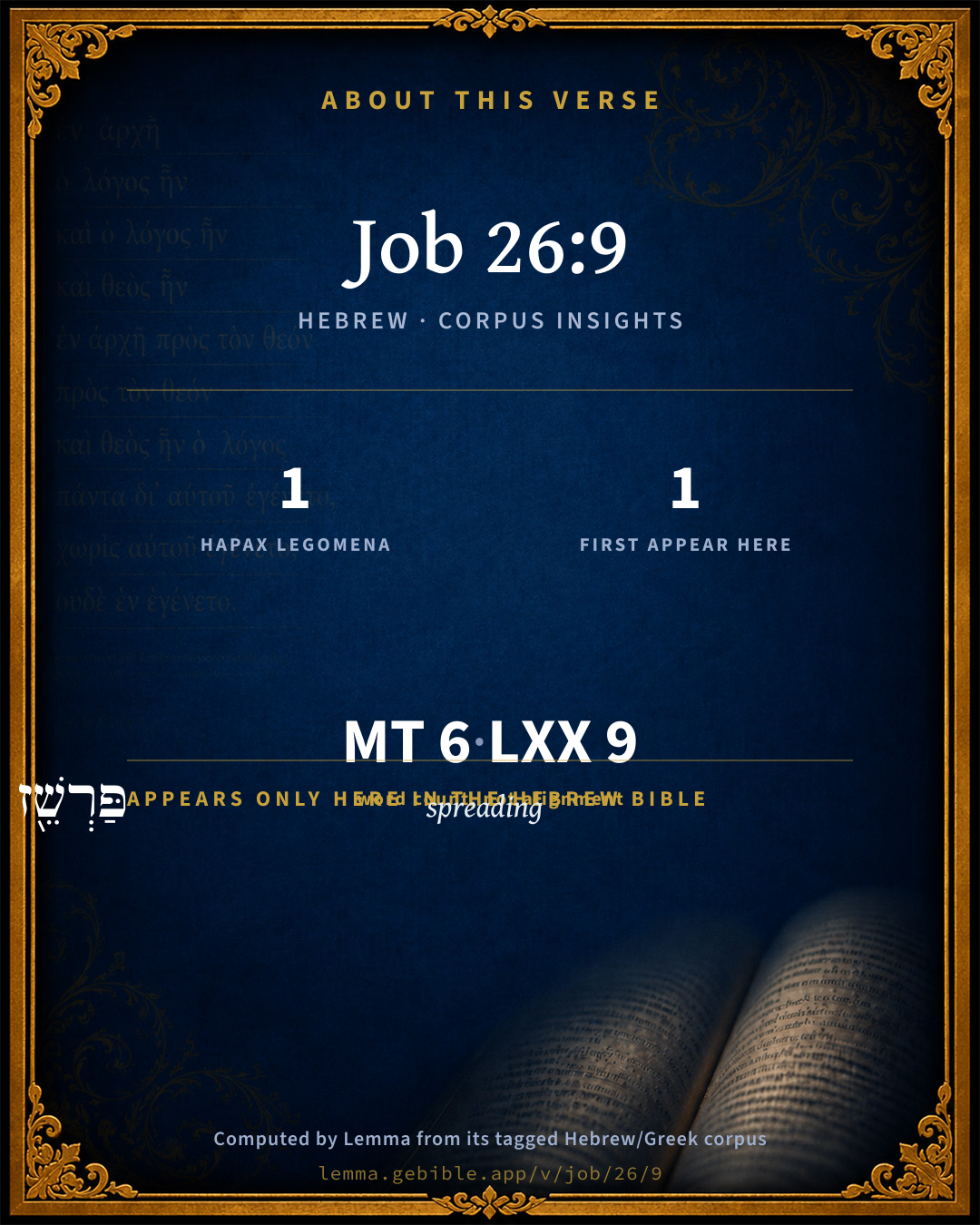
  • 1 hapax legomenon — only here in the Hebrew Bible
  • 1 first appearance in the Hebrew Bible
Full analysis ↓
Download a study sheet

One document with this verse’s original text, its word-by-word gloss line, the meaning frame, cross-references with their text, attributed commentary, and full source and license credits — printable, and it pastes into notes with its structure intact.

This verse Autodidact and up

Study sheet (.html) Plain text (.txt)

A passage Seminary Student

Up to 50 verses in one chapter. A passage sheet keeps up to 6 commentary sources and 12 cross-references per verse, in the order this page ranks them, and says so on the sheet whenever that leaves anything out. Ask for a single verse and you get the Autodidact verse sheet above.

Everything on this page stays free to read, with no account — the sheet is a download of what is already on screen, not access to it.

Want to remove ads? Support Godless Engineer
Compare translations 3

The same verse in 3 English versions, stacked beneath the original-language interlinear above. Click any original word for its lexicon entry.

Each is an independent rendering of the whole verse — the interlinear is not word-aligned to these translations.

Highlighted words mark where these versions differ — a whole-verse word diff, not a word-by-word alignment.

  • World English Bible Public Domain
    He encloses the face of his throne, And spreads his cloud on it.
  • King James Version Public Domain
    He holdeth back the face of his throne, and spreadeth his cloud upon it.
  • unfoldingWord Literal Text CC BY-SA 4.0
    the one covering the face of the full moon, spreading his cloud upon it.

unfoldingWord Literal Text — © unfoldingWord, licensed CC BY-SA 4.0. Word-aligned USFM3 via Door43 (git.door43.org/unfoldingWord/en_ult).

Versions to compare (up to 4)

3 of 4 selected

Show all 18 translations

Every available English version of this verse, each an independent rendering of the whole verse.

  • World English Bible Public Domain
    He encloses the face of his throne, And spreads his cloud on it.
  • Berean Standard Bible Public Domain
    He covers the face of the full moon, spreading over it His cloud.
  • Majority Standard Bible Public Domain
    He covers the face of the full moon, spreading over it His cloud.
  • King James Version Public Domain
    He holdeth back the face of his throne, and spreadeth his cloud upon it.
  • American Standard Version (1901) Public Domain
    He incloseth the face of his throne, And spreadeth his cloud upon it.
  • Revised Version (1885) Public Domain
    He closeth in the face of his throne, and spreadeth his cloud upon it.
  • Geneva Bible (1599) Public Domain
    He holdeth backe the face of his throne: and spreadeth his cloude vpon it.
  • Douay-Rheims (1899) Public Domain
    He withholdeth the face of his throne, and spreadeth his cloud over it.
  • Young's Literal Translation Public Domain
    Taking hold of the face of the throne, Spreading over it His cloud.
  • Literal Standard Version CC BY-SA 4.0
    Taking hold of the face of the throne, || Spreading His cloud over it.
  • Unlocked Literal Bible CC BY-SA 4.0
    He covers the surface of the moon and spreads his clouds on it.
  • unfoldingWord Literal Text CC BY-SA 4.0
    the one covering the face of the full moon, spreading his cloud upon it.
  • Darby Bible Public Domain
    He covereth the face of his throne, he spreadeth his cloud upon it.
  • World Messianic Bible Public Domain
    He encloses the face of his throne, and spreads his cloud on it.
  • Webster's Bible Public Domain
    He holdeth back the face of his throne, and spreadeth his cloud upon it.
  • Free Bible Version CC BY-SA 4.0
    He veils his throne; covering it with his clouds.
  • Bible in Basic English Public Domain
    By him the face of his high seat is veiled, and his cloud stretched out over it.
  • JPS Tanakh (1917) Public Domain
    He closeth in the face of His throne, and spreadeth His cloud upon it.

Literal Standard Version (2020), Covenant Press — licensed CC BY-SA 4.0. Text via the HelloAO Bible API (eBible.org). Unlocked Literal Bible (unfoldingWord) — licensed CC BY-SA 4.0. Text via the HelloAO Bible API (eBible.org). unfoldingWord Literal Text — © unfoldingWord, licensed CC BY-SA 4.0. Word-aligned USFM3 via Door43 (git.door43.org/unfoldingWord/en_ult). Free Bible Version, Dr. Jonathan Gallagher — licensed CC BY-SA 4.0. Text via the HelloAO Bible API (eBible.org).

Word by word

More ways to search: Search by grammar → Find every occurrence → Compare this word →

Practice this passage: Drill this verse → Learn its vocabulary →

About this verse

These counts appear in no published source. They are computed here, from the morphology-tagged text and Lemma’s own curated glosses. What Lemma adds →

6
words
6
distinct lemmas
Wisdom
section

Notable vocabulary

1 hapax legomenon — a word that appears only here in the entire Hebrew Bible:

  • פַּרְשֵׁ֖ז spreading H6576

First appearance in Scripture

This word makes its first canonical appearance in the Hebrew Bible here:

  • פַּרְשֵׁ֖ז spreading H6576

Grammatical profile

  • 2 verbs
  • 3 nouns
  • 1 preposition

Verb forms

  • מְאַחֵ֥ז Piel · Participle Active
  • פַּרְשֵׁ֖ז Pilel · Infinitive Absolute

Hebrew & Septuagint length

In English translation the verse runs 13 words from the Hebrew and 14 from the Septuagint (LXX English) — closely comparable.

A rough comparison of the two English renderings, which tokenize alike — not a word-level alignment.

Word counts can differ between the Hebrew and the Greek without any difference in meaning — e.g. the Hebrew direct-object marker אֵת has no separate Greek word, and Greek often adds the article ὁ.

In the original languages it is 6 Hebrew tokens and 9 Greek tokens — but the two are counted differently (Hebrew bundles its prefixes and suffixes into one token; the Greek is in lemma form), so that isn’t a like-for-like length.

Cross-references

8

Topical passages linked to Job 26:9 in the Treasury of Scripture Knowledge — connected by theme and wording, ordered by reader-vote popularity; previews shown in the World English Bible.

  • Psalms 97:2 Clouds and darkness are around him. Righteousness and justice are the foundation of his throne.
  • Job 22:14 Thick clouds are a covering to him, so that he doesn't see. He walks on the vault of the sky.'
  • Exodus 20:21 The people stayed at a distance, and Moses drew near to the thick darkness where God was.
  • Exodus 33:20–23 He said, "You cannot see my face, for man may not see me and live."
  • Exodus 34:3 No one shall come up with you; neither let anyone be seen throughout all the mountain; neither let the flocks nor herds feed before that mountain."
  • 1 Kings 8:12 Then spoke Solomon, Yahweh has said that he would dwell in the thick darkness.
  • Habakkuk 3:3–5 God came from Teman, The Holy One from Mount Paran. Selah. His glory covered the heavens, And his praise filled the earth.
  • 1 Timothy 6:16 who alone has immortality, dwelling in unapproachable light; whom no man has seen, nor can see: to whom be honor and eternal power. Amen.

Cross-references courtesy of OpenBible.info (CC BY 4.0).

Hebrew and Greek witnesses Masoretic Hebrew ↔ Greek Septuagint

The same verse in the two great witnesses to the Old Testament, shown verse-for-verse.

These are two independent witnesses, not word-aligned to each other, and the Septuagint is shown in lemma (dictionary) form.

Hebrew Job 26:9 Masoretic · Westminster Leningrad Codex

מְאַחֵ֥ז פְּנֵי כִסֵּ֑ה פַּרְשֵׁ֖ז עָלָ֣יו עֲנָנֽוֹ

He encloses the face of his throne, And spreads his cloud on it.

World English Bible · Public Domain

Greek LXX Job 26:9 Septuagint · lemma form

ὁ κρατέω πρόσωπον θρόνος ἐκπετάζω ἐπί αὐτός νέφος αὐτός

He keeps back the face of his throne, stretching out his cloud upon it.

LXX2012 (modern English Septuagint) · Public Domain

Hebrew: Westminster Leningrad Codex (CC BY 4.0). Greek: Septuagint (public domain); English from LXX2012 (modern English Septuagint) (Public Domain). How the Septuagint differs from the Hebrew →

Commentary

Notes on Job 26:9 from classic Christian and Jewish commentators (each source and its license shown beneath its notes). The classic Christian expositions comment on the surrounding passage and are grouped to its opening verse, so a note may address several verses; the Jewish commentaries on the Tanakh (Rashi and others) are per-verse, so they appear only where the commentator wrote on this verse.

Lemma curates 59 commentaries, every one of them public domain or Creative Commons licensed, each selected and text-cleaned for this edition rather than reprinted as found. About our sources →

Trapp's Complete Commentary

John Trapp

Job 26:9 He holdeth back the face of his throne, [and] spreadeth his cloud upon it.

Ver. 9. He holdeth back the face of his throne] i.e. Of heaven, Isa 66:1, which he soon overcloudeth and muffleth up, or masketh, with a veil. Mystically, by the face of his throne, we may understand the knowledge of his glory; for this is held from us so in this world, that we cannot perfectly know him as he is, but must content ourselves with a learned ignorance, 1Jn 3:3. Here darkness is, and will be, under his feet, Psa 18:9.

And spreadeth his cloud upon it] It is fitly called his cloud, because, 1. It is his handiwork, Psa 18:11; Gen 9:14; Job 28:26-27; Job 37:15-16; Job 38:9; Psa 104:5. His sun draweth up those vapours, which, being thickened in the middle region of the air by the cold encompassing and driving them together, become a cloud. 2. He used it of old as a sign of his glorious power and gracious presence with his people, Exo 13:21; Exo 16:10 2Ch 5:13-14; and as a figure of Christ’s guiding and protecting his Church through the wilderness of this world, Isa 4:5-6 3. He still rideth in state upon the clouds, Isa 19:1. Christ was by a cloud coached up to heaven, Act 1:9, and shall come in like manner, Rev 1:7; Rev 10:1. We also shall then be caught up in the clouds to meet the Lord in the air, and so shall we ever be with the Lord, 1Th 4:17. - O mora! Christe, veni.

John Trapp, A Commentary or Exposition upon All the Books of the Old and New Testament (1647–1656) — public domain. Text from a community e-Sword module.

The Biblical Illustrator

Joseph S. Exell

Job_26:9

He holdeth back the face of His throne, and spreadeth His cloud upon it.

The cloud upon the throne

Aided by Divine revelation, the researches of man have done much and well in tracking out the footprints of Deity, in exploring His hidden works, and leading us through nature up to that God whose glory is thus dimly shadowed forth, and upon whom nature depends for all its laws, its continuance and well-being. But after all, there is still around the throne of God a cloud so dense that it cannot be pierced by the keenest eye of the most assiduous investigator, and defies all the daring powers of the most gifted intellect. How insignificant do we appear in the presence of the Infinite, the Incomprehensible!

I. The truth to be illustrated. The figurative language of the text seems to have reference to the mystery which surrounds the throne of God as the seat of His universal empire.

1. In reference to the kingdom of creation, it must be acknowledged that the mind of man has discovered much that is vast and sublime. It has discovered what are called the laws of gravitation. But who can define the precise nature of this gravitation? Is it not a name given to something, the effects of which are manifest, but whose real and essential nature is unknown? We go to the patriarchal hills, and explore the bosom of the earth, and discover further illustration of the text. There is something here which baffles all mans powers to explain. Look at that living mystery of all mysteries which we carry about with us; consider the mechanism of the human frame, and the moral constitution of our nature. Who can trace the connection that subsists between mind and matter; how is it that the physical frame is subject to the volitions of mind?

2. In reference to the kingdom of Gods moral government, and the dispensations of an overruling providence. As a general rule, vice brings along with it its own scourge, and virtue its own reward; yet in how many instances are we staggered with perplexity, when we see the profane and the ungodly among the most prosperous in temporal matters, whilst the man who fears God, and pursues his honest avocation with persevering industry, is often bound round with sorrow as with a garment, and disastrous events come upon him in quick succession.

3. In reference to the kingdom of grace. At every step we find ourselves encompassed with inscrutable mystery, whether we consider the doctrines taught, the objects embraced, or the change produced.

II. The consolation suggested. It is not one opposing power holding back the throne of another, and spreading a cloud upon it with some vindictive design. It is the King Himself holding back His own throne, and Himself covering it with a cloud. God is seated upon the cloud-wrapped throne, not merely as universal Governor, but in the more endearing character of a Father. All things are working together for good under the superintendence of Him who sitteth upon the throne. These considerations should tend to check the despondent repinings in which we are so often disposed to indulge. The cloud is spread upon the throne now; but let us trust God where we cannot trace Him; only let us live by faith in His Son; and soon the cloud will pass away before our beatific vision; soon shall we see the King in His beauty, on His throne dismantled of the cloud, smiting with a Fathers warmest love. We shall then acknowledge with grateful hearts--He did all things well. (W. J. Brock, A. B.)

The Biblical Illustrator, edited by Joseph S. Exell (c. 1880s–1900s) — public domain. Text from a community e-Sword module.

Joseph Benson's Commentary

Job 26:9. He holdeth back — Namely, from our view, that its effulgent brightness may not dazzle our sight; the face of his throne — The heaven of heavens: where he dwells, its light and glory being too great for mortal eyes; and spreadeth his clouds upon it — And thereby mercifully hides from our eyes those overpowering splendours which we could not bear to behold. Bishop Patrick, however, understands this merely of God’s covering the face of the sky with clouds, to prevent “the beams of the sun from scorching the earth.”

Joseph Benson's Commentary on the Old and New Testaments (1811–1818) — public domain. Text from a community e-Sword module.

Jamieson, Fausset & Brown

Robert Jamieson, A. R. Fausset & David Brown

Rather, He encompasseth or closeth. God makes the clouds a veil to screen the glory not only of His person, but even of the exterior of His throne from profane eyes. His agency is everywhere, yet He Himself is invisible (Psa 18:11; Psa 104:3).

Jamieson, Fausset & Brown — Commentary Critical and Explanatory on the Whole Bible (1871) — public domain (CC PDM 1.0). Text via the HelloAO Bible API.

Adam Clarke's Commentary

Verse 9. He holdeth back the face of his throne] Though all these are most elegant effects of an omniscient and almighty power, yet the great Agent is not personally discoverable; he dwelleth in light unapproachable, and in mercy hides himself from the view of his creatures. The words, however may refer to those obscurations of the face of heaven, and the hiding of the body of the sun, when the atmosphere is laden with dense vapours, and the rain begins to be poured down on the earth.

Adam Clarke's Commentary on the Bible (1810–1826) — public domain. Text from a community e-Sword/MySword module.

Ellicott's Commentary for English Readers

(9) He holdeth back the face.—Or, covereth the face of his throne in the heavens, spreading his rack of cloud upon it.

A Bible Commentary for English Readers, edited by Charles John Ellicott (1878–1897) — public domain. Text from a community e-Sword module.

The Cambridge Bible for Schools and Colleges

gen. ed. J. J. S. Perowne

9. he holdeth back] Or, he shutteth up, or, enshrouds. The “face of his throne” is perhaps the outside of it, or that view which it would present if seen; and the meaning is that He enshrouds His throne so that it is not seen by those below. The idea cannot be that this is an occasional phenomenon, as if sometimes His throne could be seen, for though He has set His glory on the heavens, Psa_8:2 (comp. Exo_24:10; Psa_18:12), this is but a reflection of the inner glory. The conception rather is that clouds are ever about Him, in His lofty abode, and even accompany and enshroud Him in all His movements; ch. Job_38:1; Amo_9:6; Psa_104:3-13.

The Cambridge Bible for Schools and Colleges (gen. ed. J. J. S. Perowne; Cambridge University Press, 1878–1918) — public domain. Text from a community e-Sword module.

John Gill's Exposition

He holdeth back the face of his throne,.... His throne is the heaven of heavens; the face of it, or what is before it, is the starry and airy heavens; this face of his throne is sometimes held back, or covered with clouds, that so his throne is so far from being visible, that even the face of it, or the outside or external appearance of it, is not to be seen, as follows:

and spreadeth his cloud upon it; and both he and his throne are invisible; clouds and darkness are round about him, and his pavilion round about are dark waters, and thick clouds of the skies, Psa 18:11; and even the light in which he dwells, and with which he clothes himself, is impervious to us, and is so dazzling, that itself covers and keeps back himself and throne from being seen by mortals. The Targum suggests, that what is here said to be done is done that the angels may not see it; but these always stand before the throne of God, and always behold the face of God himself.

John Gill's Exposition of the Whole Bible (1746–1763) — public domain (CC PDM 1.0). Text via the HelloAO Bible API.

Albert Barnes' Notes on the Bible

He holdeth back the face of his throne - That is, he does not exhibit it - he covers it with clouds. The idea seems to be, that God sometimes comes forth and manifests himself to mankind, but that he comes encompassed with clouds, so that his throne cannot be seen. So in Psa 18:11, “He made darkness his secret place, his pavilion round about him were dark waters and thick clouds of the skies.” God is often represented as encompassed with clouds, or as accompanied with tempests.

And spreadeth his cloud upon it - That is, so that it cannot be seen. There is much poetic beauty in this image. It is, that the clouds are made to conceal the splendor of the throne of God from the sight of man, and that all their sublimity and grandeur, as they roll on one another, and all their beauty when painted with so many colors in the evening, are designed to hide that throne from mortal eyes. No one sees God; and though it is manifest that he is every where employed, and that he comes forth with amazing grandeur in the works of creation and providence, yet he is himself invisible.

Albert Barnes' Notes on the Bible (1834–1885) — public domain. Text from a community e-Sword/MySword module.

Haydock's Catholic Bible Commentary

Over it. The firmament, with all its beauty, is but like a cloud, to conceal from our feeble eyes the splendor of God’s throne.

George Leo Haydock (1774–1849), Haydock's Catholic Family Bible and Commentary, 1859 edition — public domain. Excludes Psalms (Douay-Rheims chapter numbering differs from Protestant) and Deuterocanonical books (Catholic canon only).

Matthew Poole's English Annotations

He holdeth back, i.e. to wit, from our view, that its lustre and glory should not reach us, and so dazzle our sight; he covereth it with a cloud, as the next words explain it. Or, he holdeth fast, or binds together, or strengthens it, that it may be able to bear that burden.

The face of his throne; either,

1. This lower air, which is as the face or open part of the heavens, which is often called God’s throne, as Psa 11:4; Isa 66:1; Amo 9:6. Or,

2. The appearance or manifestation of the heaven of heavens, where he dwelleth, whose light and glory is too great for mortal eyes, which therefore by clouds and other ways he hides from us.

Matthew Poole's English Annotations on the Holy Bible (1683–1685) — public domain. Text from a community e-Sword/MySword module.

Whedon's Commentary on the Bible

Daniel D. Whedon

9. Holdeth back — Who veileth. The word אחז, used in Neh_7:3 in the sense of barring (the gate,) also signifies “hold fast,” (see Job_23:11,) or “fasten together.” 2Ch_9:18. In this, the sole case of the Piel form, it is generally interpreted to mean “enshroud,” or “inclose,” although Merx understands its meaning to be that of bearing or holding up, with the idea that God miraculously holds up the throne on which he sits. But the text, it is to be remembered, speaks of “the outside,” “the face,” of the throne. It is a beautiful poetical conception that the firmament not only reflects the splendour of God, (Exo_24:10,) but also veils his throne (literally, the face of his throne) from human eyes. Isa_66:1. All nature may be regarded as a veil of deity “through whose mantling folds” he deigns to show so much of his being as eye or heart can bear. Compare Amo_9:6; Psa_104:3.

Daniel D. Whedon (gen. ed.), Commentary on the Old and New Testaments (1874–1909) — public domain. Text from a community e-Sword module.

The Pulpit Commentary

He holdeth back the face of his throne; rather, he covereth up. He makes the clouds to gather in the vault of heaven, above which is his throne, and in this way conceals it and covers it up. And spreadeth his cloud upon it; or, over it, so blotting it out from sight. Behind the more obvious meaning lies one which is deeper and more spiritual. God withdraws himself from sight, gathers clouds and darkness around him to be the habitation of his seat, hides from men the principles of his government and administration, makes himself unapproachable and inscrutable, is a mystery and an enigma which man cannot hope to understand or solve. (comp. 1Ki_8:12 Psa_18:11 Psa_97:2)

The Pulpit Commentary (1880–1919), ed. H.D.M. Spence-Jones & Joseph S. Exell — public domain. Text from a community e-Sword module.

John Wesley's Explanatory Notes

Holdeth - From our view, that his glory may not dazzle our sight; he covereth it with a cloud. Throne - The heaven of heavens, where he dwelleth.

John Wesley, Explanatory Notes Upon the Whole Bible (1754–1765) — public domain. Text via the GEBible commentary corpus.

unfoldingWord translationNotes

Door43 World Missions Community

and spreads his clouds on it

This phrase tells how he covers the surface of the moon. AT: "by spreading his clouds in front of it"

He has engraved a circular boundary on the surface of the waters

This speaks of the horizon, where the earth appears to meet the sky, as if God has marked a boundary on the ocean.

translationWords

face

light

darkness

unfoldingWord translationNotes — © Distant Shores Media and the Door43 World Missions Community, licensed CC BY-SA 4.0. Source: git.door43.org/Door43/en_tn.

Rashi

Rabbi Shlomo Yitzchaki (Rashi)

He closes in with walls the face of His throne of glory, like (Ps. 18:12), “He made darkness His secret place.”

He spreads over the throne His cloud (Ezek. 1:22), “And there was a likeness over the heads of the living creatures, of an expanse.”

Rashi on the Tanakh — English translations: “The Judaica Press complete Tanach with Rashi, translated by A. J. Rosenberg” (CC BY 4.0); “Pentateuch with Rashi's commentary by M. Rosenbaum and A.M. Silbermann, 1929-1934” (public domain); “The Metsudah Tanach series, Lakewood, N.J” (CC BY 4.0); and “The Book of Joshua, Metsudah Publications, 1997” (CC BY 4.0). Text via Sefaria.

Lesson kit

Teaching starters — assembled from the data on this page, not authored interpretation. Every prompt links to the verse data it draws on. Edit before teaching.

Job, in the Wisdom, opens this verse with 6 words (6 distinct Hebrew lemmas). Its most distinctive word is parshêz (“spreading”). A historical commentator’s framing appears above. Read the whole chapter for the surrounding context.

Discussion questions

  1. How does “spreading” (parshêz) shape what this verse is saying?
  2. This verse holds 1 word here found nowhere else in the Hebrew Bible. What might the rare word draw attention to?
  3. The word “spreading” first appears here in Scripture. What is being introduced at this debut?
  4. Psalms 97:2 shares this passage’s theme. How do the two illuminate each other?
  5. These translations render this verse differently. What is at stake in choosing one wording over another?
  6. The verb «מְאַחֵ֥ז» is Piel Participle Active. How does its form color the action?
  7. Reading how Trapp's Complete Commentary and The Biblical Illustrator read this verse, where do the two commentators agree and where do they part?

Things to notice

Reading settings

Reading text

Shown beneath each verse's original-language words.

Old Testament
Old Testament edition

Read the OT as the Masoretic Hebrew (MT) or the Greek Septuagint (LXX).

English shown for the Greek Septuagint (in the Hebrew ↔ Greek comparison).

Comparing translations? Open the Compare panel on any verse page to stack up to four side by side.