
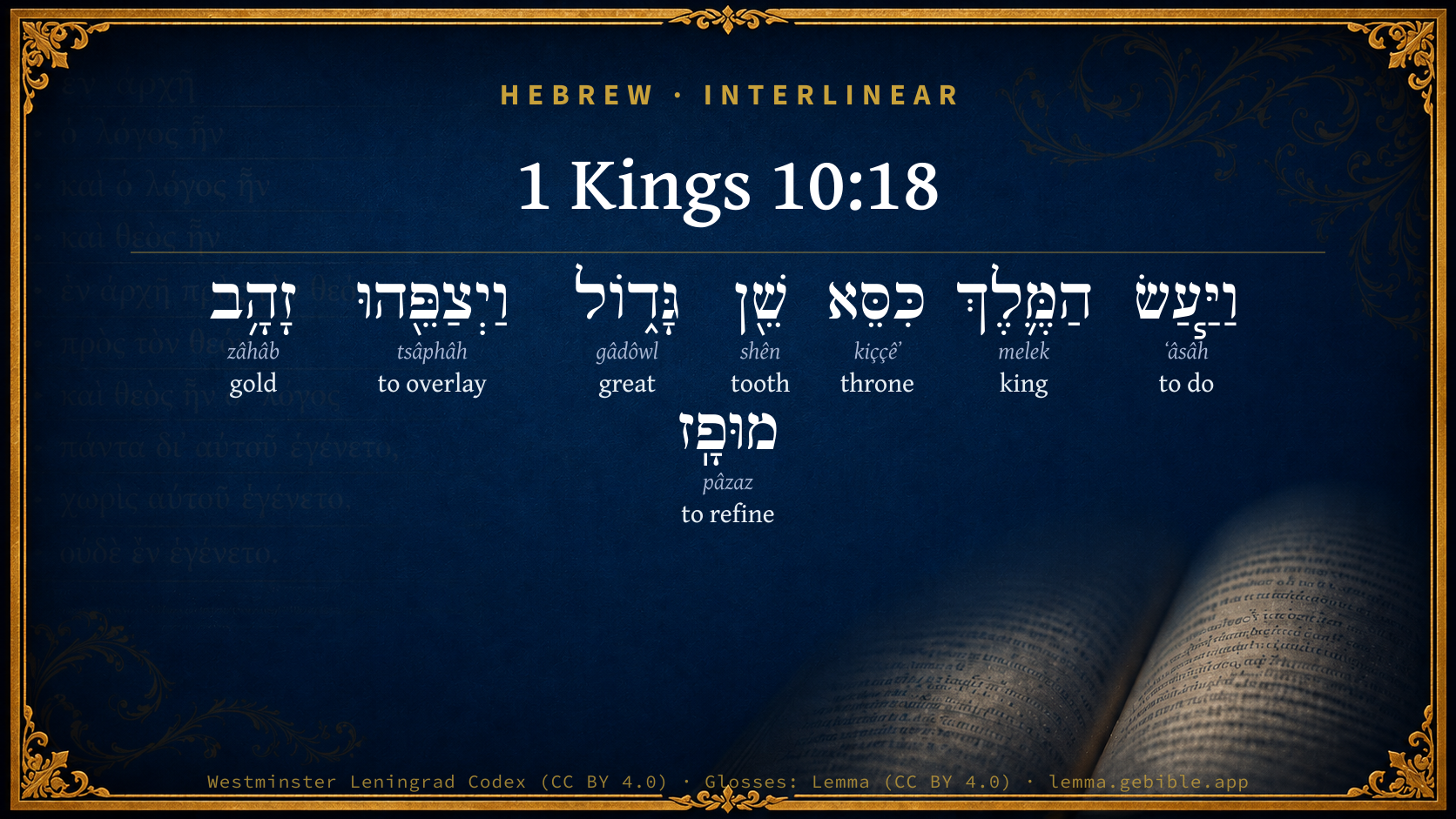
1 Kings 10:18

Hebrew (Westminster Leningrad Codex) 1 Kings 10:18 appears in the Hebrew Old Testament. The text above is from the Westminster Leningrad Codex. Each word links to its Strong’s number, a concise gloss, and parsing drawn from the Open Scriptures Hebrew Bible morphology. Click any word for its full Brown-Driver-Briggs (BDB) entry.
Download image
Cite this verse

1 Kings 10:18 (World English Bible). Public Domain. Lemma interlinear Bible study tool, https://lemma.gebible.app/v/1-kings/10/18.

Show BibTeX & RIS
BibTeX
RIS
English Translation
Moreover the king made a great throne of ivory, and overlaid it with the finest gold.
World English Bible · Public Domain
Highlights
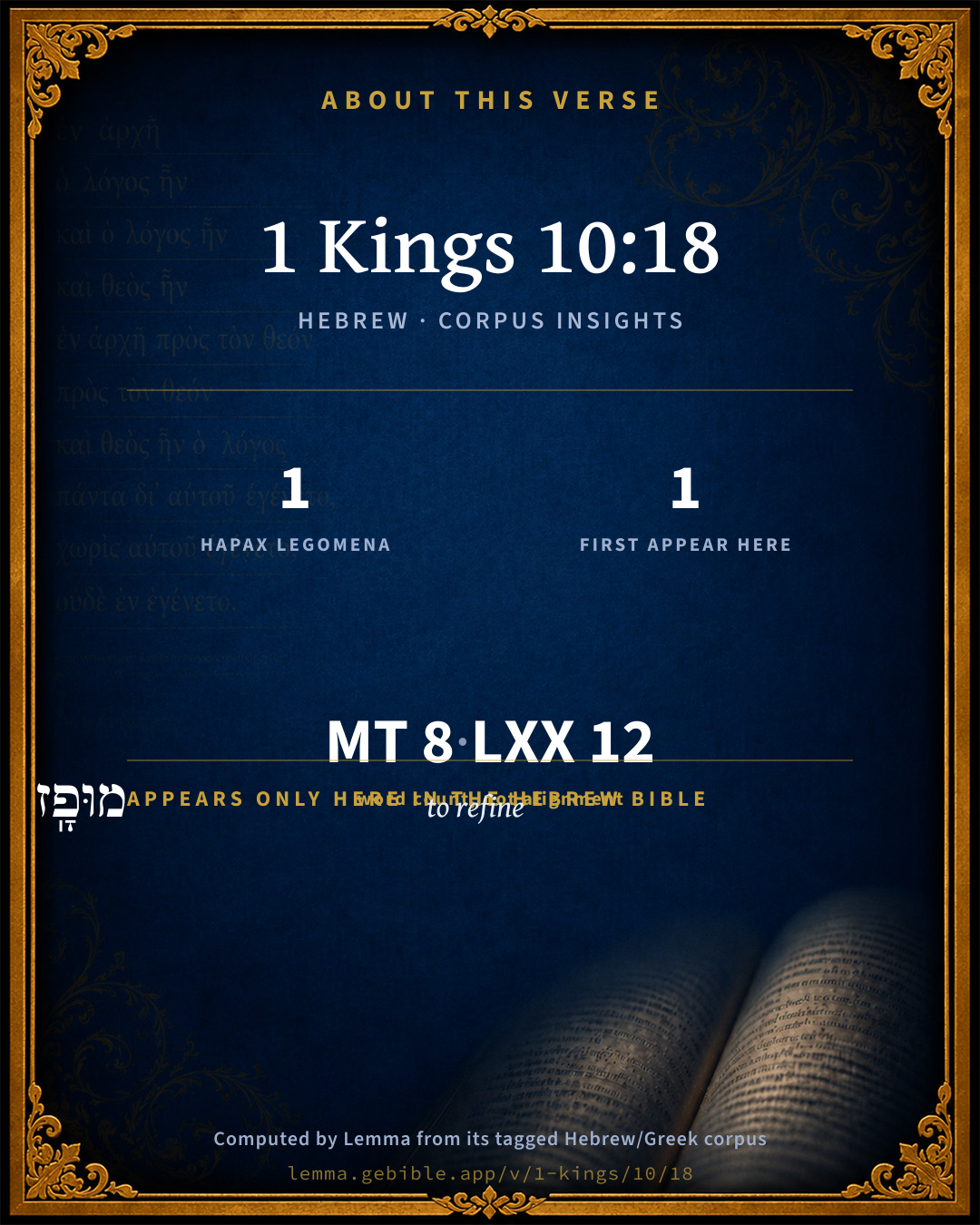
  • 1 hapax legomenon — only here in the Hebrew Bible
  • 1 first appearance in the Hebrew Bible
Full analysis ↓
Download a study sheet

One document with this verse’s original text, its word-by-word gloss line, the meaning frame, cross-references with their text, attributed commentary, and full source and license credits — printable, and it pastes into notes with its structure intact.

This verse Autodidact and up

Study sheet (.html) Plain text (.txt)

A passage Seminary Student

Up to 50 verses in one chapter. A passage sheet keeps up to 6 commentary sources and 12 cross-references per verse, in the order this page ranks them, and says so on the sheet whenever that leaves anything out. Ask for a single verse and you get the Autodidact verse sheet above.

Everything on this page stays free to read, with no account — the sheet is a download of what is already on screen, not access to it.

Want to remove ads? Support Godless Engineer
Compare translations 3

The same verse in 3 English versions, stacked beneath the original-language interlinear above. Click any original word for its lexicon entry.

Each is an independent rendering of the whole verse — the interlinear is not word-aligned to these translations.

Highlighted words mark where these versions differ — a whole-verse word diff, not a word-by-word alignment.

  • World English Bible Public Domain
    Moreover the king made a great throne of ivory, and overlaid it with the finest gold.
  • King James Version Public Domain
    Moreover the king made a great throne of ivory, and overlaid it with the best gold.
  • unfoldingWord Literal Text CC BY-SA 4.0
    And the king made a great ivory throne, and he overlaid it refined gold.

unfoldingWord Literal Text — © unfoldingWord, licensed CC BY-SA 4.0. Word-aligned USFM3 via Door43 (git.door43.org/unfoldingWord/en_ult).

Versions to compare (up to 4)

3 of 4 selected

Show all 18 translations

Every available English version of this verse, each an independent rendering of the whole verse.

  • World English Bible Public Domain
    Moreover the king made a great throne of ivory, and overlaid it with the finest gold.
  • Berean Standard Bible Public Domain
    Additionally, the king made a great throne of ivory and overlaid it with pure gold.
  • Majority Standard Bible Public Domain
    Additionally, the king made a great throne of ivory and overlaid it with pure gold.
  • King James Version Public Domain
    Moreover the king made a great throne of ivory, and overlaid it with the best gold.
  • American Standard Version (1901) Public Domain
    Moreover the king made a great throne of ivory, and overlaid it with the finest gold.
  • Revised Version (1885) Public Domain
    Moreover the king made a great throne of ivory, and overlaid it with the finest gold.
  • Geneva Bible (1599) Public Domain
    Then the King made a great throne of yuorie, and couered it with the best golde.
  • Douay-Rheims (1899) Public Domain
    King Solomon also made a great throne of ivory: and overlaid it with the finest gold.
  • Young's Literal Translation Public Domain
    And the king maketh a great throne of ivory, and overlayeth it with refined gold;
  • Literal Standard Version CC BY-SA 4.0
    And the king makes a great throne of ivory, and overlays it with refined gold;
  • Unlocked Literal Bible CC BY-SA 4.0
    Then the king made a great throne of ivory and overlaid it with the finest gold.
  • unfoldingWord Literal Text CC BY-SA 4.0
    And the king made a great ivory throne, and he overlaid it refined gold.
  • Darby Bible Public Domain
    And the king made a great throne of ivory, and overlaid it with refined gold:
  • World Messianic Bible Public Domain
    Moreover the king made a great throne of ivory, and overlaid it with the finest gold.
  • Webster's Bible Public Domain
    Moreover, the king made a great throne of ivory, and overlaid it with the best gold.
  • Free Bible Version CC BY-SA 4.0
    The king also made a great throne of ivory, and covered it with pure gold.
  • Bible in Basic English Public Domain
    Then the king made a great ivory seat, plated with the best gold.
  • JPS Tanakh (1917) Public Domain
    Moreover the king made a great throne of ivory, and overlaid it with the finest gold.

Literal Standard Version (2020), Covenant Press — licensed CC BY-SA 4.0. Text via the HelloAO Bible API (eBible.org). Unlocked Literal Bible (unfoldingWord) — licensed CC BY-SA 4.0. Text via the HelloAO Bible API (eBible.org). unfoldingWord Literal Text — © unfoldingWord, licensed CC BY-SA 4.0. Word-aligned USFM3 via Door43 (git.door43.org/unfoldingWord/en_ult). Free Bible Version, Dr. Jonathan Gallagher — licensed CC BY-SA 4.0. Text via the HelloAO Bible API (eBible.org).

Word by word

More ways to search: Search by grammar → Find every occurrence → Compare this word →

Practice this passage: Drill this verse → Learn its vocabulary →

About this verse

These counts appear in no published source. They are computed here, from the morphology-tagged text and Lemma’s own curated glosses. What Lemma adds →

8
words
8
distinct lemmas
Historical
section

Notable vocabulary

1 hapax legomenon — a word that appears only here in the entire Hebrew Bible:

  • מוּפָֽז to refine H6338

First appearance in Scripture

This word makes its first canonical appearance in the Hebrew Bible here:

  • מוּפָֽז to refine H6338

Shared distinctive vocabulary

וַיְצַפֵּ֖הוּ to overlay H6823 occurs in 40 verses of the Hebrew Bible. Also found in:

Grammatical profile

  • 3 verbs
  • 4 nouns
  • 1 adjective

Verb forms

  • וַיַּ֧עַשׂ Qal · Sequential Imperfect
  • וַיְצַפֵּ֖הוּ Piel · Sequential Imperfect
  • מוּפָֽז Hophal · Participle Passive

Hebrew & Septuagint length

In English translation the verse runs 16 words from the Hebrew and 14 from the Septuagint (LXX English) — closely comparable.

A rough comparison of the two English renderings, which tokenize alike — not a word-level alignment.

Word counts can differ between the Hebrew and the Greek without any difference in meaning — e.g. the Hebrew direct-object marker אֵת has no separate Greek word, and Greek often adds the article ὁ.

In the original languages it is 8 Hebrew tokens and 12 Greek tokens — but the two are counted differently (Hebrew bundles its prefixes and suffixes into one token; the Greek is in lemma form), so that isn’t a like-for-like length.

Cross-references

13

Topical passages linked to 1 Kings 10:18 in the Treasury of Scripture Knowledge — connected by theme and wording, ordered by reader-vote popularity; previews shown in the World English Bible.

  • 1 Kings 10:22 For the king had at sea a navy of Tarshish with the navy of Hiram: once every three years came the navy of Tarshish, bringing gold, and silver, ivory, and apes, and peacocks.
  • Psalms 45:8 All your garments smell like myrrh, aloes, and cassia. Out of ivory palaces stringed instruments have made you glad.
  • Revelation 20:11 I saw a great white throne, and him who sat on it, from whose face the earth and the heaven fled away. There was found no place for them.
  • 1 Kings 22:39 Now the rest of the acts of Ahab, and all that he did, and the ivory house which he built, and all the cities that he built, aren't they written in the book of the chronicles of the kings of Israel?
  • Amos 6:4 Who lie on beds of ivory, And stretch themselves on their couches, And eat the lambs out of the flock, And the calves out of the midst of the stall;
  • Hebrews 1:8 but of the Son he says, "Your throne, O God, is forever and ever; The scepter of uprightness is the scepter of your Kingdom.
  • Revelation 18:12 merchandise of gold, silver, precious stones, pearls, fine linen, purple, silk, scarlet, all expensive wood, every vessel of ivory, every vessel made of most precious wood, and of brass, and iron, and marble;
  • 2 Chronicles 9:17–19 Moreover the king made a great throne of ivory, and overlaid it with pure gold.
  • Psalms 45:6 Your throne, God, is forever and ever. A scepter of equity is the scepter of your kingdom.
  • Psalms 110:1 Yahweh says to my Lord, "Sit at my right hand, Until I make your enemies your footstool for your feet."
  • Psalms 122:5 For there are set thrones for judgment, The thrones of David's house.
  • Ezekiel 27:6 Of the oaks of Bashan have they made your oars; they have made your benches of ivory inlaid in boxwood, from the isles of Kittim.
  • Hebrews 1:3 His Son is the radiance of his glory, the very image of his substance, and upholding all things by the word of his power, when he had by himself made purification for our sins, sat down on the right hand of the Majesty on high;

Cross-references courtesy of OpenBible.info (CC BY 4.0).

Hebrew and Greek witnesses Masoretic Hebrew ↔ Greek Septuagint

The same verse in the two great witnesses to the Old Testament, shown verse-for-verse.

These are two independent witnesses, not word-aligned to each other, and the Septuagint is shown in lemma (dictionary) form.

Hebrew 1 Kings 10:18 Masoretic · Westminster Leningrad Codex

וַיַּ֧עַשׂ הַמֶּ֛לֶךְ כִּסֵּא שֵׁ֖ן גָּד֑וֹל וַיְצַפֵּ֖הוּ זָהָ֥ב מוּפָֽז

Moreover the king made a great throne of ivory, and overlaid it with the finest gold.

World English Bible · Public Domain

Greek LXX 1 Kings 10:18 Septuagint · lemma form

καί ποιέω ὁ βασιλεύς θρόνος ἐλεφάντινος μέγας καί περιχρυσόω αὐτός χρυσίον δόκιμος

And the king made a great ivory throne, and gilded it with pure gold.

LXX2012 (modern English Septuagint) · Public Domain

On this verse, Keil & Delitzsch discusses the Septuagint’s reading. Read the note in Commentary ↓

Hebrew: Westminster Leningrad Codex (CC BY 4.0). Greek: Septuagint (public domain); English from LXX2012 (modern English Septuagint) (Public Domain). How the Septuagint differs from the Hebrew →

Targum (Aramaic paraphrase)

1

The Targum is the ancient Jewish Aramaic paraphrase of the Hebrew Scriptures — an interpretive translation, not the Hebrew text itself. Onkelos (literal) and Pseudo-Jonathan (expansive) render the Torah, and Jonathan the Prophets. Coverage is partial: where no permissively-licensed English translation exists for a verse, only the Aramaic is shown. This is verse-level text, not a word-by-word alignment to the Hebrew.

  1. Targum Jonathan Prophets (Joshua–Malachi)
    וַעֲבַד מַלְכָּא כּוּרְסַיָא דְשִׁינָא רַבָּא וַחֲפָהִי דַהֲבָא טָבָא:

    (no public-domain English translation for this verse)

    Targum Jonathan — Aramaic: “Mikraot Gedolot” (public domain). English: “Sefaria Community Translation” (CC0 1.0 (public-domain dedication)); “London "Chaldee Paraphrase," 1871” (public domain). Text via Sefaria.

Commentary

Notes on 1 Kings 10:18 from classic Christian and Jewish commentators (each source and its license shown beneath its notes). The classic Christian expositions comment on the surrounding passage and are grouped to its opening verse, so a note may address several verses; the Jewish commentaries on the Tanakh (Rashi and others) are per-verse, so they appear only where the commentator wrote on this verse.

Lemma curates 59 commentaries, every one of them public domain or Creative Commons licensed, each selected and text-cleaned for this edition rather than reprinted as found. About our sources →

Trapp's Complete Commentary

John Trapp

1Ki 10:18 Moreover the king made a great throne of ivory, and overlaid it with the best gold.

Ver. 18. Moreover the king made a great throne.] Which stood, likely, in the porch of judgment. {1Ki 7:7}

And overlaid it with the best gold.] To show, saith Martyr, the incorruption that should be in kings, who should administer justice justice, - Moses’ expression, - that is, pure justice.

John Trapp, A Commentary or Exposition upon All the Books of the Old and New Testament (1647–1656) — public domain. Text from a community e-Sword module.

Joseph Benson's Commentary

1Ki 10:18-20. The king made a great throne of ivory — We never read of ivory till about Solomon’s time; who, perhaps, brought elephants out of India, or at least took care to have a great deal of ivory imported from thence; for we read of ivory palaces Psa 45:9, whose walls were overlaid with ivory; which was more precious than gold in ancient times, as Pliny tells us in many places. And overlaid it with the best gold — Not entirely, so as to cover the ivory, for in that case it might as well have been made of wood; but here and there, and with curious ornaments. Thus, the throne appeared the more beautiful by this mixture of gold and ivory, with which, at due distances, it was studded. It was in the form of a niche, and the top of it was round behind — Making a half circle over his head. It was placed in the porch, mentioned 1Ki 7:7, which was very magnificent, being both the king’s seat of judgment, and the public audience, where he showed himself either to the nobles, or to the strangers that resorted to him. Here it stood “in the midst of a flight of rich pillars of cedar, curiously carved and covered, or rather inlaid, with gold. The ascent to it was by six steps, each step being supported, on either side, by a small lion, and the arms of the seat with two large ones, as big as life. All these, and even the steps themselves, were covered with ivory and gold.” — Dodd. There was not the like made in any kingdom — That is, in those times there was none to be compared to it: but in after ages there were, perhaps, some equally glorious. For Alhæneus says, “The throne of the Parthian kings was of gold, encompassed with four golden pillars, adorned with precious stones; and that the Persian kings sat in judgment under a golden vine, and other trees of gold, the bunches of whose grapes were made of several sorts of precious stones.”

Joseph Benson's Commentary on the Old and New Testaments (1811–1818) — public domain. Text from a community e-Sword module.

Tyndale Open Study Notes

Tyndale Open Resources

10:18-21 Solomon obtained ivory through commercial ventures with Hiram. Ancient Near Eastern kings often used lion figures as symbols of royal power and divine protection of the throne.

Tyndale Open Study Notes — © Tyndale Open Resources, licensed CC BY-SA 4.0. Text via the HelloAO Bible API.

Jamieson, Fausset & Brown

Robert Jamieson, A. R. Fausset & David Brown

a great throne of ivory--It seems to have been made not of solid ivory, but veneered. It was in the form of an armchair, with a carved back. The ascent to it was by six steps, on each of which stood lions, in place of a railing--while a lion, probably of gilt metal, stood at each side, which, we may suppose from the analogy of other Oriental thrones, supported a canopy. A golden footstool is mentioned (Ch2 9:18) as attached to this throne, whose magnificence is described as unrivalled.

Jamieson, Fausset & Brown — Commentary Critical and Explanatory on the Whole Bible (1871) — public domain (CC PDM 1.0). Text via the HelloAO Bible API.

Ellicott's Commentary for English Readers

(18) Ivory.—This seems to have been brought in by the Tyrians (1Ki_10:22), and it may be noted that the only other notice of ivory in the history is in the “ivory house” of Ahab (1Ki_22:39), who was allied with Tyre. In Psa_45:8 (presumably of the age of Solomon) we find mention of “ivory palaces,” or possibly “caskets.” The Tyrians are described in Eze_27:15 as receiving it through Dedan in Arabia, whither, no doubt, it came from India. But the Egyptians used ivory largely, drawing it from Africa; and there was, in later times, a port on the Red Sea which was a mart for ivory. The Tyrians may, therefore, have imported it both from India and from Africa. The throne of Solomon was probably inlaid with ivory and gold. Traces of such inlaying are found in Assyrian and Egyptian monuments. It is probable that, like his other architectural and decorative work, it was executed by Tyrian workmen, and the detailed description of it shows how greatly it impressed the imagination of Israel. The lion was the emblem of the house of Judah; the number twelve corresponded to the twelve tribes; and the exaltation of the throne—specially remarkable in a country where men sat commonly on the ground or on cushions—was the emblem of majesty. In the Dictionary of the Bible (“THRONE”) is given a sketch of an Assyrian throne, from a Nineveh bas-relief, which has horses in the position, supporting “the stays,” or arms of the throne, here ascribed to the lions.

A Bible Commentary for English Readers, edited by Charles John Ellicott (1878–1897) — public domain. Text from a community e-Sword module.

The Cambridge Bible for Schools and Colleges

gen. ed. J. J. S. Perowne

18. a great throne of ivory] Like Ahab’s ivory house, mentioned later on (1Ki_22:39), the throne was no doubt only inlaid with ivory, in such a way that where the gold did not cover the framework there the ivory appeared. And we may suppose that the ivory was a very conspicuous part of the structure, or else the throne would not be called from it.

with the best gold] R.V. ‘finest gold.’ The Hebrew participle (which occurs in no other place) is from a root which signifies ‘to refine,’ ‘to purge.’ Hence the rendering of R.V. is preferable. The Hebrew word is ‘muphaz,’ and the excessive rarity of its occurrence has led some to conjecture that the reading here ought to be as in Jer_10:9 ‘ma-uphaz,’ i.e. ‘from Uphaz.’ Uphaz is thought to be a later form of the word Ophir. It is found also in Dan_10:5. But though the participle in the text is rare, there is a cognate word of frequent occurrence, meaning ‘fine gold,’ so that we need not doubt about the sense in this passage.

The Cambridge Bible for Schools and Colleges (gen. ed. J. J. S. Perowne; Cambridge University Press, 1878–1918) — public domain. Text from a community e-Sword module.

John Gill's Exposition

Moreover, the king made a great throne of ivory,.... To sit on and judge his people; and ivory being white, may denote the purity, justice, and equity with which he judged; the white throne in Rev 20:11 may be an allusion to this; the ivory he had from Tarshish, Kg1 10:22.

and overlaid it with the best gold; for the greater splendour and majesty of it; not that he covered it all over, for then the ivory would not be seen, but interlined it, or studded it with it, whereby it appeared the more beautiful and magnificent. Such a throne of gold and ivory was decreed to Caesar by the Romans (p).

(p) Appian. Alex. l. 2.

John Gill's Exposition of the Whole Bible (1746–1763) — public domain (CC PDM 1.0). Text via the HelloAO Bible API.

Albert Barnes' Notes on the Bible

It is, on the whole, probable that the substance of the throne was wood, and that the ivory, cut into thin slabs, and probably carved in patterns, was applied externally as a veneer. This is found to have been the practice in Assyria. The gold was probably not placed over the ivory, but covered other parts of the throne.

Albert Barnes' Notes on the Bible (1834–1885) — public domain. Text from a community e-Sword/MySword module.

Haydock's Catholic Bible Commentary

Ivory. Hebrew, "of the tooth" (or horn) of elephants: people do not agree of which the ivory is formed. See Pliny ([Natural History?] viii. 3.) for the former sentiment, and for the latter, Varro vi. Ezechiel (xxvii. 15.) seems to unite both sentiments, calling it, "horns of the tooth." (Haydock) --- Ivory may, in effect, be wrought like horn. --- Finest. Hebrew, "gold of Uphas." This was the country whence it was brought; (Jeremias x. 9.) probably Colchis, where the river Phasis, or Phison, flows, Genesis ii. 11. (Calmet) --- The Chaldean calls Uphas, (in Jeremias) Ophir; and Huet supposes that Paz and Parvaim designate the same place, chap. ix. 28., and Job xxviii. 17. (Du Hamel) --- In Paralipomenon, we only read, pure gold, which would suffer the ivory to appear in some places. (Calmet)

George Leo Haydock (1774–1849), Haydock's Catholic Family Bible and Commentary, 1859 edition — public domain. Excludes Psalms (Douay-Rheims chapter numbering differs from Protestant) and Deuterocanonical books (Catholic canon only).

Matthew Poole's English Annotations

Overlaid it; not wholly, but in part, here and there, which made it more beautiful to the eye. Probably the main substance of it was ivory, but some cavities were left in it which were filled with gold.

Matthew Poole's English Annotations on the Holy Bible (1683–1685) — public domain. Text from a community e-Sword/MySword module.

Whedon's Commentary on the Bible

Daniel D. Whedon

18. Throne of ivory — Like Ahab’s ivory house, (1Ki_22:39,) and the ivory palaces and beds mentioned Psa_45:8, Amo_6:4, this throne was not made entirely of ivory, but was so set with ivory, and so much of this material was used in its construction, that it naturally received this name. Ivory was an important article of ancient commerce, as Assyrian monuments show.

Daniel D. Whedon (gen. ed.), Commentary on the Old and New Testaments (1874–1909) — public domain. Text from a community e-Sword module.

The Pulpit Commentary

Moreover the ling made a great throne Heb. seat. The use of a chair where the custom of the country is to squat on the ground, or to recline on a divan, is always a mark of dignity. See 2Ki_4:10; Pro_9:14 of ivory Heb. tooth. Below in ver. 22 we have elephant"s tooth. It is generally thought that this "throne of the house of David" (Psa_122:5) was of wood, veneered with ivory, as was the practice in Assyria (Rawlinson, "Ancient Monarchies," 1. p. 463), and in the chryselephantine statues of the Greeks (Paus. 2:4. 1; 6:25. 4, etc.) Bahr says there is no more necessity for believing this throne to have been of solid ivory than the "ivory house" mentioned in 1Ki_22:39. (Cf. Psa_45:8;) , 2Ch_9:17 gold. It is very unlikely that the gold entirely covered and concealed the ivory, especially if the latter was merely a veneer. Keil and Bahr consider that the gold was laid on the wood and the ivory inserted between the plates, but the text does not speak of overlaying with ivory, but of overlaying ivory with gold. And the presumption is that the ivory was solid. In the Greek statues both ivory and gold were applied in laminae, the former representing the flesh, the latter the drapery.

The Pulpit Commentary (1880–1919), ed. H.D.M. Spence-Jones & Joseph S. Exell — public domain. Text from a community e-Sword module.

Keil & Delitzsch

C. F. Keil & F. Delitzsch

Solomon had a great throne of ivory made, and had it overlaid with fine gold. כּסּא־שׁן is not a throne made of ivory, but one merely ornamented with ivory; and we are to imagine the gilding as effected by laying the gold simply upon the wood, and inserting the ivory within the gold plate. מוּפז, a hophal participle of פּזז: aurum depuratum, hence = טהור in Ch2 9:17. The throne had six steps, and a "rounded head on the hinder part thereof," i.e., a back which was arched above or rounded off,

(Note: Instead of מאחריו לכּסּה עגול וראשׁ we have in the Chronicles מאחזים לכּסּא בּזּהב וכבשׁ, "and a footstool in gold fastened to the throne" (the plural מאחזים refers to the footstool and the steps). Now, however easily מאחזים may have been written by mistake for מאחריו, זהב כבשׁ cannot have grown out of עגול ראשׁ by any such mistake. The quid-pro-quo of the lxx for עגול rof xxl ראשׁ, προτομαὶ μόσχων, in which עגול is certainly confounded with עגל, does not warrant the conjecture of Thenius, that the Chronicler found עגל in his original and substituted כּבשׂ (lamb), whereupon כּבשׂ (lamb) was changed by another hand into כּבשׁ footstep, and ראשׁ was dropped altogether.)

and ירת, arms, i.e., arms on both sides of the seat (השּׁבת מקום), and two lions standing by the side of the arms. Beside this there were twelve lions upon the six steps, namely two upon each step, one on this side and one on that. Instead of אריים (Kg1 10:20) we find ארירת in Kg1 10:19, just as we do in both verses of the Chronicles, not because the reference is to artificial, inanimate figures and not to natural lions, as Thenius supposes, but because the plural ending ים- is an unusual one with this word; and even where natural lions are spoken of, we always find ארירת in other passages (cf. Jdg 14:5; Sa2 1:23; Kg2 17:25; Sol 4:8, etc.). The lions were symbols of the ruler's authority; and the twelve lions upon the steps may possibly have pointed to the rule over the twelve tribes of Israel, which was concentrated in the throne; not "watchers of the throne," as Thenius thinks. This throne was so splendid a work, that the historian observes that nothing of the kind had ever been made for any other kingdom. Upon the early Assyrian monuments we do indeed find high seats depicted, which are very artistically worked, and provided with backs and arms, and some with the arms supported by figures of animals (see Layard's Nineveh and its Remains, vol. ii. p. 301), but none resembling Solomon's throne. It is not till a later age that the more splendid thrones appear (vid., Rosenmller, A. u. N. Morgenland, iii. pp. 176ff.).

Keil & Delitzsch — Biblical Commentary on the Old Testament (1861–1891) — public domain (CC PDM 1.0). Text via the HelloAO Bible API. (Old Testament only.)

unfoldingWord translationNotes

Door43 World Missions Community

the king made

It might be best to translate so that the reader understands that other people helped the king do this. AT: "the king's men made" (See: Synecdoche)

throne of ivory

Ivory is the hard, white substance from the tusks or teeth of large animals. (See: Translate Unknowns)

translationWords

throne

lions

kingdom

unfoldingWord translationNotes — © Distant Shores Media and the Door43 World Missions Community, licensed CC BY-SA 4.0. Source: git.door43.org/Door43/en_tn.

Rashi

Rabbi Shlomo Yitzchaki (Rashi)

Glittering gold. Sparkling like pearls.

Rashi on the Tanakh — English translations: “The Judaica Press complete Tanach with Rashi, translated by A. J. Rosenberg” (CC BY 4.0); “Pentateuch with Rashi's commentary by M. Rosenbaum and A.M. Silbermann, 1929-1934” (public domain); “The Metsudah Tanach series, Lakewood, N.J” (CC BY 4.0); and “The Book of Joshua, Metsudah Publications, 1997” (CC BY 4.0). Text via Sefaria.

Lesson kit

Teaching starters — assembled from the data on this page, not authored interpretation. Every prompt links to the verse data it draws on. Edit before teaching.

1 Kings, in the Historical, opens this verse with 8 words (8 distinct Hebrew lemmas). Its most distinctive word is pâzaz (“to refine”). A historical commentator’s framing appears above. Read the whole chapter for the surrounding context.

Discussion questions

  1. How does “to refine” (pâzaz) shape what this verse is saying?
  2. 1 word here appears nowhere else in the Hebrew Bible. Why might the author reach for such rare wording?
  3. This is the first place “to refine” appears in Scripture (first appears here). What does its debut here establish?
  4. How does Exodus 25:11, which shares the word «to overlay», read alongside this verse?
  5. These translations render this verse differently; the difference is in the English rendering, not the original. What questions does that raise?
  6. «וַיַּ֧עַשׂ» is a Qal Sequential Imperfect verb. How does that grammatical form shape the action described?
  7. Compare how Trapp's Complete Commentary and Joseph Benson's Commentary read this verse. Where do they agree or differ?

Things to notice

Reading settings

Reading text

Shown beneath each verse's original-language words.

Old Testament
Old Testament edition

Read the OT as the Masoretic Hebrew (MT) or the Greek Septuagint (LXX).

English shown for the Greek Septuagint (in the Hebrew ↔ Greek comparison).

Comparing translations? Open the Compare panel on any verse page to stack up to four side by side.