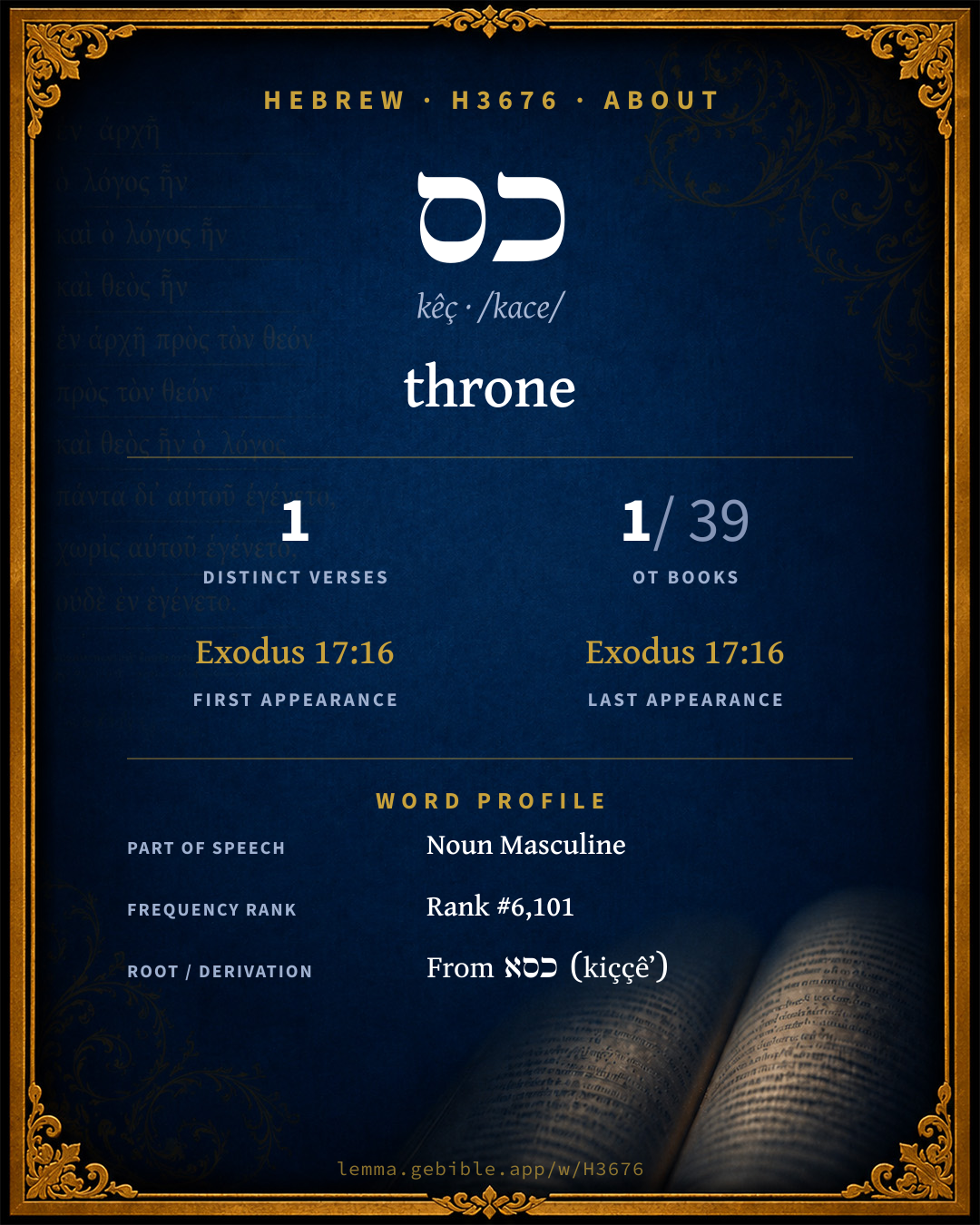
כֵּס
throne
Full lexicon entry — Brown-Driver-Briggs (BDB)
From Brown-Driver-Briggs (BDB)
Where this word appears
Grammar key — what these labels mean
Part of speech
- Noun
- A naming word — a person, place, thing, or idea.
Noun type
- Common
- A common noun — a general class of person, place, or thing (“king,” “city,” “water”), not a specific name.
State
- Construct
- A noun bound to a following noun in a possessive / “of” relationship (the construct chain).
Gender
- Masculine
- Grammatically masculine.
Number
- Singular
- One.
Every verse where H3676 appears — 1 distinct verse across 1 book. Click any verse to open its interlinear word-by-word view. Verse text shown in the World English Bible for context — . Each verse’s Hebrew form is shown with its reference; the English is not keyword-highlighted, since the data carries no word-level English alignment. Use “Compare translations” on any verse to read it across multiple English versions. This concordance covers the Hebrew Bible; Septuagint (Greek Old Testament) occurrences are not indexed here.
Exodus 1 verse
About this entry
At a glance — auto-summarized from this page’s data, not written by a person. Every figure links to its source below. This summary describes the numbers; it doesn’t interpret them.
The Hebrew noun כס centers on the idea of “throne.” It is rare — just 1 verse in the entire Hebrew Bible. Exodus dominates its distribution — 1 of 1 verses. A true hapax — its single appearance is Exodus 17:16. Related forms include כסא and כרסא. For the data behind this summary, explore the sense tree and the renderings breakdown below.
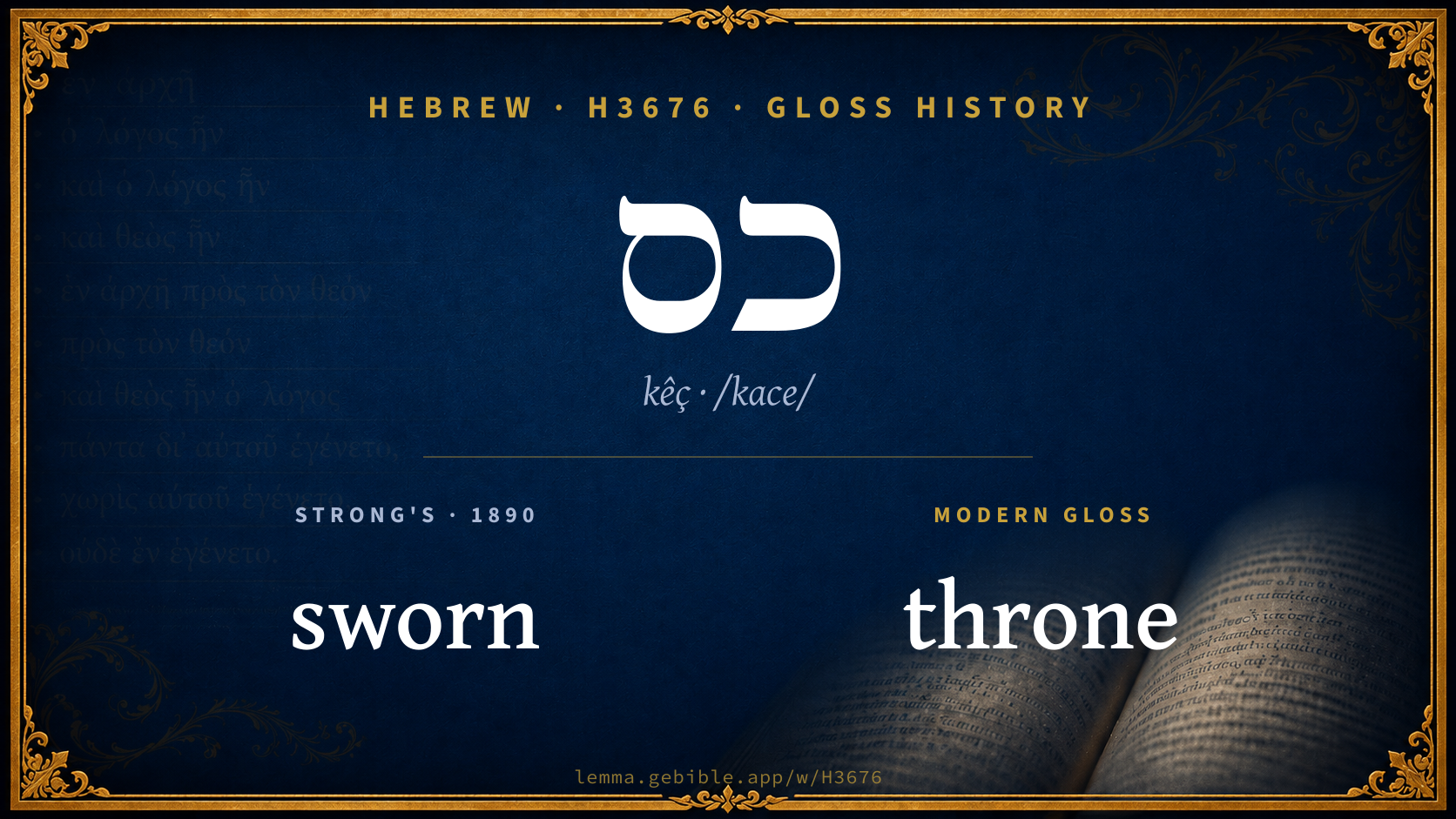
Gloss history
Strong's 1890 vs modern scholarship
About this word
Strong's H3676 catalogs a Hebrew word from the Hebrew Old Testament.
These counts are not copied from any lexicon or concordance. They are computed here, from the morphology-tagged Hebrew Old Testament. What Lemma adds →
- 1
- distinct verses
- The word appears in 1 distinct verse.
- 1 / 39
- OT books
- The word appears in 1 of 39 Old Testament books.
- #6,101
- by frequency
- Rank #6,101 (rank 6,101 of 8,640 Hebrew words by occurrence).
View all 1 occurrence in the concordance →
Most concentrated in
- Exodus 1 verse 100%
By section of the Old Testament
By traditional corpus
Conventional, traditional groupings — biblical authorship is debated, so this is a traditional corpus grouping, not an authorship claim. Each share is this word’s portion of its verses in that division of the Hebrew canon. Each figure is a share of the word’s 1 distinct verse.
- Torah (Pentateuch) 1 verse · 100%
How translations render this word
Counts come from each version’s own published word-to-Strong’s tagging or interlinear alignment — an approximate guide to how each version renders this word, not a word-level alignment the data otherwise carries. Because each total is that version’s own tagged count, the per-version totals vary from one another and need not match the appearance or distinct-verse counts above. These counts may also differ from a printed concordance because Lemma counts each distinctly tagged rendering and does not collapse phrase taggings into a single head-word total. This is a fixed set of word-tagged versions (KJV, ASV, BSB, ULT) and does not change with the reading translation you choose elsewhere. Each version’s license is shown beside its name below (and on Sources).
- King James Version: not separately translated
- Berean Standard Bible: Throne 1×
- unfoldingWord Literal Text: Throne of 1×
King James Version Public Domain
Does not render H3676 with a distinct English word (not separately translated in its 1 tagged occurrence).
Berean Standard Bible Public Domain
Renders H3676 across 1 tagged occurrence — most commonly:
unfoldingWord Literal Text CC BY-SA 4.0
Renders H3676 across 1 tagged occurrence — most commonly:
5 senses and sub-senses in the full BDB
What do BDB’s symbols mean?
BDB uses these scholarly abbreviations:
| Symbol | Meaning |
|---|---|
| 𝔊 | the Septuagint (the ancient Greek translation, LXX) |
| 𝔙 | the Vulgate (the Latin translation) |
| 𝔖 | the Syriac version (the Peshitta) |
| 𝔗 | the Targum (the Aramaic translation) |
| ψ | the Psalms |
| √ | root (the underlying root or stem) |
| ‖ | parallel passage (a synonymous or contrasted parallel) |
| † | the dagger: every passage where the word occurs is cited |
The 5 senses and sub-senses the full Brown-Driver-Briggs lexicon distinguishes for this word, in lexicon order (not ranked by frequency), with BDB’s own verbatim wording and sub-sense lettering. Shown in Hebrew script with BDB’s own scholarly abbreviations. The condensed entry is in the Lexicon Entry tab.
- 1.
- a. of king = throne Gn 41:40 (E), Ex 11:5; 12:29 (both J) 1 K 2:19 Is 47:1 Ez 26:16; of queen-mother 1 K 2:19b; כ׳ מַלְכוּתוֹ Est 5:1 his royal throne; of future (Messianic) prince Zc 6:13a (in v b read על־ימינו 𝔊 StaZAW 1881, 10); of dead kings in Sheʾôl Is 14:9; נָתַן כ׳, in, or against a place, said of king himself, (only Je) is a sign of conquest (Je 1:15); so שִׂים כ׳ 43:10, and (of י׳) 49:38; in Ju 3:20, though of king, not seat of office; 12 times elsewhere, lit. e.g. Genesis 41:40
- b. throne of י׳ (אלהים) as heavenly king, Is 6:1 Ez 1:26(×2); 10:1 1 K 22:19 = 2 Ch 18:18; Jb 26:9 ψ 11:4 Is 66:1 heaven is my throne; as seat of judgment ψ 9:5, 8; in oath יָד עַל־כֵּס יָהּ Ex 17:16 (cf. Di; > Cler JDMich Ges Buhl SS נֵס banner; 𝔊 κρυφαία √ כסה, favours כס); Jerusalem called throne of י׳ Je 3:17, so the sanctuary 17:12 (כ׳ כָּבוֹד מָרוֹם), Ez 43:7. e.g. Isaiah 6:1
- 2. of high priest 1 S 1:9; 4:13, 18; of honoured guest 2 K 4:10; of governor Ne 3:7; of (unjust) judge כ׳ הַוּוֹת ψ 94:20; = conspicuous seat (lit.) Pr 9:14; = seat of distinction, explicitly כ׳ כָּבוֹד Is 22:23; כ׳ alone 2 K 25:28(×2) = Je 52:32(×2) Est 3:1. e.g. 1 Samuel 1:9
- 3.
- a. fig. = royal dignity, authority, power, הַמֶּלֶךְ וְכִסְאוֹ נָקִי 2 S 14:9; לְדָוִד וּלְזַרְעוֹ וּלְבֵיתוֹ וּלְכ׳ 1 K 2:33; especially kingdom, c. vbs. of setting up, establishing, י׳ subj., הֵקִים כ׳ דָוִד 2 S 3:10, וּבָנִיתִי בִסְאֲךָ ψ 89:5, so c. שִׂים v 30; king subj., סָעַד בַּחֶסֶד כִּסְאוֹ Pr 20:28; pass. כ׳ דָוִד יִהְיֶה נכון 1 K 2:45 the throne of David shall be established, cf. 2 S 7:16 = 1 Ch 17:14; וְתוּכַן בַּחֶסֶד כ׳ Is 16:5 (of Mess. reign); so (in gen.) בִּצְדָקָה יִכּוֹן כ׳ Pr 16:12, cf. 25:5; 29:14; intrans. (c. הָיָה ψ 89:37; more fully, י׳ subj., וְכֹנַנְתִּי אֶת־כ׳ מַמְלַכְתּוֹ 2 S 7:13 (כֹּנֵן כסאו in ‖ 1 Ch 17:12), וַהֲקִמֹתִי אֶת־כ׳ מַמְלַכְתְּךָ עַל ־יִשְׂרָאֵל 1 K 9:5, cf. ‖ 2 Ch 7:18 and וַהֲכִינוֹתִי כ׳ מַלְכוּתוֹ עַל־יִשְׂרָאֵל 1 Ch 22:10; also מגּר כ׳ ψ 89:45 cast down throne, of Gentile nations וְהָפַכְתִּי כ׳ מַמְלָכוֹת Hg 2:22; יָשַׁב על־כ׳ sit on the throne of any one (especially David) = be his successor 1 K 1:13, 17, 20, 24, 27, 30, 35, 48; 2:12; 3:6 2 K 13:13, especially Je 13:13; 17:25; 22:2 + 5 times Je; יֵֽשְׁבוּ לְכ׳ לָ֑ךְ ψ 132:12; more fully 1 Ch 29:23; †caus. הוֹשִׁיב על־כ׳ 1 K 2:24; 5:19 2 K 10:3; חֹשִׁיב לַכּ׳ fig. Jb 36:7, of placing in honour; מִפְּרִי בִטְנְךָ אָשִׁית לְכ׳ לָ֑ךְ ψ 132:11; †ישׁב על־כ׳ also = take one’s seat as king, become actual king, possess royalty 1 K 16:11, often sit on the throne of Isr. 1 K 8:20, 25 = 2 Ch 6:10, 16, 1 K 10:9 2 K 10:30; 15:12, Je 33:17; without ישׁב 1 K 2:4; 9:5, cf. also Is 9:6 (Mess.); ישׁב על־כסא מַמְלַכְתּוֹ Dt 17:18, על־כסא הַמְּלוּכָה 1 K 1:46, and even לָשֶׁבֶת עַל־כִּסֵּא מַלְכוּת י׳ עַל־יִשְׂרָאֵל 1 Ch 28:5; also ישׁב עַל־כ׳ הַמְּלָכִים 2 K 11:19, ‖ כ׳ הַמַּמְלָכָה 2 Ch 23:20; of (royal) throne as judgment seat Pr 20:8, cf. also ψ 122:5; set one upon the throne of Isr. נתן פ׳ על־כ׳ ישׂ׳ 1 K 10:9 cf. ‖ 2 Ch 9:8; in compar. sentence יְגַדֵּל אֶת־כִּסְאוֹ מִכּ׳, i.e. make him a more powerful king than, 1 K 1:37, cf. v 47; of king of Babylon, מִמַּעַל לְכוֹכְבֵי־אֵל אָרִים כִּסְאִי Is 14:13. In ψ 45:7 כִּסְאֲךָ אלהים וגו׳ the text is prob. corrupt: AE Hi Ew Bae read thy throne is (a throne) of God; Bi Che insert נכונה יסודתו הקימו thy throne [its foundation is firmly fixed], God [has established it]; v. further Dr§ 194, Obs.. e.g. 2 Samuel 14:9
- b. throne of י׳ (אלהים) = his royal dignity, sovereignty, La 5:19 ψ 93:2; 103:19 (הֵכִין כ׳; ‖ מַלְכוּת); כ׳ כְבוֹדֶ֑ךָ Je 14:21; יָשַׁב עַל־כ׳ קָדְשׁוֹ ψ 47:9; צֶדֶק וּמִשְׁפָּט מְכוֹן כִּסְאֶ֑ךָ ψ 89:15 cf. 97:2. e.g. Lamentations 5:19
Senses from the full Brown-Driver-Briggs lexicon (Brown, Driver, Briggs; Oxford 1906 — public domain), digitized via Sefaria, supplemented by the OpenScriptures HebrewLexicon (CC BY 4.0). Full attribution on Sources.
Word origin
n.m. 2 S 7:16 seat of honour, throne (NH id.; Ph. (pl.) כרסים; Aramaic כּוּרְסְיָא, ܟܽܘܪܣܝܳܐ; Biblical Aramaic כָּרְסֵא, Zinj. כרסא DHMSendsch. 58. 44; Arabic كُرْسِىٌّ; but Assyrian kussu; perhaps Akkad. loan-word; ideogr. iṣ GU. ZA, cf. DlHWB 343);—abs. כִּסֵּא Gn 41:40 +; כִּסֵּה 1 K 10:19(×2) Jb 26:9, הַכִּסֶּא Ez 1:26; cstr. כִּסֵּא 2 S 3:10 +, כֵּס Ex 17:16 (si vera l.; v. infr.); sf. כִּסְאִי 1 K 1:13 +, כִּסְאֲךָ 2 S 7:16 +, כִּסְאֶ֑ךָ 1 K 5:19 +, כִּסְאוֹ Ex 11:5 +; pl. כִּסְאוֹת ψ 122:5(×2); sf. כִּסְאוֹתָם Ez 26:16 Is 14:9;—seat of honour, usually
— Brown-Driver-Briggs (Oxford 1906, public domain), digitized via Sefaria, supplemented by the OpenScriptures HebrewLexicon (CC BY 4.0). See Sources.
Derived from כסא (kiççêʼ) (H3678) — throne.
Jastrow Dictionary
A second Hebrew/Aramaic lexicon for comparison, covering Aramaic and post-biblical (Talmudic, Targumic, Midrashic) usage that the biblical-Hebrew BDB does not. Matched by lemma rather than by Strong’s number, so a lemma may carry more than one Jastrow headword (shown separately below), and the entries cover usage well beyond the Bible.
כס
- , Num. R. s. 1 כס נאה, read אַכְסַנְיָא, v. Tanḥ. B’midb. 2.—Sabb. 67ᵃ, v. כַּסְכְּסַיָּיה.
כָּס
- , v. כָּסַס, כְּסַס a. נְכַס.
כֹּס
- , cup, v. כּוֹס, כַּסָּא.
A Dictionary of the Targumim, the Talmud Babli and Yerushalmi, and the Midrashic Literature (Marcus Jastrow; London, Luzac, 1903) — Public Domain. Digitized via Sefaria. Digitized via Sefaria. Full attribution on Sources.
Same root — word family
Other BDB entries built from the same root as H3676, grouped by Strong’s listed origin. These share a root / origin per the lexicon — not necessarily a shared meaning. Each links to that word’s own entry.
Derives from
Shares the same root
Compare all same-root words → They share a root, not necessarily a meaning.
Septuagint verse parallels
This word appears in 1 verse that also exists in the Greek Old Testament (Septuagint), out of the 1 Hebrew verse it occurs in. You can read those verses in Greek by switching the Old Testament edition to the Septuagint.
Read these verses in the Septuagint
This is a verse-level parallel only — the same verses exist in both the Hebrew and Greek Old Testaments. No word-level Hebrew↔Greek correspondence is claimed: the data carries no such alignment, so no Greek word is shown as this Hebrew word’s translation. Coverage is not total — the Septuagint omits the deuterocanon and renumbers the Psalms, so some Hebrew verses have no direct Greek parallel.