
Psalms 89:14

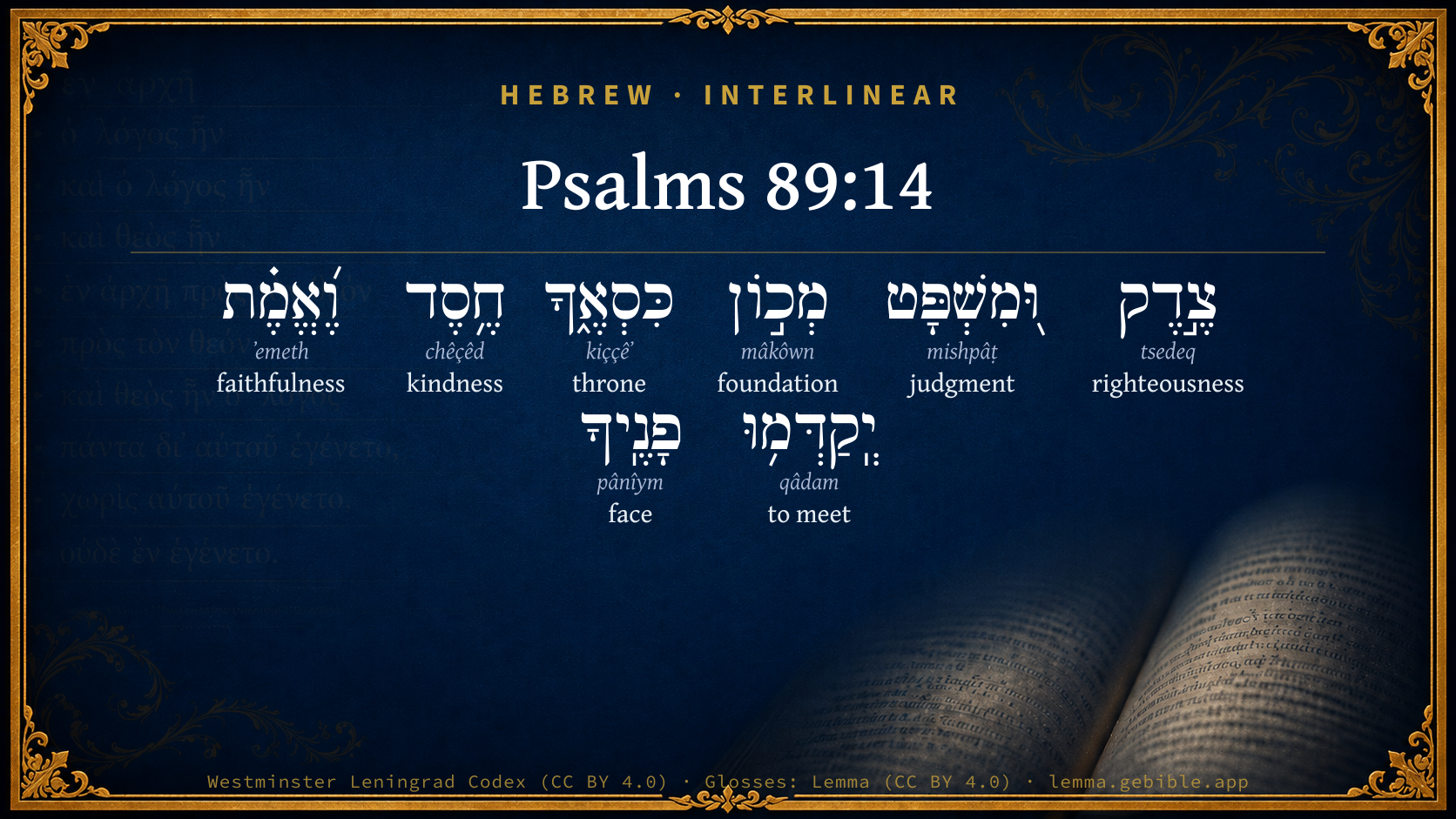
Hebrew (Westminster Leningrad Codex) Psalms 89:14 appears in the Hebrew Old Testament. The text above is from the Westminster Leningrad Codex. Each word links to its Strong’s number, a concise gloss, and parsing drawn from the Open Scriptures Hebrew Bible morphology. Click any word for its full Brown-Driver-Briggs (BDB) entry.
Download image
Cite this verse

Psalms 89:14 (World English Bible). Public Domain. Lemma interlinear Bible study tool, https://lemma.gebible.app/v/psalms/89/14.

Show BibTeX & RIS
BibTeX
RIS
English Translation
Righteousness and justice are the foundation of your throne. Loving kindness and truth go before your face.
World English Bible · Public Domain
Download a study sheet

One document with this verse’s original text, its word-by-word gloss line, the meaning frame, cross-references with their text, attributed commentary, and full source and license credits — printable, and it pastes into notes with its structure intact.

This verse Autodidact and up

Study sheet (.html) Plain text (.txt)

A passage Seminary Student

Up to 50 verses in one chapter. A passage sheet keeps up to 6 commentary sources and 12 cross-references per verse, in the order this page ranks them, and says so on the sheet whenever that leaves anything out. Ask for a single verse and you get the Autodidact verse sheet above.

Everything on this page stays free to read, with no account — the sheet is a download of what is already on screen, not access to it.

Want to remove ads? Support Godless Engineer
Compare translations 3

The same verse in 3 English versions, stacked beneath the original-language interlinear above. Click any original word for its lexicon entry.

Each is an independent rendering of the whole verse — the interlinear is not word-aligned to these translations.

Highlighted words mark where these versions differ — a whole-verse word diff, not a word-by-word alignment.

  • World English Bible Public Domain
    Righteousness and justice are the foundation of your throne. Loving kindness and truth go before your face.
  • King James Version Public Domain
    Justice and judgment are the habitation of thy throne: mercy and truth shall go before thy face.
  • unfoldingWord Literal Text CC BY-SA 4.0
    Righteousness and justice the foundation of your throne; covenant faithfulness and truth precede your face.

unfoldingWord Literal Text — © unfoldingWord, licensed CC BY-SA 4.0. Word-aligned USFM3 via Door43 (git.door43.org/unfoldingWord/en_ult).

Versions to compare (up to 4)

3 of 4 selected

Show all 18 translations

Every available English version of this verse, each an independent rendering of the whole verse.

  • World English Bible Public Domain
    Righteousness and justice are the foundation of your throne. Loving kindness and truth go before your face.
  • Berean Standard Bible Public Domain
    Righteousness and justice are the foundation of Your throne; loving devotion and faithfulness go before You.
  • Majority Standard Bible Public Domain
    Righteousness and justice are the foundation of Your throne; loving devotion and faithfulness go before You.
  • King James Version Public Domain
    Justice and judgment are the habitation of thy throne: mercy and truth shall go before thy face.
  • American Standard Version (1901) Public Domain
    Righteousness and justice are the foundation of thy throne: Lovingkindness and truth go before thy face.
  • Revised Version (1885) Public Domain
    Righteousness and judgment are the foundation of thy throne: mercy and truth go before thy face.
  • Geneva Bible (1599) Public Domain
    Righteousnesse and equitie are the stablishment of thy throne: mercy and trueth goe before thy face.
  • Douay-Rheims (1899) Public Domain
    thy arm is with might. Let thy hand be strengthened, and thy right hand exalted:
  • Young's Literal Translation Public Domain
    Righteousness and judgment `Are' the fixed place of Thy throne, Kindness and truth go before Thy face.
  • Literal Standard Version CC BY-SA 4.0
    Righteousness and judgment || [Are] the fixed place of Your throne, || Kindness and truth go before Your face.
  • Unlocked Literal Bible CC BY-SA 4.0
    Righteousness and justice are the foundation of your throne. Covenant faithfulness and trustworthiness come before you.
  • unfoldingWord Literal Text CC BY-SA 4.0
    Righteousness and justice the foundation of your throne; covenant faithfulness and truth precede your face.
  • Darby Bible Public Domain
    Righteousness and judgment are the foundation of thy throne; loving-kindness and truth go before thy face.
  • World Messianic Bible Public Domain
    Righteousness and justice are the foundation of your throne. Loving kindness and truth go before your face.
  • Webster's Bible Public Domain
    \\89:13\\Thou hast a mighty arm: strong is thy hand, and high is thy right hand.
  • Free Bible Version CC BY-SA 4.0
    Your character of goodness and fairness is the basis for the way you rule; dependable love and trustworthiness are always with you.
  • Bible in Basic English Public Domain
    The seat of your kingdom is resting on righteousness and right judging: mercy and good faith come before your face.
  • JPS Tanakh (1917) Public Domain
    (89-15) Righteousness and justice are the foundation of Thy throne; mercy and truth go before Thee.

Literal Standard Version (2020), Covenant Press — licensed CC BY-SA 4.0. Text via the HelloAO Bible API (eBible.org). Unlocked Literal Bible (unfoldingWord) — licensed CC BY-SA 4.0. Text via the HelloAO Bible API (eBible.org). unfoldingWord Literal Text — © unfoldingWord, licensed CC BY-SA 4.0. Word-aligned USFM3 via Door43 (git.door43.org/unfoldingWord/en_ult). Free Bible Version, Dr. Jonathan Gallagher — licensed CC BY-SA 4.0. Text via the HelloAO Bible API (eBible.org).

Word by word

More ways to search: Search by grammar → Find every occurrence → Compare this word →

Practice this passage: Drill this verse → Learn its vocabulary →

About this verse

These counts appear in no published source. They are computed here, from the morphology-tagged text and Lemma’s own curated glosses. What Lemma adds →

8
words
8
distinct lemmas
Wisdom
section

Notable vocabulary

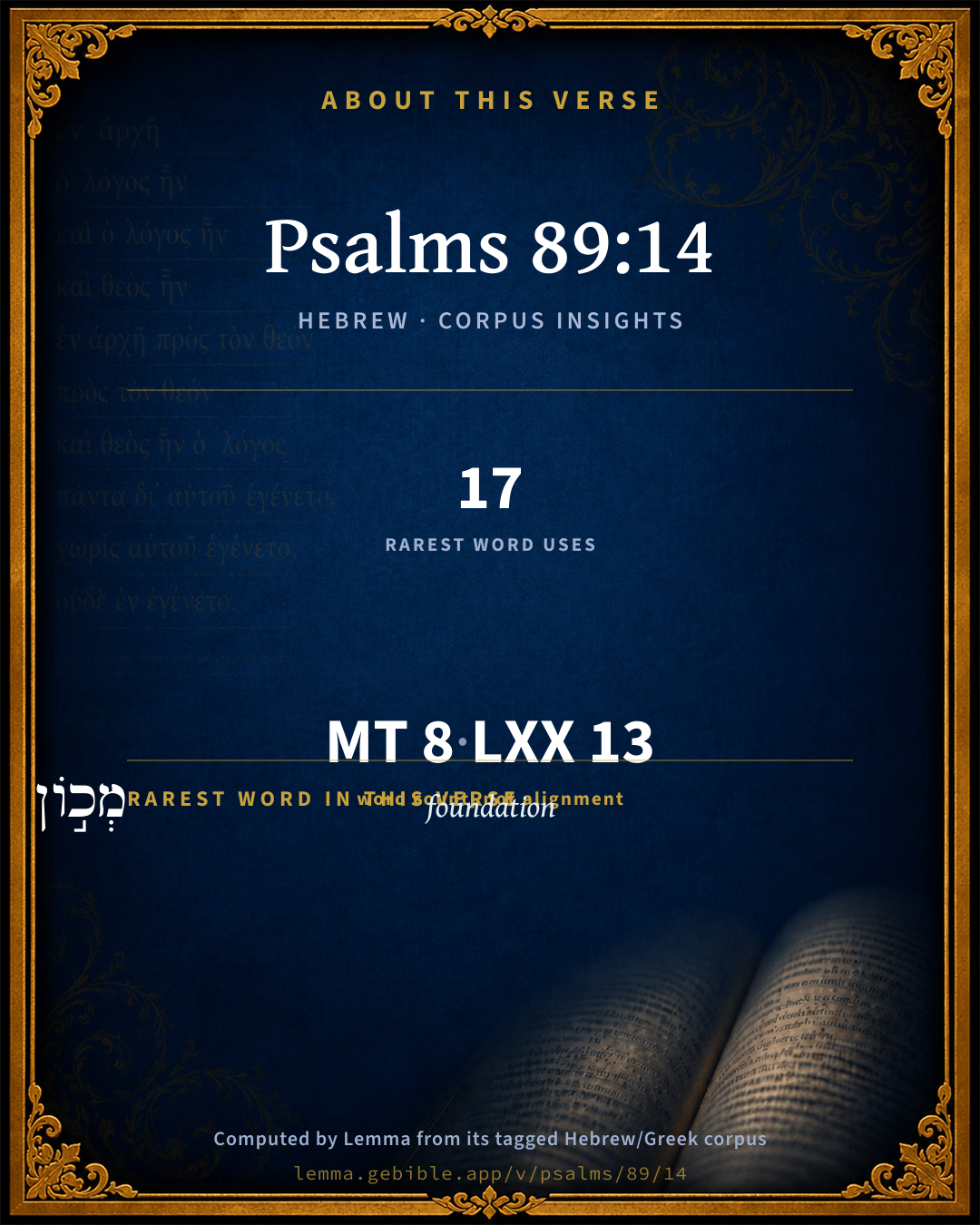
The rarest word here is מְכ֣וֹן foundation H4349 — appearing just 17 times in the whole Hebrew Bible.

Shared distinctive vocabulary

מְכ֣וֹן foundation H4349 occurs in 17 verses of the Hebrew Bible. Also found in:

Grammatical profile

  • 1 verb
  • 7 nouns

Verb forms

  • יְֽקַדְּמ֥וּ Piel · Imperfect

Hebrew & Septuagint length

In English translation the verse runs 17 words from the Hebrew and 17 from the Septuagint (LXX English) — the same length.

A rough comparison of the two English renderings, which tokenize alike — not a word-level alignment.

Word counts can differ between the Hebrew and the Greek without any difference in meaning — e.g. the Hebrew direct-object marker אֵת has no separate Greek word, and Greek often adds the article ὁ.

In the original languages it is 8 Hebrew tokens and 13 Greek tokens — but the two are counted differently (Hebrew bundles its prefixes and suffixes into one token; the Greek is in lemma form), so that isn’t a like-for-like length.

Cross-references

10

Topical passages linked to Psalms 89:14 in the Treasury of Scripture Knowledge — connected by theme and wording, ordered by reader-vote popularity; previews shown in the World English Bible.

  • Psalms 97:2 Clouds and darkness are around him. Righteousness and justice are the foundation of his throne.
  • Proverbs 16:12 It is an abomination for kings to do wrong, For the throne is established by righteousness.
  • Psalms 45:6–7 Your throne, God, is forever and ever. A scepter of equity is the scepter of your kingdom.
  • Psalms 85:13 Righteousness goes before him, And prepares the way for his steps.
  • Psalms 145:17 Yahweh is righteous in all his ways, And gracious in all his works.
  • Deuteronomy 32:4 The Rock, his work is perfect; For all his ways are justice: A God of faithfulness and without iniquity, Just and right is he.
  • Psalms 99:4 The King's strength also loves justice. You do establish equity. You execute justice and righteousness in Jacob.
  • Revelation 15:3 They sang the song of Moses, the servant of God, and the song of the Lamb, saying, "Great and marvelous are your works, Lord God, the Almighty; Righteous and true are your ways, you King of the nations.
  • Psalms 89:2 I indeed declare, "Love stands firm forever. You established the heavens. Your faithfulness is in them."
  • John 1:17 For the law was given through Moses. Grace and truth came through Jesus Christ.

Cross-references courtesy of OpenBible.info (CC BY 4.0).

Hebrew and Greek witnesses Masoretic Hebrew ↔ Greek Septuagint

The same verse in the two great witnesses to the Old Testament, shown verse-for-verse.

You’re reading Greek Psalm 88 (Hebrew Psalm 89). The Septuagint counts the superscription, so verse numbers can differ from the Hebrew — chapter-level alignment, not verse-by-verse. Numbering follows Rahlfs.

These are two independent witnesses, not word-aligned to each other, and the Septuagint is shown in lemma (dictionary) form.

Hebrew Psalms 89:14 Masoretic · Westminster Leningrad Codex

צֶ֣דֶק וּ֭מִשְׁפָּט מְכ֣וֹן כִּסְאֶ֑ךָ חֶ֥סֶד וֶ֝אֱמֶ֗ת יְֽקַדְּמ֥וּ פָנֶֽיךָ

Righteousness and justice are the foundation of your throne. Loving kindness and truth go before your face.

World English Bible · Public Domain

Greek LXX Greek Psalm 88:14 Septuagint · lemma form

σός ὁ βραχίων μετά δυναστεία κραταιόω ὁ χείρ σύ ὑψόω ὁ δεξιός σύ

Justice and judgment are the establishment of your throne: mercy and truth shall go before your face.

LXX2012 (modern English Septuagint) · Public Domain

On this verse, The Treasury of David discusses the Septuagint’s reading. Read the note in Commentary ↓

Hebrew: Westminster Leningrad Codex (CC BY 4.0). Greek: Septuagint (public domain); English from LXX2012 (modern English Septuagint) (Public Domain). How the Septuagint differs from the Hebrew →

Commentary

Notes on Psalms 89:14 from classic Christian and Jewish commentators (each source and its license shown beneath its notes). The classic Christian expositions comment on the surrounding passage and are grouped to its opening verse, so a note may address several verses; the Jewish commentaries on the Tanakh (Rashi and others) are per-verse, so they appear only where the commentator wrote on this verse.

Lemma curates 59 commentaries, every one of them public domain or Creative Commons licensed, each selected and text-cleaned for this edition rather than reprinted as found. About our sources →

Trapp's Complete Commentary

John Trapp

Psa 89:14 Justice and judgment [are] the habitation of thy throne: mercy and truth shall go before thy face.

Ver. 14. Justice and judgment are the habitation (or basis) of thy throne] These are the supporters and pillars.

Mercy and truth, &c.] These are the forerunners, or satellites; I should much fear justice and judgment, saith Austin, were it not that mercy and truth comfort me: "Grace and truth came by Jesus Christ," Joh 1:17.

John Trapp, A Commentary or Exposition upon All the Books of the Old and New Testament (1647–1656) — public domain. Text from a community e-Sword module.

The Biblical Illustrator

Joseph S. Exell

Psa_89:14

Justice and judgment are the habitation of Thy throne.

The throne of grace

I. A view of the throne.

1. What it is, and why so called. It is God manifesting Himself in our own nature, and dealing with sinners through Christ according to the grace of the Gospel (2Co_5:19-20). Now, Gods administration of grace toward guilty sinners through Christ may be called a throne, either--

(1) With allusion unto the mercy-seat in the typical temple of Jerusalem; or--

(2) Because of the glorious greatness and royal majesty of God flint shines in this administration of grace through Christ.

2. What comfortable views of God are to be had by a guilty trembling sinner from this throne of grace. In general, every view of God here is inviting and encouraging. More particularly--

(1) God upon a throne of grace is to be seen as the God and Father of our Lord Jesus Christ (Eph_1:3).

(2) From a throne of grace, God is to be seen as a God of love--yea, as love itself (1Jn_4:16).

(3) From a throne of grace, a guilty sinner may view Him as a God of peace (Heb_13:20).

II. The foundation of this throne is justice and judgment.

1. It is an ancient foundation; for Christ was set up from everlasting, or ever the earth was; He is the Lamb slain from the foundation of the world.

2. It is a foundation of Gods own laying, and He had pleasure in laying it (Isa_28:16).

3. It is a firm foundation (Mat_16:18).

4. It is a tried foundation. Justice tried it, and found it firm and stable. The powers of hell tried to overturn this foundation; but their kingdom and power was broken in pieces in the enterprise. The saints have all tried this foundation, and proclaim it sufficient to bear their weight; yea, it is sufficient to bear the weight of all mankind--yea, of millions of worlds, if they existed, and would venture upon it (Heb_7:25).

5. It is a precious foundation (1Pe_1:19).

6. It is a most beautiful foundation. What God says of His Church (Isa_54:11) is much more true of the throne of grace.

III. Notice some pillars wherewith the throne is surrounded and supported. The foundation of this throne being laid in the satisfaction of justice, all the other perfections, or attributes, of the Divine nature, fall in for the support of the reign and administration of grace.

IV. Inquire why God will have justice and judgment for the foundation of His throne of grace. The answer is, That grace might reign through righteousness; that the glory of grace might be displayed in a consistency with the honour of Divine justice. Here a question offers, How does grace reign, or how is the glory of grace displayed in and by the righteousness of a surety?

1. Grace reigns and is displayed in the contrivance of this righteousness; for it is the device of infinite wisdom, animated and inspired by free grace.

2. Grace reigns and is displayed in the acceptation of this righteousness. What but infinite love and grace could prevail with inexorable justice, so far to dispense with the rigour of the law, as to admit of a suretys righteousness in the room of the sinner!

3. Grace reigns in the impetration of this righteousness; for God (in His amazing grace) sent forth His Son made of a woman, etc.

4. Grace reigns in the revelation of this righteousness. Grace was not content to contrive and bring about this righteousness, but the news of it must be proclaimed to a lost world, as it were by sound of trumpet.

5. Grace reigns through righteousness, inasmuch as that it is by the revelation of this justice-satisfying righteousness that grace conquers and powerfully subdues sinners, brings them under its own government and dominion.

V. Application.

1. Is it so that justice satisfied, and judgment executed upon the ever-blessed Surety, is the foundation of a throne of grace, then, hence we may see what an expensive piece of work a throne of grace is. Why, the foundation of it is laid in the death and blood of the Son of God.

2. See from this doctrine the glory of a Gospel-dispensation.

3. If it be so that justice satisfied, and judgment executed upon Christ, is the foundation of throne of grace, then see hence, that the salvation of a lost sinner by grace is very consistent with the honour of Divine justice.

4. Has God erected a throne of grace at the expense of the death and satisfaction of His eternal Son? Then I would have you to try, whether you be courtiers about this throne. (E. Erskine.)

The necessity and foundations of a throne of grace for the behoof of poor sinners

I. The necessity there was of a throne of grace for the behoof of poor sinners.

1. Sin having entered, they could have no more benefit by the throne of law-goodness, which runs in that channel, Do this and live (Gen_3:22; Gen_3:24).

2. They were bound over to answer at the throne of strict justice; for so was the law-treaty related and determined (Gen_2:17).

(1) They could have no claim to law-goodness and bounty, but upon perfect obedience (Gal_3:12).

(2) They were utterly unable to stand before the tribunal of justice (Psa_130:3; Psa_143:2).

(3) The criminal once falling under the weight of the sentence a sacrifice to justice, there is no rising again (Psa_94:23).

(4) Justice had determined the execution-day to be the same with the sinning-day (Gen_2:17).

II. The necessity of these foundations and stays of justice and judgment against sin for the throne of grace to stand on.

1. The justice of God could not suffer it to be erected but on these bases (Gen_18:25; 1Th_1:6).

2. The holiness of God and His hatred of sin would not suffer it (Psa_5:5; Hab_1:13).

3. The truth of God was a bar in the way of emanations of mercy and grace without satisfaction to justice (Gen_2:17).

4. The honour of the holy law, the eternal rule of righteousness, stood in the way of erecting a throne of grace but on these foundations; it behoved to be magnified and made honourable (Isa_42:21).

5. If there had not been an absolute necessity of these foundations for a throne of grace to stand on, they had never been laid at the cost of the blood of the Son of God (Rom_3:25).

III. The laying of these foundations and the erecting of the throne of grace upon them.

1. The general ends of this new erection.

(1) The saving of sinners from the wrath of God due to them for their sins.

(2) The making of sinners positively happy in the favour of God for evermore.

2. The necessary foundations of this throne.

(1) Justice, as distinguished from judgment, whereby God gives good unto any, agreeably to the laws of righteousness, which the justice of His nature requires to be observed in His government of the world (Gen_18:25).

(2) Judgment, whereby vindictive justice is satisfied for sin, for the breaking of the holy law; vengeance is taken upon it in proportion to the offence, which in a sort is an infinite offence.

3. How these foundations were laid. There being no help among the creatures, God laid help on His own Son (Psa_89:19).

Thus He made provision--

1. For the first foundation of the throne of grace, namely, justice, by His obeying the law completely in the sinners room, observing exactly and giving obedience to its commands.

2. He made provision for the other foundation, namely, judgment, by suffering in the sinners stead (Gal_3:13). (T. Boston, D.D.)

Divine justice

Consider the justice of God--

I. As an element of His government.

II. As the rule of His conduct. (W. H. H. Murray.)

The Biblical Illustrator, edited by Joseph S. Exell (c. 1880s–1900s) — public domain. Text from a community e-Sword module.

J. A. Alexander on Psalms

Joseph Addison Alexander

15. (Psa 89:14) Justice and judgment (are) the place of thy throne; mercy and truth shall go before thy face. The word translated place may also have the more specific sense of dwelling-place. The meaning is that God reigns in the midst of perfect righteousness. See above, on Psa 89:8. The verb in the last clause always means to go or come before, sometimes in the sense of coming into one's presence, sometimes in that of meeting or encountering, sometimes (as here) in that of being a forerunner. See above, on Psa 85:13.

Joseph Addison Alexander, The Psalms Translated and Explained (1850) — public domain. Text from a community e-Sword module.

Tyndale Open Study Notes

Tyndale Open Resources

89:14-18 God rules wisely over creation. The qualities of righteousness, justice, and faithfulness fit the profile of a wise ruler. The happy people who live under his rule enjoy his protection.

Tyndale Open Study Notes — © Tyndale Open Resources, licensed CC BY-SA 4.0. Text via the HelloAO Bible API.

Geneva Bible (1599)

Geneva Bible translators

For hereby he judgeth the world, and showeth himself a merciful Father, and faithful protector unto his.

Geneva Bible (1599) marginal notes — public domain. Text via Bolls.life.

Adam Clarke's Commentary

Verse 14. Justice and judgment are the habitation of thy throne] The throne - the government, of God, is founded in righteousness and judgment. He knows what is right; he sees what is right; he does what is right; and his judgments are ever according to righteousness. His decisions are all oracles, no one of them is ever reversed.

Mercy and truth shall go before thy face.] These shall be the heralds that shall announce the coming of the Judge. His truth binds him to fulfil all his declarations; and his mercy shall be shown to all those who have fled for refuge to the hope that is set before them in the Gospel. See Clarke on Ps 85:10; "Ps 85:11".

Adam Clarke's Commentary on the Bible (1810–1826) — public domain. Text from a community e-Sword/MySword module.

John Calvin's Commentaries

14. Righteousness and judgement are the place of thy throne. These encomiums serve more effectually to confirm the hope of true believers than if the Divine power alone had been presented to our view. Whenever mention is made of God, it behoves us to apply our minds principally to those attributes of his nature which are specially fitted for establishing our faith, that we may not lose ourselves by vainly indulging in subtile speculations, by which foolish men, although they may minister to their own mental recreation, make no advances to the right understanding of what God really is. The prophet, therefore, in allusion to the insignia and pomp of kings, declares that righteousness and judgment are the pillars of the throne on which God sits conspicuous in sovereign state, and that mercy and truth are, as it were, his pursuivants; as if he had said, “The ornaments with which God is invested, instead of being a robe of purple, a diadem, or a scepter, are, that he is the righteous and impartial judge of the world, a merciful father, and a faithful protector of his people.” Earthly kings, from their having nothing in themselves to procure for them authority, and to give them dignity, are under the necessity of borrowing elsewhere what will invest them therewith; but God having in himself an all-sufficiency, and standing in no need of any other helps, exhibits to us the splendor of his own image in his righteousness, mercy, and truth.

John Calvin's Commentaries (1540-1563) — public domain. Text from the Calvin Translation Society English edition (1840s-50s) via the Christian Classics Ethereal Library (ccel.org). Calvin's coverage is partial (roughly two-thirds of the Bible); uncommented books and verses are honest gaps, never fabricated. The 19th-century editor's footnotes and remarks are omitted so the notes are faithfully Calvin's own voice.

Ellicott's Commentary for English Readers

(14) Habitation.—Rather, foundation, or pillars. Righteousness and judgment support God’s throne, and mercy and truth (“those genii of sacred history”) precede (present tense, not future) Him as forerunners precede a king.

A Bible Commentary for English Readers, edited by Charles John Ellicott (1878–1897) — public domain. Text from a community e-Sword module.

The Cambridge Bible for Schools and Colleges

gen. ed. J. J. S. Perowne

14. Righteousness and judgement are the foundation of thy throne:

Lovingkindness and truth attend thy presence.

The first line recurs in Psa_97:2. Cp. too Psa_33:5. Righteousness, or the principle of justice, and judgement, or the application of it in act, are the basis of all true government, divine as well as human (Pro_16:12; Pro_25:5). Lovingkindness and truth are represented as angels attending in God’s Presence (Psa_95:2), ready to do His bidding (Psa_43:3), rather than as couriers preceding Him.

The Cambridge Bible for Schools and Colleges (gen. ed. J. J. S. Perowne; Cambridge University Press, 1878–1918) — public domain. Text from a community e-Sword module.

John Gill's Exposition

Blessed is the people that know the joyful sound,.... Of the love, grace, and mercy of God displayed in Christ, of peace and pardon by his blood, of justification by his righteousness, of atonement by his sacrifice, and of complete salvation by his obedience, sufferings, and death; this is the sound of the Gospel, and a joyful one it is to sensible sinners; and is so called in allusion either to a shout made upon a victory gained, and such a sound is the Gospel; it declares victory by Christ over sin, Satan, the world, and death, and every enemy; and that he has made his people more than conquerors over them; or to the jubilee trumpet, which proclaimed liberty and a restoration of inheritances, Lev 25:9 and so the Gospel proclaims liberty to the captives, freedom from the dominion of sin, and condemnation by it, from the tyranny of Satan, and the bondage of the law; and gives an account of the inheritance the saints have in Christ, and through his death, to which they are regenerated, and for which they are made meet by the Spirit of God, and of which he is the seal and earnest: or to the silver trumpets, for the use of the congregation of Israel, and blown at their solemn feasts, and other times, and were all of a piece, Num 10:1, the trumpet of the Gospel gives a certain sound, an even one, a very musical one; there is no jar nor discord in it; is a soul charming alluring sound, and very loud; it has reached, and will reach again, to the ends of the earth, Rom 10:18, it is a blessing to hear it, but it is a greater to "know" it, not merely notionally, but spiritually and experimentally; so as not only to approve of it, and be delighted with it, but so as to distinguish it from all other sounds; and by faith to receive it, and appropriate the things it publishes to a man's own soul; and such must be "blessed", or happy persons, for the reasons following in this verse, and in Psa 89:16,

they shall walk, O Lord, in the light of thy countenance: enjoy the gracious presence of God, have the manifestation of himself, the discoveries of his love, communion with him through Christ, and the comforts of the Holy Spirit, and these continued; so that they shall walk in the sunshine of these things, though not always; for sometimes they walk in darkness, and see no light; but it is an unspeakable mercy and blessing to walk herein at any time, for ever so short a season, see Psa 4:6.

John Gill's Exposition of the Whole Bible (1746–1763) — public domain (CC PDM 1.0). Text via the HelloAO Bible API.

Albert Barnes' Notes on the Bible

justice and judgment are the habitation of the throne - Margin, “establishment.” The Hebrew word - מכון mâkôn - means properly a place where one stands; then, a foundation or basis. The idea here is, that the throne of God is founded on justice and right judgment; it is this which supports it; his administration is maintained because it is right. This supposes that there is such a thing as right or justice in itself considered, or in the nature of things, and independently of the will of God; that the divine administration will be conformed to that, and will be firm because it is thus conformed to it. Even omnipotent power could not maintain permanently a throne founded on injustice and wrong. Such an administration would sooner or later make its own destruction sure.

Mercy, and truth shall go before thy face - literally, anticipate thy face; that is, thy goings. Wherever thou dost go, wherever thou dost manifest thyself, there will be mercy and faithfulness. Thy march through the world will be attended with kindness and fidelity. So certain is this, that his coming will, as it were, be anticipated by truth and goodness.

Albert Barnes' Notes on the Bible (1834–1885) — public domain. Text from a community e-Sword/MySword module.

Matthew Poole's English Annotations

Justice and judgment, i.e. just judgment, or justice in judging, as Jer 9:24; 22:3. A common figure, called hendiaduo. The habitation; or, the basis or foundation, as this word is used Ezr 2:68; 3:3; Psa 97:2; 104:5; the groundwork of all his proceedings, and the stability of his throne and government. For God could not be the Judge and Ruler of the world if he did not right, Gen 18:25; compare Pro 16:12. The sense and scope of this verse may be this, Though thy present dispensations, in breaking thy covenant with David, and in suffering his posterity and thine own people to be devoured by such as are much more wicked than they, be a great deep and secret, yet I rest satisfied that they are just. In like manner the prophet fortifies himself under the like thoughts, Jer 12:1.

Shall go before thy face, as thy harbingers and companions, wheresoever thou goest. Thou art neither unmerciful nor unfaithful in any of thy dealings.

Matthew Poole's English Annotations on the Holy Bible (1683–1685) — public domain. Text from a community e-Sword/MySword module.

The Treasury of David

Charles H. Spurgeon

Ver. 14. Justice and judgment are the habitation of thy throne. They are the basis of the divine government, the sphere within which his sovereignty moves. God as a sovereign is never unjust or unwise. He is too holy to be unrighteous, too wise to be mistaken; this is constant matter for joy to the upright in heart.

Mercy and truth shall go before thy face. They are the harbingers and heralds of the Lord; he calls these to the front to deal with guilty and changeful man; he makes them, in the person of the Lord Jesus, to be his ambassadors, and so poor, guilty man is enabled to endure the presence of his righteous Lord. If mercy had not paved the way, the coming of God to any man must have been swift destruction.

Thus has the poet sung the glories of the covenant God. It was meet that before he poured forth his lament he should record his praise, lest his sorrow should seem to have withered his faith. Before we argue our case before the Lord it is most becoming to acknowledge that we know him to be supremely great and good, whatever may be the appearance of his providence; this is such a course as every wise man will take who desires to have an answer of peace in the day of trouble.

Ver. 14. Justice and judgment are the habitation of thy throne. As if the Psalmist had said, "The ornaments with which God is invested, instead of being a robe of purple, a diadem, or a sceptre, are, that he is the righteous and impartial judge of the world, a merciful father, and a faithful protector of his people." Earthly kings, from their having nothing in themselves to procure for them authority, and to give them dignity, are under the necessity of borrowing elsewhere what will invest them therewith; but God, having in himself all sufficiency, and standing in no need of any other helps, exhibits to us the splendour of his own image in his righteousness, mercy, and truth. John Calvin.

Ver. 14. Justice and judgment are the habitation of thy throne. The Holy Ghost alludes to the thrones of earthly princes, which were underpropped with pillars, as Solomon's throne with lions, 1Ki 19:20, that were both a support and an ornament to it. Now, saith the Psalmist, justice and judgment are the pillars upon which God's throne standeth, as Calvin expounds it, the robe and diadem, the purple and sceptre, the regalia with which God's throne is adorned. George Swinnock.

Ver. 14. Justice and judgment are the habitation of thy throne. Jehovah is here exhibited, by the sacred poet, under the character of a Sovereign, and of a Judge, he being presented to our adoring regard as on his throne; the throne of universal empire, and absolute dominion; as exercising his authority, and executing his laws, with an omnipotent but impartial hand. For "Justice and judgment are the habitation", the preparation, the establishment, or the basis, of this throne. Our textual translation is, habitation; the marginal, establishment; the Septuagint, preparation; and, if I mistake not, our best modern interpreters render the original term, basis or foundation; which, on the whole, seems most agreeable. The basis, then, of Jehovah's government, or that on which it rests, is "justice and judgment." By "justice", I conceive we are to understand the attribute so called; and, by "judgment", the impartial exercise of that attribute in the Divine administration. So that were not the Most High to administer impartial justice in his moral government, he might be considered, if it be lawful to use the expression, as abdicating his throne. Abraham Booth, 1734-1806.

Ver. 14. Justice, which defends his subjects, and does every one right. Judgment, which restrains rebels, and keeps off injuries. Mercy, which shows compassion, pardons, supports the weak. Truth, that performs whatsoever he promises. William Nicholson.

Ver. 14. Mercy and truth shall go before thy face. Note

1. Mercy is said to go before the face of God, because God sends mercy before judgment, that he might find less to punish: so Bellarmine.

2. That God permits not his face to be seen before He has forgiven our sins through mercy: so Rickelius.

3. That no one comes to the knowledge of God, but he who has obtained mercy beforehand.

4. That God comes to no one unless His grace go before Him. ...Truth goes before the face of God, because God keeps it ever before his eyes, to mould his actions thereby. Pindar calls truth yugatera Dios the daughter of God. Epaminoudas the Theban general, cultivated truth so studiously, that he is reported never to have spoken a falsehood even in jest. In the courts of kings this is a rare virtue. Le Blanc.

Ver. 14. Mercy and truth. Mercy in promising; truth in performing. Truth, in being as good as thy word; mercy, in being better. Matthew Henry.

Ver. 14. Shall go. In his active going forth, tender mercy and goodness announce him, and faithful truth will tell his people he is there when he comes forth. His activities are mercy and faithfulness, because his will is at work and his nature is love. Yet his throne still maintains justice and judgment. J.N. Darby.

Ver. 14.

1. The Equity of the divine government"justice", etc. No creature can eventually be unjustly dealt with under his dominion, and his kingdom ruleth over all.

2. The Sovereignty of the divine government. Truth before mercy. Mercy founded upon truth. "Thou wilt perform the truth to Jacob and the mercy to Abraham." The covenant made in mercy to Abraham is fulfilled in truth to Jacob.

Psalms 89:15*

Charles H. Spurgeon's The Treasury of David (1869–1885) — public domain. Psalms only. Text from a community e-Sword/MySword module.

Whedon's Commentary on the Bible

Daniel D. Whedon

14. Justice and judgment—The former the principle, the latter the administration, of righteousness.

Habitation—The restingplace, the foundation of thy throne.

Mercy and truth—The same as the “mercies” and “faithfulness” in Psa_89:1, which the author makes the theme of his psalm. God’s mercy must always be in harmony with his justice, judgment, and truth.

Daniel D. Whedon (gen. ed.), Commentary on the Old and New Testaments (1874–1909) — public domain. Text from a community e-Sword module.

The Pulpit Commentary

Justice and judgment; or, right eousness and justice (Cheyne). The psalmist here rises to a higher level from that of might to that of right. God is not merely strong to do whatever he wills; but all that he wills is consonant with right and justice. Are the habitation of thy throne; rather, the basis, or "foundation." (So Kay, Cheyne, and the Revised Version.) Mercy and truth shall go before thy face; i.e. shall stand ever in front of thee; be thy inseparable companions. Whatever thou doest shall be done "in truth and equity.

Equity and righteousness.

Prayer book Version, "Righteousness and equity are the habitation of thy seat;" Revised Version, "Justice and judgment are the foundation of thy throne." The terms "justice," "righteousness." stand for the abstract virtue; the terms "judgment," "equity," stand for the applications and adaptations of justice to times, circumstances, and men. Equity is the law of right applied to particular circumstances. The double assertion made concerning God is that what he does is always right judged by the standards of righteousness, and always right judged by the frailties and infirmities of men. Both these considerations help to bring men full confidence in him, and assurance concerning his ways with them.

I GOD"S WAYS ARE ALWAYS RIGHT TO THE STANDARD. "Righteousness is the basis of his throne;" the distinguishing feature of his rule. "Shall not the Judge of all the earth do right?" If it be asked Where is the standard of righteousness? we may reply In man"s own moral sense. If he knows right from wrong, he must know right. The appraisement man can make of his own acts involves his power to appraise acts which are said to be acts of God. But this caution needs to be fully presented and illustrated that the standard of right is not the sentiment of any single individual, but the harmonious sentiment of all the race in all the ages. It is a human standard, not an individual standard. There has grown up in the world a standard of righteousness, which is now well established; by it the acts declared as God"s may be judged; and it will always be found that inspired descriptions of righteousness are, in effect, descriptions of the established human standard; and that all acts of God commended in the inspired record will stand the test of that established human standard. It should be carefully shown that there is not one standard for man, and a differing standard for God. Right for God is right for man. Cases that seem doubtful are simply cases misapprehended. Poets may say, "Whatever is right." Pious men say, "Whatever God does is right.

II GOD"S WAYS ARE ALWAYS RIGHT TO THE CIRCUMSTANCE. There is a temporary right as well as an eternal right. There is an uneducated right, and a cultured right, dependent on conditions of conscience. There is a right at the moment, and a right forever. There is a right absolute, and a right in adaptation. Illustrate from the mother"s idea of right in relation to her child. She has to fit her right to the capacity and condition of her child. There is a right form and setting and clothing of the eternal right. So the psalmist may find God"s right in the adjustment of his dealings with the wilful and wayward Davidic king, Rehoboam. R.T.

The Pulpit Commentary (1880–1919), ed. H.D.M. Spence-Jones & Joseph S. Exell — public domain. Text from a community e-Sword module.

John Wesley's Explanatory Notes

Justice and judgment - Justice in judging.

John Wesley, Explanatory Notes Upon the Whole Bible (1754–1765) — public domain. Text via the GEBible commentary corpus.

Lesson kit

Teaching starters — assembled from the data on this page, not authored interpretation. Every prompt links to the verse data it draws on. Edit before teaching.

Psalms, in the Wisdom, opens this verse with 8 words (8 distinct Hebrew lemmas). Its most distinctive word is mâkôwn (“foundation”). A historical commentator’s framing appears above. Read the whole chapter for the surrounding context.

Discussion questions

  1. The word mâkôwn carries the sense “foundation.” How does it shape the verse?
  2. Exodus 15:17 shares the word «foundation» with this verse. How do the two illuminate each other?
  3. These translations render this verse differently; the difference is in the English rendering, not the original. What questions does that raise?
  4. The verb «יְֽקַדְּמ֥וּ» is Piel Imperfect. How does its form color the action?
  5. Reading how Trapp's Complete Commentary and The Biblical Illustrator read this verse, where do the two commentators agree and where do they part?

Things to notice

Reading settings

Reading text

Shown beneath each verse's original-language words.

Old Testament
Old Testament edition

Read the OT as the Masoretic Hebrew (MT) or the Greek Septuagint (LXX).

English shown for the Greek Septuagint (in the Hebrew ↔ Greek comparison).

Comparing translations? Open the Compare panel on any verse page to stack up to four side by side.