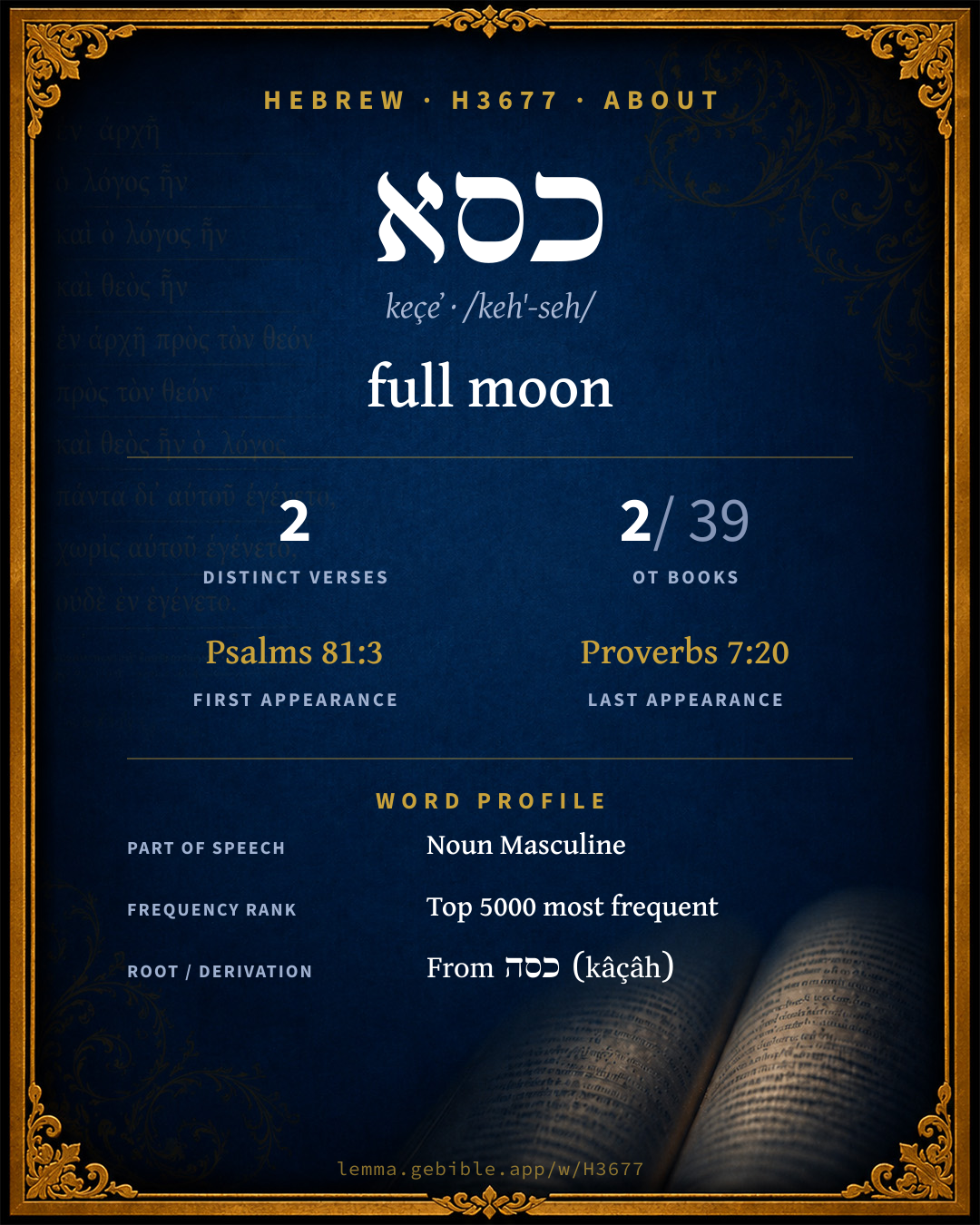
כֶּ֫סֶא
full moon
Full lexicon entry — Brown-Driver-Briggs (BDB)
From Brown-Driver-Briggs (BDB)
Where this word appears
Grammar key — what these labels mean
Noun type
- Common
- A common noun — a general class of person, place, or thing (“king,” “city,” “water”), not a specific name.
State
- Absolute
- The independent form of a noun, not bound to a following word.
Gender
- Masculine
- Grammatically masculine.
Number
- Singular
- One.
Every verse where H3677 appears — 2 distinct verses across 2 books. Click any verse to open its interlinear word-by-word view. Verse text shown in the World English Bible for context — . Each verse’s Hebrew form is shown with its reference; the English is not keyword-highlighted, since the data carries no word-level English alignment. Use “Compare translations” on any verse to read it across multiple English versions. This concordance covers the Hebrew Bible; Septuagint (Greek Old Testament) occurrences are not indexed here.
Psalms 1 verse
Proverbs 1 verse
About this entry
At a glance — auto-summarized from this page’s data, not written by a person. Every figure links to its source below. This summary describes the numbers; it doesn’t interpret them.
The Hebrew noun כסא centers on the idea of “full moon.” The Hebrew Bible uses it only 2 verses. Psalms dominates its distribution — 1 of 2 verses. Debuting at Psalms 81:3, it then recurs through the corpus. Sharing its root, it stands alongside כסה, כסא and כסוי. Dig into 2-verse concordance and the renderings breakdown below.
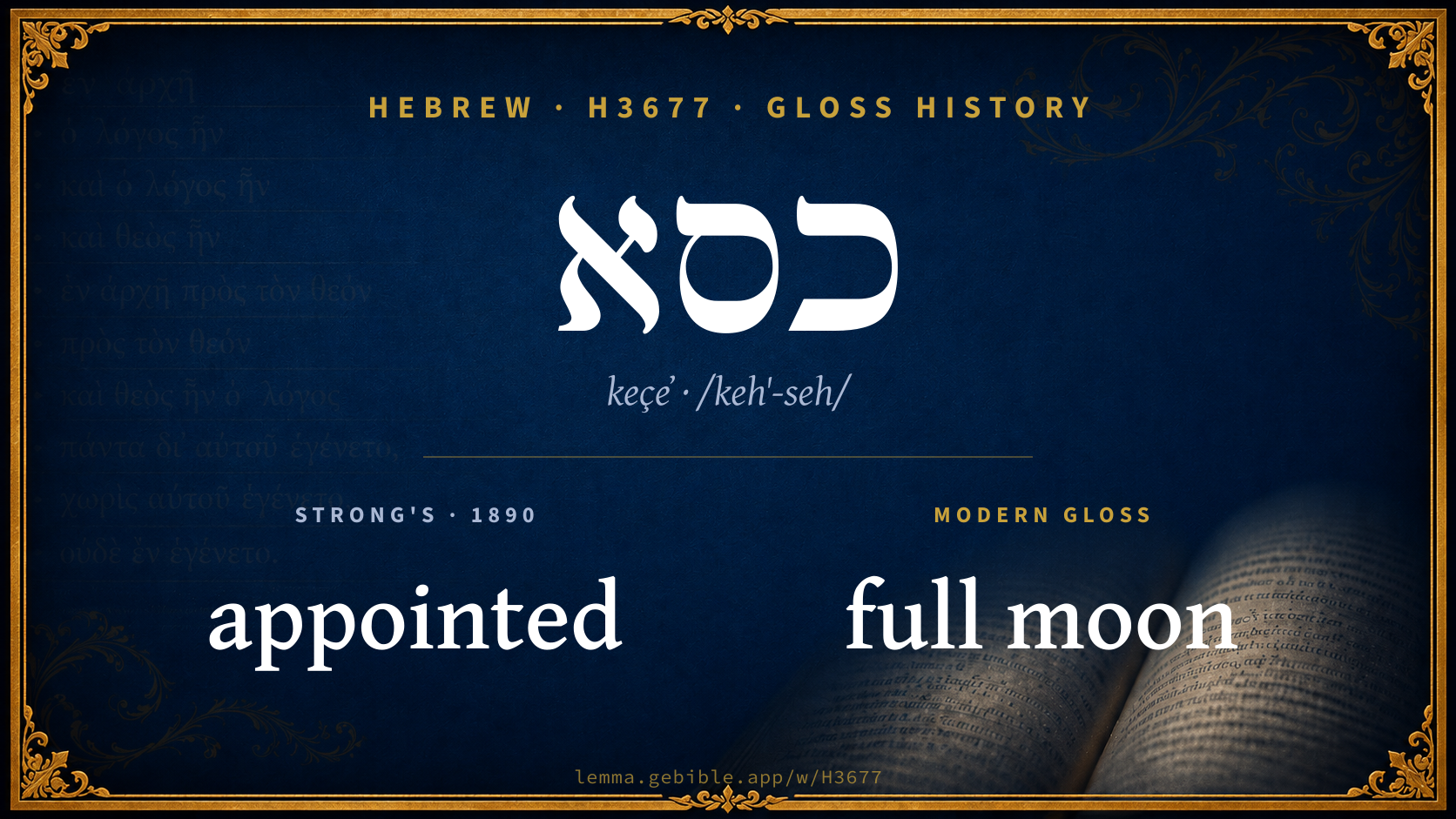
Gloss history
Strong's 1890 vs modern scholarship
About this word
Strong's H3677 catalogs a Hebrew word from the Hebrew Old Testament.
These counts are not copied from any lexicon or concordance. They are computed here, from the morphology-tagged Hebrew Old Testament. What Lemma adds →
- 2
- distinct verses
- The word appears in 2 distinct verses.
- 2 / 39
- OT books
- The word appears in 2 of 39 Old Testament books.
- #4,807
- by frequency
- Top 5000 most frequent Hebrew words (rank 4,807 of 8,640 Hebrew words by occurrence).
View all 2 occurrences in the concordance →
By traditional corpus
Conventional, traditional groupings — biblical authorship is debated, so this is a traditional corpus grouping, not an authorship claim. Each share is this word’s portion of its verses in that division of the Hebrew canon. Each figure is a share of the word’s 2 distinct verses.
- Writings (Ketuvim) 2 verses · 100%
How translations render this word
Counts come from each version’s own published word-to-Strong’s tagging or interlinear alignment — an approximate guide to how each version renders this word, not a word-level alignment the data otherwise carries. Because each total is that version’s own tagged count, the per-version totals vary from one another and need not match the appearance or distinct-verse counts above. These counts may also differ from a printed concordance because Lemma counts each distinctly tagged rendering and does not collapse phrase taggings into a single head-word total. This is a fixed set of word-tagged versions (KJV, ASV, BSB, ULT) and does not change with the reading translation you choose elsewhere. Each version’s license is shown beside its name below (and on Sources).
- King James Version: Appointed 1×, Time appointed 1×
- American Standard Version: Moon 1×
- Berean Standard Bible: Full moon 1×, Moon full 1×
- unfoldingWord Literal Text: Full moon 2×
King James Version Public Domain
Renders H3677 across 2 tagged occurrences — most commonly:
American Standard Version Public Domain
Renders H3677 across 1 tagged occurrence — most commonly:
Berean Standard Bible Public Domain
Renders H3677 across 2 tagged occurrences — most commonly:
unfoldingWord Literal Text CC BY-SA 4.0
Renders H3677 across 2 tagged occurrences — most commonly:
Senses in BDB
The 1 sense BDB distinguishes for this word, in lexicon order (not ranked by frequency or importance). The full entry — with sub-senses — is in the Lexicon Entry tab.
- full moon
Word origin
כֶּ֫סֶא Pr 7:20, כֶּ֫סֶה ψ 81:4 n.[m.] full moon
— Brown-Driver-Briggs (Oxford 1906, public domain), digitized via Sefaria, supplemented by the OpenScriptures HebrewLexicon (CC BY 4.0). See Sources.
Derived from כסה (kâçâh) (H3680) — to cover.
Jastrow Dictionary
A second Hebrew/Aramaic lexicon for comparison, covering Aramaic and post-biblical (Talmudic, Targumic, Midrashic) usage that the biblical-Hebrew BDB does not. Matched by lemma rather than by Strong’s number, so a lemma may carry more than one Jastrow headword (shown separately below), and the entries cover usage well beyond the Bible.
כְּסָא I
- to cover, v. כְּסֵי II.
כְּסָא II
- to reprehend, v. כְּסַס a. כְּסַן.
כַּסָּא I
- , cup, calyx. Targ. Gen. XL, 11; a. fr.—Targ. I Kings VII, 26; a. fr.—Targ. II Sam. XII, 3 כָּסֵיה ed. Lag. (oth. כּוֹסֵיה).—Ber. 28ᵃ, v. יְקָרָא. Ib. 51ᵇ, v. בִּרְכְתָא. Y. Ḥag. II, 78ᵃ bot., v. בִּשְׂרוּתָה. Ib. כ׳ דקיסא וכ׳ out of a cup of sharp-edged glass drink quickly (ere it cut your lip); [Y. Bets. II, 61ᶜ top סמא; Y. Maas. Sh. V, 56ᶜ top סבא, Meïri to Bets. 20ᵇ ססא]; a. fr.—Pl. כַּסִּין, כַּסַּיָּיא, כַּסֵּי, כָּס׳. Targ. Jer. XXXV, 5.—Y. Nidd. II, end, 50ᵇ כ׳ טיברייאי (not … אה) Tiberian glass cups (transparent). Pes. 110ᵃ; a. fr.—(בּית) בּי כַּסַּיָּא = h. בית הכוסות, v. כּוֹס. Lev. R. s. 3; [Koh. R. to VII, 19 (of the human body) בית כסא, by mistake borrowed from Lev. R. l. c.; v. Yalk. Koh. 976].
כַּסָּא II
- (כְּסַס)
- 1. fodder, v. כִּיסְתָא II.
- 2. hash. כ׳ דהרסנא, v. הַרְסָנָא.—Pl. כַּסֵּי. Ab. Zar. 38ᵃ ed.
כִּסֵּא
- bolsters, chair, throne. Tosef. Bets. III, 11. Ib. 17 אין יוצאין בכִּסֵּה ed. Zuck. (Var. בכסא) you must not be carried out on a sedan chair (on Holy Days); Bets. 25ᵇ. Ib. כ׳ מה אתון ביה what is your opinion about carrying a person on a chair &c.?—Kel. XXII, 3 הכ׳ שלפני קתידרא the bolster in front of the cathedra (a kind of footstool). Ib. 4, v. חִפּוּי; a. fr.—כ׳ הכבוד the throne of Divine Majesty. Ḥag. 13ᵃ; a. fr.—כ׳ הדין the throne of Divine judgment; כ׳ רחמים mercy-seat. Lev. R. s. 29 אני עומד מכ׳ הדין וכ׳ I rise from the throne of judgment and seat myself on the throne of mercy; a. fr.—Euphem. בית הכ׳ privy. Tam. I, 1 בית הכ׳ של כבוד a chaste privy. Ber. 25ᵃ; a. fr.—Pl. כִּסָּאוֹת, כִּסָּיוֹת, כִּי׳; with suff. כִּסְאֵי־. Ex. R. s. 31; a. fr.—Tosef. Kel. B. Mets. X, 6 הכיסיות שבבימה (not הכו׳) the (stationary) seats in public courts. Pesik. R. s. 23-24 עמדו מכִּסְאֵיהֶם arose from their thrones.—[Zab. IV, 4 כסאות, v. כֶּסֶת.]
כֶּסֶא
- (כָּסָה I) mark, distinction; marked, appointed time. Lev. R. s. 29; Pesik. Baḥod., p. 153ᵃ (ref. to Ps. LXXXI, 4) וכי כל החדשים אינן חדש אלא בכ׳ ‘on the New Moon’, are all other new moons no New Moons (festive days)?; but (therefore is added) bakkesé, on the distinguished (month), v. כָּסָה I. [Pirké d’R. El. ch. VII, end, a. Bets. 16ᵃ our w. is taken in the sense of cover.] e.g. Psalms 81:4
כְּסֵי
- , v. כְּסַן
כְּסֵי ²
- , Part. pass. כְּסִי, f. כַּסְיָא hidden. Targ. I Sam. III, 1 כְּסִי Bxt. (ed. כַּסִּי, כַּסֵּי; h. text יקר). Targ. II Kings VI, 8 (h. text פלני). Targ. Job XXVIII, 21. Targ. II Kings VI, 9 כָּסָן (h. text נְחִתִּים).
- to cover, hide, conceal. Targ. O. Gen. XXXVIII, 15 (Y. כעיסת). Ib. XLVII, 18; a. fr.—Part. pass. מְכַסָּא unknown, remote. Targ. II Kings XIX, 2. Targ. O. Lev. IV, 13. Targ. II Sam. XIII, 2 (h. text ויפלא); a. e.—Sabb. 156ᵇ כַּסִּי רישיך וכ׳ keep thy head covered in order that the fear of the Lord may rest upon thee. Ib. 125ᵃ לכַסּוּיֵי בהו וכ׳ to cover a nuisance with it. Gen. R. s. 52, [read as:] Yalk. ib. 91 וכסי עיניך מינאי and close thine eye from upon me, i.e. take the indulgence money. Taan. 25ᵃ רקיע … כסי פניך ולא אִיכַּסִי ‘cover thy face, O sky,’ but the sky was not covered. Ḥull. 87ᵃ אפשר … ומְכַסֵּי בחדא he may kill with one hand and cover (the blood) with the other; a. fr.
- to be covered, hidden; to cover one’s self; to conceal one’s self, withdraw. Targ. Y. Gen. XX, 16. Targ. Y. Lev. IV, 13. Targ. Gen. XVIII, 14 (h. text יפלא, v. supra); a. fr.—Targ. Ps. CXXXIX, 6 מִכַּסְיָא.—Taan. l. c., v. supra. Ib. 23ᵃ א׳ מעינא ונים וכ׳ he disappeared and slept seventy years. Keth. 63ᵃ שאילי … ואִיכַּסָּאִי borrow some garments and dress thyself; a. fr.
A Dictionary of the Targumim, the Talmud Babli and Yerushalmi, and the Midrashic Literature (Marcus Jastrow; London, Luzac, 1903) — Public Domain. Digitized via Sefaria. Digitized via Sefaria. Full attribution on Sources.
Forms in the corpus
The 2 distinct written forms H3677 takes in the Hebrew Bible, most frequent first — each parse links to that state’s occurrences in the concordance. Hebrew forms include their vowel points and cantillation, so a single lemma takes many written forms.
| Form | Parsing | Example | Uses |
|---|---|---|---|
| בַּ֝/כֵּ֗סֶה | Noun, Common, Masculine, Singular, Absolute | Psalms 81:3 | 1 |
| הַ֝/כֵּ֗סֶא | Noun, Common, Masculine, Singular, Absolute | Proverbs 7:20 | 1 |
Same root — word family
Other BDB entries built from the same root as H3677, grouped by Strong’s listed origin. These share a root / origin per the lexicon — not necessarily a shared meaning. Each links to that word’s own entry.
Derives from
Shares the same root
- כסא kiççêʼ H3678 throne
- כסוי kâçûwy H3681 covering
- כסות kᵉçûwth H3682 covering
- כסת keçeth H3704 band
- מכסה mikçeh H4372 covering
- מכסה mᵉkaççeh H4374 covering
Compare all same-root words → Showing 4 of 8 — not the complete family. They share a root, not necessarily a meaning.
Septuagint verse parallels
This word appears in 2 verses that also exist in the Greek Old Testament (Septuagint), out of the 2 Hebrew verses it occurs in. You can read those verses in Greek by switching the Old Testament edition to the Septuagint.
Read these verses in the Septuagint
This is a verse-level parallel only — the same verses exist in both the Hebrew and Greek Old Testaments. No word-level Hebrew↔Greek correspondence is claimed: the data carries no such alignment, so no Greek word is shown as this Hebrew word’s translation. Coverage is not total — the Septuagint omits the deuterocanon and renumbers the Psalms, so some Hebrew verses have no direct Greek parallel.