
Jeremiah 49:38

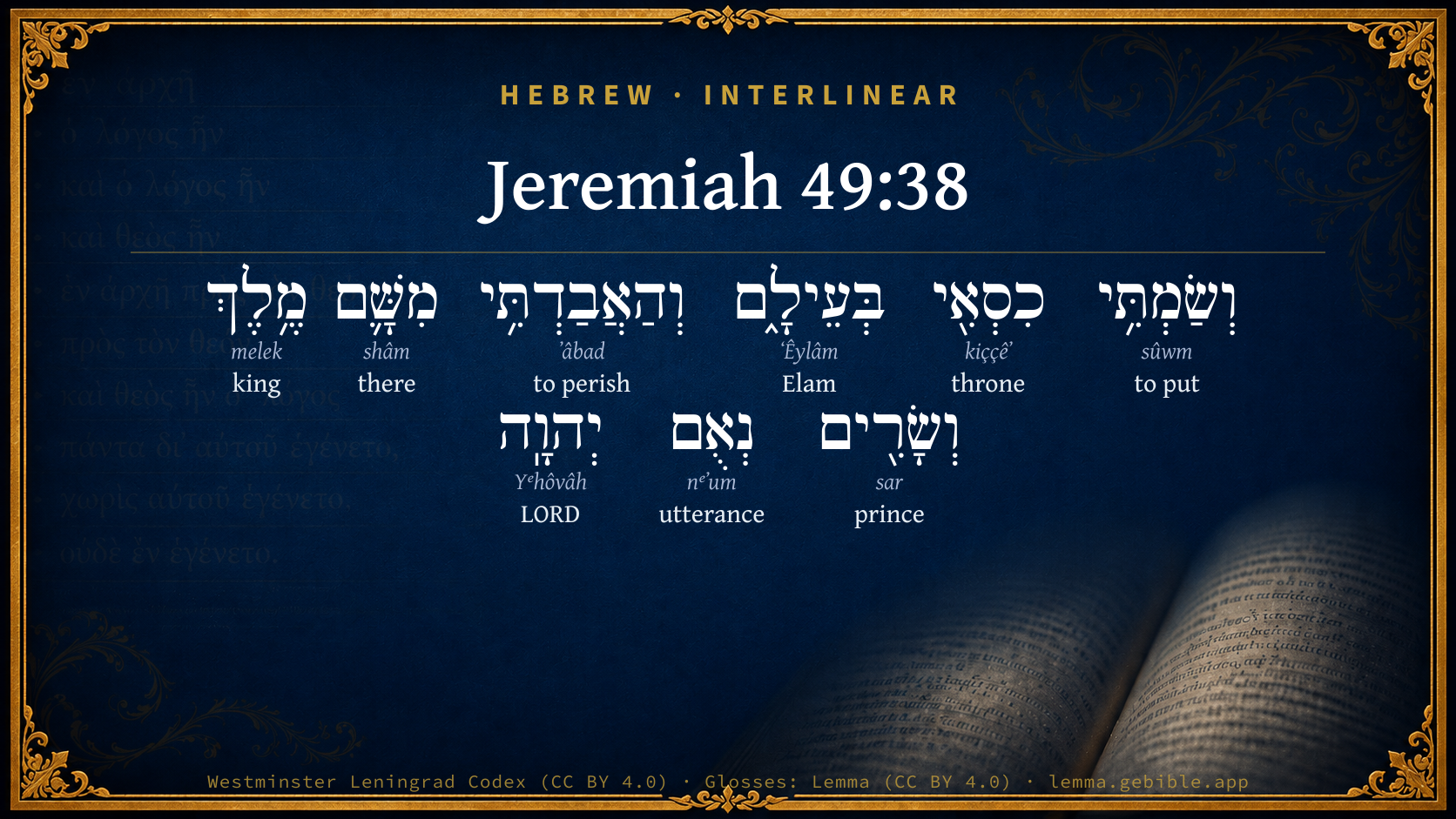
Hebrew (Westminster Leningrad Codex) Jeremiah 49:38 appears in the Hebrew Old Testament. The text above is from the Westminster Leningrad Codex. Each word links to its Strong’s number, a concise gloss, and parsing drawn from the Open Scriptures Hebrew Bible morphology. Click any word for its full Brown-Driver-Briggs (BDB) entry.
Download image
Cite this verse

Jeremiah 49:38 (World English Bible). Public Domain. Lemma interlinear Bible study tool, https://lemma.gebible.app/v/jeremiah/49/38.

Show BibTeX & RIS
BibTeX
RIS
English Translation
and I will set my throne in Elam, and will destroy from there king and princes, says Yahweh.
World English Bible · Public Domain
Download a study sheet

One document with this verse’s original text, its word-by-word gloss line, the meaning frame, cross-references with their text, attributed commentary, and full source and license credits — printable, and it pastes into notes with its structure intact.

This verse Autodidact and up

Study sheet (.html) Plain text (.txt)

A passage Seminary Student

Up to 50 verses in one chapter. A passage sheet keeps up to 6 commentary sources and 12 cross-references per verse, in the order this page ranks them, and says so on the sheet whenever that leaves anything out. Ask for a single verse and you get the Autodidact verse sheet above.

Everything on this page stays free to read, with no account — the sheet is a download of what is already on screen, not access to it.

Want to remove ads? Support Godless Engineer
Compare translations 3

The same verse in 3 English versions, stacked beneath the original-language interlinear above. Click any original word for its lexicon entry.

Each is an independent rendering of the whole verse — the interlinear is not word-aligned to these translations.

Highlighted words mark where these versions differ — a whole-verse word diff, not a word-by-word alignment.

  • World English Bible Public Domain
    and I will set my throne in Elam, and will destroy from there king and princes, says Yahweh.
  • King James Version Public Domain
    And I will set my throne in Elam, and will destroy from thence the king and the princes, saith the LORD.
  • unfoldingWord Literal Text CC BY-SA 4.0
    Then I will put my throne in Elam and will destroy its king and leaders from there—this is Yahweh’s declaration—

unfoldingWord Literal Text — © unfoldingWord, licensed CC BY-SA 4.0. Word-aligned USFM3 via Door43 (git.door43.org/unfoldingWord/en_ult).

Versions to compare (up to 4)

3 of 4 selected

Show all 18 translations

Every available English version of this verse, each an independent rendering of the whole verse.

  • World English Bible Public Domain
    and I will set my throne in Elam, and will destroy from there king and princes, says Yahweh.
  • Berean Standard Bible Public Domain
    I will set My throne in Elam, and destroy its king and officials,” declares the LORD.
  • Majority Standard Bible Public Domain
    I will set My throne in Elam, and destroy its king and officials,” declares the LORD.
  • King James Version Public Domain
    And I will set my throne in Elam, and will destroy from thence the king and the princes, saith the LORD.
  • American Standard Version (1901) Public Domain
    and I will set my throne in Elam, and will destroy from thence king and princes, saith Jehovah.
  • Revised Version (1885) Public Domain
    and I will set my throne in Elam, and will destroy from thence king and princes, saith the LORD.
  • Geneva Bible (1599) Public Domain
    And I wil set my throne in Elam, and I wil destroy both the King and the princes from thence, saith the Lord: but in the latter daies I wil bring againe the captiuitie of Elam, sayeth the Lord.
  • Douay-Rheims (1899) Public Domain
    And I will set my throne in Elam, and destroy kings and princes from thence, saith the Lord.
  • Young's Literal Translation Public Domain
    And I have set My throne in Elam, And I have destroyed thence King and princes -- an affirmation of Jehovah.
  • Literal Standard Version CC BY-SA 4.0
    And I have set My throne in Elam, || And I have destroyed king and princes from there, || A declaration of YHWH.
  • Unlocked Literal Bible CC BY-SA 4.0
    Then I will put my throne in Elam and will destroy its king and leaders from there—this is Yahweh's declaration—
  • unfoldingWord Literal Text CC BY-SA 4.0
    Then I will put my throne in Elam and will destroy its king and leaders from there—this is Yahweh’s declaration—
  • Darby Bible Public Domain
    And I will set my throne in Elam, and will destroy from thence king and princes, saith Jehovah.
  • World Messianic Bible Public Domain
    I will set my throne in Elam, and will destroy from there king and princes,’ says the LORD.
  • Webster's Bible Public Domain
    And I will set my throne in Elam, and will destroy from thence the king and the princes, saith the LORD.
  • Free Bible Version CC BY-SA 4.0
    I will set up my throne in Elam, and destroy its king and officials, declares the Lord.
  • Bible in Basic English Public Domain
    I will put the seat of my power in Elam, and in Elam I will put an end to kings and rulers, says the Lord.
  • JPS Tanakh (1917) Public Domain
    And I will set My throne in Elam, and will destroy from thence king and princes, saith the LORD.

Literal Standard Version (2020), Covenant Press — licensed CC BY-SA 4.0. Text via the HelloAO Bible API (eBible.org). Unlocked Literal Bible (unfoldingWord) — licensed CC BY-SA 4.0. Text via the HelloAO Bible API (eBible.org). unfoldingWord Literal Text — © unfoldingWord, licensed CC BY-SA 4.0. Word-aligned USFM3 via Door43 (git.door43.org/unfoldingWord/en_ult). Free Bible Version, Dr. Jonathan Gallagher — licensed CC BY-SA 4.0. Text via the HelloAO Bible API (eBible.org).

Word by word

More ways to search: Search by grammar → Find every occurrence → Compare this word →

Practice this passage: Drill this verse → Learn its vocabulary →

בְּעֵילָ֑ם
ʻÊylâm
H5867
“in/at · Elam”
Preposition + Noun, Proper
Part of Speech
Preposition + Noun
Type
Proper
Full BDB Definition

Origin: probably from H5956

TWOT: None

Elam = "eternity" - a Korhite Levite in the time of David (noun proper masculine) - a chief man of the tribe of Benjamin (noun proper masculine) - ancestor of a family of exiles who returned with Zerubbabel (noun proper masculine) - a chief of the people who signed the covenant with Nehemiah (noun proper masculine) - another ancestor of another family of exiles who returned with Zerubbabel (noun proper masculine) - a priest who assisted at the dedication of the wall of Jerusalem in the time of Nehemiah (noun proper masculine) - another head of a family of returning exiles (noun proper masculine) - a province east of Babylon and northeast of the lower Tigris (noun proper locative)
  1. וְשַׂמְתִּ֥י sûwm H7760 “and · to put” Conjunction + Verb, Qal, Sequential Perfect, 1st Person, Common, Singular
  2. כִסְאִ֖י kiççêʼ H3678 “throne · my” Noun, Common, Masculine, Singular, Construct + Suffix, Personal, 1st Person, Common, Singular
  3. וְהַאֲבַדְתִּ֥י ʼâbad H6 “and · to perish” Conjunction + Verb, Hiphil, Sequential Perfect, 1st Person, Common, Singular
  4. מִשָּׁ֛ם shâm H8033 “from · there” Preposition + Adverb
  5. מֶ֥לֶךְ melek H4428 “king” Noun, Common, Masculine, Singular, Absolute
  6. וְשָׂרִ֖ים sar H8269 “and · princes” Conjunction + Noun, Common, Masculine, Plural, Absolute
  7. נְאֻם nᵉʼum H5002 “utterance of” Noun, Common, Masculine, Singular, Construct
  8. יְהוָֽה Yᵉhôvâh H3068 “LORD” Noun, Proper

About this verse

These counts appear in no published source. They are computed here, from the morphology-tagged text and Lemma’s own curated glosses. What Lemma adds →

9
words
9
distinct lemmas
Prophets
section

Shared distinctive vocabulary

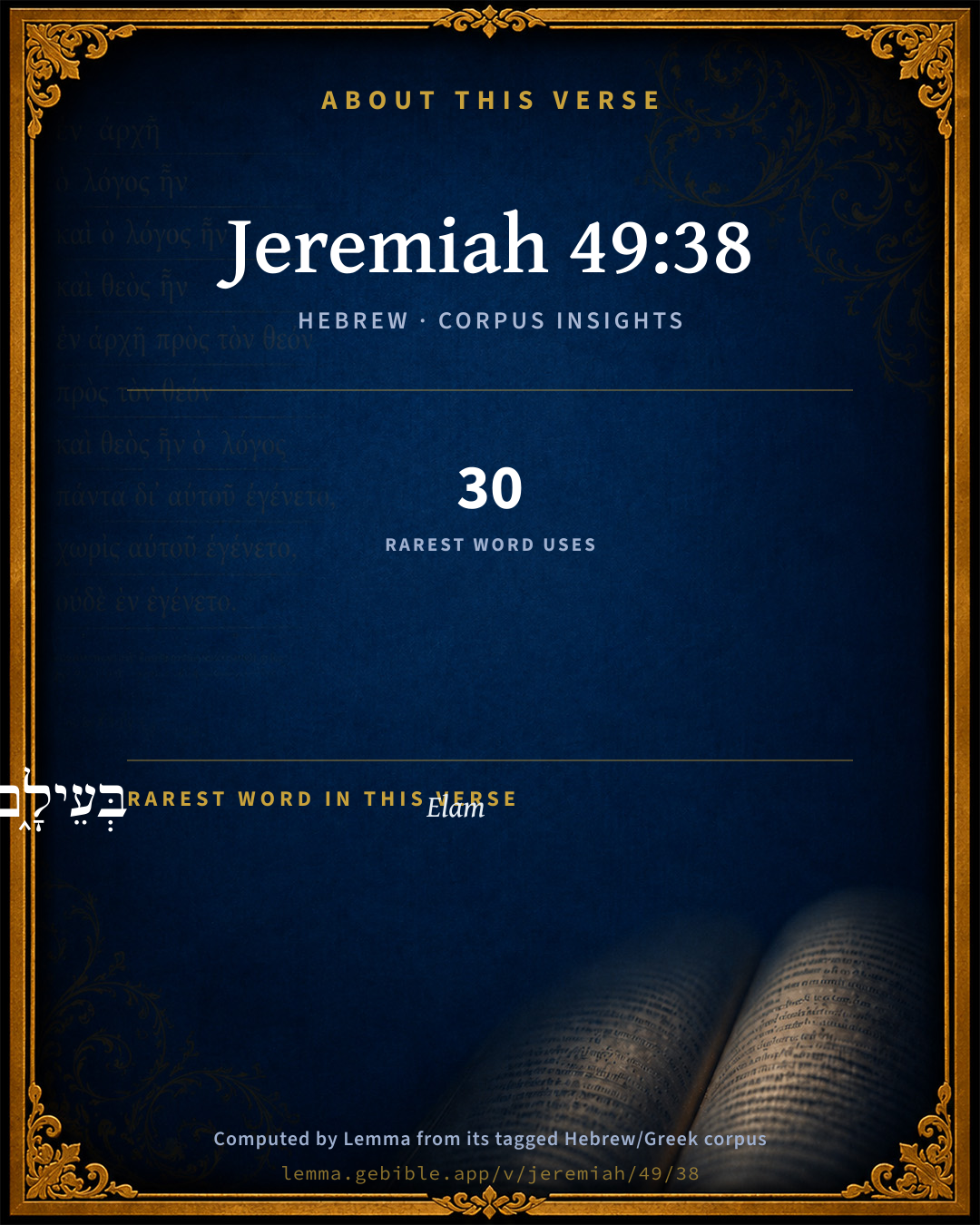
בְּעֵילָ֑ם Elam H5867 occurs in 27 verses of the Hebrew Bible. Also found in:

Grammatical profile

  • 2 verbs
  • 6 nouns
  • 1 adverb

Verb forms

  • וְשַׂמְתִּ֥י Qal · Sequential Perfect
  • וְהַאֲבַדְתִּ֥י Hiphil · Sequential Perfect

Cross-references

2

Topical passages linked to Jeremiah 49:38 in the Treasury of Scripture Knowledge — connected by theme and wording, ordered by reader-vote popularity; previews shown in the World English Bible.

  • Jeremiah 43:10 and tell them, Thus says Yahweh of Hosts, the God of Israel: Behold, I will send and take Nebuchadrezzar the king of Babylon, my servant, and will set his throne on these stones that I have hidden; and he shall spread his royal pavilion over them.
  • Daniel 7:9–14 I saw until thrones were placed, and one who was ancient of days sat: his clothing was white as snow, and the hair of his head like pure wool; his throne was fiery flames, [and] the wheels of it burning fire.

Cross-references courtesy of OpenBible.info (CC BY 4.0).

Hebrew and Greek witnesses Masoretic Hebrew ↔ Greek Septuagint

The same verse in the two great witnesses to the Old Testament, shown verse-for-verse.

These are two independent witnesses, not word-aligned to each other, and the Septuagint is shown in lemma (dictionary) form.

Hebrew Jeremiah 49:38 Masoretic · Westminster Leningrad Codex

וְשַׂמְתִּ֥י כִסְאִ֖י בְּעֵילָ֑ם וְהַאֲבַדְתִּ֥י מִשָּׁ֛ם מֶ֥לֶךְ וְשָׂרִ֖ים נְאֻם יְהוָֽה

and I will set my throne in Elam, and will destroy from there king and princes, says Yahweh.

World English Bible · Public Domain

Greek LXX Structure differs

In the Septuagint, Jeremiah is about an eighth shorter than the Hebrew and arranges its material differently — the Oracles Against the Nations (Hebrew chapters 46–51) appear in the middle of the Greek book, after 25:13. Because the chapter and verse boundaries do not line up, a verse-for-verse comparison with the Hebrew is not shown.

A verse-for-verse comparison isn’t shown here because the chapters and verses don’t line up. Switch to the LXX edition with the MT / LXX toggle above to read the Greek directly.

Hebrew: Westminster Leningrad Codex (CC BY 4.0). Greek: Septuagint (public domain); English from a public-domain English Septuagint. How the Septuagint differs from the Hebrew →

Targum (Aramaic paraphrase)

1

The Targum is the ancient Jewish Aramaic paraphrase of the Hebrew Scriptures — an interpretive translation, not the Hebrew text itself. Onkelos (literal) and Pseudo-Jonathan (expansive) render the Torah, and Jonathan the Prophets. Coverage is partial: where no permissively-licensed English translation exists for a verse, only the Aramaic is shown. This is verse-level text, not a word-by-word alignment to the Hebrew.

  1. Targum Jonathan Prophets (Joshua–Malachi)
    וַאֲשַׁוֵי כוּרְסֵי מַלְכוּתִי בְּעֵילָם וְאוֹבִיד מִתַּמָן מְלַךְ וְשִׁלְטוֹן אֲמַר יְיָ:

    (no public-domain English translation for this verse)

    Targum Jonathan — Aramaic: “Mikraot Gedolot” (public domain). English: “Sefaria Community Translation” (CC0 1.0 (public-domain dedication)); “London "Chaldee Paraphrase," 1871” (public domain). Text via Sefaria.

Commentary

Notes on Jeremiah 49:38 from classic Christian and Jewish commentators (each source and its license shown beneath its notes). The classic Christian expositions comment on the surrounding passage and are grouped to its opening verse, so a note may address several verses; the Jewish commentaries on the Tanakh (Rashi and others) are per-verse, so they appear only where the commentator wrote on this verse.

Lemma curates 59 commentaries, every one of them public domain or Creative Commons licensed, each selected and text-cleaned for this edition rather than reprinted as found. About our sources →

Trapp's Complete Commentary

John Trapp

Jer 49:38 And I will set my throne in Elam, and will destroy from thence the king and the princes, saith the LORD.

Ver. 38. And I will set my throne in Elam,] i.e., I will solemnly execute my judgments upon these people, as if I sat in my judgment seat in a public court in the midst of them. {a}

{a} Diod.

John Trapp, A Commentary or Exposition upon All the Books of the Old and New Testament (1647–1656) — public domain. Text from a community e-Sword module.

Tyndale Open Study Notes

Tyndale Open Resources

49:38 I will set my throne in Elam: The Lord would express his supreme authority by destroying Elam’s king and officials.

Tyndale Open Study Notes — © Tyndale Open Resources, licensed CC BY-SA 4.0. Text via the HelloAO Bible API.

Geneva Bible (1599)

Geneva Bible translators

I will place Nebuchadnezzar there, and in these prophecies Jeremiah speaketh of those countries, which should be subdued under the first of those four monarchies whereof Daniel maketh mention.

This may be referred to the Empire of Persians and Medes after the Chaldeans, or unto the time of Christ, as Jer. 48:47.

Geneva Bible (1599) marginal notes — public domain. Text via Bolls.life.

Jamieson, Fausset & Brown

Robert Jamieson, A. R. Fausset & David Brown

I will show Myself King by My judgments there, as though My tribunal were erected there. The throne of Cyrus, God's instrument, set up over Media, of which Elam was a part, may be meant [GROTIUS]; or rather, that of Nebuchadnezzar (Jer 43:10). Then the restoration of Elam (Jer 49:39) will refer partly to that which took place on the reduction of Babylon by Cyrus, prince of Persia and Media.

Jamieson, Fausset & Brown — Commentary Critical and Explanatory on the Whole Bible (1871) — public domain (CC PDM 1.0). Text via the HelloAO Bible API.

Adam Clarke's Commentary

Verse 38. I will set my throne in Elam] This is spoken either of Nebuchadnezzar or Cyrus. It is certain that Cyrus did render himself master of Elymais and Media, which are in the land of Elam.

Adam Clarke's Commentary on the Bible (1810–1826) — public domain. Text from a community e-Sword/MySword module.

John Calvin's Commentaries

He confirms what I have just referred to as to their consumption; but he at the same time adds, that God would be in such a way the avenger as though his tribunal was erected in that land. He threatens that he would destroy the king and the princes; and this, as I have explained, was the consumption; for though some individuals would remain alive, yet the name of the people would not survive, the whole race as such would become extinct.

But these words ought to be noticed — that God would erect his throne. God is said to erect his throne when he rules; but his kingdom is not to be taken always in a good sense. God is properly said to rule or reign among the faithful, whom he governs by his Spirit. So God’s kingdom begins and has its origin when regeneration takes place. But sometimes, as I have already said, God is said to reign in the midst of his enemies, as we have seen respecting the Egyptians. He then erected his throne when he executed his recorded judgment on the Elamites, for though the Elamites were blind, yet God’s power was made really evident, and by the effect he proved that he was the King of that people whose wickedness he punished with so much severity. In short, as God is said to be silent, to sleep, or to lie down, when he does not execute his vengeance; so in this place he is said to erect his throne when he discharges the office of a Judge. It follows —

John Calvin's Commentaries (1540-1563) — public domain. Text from the Calvin Translation Society English edition (1840s-50s) via the Christian Classics Ethereal Library (ccel.org). Calvin's coverage is partial (roughly two-thirds of the Bible); uncommented books and verses are honest gaps, never fabricated. The 19th-century editor's footnotes and remarks are omitted so the notes are faithfully Calvin's own voice.

Ellicott's Commentary for English Readers

(38) I will set my throne in Elam.—The throne of Jehovah is, it is clear, the throne of the king who is, for the time, His chosen instrument and servant, in this case therefore the throne of Nebuchadnezzar (Jer_43:10), against whom. Elam, like the other nations in Jer_25:13-25, and in Jeremiah 48, 49, had apparently risen in rebellion. Of this we have, perhaps, a trace in the statement of Jdt_1:1-13, that Nebuchadnezzar defeated Arphaxad, a king of Media, in the seventeenth year of his reign. The words find an historical fulfilment in the fact that Shushan, “in the province of Elam,” became one of the royal residences of the Chaldæan kings (Dan_8:2), and continued to be so under those of Persia, who, as regards the population of Elam proper, were as conquerors (Neh_1:1; Est_1:2). A like prediction of the fall of Elam, among other nations, before the attack of the King of Babylon is found in Eze_32:24.

A Bible Commentary for English Readers, edited by Charles John Ellicott (1878–1897) — public domain. Text from a community e-Sword module.

The Cambridge Bible for Schools and Colleges

gen. ed. J. J. S. Perowne

38. set my throne in] sit in judgement upon. Cp. Jer_1:15, Jer_43:10.

The Cambridge Bible for Schools and Colleges (gen. ed. J. J. S. Perowne; Cambridge University Press, 1878–1918) — public domain. Text from a community e-Sword module.

John Gill's Exposition

And I will set my throne in Elam,.... Either when Alexander subdued it, or Cyrus, or rather Nebuchadnezzar, whose palace probably was, as it is certain his successors was, in Shushan in Elam, as before observed from Dan 8:2. This is called the Lord's throne, because he gave it to him; his conquest of Elam, and his dominion over it, were from him:

and will destroy from thence the king and the princes, saith the Lord; so that there should be no more kings of Elam, and princes and nobles of their own, after this time; and because mention is made of the kings of Elam in the times of Nebuchadnezzar, Jer 25:25; though that is observed in the first year of his reign, some have thought that it is best to understand it or Cyrus, the Lord's servant and anointed; and whose throne might well be called the throne of God, which he gave him, and set him on in an eminent manner, not only there, but elsewhere; see Ezr 1:2; and when this country of Elam, or Elymais, became at part of the Persian empire, and never had any more kings to reign over it separately. Some of the Jewish Rabbins (b), as Kimchi observes, interpret the king and princes of Vashti of Haman and his sons; but very wrongly.

(b) In T. Bab. Megillah, fol. 10. 2.

John Gill's Exposition of the Whole Bible (1746–1763) — public domain (CC PDM 1.0). Text via the HelloAO Bible API.

Albert Barnes' Notes on the Bible

Literally, king and princes. Elam will lose its independence, and henceforward have no native ruler with his attendant officers.

Albert Barnes' Notes on the Bible (1834–1885) — public domain. Text from a community e-Sword/MySword module.

Haydock's Catholic Bible Commentary

Thence. Daniel (viii. 2.) governed at Susa, the capital of Elam, for Baltassar.

George Leo Haydock (1774–1849), Haydock's Catholic Family Bible and Commentary, 1859 edition — public domain. Excludes Psalms (Douay-Rheims chapter numbering differs from Protestant) and Deuterocanonical books (Catholic canon only).

Matthew Poole's English Annotations

God here calls the throne of Nebuchadnezzar, or Cyrus, or Alexander, (whoever he was that conquered the Persians,) his throne:

1. Because God gave it the conqueror.

2. Or because God showed himself the Lord of hosts, or the Lord of the whole earth, by disposing the kingdom of Persia at his pleasure. He doth not threaten the destruction of the whole nation, but the making of it all tributary, so as it should have no kings nor princes of its own.

Matthew Poole's English Annotations on the Holy Bible (1683–1685) — public domain. Text from a community e-Sword/MySword module.

Whedon's Commentary on the Bible

Daniel D. Whedon

38. I will set my throne — Of judgment, to punish king and princes, (not, as in the text, “the king and the princes.”)

Daniel D. Whedon (gen. ed.), Commentary on the Old and New Testaments (1874–1909) — public domain. Text from a community e-Sword module.

The Pulpit Commentary

I will set my throne; i.e. my tribunal. (as Jer_43:10) The king and the princes; rather, king and princes. The threat is not merely that the reigning king shall be dethroned, but that Elam shall lose its native rulers altogether.

The Pulpit Commentary (1880–1919), ed. H.D.M. Spence-Jones & Joseph S. Exell — public domain. Text from a community e-Sword module.

John Wesley's Explanatory Notes

My throne - God calls the throne of Cyrus or Alexander his throne; because he gave it the conqueror.

John Wesley, Explanatory Notes Upon the Whole Bible (1754–1765) — public domain. Text via the GEBible commentary corpus.

Rashi

Rabbi Shlomo Yitzchaki (Rashi)

And I will place My throne My siege (מָצוֹר).

Rashi on the Tanakh — English translations: “The Judaica Press complete Tanach with Rashi, translated by A. J. Rosenberg” (CC BY 4.0); “Pentateuch with Rashi's commentary by M. Rosenbaum and A.M. Silbermann, 1929-1934” (public domain); “The Metsudah Tanach series, Lakewood, N.J” (CC BY 4.0); and “The Book of Joshua, Metsudah Publications, 1997” (CC BY 4.0). Text via Sefaria.

Lesson kit

Teaching starters — assembled from the data on this page, not authored interpretation. Every prompt links to the verse data it draws on. Edit before teaching.

Jeremiah, in the Prophets, opens this verse with 9 words (9 distinct Hebrew lemmas). Its most distinctive word is ʻÊylâm (“Elam”). A historical commentator’s framing appears above. Read the whole chapter for the surrounding context.

Discussion questions

  1. What does “Elam” (ʻÊylâm) contribute to the verse as a whole?
  2. How does Genesis 10:22, which shares the word «Elam», read alongside this verse?
  3. The translations on this page render this verse differently — a whole-verse word diff, not a word-by-word alignment. What might account for the different wordings?
  4. «וְשַׂמְתִּ֥י» is a Qal Sequential Perfect verb. How does that grammatical form shape the action described?
  5. Compare how Trapp's Complete Commentary and Tyndale Open Study Notes read this verse. Where do they agree or differ?

Things to notice

Reading settings

Reading text

Shown beneath each verse's original-language words.

Old Testament
Old Testament edition

Read the OT as the Masoretic Hebrew (MT) or the Greek Septuagint (LXX).

English shown for the Greek Septuagint (in the Hebrew ↔ Greek comparison).

Comparing translations? Open the Compare panel on any verse page to stack up to four side by side.