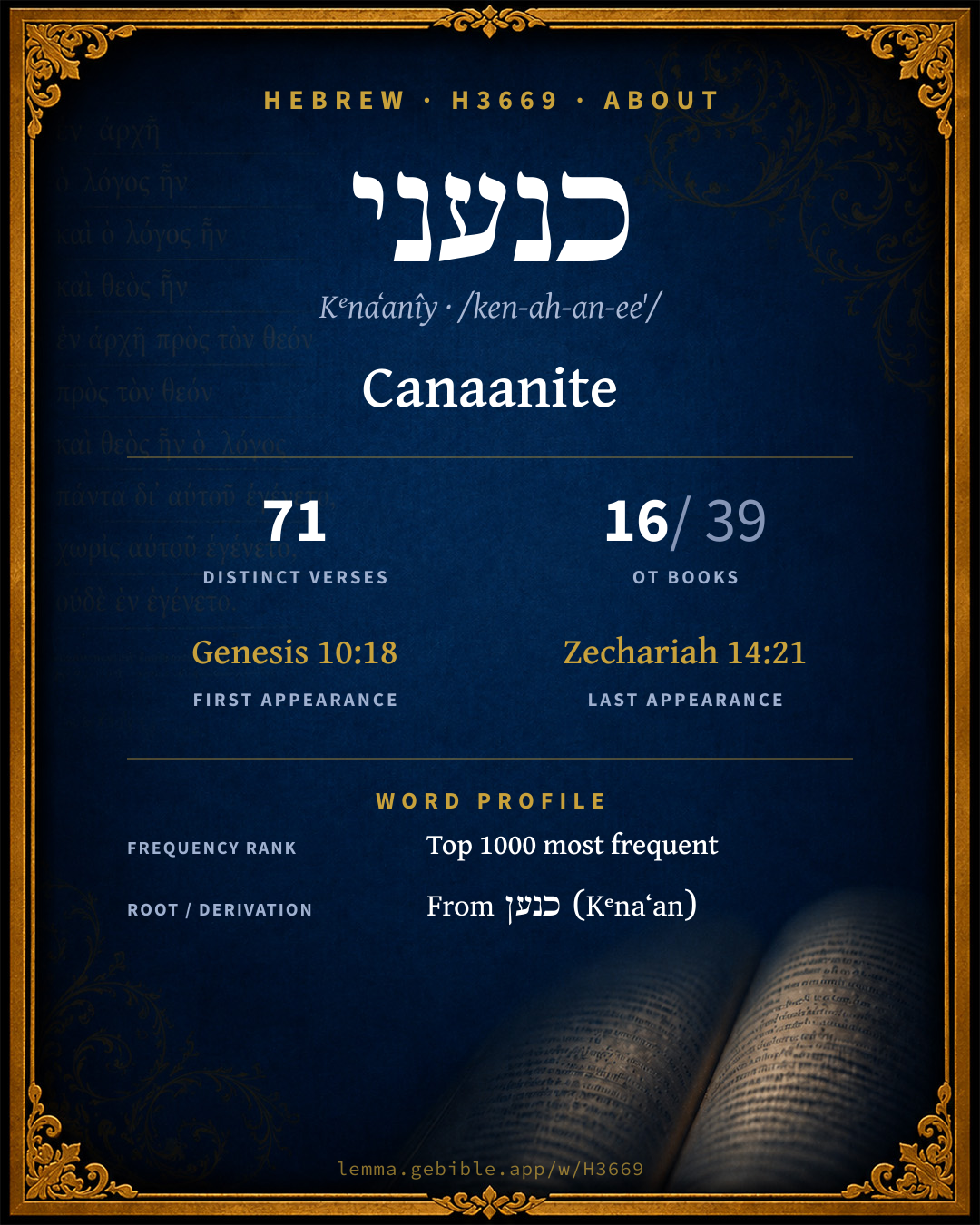
כְּנַעֲנִי
Canaanite
BDB lists 4 entries for ‘Canaanite’ fuller range ↓
Full lexicon entry — Brown-Driver-Briggs (BDB)
From Brown-Driver-Briggs (BDB)
Where this word appears
Grammar key — what these labels mean
Part of speech
- Noun
- A naming word — a person, place, thing, or idea.
Noun type
- Gentilic
- A noun naming a member of a people, tribe, or region of origin (e.g. an Israelite, a Moabite).
State
- Absolute
- The independent form of a noun, not bound to a following word.
Gender
- Masculine
- Grammatically masculine.
- Feminine
- Grammatically feminine.
Number
- Singular
- One.
- Plural
- More than one (in Hebrew, generally three or more).
Grammatical forms
- Noun, Gentilic, Masculine, Singular, Absolute 67 times (92%)
- Noun, Gentilic, Feminine, Singular, Absolute 3 times (4%)
- Noun, Gentilic, Masculine, Plural, Absolute 3 times (4%)
Parsed forms decoded from the imported morphology (morphhb / Westminster Leningrad Codex — WLC text public domain, morphhb tagging CC BY 4.0), counted across 73 parsed occurrences — not distinct verses.
Every verse where H3669 appears — 71 distinct verses across 16 books. Click any verse to open its interlinear word-by-word view. Verse text shown in the World English Bible for context — . Each verse’s Hebrew form is shown with its reference; the English is not keyword-highlighted, since the data carries no word-level English alignment. Use “Compare translations” on any verse to read it across multiple English versions. This concordance covers the Hebrew Bible; Septuagint (Greek Old Testament) occurrences are not indexed here.
Genesis 11 verses
- Genesis 10:18 הַֽ/כְּנַעֲנִֽי ptcl def.art + n Gentilic ms the Arvadite, the Zemarite, and the Hamathite. Afterward the families of the Canaanites were spread abroad.
- Genesis 10:19 הַֽ/כְּנַעֲנִי֙ ptcl def.art + n Gentilic ms The border of the Canaanites was from Sidon, as you go toward Gerar, to Gaza; as you go toward Sodom, Gomorrah, Admah, and Zeboiim, to Lasha.
- Genesis 12:6 וְ/הַֽ/כְּנַעֲנִ֖י conj + ptcl def.art + n Gentilic ms Abram passed through the land to the place of Shechem, to the oak of Moreh. The Canaanite was then in the land.
- Genesis 13:7 וְ/הַֽ/כְּנַעֲנִי֙ conj + ptcl def.art + n Gentilic ms There was a strife between the herdsmen of Abram's cattle and the herdsmen of Lot's cattle: and the Canaanite and the Perizzite lived then in the land.
- Genesis 15:21 הַֽ/כְּנַעֲנִ֔י ptcl def.art + n Gentilic ms the Amorites, the Canaanites, the Girgashites, and the Jebusites."
- Genesis 24:3 הַֽ/כְּנַעֲנִ֔י ptcl def.art + n Gentilic ms I will make you swear by Yahweh, the God of heaven and the God of the earth, that you shall not take a wife for my son of the daughters of the Canaanites, among whom I live.
- Genesis 24:37 הַֽ/כְּנַעֲנִ֔י ptcl def.art + n Gentilic ms My master made me swear, saying, 'You shall not take a wife for my son of the daughters of the Canaanites, in whose land I live,
- Genesis 34:30 בַּֽ/כְּנַעֲנִ֖י prep det + n Gentilic ms Jacob said to Simeon and Levi, "You have troubled me, to make me odious to the inhabitants of the land, among the Canaanites and the Perizzites. I am few in number. They will gather themselves together against me and strike me, and I will be destroyed, I and my house."
- Genesis 38:2 כְּנַעֲנִ֖י n Gentilic ms Judah saw there a daughter of a certain Canaanite whose name was Shua. He took her, and went in to her.
- Genesis 46:10 הַֽ/כְּנַעֲנִֽית ptcl def.art + n Gentilic fs The sons of Simeon: Jemuel, Jamin, Ohad, Jachin, Zohar, and Shaul the son of a Canaanite woman.
- Genesis 50:11 הַֽ/כְּנַעֲנִ֜י ptcl def.art + n Gentilic ms When the inhabitants of the land, the Canaanites, saw the mourning in the floor of Atad, they said, "This is a grievous mourning by the Egyptians." Therefore, the name of it was called Abel Mizraim, which is beyond the Jordan.
Exodus 9 verses
- Exodus 3:8 הַֽ/כְּנַעֲנִי֙ ptcl def.art + n Gentilic ms I have come down to deliver them out of the hand of the Egyptians, and to bring them up out of that land to a good and large land, to a land flowing with milk and honey; to the place of the Canaanite, the Hittite, the Amorite, the Perizzite, the Hivite, and the Jebusite.
- Exodus 3:17 הַֽ/כְּנַעֲנִי֙ ptcl def.art + n Gentilic ms and I have said, I will bring you up out of the affliction of Egypt to the land of the Canaanite, the Hittite, the Amorite, the Perizzite, the Hivite, and the Jebusite, to a land flowing with milk and honey."'
- Exodus 6:15 הַֽ/כְּנַעֲנִ֑ית ptcl def.art + n Gentilic fs The sons of Simeon: Jemuel, and Jamin, and Ohad, and Jachin, and Zohar, and Shaul the son of a Canaanite woman; these are the families of Simeon.
- Exodus 13:5 הַֽ֠/כְּנַעֲנִי ptcl def.art + n Gentilic ms It shall be, when Yahweh shall bring you into the land of the Canaanite, and the Hittite, and the Amorite, and the Hivite, and the Jebusite, which he swore to your fathers to give you, a land flowing with milk and honey, that you shall keep this service in this month.
- Exodus 13:11 הַֽ/כְּנַעֲנִ֔י ptcl def.art + n Gentilic ms "It shall be, when Yahweh shall bring you into the land of the Canaanite, as he swore to you and to your fathers, and shall give it you,
- Exodus 23:23 וְ/הַֽ/כְּנַעֲנִ֔י conj + ptcl def.art + n Gentilic ms For my angel shall go before you, and bring you in to the Amorite, the Hittite, the Perizzite, the Canaanite, the Hivite, and the Jebusite; and I will cut them off.
- Exodus 23:28 הַֽ/כְּנַעֲנִ֛י ptcl def.art + n Gentilic ms I will send the hornet before you, which will drive out the Hivite, the Canaanite, and the Hittite, from before you.
- Exodus 33:2 הַֽ/כְּנַעֲנִי֙ ptcl def.art + n Gentilic ms I will send an angel before you; and I will drive out the Canaanite, the Amorite, and the Hittite, and the Perizzite, the Hivite, and the Jebusite:
- Exodus 34:11 וְ/הַֽ/כְּנַעֲנִ֔י conj + ptcl def.art + n Gentilic ms Observe that which I command you this day. Behold, I drive out before you the Amorite, the Canaanite, the Hittite, the Perizzite, the Hivite, and the Jebusite.
Numbers 7 verses
- Numbers 13:29 וְ/הַֽ/כְּנַעֲנִי֙ conj + ptcl def.art + n Gentilic ms Amalek dwells in the land of the South: and the Hittite, and the Jebusite, and the Amorite, dwell in the hill-country; and the Canaanite dwells by the sea, and along by the side of the Jordan.
- Numbers 14:25 וְ/הַֽ/כְּנַעֲנִ֖י conj + ptcl def.art + n Gentilic ms Now the Amalekite and the Canaanite dwell in the valley: tomorrow turn you, and get you into the wilderness by the way to the Red Sea.
- Numbers 14:43 וְ/הַ/כְּנַעֲנִ֥י conj + ptcl def.art + n Gentilic ms For there the Amalekite and the Canaanite are before you, and you shall fall by the sword: because you are turned back from following Yahweh, therefore Yahweh will not be with you.
- Numbers 14:45 וְ/הַֽ/כְּנַעֲנִ֔י conj + ptcl def.art + n Gentilic ms Then the Amalekite came down, and the Canaanite who lived in that mountain, and struck them and beat them down, even to Hormah.
- Numbers 21:1 הַ/כְּנַעֲנִ֤י ptcl def.art + n Gentilic ms The Canaanite, the king of Arad, who lived in the South, heard tell that Israel came by the way of Atharim; and he fought against Israel, and took some of them captive.
- Numbers 21:3 הַֽ/כְּנַעֲנִ֔י ptcl def.art + n Gentilic ms Yahweh listened to the voice of Israel, and delivered up the Canaanites; and they utterly destroyed them and their cities: and the name of the place was called Hormah.
- Numbers 33:40 הַֽ/כְּנַעֲנִי֙ ptcl def.art + n Gentilic ms The Canaanite, the king of Arad, who lived in the South in the land of Canaan, heard of the coming of the children of Israel.
Deuteronomy 4 verses
- Deuteronomy 1:7 הַֽ/כְּנַעֲנִי֙ ptcl def.art + n Gentilic ms turn you, and take your journey, and go to the hill-country of the Amorites, and to all [the places] near thereunto, in the Arabah, in the hill-country, and in the lowland, and in the South, and by the sea-shore, the land of the Canaanites, and Lebanon, as far as the great river, the river Euphrates.
- Deuteronomy 7:1 וְ/הַ/כְּנַעֲנִ֣י conj + ptcl def.art + n Gentilic ms When Yahweh your God shall bring you into the land where you go to possess it, and shall cast out many nations before you, the Hittite, and the Girgashite, and the Amorite, and the Canaanite, and the Perizzite, and the Hivite, and the Jebusite, seven nations greater and mightier than you;
- Deuteronomy 11:30 הַֽ/כְּנַעֲנִ֔י ptcl def.art + n Gentilic ms Aren't they beyond the Jordan, behind the way of the going down of the sun, in the land of the Canaanites who dwell in the Arabah, over against Gilgal, beside the oaks of Moreh?
- Deuteronomy 20:17 הַ/כְּנַעֲנִ֣י ptcl def.art + n Gentilic ms but you shall utterly destroy them: the Hittite, and the Amorite, the Canaanite, and the Perizzite, the Hivite, and the Jebusite; as Yahweh your God has commanded you;
Joshua 14 verses
- Joshua 3:10 הַ/כְּנַעֲנִ֨י ptcl def.art + n Gentilic ms Joshua said, Hereby you shall know that the living God is among you, and that he will without fail drive out from before you the Canaanite, and the Hittite, and the Hivite, and the Perizzite, and the Girgashite, and the Amorite, and the Jebusite.
- Joshua 5:1 הַֽ/כְּנַעֲנִי֙ ptcl def.art + n Gentilic ms It happened, when all the kings of the Amorites, who were beyond the Jordan westward, and all the kings of the Canaanites, who were by the sea, heard how that Yahweh had dried up the waters of the Jordan from before the children of Israel, until we were passed over, that their heart melted, neither was there spirit in them any more, because of the children of Israel.
- Joshua 7:9 הַֽ/כְּנַעֲנִ֗י ptcl def.art + n Gentilic ms For the Canaanites and all the inhabitants of the land will hear of it, and will compass us round, and cut off our name from the earth: and what will you do for your great name?
- Joshua 9:1 הַֽ/כְּנַעֲנִי֙ ptcl def.art + n Gentilic ms It happened, when all the kings who were beyond the Jordan, in the hill-country, and in the lowland, and on all the shore of the great sea in front of Lebanon, the Hittite, and the Amorite, the Canaanite, the Perizzite, the Hivite, and the Jebusite, heard of it;
- Joshua 11:3 הַֽ/כְּנַעֲנִי֙ ptcl def.art + n Gentilic ms to the Canaanite on the east and on the west, and the Amorite, and the Hittite, and the Perizzite, and the Jebusite in the hill-country, and the Hivite under Hermon in the land of Mizpah.
- Joshua 12:8 וְ/הַֽ/כְּנַעֲנִי֙ conj + ptcl def.art + n Gentilic ms in the hill-country, and in the lowland, and in the Arabah, and in the slopes, and in the wilderness, and in the South; the Hittite, the Amorite, and the Canaanite, the Perizzite, the Hivite, and the Jebusite:
- Joshua 13:3 לַֽ/כְּנַעֲנִ֖י prep det + n Gentilic ms from the Shihor, which is before Egypt, even to the border of Ekron northward, [which] is reckoned to the Canaanites; the five lords of the Philistines; the Gazites, and the Ashdodites, the Ashkelonites, the Gittites, and the Ekronites; also the Avvim,
- Joshua 13:4 הַֽ/כְּנַעֲנִ֗י ptcl def.art + n Gentilic ms on the south; all the land of the Canaanites, and Mearah that belongs to the Sidonians, to Aphek, to the border of the Amorites;
- Joshua 16:10 הַֽ/כְּנַעֲנִ֖י הַֽ/כְּנַעֲנִ֜י ptcl def.art + n Gentilic ms ptcl def.art + n Gentilic ms They didn't drive out the Canaanites who lived in Gezer: but the Canaanites dwell in the midst of Ephraim to this day, and are become servants to do forced labor.
- Joshua 17:12 הַֽ/כְּנַעֲנִ֔י ptcl def.art + n Gentilic ms Yet the children of Manasseh couldn't drive out [the inhabitants of] those cities; but the Canaanites would dwell in that land.
- Joshua 17:13 הַֽ/כְּנַעֲנִ֖י ptcl def.art + n Gentilic ms It happened, when the children of Israel had grown strong, that they put the Canaanites to forced labor, and didn't utterly drive them out.
- Joshua 17:16 הַֽ/כְּנַעֲנִי֙ ptcl def.art + n Gentilic ms The children of Joseph said, The hill-country is not enough for us: and all the Canaanites who dwell in the land of the valley have chariots of iron, both they who are in Beth-shean and its towns, and they who are in the valley of Jezreel.
- Joshua 17:18 הַֽ/כְּנַעֲנִ֗י ptcl def.art + n Gentilic ms but the hill-country shall be yours; for though it is a forest, you shall cut it down, and the goings out of it shall be yours; for you shall drive out the Canaanites, though they have chariots of iron, and though they are strong.
- Joshua 24:11 וְ/הַֽ/כְּנַעֲנִ֗י conj + ptcl def.art + n Gentilic ms You went over the Jordan, and came to Jericho: and the men of Jericho fought against you, the Amorite, and the Perizzite, and the Canaanite, and the Hittite, and the Girgashite, the Hivite, and the Jebusite; and I delivered them into your hand.
Judges 15 verses
- Judges 1:1 הַֽ/כְּנַעֲנִ֛י ptcl def.art + n Gentilic ms It happened after the death of Joshua, the children of Israel asked of Yahweh, saying, Who shall go up for us first against the Canaanites, to fight against them?
- Judges 1:3 בַּֽ/כְּנַעֲנִ֔י prep det + n Gentilic ms Judah said to Simeon his brother, Come up with me into my lot, that we may fight against the Canaanites; and I likewise will go with you into your lot. So Simeon went with him.
- Judges 1:4 הַ/כְּנַעֲנִ֥י ptcl def.art + n Gentilic ms Judah went up; and Yahweh delivered the Canaanites and the Perizzites into their hand: and they struck of them in Bezek ten thousand men.
- Judges 1:5 הַֽ/כְּנַעֲנִ֖י ptcl def.art + n Gentilic ms They found Adoni-bezek in Bezek; and they fought against him, and they struck the Canaanites and the Perizzites.
- Judges 1:9 בַּֽ/כְּנַעֲנִ֑י prep det + n Gentilic ms Afterward the children of Judah went down to fight against the Canaanites who lived in the hill-country, and in the South, and in the lowland.
- Judges 1:10 הַֽ/כְּנַעֲנִי֙ ptcl def.art + n Gentilic ms Judah went against the Canaanites who lived in Hebron (now the name of Hebron before was Kiriath Arba); and they struck Sheshai, and Ahiman, and Talmai.
- Judges 1:17 הַֽ/כְּנַעֲנִ֖י ptcl def.art + n Gentilic ms Judah went with Simeon his brother, and they struck the Canaanites who inhabited Zephath, and utterly destroyed it. The name of the city was called Hormah.
- Judges 1:27 הַֽ/כְּנַעֲנִ֔י ptcl def.art + n Gentilic ms Manasseh did not drive out [the inhabitants of] Beth-shean and its towns, nor [of] Taanach and its towns, nor the inhabitants of Dor and its towns, nor the inhabitants of Ibleam and its towns, nor the inhabitants of Megiddo and its towns; but the Canaanites would dwell in that land.
- Judges 1:28 הַֽ/כְּנַעֲנִ֖י ptcl def.art + n Gentilic ms It happened, when Israel had grown strong, that they put the Canaanites to forced labor, and did not utterly drive them out.
- Judges 1:29 הַֽ/כְּנַעֲנִ֖י הַֽ/כְּנַעֲנִ֛י ptcl def.art + n Gentilic ms ptcl def.art + n Gentilic ms Ephraim didn't drive out the Canaanites who lived in Gezer; but the Canaanites lived in Gezer among them.
- Judges 1:30 הַֽ/כְּנַעֲנִי֙ ptcl def.art + n Gentilic ms Zebulun didn't drive out the inhabitants of Kitron, nor the inhabitants of Nahalol; but the Canaanites lived among them, and became subject to forced labor.
- Judges 1:32 הַֽ/כְּנַעֲנִ֖י ptcl def.art + n Gentilic ms but the Asherites lived among the Canaanites, the inhabitants of the land; for they did not drive them out.
- Judges 1:33 הַֽ/כְּנַעֲנִ֖י ptcl def.art + n Gentilic ms Naphtali didn't drive out the inhabitants of Beth-shemesh, nor the inhabitants of Beth Anath; but he lived among the Canaanites, the inhabitants of the land: nevertheless the inhabitants of Beth-shemesh and of Beth Anath became subject to forced labor.
- Judges 3:3 הַֽ/כְּנַעֲנִי֙ ptcl def.art + n Gentilic ms [namely], the five lords of the Philistines, and all the Canaanites, and the Sidonians, and the Hivites who lived on Mount Lebanon, from Mount Baal Hermon to the entrance of Hamath.
- Judges 3:5 הַֽ/כְּנַעֲנִ֑י ptcl def.art + n Gentilic ms The children of Israel lived among the Canaanites, the Hittites, and the Amorites, and the Perizzites, and the Hivites, and the Jebusites:
2 Samuel 1 verse
1 Kings 1 verse
1 Chronicles 1 verse
Ezra 1 verse
Nehemiah 2 verses
- Nehemiah 9:8 הַ/כְּנַעֲנִ֨י ptcl def.art + n Gentilic ms and found his heart faithful before you, and made a covenant with him to give the land of the Canaanite, the Hittite, the Amorite, and the Perizzite, and the Jebusite, and the Girgashite, to give it to his seed, and have performed your words; for you are righteous.
- Nehemiah 9:24 הַ/כְּנַ֣עֲנִ֔ים ptcl def.art + n Gentilic mp So the children went in and possessed the land, and you subdued before them the inhabitants of the land, the Canaanites, and gave them into their hands, with their kings, and the peoples of the land, that they might do with them as they would.
Job 1 verse
Proverbs 1 verse
Ezekiel 1 verse
Obadiah 1 verse
Zechariah 1 verse
About this entry
At a glance — auto-summarized from this page’s data, not written by a person. Every figure links to its source below. This summary describes the numbers; it doesn’t interpret them.
כנעני — transliterated Kᵉnaʻanîy — is a Hebrew name carrying the sense “Canaanite.” Debuting at Genesis 10:18, it then recurs through the corpus. Spanning 71 verses in 16 books, it ranks among the moderately common words of the Hebrew Bible. The sections below give every occurrence and version rendering.
Gloss history
Strong's 1890 vs modern scholarship
About this word
Strong's H3669 catalogs a Hebrew word from the Hebrew Old Testament.
These counts are not copied from any lexicon or concordance. They are computed here, from the morphology-tagged Hebrew Old Testament. What Lemma adds →
- 71
- distinct verses
- The word appears in 71 distinct verses.
- 16 / 39
- OT books
- The word appears in 16 of 39 Old Testament books.
- #542
- by frequency
- Top 1000 most frequent Hebrew words (rank 542 of 8,640 Hebrew words by occurrence).
View all 71 occurrences in the concordance →
By section of the Old Testament
By traditional corpus
Conventional, traditional groupings — biblical authorship is debated, so this is a traditional corpus grouping, not an authorship claim. Each share is this word’s portion of its verses in that division of the Hebrew canon. Each figure is a share of the word’s 71 distinct verses.
- Prophets (Nevi'im) 34 verses · 48%
- Torah (Pentateuch) 31 verses · 44%
- Writings (Ketuvim) 6 verses · 8%
How translations render this word
Counts come from each version’s own published word-to-Strong’s tagging or interlinear alignment — an approximate guide to how each version renders this word, not a word-level alignment the data otherwise carries. Because each total is that version’s own tagged count, the per-version totals vary from one another and need not match the appearance or distinct-verse counts above. These counts may also differ from a printed concordance because Lemma counts each distinctly tagged rendering and does not collapse phrase taggings into a single head-word total. This is a fixed set of word-tagged versions (KJV, ASV, BSB, ULT) and does not change with the reading translation you choose elsewhere. Each version’s license is shown beside its name below (and on Sources).
BDB lists this Strong’s number as 2 distinct words (homographs). Each count above pools all of them and is not split by sense — see the Senses section below. A low-frequency rendering may belong to a different one of those words, not the primary meaning.
- King James Version†: Canaanites 46×, Canaanite 11×, Against the canaanites 4×
- American Standard Version†: Canaanites 28×, Canaanite 27×, Against the canaanites 4×
- Berean Standard Bible†: Canaanites 54×, Canaanite 8×, Against the canaanites 2×
- unfoldingWord Literal Text†: Canaanite 43×, Canaanites 21×, Canaanite woman 2×
King James Version Public Domain
Renders H3669 across 73† tagged occurrences — most commonly:
Plus 10 renderings that appear only once — usually multi-word phrases or single function words the recovered tagging swept in, not distinct renderings.
American Standard Version Public Domain
Renders H3669 across 73† tagged occurrences — most commonly:
Plus 12 renderings that appear only once — usually multi-word phrases or single function words the recovered tagging swept in, not distinct renderings.
Berean Standard Bible Public Domain
Renders H3669 across 72† tagged occurrences — most commonly:
Plus 4 renderings that appear only once — usually multi-word phrases or single function words the recovered tagging swept in, not distinct renderings. Not rendered by a distinct English word in 1 further occurrence.
unfoldingWord Literal Text CC BY-SA 4.0
Renders H3669 across 74† tagged occurrences — most commonly:
Plus 8 renderings that appear only once — usually multi-word phrases or single function words the recovered tagging swept in, not distinct renderings.
Senses in the full BDB
What do BDB’s symbols mean?
BDB uses these scholarly abbreviations:
| Symbol | Meaning |
|---|---|
| 𝔊 | the Septuagint (the ancient Greek translation, LXX) |
| 𝔙 | the Vulgate (the Latin translation) |
| 𝔖 | the Syriac version (the Peshitta) |
| 𝔗 | the Targum (the Aramaic translation) |
| ψ | the Psalms |
| √ | root (the underlying root or stem) |
| ‖ | parallel passage (a synonymous or contrasted parallel) |
| † | the dagger: every passage where the word occurs is cited |
The 4 senses and sub-senses the full Brown-Driver-Briggs lexicon distinguishes for this word, in lexicon order (not ranked by frequency), with BDB’s own verbatim wording and sub-sense lettering. Shown in Hebrew script with BDB’s own scholarly abbreviations. The condensed entry is in the Lexicon Entry tab. See also the Forms in the corpus table below.
כנעני I om. gent. of 1. כְּנַעַן
- 1. adj. אִישׁ כ׳ Gn 38:2 (J). e.g. Genesis 38:2
- 2. c. art. as subst.,
- a. of individual, הַכּ׳ מֶלֶךְ־עֲרָד Nu 21:1 (J) and hence 33:40 (P or R); f. הַכְּנַעֲנִית Gn 46:10 = Ex 6:15 (P) בַּת־שׁוּעַ הַכְּנַעֲנִית 1 Ch 2:3. e.g. Numbers 21:1
- b. usually coll. (c. art.) of pre-Isr. inhabitants of כְּנַעַן (q.v.) Gn 12:6; 24:3, 37; 50:11 (all J), Nu 21:3 (J), Jos 13:3 (D), Ju 1:1, 3, 9, 10, 17, many of whom continued to live in the midst of Isr., v 27, 28, 29(×2), 30, 32, 33 Jos 16:10(×2), 17:12, 13, 16, 18 (all JE), 1 K 9:16; pl. only Ob 20, and יֹשְׁבֵי הָאָרֶץ הַכְּנַעֲנִים Ne 9:24; מִשְׁפְּחוֹת הַכּ׳ Gn 10:18, גְּבוּל הַכּ׳ v 19 (both J), אֶרֶץ הַכּ׳ Ex 13:11 (JE), Ez 16:3; often of part of the inhabit., הַכּ׳ וְכָל יֹשְׁבֵי הָאָרֶץ Jos 7:9 (JE), Dt 11:30; with other n.pr.gent., + הַפְּרִזִּי Gn 13:7; 34:30 (both J), Ju 1:4, 5, + הָאֱמֹרִי Dt 1:7 Jos 5:1; 13:4 (all D); + הַחִוִּי 2 S 24:7; + עֲמָלֵקִ(י) Nu 14:25, 43, 45; especially in the list of peoples dispossessed by Isr., Gn 15:21 Ex 3:8, 17; 13:5; 23:23, 28; 33:2; 34:11 Nu 13:29 (הַכּ׳ dwelling by the sea and along Jordan [cf. Dt 1:7; 11:30 Jos 5:1; 11:3; 13:4]; all these JE), Dt 7:1; 20:17 Jos 3:10; 9:1; 11:3; 12:8; 24:11 (all JED), Ju 3:3, 5; hence Ezr 9:1 Ne 9:8. Cf. Dr Dt. p. 11, 13 f., 97, 133. e.g. Genesis 12:6
כנעני II trader, merchant (cf. ii. כְּנַעַו)
Senses from the full Brown-Driver-Briggs lexicon (Brown, Driver, Briggs; Oxford 1906 — public domain), digitized via Sefaria, supplemented by the OpenScriptures HebrewLexicon (CC BY 4.0). Full attribution on Sources.
Word origin
I. adj. et nom. gent. of 1. כְּנַעַן;—usually ms. (הַ)כְּנַעֲנִי Gn 38:2 Nu 21:1 +; fs. הַכְּנַעֲנִית Gn 46:10 = Ex 6:15 1 Ch 2:3; mpl.; (הַ)כְּנַעֲנִים Ob 20 Ne 9:24;—
II. n.m. trader, merchant (cf. ii. כְּנַעַו); only sg. (but v. infr. pl. כְּנַעֲנִים Jb 40:30; pl. sf. כִּנְעָנֶיהָ (si vera l.) Is 23:8 (‖ סֹחֲרֶיהָ).):—וְלֹא יִהְיֶה כ׳ עוֹד בְּבֵית י׳ Zc 14:21 (Aq.); וַחֲגוֹר נָֽתְנָה לַכּ׳ Pr 31:24 (‖ סָדִין עָֽשְׂתָה וַתִּמְכֹּר). In Zc 11:7, 11 read perhaps (לִ)כְנַעֲנִיֵּי for (לָ)כֵן עֲנִיֵּי, 𝔊 Χαναναῖοι, Χαναανῖτιν, StaZAW, 1881, 26 (who comp. as to sense Ho 12:8), cf. Klo We Marti.
— Brown-Driver-Briggs (Oxford 1906, public domain), digitized via Sefaria, supplemented by the OpenScriptures HebrewLexicon (CC BY 4.0). See Sources.
Derived from כנען (Kᵉnaʻan) (H3667) — Canaan.
Jastrow Dictionary
A second Hebrew/Aramaic lexicon for comparison, covering Aramaic and post-biblical (Talmudic, Targumic, Midrashic) usage that the biblical-Hebrew BDB does not. Matched by lemma rather than by Strong’s number, so a lemma may carry more than one Jastrow headword (shown separately below), and the entries cover usage well beyond the Bible.
כְּנַעֲנִי
- (b. h.)
- 1. Canaanite. Tosef. B. Kam. VIII, 19. Mekh. Mishp., Nzikin, s. 7 (ref. to Ex. XXI, 26) בכ׳ וכ׳ the text speaks of a Canaanite slave, opp. to עבד עברי. Kidd. I, 3 עבד כ׳ נקנה וכ׳ a Canaanite slave is taken possession of &c.; a. fr.—Pl. כְּנַעֲנִים. Tosef. B. Kam. IX, 10. Mekh. l. c. s. 3 כדרך שהכ׳ וכ׳ as the Canaanite slaves go free. Sot. 35ᵇ כ׳ שבח"ל Canaanites outside of Palestine. e.g. Exodus 21:26
- 2. Phœnician, merchant. Sifré Deut. 306; Yalk. ib. 942 (ref. to יערף, Deut. XXXII, 2) לשון כ׳ וכ׳ it is a merchant’s expression, f. i., a man says not to his neighbor, ‘change for me &c.,’ but ‘break &c.’ (ערוף). e.g. Deuteronomy 32:2
A Dictionary of the Targumim, the Talmud Babli and Yerushalmi, and the Midrashic Literature (Marcus Jastrow; London, Luzac, 1903) — Public Domain. Digitized via Sefaria. Digitized via Sefaria. Full attribution on Sources.
Forms in the corpus
The 36 distinct written forms H3669 takes in the Hebrew Bible, most frequent first — each parse links to that state’s occurrences in the concordance. Hebrew forms include their vowel points and cantillation, so a single lemma takes many written forms.
| Form | Parsing | Example | Uses |
|---|---|---|---|
| הַֽ/כְּנַעֲנִי֙ | Noun, Gentilic, Masculine, Singular, Absolute | Deuteronomy 1:7 | 12 |
| הַֽ/כְּנַעֲנִ֖י | Noun, Gentilic, Masculine, Singular, Absolute | Joshua 16:10 | 8 |
| הַֽ/כְּנַעֲנִ֔י | Noun, Gentilic, Masculine, Singular, Absolute | Deuteronomy 11:30 | 7 |
| הַֽ/כְּנַעֲנִ֛י | Noun, Gentilic, Masculine, Singular, Absolute | Exodus 23:28 | 4 |
| הַֽ/כְּנַעֲנִ֗י | Noun, Gentilic, Masculine, Singular, Absolute | Joshua 7:9 | 3 |
| וְ/הַֽ/כְּנַעֲנִ֔י | Noun, Gentilic, Masculine, Singular, Absolute | Exodus 23:23 | 3 |
| וְ/הַֽ/כְּנַעֲנִי֙ | Noun, Gentilic, Masculine, Singular, Absolute | Genesis 13:7 | 3 |
| הַ/כְּנַעֲנִ֨י | Noun, Gentilic, Masculine, Singular, Absolute | Joshua 3:10 | 2 |
| הַֽ/כְּנַעֲנִ֑י | Noun, Gentilic, Masculine, Singular, Absolute | Ezekiel 16:3 | 2 |
| הַֽ/כְּנַעֲנִ֑ית | Noun, Gentilic, Feminine, Singular, Absolute | Exodus 6:15 | 2 |
| הַֽ/כְּנַעֲנִ֜י | Noun, Gentilic, Masculine, Singular, Absolute | Genesis 50:11 | 2 |
| בַּֽ/כְּנַעֲנִ֑י | Noun, Gentilic, Masculine, Singular, Absolute | Judges 1:9 | 1 |
| בַּֽ/כְּנַעֲנִ֔י | Noun, Gentilic, Masculine, Singular, Absolute | Judges 1:3 | 1 |
| בַּֽ/כְּנַעֲנִ֖י | Noun, Gentilic, Masculine, Singular, Absolute | Genesis 34:30 | 1 |
| הַ/כְּנַ֣עֲנִ֔ים | Noun, Gentilic, Masculine, Plural, Absolute | Nehemiah 9:24 | 1 |
| הַ/כְּנַעֲנִ֣י | Noun, Gentilic, Masculine, Singular, Absolute | Deuteronomy 20:17 | 1 |
| הַ/כְּנַעֲנִ֤י | Noun, Gentilic, Masculine, Singular, Absolute | Numbers 21:1 | 1 |
| הַ/כְּנַעֲנִ֥י | Noun, Gentilic, Masculine, Singular, Absolute | Judges 1:4 | 1 |
| הַֽ/כְּנַעֲנִֽית | Noun, Gentilic, Feminine, Singular, Absolute | Genesis 46:10 | 1 |
| הַֽ֠/כְּנַעֲנִי | Noun, Gentilic, Masculine, Singular, Absolute | Exodus 13:5 | 1 |
| הַֽ/כְּנַעֲנִ֔י | Noun, Gentilic, Masculine, Singular, Absolute | Genesis 15:21 | 1 |
| הַֽ/כְּנַעֲנִֽי | Noun, Gentilic, Masculine, Singular, Absolute | Genesis 10:18 | 1 |
| הַֽ/כְּנַעֲנִי֙ | Noun, Gentilic, Masculine, Singular, Absolute | Genesis 10:19 | 1 |
| וְ/הַ/כְּנַעֲנִ֣י | Noun, Gentilic, Masculine, Singular, Absolute | Deuteronomy 7:1 | 1 |
| וְ/הַ/כְּנַעֲנִ֥י | Noun, Gentilic, Masculine, Singular, Absolute | Numbers 14:43 | 1 |
| וְ/הַֽ/כְּנַעֲנִ֑י | Noun, Gentilic, Masculine, Singular, Absolute | 2 Samuel 24:7 | 1 |
| וְ/הַֽ/כְּנַעֲנִ֖י | Noun, Gentilic, Masculine, Singular, Absolute | Numbers 14:25 | 1 |
| וְ/הַֽ/כְּנַעֲנִ֗י | Noun, Gentilic, Masculine, Singular, Absolute | Joshua 24:11 | 1 |
| וְ/הַֽ/כְּנַעֲנִ֖י | Noun, Gentilic, Masculine, Singular, Absolute | Genesis 12:6 | 1 |
| כְנַעֲנִ֥י | Noun, Gentilic, Masculine, Singular, Absolute | Zechariah 14:21 | 1 |
| כְּֽנַעֲנִֽים | Noun, Gentilic, Masculine, Plural, Absolute | Job 41:6 | 1 |
| כְּנַעֲנִ֖י | Noun, Gentilic, Masculine, Singular, Absolute | Genesis 38:2 | 1 |
| כְּנַעֲנִים֙ | Noun, Gentilic, Masculine, Plural, Absolute | Obadiah 1:20 | 1 |
| לַ/כְּנַעֲנִ֨י | Noun, Gentilic, Masculine, Singular, Absolute | Ezra 9:1 | 1 |
| לַֽ/כְּנַעֲנִ֖י | Noun, Gentilic, Masculine, Singular, Absolute | Joshua 13:3 | 1 |
| לַֽ/כְּנַעֲנִֽי | Noun, Gentilic, Masculine, Singular, Absolute | Proverbs 31:24 | 1 |
Same root — word family
Other BDB entries built from the same root as H3669, grouped by Strong’s listed origin. These share a root / origin per the lexicon — not necessarily a shared meaning. Each links to that word’s own entry.
Derives from
Proper names from this root
People and places named from this root — a name, not an additional meaning of the word.
Compare all same-root words → 3 of the same-root words are proper names (people or places). They share a root, not necessarily a meaning.
Bible dictionary
Public-domain dictionary articles matched to this entry by name (Canaanite). A biblical name can be shared by more than one person or place, so an article may treat several.
Easton's Bible Dictionary · M. G. Easton, 1897
A name given to the apostle Simon (Matt. 10:4; Mark 3:18). The word here does not, however, mean a descendant of Canaan, but is a translation, or rather almost a transliteration, of the Syriac word Kanenyeh (R.V. rendered "Cananaen"), which designates the Jewish sect of the Zealots. Hence he is called elsewhere (Luke 6:15) "Simon Zelotes;" i.e., Simon of the sect of the Zealots. (See SIMON.)
Classic public-domain reference works; full attribution on Sources.
Septuagint verse parallels
This word appears in 69 verses that also exist in the Greek Old Testament (Septuagint), out of the 71 Hebrew verses it occurs in. You can read those verses in Greek by switching the Old Testament edition to the Septuagint.
Read these verses in the Septuagint
- Genesis 10:18
- Exodus 3:8
- Numbers 13:29
- Deuteronomy 1:7
- Joshua 3:10
- Judges 1:1
- 2 Samuel 24:7
- 1 Kings 9:16
- 1 Chronicles 2:3
- Ezra 9:1
- Job 41:6
- Proverbs 31:24
This is a verse-level parallel only — the same verses exist in both the Hebrew and Greek Old Testaments. No word-level Hebrew↔Greek correspondence is claimed: the data carries no such alignment, so no Greek word is shown as this Hebrew word’s translation. Coverage is not total — the Septuagint omits the deuterocanon and renumbers the Psalms, so some Hebrew verses have no direct Greek parallel.