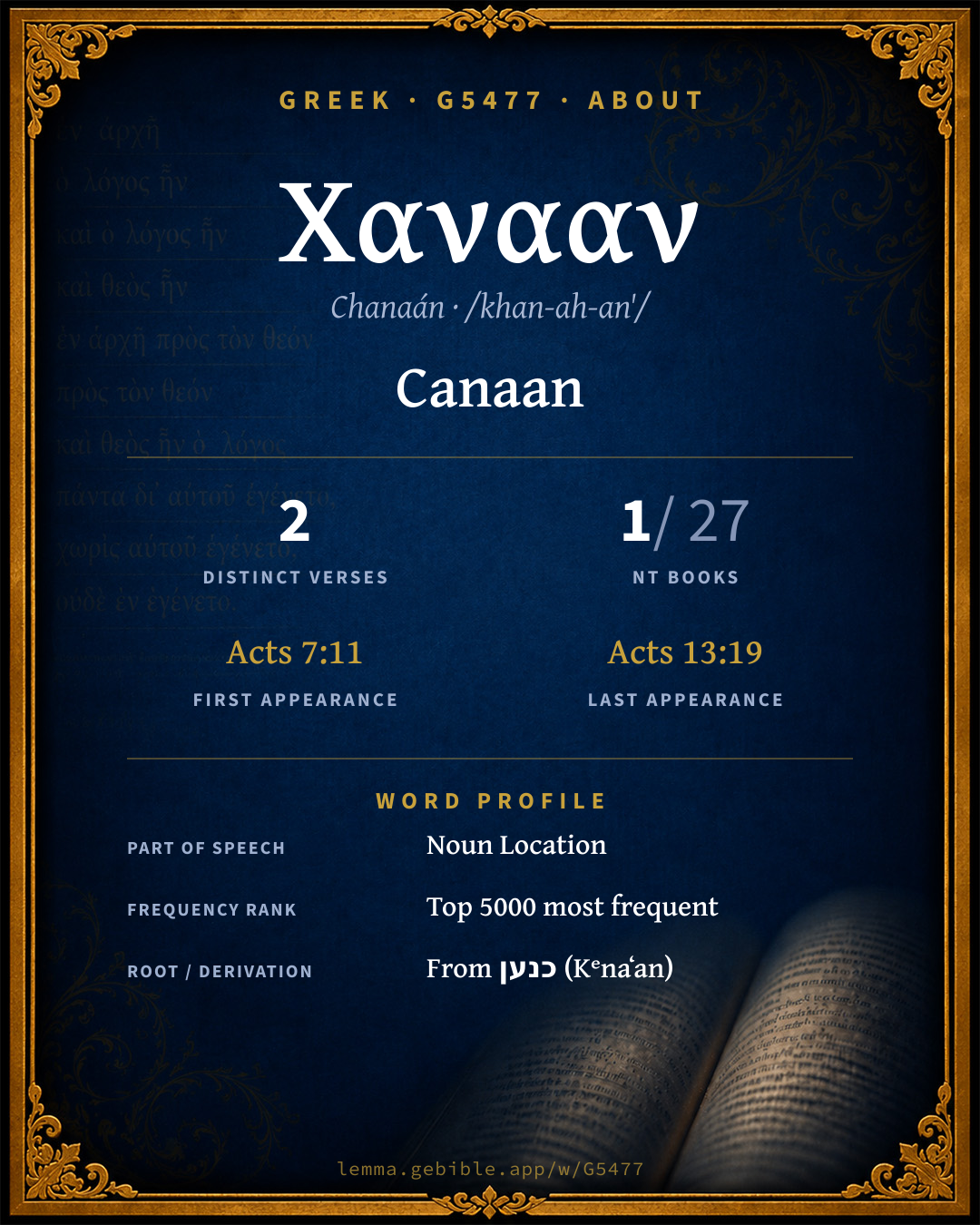
Χαναάν
Canaan
Thayer's lists 4 entries for ‘Canaan’ fuller range ↓
Full lexicon entry — Thayer's Greek Lexicon
From Thayer's Greek Lexicon
Where this word appears
Every verse where G5477 appears — 2 distinct verses across 1 book. Click any verse to open its interlinear word-by-word view. Verse text shown in the World English Bible for context — . Each verse’s Greek form is shown with its reference; the English is not keyword-highlighted, since the data carries no word-level English alignment. Use “Compare translations” on any verse to read it across multiple English versions. This concordance covers the Greek New Testament; Septuagint (Greek Old Testament) occurrences of this word are not indexed here.
Acts 2 verses
- Acts 7:11 Χανάαν n proper indecl Now a famine came over all the land of Egypt and Canaan, and great affliction. Our fathers found no food.
- Acts 13:19 Χανάαν n proper indecl When he had destroyed seven nations in the land of Canaan, he gave them their land for an inheritance, for about four hundred fifty years.
About this entry
At a glance — auto-summarized from this page’s data, not written by a person. Every figure links to its source below. This summary describes the numbers; it doesn’t interpret them.
Χανααν (Chanaán) is a Greek name most often rendered “Canaan.” A scarce word — 2 verses in all of the Greek New Testament. Acts dominates its distribution — 2 of 2 verses. Debuting at Acts 7:11, it then recurs through the corpus. For the data behind this summary, explore 2-verse concordance and the renderings breakdown below.
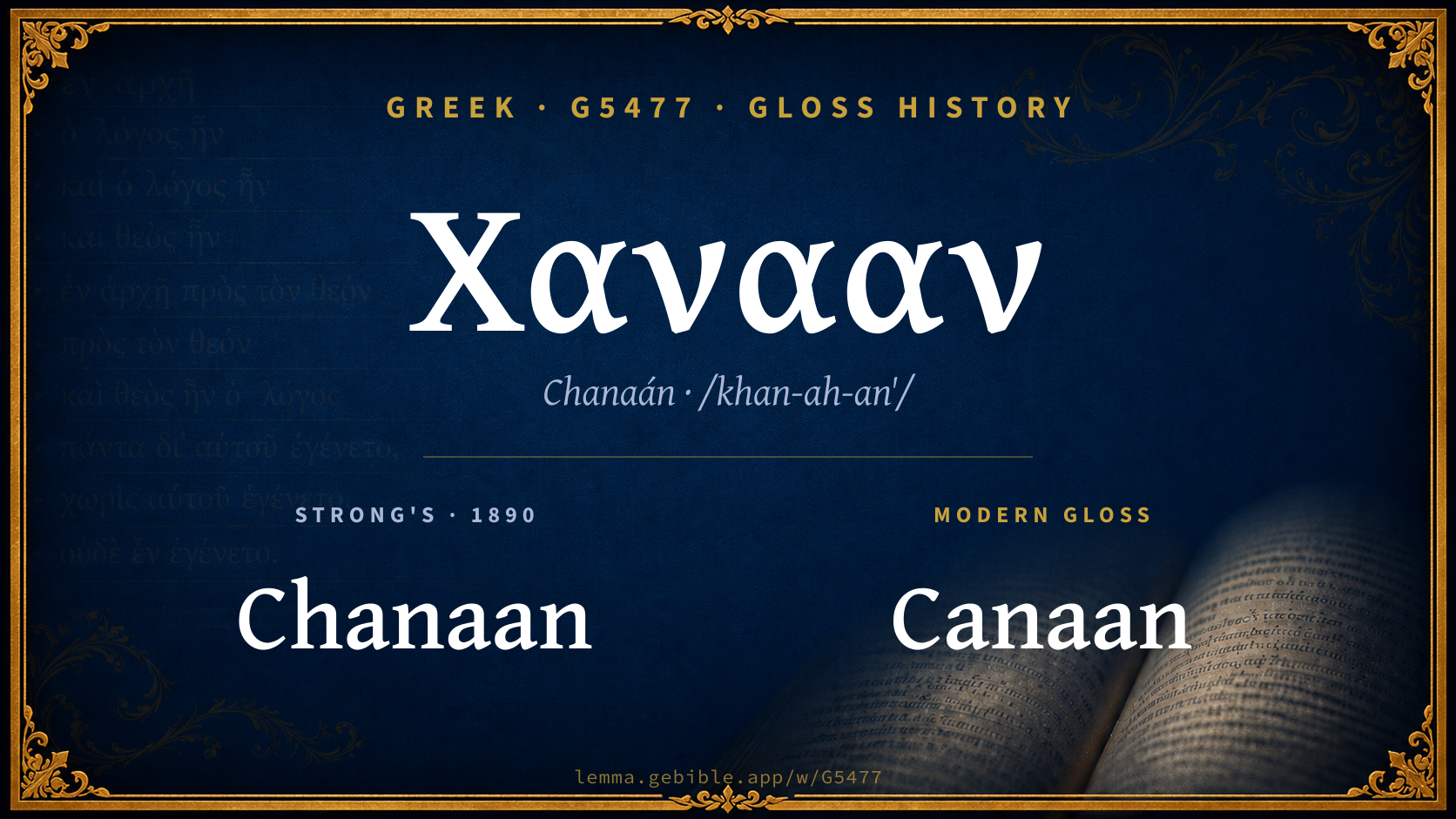
Gloss history
Strong's 1890 vs modern scholarship
About this word
Strong's G5477 catalogs a Greek word from the Greek New Testament.
These counts are not copied from any lexicon or concordance. They are computed here, from the morphology-tagged Greek New Testament. What Lemma adds →
- 2
- distinct verses
- The word appears in 2 distinct verses.
- 1 / 27
- NT books
- The word appears in 1 of 27 New Testament books.
- #2,678
- by frequency
- Top 5000 most frequent Greek words (rank 2,678 of 5,347 Greek words by occurrence).
View all 2 occurrences in the concordance →
Most concentrated in
- Acts 2 verses 100%
By section of the New Testament
By traditional corpus
Conventional, traditional groupings — biblical authorship is debated, so this is a traditional corpus grouping, not an authorship claim. Some books belong to more than one corpus (Luke is in both the Gospels and the Lukan corpus, and so on), so these shares overlap and need not total 100%. Each figure is a share of the word’s 2 distinct verses.
- Lukan (Luke–Acts) 2 verses · 100%
How translations render this word
Counts come from each version’s own published word-to-Strong’s tagging or interlinear alignment — an approximate guide to how each version renders this word, not a word-level alignment the data otherwise carries. Because each total is that version’s own tagged count, the per-version totals vary from one another and need not match the appearance or distinct-verse counts above. These counts may also differ from a printed concordance because Lemma counts each distinctly tagged rendering and does not collapse phrase taggings into a single head-word total. This is a fixed set of word-tagged versions (KJV, ASV, BSB, ULT) and does not change with the reading translation you choose elsewhere. Each version’s license is shown beside its name below (and on Sources).
- King James Version: Chanaan 2×
- American Standard Version: Canaan 2×
- Berean Standard Bible: Canaan 2×
- unfoldingWord Literal Text: Canaan 2×
King James Version Public Domain
Renders G5477 across 2 tagged occurrences — most commonly:
American Standard Version Public Domain
Renders G5477 across 2 tagged occurrences — most commonly:
Berean Standard Bible Public Domain
Renders G5477 across 2 tagged occurrences — most commonly:
unfoldingWord Literal Text CC BY-SA 4.0
Renders G5477 across 2 tagged occurrences — most commonly:
Senses in Thayer's
The 4 senses Thayer's distinguishes for this word, in lexicon order (not ranked by frequency or importance). The full entry — with sub-senses — is in the Lexicon Entry tab.
- Canaan = "lowland"
- the land of Canaan
- in a narrower sense: the part of Palestine lying west of the Jordan
- in a wider sense: all of Palestine
Word origin
Derived from כנען (Kᵉnaʻan) (H3667) — Canaan.
Of hebrew origin [ H3667 ]; Chanaan (that is Kenaan ) the early name of Palestine : - Chanaan.
— Strong’s Exhaustive Concordance (1890), public domain.
Same root — word family
Other Thayer's entries built from the same root as G5477, grouped by Strong’s listed origin. These share a root / origin per the lexicon — not necessarily a shared meaning. Each links to that word’s own entry.
Derives from
Proper names from this root
People and places named from this root — a name, not an additional meaning of the word.
- כנענה Kᵉnaʻănâh H3668 Chenaanah
- כנעני Kᵉnaʻanîy H3669 Canaanite
- Χανααναιος Chanaanaîos G5478 Canaanite
Compare all same-root words → Showing 4 of 5 — not the complete family. 4 of the same-root words are proper names (people or places). They share a root, not necessarily a meaning.
Bible dictionary
Public-domain dictionary articles matched to this entry by name (Canaan). A biblical name can be shared by more than one person or place, so an article may treat several.
Easton's Bible Dictionary · M. G. Easton, 1897
(1.) The fourth son of Ham (Gen. 10:6). His descendants were under a curse in consequence of the transgression of his father (9:22-27). His eldest son, Zidon, was the father of the Sidonians and Phoenicians. He had eleven sons, who were the founders of as many tribes (10:15-18).
(2.) The country which derived its name from the preceding. The name as first used by the Phoenicians denoted only the maritime plain on which Sidon was built. But in the time of Moses and Joshua it denoted the whole country to the west of the Jordan and the Dead Sea (Deut. 11:30). In Josh. 5:12 the LXX. read, "land of the Phoenicians," instead of "land of Canaan."
The name signifies "the lowlands," as distinguished from the land of Gilead on the east of Jordan, which was a mountainous district. The extent and boundaries of Canaan are fully set forth in different parts of Scripture (Gen. 10:19; 17:8; Num. 13:29; 34:8). (See CANAANITES, PALESTINE.)
Smith's Bible Dictionary · William Smith, 1863
(Ca'nan) (low, flat).
+ The fourth son of Ham, (Genesis 10:6; 1 Chronicles 1:8) the progenitor of the Phoenicians [Zidon, Or Sidon], and of the various nations who before the Israelite conquest people the seacoast of Palestine, and generally the while of the country westward of the Jordan. (Genesis 10:13; 1 Chronicles 1:13) (B.C. 2347.) + The name "Canaan" is sometimes employed for the country itself.
Hitchcock's Bible Names Dictionary · Roswell D. Hitchcock, 1869
merchant; trader; or that humbles and subdues
Classic public-domain reference works; full attribution on Sources.
Septuagint usage
The same Greek word Χανααν appears 92 times in the Greek Old Testament (Septuagint), across 87 verses in 13 books.
- 92
- LXX occurrences
- Tagged occurrences of this Greek word in the Septuagint.
- 87
- verses
- Distinct Septuagint verses containing this word.
- 13 / 39
- OT books
- The word appears in 13 of the 39 Old Testament books.
Sample Septuagint occurrences
- Genesis 9:18 χανααν
- Exodus 12:40 χανααν
- Leviticus 18:3 χανααν
- Numbers 13:17 χανααν
- Deuteronomy 11:30 χανααν
- Joshua 13:4 χανααν
- Judges 3:1 χανααν
- 1 Chronicles 1:8 χανααν
- Psalms 104:11 χανάαν
- Isaiah 23:11 χανααν
- Ezekiel 16:3 χανααν
- Hosea 12:8 χανααν
Septuagint occurrences (same lexeme)
Every verse where the same Strong’s number (G5477) appears in the Greek Septuagint — showing the first 50 of 87. Verse text shown in the World English Bible for context; the Greek form is the matched word — the English is not keyword-highlighted.
- Genesis 9:18 χανααν The sons of Noah who went forth from the ark were Shem, Ham, and Japheth. Ham is the father of Canaan.
- Genesis 9:22 χανααν Ham, the father of Canaan, saw the nakedness of his father, and told his two brothers outside.
- Genesis 9:25 χανααν He said, "Cursed be Canaan; A servant of servants will he be to his brothers."
- Genesis 9:26 χανααν He said, "Blessed be Yahweh, the God of Shem; Let Canaan be his servant.
- Genesis 9:27 χανααν God enlarge Japheth, Let him dwell in the tents of Shem; Let Canaan be his servant."
- Genesis 10:6 χανααν The sons of Ham: Cush, Mizraim, Put, and Canaan.
- Genesis 10:15 χανααν Canaan became the father of Sidon (his firstborn), Heth,
- Genesis 11:31 χανααν Terah took Abram his son, Lot the son of Haran, his son's son, and Sarai his daughter-in-law, his son Abram's wife. They went forth from Ur of the Chaldees, to go into the land of Canaan. They came to Haran, and lived there.
- Genesis 12:5 χανααν Abram took Sarai his wife, Lot his brother's son, all their substance that they had gathered, and the souls who they had gotten in Haran; and they went forth to go into the land of Canaan. Into the land of Canaan they came.
- Genesis 13:12 χανααν Abram lived in the land of Canaan, and Lot lived in the cities of the plain, and moved his tent as far as Sodom.
- Genesis 16:3 χανααν Sarai, Abram's wife, took Hagar the Egyptian, her handmaid, after Abram had lived ten years in the land of Canaan, and gave her to Abram her husband to be his wife.
- Genesis 17:8 χανααν I will give to you, and to your seed after you, the land where you are traveling, all the land of Canaan, for an everlasting possession. I will be their God."
- Genesis 23:2 χανααν Sarah died in Kiriath Arba (the same is Hebron), in the land of Canaan. Abraham came to mourn for Sarah, and to weep for her.
- Genesis 23:19 χανααν After this, Abraham buried Sarah his wife in the cave of the field of Machpelah before Mamre (the same is Hebron), in the land of Canaan.
- Genesis 28:1 χανααν Isaac called Jacob, blessed him, and commanded him, "You shall not take a wife of the daughters of Canaan.
- Genesis 28:6 χανααν Now Esau saw that Isaac had blessed Jacob and sent him away to Paddan Aram, to take him a wife from there, and that as he blessed him he gave him a charge, saying, "You shall not take a wife of the daughters of Canaan,"
- Genesis 28:8 χανααν Esau saw that the daughters of Canaan didn't please Isaac, his father.
- Genesis 31:18 χανααν and he carried away all his cattle, and all his substance which he had gathered, the cattle of his getting, which he had gathered in Paddan Aram, to go to Isaac his father to the land of Canaan.
- Genesis 33:18 χανααν Jacob came in peace to the city of Shechem, which is in the land of Canaan, when he came from Paddan Aram; and encamped before the city.
- Genesis 35:6 χανααν So Jacob came to Luz, which is in the land of Canaan (the same is Bethel), he and all the people who were with him.
- Genesis 35:27 χανααν Jacob came to Isaac his father, to Mamre, to Kiriath Arba (the same is Hebron), where Abraham and Isaac lived as foreigners.
- Genesis 36:5 χανααν Oholibamah bore Jeush, Jalam, and Korah. These are the sons of Esau, who were born to him in the land of Canaan.
- Genesis 36:6 χανααν Esau took his wives, his sons, his daughters, and all the members of his household, with his cattle, all his animals, and all his possessions, which he had gathered in the land of Canaan, and went into a land away from his brother Jacob.
- Genesis 37:1 χανααν Jacob lived in the land of his father's travels, in the land of Canaan.
- Genesis 42:5 χανααν The sons of Israel came to buy among those who came, for the famine was in the land of Canaan.
- Genesis 42:7 χανααν Joseph saw his brothers, and he recognized them, but acted like a stranger to them, and spoke roughly with them. He said to them, "Where did you come from?" They said, "From the land of Canaan to buy food."
- Genesis 42:13 χανααν They said, "We, your servants, are twelve brothers, the sons of one man in the land of Canaan; and, behold, the youngest is this day with our father, and one is no more."
- Genesis 42:29 χανααν They came to Jacob their father to the land of Canaan, and told him all that had happened to them, saying,
- Genesis 42:32 χανααν We are twelve brothers, sons of our father; one is no more, and the youngest is this day with our father in the land of Canaan.'
- Genesis 44:8 χανααν Behold, the money, which we found in our sacks' mouths, we brought again to you out of the land of Canaan. How then should we steal silver or gold out of your lord's house?
- Genesis 45:17 χανααν Pharaoh said to Joseph, "Tell your brothers, 'Do this. Load your animals, and go, travel to the land of Canaan.
- Genesis 45:25 χανααν They went up out of Egypt, and came into the land of Canaan, to Jacob their father.
- Genesis 46:6 χανααν They took their cattle, and their goods, which they had gotten in the land of Canaan, and came into Egypt-- Jacob, and all his seed with him,
- Genesis 46:12 χανααν The sons of Judah: Er, Onan, Shelah, Perez, and Zerah; but Er and Onan died in the land of Canaan. The sons of Perez were Hezron and Hamul.
- Genesis 46:31 χανααν Joseph said to his brothers, and to his father's house, "I will go up, and speak with Pharaoh, and will tell him, 'My brothers, and my father's house, who were in the land of Canaan, have come to me.
- Genesis 47:1 χανααν Then Joseph went in and told Pharaoh, and said, "My father and my brothers, with their flocks, their herds, and all that they own, have come out of the land of Canaan; and, behold, they are in the land of Goshen."
- Genesis 47:4 χανααν They said to Pharaoh, "We have come to live as foreigners in the land, for there is no pasture for your servants' flocks. For the famine is severe in the land of Canaan. Now therefore, please let your servants dwell in the land of Goshen."
- Genesis 47:13 χανααν There was no bread in all the land; for the famine was very severe, so that the land of Egypt and the land of Canaan fainted by reason of the famine.
- Genesis 47:14 χανααν Joseph gathered up all the money that was found in the land of Egypt, and in the land of Canaan, for the grain which they bought: and Joseph brought the money into Pharaoh's house.
- Genesis 47:15 χανααν When the money was all spent in the land of Egypt, and in the land of Canaan, all the Egyptians came to Joseph, and said, "Give us bread, for why should we die in your presence? For our money fails."
- Genesis 48:3 χανααν Jacob said to Joseph, "God Almighty appeared to me at Luz in the land of Canaan, and blessed me,
- Genesis 48:7 χανααν As for me, when I came from Paddan, Rachel died by me in the land of Canaan in the way, when there was still some distance to come to Ephrath, and I buried her there in the way to Ephrath (the same is Bethlehem)."
- Genesis 49:30 χανααν in the cave that is in the field of Machpelah, which is before Mamre, in the land of Canaan, which Abraham bought with the field from Ephron the Hittite as a burial place.
- Genesis 50:5 χανααν 'My father made me swear, saying, "Behold, I am dying. Bury me in my grave which I have dug for myself in the land of Canaan." Now therefore, please let me go up and bury my father, and I will come again.'"
- Genesis 50:11 χανααν When the inhabitants of the land, the Canaanites, saw the mourning in the floor of Atad, they said, "This is a grievous mourning by the Egyptians." Therefore, the name of it was called Abel Mizraim, which is beyond the Jordan.
- Genesis 50:13 χανααν for his sons carried him into the land of Canaan, and buried him in the cave of the field of Machpelah, which Abraham bought with the field, for a possession of a burying-place, from Ephron the Hittite, before Mamre.
- Exodus 12:40 χανααν Now the time that the children of Israel lived in Egypt was four hundred thirty years.
- Exodus 15:15 χανααν Then the chiefs of Edom were dismayed. Trembling takes hold of the mighty men of Moab. All the inhabitants of Canaan are melted away.
- Leviticus 18:3 χανααν You shall not do as they do in the land of Egypt, where you lived: and you shall not do as they do in the land of Canaan, where I am bringing you; neither shall you walk in their statutes.
- Leviticus 25:38 χανααν I am Yahweh your God, who brought you forth out of the land of Egypt, to give you the land of Canaan, and to be your God.
These are occurrences of the same Greek lexeme (G5477) in the Septuagint — not a translation of any one Hebrew word. The store carries no word-level Hebrew↔Greek alignment, so no Hebrew original is asserted here. Counts come from the recovered LXX Strong's tagging — high-frequency vocabulary is well covered, while rare or late forms may be untagged — so they reflect tagged occurrences and may slightly undercount.