2 Samuel 24:7

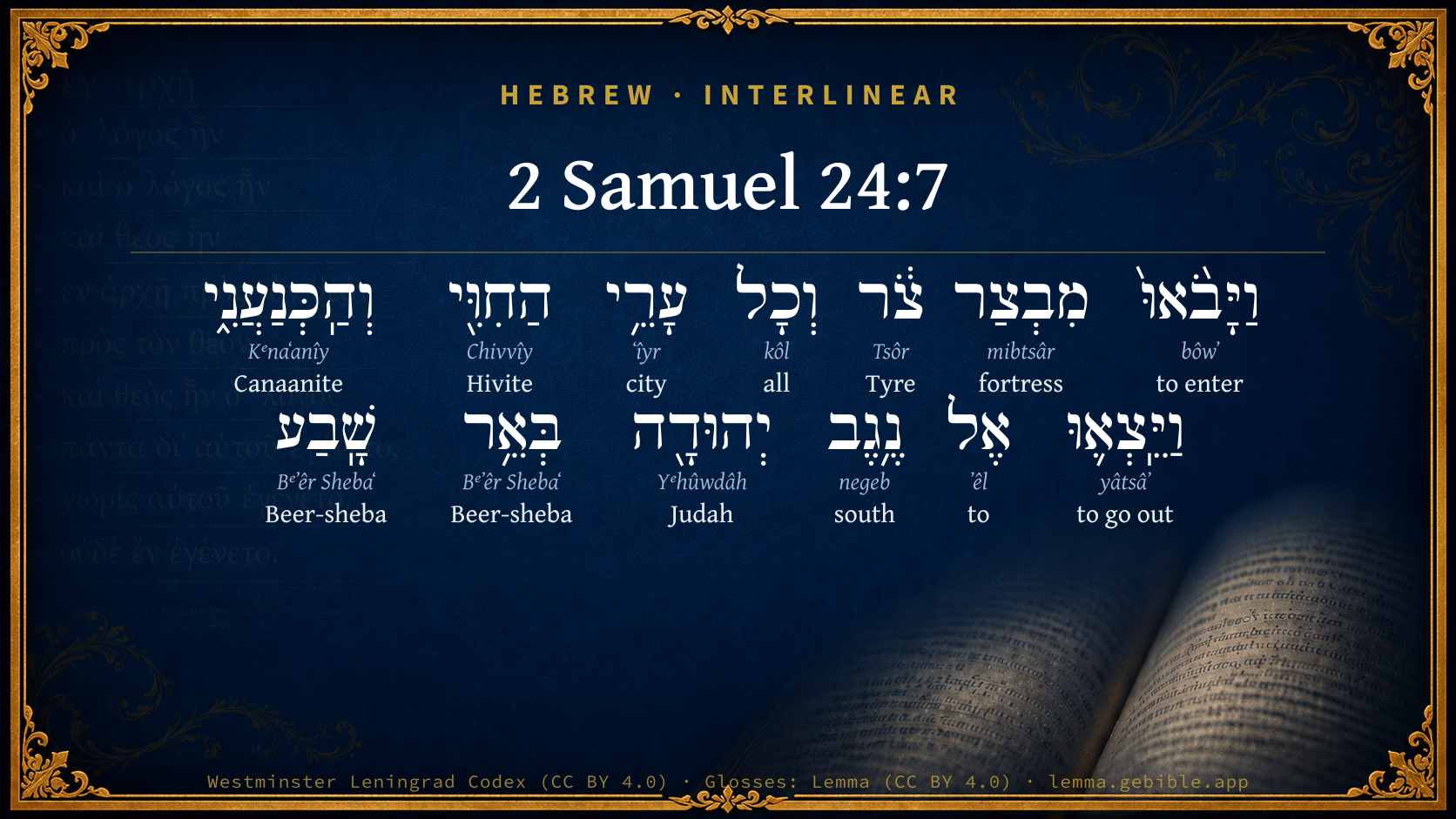
Hebrew (Westminster Leningrad Codex) 2 Samuel 24:7 appears in the Hebrew Old Testament. The text above is from the Westminster Leningrad Codex. Each word links to its Strong’s number, a concise gloss, and parsing drawn from the Open Scriptures Hebrew Bible morphology. Click any word for its full Brown-Driver-Briggs (BDB) entry.
Download image
Cite this verse

2 Samuel 24:7 (World English Bible). Public Domain. Lemma interlinear Bible study tool, https://lemma.gebible.app/v/2-samuel/24/7.

Show BibTeX & RIS
BibTeX
RIS
English Translation
and came to the stronghold of Tyre, and to all the cities of the Hivites, and of the Canaanites; and they went out to the south of Judah, at Beersheba.
World English Bible · Public Domain
Download a study sheet

One document with this verse’s original text, its word-by-word gloss line, the meaning frame, cross-references with their text, attributed commentary, and full source and license credits — printable, and it pastes into notes with its structure intact.

This verse Autodidact and up

Study sheet (.html) Plain text (.txt)

A passage Seminary Student

Up to 50 verses in one chapter. A passage sheet keeps up to 6 commentary sources and 12 cross-references per verse, in the order this page ranks them, and says so on the sheet whenever that leaves anything out. Ask for a single verse and you get the Autodidact verse sheet above.

Everything on this page stays free to read, with no account — the sheet is a download of what is already on screen, not access to it.

Want to remove ads? Support Godless Engineer
Compare translations 3

The same verse in 3 English versions, stacked beneath the original-language interlinear above. Click any original word for its lexicon entry.

Each is an independent rendering of the whole verse — the interlinear is not word-aligned to these translations.

Highlighted words mark where these versions differ — a whole-verse word diff, not a word-by-word alignment.

  • World English Bible Public Domain
    and came to the stronghold of Tyre, and to all the cities of the Hivites, and of the Canaanites; and they went out to the south of Judah, at Beersheba.
  • King James Version Public Domain
    And came to the strong hold of Tyre, and to all the cities of the Hivites, and of the Canaanites: and they went out to the south of Judah, even to Beersheba.
  • unfoldingWord Literal Text CC BY-SA 4.0
    And they came the fortress of Tyre and all of the cities of the Hivites and the Canaanites. And they went out to the Negev of Judah, Beersheba.

unfoldingWord Literal Text — © unfoldingWord, licensed CC BY-SA 4.0. Word-aligned USFM3 via Door43 (git.door43.org/unfoldingWord/en_ult).

Versions to compare (up to 4)

3 of 4 selected

Show all 18 translations

Every available English version of this verse, each an independent rendering of the whole verse.

  • World English Bible Public Domain
    and came to the stronghold of Tyre, and to all the cities of the Hivites, and of the Canaanites; and they went out to the south of Judah, at Beersheba.
  • Berean Standard Bible Public Domain
    They went toward the fortress of Tyre and all the cities of the Hivites and Canaanites. Finally, they went on to the Negev of Judah, to Beersheba.
  • Majority Standard Bible Public Domain
    They went toward the fortress of Tyre and all the cities of the Hivites and Canaanites. Finally, they went on to the Negev of Judah, to Beersheba.
  • King James Version Public Domain
    And came to the strong hold of Tyre, and to all the cities of the Hivites, and of the Canaanites: and they went out to the south of Judah, even to Beersheba.
  • American Standard Version (1901) Public Domain
    and came to the stronghold of Tyre, and to all the cities of the Hivites, and of the Canaanites; and they went out to the south of Judah, at Beer-sheba.
  • Revised Version (1885) Public Domain
    and came to the strong hold of Tyre, and to all the cities of the Hivites, and of the Canaanites: and they went out to the south of Judah, at Beer-sheba.
  • Geneva Bible (1599) Public Domain
    And came to the fortresse of Tyrus and to all the cities of the Hiuites and of the Canaanites, and went towarde the South of Iudah, euen to Beer-sheba.
  • Douay-Rheims (1899) Public Domain
    They passed near the walls of Tyre, and all the land of the Hevite, and the Chanaanite, and they came to the south of Juda into Bersabee:
  • Young's Literal Translation Public Domain
    and they come in to the fortress of Tyre, and all the cities of the Hivite, and of the Canaanite, and go out unto the south of Judah, to Beer-Sheba.
  • Literal Standard Version CC BY-SA 4.0
    and they come to the fortress of Tyre, and all the cities of the Hivite, and of the Canaanite, and go out to the south of Judah, to Beer-Sheba.
  • Unlocked Literal Bible CC BY-SA 4.0
    They reached the stronghold of Tyre and all the cities of the Hivites and the Canaanites. Then they went out to the Negev in Judah at Beersheba.
  • unfoldingWord Literal Text CC BY-SA 4.0
    And they came the fortress of Tyre and all of the cities of the Hivites and the Canaanites. And they went out to the Negev of Judah, Beersheba.
  • Darby Bible Public Domain
    and they came to the fortified city of Tyre, and to all the cities of the Hivites and of the Canaanites; and went out to the south of Judah, to Beer-sheba.
  • World Messianic Bible Public Domain
    and came to the stronghold of Tyre, and to all the cities of the Hivites and of the Canaanites; and they went out to the south of Judah, at Beersheba.
  • Webster's Bible Public Domain
    And came to the strong hold of Tyre, and to all the cities of the Hivites, and of the Canaanites: and they went out to the south of Judah, even to Beer-sheba.
  • Free Bible Version CC BY-SA 4.0
    After this they went to the fortress of Tyre, and all the towns of the Hivites and Canaanites. They ended up in the Negev of Judah at Beersheba.
  • Bible in Basic English Public Domain
    And to the walled town of Tyre, and to all the towns of the Hivites and the Canaanites: and they went out to the South of Judah at Beer-sheba.
  • JPS Tanakh (1917) Public Domain
    and came to the stronghold of Tyre, and to all the cities of the Hivites, and of the Canaanites; and they went out to the south of Judah, at Beer-sheba.

Literal Standard Version (2020), Covenant Press — licensed CC BY-SA 4.0. Text via the HelloAO Bible API (eBible.org). Unlocked Literal Bible (unfoldingWord) — licensed CC BY-SA 4.0. Text via the HelloAO Bible API (eBible.org). unfoldingWord Literal Text — © unfoldingWord, licensed CC BY-SA 4.0. Word-aligned USFM3 via Door43 (git.door43.org/unfoldingWord/en_ult). Free Bible Version, Dr. Jonathan Gallagher — licensed CC BY-SA 4.0. Text via the HelloAO Bible API (eBible.org).

Word by word

More ways to search: Search by grammar → Find every occurrence → Compare this word →

Practice this passage: Drill this verse → Learn its vocabulary →

הַחִוִּ֖י
Chivvîy
H2340
“the · Hivite”
Particle, Definite Article + Noun, Gentilic, Masculine, Singular, Absolute
Part of Speech
Particle + Noun
Type
Gentilic
Gender
Masculine
Number
Singular
State
Absolute
Full BDB Definition

Origin: perhaps from H2333

TWOT: None

Hivite = "villagers" - 6th generation of descendants of Canaan, the son of Ham, who were living in northern Canaan near Mount Hermon at the time of the conquest
  1. וַיָּבֹ֨אוּ֙ bôwʼ H935 “and · to enter” Conjunction + Verb, Qal, Sequential Imperfect, 3rd Person, Masculine, Plural
  2. מִבְצַר mibtsâr H4013 “fortress of” Noun, Common, Masculine, Singular, Construct
  3. צֹ֔ר Tsôr H6865 “Tyre” Noun, Proper
  4. וְכָל kôl H3605 “and · all of” Conjunction + Noun, Common, Masculine, Singular, Construct
  5. עָרֵ֥י ʻîyr H5892 “cities of” Noun, Common, Feminine, Plural, Construct
  6. וְהַֽכְּנַעֲנִ֑י Kᵉnaʻanîy H3669 “and · the · Canaanite” Conjunction + Particle, Definite Article + Noun, Gentilic, Masculine, Singular, Absolute
  7. וַיֵּֽצְא֛וּ yâtsâʼ H3318 “and · to go out” Conjunction + Verb, Qal, Sequential Imperfect, 3rd Person, Masculine, Plural
  8. אֶל ʼêl H413 “to” Preposition
  9. נֶ֥גֶב negeb H5045 “south of” Noun, Common, Masculine, Singular, Construct
  10. יְהוּדָ֖ה Yᵉhûwdâh H3063 “Judah” Noun, Proper
  11. בְּאֵ֥ר Bᵉʼêr Shebaʻ H884 “Beer-sheba” Noun, Proper
  12. שָֽׁבַע Bᵉʼêr Shebaʻ H884 “Beer-sheba” Noun, Proper

About this verse

These counts appear in no published source. They are computed here, from the morphology-tagged text and Lemma’s own curated glosses. What Lemma adds →

13
words
12
distinct lemmas
Historical
section

Notable vocabulary

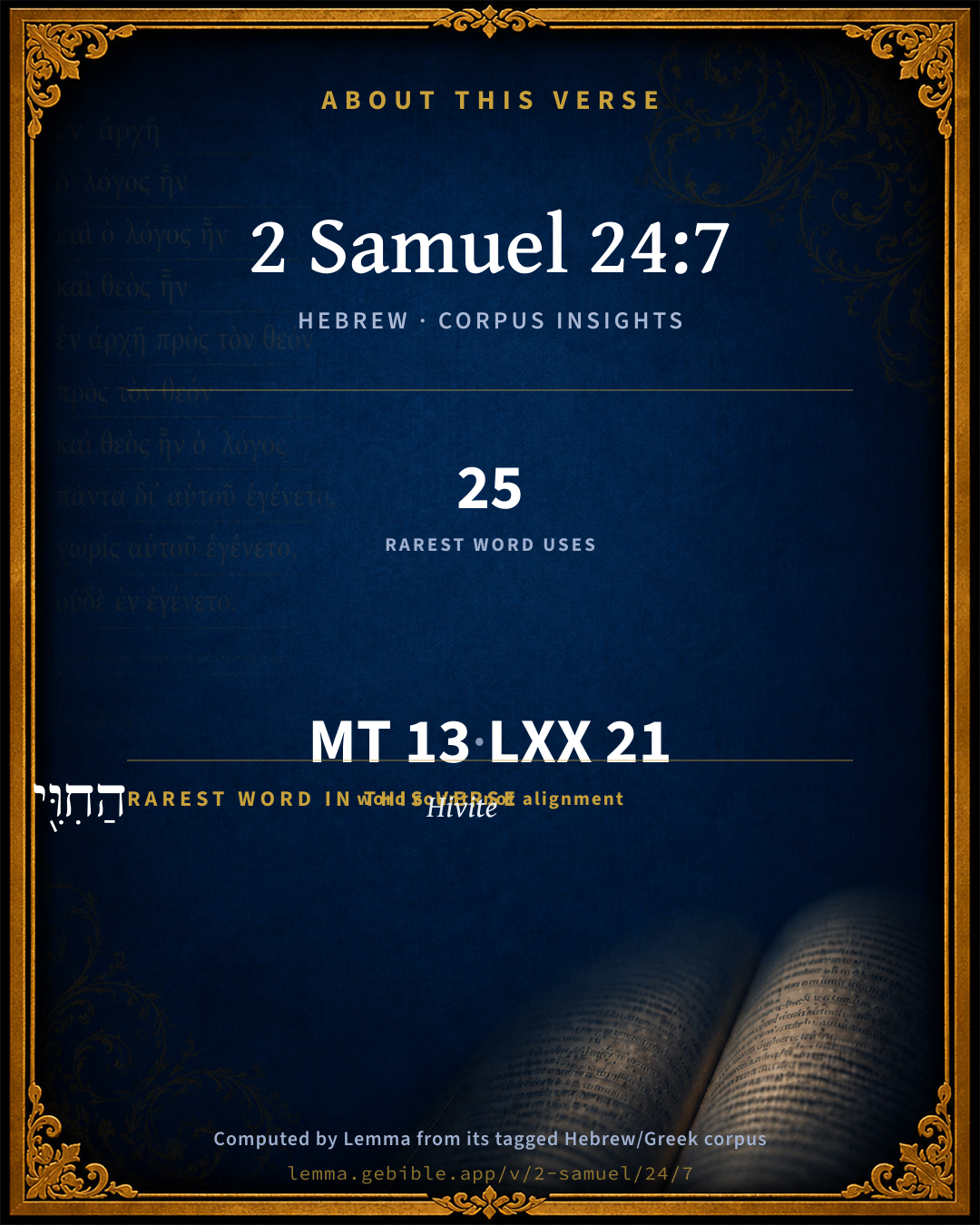
The rarest word here is הַחִוִּ֖י Hivite H2340 — appearing just 25 times in the whole Hebrew Bible.

Shared distinctive vocabulary

הַחִוִּ֖י Hivite H2340 occurs in 25 verses of the Hebrew Bible. Also found in:

Grammatical profile

  • 2 verbs
  • 10 nouns
  • 1 preposition

Verb forms

  • וַיָּבֹ֨אוּ֙ Qal · Sequential Imperfect
  • וַיֵּֽצְא֛וּ Qal · Sequential Imperfect

Repetition

A word recurs within this verse — often emphatic in Hebrew:

  • בְּאֵ֥ר Beer-sheba H884 ×2

Hebrew & Septuagint length

In English translation the verse runs 30 words from the Hebrew and 28 from the Septuagint (LXX English) — closely comparable.

A rough comparison of the two English renderings, which tokenize alike — not a word-level alignment.

Word counts can differ between the Hebrew and the Greek without any difference in meaning — e.g. the Hebrew direct-object marker אֵת has no separate Greek word, and Greek often adds the article ὁ.

In the original languages it is 13 Hebrew tokens and 21 Greek tokens — but the two are counted differently (Hebrew bundles its prefixes and suffixes into one token; the Greek is in lemma form), so that isn’t a like-for-like length.

Cross-references

5

Topical passages linked to 2 Samuel 24:7 in the Treasury of Scripture Knowledge — connected by theme and wording, ordered by reader-vote popularity; previews shown in the World English Bible.

  • Joshua 19:29 and the border turned to Ramah, and to the fortified city of Tyre; and the border turned to Hosah; and the goings out of it were at the sea by the region of Achzib;
  • Joshua 11:3 to the Canaanite on the east and on the west, and the Amorite, and the Hittite, and the Perizzite, and the Jebusite in the hill-country, and the Hivite under Hermon in the land of Mizpah.
  • Genesis 21:22–33 It happened at that time, that Abimelech and Phicol the captain of his host spoke to Abraham, saying, "God is with you in all that you do.
  • Judges 3:3 [namely], the five lords of the Philistines, and all the Canaanites, and the Sidonians, and the Hivites who lived on Mount Lebanon, from Mount Baal Hermon to the entrance of Hamath.
  • 2 Samuel 24:2 The king said to Joab the captain of the host, who was with him, Go now back and forth through all the tribes of Israel, from Dan even to Beersheba, and number you the people, that I may know the sum of the people.

Cross-references courtesy of OpenBible.info (CC BY 4.0).

Hebrew and Greek witnesses Masoretic Hebrew ↔ Greek Septuagint

The same verse in the two great witnesses to the Old Testament, shown verse-for-verse.

These are two independent witnesses, not word-aligned to each other, and the Septuagint is shown in lemma (dictionary) form.

Hebrew 2 Samuel 24:7 Masoretic · Westminster Leningrad Codex

וַיָּבֹ֨אוּ֙ מִבְצַר צֹ֔ר וְכָל עָרֵ֥י הַחִוִּ֖י וְהַֽכְּנַעֲנִ֑י וַיֵּֽצְא֛וּ אֶל נֶ֥גֶב יְהוּדָ֖ה בְּאֵ֥ר שָֽׁבַע

and came to the stronghold of Tyre, and to all the cities of the Hivites, and of the Canaanites; and they went out to the south of Judah, at Beersheba.

World English Bible · Public Domain

Greek LXX 2 Samuel 24:7 Septuagint · lemma form

καί ἔρχομαι εἰς μαψαρ τύρος καί πᾶς ὁ πόλις ὁ ευαῖος καί ὁ χαναναῖος καί ἔρχομαι κατά νότος ιουδα εἰς βηρσαβεε

And they came to Mapsar of Tyre, and to all the cities of the Evite and the Chananite: and they came by the South of Juda to Bersabee.

LXX2012 (modern English Septuagint) · Public Domain

Hebrew: Westminster Leningrad Codex (CC BY 4.0). Greek: Septuagint (public domain); English from LXX2012 (modern English Septuagint) (Public Domain). How the Septuagint differs from the Hebrew →

Targum (Aramaic paraphrase)

1

The Targum is the ancient Jewish Aramaic paraphrase of the Hebrew Scriptures — an interpretive translation, not the Hebrew text itself. Onkelos (literal) and Pseudo-Jonathan (expansive) render the Torah, and Jonathan the Prophets. Coverage is partial: where no permissively-licensed English translation exists for a verse, only the Aramaic is shown. This is verse-level text, not a word-by-word alignment to the Hebrew.

  1. Targum Jonathan Prophets (Joshua–Malachi)
    וַאֲתוֹ לְקִירְוִין כְּרִיכָן וְכָל קִרְוֵי חִוָאֵי וּכְנַעֲנָאֵי וּנְפַקוּ לְדָרוֹם יְהוּדָה לִבְאֵר שָׁבַע:

    (no public-domain English translation for this verse)

    Targum Jonathan — Aramaic: “Mikraot Gedolot” (public domain). English: “Sefaria Community Translation” (CC0 1.0 (public-domain dedication)); “London "Chaldee Paraphrase," 1871” (public domain). Text via Sefaria.

Commentary

Notes on 2 Samuel 24:7 from classic Christian and Jewish commentators (each source and its license shown beneath its notes). The classic Christian expositions comment on the surrounding passage and are grouped to its opening verse, so a note may address several verses; the Jewish commentaries on the Tanakh (Rashi and others) are per-verse, so they appear only where the commentator wrote on this verse.

Lemma curates 59 commentaries, every one of them public domain or Creative Commons licensed, each selected and text-cleaned for this edition rather than reprinted as found. About our sources →

Trapp's Complete Commentary

John Trapp

2Sa 24:7 And came to the strong hold of Tyre, and to all the cities of the Hivites, and of the Canaanites: and they went out to the south of Judah, [even] to Beersheba.

Ver. 7. And to all the cities of the Hivites.] Who would dwell among the Israelites, and could not be gotten out. {Jdg 1:31-32} So nothing is more pertinacious than a strong lust.

John Trapp, A Commentary or Exposition upon All the Books of the Old and New Testament (1647–1656) — public domain. Text from a community e-Sword module.

Geneva Bible (1599)

Geneva Bible translators

Or, Zor.

Geneva Bible (1599) marginal notes — public domain. Text via Bolls.life.

Adam Clarke's Commentary

Verse 7. The strong hold of Tyre] This must have been the old city of Tyre, which was built on the main land: the new city was built on a rock in the sea.

Adam Clarke's Commentary on the Bible (1810–1826) — public domain. Text from a community e-Sword/MySword module.

Ellicott's Commentary for English Readers

(7) Of the Hivites, and of the Canaanites.—The remnants of the original inhabitants appear still to have occupied distinct towns by themselves. The “Hivites” were chiefly in the northern part of the land, though Gibeon and its towns had belonged to them. “The Canaanites” is a general name for the remnants of all the other races.

A Bible Commentary for English Readers, edited by Charles John Ellicott (1878–1897) — public domain. Text from a community e-Sword module.

The Cambridge Bible for Schools and Colleges

gen. ed. J. J. S. Perowne

7. the strong hold of Tyre] The same term—generally rendered fenced city in the E. V.—is applied to Tyre in Jos_19:29, where Tyre is named among the places on the border of Asher. Like Zidon it was never occupied by the Israelites, and we must suppose either that the region traversed by the enumerators is defined as reaching up to though not including Tyre and Zidon, or that these cities were actually visited in order to take a census of Israelites resident in them.

the cities of the Hivites, and of the Canaanites] The old inhabitants were never exterminated from the northern part of Palestine, but made tributary, and apparently allowed to dwell in communities of their own. The district round Kedesh-Naphtali in particular was called the region of the nations or Galilee of the Gentiles (Jos_20:7; 1Ki_9:11; Isa_9:1). The Hivites dwelt principally in this northern region (Jos_11:3; Jdg_3:3), and also round Gibeon (Jos_11:19), and are probably specified as the tribe of which most survived: the Canaanites would include all the other native tribes in general.

The Cambridge Bible for Schools and Colleges (gen. ed. J. J. S. Perowne; Cambridge University Press, 1878–1918) — public domain. Text from a community e-Sword module.

John Gill's Exposition

And came to the strong hold of Tyre,.... That is, old Tyre, which stood thirty furlongs from new Tyre, the island (y); of which See Gill on Isa 23:1; this must be understood of the parts near unto it; for that itself was not within the land of Israel, and so its inhabitants not to be numbered:

and to all the cities of the Hivites, and of the Canaanites: which were possessed by them, and from whence they were not driven out by the Israelites; to all places contiguous to them, Joab and his captains came to take the number of them:

and they went out to the south of Judah: even to Beersheba; passing through the western part of the land, they came to the southern part of it, even as far as Beersheba, which was the extreme part of the land to the south.

(y) Strabo. Geograph. l. 16. p. 521.

John Gill's Exposition of the Whole Bible (1746–1763) — public domain (CC PDM 1.0). Text via the HelloAO Bible API.

Albert Barnes' Notes on the Bible

The strong hold of Tyre - “The fenced city,” as it is generally rendered throughout the historical books.

The cities of the Hivites - Gibeon, Chephirah, Beeroth, and Kirjath-jearim, and perhaps Shechem, besides those at the foot of Hermon and Lebanon, of which we do not know the names. This continuance of distinct communities of Hivites so late as the end of David’s reign is remarkable.

Albert Barnes' Notes on the Bible (1834–1885) — public domain. Text from a community e-Sword/MySword module.

Haydock's Catholic Bible Commentary

Tyre, the ancient; about 4000 paces from the new city, which stands in an island. (Strabo xvi.) See Josue xix. 29.

George Leo Haydock (1774–1849), Haydock's Catholic Family Bible and Commentary, 1859 edition — public domain. Excludes Psalms (Douay-Rheims chapter numbering differs from Protestant) and Deuterocanonical books (Catholic canon only).

Whedon's Commentary on the Bible

Daniel D. Whedon

7. Tyre — On the same seacoast, twenty miles south of Zidon. See on Jos_19:29.

Hivites — That dwelt in the north. Jdg_3:3.

Canaanites — Various tribes that dwelt between Tyre and Beer-sheba.

Daniel D. Whedon (gen. ed.), Commentary on the Old and New Testaments (1874–1909) — public domain. Text from a community e-Sword module.

The Pulpit Commentary

Tyre. (comp. Jos_19:29) Tyre and the whole coast landbetween it and Sidon had been too strong for the tribe of Asher, and remained unsubdued. But, like the independent states in India, it acknowlodged the supremacy of the paramount power. The cities of the Hivites, and of the Canaanites. It is evident from this that even in David"s time there were towns and districts were Hivites and Canaanites dwelt as distinct communities, governed probably by their own laws. But as they were bound to serve in the Israelite armies, they were included in the census, and possibly one of its rosin objects was to learn the number of fighting men of alien races dwelling in Israel. They seem to have been reckoned as belonging to the tribe in whose borders they dwelt. So Baanah and Rechab, the murderers of Ishbosheth, though Beerothites (and therefore Gibeonites, who again were Hivites), were counted to Benjamin. (2Sa_4:2) These Gentile communities were chiefly to be found in the north, for which reason it was called "the circuit (Gelil) of the nations", (Isa_9:1) and in later times from Gelil came the name Galilee. The Syriac adds "Jebusites," and we find Jerusalem occupied by a community of Jebusites living in independence in the very neighbourhood of the warlike tribe of Benjamin. (2Sa_5:6) This numbering of the aborigines by David is referred to in 2Ch_2:17, where it is added that Solomon made a separate census of them, and found that there were in Israel no fewer than a hundred and fifty-three thousand six hundred of these aliens.

The Pulpit Commentary (1880–1919), ed. H.D.M. Spence-Jones & Joseph S. Exell — public domain. Text from a community e-Sword module.

Lesson kit

Teaching starters — assembled from the data on this page, not authored interpretation. Every prompt links to the verse data it draws on. Edit before teaching.

2 Samuel, in the Historical, opens this verse with 13 words (12 distinct Hebrew lemmas). Its most distinctive word is Chivvîy (“Hivite”). A historical commentator’s framing appears above. Read the whole chapter for the surrounding context.

Discussion questions

  1. What does “Hivite” (Chivvîy) contribute to the verse as a whole?
  2. Genesis 10:17 shares the word «Hivite» with this verse. How do the two illuminate each other?
  3. “Beer-sheba” occurs 2× in this one verse. What is the effect of the repetition?
  4. These translations render this verse differently; the difference is in the English rendering, not the original. What questions does that raise?
  5. The verb «וַיָּבֹ֨אוּ֙» is Qal Sequential Imperfect. How does its form color the action?
  6. Reading how Trapp's Complete Commentary and Geneva Bible (1599) read this verse, where do the two commentators agree and where do they part?

Things to notice

Reading settings

Reading text

Shown beneath each verse's original-language words.

Old Testament
Old Testament edition

Read the OT as the Masoretic Hebrew (MT) or the Greek Septuagint (LXX).

English shown for the Greek Septuagint (in the Hebrew ↔ Greek comparison).

Comparing translations? Open the Compare panel on any verse page to stack up to four side by side.