
Obadiah 1:20

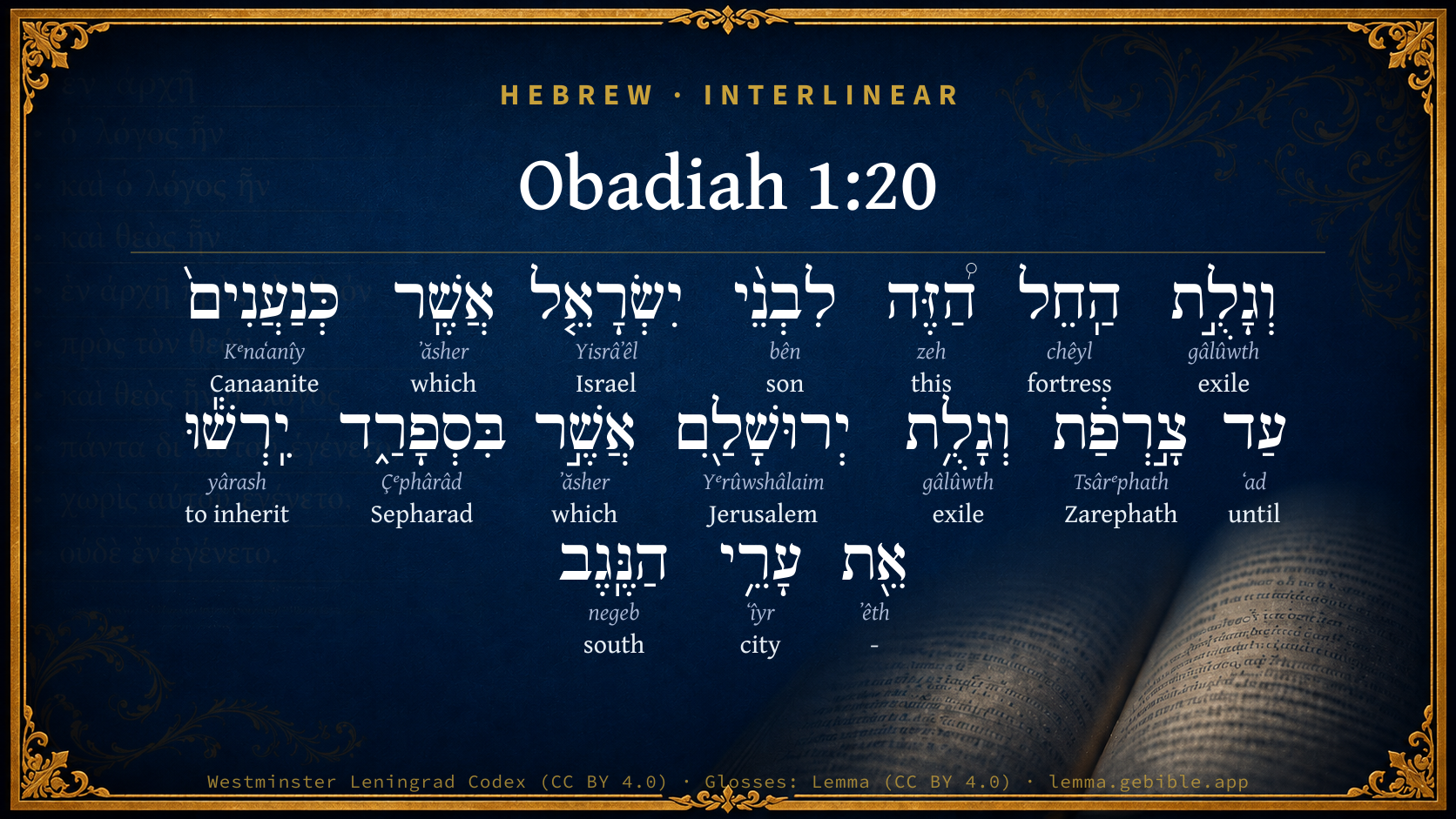
Hebrew (Westminster Leningrad Codex) Obadiah 1:20 appears in the Hebrew Old Testament. The text above is from the Westminster Leningrad Codex. Each word links to its Strong’s number, a concise gloss, and parsing drawn from the Open Scriptures Hebrew Bible morphology. Click any word for its full Brown-Driver-Briggs (BDB) entry.
Download image
Cite this verse

Obadiah 1:20 (World English Bible). Public Domain. Lemma interlinear Bible study tool, https://lemma.gebible.app/v/obadiah/1/20.

Show BibTeX & RIS
BibTeX
RIS
English Translation
The captives of this host of the children of Israel, who are among the Canaanites, will possess even to Zarephath; and the captives of Jerusalem, who are in Sepharad, will possess the cities of the Negev.
World English Bible · Public Domain
Highlights
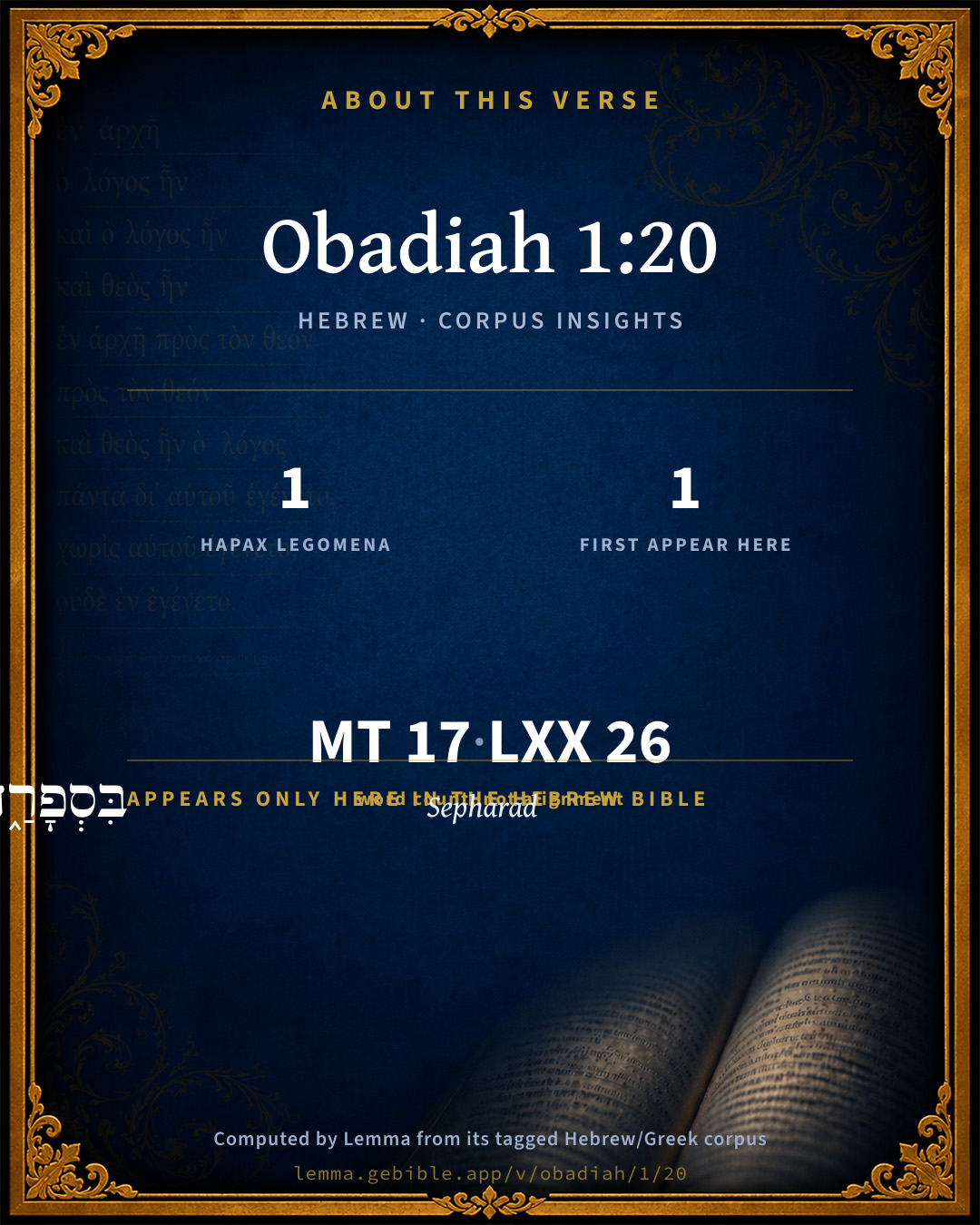
  • 1 hapax legomenon — only here in the Hebrew Bible
  • 1 first appearance in the Hebrew Bible
Full analysis ↓
Download a study sheet

One document with this verse’s original text, its word-by-word gloss line, the meaning frame, cross-references with their text, attributed commentary, and full source and license credits — printable, and it pastes into notes with its structure intact.

This verse Autodidact and up

Study sheet (.html) Plain text (.txt)

A passage Seminary Student

Up to 50 verses in one chapter. A passage sheet keeps up to 6 commentary sources and 12 cross-references per verse, in the order this page ranks them, and says so on the sheet whenever that leaves anything out. Ask for a single verse and you get the Autodidact verse sheet above.

Everything on this page stays free to read, with no account — the sheet is a download of what is already on screen, not access to it.

Want to remove ads? Support Godless Engineer
Compare translations 3

The same verse in 3 English versions, stacked beneath the original-language interlinear above. Click any original word for its lexicon entry.

Each is an independent rendering of the whole verse — the interlinear is not word-aligned to these translations.

Highlighted words mark where these versions differ — a whole-verse word diff, not a word-by-word alignment.

  • World English Bible Public Domain
    The captives of this host of the children of Israel, who are among the Canaanites, will possess even to Zarephath; and the captives of Jerusalem, who are in Sepharad, will possess the cities of the Negev.
  • King James Version Public Domain
    And the captivity of this host of the children of Israel shall possess that of the Canaanites, even unto Zarephath; and the captivity of Jerusalem, which is in Sepharad, shall possess the cities of the south.
  • unfoldingWord Literal Text CC BY-SA 4.0
    And the exile of this army of the sons of Israel, who are Canaanites, as far as Zarephath, and the exile of Jerusalem, who are in Sepharad: they will possess the cities of the Negev.

unfoldingWord Literal Text — © unfoldingWord, licensed CC BY-SA 4.0. Word-aligned USFM3 via Door43 (git.door43.org/unfoldingWord/en_ult).

Versions to compare (up to 4)

3 of 4 selected

Show all 18 translations

Every available English version of this verse, each an independent rendering of the whole verse.

  • World English Bible Public Domain
    The captives of this host of the children of Israel, who are among the Canaanites, will possess even to Zarephath; and the captives of Jerusalem, who are in Sepharad, will possess the cities of the Negev.
  • Berean Standard Bible Public Domain
    And the exiles of this host of the Israelites will possess the land of the Canaanites as far as Zarephath; and the exiles from Jerusalem who are in Sepharad will possess the cities of the Negev.
  • Majority Standard Bible Public Domain
    And the exiles of this host of the Israelites will possess the land of the Canaanites as far as Zarephath; and the exiles from Jerusalem who are in Sepharad will possess the cities of the Negev.
  • King James Version Public Domain
    And the captivity of this host of the children of Israel shall possess that of the Canaanites, even unto Zarephath; and the captivity of Jerusalem, which is in Sepharad, shall possess the cities of the south.
  • American Standard Version (1901) Public Domain
    And the captives of this host of the children of Israel, that are `among' the Canaanites, `shall possess' even unto Zarephath; and the captives of Jerusalem, that are in Sepharad, shall possess the cities of the South.
  • Revised Version (1885) Public Domain
    And the captivity of this host of the children of Israel, which are among the Canaanites, shall possess even unto Zarephath; and the captivity of Jerusalem, which is in Sepharad, shall possess the cities of the South.
  • Geneva Bible (1599) Public Domain
    And the captiuitie of this host of the children of Israel, which were among the Canaanites, shall possesse vnto Zarephath, and the captiuitie of Ierusalem, which is in Sepharad, shall possesse the cities of the South.
  • Douay-Rheims (1899) Public Domain
    And the captivity of this host of the children of Israel, all the places of the Chanaanites even to Sarepta: and the captivity of Jerusalem that is in Bospho- rus, shall possess the cities of the south.
  • Young's Literal Translation Public Domain
    And the removed of this force of the sons of Israel, That `is with' the Canaanites unto Zarephat, And the removed of Jerusalem that `is' with the Sepharad, Possess the cities of the south.
  • Literal Standard Version CC BY-SA 4.0
    And the expulsion of this force of the sons of Israel, || That [is with] the Canaanites to Zarephat, || And the expulsion of Jerusalem that [is] with the Sepharad, || Possess the cities of the south.
  • Unlocked Literal Bible CC BY-SA 4.0
    The exiles of this host of the people of Israel will possess the land of Canaan as far as Zarephath. The exiles of Jerusalem, who are in Sepharad, will possess the cities of the Negev.
  • unfoldingWord Literal Text CC BY-SA 4.0
    And the exile of this army of the sons of Israel, who are Canaanites, as far as Zarephath, and the exile of Jerusalem, who are in Sepharad: they will possess the cities of the Negev.
  • Darby Bible Public Domain
    and the captives of this host of the children of Israel [shall possess] what belonged to the Canaanites, unto Zarephath; and the captives of Jerusalem, who [were] in Sepharad, shall possess the cities of the south.
  • World Messianic Bible Public Domain
    The captives of this army of the children of Israel, who are among the Canaanites, will possess even to Zarephath; and the captives of Jerusalem, who are in Sepharad, will possess the cities of the Negev.
  • Webster's Bible Public Domain
    And the captivity of this host of the children of Israel shall possess that of the Canaanites, even to Zarephath; and the captivity of Jerusalem, which is in Sepharad, shall possess the cities of the south.
  • Free Bible Version CC BY-SA 4.0
    The army of exiles of the people of Israel shall possess the land of the Canaanites as far as Zarephath, and the exiles of Jerusalem from Sepharad shall possess the cities of the Negev.
  • Bible in Basic English Public Domain
    And those of the children of Israel who were the first to be taken away as prisoners, will have their heritage among the Canaanites as far as Zarephath; and those who were taken away from Jerusalem, who are in Sepharad, will have the towns of the South.
  • JPS Tanakh (1917) Public Domain
    And the captivity of this host of the children of Israel, that are among the Canaanites, even unto Zarephath, and the captivity of Jerusalem, that is in Sepharad, shall possess the cities of the South.

Literal Standard Version (2020), Covenant Press — licensed CC BY-SA 4.0. Text via the HelloAO Bible API (eBible.org). Unlocked Literal Bible (unfoldingWord) — licensed CC BY-SA 4.0. Text via the HelloAO Bible API (eBible.org). unfoldingWord Literal Text — © unfoldingWord, licensed CC BY-SA 4.0. Word-aligned USFM3 via Door43 (git.door43.org/unfoldingWord/en_ult). Free Bible Version, Dr. Jonathan Gallagher — licensed CC BY-SA 4.0. Text via the HelloAO Bible API (eBible.org).

Word by word

More ways to search: Search by grammar → Find every occurrence → Compare this word →

Practice this passage: Drill this verse → Learn its vocabulary →

בִּסְפָרַ֑ד
Çᵉphârâd
H5614
“in/at · Sepharad”
Preposition + Noun, Proper
Part of Speech
Preposition + Noun
Type
Proper
Full BDB Definition

Origin: of foreign derivation

TWOT: None

Sepharad = "separated" - a place where Israelites were exiled; site unknown
  1. וְגָלֻ֣ת gâlûwth H1546 “and · exile of” Conjunction + Noun, Common, Feminine, Singular, Construct
  2. הַֽחֵל chêyl H2426 “the · fortress” Particle, Definite Article + Noun, Common, Masculine, Singular, Absolute
  3. הַ֠זֶּה zeh H2088 “the · this” Particle, Definite Article + Pronoun, Demonstrative, Masculine, Singular
  4. לִבְנֵ֨י bên H1121 “to/for · sons of” Preposition + Noun, Common, Masculine, Plural, Construct
  5. יִשְׂרָאֵ֤ל Yisrâʼêl H3478 “Israel” Noun, Proper
  6. אֲשֶֽׁר ʼăsher H834 “which” Particle, Relative
  7. כְּנַעֲנִים֙ Kᵉnaʻanîy H3669 “Canaanites” Noun, Gentilic, Masculine, Plural, Absolute
  8. עַד ʻad H5704 “until” Preposition
  9. צָ֣רְפַ֔ת Tsârᵉphath H6886 “Zarephath” Noun, Proper
  10. וְגָלֻ֥ת gâlûwth H1546 “and · exile of” Conjunction + Noun, Common, Feminine, Singular, Construct
  11. יְרוּשָׁלִַ֖ם Yᵉrûwshâlaim H3389 “Jerusalem” Noun, Proper
  12. אֲשֶׁ֣ר ʼăsher H834 “which” Particle, Relative
  13. יִֽרְשׁ֕וּ yârash H3423 “to inherit” Verb, Qal, Imperfect, 3rd Person, Masculine, Plural
  14. אֵ֖ת ʼêth H853 “-” Particle, Direct Object
  15. עָרֵ֥י ʻîyr H5892 “cities of” Noun, Common, Feminine, Plural, Construct
  16. הַנֶּֽגֶב negeb H5045 “the · south” Particle, Definite Article + Noun, Common, Masculine, Singular, Absolute

About this verse

These counts appear in no published source. They are computed here, from the morphology-tagged text and Lemma’s own curated glosses. What Lemma adds →

17
words
15
distinct lemmas
Prophets
section

Notable vocabulary

1 hapax legomenon — a word that appears only here in the entire Hebrew Bible:

  • בִּסְפָרַ֑ד Sepharad H5614

First appearance in Scripture

This word makes its first canonical appearance in the Hebrew Bible here:

  • בִּסְפָרַ֑ד Sepharad H5614

Shared distinctive vocabulary

צָ֣רְפַ֔ת Zarephath H6886 occurs in 3 verses of the Hebrew Bible. Also found in:

Grammatical profile

  • 1 verb
  • 11 nouns
  • 1 pronoun
  • 1 preposition
  • 3 particles

Verb forms

  • יִֽרְשׁ֕וּ Qal · Imperfect

Repetition

Words recur within this verse — often emphatic in Hebrew:

  • וְגָלֻ֣ת exile H1546 ×2
  • אֲשֶֽׁר which H834 ×2

Hebrew & Septuagint length

In English translation the verse runs 36 words from the Hebrew and 42 from the Septuagint (LXX English) — closely comparable.

A rough comparison of the two English renderings, which tokenize alike — not a word-level alignment.

Word counts can differ between the Hebrew and the Greek without any difference in meaning — e.g. the Hebrew direct-object marker אֵת has no separate Greek word, and Greek often adds the article ὁ.

In the original languages it is 17 Hebrew tokens and 26 Greek tokens — but the two are counted differently (Hebrew bundles its prefixes and suffixes into one token; the Greek is in lemma form), so that isn’t a like-for-like length.

Cross-references

11

Topical passages linked to Obadiah 1:20 in the Treasury of Scripture Knowledge — connected by theme and wording, ordered by reader-vote popularity; previews shown in the World English Bible.

  • 1 Kings 17:9–10 Arise, get you to Zarephath, which belongs to Sidon, and dwell there: behold, I have commanded a widow there to sustain you.
  • Luke 4:26 Elijah was sent to none of them, except to Zarephath, in the land of Sidon, to a woman who was a widow.
  • Jeremiah 32:44 Men shall buy fields for money, and subscribe the deeds, and seal them, and call witnesses, in the land of Benjamin, and in the places about Jerusalem, and in the cities of Judah, and in the cities of the hill-country, and in the cities of the lowland, and in the cities of the South: for I will cause their captivity to return, says Yahweh.
  • Jeremiah 33:13 In the cities of the hill-country, in the cities of the lowland, and in the cities of the South, and in the land of Benjamin, and in the places about Jerusalem, and in the cities of Judah, shall the flocks again pass under the hands of him who numbers them, says Yahweh.
  • Jeremiah 3:18 In those days the house of Judah shall walk with the house of Israel, and they shall come together out of the land of the north to the land that I gave for an inheritance to your fathers.
  • Jeremiah 13:19 The cities of the South are shut up, and there is none to open them: Judah is carried away captive, all of it; it is wholly carried away captive.
  • Jeremiah 33:26 then will I also cast away the seed of Jacob, and of David my servant, so that I will not take of his seed to be rulers over the seed of Abraham, Isaac, and Jacob: for I will cause their captivity to return, and will have mercy on them.
  • Ezekiel 34:12–13 As a shepherd seeks out his flock in the day that he is among his sheep that are scattered abroad, so will I seek out my sheep; and I will deliver them out of all places where they have been scattered in the cloudy and dark day.
  • Hosea 1:10–11 Yet the number of the children of Israel will be as the sand of the sea, which can't be measured nor numbered; and it will come to pass that, in the place where it was said to them, 'You are not my people,' they will be called 'sons of the living God.'
  • Amos 9:14–15 I will bring back the captivity of my people Israel, And they will rebuild the ruined cities, and inhabit them; and they will plant vineyards, and drink wine from them. They shall also make gardens, And eat the fruit of them.
  • Zechariah 10:6–10 "I will strengthen the house of Judah, And I will save the house of Joseph, And I will bring them back; For I have mercy on them; And they will be as though I had not cast them off: For I am Yahweh their God, and I will hear them.

Cross-references courtesy of OpenBible.info (CC BY 4.0).

Hebrew and Greek witnesses Masoretic Hebrew ↔ Greek Septuagint

The same verse in the two great witnesses to the Old Testament, shown verse-for-verse.

These are two independent witnesses, not word-aligned to each other, and the Septuagint is shown in lemma (dictionary) form.

Hebrew Obadiah 1:20 Masoretic · Westminster Leningrad Codex

וְגָלֻ֣ת הַֽחֵל הַ֠זֶּה לִבְנֵ֨י יִשְׂרָאֵ֤ל אֲשֶֽׁר כְּנַעֲנִים֙ עַד צָ֣רְפַ֔ת וְגָלֻ֥ת יְרוּשָׁלִַ֖ם אֲשֶׁ֣ר בִּסְפָרַ֑ד יִֽרְשׁ֕וּ אֵ֖ת עָרֵ֥י הַנֶּֽגֶב

The captives of this host of the children of Israel, who are among the Canaanites, will possess even to Zarephath; and the captives of Jerusalem, who are in Sepharad, will possess the cities of the Negev.

World English Bible · Public Domain

Greek LXX Obadiah 1:20 Septuagint · lemma form

καί ὁ μετοικεσία ὁ ἀρχή οὗτος ὁ υἱός ἰσραήλ γῆ ὁ χαναναῖος ἕως σαρεπτα καί ὁ μετοικεσία ἰερουσαλήμ ἕως εφραθα καί κληρονομέω ὁ πόλις ὁ ναγεβ

And this shall be the domain of the captivity of the children of Israel, the land of the Chananites as far as Sarepta; and the captives of Jerusalem shall inherit as far as Ephratha; they shall inherit the cities of the south.

LXX2012 (modern English Septuagint) · Public Domain

On this verse, Trapp's Complete Commentary discusses the Septuagint’s reading. Read the note in Commentary ↓

Hebrew: Westminster Leningrad Codex (CC BY 4.0). Greek: Septuagint (public domain); English from LXX2012 (modern English Septuagint) (Public Domain). How the Septuagint differs from the Hebrew →

Targum (Aramaic paraphrase)

1

The Targum is the ancient Jewish Aramaic paraphrase of the Hebrew Scriptures — an interpretive translation, not the Hebrew text itself. Onkelos (literal) and Pseudo-Jonathan (expansive) render the Torah, and Jonathan the Prophets. Coverage is partial: where no permissively-licensed English translation exists for a verse, only the Aramaic is shown. This is verse-level text, not a word-by-word alignment to the Hebrew.

  1. Targum Jonathan Prophets (Joshua–Malachi)
    וְגָלוּת עַמָא הָדֵין דִבְנֵי יִשְׂרָאֵל דִבְאַרְעָא כְנַעֲנָאֵי עַד צָרְפַת וְגָלוּת יְרוּשְׁלֵם דִבְאַסְפַּמְיָא יַחְסְנוּן יַת קִרְוֵי אַרְעָא דְדָרוֹמָא:

    (no public-domain English translation for this verse)

    Targum Jonathan — Aramaic: “Mikraot Gedolot” (public domain). English: “Sefaria Community Translation” (CC0 1.0 (public-domain dedication)); “London "Chaldee Paraphrase," 1871” (public domain). Text via Sefaria.

Commentary

Notes on Obadiah 1:20 from classic Christian and Jewish commentators (each source and its license shown beneath its notes). The classic Christian expositions comment on the surrounding passage and are grouped to its opening verse, so a note may address several verses; the Jewish commentaries on the Tanakh (Rashi and others) are per-verse, so they appear only where the commentator wrote on this verse.

Lemma curates 59 commentaries, every one of them public domain or Creative Commons licensed, each selected and text-cleaned for this edition rather than reprinted as found. About our sources →

Trapp's Complete Commentary

John Trapp

Oba 1:20 And the captivity of this host of the children of Israel [shall possess] that of the Canaanites, [even] unto Zarephath; and the captivity of Jerusalem, which [is] in Sepharad, shall possess the cities of the south.

Ver. 20. And the captivity of this host of the children of Israel, &c.] i.e. The multitude of the Jews carried captive to Babylon, returning at length into their own country, shall possess all the places of the Canaanites, all the maritime cities, all the tract of ground as far as Sarepta, which is between Tyre and Zidon, therefore called Sarepta of Zidon, 1Ki 17:9. Here dwelt the Canaanites, whom Asher could not expel, Jdg 1:31-32. See Mat 15:22.

And the captivity of Jerusalem, which is in Sepharad] That is, either in some city of Assyria or in the utmost bounds of the Babylonish dominion (as some interpret the word Sepharad, by taking it asunder), or as far as Apharad (so the Septuagint), that is, Euphrates. The Hebrew doctors, as by Canaanites here they understand the Dutch, and by Zarephath France, so by Sepharad they will needs have Spain to be meant, subdued, say they, by Nebuchadnezzar, after other of his great conquests, and by him planted with Jews, carried captive from Jerusalem. With such bold and frivolous fancies do these poor deluded creatures fondly feed themselves. They are generally light, aerial, and fanatical brains, saith one; apt to rework themselves into the fool’s paradise of a sublime dotage. They not only expect a corporal restitution to their own country, but also a sovereignty over all other nations, and possession of their provinces, saith another; they believe that the Messiah is not yet come, because the Christian Empire is not yet destroyed; and therefore they pray daily for the overthrow of the Roman Empire (Buxtorf. Synag. c. 5). Out of the east it is that they expect their Messiah, whither the Spanish Jews fled (when they were banished), and are exceedingly multiplied; for those do they hold to be this captivity of Jerusalem here mentioned, viz. of the tribe of Judah; and the other in Germany and Italy, to be of the tribe of Benjamin; who, in honour of the more noble tribe, and to correspond with them the better, do learn the Spanish tongue; which those still retain, in hope, belike, to be one day lords of that large and rich country.

Shall possess the cities of the south] i.e. Shall return to their own southerly cities and provinces. And this prophecy of recovering the holy land is to be taken in a spiritual sense; and it importeth, that all those that are Israelites indeed, Jews inwardly, shall flee to the Church of Christ, Rom 9:24-29.

John Trapp, A Commentary or Exposition upon All the Books of the Old and New Testament (1647–1656) — public domain. Text from a community e-Sword module.

Joseph Benson's Commentary

Oba 1:20-21. And the captivity of this host, &c. — Those of the ten tribes that were carried away captive by Shalmaneser; shall possess that of the Canaanites — That is, all the countries they anciently possessed, with this addition, that what the Canaanites held by force, and the Israelites could not take from them, shall now be possessed by these returned captives. Even unto Zarephath — Or Sarepta, a city near Sidon, in the northern borders of Judea, 1Ki 17:9. The Canaanites, properly so called, were the ancient inhabitants of that district: see Jdg 1:32; Mat 15:21-22. And the captivity of Jerusalem — The two tribes of Judah and Benjamin, carried captive from Jerusalem by Nebuchadnezzar; which is in Sepharad — That is, as some suppose, a province of Babylon, in which the Jews resided during their captivity. Shall possess the cities of the south — All the cities which were once their own. And saviours shall come upon mount Zion, &c. — That is, deliverers. Taken literally, the expression may mean, the leaders of those captive troops who were to return from Babylon, such as Zerubbabel, Ezra, and Nehemiah. If understood mystically, these saviours are Christ, his apostles, and the other preachers of the gospel. To judge the mount of Esau — To avenge Israel upon the Edomites, or, figuratively speaking, the church of Christ upon all its enemies, here represented by Edom. Instead of saviours, the LXX., with a small alteration of the Hebrew points, read ανασωζομενοι, those that are saved, or escape: namely, the same with the remnant often mentioned in the prophets, and particularly Joe 2:32, where see the note. And the kingdom shall be the Lord’s — This will be fulfilled when the last of the four monarchies, foretold Dan 2:7, are destroyed, and the stone which smote the image becomes a great mountain, and fills the whole earth; when the God of Israel shall be honoured, obeyed, and worshipped by all mankind.

Joseph Benson's Commentary on the Old and New Testaments (1811–1818) — public domain. Text from a community e-Sword module.

Tyndale Open Study Notes

Tyndale Open Resources

1:20 in the north: Hebrew in Sepharad, probably a colony of Jewish exiles in Asia Minor who would return to the Negev. The scene corresponds with some actual events but looks beyond any single movement of refugees to the end times.

Tyndale Open Study Notes — © Tyndale Open Resources, licensed CC BY-SA 4.0. Text via the HelloAO Bible API.

Geneva Bible (1599)

Geneva Bible translators

By the Canaanites, the Jews mean the Dutchmen, and by Zarephath, France, and by Sepharad, Spain.

Geneva Bible (1599) marginal notes — public domain. Text via Bolls.life.

Jamieson, Fausset & Brown

Robert Jamieson, A. R. Fausset & David Brown

the captivity of this host--that is, the captives of this multitude of Israelites.

shall possess that of the Canaanites--MAURER translates, "the captives . . . whom the Canaanites (carried away captive into Phœnicia) even unto Zarephath, shall possess the south," namely, Idumea as well as the south (). HENDERSON, similarly, "the captives that are among the Canaanites," &c. But the corresponding clauses of the parallelism are better balanced in English Version, "the ten tribes of Israel shall possess the territory of the Canaanites," namely, Western Palestine and Phœnicia (). "And the captives of Jerusalem (and Judah) shall possess the southern cities," namely, Edom, &c. Each has the region respectively adjoining assigned to it; Israel has the western Canaanite region; Judah, the southern.

even unto Zarephath--near Zidon; called Sarepta in . The name implies it was a place for smelting metals. From this quarter came the "woman of Canaan" (). Captives of the Jews had been carried into the coasts of Palestine or Canaan, about Tyre and Zidon (; ). The Jews when restored shall possess the territory of their ancient oppressors.

in Sepharad--that is, the Bosphorus [JEROME, from his Hebrew Instructor]. Sephar, according to others (). Palæography confirms JEROME. In the cuneiform inscription containing a list of the tribes of Persia [Niebuhr tab. 31.1], before Ionia and Greece, and after Cappadocia, comes the name CPaRaD. It was therefore a district of Western Asia Minor, about Lydia, and near the Bosphorus. It is made an appellative by MAURER. "The Jerusalem captives of the dispersion" (compare ), wherever they be dispersed, shall return and possess the southern cities. Sepharad, though literally the district near the Bosphorus, represents the Jews' far and wide dispersion. JEROME says the name in Assyrian means a boundary, that is, "the Jews scattered in all boundaries and regions."

Jamieson, Fausset & Brown — Commentary Critical and Explanatory on the Whole Bible (1871) — public domain (CC PDM 1.0). Text via the HelloAO Bible API.

Adam Clarke's Commentary

Verse 20. Zarephath] Sarepta, a city of the Sidonians, 1Kg 17:9. That is, they should possess the whole city of Phoenicia, called here that of the Canaanites.

Which is in Sepharad] This is a difficult word. Some think the Bosphorus is meant; others, Spain; others, France; others, the Euphrates; others, some district in Chaldea; for there was a city called Siphora, in Mesopotamia, above the division of the Euphrates. Dr. Lightfoot says it was a part of Edom. Those who were captives among the Canaanites should possess the country of the Canaanites; and those whom the Edomites had enslaved should possess the cities of their masters. See Newcome and Lowth.

Adam Clarke's Commentary on the Bible (1810–1826) — public domain. Text from a community e-Sword/MySword module.

John Calvin's Commentaries

He afterwards adds, And the migrations of this host of the children of Israel, etc. There is here an obscurity in the words. The Hebrews by Canaan mean the Illyrians as well as Germans, and also the Gauls: for they say, that the migration, which shall be dispersed in Gaul, and in Germany, and in these far regions, shall possess the southern cities. Now by Zarephath they understand Spain. But we know, as we have elsewhere said, that the Jews are very bold in their glosses: for they are not ashamed to trifle and to blend frivolous things; and they assert this as though it were evident from history, and easily found out. Thus they prattle about things unknown to them, and this they do without any reason or discrimination. The Prophet, I doubt not, means here that all those territories, which had been formerly promised to the children of Abraham, would come into their possession when the Lord would send his Christ, not only to restore what had fallen, but also to render the state of the people in every way blessed. The import of the whole then is, that the Jews shall not only recover what they had lost, but what had not hitherto been given them to possess: all this the Lord would bestow on them when Christ came. It follows —

John Calvin's Commentaries (1540-1563) — public domain. Text from the Calvin Translation Society English edition (1840s-50s) via the Christian Classics Ethereal Library (ccel.org). Calvin's coverage is partial (roughly two-thirds of the Bible); uncommented books and verses are honest gaps, never fabricated. The 19th-century editor's footnotes and remarks are omitted so the notes are faithfully Calvin's own voice.

The Cambridge Bible for Schools and Colleges

gen. ed. J. J. S. Perowne

20. Two ways of rendering this verse are given in our English Bibles, one in the text, the other in the margin. The latter of these fully expressed would be: “And the captivity of this host of the children of Israel shall possess that (i.e. the land) of the Canaanites, even unto Zarephath; and the captivity of Jerusalem shall possess that which is in Sepharad; they shall possess the cities of the south.” But a third rendering of the verse is possible and appears to be more satisfactory than either of these:—“And the captivity of this host of the children of Israel which the Canaanites (have carried captive) even unto Zarephath and the captivity of Jerusalem which is in Sepharad (these) shall possess the cities of the south.” The prophet having assigned their dwelling-place to the main body of the people, the tribes of Judah and Benjamin who returned from Babylon, now bethinks him of their brethren, who in the general disruption of the Chaldean invasion had been carried captive in other directions. He mentions two such bodies of captives, whether as including or as representing all Jews who were in such a case, and for them he finds a home in the regions of the south. Another rendering is adopted in R.V.

this host of the children of Israel] It is suggested in the Speaker’s Commentary, that the word “this” here “indicates the body (of exiles) to which Obadiah himself belonged, and of which he formed one. We know nothing,” it is said, “of Obadiah’s history; he may well have been one of the many inhabitants of Judah who had to flee before the Babylonish inroad, and were afterwards spread as homeless exiles through the cities of Palestine and Phœnicia. If this be so, a touching personal interest attaches itself to the prophet’s words. He comforts his brother-exiles in Canaan by telling them that they, as well as the exiles in Sepharad, should return, and take possession of the cities of the south.” The suggestion is interesting, but it is more natural to understand the expression, “this host of the children of Israel,” of the entire body of the Jews, uprooted and doomed to exile as Obadiah saw them when he wrote. Of this whole captive host, he says, that portion which has been carried into Phœnicia shall be thus provided for. In this sense the word “host” (“forces”) is perhaps used in Oba_1:11. See note there.

even unto Zarephath] The Sarepta of the New Testament (Luk_4:26) famous in the history of Elijah, 1Ki_17:9-24. It was a considerable town, as its ruins now shew, on the coast road between Tyre and Sidon. Its modern representative, Sarafend, is a small village on the hill above.

in Sepharad] Great difference of opinion exists as to the meaning and reference of this word. The conjecture of Jerome that it is not a proper name, but the Assyrian word for “boundary,” which the prophet has adopted, is accepted by some. It would then mean, “who are scattered abroad in all the boundaries and regions of the earth.” Comp. Jas_1:1. It is more probable, however, that like Zarephath in the other clause of the verse, Sepharad is the name of a place, though it is not easy to determine what place is intended by it. The modern Jews understand it of Spain, and accordingly, “at the present day the Spanish Jews, who form the chief of the two great sections into which the Jewish nation is divided, are called by the Jews themselves the Sephardim, German Jews being known as the Ashkenazim.” Dict. of the Bible, Art. Sepharad. By others it is identified with Sardis, the capital of the Lydian kingdom, the name having been discovered as it is thought to designate Sardis in the cuneiform Persian inscriptions. Adopting this view (for which some have found support in Joe_3:6). Dr Pusey thus explains the whole verse: “Zarephath (probably ‘smelting-house,’ and so a place of slave-labour, pronounced Sarepta in St Luke) belonged to Sidon, lying on the sea about half way between it and Tyre. These were then, probably, captives, placed by the Tyrians for the time in safe keeping in the narrow plain between Lebanon and the sea, intercepted by Tyre itself from their home, and awaiting to be transported to a more distant slavery. These, with those already sold to the Grecians and in slavery at Sardis, form one whole. They stand as representatives of all who, whatever their lot, had been rent off from the Lord’s land, and had been outwardly severed from His heritage.” Other conjectures are given in the article in the Dictionary of the Bible. Whatever uncertainty attaches to the word Sepharad, the drift of the prophecy is perfectly clear, viz. that not only the exiles from Babylon, but Jewish captives from other and distant regions shall be brought back to live prosperously within the enlarged borders of their own land.

The Cambridge Bible for Schools and Colleges (gen. ed. J. J. S. Perowne; Cambridge University Press, 1878–1918) — public domain. Text from a community e-Sword module.

John Gill's Exposition

And the captivity of this host of the children of Israel shall possess that of the Canaanites, even unto Zarephath,.... That is, the host or army, the great number of the children of Israel, that have been carried captive, upon their return shall possess that part of the land of Israel which was inhabited formerly by the Canaanites, even as far as to Zarephath, said to belong to Zidon, Kg1 17:10; and called Sarepta of Sidon; see Luk 4:26. It is mentioned by Pliny (h) along with Sidon, where glass was made; and perhaps this place might have its name from the melting of glass in it, from which signifies to melt metals, glass, &c. it is called by Josephus (i) Sarephtha; who says it was not far from Sidon and Tyre, and lay between them: according to an Arabic geographer (k), it was twenty miles from Tyre, and ten from Sidon. Here the Prophet Elijah dwelt for a time; and in the times of Jerom (l) was shown a little tower, said to be his habitation, which travellers visited. Mr. Maundrell (m) speaks of this place as three hours' journey from Sidon, and is now called

"Sarphan, supposed (he says) to be the ancient Sarephath, or Sarepta, so famous for the residence and miracles of the Prophet Elijah; the place shown us for this city consisted of only a few houses on the tops of the mountains, within about half a mile of the sea; but it is more probable the principal part of, the city stood below, in the space between the hills and the sea, there being ruins still to be seen in that place, of a considerable extent?''

It was once a place very famous for wine; the wine of Sarepta is often made mention of by writers (n); perhaps vines might grow upon the hills and mountains about it; and this being a city of Phoenicia, on the northern border of the land of Israel, is very fitly observed as the limit of the possession of the Israelites this way;

and the captivity of Jerusalem, which is in Sepharad, shall possess the cities of the south; the Jews, who were carried captive into Babylon, to Sepharad; some place, though unknown, perhaps in the land of Babylon. Calmet (o) conjectures it may be Sippara or Sipparat, in Mesopotamia, a little above the division of the Euphrates: and the Septuagint version renders it Ephratha; which perhaps is a corruption, of the Euphrates in the present copies: the Vulgate Latin version translates it Bosphorus; and so Jerom, who says that the Hebrew that taught him assured him that Bosphorus was called Sepharad; whither Adrian is said to carry the Jews captive. Kimchi and Aben Ezra interpret it of the present captivity of theirs by Titus, who upon their return to their land shall possess the, southern part of it, which originally belonged to the tribe of Judah, Jos 15:20. If Sepharad, in the Assyrian language, signifies a border, as Jerom says it does, it denotes, as some think, that part of Arabia which borders on the south of Judea, that shall be inhabited by the Jews. Some render the words, "the captivity of Jerusalem shall possess that which is in Sepharad, and the cities of the south": but this is contrary to the accents, unless the words "shall possess" be repeated, and so two clauses made, "the captivity of Jerusalem shall possess that which is in Sepharad; they shall possess the cities of the south". The Targum and Syriac version, instead of Sepharad, have Spain; and so the Jewish writers generally interpret it. By the Canaanites they think are meant the Germans, and the country of Germany; by Zarephath, France; and by Sepharad, Spain; so Aben Ezra, Jarchi, Kimchi, and Ben Melech, fancying that they who are now captives in these countries shall one day possess them: but the prophecy only respects their settlement in their own land, and some parts adjacent to it; or rather the enlargement of the church of Christ in the world. A late learned writer (p), is of opinion that some respect may be had to this passage in the parable of the rich man and Lazarus, in which the former makes mention of "five brethren" that he had, Luk 16:28; and are by the said writer thus reckoned:

1. the house of Jacob; 2. the house of Joseph, which are said to possess the south, with the mountains of Esau, and the plain; 3. Benjamin, which shall possess Gilead; 4. the captives from the Assyrian captivity; 5. the captives from the Jerusalem captivity, namely, by Titus Vespasian, who shall possess the cities of the south.

(h) Nat. Hist. l. 5. c. 19. (i) Antiqu. l. 8. c. 13. sect. 2. (k) Scherif Ibn Idris apud Reland. Palestina Illustrata, tom. 2. l. 3. p. 935. (l) Epitaph. Paulae, fol. 51. M. (m) Journey from Aleppo, &c. p. 48. Ed. 7. (n) Vid. Roland. ut supra. (o) Dictionary, in the word "Sepharad". (p) Teelmanni Specimen, & Explic. Parabol. p. 517.

John Gill's Exposition of the Whole Bible (1746–1763) — public domain (CC PDM 1.0). Text via the HelloAO Bible API.

Albert Barnes' Notes on the Bible

And the captivity of this host of the children of Israel - , (it must, I believe, be rendered,) “which are among the Canaanites, as far as Zarephath, and the captivity of Jerusalem which is in Sepharad, shall possess the cities of the South.” Obadiah had described how the two tribes, whose were the promises to the house of David, should spread abroad on all sides. Here he represents how Judah should, in its turn, receive into its bosom those now carried away from them; so should all again be one fold.

Zarephath - (probably “smelting-house,” and so a place of slave-labor, pronounced Sarepta in Luke) Luk 4:26. belonged to Sidon 1Ki 17:9, lying on the sea about halfway between it and Tyre. . These were then, probably, captives, placed by Tyrians for the time in safe keeping in the narrow plain between Lebanon and the sea, intercepted by Tyre itself from their home, and awaiting to be transported to a more distant slavery. These, with those already sold to the Grecians and in slavery at Sardis, formed one whole. They stand as representatives of all who, whatever their lot, had been rent off from the Lord’s land, and had been outwardly severed from His heritage.

Albert Barnes' Notes on the Bible (1834–1885) — public domain. Text from a community e-Sword/MySword module.

Haydock's Catholic Bible Commentary

Sarepta. This was accomplished after the persecution of Epiphanes. --- Bosphorus. So St. Jerome’s master interpreted Bispharad. But it seems rather to mean a part of Mesopotamia. Sippara stands above, where the Euphrates divides its streams.

George Leo Haydock (1774–1849), Haydock's Catholic Family Bible and Commentary, 1859 edition — public domain. Excludes Psalms (Douay-Rheims chapter numbering differs from Protestant) and Deuterocanonical books (Catholic canon only).

Matthew Poole's English Annotations

The captivity of this host of the children of Israel, those of the ten tribes that were carried away captive by Shalmaneser, one hundred and thirty years before Jerusalem was taken by Nebuchadnezzar,

shall possess that of the Canaanites; all the country they anciently possessed, with this addition also, that what the Canaanites held by force, and the Israelites could not take from them, shall now be possessed by these returned captives.

Zarephath, called Sarepta, Luk 4:26, near Sidon.

The captivity of Jerusalem; the two tribes, carried captive when Jerusalem was taken by Nebuchadnezzar.

In Sepharad; the modern Jews call Spain Sepharad, but without any good ground, nor was it so called anciently, nor doth the Chaldee paraphrase so interpret it; nor do I meet with any thing better than a tacit confession, that most believe it is a city of Chaldea or Assyria, and toward the northern and farthest bounds of it, but where it was exactly they know not.

Shall possess the cities of the south; all the cities, which were once their own, in Judea, which lay southward from this Sepharad, where the captives dwelt, and whence they return.

Matthew Poole's English Annotations on the Holy Bible (1683–1685) — public domain. Text from a community e-Sword/MySword module.

The Pulpit Commentary

And the captivity of this host of the children of Israel shall possess that of the Canaanites, even unto Zarephath; Septuagint, Kai thv metoikesiav h arch auth toiv uioiv Israhwn ewv Sareptwn , "And this shall be the beginning of the captivity of the children of Israel, the land of the Canaanites as far as Sarepta." This would imply that the Ephraimitas should be the first to go into exile, and on their return should occupy the territory of the Canaanites on the north. But arch may mean "domain." Vulgate, Et transmigratio exercitus hujus filiorum Israel, omnia loca Chananaeorum usque ad Sareptam. The general meaning is that Jewish captives, who have been taken to other lands, shall return and possess the cities of the south. The sentence in the Hebrew is incomplete. Our translators supply, "shall possess." Pusey (in agreement with the Chaldee, and virtually with the Septuagint) renders, "which are among the Canaanites;" and this seems to be correct, making "shall possess the cities of the south" the predicate of both clauses. So the first portion of the verse means, as Henderson says, the number of Israelitish captives which were found in Phoenicia, into which they had been sold at different times as slaves. (comp. vers. 11, 14 Joe_3:6, Joe_3:7) This host. Not a general deportation, but only the portion of the people referred to. From this expression some have inferred that Obadiah himself was one of this body. This is possible, but not necessary. The captives who are among the Canaanites, even unto Zarephath; as far as Zarephath, were probably placed there for safe keeping before being sold into Greece and other countries. Zarepbath ("Melting house"), the Sarepta of St. Luke, (Luk_4:26) now Surafend or Sarafend, and celebrated in the history of Elijah, (1Ki_17:9, etc.) lay between Tyre and Sidon, a little inland, and was a town of some importance, as its ruins prove. The captivity of Jerusalem. The captives from Jerusalem. Which is in Sepharad; Septuagint, ewv Efraya "as far as Ephrathah;" Vulgate, quae in Bosphoro est. The name occurs nowhere else in the Bible, and its identification cannot be established. Jerome suggests, in his commentary, that it is the Assyrian for "boundary," and not a proper name at all. The Peshito and the rabbins And modern Jews interpret it as "Spain." Keil supposes it to be "Sparta;" Pusey, "Sardis." For this last explanation some ground has been found in an inscription of Nakshi-Rustam, where a place called Cparda occurs in a list of tribes between Cappadocia and Ionia; and Cparda is considered to be the Persian form of Sardis (see Schrader, "Keilinschr.," p. 445, etc.). A further confirmation of this identification is found in the complaint of Joel, (Joe_3:6) that the Phoenicians had sold Israelites "unto the sons of the Grecians." Professor Sayce, in a note to G. Smith"s "History of Babylonia," p. 156, places "Saparda" on the Black Sea. It may be questioned, however, whether some town nearer Judaea is not intended. Ewald would read "Sepharam," a town in North Palestine. The two bodies of captives shall possess the cities of the south. The Negeb. The cities are named in Jos 19. . The prophet sums up his prediction: with the conquest of the Gentiles salvation shall come to Zion in all its Fulness. saviours. The LXX incorrectly takes the word passively, translating it anaswzomenoi , "they that are saved;" so Aquila, Theodolion, and the Syriac; Symmachus rightly, swzontev : Vulgate, salvatores. The judges are so called in Jud_1:3:9, 15. (comp. 2Ki_13:5 Neh_9:27) The judges had a twofold character they were deliverers and governors, as in the present ease. Here the immediate reference is to Zerubbabel and the valiant Maccabees, who severely punished the Idumeans (RAPC 2Ma 10:15, etc.; Josephus, "Ant.," 13:9. 1). But all these "saviours" are types and forerunners of the Messiah, "the Saviour which is Christ the Lord?" Shall come up. Not from exile, but simply as ascending a hill, and taking their seat there. Mount Zion. The seat of the kingdom of God, in contrast with "the mount of Esau," the type of the enemies of Israel and of God. To judge; LXX, tou ekdikhsai , "to take vengeance on." But the "judging" is not only the taking of vengeance on Edom and that which it represents, the expression includes the notion of governing; so that the prophet looks forward to the time when the heathen shall submit themselves to the dominion of the people of God, and, as the following clause foretells, "the kingdoms of this world are become the kingdoms of our Lord, and of his Christ". (Rev_11:15) The kingdom shall be the Lord"s. No earthly accomplishment could fulfil this great announcement. The kingdom can be Jehovah"s; he can show himself as Ruler of the world, and be acknowledged as such by the nations, only under Christ. This is "the sceptre of Judah" of which Jacob spoke; (Gen_49:10) this is the throne of David which was to be established forever; (2Sa_7:16) this is what all the prophets fore, w, what we are still expecting, what we daily pray for, as we say, "thy kingdom come when "the Lord shall be King over all the earth, and there shall be one Lord, and his name one". (Zec_14:9)

Empire founded on salvation.

The two conceptions which are united in this verse are united, not only in the history of Judah, but in the dispensation of Divine grace as revealed in the gospel of Jesus Christ. Israel had many saviours; Moses was the first and greatest; the judges followed. In the later periods of Jewish story, Zerubbabel and Judas Maccabaeus wrought somewhat similar deliverance for their countrymen. In fact, from first to last revelation is the history of salvations, all pointing on to the one great salvation to be wrought, not for one nation only, but for all mankind. And as the Hebrew deliverers established the kingdom, and brought about the reign of righteousness and the prevalence of peace, so upon his great work of deliverance by. Christ God has founded that kingdom which is "righteousness, peace, and joy in the Holy Ghost.

I CHRIST IS A SAVIOUR WITH A VIEW TO HIS BEING A KING. His earthly manifestation was as a pitying Deliverer; his heavenly session is as a mighty Lord. In a sense, he purchased his dominion by his sacrificial death.

II CHRIST"S PEOPLE ARE SAVED IN ORDER THAT THEY MAY BE SUBJECTS. In the first instance, those who receive the gospel behold Christ as a Redeemer. But in saving them the Lord acquires rights over them; these rights they recognize, and their subjection and obedience become the note of their interest in his redemption.

III THE EARTH IS THE SCENE OF A SAVIOUR"S GRACE THAT IT MAY BECOME THE SEAT OF HIS EMPIRE. From Zion Jehovah judged the mount of Esau. God gives to his Son the heathen for his inheritance. Not by a physical, a military, but by a moral conquest Christ takes possession of our humanity. And he is Lord of all.

Saviours and judges.

"And saviours shall come up on Mount Zion to judge the mount of Esau." "Saviours and judges;" "Mount Zion and the mount of Esau:" what contrasts! And note the saviours are made the judges. The saviours on Mount Zion are made the judges of the mount of Esau. If we follow up these lines they bring us to the true centre of full salvation and perfect judgment. Almighty and most merciful Saviour, thou most worthy Judge eternal, give us now of thy Holy Spirit that we may profitably study thy Word.

I "SAVIOURS SHALL COME UP ON MOUNT ZION TO JUDGES THE MOUNT OF ESAU." Temporal deliverance had often been wrought for Israel, and still greater things would God accomplish. In Jud_1:2:16 we have an early use of two words of our text. "Nevertheless the Lord raised up judges, which saved them out of the hands of those that spoiled them." Jud_1:3:9 we read, "When the children of Israel cried unto the Lord, the Lord raised up a deliverer saviour to the children of Israel, even Othniel." Again, in ver. 15, "When the children of Israel cried unto the Lord, the Lord raised them up a deliverer, Ehud the son of Gera." In Neh_9:27 we read, "In the time of their trouble, when they cried unto thee, thou heardest them from heaven; and according to thy manifold mercies thou gavest them saviours, who saved them out of the hand of their enemies." Here, then, we see that in temporal deliverances the twofold office was entrusted to one individual. The judges were often called saviours, and the saviours were often called judges. Thus we see the primary meaning of Obadiah"s prophecy, Saviors shall come up on Mount Zion to judge the mount of Esau." In the deliver since wrought by such as Judas Maccabaeus and others we see the primary fulfilment of the words.

II In another view of the text we may remark that AS TOPICALLY MOUNT ZION STOOD OVER AGAINST THE MOUNT OF ESAU, SO SPIRITUALLY GOD"S HOLY HILL STANDS OPPOSED TO THE MOUNTAINS OF THIS WORLD the mountains of human pride, the mountains of human misery, the mountains of error, the mountains of unbelief, all the dark mountains of sin. And every such mountain shall be judged and brought low, even to the dust. A time is coming when the mountain of the Lord"s house shall be established upon the tops of the mountains. At present great mountains of evil may seem to overshadow Zion, but ere long they shall become a plain. Our God can make even the worm to thresh the mountain the least of his servants to "leap from Bashan," to "overcome troops," and "out of weakness" to become strong. "Saviours shall come up on Mount Zion to judge the mount of Esau.

III Another reflection is this: THE CHILDREN OF ZION ARE TO BE SAVIOR"S NOW; THEY SHALL BE JUDGES HEREAFTER.

1. Saviours. We are called to rescue the perishing. "He which converteth the sinner from the error of his way, shall save a soul from death". (Jam_5:20) But, as saviours, we must see well to our own souls. St. Paul"s words to Timothy are very weighty: "Take heed unto thyself, and unto the doctrine: continue in them, for in doing this, thou shalt both save thyself, and them that hear thee." In seeking to win souls we must take care that our own souls are won. In caring for others" vineyards, we must not neglect our own. This said, we return to the doctrine that the saved are to be saviours. We once had our part with the destroyer; now we are to be a blessing. We are to seek to save the lost. Moses calls to Hobab; Andrew finds Peter; Philip, Nathanael; the woman of Sychar brings her neighbours to Christ. Thus the saved are saviours. Noah calls others into the ark. Abraham invites Lot to Canaan. Rahab brings her relations under the shelter of the scarlet line. Joshua commands his household. Job sacrifices and prays for his friends. Isaiah lifts up his voice for the remnant. Jeremiah weeps and prays. Daniel fasts and makes supplication. The mothers of Salem bring their children to Christ, that he should bless them. Saviours ascend on Mount Zion. May we all know what it is thus to rise thus to ascend, and walk on God"s high places!

2. The children of Zion shall hereafter be judges. They shall "judge the world." They shall "judge angels." They shall sit with Christ on his throne.

They shall not only be manifested at the judgment seat of Christ, but shall share in the decisions of the Lamb. For the present they "judge not" unless it be themselves, or in the sense of testimony as regards the evil that is in the world. Through the cross of Christ the world has been crucified to them, and they are crucified to the world. "And this is the judgment, that the light is come into the world, and men loved the darkness rather than the light; for their works were evil." The Christian has now to bear witness to this judgment, but the full and great assize is future.

IV We may now turn our thoughts to THE LORD JESUS CHRIST. He is the almighty and most merciful Saviour; he is the most worthy Judge eternal.

1. Let us think of him as a Saviour. "Behold, I stand at the door and knock." He comes to the sinner"s heart. He knocks by his Word, by his providence, by his Spirit. He has knocked long. The heart, like the inn at Bethlehem, has no room for Christ, or the bolts of ignorance and unbelief bar him out. How long shall he be kept away? He may have given his last knock. You and I need a Saviour. Shall we not welcome him? Shall we not accept his offer? Oh, "how shall we escape, if we neglect so great salvation?

2. Let us think of him as a Judge. "Behold, the Judge standeth at the door." If we open not to the Saviour, we must open to the Judge. I have read of a man of immense wealth who built for himself a magnificent mansion, and then shut himself up in it. His sovereign, passing that way, asked for admission. He refused it. Time went on. A change took place. There had come a great depreciation of West Indian property. The proud man, who would not receive his king, saw his gates yield to the law officers of the crown. "Behold, the Judge standeth at the door." If we welcome not the knocking Saviour, how can we meet the Judge? May the Holy Spirit be our Helper, that we may have boldness in the day of judgment, and not be ashamed at Christ"s appearing! May we say with Luther"Beneath the cross I view the day When heaven and earth shall pass away, And so prepare to meet him"! A.C.T.

The kingdom.

"The kingdom shall be the Lord"s." What fulness of brightest morning glory after a long night of blackest darkness! The kingdom longed for, the kingdom prayed for, the kingdom promised, the kingdom prophesied of, shall be the kingdom come. The kingdom. Not many kingdoms, but one. Now there are many, and these diverse from each other, and often at war one with another. The Prophet Daniel spoke of this when he said, "The Lord God shall set up a kingdom which shall never be destroyed." The fulfilment is presented to us in Rev_11:15, "The seventh angel sounded; and there followed great voices in heaven, and they said, The kingdom of the world is become the kingdom of our Lord, and of his Christ: and he shall reign forever and ever." "The kingdom shall be the Lord"s." Now the world lieth in the wicked one. The kingdom is Satan"s. Look at its sins, its miseries, its darkness, its degradation, its ruin. The kingdom is Satan"s. See the heathen world bowing to wood and stone, or worshipping devils. Look at the vast millions carried away by the Mohammedan delusion. Turn to the multitudes hardened by Jewish infidelity. View so called Christendom, with teeming myriads rejecting the truth. See also the millions that have not so much as the profession of any religion. Is not Satan the prince of this world? Is not the great enemy of souls usurping the seat of power? Oh, then, as we think of Israel not gathered home; as we think of Babylon drunk with the blood of saints; as we think of the infidelity and ignorance which stalk abroad in the professing Church and in the world; as we think of war and bloodshed deluging the earth; as we think of nations discomfited by the frailties of human governments; as we think of the Church torn by contentions; as we think of Rachels weeping for their lost ones; as we think of the tears which bedew the cheeks of orphans and widows; as we think of the sorrows in our hospitals; as we think of the bitter poverty in our large cities; as we think, too, of the groans of the poor brute creation; and as we think of the sad partings, the great disappointments, the strong animosities, and the cruel wrongs common to earth; shall we not pray for the fulfilment of our text? shall we not cry, "Thy kingdom come"? shall we not exclaim, with St. John, "Come, Lord Jesus: come quickly"? It is a cry for the end of toil, the end of suffering, the end of tears, the end of temptations, the end of sin, the end of gloom, the end of darkness, the end of death. It is a loud cry for the song of heaven to be heard, "Now is come salvation and strength, and the kingdom of God, and the power of his Christ." It is an earnest longing to join in the Hallelujah chorus of the great multitude, as the voice of many waters, and as the voice of mighty thuuderings, saying, "Alleluia: for the Lord God omnipotent reigneth!" "The kingdom shall be the Lord"s." At present, although the kingdom of nature is his, creation groans, being burdened. At present the kingdom of providence is his, but man keeps blotting the pages of history, and things are not as they ought to be. At present the kingdom of grace is his, but his grace is often frustrated, and the subjects of his grace live far below their privileges and high calling. Ere long, and the three kingdoms shall be no more imperfect. They shall be consummated in the full Christocracy kingdom shall be the Lord"s." The kingdom of glory shall come, and shall have no end. In closing our study of the Book of Obadiah let us carry with us the sweet echoes of its last words. May the Holy Spirit, in all the vicissitudes of earth, keep us in mind that "the kingdom shall be the Lord"s"! Ere long, and he shall come whose right it is to rein. In the interval before the advent let us be alive to our duty.

I LET US BE READY FOR IT. No one who is impenitent and unbelieving can be ready. Like Ethelred, he is all unready. To be prepared for Christ"s coming, we must be washed in his blood, justified by his righteousness, and sanctified by the Spirit of holiness.

II LET US BE LOOKING FOR IT. Let us say with St. Paul, "We wait for the Saviour, the Lord Jesus Christ, who shall fashion anew the body of our humiliation, that it may be conformed to the body of his glory." Let us mount our heimwehfluh in longing expectation and hope. Christ"s disciples are to be not only servants, but like unto servants who wait for their lord. The servant who expects his lord, has him in mind, and is on the look out, lest, coming suddenly, his lord finds him sleeping.

III LET US BE WORKING FOR IT. The absent Saviour has given to every man his work. Each one has something to do. Every true disciple is a worker, called to prepare the way of the Lord to make some crooked path straighter, some rough place smoother, some mountain lower, some valley higher. "The kingdom shall be the Lord"s.

IV LET US BE LIVING FOR IT. "What manner of persons ought ye to be?" How weaned! How unworldly! How heavenly-minded! How Christlike! For "the kingdom shall be the Lord"s.

V LET US BE PRAYING FOR IT. "That it may please thee shortly to accomplish the number of thine elect, and hasten thy kingdom." "Come, then, and added to thy many crowns Receive yet one, the crown of all the earth, Thou who alone art worthy.

VI LET US BE GLAD. We ought to rejoice. We ought to lift up our heads. Advent bells are ringing. The sound of the bells on our High Priest"s robe may be heard as he comes forth to bless. Hallelujah! "The kingdom shall be the Lord"s. A.C.T.

The Pulpit Commentary (1880–1919), ed. H.D.M. Spence-Jones & Joseph S. Exell — public domain. Text from a community e-Sword module.

John Wesley's Explanatory Notes

The captivity - Those of the ten tribes that were carried away captive by Salmanesar. Of the Canaanites - All the country they anciently possessed with this addition, that what the Canaanites held by force, and the Israelites could not take from them, shall now be possessed by these returned captives. Zarephath - Near Sidon. Of Jerusalem - The two tribes carried captive by Nebuchadnezzar. Sepharad - Probably a region of Chaldea. The cities - All the cities which were once their own.

John Wesley, Explanatory Notes Upon the Whole Bible (1754–1765) — public domain. Text via the GEBible commentary corpus.

Rashi

Rabbi Shlomo Yitzchaki (Rashi)

And this exiled host Heb. הַחֵל. Jonathan renders: This people. הַחֵל, An expression of a host. Cf. (Isa. 36:2) “And he came (sic) to Jerusalem with an army (חֵיל) of a great multitude,” which deals with Rabshakeh, only that this one is missing a “yud.” It is also possible to explain גָלֻת הַחֵל as “the exile of this valley.”

who are [with] the Canaanites as far as Zarephath—The exile which is of the children of Israel who were exiled from the ten tribes to the land of the Canaanites as far as Zarephath

and the exile of Jerusalem which is in Sepharad—who are of the people of Judah who were exiled to Sepharad - they shall inherit the cities of the southland, which are in the southern part of Eretz Israel. The exegetes claim that Zarephath is the kingdom called France in French. Sepharad—Jonathan renders: Spain.

Rashi on the Tanakh — English translations: “The Judaica Press complete Tanach with Rashi, translated by A. J. Rosenberg” (CC BY 4.0); “Pentateuch with Rashi's commentary by M. Rosenbaum and A.M. Silbermann, 1929-1934” (public domain); “The Metsudah Tanach series, Lakewood, N.J” (CC BY 4.0); and “The Book of Joshua, Metsudah Publications, 1997” (CC BY 4.0). Text via Sefaria.

Lesson kit

Teaching starters — assembled from the data on this page, not authored interpretation. Every prompt links to the verse data it draws on. Edit before teaching.

Obadiah, in the Prophets, opens this verse with 17 words (15 distinct Hebrew lemmas). Its most distinctive word is Çᵉphârâd (“Sepharad”). A historical commentator’s framing appears above. Read the whole chapter for the surrounding context.

Discussion questions

  1. What does “Sepharad” (Çᵉphârâd) contribute to the verse as a whole?
  2. 1 word here appears nowhere else in the Hebrew Bible. Why might the author reach for such rare wording?
  3. This is the first place “Sepharad” appears in Scripture (first appears here). What does its debut here establish?
  4. How does 1 Kings 17:9, which shares the word «Zarephath», read alongside this verse?
  5. What does the repetition of “exile” (2× in this one verse) do in this verse?
  6. These translations render this verse differently. What is at stake in choosing one wording over another?
  7. «יִֽרְשׁ֕וּ» is a Qal Imperfect verb. How does that grammatical form shape the action described?
  8. Compare how Trapp's Complete Commentary and Joseph Benson's Commentary read this verse. Where do they agree or differ?

Things to notice

  • 1 word in this verse appears nowhere else in the Hebrew Bible.
  • 1 word makes its first canonical appearance in Scripture here.
  • This verse counts 17 Hebrew ↔ 26 Greek words.
  • These translations choose different wording for 16 words in this verse.
  • “exile” occurs 2× in this single verse.

Reading settings

Reading text

Shown beneath each verse's original-language words.

Old Testament
Old Testament edition

Read the OT as the Masoretic Hebrew (MT) or the Greek Septuagint (LXX).

English shown for the Greek Septuagint (in the Hebrew ↔ Greek comparison).

Comparing translations? Open the Compare panel on any verse page to stack up to four side by side.