
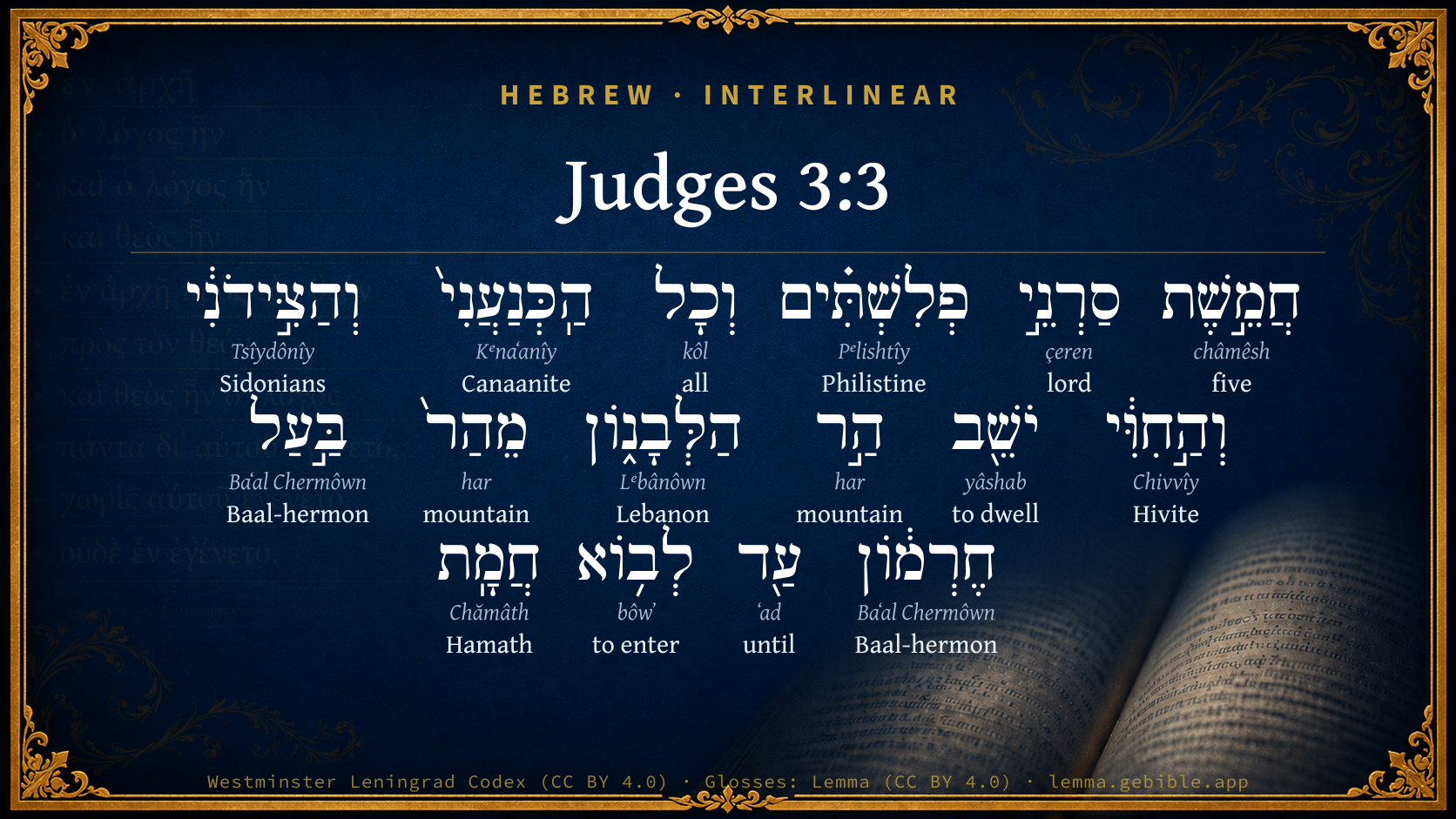
Judges 3:3

Hebrew (Westminster Leningrad Codex) Judges 3:3 appears in the Hebrew Old Testament. The text above is from the Westminster Leningrad Codex. Each word links to its Strong’s number, a concise gloss, and parsing drawn from the Open Scriptures Hebrew Bible morphology. Click any word for its full Brown-Driver-Briggs (BDB) entry.
Download image
Cite this verse

Judges 3:3 (World English Bible). Public Domain. Lemma interlinear Bible study tool, https://lemma.gebible.app/v/judges/3/3.

Show BibTeX & RIS
BibTeX
RIS
English Translation
[namely], the five lords of the Philistines, and all the Canaanites, and the Sidonians, and the Hivites who lived on Mount Lebanon, from Mount Baal Hermon to the entrance of Hamath.
World English Bible · Public Domain
Highlights
  • 1 first appearance in the Hebrew Bible
Full analysis ↓
Download a study sheet

One document with this verse’s original text, its word-by-word gloss line, the meaning frame, cross-references with their text, attributed commentary, and full source and license credits — printable, and it pastes into notes with its structure intact.

This verse Autodidact and up

Study sheet (.html) Plain text (.txt)

A passage Seminary Student

Up to 50 verses in one chapter. A passage sheet keeps up to 6 commentary sources and 12 cross-references per verse, in the order this page ranks them, and says so on the sheet whenever that leaves anything out. Ask for a single verse and you get the Autodidact verse sheet above.

Everything on this page stays free to read, with no account — the sheet is a download of what is already on screen, not access to it.

Want to remove ads? Support Godless Engineer
Compare translations 3

The same verse in 3 English versions, stacked beneath the original-language interlinear above. Click any original word for its lexicon entry.

Each is an independent rendering of the whole verse — the interlinear is not word-aligned to these translations.

Highlighted words mark where these versions differ — a whole-verse word diff, not a word-by-word alignment.

  • World English Bible Public Domain
    [namely], the five lords of the Philistines, and all the Canaanites, and the Sidonians, and the Hivites who lived on Mount Lebanon, from Mount Baal Hermon to the entrance of Hamath.
  • King James Version Public Domain
    Namely, five lords of the Philistines, and all the Canaanites, and the Sidonians, and the Hivites that dwelt in mount Lebanon, from mount Baalhermon unto the entering in of Hamath.
  • unfoldingWord Literal Text CC BY-SA 4.0
    the five rulers of the Philistines, and all of the Canaanite and the Sidonian and the Hivite, the dweller of the mountain of Lebanon, from Mount Baal Hermon to Lebo Hamath.

unfoldingWord Literal Text — © unfoldingWord, licensed CC BY-SA 4.0. Word-aligned USFM3 via Door43 (git.door43.org/unfoldingWord/en_ult).

Versions to compare (up to 4)

3 of 4 selected

Show all 18 translations

Every available English version of this verse, each an independent rendering of the whole verse.

  • World English Bible Public Domain
    [namely], the five lords of the Philistines, and all the Canaanites, and the Sidonians, and the Hivites who lived on Mount Lebanon, from Mount Baal Hermon to the entrance of Hamath.
  • Berean Standard Bible Public Domain
    the five rulers of the Philistines, all the Canaanites, the Sidonians, and the Hivites who lived in the mountains of Lebanon from Mount Baal-hermon to Lebo-hamath.
  • Majority Standard Bible Public Domain
    the five rulers of the Philistines, all the Canaanites, the Sidonians, and the Hivites who lived in the mountains of Lebanon from Mount Baal-hermon to Lebo-hamath.
  • King James Version Public Domain
    Namely, five lords of the Philistines, and all the Canaanites, and the Sidonians, and the Hivites that dwelt in mount Lebanon, from mount Baalhermon unto the entering in of Hamath.
  • American Standard Version (1901) Public Domain
    `namely', the five lords of the Philistines, and all the Canaanites, and the Sidonians, and the Hivites that dwelt in mount Lebanon, from mount Baal-hermon unto the entrance of Hamath.
  • Revised Version (1885) Public Domain
    namely, the five lords of the Philistines, and all the Canaanites, and the Zidonians, and the Hivites that dwelt in mount Lebanon, from mount Baal-hermon unto the entering in of Hamath.
  • Geneva Bible (1599) Public Domain
    Fiue princes of the Philistims, and all the Canaanites, and the Sidonians, and the Hiuites that dwelt in mount Lebanon, from mount Baal-hermon vntill one come to Hamath.
  • Douay-Rheims (1899) Public Domain
    The five princes of the Philistines, and all the Chanaanites, and the Sidonians, and the Hevites that dwelt in mount Libanus, from mount Baal Hermon to the entering into Emath.
  • Young's Literal Translation Public Domain
    five princes of the Philistines, and all the Canaanite, and the Zidonian, and the Hivite inhabiting mount Lebanon, from mount Baal-Hermon unto the entering in of Hamath;
  • Literal Standard Version CC BY-SA 4.0
    five princes of the Philistines, and all the Canaanite, and the Zidonian, and the Hivite inhabiting Mount Lebanon, from Mount Ba‘al-Hermon to the entering in of Hamath;
  • Unlocked Literal Bible CC BY-SA 4.0
    These are the nations: the five kings from the Philistines, all the Canaanites, the Sidonians, and the Hivites who lived in the Lebanon mountains, from Mount Baal Hermon to Hamath Pass.
  • unfoldingWord Literal Text CC BY-SA 4.0
    the five rulers of the Philistines, and all of the Canaanite and the Sidonian and the Hivite, the dweller of the mountain of Lebanon, from Mount Baal Hermon to Lebo Hamath.
  • Darby Bible Public Domain
    These are the nations: the five lords of the Philistines, and all the Canaanites, and the Sido'nians, and the Hivites who dwelt on Mount Lebanon, from Mount Ba'al-her'mon as far as the entrance of Hamath.
  • World Messianic Bible Public Domain
    the five lords of the Philistines, all the Canaanites, the Sidonians, and the Hivites who lived on Mount Lebanon, from Mount Baal Hermon to the entrance of Hamath.
  • Webster's Bible Public Domain
    Namely, five lords of the Philistines, and all the Canaanites, and the Sidonians, and the Hivites that dwelt on mount Lebanon, from mount Baal-hermon to the entrance of Hamath.
  • Free Bible Version CC BY-SA 4.0
    They are: the five rulers of the Philistines, all the Canaanites, the Sidonians, and the Hivites living in the mountains of Lebanon from Mount Baal-hermon to Lebo-hamath.
  • Bible in Basic English Public Domain
    The five chiefs of the Philistines, and all the Canaanites and the Zidonians and the Hivites living in Mount Lebanon, from the mountain Baal-hermon as far as Hamath:
  • JPS Tanakh (1917) Public Domain
    namely, the five lords of the Philistines, and all the Canaanites, and the Zidonians, and the Hivites that dwelt in mount Lebanon, from mount Baal-hermon unto the entrance of Hamath.

Literal Standard Version (2020), Covenant Press — licensed CC BY-SA 4.0. Text via the HelloAO Bible API (eBible.org). Unlocked Literal Bible (unfoldingWord) — licensed CC BY-SA 4.0. Text via the HelloAO Bible API (eBible.org). unfoldingWord Literal Text — © unfoldingWord, licensed CC BY-SA 4.0. Word-aligned USFM3 via Door43 (git.door43.org/unfoldingWord/en_ult). Free Bible Version, Dr. Jonathan Gallagher — licensed CC BY-SA 4.0. Text via the HelloAO Bible API (eBible.org).

Word by word

More ways to search: Search by grammar → Find every occurrence → Compare this word →

Practice this passage: Drill this verse → Learn its vocabulary →

בַּ֣עַל
Baʻal Chermôwn
H1179
“Baal-hermon”
Noun, Proper
Part of Speech
Noun
Type
Proper
Full BDB Definition

Origin: from H1167 and H2768

TWOT: None

Baal-hermon or Baal-chermon = "lord of destruction" - a city near or on Mount Hermon, named as a seat of Baal worship
  1. חֲמֵ֣שֶׁת châmêsh H2568 “five” Adjective, Cardinal number, Masculine, Singular, Construct
  2. סַרְנֵ֣י çeren H5633 “lords of” Noun, Common, Masculine, Plural, Construct
  3. פְלִשְׁתִּ֗ים Pᵉlishtîy H6430 “Philistines” Noun, Gentilic, Masculine, Plural, Absolute
  4. וְכָל kôl H3605 “and · all of” Conjunction + Noun, Common, Masculine, Singular, Construct
  5. הַֽכְּנַעֲנִי֙ Kᵉnaʻanîy H3669 “the · Canaanite” Particle, Definite Article + Noun, Gentilic, Masculine, Singular, Absolute
  6. וְהַצִּ֣ידֹנִ֔י Tsîydônîy H6722 “and · the · Sidonians” Conjunction + Particle, Definite Article + Noun, Gentilic, Masculine, Singular, Absolute
  7. וְהַ֣חִוִּ֔י Chivvîy H2340 “and · the · Hivite” Conjunction + Particle, Definite Article + Noun, Gentilic, Masculine, Singular, Absolute
  8. יֹשֵׁ֖ב yâshab H3427 “dwelling” Verb, Qal, Participle Active, Masculine, Singular, Absolute
  9. הַ֣ר har H2022 “mountain of” Noun, Common, Masculine, Singular, Construct
  10. הַלְּבָנ֑וֹן Lᵉbânôwn H3844 “the · Lebanon” Particle, Definite Article + Noun, Proper
  11. מֵהַר֙ har H2022 “from · mountain of” Preposition + Noun, Common, Masculine, Singular, Construct
  12. חֶרְמ֔וֹן Baʻal Chermôwn H1179 “Baal-hermon” Noun, Proper
  13. עַ֖ד ʻad H5704 “until” Preposition
  14. לְב֥וֹא bôwʼ H935 “entrance” Noun, Proper
  15. חֲמָֽת Chămâth H2574 “Hamath” Noun, Proper

About this verse

These counts appear in no published source. They are computed here, from the morphology-tagged text and Lemma’s own curated glosses. What Lemma adds →

16
words
14
distinct lemmas
Historical
section

Notable vocabulary

The rarest word here is בַּ֣עַל Baal-hermon H1179 — appearing just 4 times in the whole Hebrew Bible.

First appearance in Scripture

This word makes its first canonical appearance in the Hebrew Bible here:

  • בַּ֣עַל Baal-hermon H1179

Shared distinctive vocabulary

בַּ֣עַל Baal-hermon H1179 occurs in 2 verses of the Hebrew Bible. Also found in:

Grammatical profile

  • 1 verb
  • 13 nouns
  • 1 adjective
  • 1 preposition

Verb forms

  • יֹשֵׁ֖ב Qal · Participle Active

Repetition

Words recur within this verse — often emphatic in Hebrew:

  • הַ֣ר mountain H2022 ×2
  • בַּ֣עַל Baal-hermon H1179 ×2

Hebrew & Septuagint length

In English translation the verse runs 31 words from the Hebrew and 26 from the Septuagint (LXX English) — closely comparable.

A rough comparison of the two English renderings, which tokenize alike — not a word-level alignment.

Word counts can differ between the Hebrew and the Greek without any difference in meaning — e.g. the Hebrew direct-object marker אֵת has no separate Greek word, and Greek often adds the article ὁ.

In the original languages it is 16 Hebrew tokens and 26 Greek tokens — but the two are counted differently (Hebrew bundles its prefixes and suffixes into one token; the Greek is in lemma form), so that isn’t a like-for-like length.

Cross-references

22

Topical passages linked to Judges 3:3 in the Treasury of Scripture Knowledge — connected by theme and wording, ordered by reader-vote popularity; previews shown in the World English Bible.

  • Joshua 13:3 from the Shihor, which is before Egypt, even to the border of Ekron northward, [which] is reckoned to the Canaanites; the five lords of the Philistines; the Gazites, and the Ashdodites, the Ashkelonites, the Gittites, and the Ekronites; also the Avvim,
  • Joshua 13:5 and the land of the Gebalites, and all Lebanon, toward the sunrise, from Baal Gad under Mount Hermon to the entrance of Hamath;
  • Genesis 10:15–19 Canaan became the father of Sidon (his firstborn), Heth,
  • Genesis 49:13 "Zebulun will dwell at the haven of the sea. He will be for a haven of ships. His border will be on Sidon.
  • Numbers 13:29 Amalek dwells in the land of the South: and the Hittite, and the Jebusite, and the Amorite, dwell in the hill-country; and the Canaanite dwells by the sea, and along by the side of the Jordan.
  • Numbers 34:8 from Mount Hor you shall mark out to the entrance of Hamath; and the goings out of the border shall be at Zedad;
  • Deuteronomy 1:7 turn you, and take your journey, and go to the hill-country of the Amorites, and to all [the places] near thereunto, in the Arabah, in the hill-country, and in the lowland, and in the South, and by the sea-shore, the land of the Canaanites, and Lebanon, as far as the great river, the river Euphrates.
  • Deuteronomy 3:9 ([which] Hermon the Sidonians call Sirion, and the Amorites call it Senir;)
  • Joshua 11:3 to the Canaanite on the east and on the west, and the Amorite, and the Hittite, and the Perizzite, and the Jebusite in the hill-country, and the Hivite under Hermon in the land of Mizpah.
  • Joshua 11:8–13 Yahweh delivered them into the hand of Israel, and they struck them, and chased them to great Sidon, and to Misrephoth Maim, and to the valley of Mizpeh eastward; and they struck them, until they left them none remaining.
  • Joshua 19:28 and Ebron, and Rehob, and Hammon, and Kanah, even to great Sidon;
  • Judges 4:2 Yahweh sold them into the hand of Jabin king of Canaan, who reigned in Hazor; the captain of whose host was Sisera, who lived in Harosheth of the Gentiles.
  • Judges 4:23–24 So God subdued on that day Jabin the king of Canaan before the children of Israel.
  • Judges 10:7 The anger of Yahweh was kindled against Israel, and he sold them into the hand of the Philistines, and into the hand of the children of Ammon.
  • Judges 10:12 The Sidonians also, and the Amalekites, and the Maonites, did oppress you; and you cried to me, and I saved you out of their hand.
  • Judges 14:4 But his father and his mother didn't know that it was of Yahweh; for he sought an occasion against the Philistines. Now at that time the Philistines had rule over Israel.
  • Judges 18:7 Then the five men departed, and came to Laish, and saw the people who were therein, how they lived in security, after the manner of the Sidonians, quiet and secure; for there was none in the land, possessing authority, that might put [them] to shame in anything, and they were far from the Sidonians, and had no dealings with any man.
  • 1 Samuel 4:1–2 The word of Samuel came to all Israel. Now Israel went out against the Philistines to battle, and encamped beside Ebenezer: and the Philistines encamped in Aphek.
  • 1 Samuel 6:18 and the golden mice, according to the number of all the cities of the Philistines belonging to the five lords, both of fortified cities and of country villages, even to the great stone, whereon they set down the ark of Yahweh, [which stone remains] to this day in the field of Joshua the Beth-shemite.
  • 1 Samuel 13:5 The Philistines assembled themselves together to fight with Israel, thirty thousand chariots, and six thousand horsemen, and people as the sand which is on the sea-shore in multitude: and they came up, and encamped in Michmash, eastward of Beth Aven.
  • 1 Samuel 13:19–23 Now there was no smith found throughout all the land of Israel; for the Philistines said, Lest the Hebrews make them swords or spears:
  • 1 Samuel 29:2 The lords of the Philistines passed on by hundreds, and by thousands; and David and his men passed on in the rearward with Achish.

Cross-references courtesy of OpenBible.info (CC BY 4.0).

Hebrew and Greek witnesses Masoretic Hebrew ↔ Greek Septuagint

The same verse in the two great witnesses to the Old Testament, shown verse-for-verse.

These are two independent witnesses, not word-aligned to each other, and the Septuagint is shown in lemma (dictionary) form.

Hebrew Judges 3:3 Masoretic · Westminster Leningrad Codex

חֲמֵ֣שֶׁת סַרְנֵ֣י פְלִשְׁתִּ֗ים וְכָל הַֽכְּנַעֲנִי֙ וְהַצִּ֣ידֹנִ֔י וְהַ֣חִוִּ֔י יֹשֵׁ֖ב הַ֣ר הַלְּבָנ֑וֹן מֵהַר֙ בַּ֣עַל חֶרְמ֔וֹן עַ֖ד לְב֥וֹא חֲמָֽת

[namely], the five lords of the Philistines, and all the Canaanites, and the Sidonians, and the Hivites who lived on Mount Lebanon, from Mount Baal Hermon to the entrance of Hamath.

World English Bible · Public Domain

Greek LXX Judges 3:3 Septuagint · lemma form

ὁ πέντε σατραπεία ὁ ἀλλόφυλος καί πᾶς ὁ χαναναῖος καί ὁ σιδώνιος καί ὁ ευαῖος ὁ καταοἰκέω ὁ λίβανος ἀπό ὁ ὄρος ὁ αερμων ἕως λαβωεμαθ

The five lordships of the Phylistines, and every Chananite, and the Sidonian, and the Evite who lived in Libanus from the mount of Aermon to Laboemath.

LXX2012 (modern English Septuagint) · Public Domain

On this verse, Ellicott's Commentary for English Readers discusses the Septuagint’s reading. Read the note in Commentary ↓

Hebrew: Westminster Leningrad Codex (CC BY 4.0). Greek: Septuagint (public domain); English from LXX2012 (modern English Septuagint) (Public Domain). How the Septuagint differs from the Hebrew →

Targum (Aramaic paraphrase)

1

The Targum is the ancient Jewish Aramaic paraphrase of the Hebrew Scriptures — an interpretive translation, not the Hebrew text itself. Onkelos (literal) and Pseudo-Jonathan (expansive) render the Torah, and Jonathan the Prophets. Coverage is partial: where no permissively-licensed English translation exists for a verse, only the Aramaic is shown. This is verse-level text, not a word-by-word alignment to the Hebrew.

  1. Targum Jonathan Prophets (Joshua–Malachi)
    חַמְשָׁא טוּרְנֵי פְּלִשְׁתָּאֵי וְכָל כְּנַעֲנָאֵי וְצִידוֹנָאֵי וְחִוָאֵי יַתְבֵי טוּרָא דִלְבָנוֹן מִטוּר מֵישַׁר חֶרְמוֹן עַד מַעֲלָנָא דַחֲמָת:

    (no public-domain English translation for this verse)

    Targum Jonathan — Aramaic: “Mikraot Gedolot” (public domain). English: “Sefaria Community Translation” (CC0 1.0 (public-domain dedication)); “London "Chaldee Paraphrase," 1871” (public domain). Text via Sefaria.

Commentary

Notes on Judges 3:3 from classic Christian and Jewish commentators (each source and its license shown beneath its notes). The classic Christian expositions comment on the surrounding passage and are grouped to its opening verse, so a note may address several verses; the Jewish commentaries on the Tanakh (Rashi and others) are per-verse, so they appear only where the commentator wrote on this verse.

Lemma curates 59 commentaries, every one of them public domain or Creative Commons licensed, each selected and text-cleaned for this edition rather than reprinted as found. About our sources →

Trapp's Complete Commentary

John Trapp

Jdg 3:3 [Namely], five lords of the Philistines, and all the Canaanites, and the Sidonians, and the Hivites that dwelt in mount Lebanon, from mount Baalhermon unto the entering in of Hamath.

Ver. 3. Five lords of the Philistines.] Three of them had been subdued; {Jdg 1:18} but were now lost again.

John Trapp, A Commentary or Exposition upon All the Books of the Old and New Testament (1647–1656) — public domain. Text from a community e-Sword module.

Joseph Benson's Commentary

Jdg 3:3. Five lords of the Philistines — See Jos 13:2-3, and Jdg 1:18, where it appears that three of them had been, in some measure, subdued, but had now recovered their country again, in consequence of the slothful conduct of the Israelites. All the Canaanites — Properly so called, who were very numerous, and dispersed through several parts of the land, whence they gave denomination to all the rest of the people. Sidonians — The people living near Zidon, and subject to its jurisdiction. Baal-hermon — Which was the eastern part about Lebanon.

Joseph Benson's Commentary on the Old and New Testaments (1811–1818) — public domain. Text from a community e-Sword module.

Ellicott's Commentary for English Readers

(3) Five lords of the Philistines.—The princes of the Pentapolis, Gaza, Ashdod, Askelon, Gath, Ekron. The word rendered “lords” is evidently a technical or local title—Seranim. It is rendered by the LXX. “satrapies,” and by the Vulgate, “satraps.” It is variously derived from seren, “a hinge” (comp. “cardinal” from “cardo”); from sar, “a prince,” being interchanged with sarim, in 1 Sam. 13:30; 1Sa_29:6 (Ewald, i. 332); and from some Phœnician root. For the Philistines, see Jdg_13:1.

All the Canaanites.—Of the shephçlah or maritime plain.

The Sidonians.—In Gen_10:15 “Sidon” is the eldest son of Canaan. They maintained their complete independence to the last.

The Hivites that dwelt in Mount Lebanon.—In Jos_11:3 they are described as living “under Hermon, in the land at Mizpeh,” whence Mizpeh has been identified with “el-Mutalleh,” which also means “the look-out” or “watch-tower.” The name has been derived from Havvah, a circular encampment or village, because they lived (as they do to this day in northern Syria) in circular villages, with enclosures for cattle in the centre. Ewald ( i. 318) supposes that the word means “midlanders,” and Gesenius “villagers.” The Hivite is the sixth son of Canaan, in Gen_10:17.

Mount Baal-hermon unto the entering in of Hamath.—In Jos_13:5 we have “from Baal-gad under mount Hermon unto,” &c. Baal-gad is also mentioned in Jos_12:7; Jos_11:17, and is usually supposed to be Paneas or Cesarea Philippi. It was probably a temple of Baal, but must be farther south than Baalbek. The hill of Paneas is therefore, in all probability, “ Mount Baal-hermon,” and Baal-hermon may be only another name for Baal-gad. Fürst supposes that both Gad and Gedi (in Engedi) are names of Astarte.

The entering in of Hamath.—This is the usual phrase to describe the northern boundary of Canaan. The LXX. take it as a proper name, Labo emath.

A Bible Commentary for English Readers, edited by Charles John Ellicott (1878–1897) — public domain. Text from a community e-Sword module.

The Cambridge Bible for Schools and Colleges

gen. ed. J. J. S. Perowne

3. This verse should be compared with Jos_13:2-6 D. The nations here are those occupying particular districts in W. Palestine; contrast Jdg_3:5, and the races mentioned in ch. 1.

the five lords of the Philistines] Probably one for each of the five cities named in 1Sa_6:17, cf. Jos_13:3. The word for ‘lords’ (seren, sing.) is only found in this connexion, cf. ch. 16; it is evidently a native title.

and all the Canaanites] Hardly the entire population of W. Palestine, as in J (see Jdg_1:34 n.), but ‘Canaanites’ in the restricted sense found in E and D, viz. the inhabitants of the sea coast and Jordan valley, cf. Num_13:29 E; Deu_1:7; Deu_11:30; Jos_5:1; Jos_13:3 f. D; Zep_2:5. Similarly in the Amarna tablets Kinaḥḥi (Canaan), and in some Egypt. inscr. Ka-n-’-na as a geographical term, appears to be limited to the northern ‘lowland ‘or sea coast (Ency. Bibl. art. Canaan).

the Zidonians] is a general term for the Phoenicians, used in the O.T. (Deu_3:9; Jos_13:4; Jos_13:6; Jdg_10:12; Jdg_18:7 etc.), by the Assyrians, and the Greeks, and the Phoenicians themselves1[25]

[25] See NSI., pp. 54, 352.

the Hivites that dwelt in mount Lebanon] Elsewhere the Hivites inhabit the centre of Canaan, Gen_34:2, Jos_9:7 etc.; the Lebanon district belonged to the kingdom of the Hittites (Jdg_1:26 n.), which extended from the far N.W. till it touched Canaan at this point. Hence for Hivites read Hittites, cf. Jos_11:3 LXX

mount Baal-hermon] i.e. the mountain to which the town of Baal-hermon (1Ch_5:23) gave its name. But such a designation is contrary to usage; Jos_13:5 D, in a passage closely resembling this, has ‘Baal-gad under Mt Hermon,’ which may be the correct reading here (Budde, Nowack); or we may simply follow LXX. cod. B ‘mount H.’

the entering in of Hamath] frequently marks the N. boundary of Canaan or of Israel, Num_13:21; Num_34:8; Jos_13:5; 1Ki_8:65; 2Ki_14:25 etc. The ‘Entrance of H.’ is the great valley between Lebanon and Hermon-Antilibanus, called Coele-Syria in classical times, and now ‘The Valley’ (El-Biḳa‘, cf. Jos_11:17); Moore, however, considers it to have been the plain of Ḥömṣ, 30 m. S. of Hamaṭh. The city itself (now Ḥamâ) lay on the Orontes, about 150 m. N. of Dan, but its territory stretched 50 m. to the S., as far as Riblah (2Ki_23:33). Hamath is mentioned in Egyptian monuments and the Amarna letters before the Israelite invasion, and in the inscrr. of the Assyrian kings (Schrader COT. 323).

The Cambridge Bible for Schools and Colleges (gen. ed. J. J. S. Perowne; Cambridge University Press, 1878–1918) — public domain. Text from a community e-Sword module.

John Gill's Exposition

Namely, five lords of the Philistines,.... The places they were lords of were Gaza, Ashdod, Ashkelon, Gath, and Ekron; see Jos 13:3; three of these, Gaza, Ashkelon, and Ekron, had been taken from them by Judah, since the death of Joshua, Jdg 1:18; but they soon recovered them again, perhaps by the help of the other two. The Philistines were a people originally of Egypt, but came from thence and settled in these parts, and were here as early as in the times of Abraham, and were very troublesome neighbours to the Israelites in later times; see Gen 10:14,

and all the Canaanites; these were a particular tribe or nation in the land so called, which inhabited by the sea, and by the coast of Jordan, Num 13:29; otherwise this is the general name for the seven nations:

and the Sidonians; the inhabitants of the famous city of Sidon, which had its name from the firstborn of Canaan, Gen 10:15,

and the Hivites that dwelt in Mount Lebanon; on the north of the land of Canaan:

from Mount Baalhermon; the eastern part of Lebanon, the same with Baalgad, where Baal was worshipped:

unto the entering in of Hamath; the boundary of the northern part of the land, which entrance led into the valley between Libanus and Antilibanus; see Num 34:8.

John Gill's Exposition of the Whole Bible (1746–1763) — public domain (CC PDM 1.0). Text via the HelloAO Bible API.

Albert Barnes' Notes on the Bible

Lords - Seranim, a title used exclusively of the princes of the five Philistine cities. The title is probably of Phoenician origin.

Joshua appears to have smitten and subdued the Hivites as far north as Baal-Gad, in the valley of Lebanon under Mount Hermon Jos 11:17; Jos 12:7, but no further Jos 13:5. There was an unsubdued Hivite population to the north of Baal-hermon (probably Baal-Gad under Hermon, since it is not synonymous with Hermon; see 1Ch 5:23), to the entering in of Hamath: i. e. in the fertile valley of Coele-Syria. Hamath is always spoken of as the extreme northern boundary of the land of Canaan. It was the gate of approach to Canaan from Babylon, and all the north Zec 9:2; Jer 39:5. It formed part of the dominions of Solomon 2Ch 8:4, and of the future inheritance of Israel, as described in vision by Ezekiel Eze 47:16.

Albert Barnes' Notes on the Bible (1834–1885) — public domain. Text from a community e-Sword/MySword module.

Haydock's Catholic Bible Commentary

Princes, (satrapas) a Persian word. (Menochius) --- These heads of the five great cities of the Philistines, are called Seranim, (Haydock) but never kings, whether they were governors of so many petty states, united in the same form of republican or aristocratical government, or independent of each other. See Josue xiii. Three of these cities are said to have been take by Juda, (chap. i. 18,) unless the Septuagint be more accurate, as this passage would seem to insinuate. (Calmet) --- They might have thrown off the yoke in a short time, as we before observed. These five cities were Gaza, Geth, Ascalon, Azotus, and Accaron. (Haydock) --- All but Geth were on the Mediterranean sea. (Calmet) --- All the Chanaanites, &c., who dwelt in Libanus, with some others, who were dispersed though the country, ver. 5. (Haydock) --- These chiefly inhabited the environs of Sidon. --- Baal Hermon. The idol of Baal might probably be adored on this mountain. (Menochius) --- We find Baal-gad in the same neighbourhood, and both may mean the same city. (Calmet)

George Leo Haydock (1774–1849), Haydock's Catholic Family Bible and Commentary, 1859 edition — public domain. Excludes Psalms (Douay-Rheims chapter numbering differs from Protestant) and Deuterocanonical books (Catholic canon only).

Matthew Poole's English Annotations

Five lords of the Philistines; whereof three had been in some sort subdued, Jdg 1:18, but afterwards rescued themselves, and recovered their former strength. See Poole on "Jdg 1:18".

The Canaanites; properly so called, who were very numerous, and dispersed through several parts of the land whence they gave denomination to all the rest of the people.

The Sidonians; the people living near Sidon, and subject to its jurisdiction.

Mount Baal-hermon was the eastern part of Mount Lebanon: see Deu 3:8,9.

Matthew Poole's English Annotations on the Holy Bible (1683–1685) — public domain. Text from a community e-Sword/MySword module.

Whedon's Commentary on the Bible

Daniel D. Whedon

3. Five lords of the Philistines — Namely, the kings or chiefs of the five great cities, Gaza, Ashdod, Eshkalon, Gath, and Ekron. See notes on Jos_13:2-6, with which passage this is substantially identical. The Canaanites, as distinguished here from the Sidonians, are probably to be understood of the tribes or natives south of Phenicia, and near the plain of Esdraelon. Hazor was probably the seat of their principal kingdom. Chap.

Jdg_4:2.

The Hivites that dwelt in Mount Lebanon — The range of Lebanon in the north seems to have been the chief seat of the Hivites after the time of Joshua, and they had many cities there in the time of David. 2Sa_24:7. Baal-hermon is supposed by some to be another name for Baal-gad, mentioned Jos_11:17; Jos_13:5; but it seems most natural to understand Mount Baal-hermon to be the well known Mount Hermon, the modern Jebelesh-Sheikh. Here, probably, was a notable sanctuary of Baal, which gave its name to the whole mountain.

Hamath — See note on Jos_13:5.

Daniel D. Whedon (gen. ed.), Commentary on the Old and New Testaments (1874–1909) — public domain. Text from a community e-Sword module.

The Pulpit Commentary

The five lords, etc. The title seren, here rendered "lord," is one exclusively applied to the lords of the five Philistine cities enumerated in Jos_13:3 1Sa_6:17, 1Sa_6:18, viz., Gaza, Ashdod, Ashkelon, Gath, and Ekron. It occurs repeatedly in Jud_1:16 1Sa 5 Jud_1:6, etc. The word means an axle-tree. The entering in of Hamath. There are two theories in regard to Hamath. Some, as Professor Rawlinson in the "Dictionary of the Bible," identify it with Hamah , a large and important city on the Orontes in Upper Syria, and consider that the kingdom of Hamath, which was overthrown by the king of Assyria, (2Ki_18:34 2Ki_19:13) and of which Hamath was the capital, was for the most part an independent Hamitic or Canaanite kingdom, (Gen_10:18) but occasionally, as in the days of Solomon and Jeroboam, (1Ki_8:65 2Ki_14:28 2Ch_8:4) subject to Israel Others, however, justly considering the great improbability of the Israelite dominion having ever extended so far north as the valley of the Orontes, and observing how it is spoken of as an integral part of Israel, (1Ki_8:65) look for Hamath much further south, in the neighbourhood of Beth-rehob. (see Jud_1:18:28, note) As regards the phrase "the entering in of Hamath," the identical Hebrew words occur seven times, viz., Num_13:21 Num_34:8 Jos_13:5; in this passage; 1Ki_8:65 2Ki_14:25 2Ch_7:8, and are variously rendered in the A.V: "as men come to Hamath;" "unto the entrance of Hamath;" "the entering into Hamath;" "the entering in of Hamath (three times); and the entering of Hamath." The exact meaning of the phrase seems to be "the approach to Hamath," some particular spot in the valley from whence the direct road to Hamath begins; very much like the railway term for certain stations which are the nearest to, though at some little distance from, the place from which they are named, as, e.g. , Shapwick Road, Mildenhall Road, etc. The latter words of the verse describe the territory of the Hivites, which reached from Mount Baal-hermon in the Lebanon range as far as the point where the road leads to Hamath.

The Pulpit Commentary (1880–1919), ed. H.D.M. Spence-Jones & Joseph S. Exell — public domain. Text from a community e-Sword module.

John Wesley's Explanatory Notes

Five lords - Whereof three had been in some sort subdued, chap. i, 18. but afterwards recovered their strength. Canaanites - Properly so called, who were very numerous, and dispersed through several parts of the land, whence they gave denomination to all the rest of the people. Zidonions - The people living near Zidon, and subject to its jurisdiction. Baal-hermon - Which was the eastern part about Lebanon.

John Wesley, Explanatory Notes Upon the Whole Bible (1754–1765) — public domain. Text via the GEBible commentary corpus.

Rashi

Rabbi Shlomo Yitzchaki (Rashi)

Five Pelishtite sovereignties. These were the nations whom He permited to remain as a test.

Rashi on the Tanakh — English translations: “The Judaica Press complete Tanach with Rashi, translated by A. J. Rosenberg” (CC BY 4.0); “Pentateuch with Rashi's commentary by M. Rosenbaum and A.M. Silbermann, 1929-1934” (public domain); “The Metsudah Tanach series, Lakewood, N.J” (CC BY 4.0); and “The Book of Joshua, Metsudah Publications, 1997” (CC BY 4.0). Text via Sefaria.

Lesson kit

Teaching starters — assembled from the data on this page, not authored interpretation. Every prompt links to the verse data it draws on. Edit before teaching.

Judges, in the Historical, opens this verse with 16 words (14 distinct Hebrew lemmas). Its most distinctive word is Baʻal Chermôwn (“Baal-hermon”). A historical commentator’s framing appears above. Read the whole chapter for the surrounding context.

Discussion questions

  1. The word Baʻal Chermôwn carries the sense “Baal-hermon.” How does it shape the verse?
  2. The word “Baal-hermon” first appears here in Scripture. What is being introduced at this debut?
  3. 1 Chronicles 5:23 shares the word «Baal-hermon» with this verse. How do the two illuminate each other?
  4. “mountain” occurs 2× in this one verse. What is the effect of the repetition?
  5. The translations on this page render this verse differently — a whole-verse word diff, not a word-by-word alignment. What might account for the different wordings?
  6. The verb «יֹשֵׁ֖ב» is Qal Participle Active. How does its form color the action?
  7. Reading how Trapp's Complete Commentary and Joseph Benson's Commentary read this verse, where do the two commentators agree and where do they part?

Things to notice

Reading settings

Reading text

Shown beneath each verse's original-language words.

Old Testament
Old Testament edition

Read the OT as the Masoretic Hebrew (MT) or the Greek Septuagint (LXX).

English shown for the Greek Septuagint (in the Hebrew ↔ Greek comparison).

Comparing translations? Open the Compare panel on any verse page to stack up to four side by side.