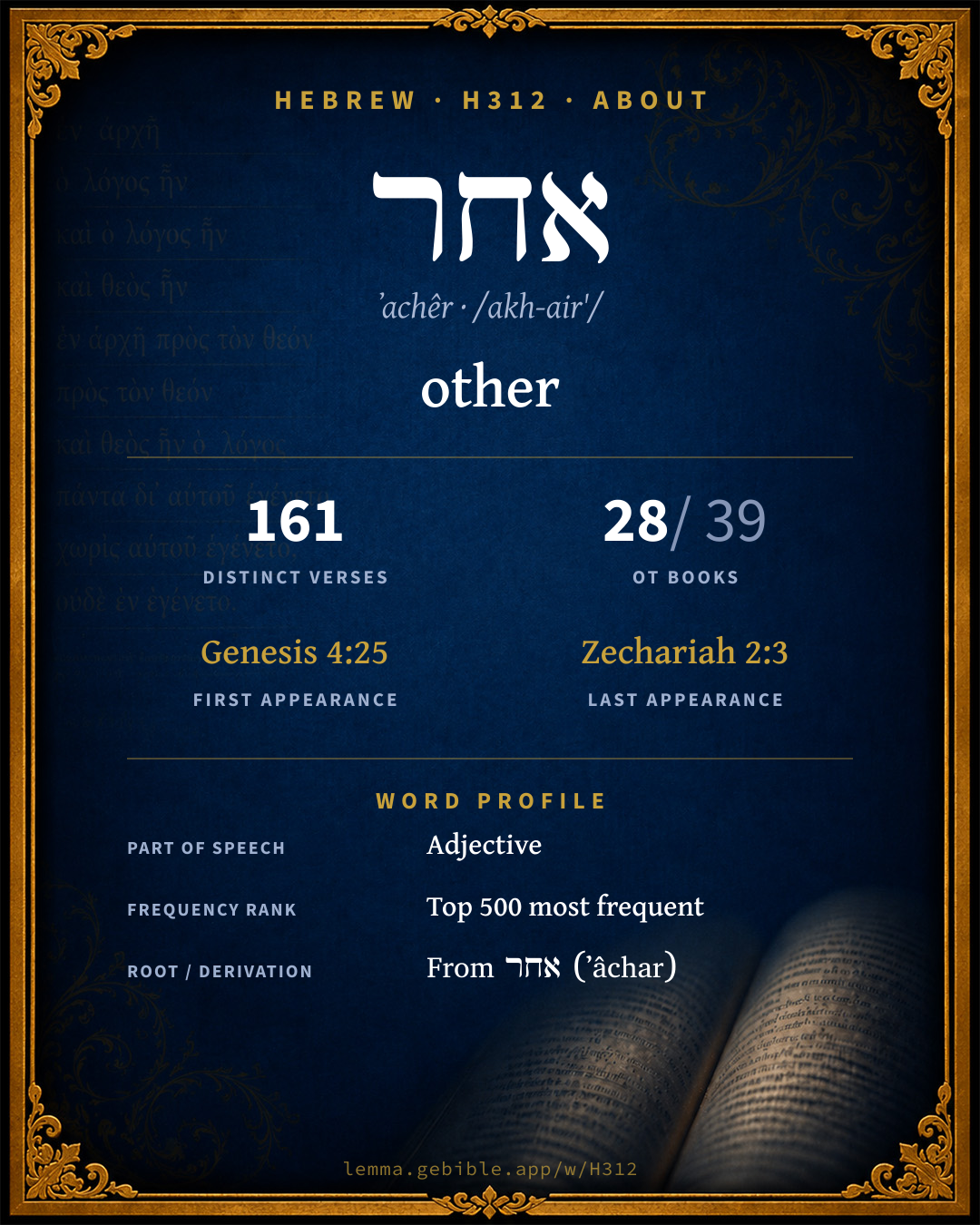
אַחֵר
other
also: another, following fuller range ↓
Full lexicon entry — Brown-Driver-Briggs (BDB)
From Brown-Driver-Briggs (BDB)
Where this word appears
Grammar key — what these labels mean
Part of speech
- Adjective
- A word that describes or qualifies a noun.
State
- Absolute
- The independent form of a noun, not bound to a following word.
Gender
- Masculine
- Grammatically masculine.
- Feminine
- Grammatically feminine.
Number
- Plural
- More than one (in Hebrew, generally three or more).
- Singular
- One.
Every verse where H312 appears in the Book of Jeremiah — 25 distinct verses. Click any verse to open its interlinear word-by-word view. Verse text shown in the World English Bible for context — . Each verse’s Hebrew form is shown with its reference; the English is not keyword-highlighted, since the data carries no word-level English alignment. Use “Compare translations” on any verse to read it across multiple English versions. This concordance covers the Hebrew Bible; Septuagint (Greek Old Testament) occurrences are not indexed here.
Jeremiah
- Jeremiah 1:16 אֲחֵרִ֔ים adj Adjective mp I will utter my judgments against them touching all their wickedness, in that they have forsaken me, and have burned incense to other gods, and worshiped the works of their own hands.
- Jeremiah 3:1 אַחֵ֗ר adj Adjective ms They say, If a man put away his wife, and she go from him, and become another man's, will he return to her again? Won't that land be greatly polluted? But you have played the prostitute with many lovers; yet return again to me, says Yahweh.
- Jeremiah 6:12 לַ/אֲחֵרִ֔ים prep + Adjective Adjective mp Their houses shall be turned to others, their fields and their wives together; for I will stretch out my hand on the inhabitants of the land, says Yahweh.
- Jeremiah 7:6 אֲחֵרִ֛ים adj Adjective mp if you don't oppress the foreigner, the fatherless, and the widow, and don't shed innocent blood in this place, neither walk after other gods to your own hurt:
- Jeremiah 7:9 אֲחֵרִ֖ים adj Adjective mp Will you steal, murder, and commit adultery, and swear falsely, and burn incense to Baal, and walk after other gods that you have not known,
- Jeremiah 7:18 אֲחֵרִ֔ים adj Adjective mp The children gather wood, and the fathers kindle the fire, and the women knead the dough, to make cakes to the queen of the sky, and to pour out drink-offerings to other gods, that they may provoke me to anger.
- Jeremiah 8:10 לַ/אֲחֵרִ֗ים prep + Adjective Adjective mp Therefore will I give their wives to others, and their fields to those who shall possess them: for everyone from the least even to the greatest is given to covetousness; from the prophet even to the priest every one deals falsely.
- Jeremiah 11:10 אֲחֵרִ֖ים adj Adjective mp They are turned back to the iniquities of their forefathers, who refused to hear my words; and they are gone after other gods to serve them: the house of Israel and the house of Judah have broken my covenant which I made with their fathers.
- Jeremiah 13:10 אֲחֵרִ֔ים adj Adjective mp This evil people, who refuse to hear my words, who walk in the stubbornness of their heart, and are gone after other gods to serve them, and to worship them, shall even be as this belt, which is profitable for nothing.
- Jeremiah 16:11 אֲחֵרִ֔ים adj Adjective mp Then shall you tell them, Because your fathers have forsaken me, says Yahweh, and have walked after other gods, and have served them, and have worshiped them, and have forsaken me, and have not kept my law;
- Jeremiah 16:13 אֲחֵרִים֙ adj Adjective mp therefore will I cast you forth out of this land into the land that you have not known, neither you nor your fathers; and there shall you serve other gods day and night; for I will show you no favor.
- Jeremiah 18:4 אַחֵ֔ר adj Adjective ms When the vessel that he made of the clay was marred in the hand of the potter, he made it again another vessel, as seemed good to the potter to make it.
- Jeremiah 19:4 אֲחֵרִ֔ים adj Adjective mp Because they have forsaken me, and have estranged this place, and have burned incense in it to other gods, that they didn't know, they and their fathers and the kings of Judah; and have filled this place with the blood of innocents,
- Jeremiah 19:13 אֲחֵרִֽים adj Adjective mp and the houses of Jerusalem, and the houses of the kings of Judah, which are defiled, shall be as the place of Topheth, even all the houses on whose roofs they have burned incense to all the host of the sky, and have poured out drink-offerings to other gods.
- Jeremiah 22:9 אֲחֵרִ֖ים adj Adjective mp Then they shall answer, Because they forsook the covenant of Yahweh their God, and worshiped other gods, and served them.
- Jeremiah 22:26 אַחֶ֔רֶת adj Adjective fs I will cast you out, and your mother who bore you, into another country, where you were not born; and there shall you die.
- Jeremiah 25:6 אֲחֵרִ֔ים adj Adjective mp and don't go after other gods to serve them or worship them, and don't provoke me to anger with the work of your hands; and I will do you no harm.
- Jeremiah 32:29 אֲחֵרִ֔ים adj Adjective mp and the Chaldeans, who fight against this city, shall come and set this city on fire, and burn it, with the houses, on whose roofs they have offered incense to Baal, and poured out drink-offerings to other gods, to provoke me to anger.
- Jeremiah 35:15 אֲחֵרִים֙ adj Adjective mp I have sent also to you all my servants the prophets, rising up early and sending them, saying, Return you now every man from his evil way, and amend your doings, and don't go after other gods to serve them, and you shall dwell in the land which I have given to you and to your fathers: but you have not inclined your ear, nor listened to me.
- Jeremiah 36:28 אַחֶ֑רֶת adj Adjective fs Take again another scroll, and write in it all the former words that were in the first scroll, which Jehoiakim the king of Judah has burned.
- Jeremiah 36:32 אַחֶ֗רֶת adj Adjective fs Then took Jeremiah another scroll, and gave it to Baruch the scribe, the son of Neriah, who wrote therein from the mouth of Jeremiah all the words of the book which Jehoiakim king of Judah had burned in the fire; and there were added besides to them many like words.
- Jeremiah 44:3 אֲחֵרִ֑ים adj Adjective mp because of their wickedness which they have committed to provoke me to anger, in that they went to burn incense, [and] to serve other gods, that they didn't know, neither they, nor you, nor your fathers.
- Jeremiah 44:5 אֲחֵרִֽים adj Adjective mp But they didn't listen, nor inclined their ear to turn from their wickedness, to burn no incense to other gods.
- Jeremiah 44:8 אֲחֵרִים֙ adj Adjective mp in that you provoke me to anger with the works of your hands, burning incense to other gods in the land of Egypt, where you are gone to sojourn; that you may be cut off, and that you may be a curse and a reproach among all the nations of the earth?
- Jeremiah 44:15 אֲחֵרִ֔ים adj Adjective mp Then all the men who knew that their wives burned incense to other gods, and all the women who stood by, a great assembly, even all the people who lived in the land of Egypt, in Pathros, answered Jeremiah, saying,
About this entry
At a glance — auto-summarized from this page’s data, not written by a person. Every figure links to its source below. This summary describes the numbers; it doesn’t interpret them.
“other” is the headline sense of the Hebrew adjective אחר (ʼachêr). Scripture first uses it in Genesis 4:25. It appears 161 verses across 28 books of the Hebrew Bible, among its common vocabulary. Not a single-sense word, it carries 3 senses, among them “another” and “following”. It shares a root with אחר, אחר and אחרון. The sections below give every sense, occurrence, and version rendering.
Gloss history
Strong's 1890 vs modern scholarship
About this word
Strong's H312 catalogs a Hebrew word from the Hebrew Old Testament.
These counts are not copied from any lexicon or concordance. They are computed here, from the morphology-tagged Hebrew Old Testament. What Lemma adds →
- 161
- distinct verses
- The word appears in 161 distinct verses.
- 28 / 39
- OT books
- The word appears in 28 of 39 Old Testament books.
- #276
- by frequency
- Top 500 most frequent Hebrew words (rank 276 of 8,640 Hebrew words by occurrence).
View all 161 occurrences in the concordance →
Most concentrated in
- Deuteronomy 25 verses 16%
- Jeremiah 25 verses 16%
- Genesis 15 verses 9%
By section of the Old Testament
By traditional corpus
Conventional, traditional groupings — biblical authorship is debated, so this is a traditional corpus grouping, not an authorship claim. Each share is this word’s portion of its verses in that division of the Hebrew canon. Each figure is a share of the word’s 161 distinct verses.
- Prophets (Nevi'im) 76 verses · 47%
- Torah (Pentateuch) 52 verses · 32%
- Writings (Ketuvim) 33 verses · 20%
How translations render this word
Counts come from each version’s own published word-to-Strong’s tagging or interlinear alignment — an approximate guide to how each version renders this word, not a word-level alignment the data otherwise carries. Because each total is that version’s own tagged count, the per-version totals vary from one another and need not match the appearance or distinct-verse counts above. These counts may also differ from a printed concordance because Lemma counts each distinctly tagged rendering and does not collapse phrase taggings into a single head-word total. This is a fixed set of word-tagged versions (KJV, ASV, BSB, ULT) and does not change with the reading translation you choose elsewhere. Each version’s license is shown beside its name below (and on Sources).
BDB lists this Strong’s number as 2 distinct words (homographs). Each count above pools all of them and is not split by sense — see the Senses section below. A low-frequency rendering may belong to a different one of those words, not the primary meaning.
- King James Version†: Other 89×, Another 44×, Others 7×
- American Standard Version†: Other 79×, Another 40×, Others 5×
- Berean Standard Bible†: Other 78×, Another 44×, Others 10×
- unfoldingWord Literal Text†: Other 84×, Another 54×, Others 8×
King James Version Public Domain
Renders H312 across 166† tagged occurrences — most commonly:
Plus 22 renderings that appear only once — usually multi-word phrases or single function words the recovered tagging swept in, not distinct renderings.
American Standard Version Public Domain
Renders H312 across 166† tagged occurrences — most commonly:
Plus 31 renderings that appear only once — usually multi-word phrases or single function words the recovered tagging swept in, not distinct renderings.
Berean Standard Bible Public Domain
Renders H312 across 164† tagged occurrences — most commonly:
Plus 15 renderings that appear only once — usually multi-word phrases or single function words the recovered tagging swept in, not distinct renderings. Not rendered by a distinct English word in 2 further occurrences.
unfoldingWord Literal Text CC BY-SA 4.0
Renders H312 across 163† tagged occurrences — most commonly:
Plus 12 renderings that appear only once — usually multi-word phrases or single function words the recovered tagging swept in, not distinct renderings.
Senses in BDB
The 3 senses BDB distinguishes for this word, in lexicon order (not ranked by frequency or importance). The full entry — with sub-senses — is in the Lexicon Entry tab.
- another, other, following
- following, further
- other, different
Word origin
I. adj. another (proposes one coming behind), f. אַחֶ֑רֶת Ez 41:24 (dag. f. implic.); pl. אֲחֵרִים (as if from sg. אָחֵר), once Jb 31:10 אֲחֵרִין, אֲחֵרוֹת ( = Arabic آخَرُ, Sab. אאחֿר, Assyrian aḫrû future, fpl. as subst. aḫrât ûmê future of days) Gn 4:25 זֶרַע אַחֵר another seed 8:10 שִׁבְעַת יָמִים אֲחֵרִים seven other days Ex 22:4 בִּשְׂדֵה אַחֵר in the field of another + often; אִישׁ אַחֵר another man (husband) Gn 29:19 Dt 24:2 Je 3:1; חָצֵר הָאַחֶרֶת 1 K 7:8 the other court, v. חָצֵר; הַחוֹמָה א׳ 2 Ch 32:5 the other wall, v. חוֹמָה. Appended to a n.pr. for distinction Ezr 2:31 = Ne 7:34 (see v 7 = Ne v 12) Ne 7:33 (prob. here textual error, v. BeRy 18: not in Ezr 2:29). Often with the collat. sense of different, as בְּגָדִים א׳ other garments Lv 6:4 1 S 28:8 Ez 42:14; 44:19; עָפָר, אֲבָנִים Lv 14:42; רוּחַ Nu 14:24; וְנֶהְפַּכְתָּ֫ לְאִישׁ אַ׳ 1 S 10:6; לֵב v 9 Ez 11:19 (𝔊 Hi Sm); שֵׁם Is 65:15 (cf. 62:2 חָדָשׁ); with that of strange, alien, as אִישׁ אַ׳ Dt 20:5, 6, 7; 28:30 (so אַחֵר, אֲחֵרִים alone ψ 109:8 Jb 31:8, 10 Is 65:22 Je 6:12; 8:10 al.); עַם Dt 28:32; אֶרֶץ 29:27 Je 22:26; אִשָּׁה Ju 11:2; לָשׁוֹן Is 28:11 (‖ בְּלַעֲגֵי שָׂפָה); especially in the phrase אֱלֹהִים אֲחֵרִים other gods (63 times) Ex 20:3 (= Dt 5:7) 23:13 (both JE) Jos 24:2, 16 (E) 1 S 26:19 Ho 3:1, & particularly in Dt (6:14; 8:19 + 15 times) & Deut. writers, as Jos 23:16 Ju 2:12, 17, 19 Je (18 times) & compiler of Kings; אֵל אַחֵר once Ex 34:14 (JE). So אַחֵר alone Is 42:8 ψ 16:4. †Of time, following, next (rare) בַּשָּׁנָה הָאַ׳ Gn 17:21 (P) in the next year; 2 K 6:29 בַּיּוֹם הָאַ׳; דּוֹר אַ׳ Joel 1:3 ψ 109:13 poet. the next generation (Ju 2:10 in prose = another generation).
II. n.pr.m. 1 Ch 7:12 (ident. & meaning quite dub.; Be thinks = אַחֵר adj. another, to avoid naming Dan (cf. Gn 46:23 Nu 26:42) on account of the narrative Ju 17f. Öt identifies with שַׁחֲרַיִם 8:8).
— Brown-Driver-Briggs (Oxford 1906, public domain), digitized via Sefaria, supplemented by the OpenScriptures HebrewLexicon (CC BY 4.0). See Sources.
Derived from אחר (ʼâchar) (H309) — to delay.
Jastrow Dictionary
A second Hebrew/Aramaic lexicon for comparison, covering Aramaic and post-biblical (Talmudic, Targumic, Midrashic) usage that the biblical-Hebrew BDB does not. Matched by lemma rather than by Strong’s number, so a lemma may carry more than one Jastrow headword (shown separately below), and the entries cover usage well beyond the Bible.
אָחַר
- 1. to be behind, v. Pi.
- 2. (euphem.) to cover (of camels). B. Bath. 93ᵃ; Shebu. 34ᵃ; Snh. 37ᵇ (Ms. M. B. Bath. l. c. יהיר). Tosef. B. Kam. III, 6 אוֹחֵיר.
- to tarry, hesitate; to set behind. Pes. IX, 9 אם אֵחַרְתִּי if I should be late. Y. Yoma III, 40ᶜ top א׳ בו מעשה the text orders a later action after it. Y. Ned. X, 42ᵃ; 42ᵇ א׳ בעמידה he tarried in standing, i.e. was the last to sit down. Gen. R. s. 81, beg. א׳ אדם את נדרו if one procrastinates the fulfillment of his vow; a. fr.
- to be postponed, be done late, be placed later. Y. Yoma III, 40ᶜ top בכלל מְאוּחָר היה would belong to things to be done later. Ib. יוּאֲחַר וכ׳ let it be done later than &c.—אין מוקדם ומאוחר בתורה there is no ‘earlier’ or ‘later’ (no chronological order) in the events or laws of the Scripture. Pes. 6ᵇ; a. e.; Y. Sot. VIII, 22ᵈ מוּאֲחַר.—Shebi. X, 5, a. fr. מאוחר (a document) postdated, opp. מוקדם antedated. B. Mets. V, 10 רבית מְאוּחֶרֶת postpaid interests.
אֲחַר
- 1. to be behind.
- 2. *to cover. Targ. Jer. V, 8 (of steeds, h. text מוזנים; some ed. ד for. ר).
- take ye a later meal (on Sabbaths).
- same. Targ. II Sam. XX, 5; a. fr.—[Targ. Prov. XXIII, 30 מַוְחֲרִין, מְוַוחֲרִין Part. Af. or Pa. of יחר = מוֹחר׳, מאחר׳.]
- , contr. אִתְחַר to be delayed. Targ. Y. I Deut. I, 2; cmp. however ib. v. 6, v. אֲרַח.
אַחַר
- v. foreg.), pl. constr. אַחֲרֵי after, behind. Gen. R. s. 44 wherever the Bible uses the preposition aḥaré סמוך, it means in connection with, אחר מופלג while aḥar means without connection (later on). Yoma 6ᵃ אחר א׳ after ‘after’, i.e. some time after the act, opp. חד אחר one ‘after’, immediately, v. אֶוְתִּיוֹס.—לְאַחֲרָיו, לְאַחֲרֶיהָ, מֵאַחֲרָיו, מֵאַחֲרֶיהָ after it, as concluding, opp. לפניה, לפניו introductory (prayer).—Ber. I, 4 אחת לא׳ one benediction after the Sh’ma. Ib. III, 4 לאחריו (prayer) after meal; a. fr.—כִּלְאַחַר יד as if doing a thing with the back of the hand, i.e. in a manner different from the usual way of doing it. Sabb. 153ᵇ; a. fr.—מֵאַחַר
- 1. (conj. followed by ש־ or ד־) after, since, whereas, because. Ḥull. 29ᵃ מא׳ ששנינו after it has once been stated in the Mishnah … why was it necessary (?) &c. Ib.ᵇ ומאחר דאפי׳ וכ׳ and since it is not even rabbinically unfit, why &c.; a. fr.
- 2. a legal term, meaḥar, the presumption of the truth of one’s statement, because he might have pleaded more profitably, if he had been inclined to lie. Y. Shebu. VI, 36ᵈ bot. אין אומרים בממון מא׳ מאחר וכ׳ in money matters we do not apply the principle of meaḥer, so as to say that because he might have said ‘thou hast not lent me anything’, he may say, ‘thou didst lend me, but I paid half of it’ (and his plea must be accepted without an oath); v. מִיגּוֹ s. v. גּוֹ.—אַחֲרֶיךָ thy successor. Y. Kil. IX, 32ᶜ top יהודה בני א׳ וכ׳ my son Judah shall succeed thee, none else (is worthy). Keth. 95ᵇ my property I bequeath to thee ואַחֲרַיִיךְ לפ׳ and after thee it shall go over to …—אַחַר כָּךְ (abbrev. אח"כ) afterwards, subsequently. Pes. X, 2; a. v. fr.
אַחֵר
- v. foreg. a. [back of,] another, the other, stranger. דבר א׳ (abbr. ד"א)
- 1. another thing, another explanation. Snh. IV, 5; a. v. fr. in Midr.
- 2. euphem. for idolatry, swine &c., v. דָּבָר.
- 3. Aḥer, [apostate,] byname of Elisha ben Abuyah. Ḥag. 14ᵇ; a. e.—Pl. אֲחֵרִים others; 1) freq. in Mishn. for anonymous authorities differing in opinion, א׳ אומרים, v. Hor. 13ᵇ אסיקו לר׳ מאיר א׳ R. Meïr is quoted under the word aḥerim.—2) freq. for strangers, gentiles. Snh. 52ᵇ אשת א׳ the wife of a non-Israelite. B. Mets. 111ᵇ; a. fr.—Fem. אֲחֶרֶת. Yoma I, 1 אשה א׳ a second (additional) wife; a. fr.—Snh. 104ᵃ זאת ועוד א׳ this and something besides (shall happen).
A Dictionary of the Targumim, the Talmud Babli and Yerushalmi, and the Midrashic Literature (Marcus Jastrow; London, Luzac, 1903) — Public Domain. Digitized via Sefaria. Digitized via Sefaria. Full attribution on Sources.
Forms in the corpus
The 48 distinct written forms H312 takes in the Hebrew Bible, most frequent first — each parse links to that state’s occurrences in the concordance. Hebrew forms include their vowel points and cantillation, so a single lemma takes many written forms.
| Form | Parsing | Example | Uses |
|---|---|---|---|
| אֲחֵרִ֔ים | Adjective, Adjective, Masculine, Plural, Absolute | Deuteronomy 8:19 | 29 |
| אֲחֵרִ֑ים | Adjective, Adjective, Masculine, Plural, Absolute | Deuteronomy 6:14 | 14 |
| אֲחֵרִ֖ים | Adjective, Adjective, Masculine, Plural, Absolute | Daniel 12:5 | 12 |
| אַחֵ֔ר | Adjective, Adjective, Masculine, Singular, Absolute | Esther 4:14 | 11 |
| אֲחֵרִֽים | Adjective, Adjective, Masculine, Plural, Absolute | Deuteronomy 31:18 | 10 |
| אַחֵ֑ר | Adjective, Adjective, Masculine, Singular, Absolute | Exodus 22:5 | 9 |
| אַחֵֽר | Adjective, Adjective, Masculine, Singular, Absolute | Deuteronomy 24:2 | 9 |
| אַחֵ֖ר | Adjective, Adjective, Masculine, Singular, Absolute | Deuteronomy 20:5 | 6 |
| אֲחֵרִים֙ | Adjective, Adjective, Masculine, Plural, Absolute | Deuteronomy 31:20 | 5 |
| אַחֵר֙ | Adjective, Adjective, Masculine, Singular, Absolute | Deuteronomy 28:30 | 4 |
| אַחֶ֔רֶת | Adjective, Adjective, Feminine, Singular, Absolute | Genesis 26:21 | 4 |
| אַחֶ֖רֶת | Adjective, Adjective, Feminine, Singular, Absolute | Deuteronomy 29:28 | 3 |
| וְ/אַחֵ֣ר | Adjective, Adjective, Masculine, Singular, Absolute | Isaiah 65:22 | 3 |
| אֲחֵרִ֗ים | Adjective, Adjective, Masculine, Plural, Absolute | Deuteronomy 28:64 | 2 |
| אֲחֵרִ֛ים | Adjective, Adjective, Masculine, Plural, Absolute | Deuteronomy 13:2 | 2 |
| אֲחֵרֽוֹת | Adjective, Adjective, Feminine, Plural, Absolute | Genesis 29:27 | 2 |
| אַחֵ֛ר | Adjective, Adjective, Masculine, Singular, Absolute | Genesis 43:22 | 2 |
| אַחֵ֣ר | Adjective, Adjective, Masculine, Singular, Absolute | 2 Samuel 18:26 | 2 |
| אַחֶ֑רֶת | Adjective, Adjective, Feminine, Singular, Absolute | Isaiah 28:11 | 2 |
| אַחֶ֛רֶת | Adjective, Adjective, Feminine, Singular, Absolute | 1 Chronicles 2:26 | 2 |
| הָ/אַחֵֽר | Adjective, Adjective, Masculine, Singular, Absolute | 2 Chronicles 3:11 | 2 |
| הָ/אַחֶ֗רֶת | Adjective, Adjective, Feminine, Singular, Absolute | Ezekiel 40:40 | 2 |
| הָ/אַחֶ֨רֶת֙ | Adjective, Adjective, Feminine, Singular, Absolute | 2 Chronicles 3:11 | 2 |
| לְ/אַחֵ֣ר | Adjective, Adjective, Masculine, Singular, Absolute | Isaiah 42:8 | 2 |
| לַ/אֲחֵרִ֣ים | Adjective, Adjective, Masculine, Plural, Absolute | Proverbs 5:9 | 2 |
| אֲחֵר֔וֹת | Adjective, Adjective, Feminine, Plural, Absolute | Leviticus 14:42 | 1 |
| אֲחֵר֗וֹת | Adjective, Adjective, Feminine, Plural, Absolute | Genesis 41:3 | 1 |
| אֲחֵרִ֣ים | Adjective, Adjective, Masculine, Plural, Absolute | Job 34:24 | 1 |
| אֲחֵרִ֤ים | Adjective, Adjective, Masculine, Plural, Absolute | 1 Kings 14:9 | 1 |
| אֲחֵרִֽין | Adjective, Adjective, Masculine, Plural, Absolute | Job 31:10 | 1 |
| אֲחֵרוֹת֙ | Adjective, Adjective, Feminine, Plural, Absolute | Genesis 41:19 | 1 |
| אַ֝חֵ֗ר | Adjective, Adjective, Masculine, Singular, Absolute | Psalms 109:13 | 1 |
| אַחֵ֗ר | Adjective, Adjective, Masculine, Singular, Absolute | Jeremiah 3:1 | 1 |
| אַחֵ֜ר | Adjective, Adjective, Masculine, Singular, Absolute | Judges 2:10 | 1 |
| אַחֵ֥ר | Adjective, Adjective, Masculine, Singular, Absolute | Job 8:19 | 1 |
| אַחֵ֪ר | Adjective, Adjective, Masculine, Singular, Absolute | Psalms 16:4 | 1 |
| אַחֶ֗רֶת | Adjective, Adjective, Feminine, Singular, Absolute | Jeremiah 36:32 | 1 |
| אַחֶ֨רֶת֙ | Adjective, Adjective, Feminine, Singular, Absolute | Numbers 14:24 | 1 |
| הָ/אַחֵ֗ר | Adjective, Adjective, Masculine, Singular, Absolute | 2 Kings 6:29 | 1 |
| הָ/אַחֶ֜רֶת | Adjective, Adjective, Feminine, Singular, Absolute | 1 Kings 3:22 | 1 |
| הָ/אַחֶֽרֶת | Adjective, Adjective, Feminine, Singular, Absolute | Genesis 17:21 | 1 |
| וְ/לַ/אֲחֵרִ֖ים | Adjective, Adjective, Masculine, Plural, Absolute | Daniel 11:4 | 1 |
| לְ/אַחֵ֥ר | Adjective, Adjective, Masculine, Singular, Absolute | Isaiah 48:11 | 1 |
| לַ/אֲחֵרִ֔ים | Adjective, Adjective, Masculine, Plural, Absolute | Jeremiah 6:12 | 1 |
| לַ/אֲחֵרִ֗ים | Adjective, Adjective, Masculine, Plural, Absolute | Jeremiah 8:10 | 1 |
| לַ/אֲחֵרִֽים | Adjective, Adjective, Masculine, Plural, Absolute | Nehemiah 5:5 | 1 |
| לָ/אַחֶֽרֶת | Adjective, Adjective, Feminine, Singular, Absolute | Ezekiel 41:24 | 1 |
| מֵ/אַחֶ֛רֶת | Adjective, Adjective, Feminine, Singular, Absolute | 2 Samuel 13:16 | 1 |
Same root — word family
Other BDB entries built from the same root as H312, grouped by Strong’s listed origin. These share a root / origin per the lexicon — not necessarily a shared meaning. Each links to that word’s own entry.
Derives from
Shares the same root
Proper names from this root
People and places named from this root — a name, not an additional meaning of the word.
Compare all same-root words → Showing 4 of 6 — not the complete family. 1 of the same-root words is a proper name (a person or place). They share a root, not necessarily a meaning.
Septuagint verse parallels
This word appears in 151 verses that also exist in the Greek Old Testament (Septuagint), out of the 161 Hebrew verses it occurs in. You can read those verses in Greek by switching the Old Testament edition to the Septuagint.
Read these verses in the Septuagint
- Genesis 4:25
- Exodus 20:3
- Leviticus 6:11
- Numbers 14:24
- Deuteronomy 5:7
- Joshua 23:16
- Judges 2:10
- Ruth 2:8
- 1 Samuel 8:8
- 2 Samuel 13:16
- 1 Kings 3:22
- 2 Kings 1:11
This is a verse-level parallel only — the same verses exist in both the Hebrew and Greek Old Testaments. No word-level Hebrew↔Greek correspondence is claimed: the data carries no such alignment, so no Greek word is shown as this Hebrew word’s translation. Coverage is not total — the Septuagint omits the deuterocanon and renumbers the Psalms, so some Hebrew verses have no direct Greek parallel.