
Job 34:24

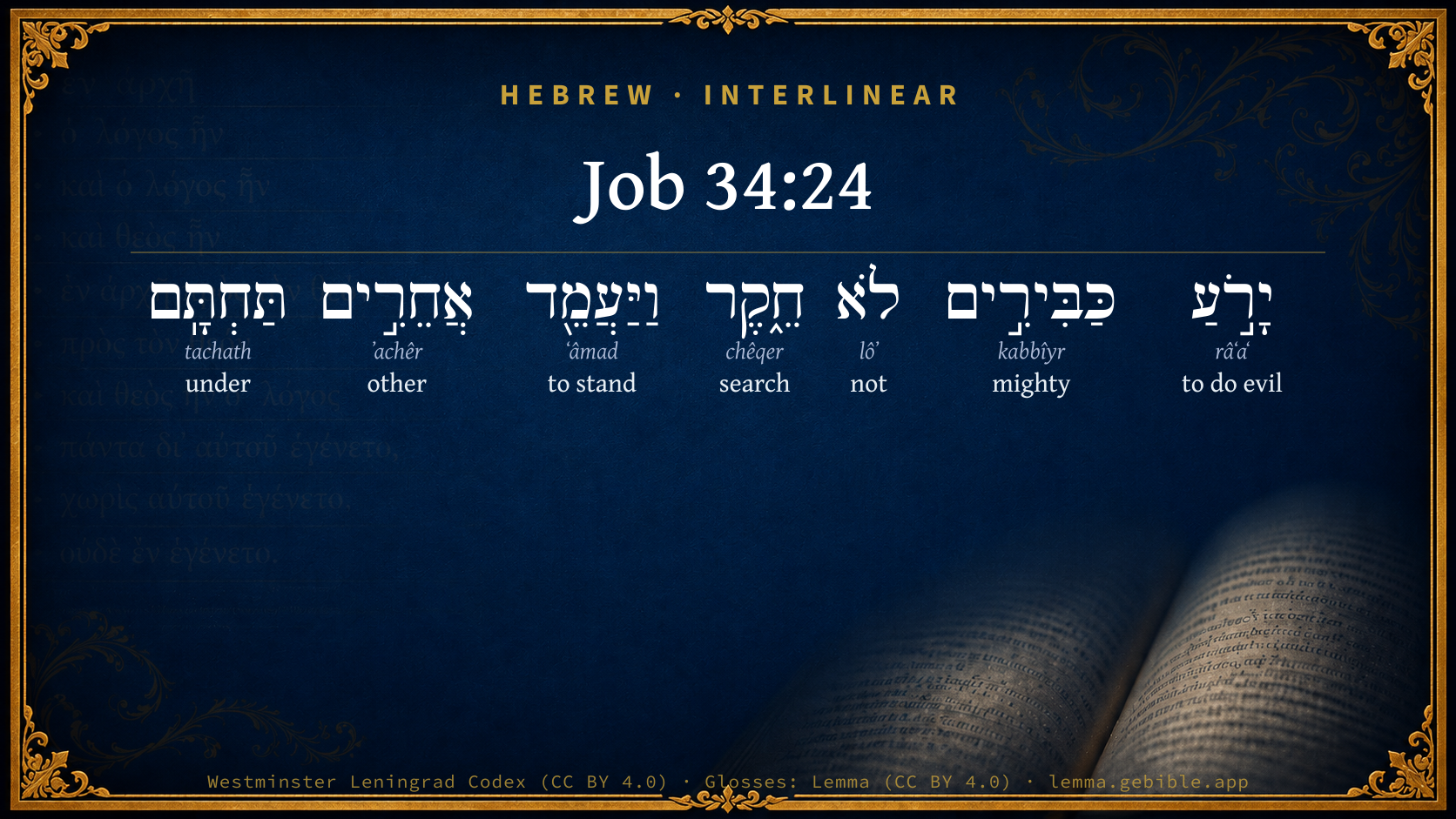
Hebrew (Westminster Leningrad Codex) Job 34:24 appears in the Hebrew Old Testament. The text above is from the Westminster Leningrad Codex. Each word links to its Strong’s number, a concise gloss, and parsing drawn from the Open Scriptures Hebrew Bible morphology. Click any word for its full Brown-Driver-Briggs (BDB) entry.
Download image
Cite this verse

Job 34:24 (World English Bible). Public Domain. Lemma interlinear Bible study tool, https://lemma.gebible.app/v/job/34/24.

Show BibTeX & RIS
BibTeX
RIS
English Translation
He breaks in pieces mighty men in ways past finding out, And sets others in their place.
World English Bible · Public Domain
Download a study sheet

One document with this verse’s original text, its word-by-word gloss line, the meaning frame, cross-references with their text, attributed commentary, and full source and license credits — printable, and it pastes into notes with its structure intact.

This verse Autodidact and up

Study sheet (.html) Plain text (.txt)

A passage Seminary Student

Up to 50 verses in one chapter. A passage sheet keeps up to 6 commentary sources and 12 cross-references per verse, in the order this page ranks them, and says so on the sheet whenever that leaves anything out. Ask for a single verse and you get the Autodidact verse sheet above.

Everything on this page stays free to read, with no account — the sheet is a download of what is already on screen, not access to it.

Want to remove ads? Support Godless Engineer
Compare translations 3

The same verse in 3 English versions, stacked beneath the original-language interlinear above. Click any original word for its lexicon entry.

Each is an independent rendering of the whole verse — the interlinear is not word-aligned to these translations.

Highlighted words mark where these versions differ — a whole-verse word diff, not a word-by-word alignment.

  • World English Bible Public Domain
    He breaks in pieces mighty men in ways past finding out, And sets others in their place.
  • King James Version Public Domain
    He shall break in pieces mighty men without number, and set others in their stead.
  • unfoldingWord Literal Text CC BY-SA 4.0
    He shatters the mighty no investigation, and he establishes others instead of them.

unfoldingWord Literal Text — © unfoldingWord, licensed CC BY-SA 4.0. Word-aligned USFM3 via Door43 (git.door43.org/unfoldingWord/en_ult).

Versions to compare (up to 4)

3 of 4 selected

Show all 18 translations

Every available English version of this verse, each an independent rendering of the whole verse.

  • World English Bible Public Domain
    He breaks in pieces mighty men in ways past finding out, And sets others in their place.
  • Berean Standard Bible Public Domain
    He shatters the mighty without inquiry and sets up others in their place.
  • Majority Standard Bible Public Domain
    He shatters the mighty without inquiry and sets up others in their place.
  • King James Version Public Domain
    He shall break in pieces mighty men without number, and set others in their stead.
  • American Standard Version (1901) Public Domain
    He breaketh in pieces mighty men `in ways' past finding out, And setteth others in their stead.
  • Revised Version (1885) Public Domain
    He breaketh in pieces mighty men in ways past finding out, and setteth others in their stead.
  • Geneva Bible (1599) Public Domain
    He shall breake the mightie without seeking, and shall set vp other in their stead.
  • Douay-Rheims (1899) Public Domain
    He shall break in pieces many and innumerable, and shall make others to stand in their stead.
  • Young's Literal Translation Public Domain
    He breaketh the mighty -- no searching! And He appointeth others in their stead.
  • Literal Standard Version CC BY-SA 4.0
    He breaks the mighty—no searching! And He appoints others in their stead.
  • Unlocked Literal Bible CC BY-SA 4.0
    He breaks mighty men into pieces for their ways that need no further investigation; he puts others in their places.
  • unfoldingWord Literal Text CC BY-SA 4.0
    He shatters the mighty no investigation, and he establishes others instead of them.
  • Darby Bible Public Domain
    He breaketh in pieces mighty men without inquiry, and setteth others in their stead;
  • World Messianic Bible Public Domain
    He breaks mighty men in pieces in ways past finding out, and sets others in their place.
  • Webster's Bible Public Domain
    He shall break in pieces mighty men without number, and set others in their stead.
  • Free Bible Version CC BY-SA 4.0
    He brings down the mighty without needing an investigation; he sets up others in their place.
  • Bible in Basic English Public Domain
    He sends the strong to destruction without searching out their cause, and puts others in their place.
  • JPS Tanakh (1917) Public Domain
    He breaketh in pieces mighty men without inquisition, and setteth others in their stead.

Literal Standard Version (2020), Covenant Press — licensed CC BY-SA 4.0. Text via the HelloAO Bible API (eBible.org). Unlocked Literal Bible (unfoldingWord) — licensed CC BY-SA 4.0. Text via the HelloAO Bible API (eBible.org). unfoldingWord Literal Text — © unfoldingWord, licensed CC BY-SA 4.0. Word-aligned USFM3 via Door43 (git.door43.org/unfoldingWord/en_ult). Free Bible Version, Dr. Jonathan Gallagher — licensed CC BY-SA 4.0. Text via the HelloAO Bible API (eBible.org).

Word by word

More ways to search: Search by grammar → Find every occurrence → Compare this word →

Practice this passage: Drill this verse → Learn its vocabulary →

About this verse

These counts appear in no published source. They are computed here, from the morphology-tagged text and Lemma’s own curated glosses. What Lemma adds →

7
words
7
distinct lemmas
Wisdom
section

Notable vocabulary

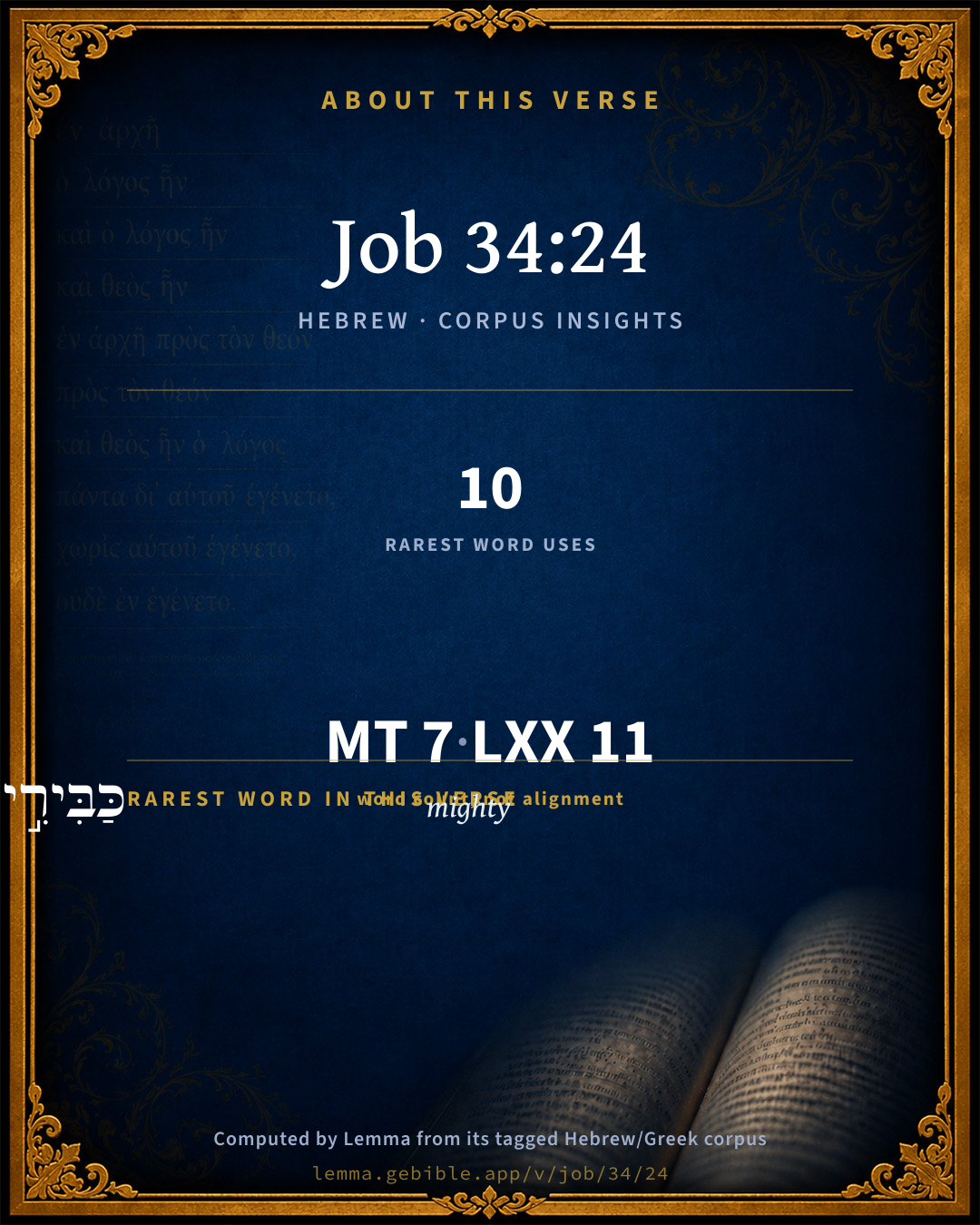
The rarest word here is כַּבִּירִ֣ים mighty H3524 — appearing just 10 times in the whole Hebrew Bible.

Shared distinctive vocabulary

כַּבִּירִ֣ים mighty H3524 occurs in 9 verses of the Hebrew Bible. Also found in:

Grammatical profile

  • 2 verbs
  • 1 noun
  • 2 adjectives
  • 1 preposition
  • 1 particle

Verb forms

  • יָרֹ֣עַ Qal · Imperfect
  • וַיַּעֲמֵ֖ד Hiphil · Sequential Imperfect

Hebrew & Septuagint length

In English translation the verse runs 17 words from the Hebrew and 19 from the Septuagint (LXX English) — closely comparable.

A rough comparison of the two English renderings, which tokenize alike — not a word-level alignment.

Word counts can differ between the Hebrew and the Greek without any difference in meaning — e.g. the Hebrew direct-object marker אֵת has no separate Greek word, and Greek often adds the article ὁ.

In the original languages it is 7 Hebrew tokens and 11 Greek tokens — but the two are counted differently (Hebrew bundles its prefixes and suffixes into one token; the Greek is in lemma form), so that isn’t a like-for-like length.

Cross-references

15

Topical passages linked to Job 34:24 in the Treasury of Scripture Knowledge — connected by theme and wording, ordered by reader-vote popularity; previews shown in the World English Bible.

  • Psalms 2:9 You shall break them with a rod of iron. You shall dash them in pieces like a potter's vessel."
  • Psalms 72:4 He will judge the poor of the people. He will save the children of the needy, And will break the oppressor in pieces.
  • Psalms 94:5 They break your people in pieces, Yahweh, And afflict your heritage.
  • Psalms 113:7–8 He raises up the poor out of the dust. Lifts up the needy from the ash heap;
  • Daniel 2:21 He changes the times and the seasons; he removes kings, and sets up kings; he gives wisdom to the wise, and knowledge to those who have understanding;
  • 1 Samuel 2:30–36 Therefore Yahweh, the God of Israel, says, I said indeed that your house, and the house of your father, should walk before me forever: but now Yahweh says, Be it far from me; for those who honor me I will honor, and those who despise me shall be lightly esteemed.
  • 1 Kings 14:7–8 Go, tell Jeroboam, Thus says Yahweh, the God of Israel: Because I exalted you from among the people, and made you prince over my people Israel,
  • 1 Kings 14:14 Moreover Yahweh will raise him up a king over Israel, who shall cut off the house of Jeroboam that day: but what? even now.
  • Job 12:19 He leads priests away stripped, And overthrows the mighty.
  • Job 19:2 "How long will you torment me, And crush me with words?
  • Jeremiah 51:20–23 You are my battle-axe and weapons of war: and with you will I break in pieces the nations; and with you will I destroy kingdoms;
  • Daniel 2:34–35 You saw until a stone was cut out without hands, which struck the image on its feet that were of iron and clay, and broke them in pieces.
  • Daniel 2:44–45 In the days of those kings shall the God of heaven set up a kingdom which shall never be destroyed, nor shall the sovereignty of it be left to another people; but it shall break in pieces and consume all these kingdoms, and it shall stand forever.
  • Daniel 5:28–31 PERES; your kingdom is divided, and given to the Medes and Persians.
  • 1 Samuel 15:28 Samuel said to him, Yahweh has torn the kingdom of Israel from you this day, and has given it to a neighbor of yours who is better than you.

Cross-references courtesy of OpenBible.info (CC BY 4.0).

Hebrew and Greek witnesses Masoretic Hebrew ↔ Greek Septuagint

The same verse in the two great witnesses to the Old Testament, shown verse-for-verse.

These are two independent witnesses, not word-aligned to each other, and the Septuagint is shown in lemma (dictionary) form.

Hebrew Job 34:24 Masoretic · Westminster Leningrad Codex

יָרֹ֣עַ כַּבִּירִ֣ים לֹא חֵ֑קֶר וַיַּעֲמֵ֖ד אֲחֵרִ֣ים תַּחְתָּֽם

He breaks in pieces mighty men in ways past finding out, And sets others in their place.

World English Bible · Public Domain

Greek LXX Job 34:24 Septuagint · lemma form

ὁ καταλαμβάνω ἀνεξιχνίαστος ἔνδοξος τε καί ἐξαίσιος ὅς οὐ εἰμί ἀριθμός

For the Lord looks down upon all men, who comprehends unsearchable things, glorious also and excellent things without number.

LXX2012 (modern English Septuagint) · Public Domain

On this verse, Haydock's Catholic Bible Commentary discusses the Septuagint’s reading. Read the note in Commentary ↓

Hebrew: Westminster Leningrad Codex (CC BY 4.0). Greek: Septuagint (public domain); English from LXX2012 (modern English Septuagint) (Public Domain). How the Septuagint differs from the Hebrew →

Commentary

Notes on Job 34:24 from classic Christian and Jewish commentators (each source and its license shown beneath its notes). The classic Christian expositions comment on the surrounding passage and are grouped to its opening verse, so a note may address several verses; the Jewish commentaries on the Tanakh (Rashi and others) are per-verse, so they appear only where the commentator wrote on this verse.

Lemma curates 59 commentaries, every one of them public domain or Creative Commons licensed, each selected and text-cleaned for this edition rather than reprinted as found. About our sources →

Trapp's Complete Commentary

John Trapp

Job 34:24 He shall break in pieces mighty men without number, and set others in their stead.

Ver. 24. He shall break in pieces mighty men, &c.] Infinite conterit validos, so Tremellius rendereth it. He infinitely mauleth the mighty; and breaketh them in pieces like a potter’s vessel, Psa 2:9.

Without number] Or, Without inquisition; as knowing all things beforehand, and not needing any evidences or examination of witnesses; or, without end, because their ruin is endless, Ruina maiorum sit cautela minorum.

And set others in their stead] As is to be seen in the rise, reign, and ruin of the four mighty monarchies, and others not a few, that had their times and their turns; as the kingdom of the ten tribes, which in a few years fell into nine different families; and few of those kings died a natural death. No more did the emperors of Rome, till Constantine. See Dan 2:21 Psa 113:7-8.

John Trapp, A Commentary or Exposition upon All the Books of the Old and New Testament (1647–1656) — public domain. Text from a community e-Sword module.

Joseph Benson's Commentary

Job 34:24-26. He shall break in pieces mighty men, &c. — Neither their greatness nor their numbers can secure them from the stroke of God’s justice; and set others in their stead — Give away their power and dignity to others, who shall come in their place. Therefore he knoweth their works — That is, it appears from this that he knows all their evil works, because he judges and punishes them for them; and he overturneth them in the night — When they are at rest and secure; or, he turneth or bringeth upon them the night, namely, of calamity and tribulation, as the next words explain it, and as the words light and darkness are often used. He striketh them as wicked men — That is, as he useth to smite wicked men; or, as תחת, tachath, rather means here, according to Ab. Ezra, inter improbos, among the wicked, or, for wicked men; that is, because they are wicked men, therefore he destroys them without any regard to their quality; in the open sight of others — In public view, for their greater shame, for the greater glory of God’s justice, and for the greater terror of other wicked persons.

Joseph Benson's Commentary on the Old and New Testaments (1811–1818) — public domain. Text from a community e-Sword module.

Tyndale Open Study Notes

Tyndale Open Resources

34:24 God knows everything without asking anyone (34:25). • sets up others in their place: Dan 2:21; 5:28-30.

Tyndale Open Study Notes — © Tyndale Open Resources, licensed CC BY-SA 4.0. Text via the HelloAO Bible API.

Geneva Bible (1599)

Geneva Bible translators

For all his creatures are at hand to serve him, so that he needeth not to seek for any other army.

Geneva Bible (1599) marginal notes — public domain. Text via Bolls.life.

Jamieson, Fausset & Brown

Robert Jamieson, A. R. Fausset & David Brown

break in pieces-- (Psa 2:9; Job 12:18; Dan 2:21).

Jamieson, Fausset & Brown — Commentary Critical and Explanatory on the Whole Bible (1871) — public domain (CC PDM 1.0). Text via the HelloAO Bible API.

Adam Clarke's Commentary

Verse 24. He shall break in pieces] In multitudes of cases God depresses the proud, and raises up the humble and meek. Neither their strength nor number can afford them security.

Adam Clarke's Commentary on the Bible (1810–1826) — public domain. Text from a community e-Sword/MySword module.

Ellicott's Commentary for English Readers

(24) Without number.—Rather, in an unsearchable manner, as before, Job_34:20, “without hand,” i.e., without human means.

A Bible Commentary for English Readers, edited by Charles John Ellicott (1878–1897) — public domain. Text from a community e-Sword module.

The Cambridge Bible for Schools and Colleges

gen. ed. J. J. S. Perowne

24. he shall break … without number] Rather, he breaketh … without inquisition. The verse amplifies the conception of the preceding verse.

The Cambridge Bible for Schools and Colleges (gen. ed. J. J. S. Perowne; Cambridge University Press, 1878–1918) — public domain. Text from a community e-Sword module.

John Gill's Exposition

He striketh them as wicked men,.... Such is the strict justice of God, that he never strikes men, or inflicts punishment on them, or brings down his judgments upon them, but as wicked men, and because of their wickedness; the casting of man out of Eden was for his sin, as well as the casting down the angels from heaven that sinned; the drowning of the old world, the destruction of Sodom and Gomorrah, the ruin of Pharaoh and his host, the driving the Canaanites out of their land, the various captivities of the Israelites, with other instances of God's displeasure with men in this world, and the everlasting punishment of them in another, are only of them as wicked men, and for sin; and therefore he is not chargeable with any unrighteousness. Sephorno interprets it, "instead of wicked men", and illustrates it by the shaking out of Pharaoh and his host into the sea in the room and stead of the wicked Israelites, that came up from thence,

in the open sight of others: which the same interpreter refers to the Israelites seeing the Egyptians dead on the seashore; or "in the place of them that see" (f), that is, in a public manner, as generally malefactors are executed, to which the allusion may be; it denotes the publicness of God's righteous judgments on wicked men, for the greater declaration of his power and justice, and for the greater shame and disgrace of such wicked men, and for the joy and comfort of the righteous delivered from them.

(f) "in loco videntium", V. L. Pagninus, Montanus, Piscator, Michaelis; "in loco spectantium", Beza, Cocceius, Schultens.

John Gill's Exposition of the Whole Bible (1746–1763) — public domain (CC PDM 1.0). Text via the HelloAO Bible API.

Albert Barnes' Notes on the Bible

He shall break in pieces - He crushes or destroys the great. He is not intimidated by their wealth, their rank, or their number.

Without number - Margin, more correctly, “searching out.” That is, he does it without the protracted process of a judicial investigation. The Hebrew word used here (חקר chêqer) means properly “a searching out,” “an examination”; and the meaning here is, that there is no need of his going into a protracted investigation into the lives of wicked people before he brings them to punishment. He sees them at once; knows all their conduct, and may proceed against them without delay. Hence, it is that he comes often in such a sudden manner, and cuts them off. A human tribunal is under a necessity of examining witnesses and of attending to all the palliating circumstances, before it can pronounce a sentence on an offender. But it is not so with God. He judges at once and directly, and comes forth therefore in a sudden manner to cut down the guilty.

And set others in their stead - Place others in the situation which they now occupy. That is, he can with the utmost case make entire revolutions among people.

Albert Barnes' Notes on the Bible (1834–1885) — public domain. Text from a community e-Sword/MySword module.

Haydock's Catholic Bible Commentary

Stead. Where are not the ancient Assyrians, Carthaginians, &c., who once made such a figure in the world? (Calmet) --- Septuagint, "glorious and sudden, and unnumbered." The next eight verses are taken from Theodotion. (Haydock)

George Leo Haydock (1774–1849), Haydock's Catholic Family Bible and Commentary, 1859 edition — public domain. Excludes Psalms (Douay-Rheims chapter numbering differs from Protestant) and Deuterocanonical books (Catholic canon only).

Matthew Poole's English Annotations

Mighty men without number; neither their greatness nor their numbers can secure them from the stroke of God’s justice.

Set others in their stead, i.e. give away their power and dignity to others who shall come in their place.

Matthew Poole's English Annotations on the Holy Bible (1683–1685) — public domain. Text from a community e-Sword/MySword module.

Whedon's Commentary on the Bible

Daniel D. Whedon

24. Without number — לא חקר. Without searching. God needs no process of investigation that he may discern, sever, and “break in pieces” the guilty.

Daniel D. Whedon (gen. ed.), Commentary on the Old and New Testaments (1874–1909) — public domain. Text from a community e-Sword module.

The Pulpit Commentary

He shall break in pieces mighty men without number; rather, in ways that are unsearchable, or in ways past finding out (see the Revised Version). And set others in their stead. (comp. 1Sa_2:7 Psa_75:7 Dan_2:21)

The Pulpit Commentary (1880–1919), ed. H.D.M. Spence-Jones & Joseph S. Exell — public domain. Text from a community e-Sword module.

Keil & Delitzsch

C. F. Keil & F. Delitzsch

24 He breaketh the mighty in pieces without investigation

And setteth others in their place.

25 Thus He seeth through their works,

And causeth their overthrow by night, thus they are crushed.

26 He smiteth them after the manner of evil-doers

In the sight of the public.

27 For for such purpose are they fallen away from Him

And have not considered any of His ways,

28 To cause the cry of the poor to come up to Him,

And that He should hear the cry of the needy.

He makes short work (לא־חקר for בּלא, as Job 12:24; Job 38:26 : without research, viz., into their conduct, which is at once manifest to Him; not: in an incomprehensible manner, which is unsuitable, and still less: innumerabiles, as Jer., Syr.) with the mighty (כּבּירים, Arab. kibâr, kubarâ), and in consequence of this (fut. consec.) sets up (constituit) others, i.e., better and worthier rulers (comp. אהר, Job 8:19; Isa 55:1-13 :15), in their stead. The following לכן is not equivalent to לכן אשׁר, for which no satisfactory instance exists; on the contrary, לכן here, as more frequently, introduces not the real consequence (Job 20:2), but a logical inference, something that directly follows in and with what precedes (corresponding to the Greek ἄρα, just so, consequently), comp. Job 42:3; Isa 26:14; Isa 61:7; Jer 2:33; Jer 5:2; Zac 11:7 (vid., Khler in loc.). Thus, then, as He hereby proves, He is thoroughly acquainted with their actions (מעבּד, nowhere besides in the book of Job, an Aramaizing expression for מעשׂה). This abiding fact of divine omniscience, inferred from the previously-mentioned facts, then serves again in its turn, in Job 34:25, as the source of facts by which it is verified. לילה is by no means an obj. The expositions: et inducit noctem (Jer.), He walks in the night in which He has veiled Himself (Umbr.), convertit eos in noctem (Syr., Arab.), and such like, all read in the two words what they do not imply. It is either to be translated: He throws them by night (לילה as Job 27:20) upon the heaps (הפך as Pro 12:7), or, since the verb has no objective suff.: He maketh a reformation or overthrow during the night, i.e., creates during the night a new order of things, and they who stood at the head of the former affairs are crushed by the catastrophe.

Job 34:26

The following תּחת רשׁעים cannot signify: on the place of the evil-doers, i.e., in the place where evil-doers are punished (Hirz., Hahn, and others), for תּחת (תּחתּי) only has this signification with the suff. (vid., on Hab 3:16); but not otherwise than: in the evil-doers' stead, taking them and treating them as such, as Jer. has correctly translated: quasi impios (comp. Isa 10:4, Jerome, cum interfectis). The place first mentioned afterwards is not exactly the usual place of judgment, but any place whatever where all can see it. There He smites those who hitherto held positions of eminence, as of unimpeachable honour, like the common criminal; ספק, Arab. ṣfq, complodere, and then ictu resonante percutere, as the likewise cognate Arab. sf' signifies first to box the ear (as Arab. sfq = ṣfq), then so to strike that it smacks. As little as לכן, Job 34:25, was = לכן אשׁר, just so little is אשׁר על־כּן, Job 34:27, = על־כן אשׁר (vid., on the other hand what is said on Gen 18:5 concerning כּי־על־כּן). Elihu wishes to say that they endure such a destiny of punishment, because they therefore, i.e., in order to suffer such, have turned aside from following after God, and have not thought on all His ways, i.e., guidings, by which He manifested Himself to them: they have thus sought to cause the cry of the poor to come (Jer. well renders: ut pervenire facerent ad eum) before Him (עליו, perhaps with the idea of urging forward = לפניו or בּאזניו), and that He may hear the cry of the lowly (construction exactly like Job 33:17), i.e., have sought to bring forth His avenging justice by injustice that cries aloud to heaven.

Keil & Delitzsch — Biblical Commentary on the Old Testament (1861–1891) — public domain (CC PDM 1.0). Text via the HelloAO Bible API. (Old Testament only.)

unfoldingWord translationNotes

Door43 World Missions Community

General Information:

Elihu continues speaking.

He breaks mighty men into pieces

This speaks of God destroying these men as if he actually broke their bodies into pieces. AT: "He destroys mighty men" or "He destroys important people" (See: Idiom)

for their ways that need no further investigation

He does not need to investigate what they have done because he already knows everything about them. AT: "without needing to do further investigation, because he already knows their ways" (See: Assumed Knowledge and Implicit Information)

their ways

This is an idiom. AT: "the things they have done"

he puts others in their places

This means that he appoints other people to rule in their positions. AT: "and he chooses other people to rule in their places" (See: Assumed Knowledge and Implicit Information)

in the night

This is an idiom. AT: "when they are not expecting it" (See: Idiom)

they are destroyed

This can be stated in active form. AT: "and destroys them" (See: Active or Passive)

translationWords

might

know

works

unfoldingWord translationNotes — © Distant Shores Media and the Door43 World Missions Community, licensed CC BY-SA 4.0. Source: git.door43.org/Door43/en_tn.

Rashi

Rabbi Shlomo Yitzchaki (Rashi)

He shatters Heb. ירע, [like] ירוֹצֵץ. He shatters, and like (Isa. 24:19), “has broken (התרעעה).”

and He stands others in their stead.

Rashi on the Tanakh — English translations: “The Judaica Press complete Tanach with Rashi, translated by A. J. Rosenberg” (CC BY 4.0); “Pentateuch with Rashi's commentary by M. Rosenbaum and A.M. Silbermann, 1929-1934” (public domain); “The Metsudah Tanach series, Lakewood, N.J” (CC BY 4.0); and “The Book of Joshua, Metsudah Publications, 1997” (CC BY 4.0). Text via Sefaria.

Lesson kit

Teaching starters — assembled from the data on this page, not authored interpretation. Every prompt links to the verse data it draws on. Edit before teaching.

Job, in the Wisdom, opens this verse with 7 words (7 distinct Hebrew lemmas). Its most distinctive word is kabbîyr (“mighty”). A historical commentator’s framing appears above. Read the whole chapter for the surrounding context.

Discussion questions

  1. The word kabbîyr carries the sense “mighty.” How does it shape the verse?
  2. Job 8:2 shares the word «mighty» with this verse. How do the two illuminate each other?
  3. These translations render this verse differently; the difference is in the English rendering, not the original. What questions does that raise?
  4. The verb «יָרֹ֣עַ» is Qal Imperfect. How does its form color the action?
  5. Reading how Trapp's Complete Commentary and Joseph Benson's Commentary read this verse, where do the two commentators agree and where do they part?

Things to notice

Reading settings

Reading text

Shown beneath each verse's original-language words.

Old Testament
Old Testament edition

Read the OT as the Masoretic Hebrew (MT) or the Greek Septuagint (LXX).

English shown for the Greek Septuagint (in the Hebrew ↔ Greek comparison).

Comparing translations? Open the Compare panel on any verse page to stack up to four side by side.