Jeremiah 22:26

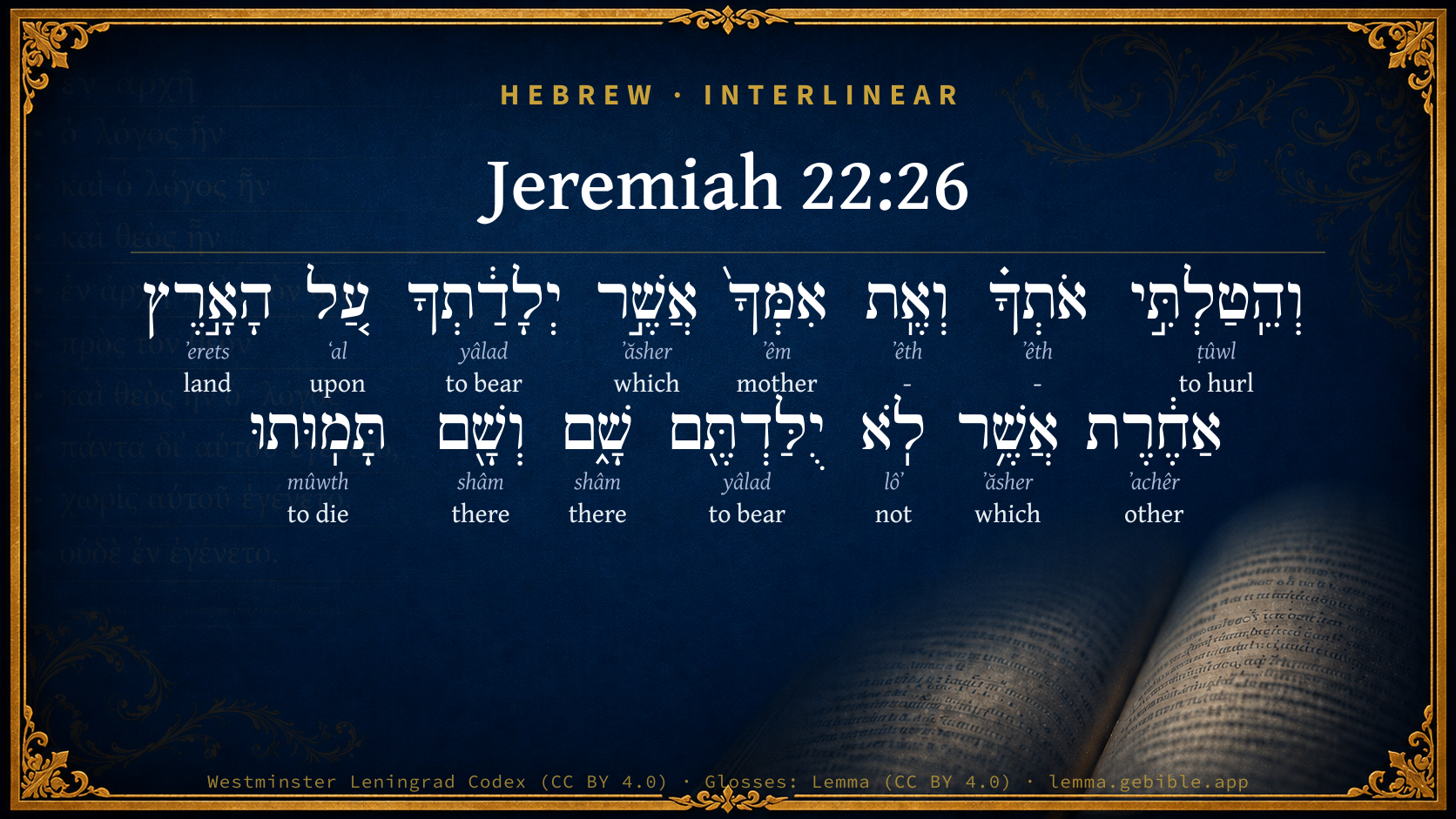
Hebrew (Westminster Leningrad Codex) Jeremiah 22:26 appears in the Hebrew Old Testament. The text above is from the Westminster Leningrad Codex. Each word links to its Strong’s number, a concise gloss, and parsing drawn from the Open Scriptures Hebrew Bible morphology. Click any word for its full Brown-Driver-Briggs (BDB) entry.
Download image
Cite this verse

Jeremiah 22:26 (World English Bible). Public Domain. Lemma interlinear Bible study tool, https://lemma.gebible.app/v/jeremiah/22/26.

Show BibTeX & RIS
BibTeX
RIS
English Translation
I will cast you out, and your mother who bore you, into another country, where you were not born; and there shall you die.
World English Bible · Public Domain
Download a study sheet

One document with this verse’s original text, its word-by-word gloss line, the meaning frame, cross-references with their text, attributed commentary, and full source and license credits — printable, and it pastes into notes with its structure intact.

This verse Autodidact and up

Study sheet (.html) Plain text (.txt)

A passage Seminary Student

Up to 50 verses in one chapter. A passage sheet keeps up to 6 commentary sources and 12 cross-references per verse, in the order this page ranks them, and says so on the sheet whenever that leaves anything out. Ask for a single verse and you get the Autodidact verse sheet above.

Everything on this page stays free to read, with no account — the sheet is a download of what is already on screen, not access to it.

Want to remove ads? Support Godless Engineer
Compare translations 3

The same verse in 3 English versions, stacked beneath the original-language interlinear above. Click any original word for its lexicon entry.

Each is an independent rendering of the whole verse — the interlinear is not word-aligned to these translations.

Highlighted words mark where these versions differ — a whole-verse word diff, not a word-by-word alignment.

  • World English Bible Public Domain
    I will cast you out, and your mother who bore you, into another country, where you were not born; and there shall you die.
  • King James Version Public Domain
    And I will cast thee out, and thy mother that bare thee, into another country, where ye were not born; and there shall ye die.
  • unfoldingWord Literal Text CC BY-SA 4.0
    And I will hurl you and your mother who bore you into another land where you were not born, and there you will die.

unfoldingWord Literal Text — © unfoldingWord, licensed CC BY-SA 4.0. Word-aligned USFM3 via Door43 (git.door43.org/unfoldingWord/en_ult).

Versions to compare (up to 4)

3 of 4 selected

Show all 18 translations

Every available English version of this verse, each an independent rendering of the whole verse.

  • World English Bible Public Domain
    I will cast you out, and your mother who bore you, into another country, where you were not born; and there shall you die.
  • Berean Standard Bible Public Domain
    I will hurl you and the mother who gave you birth into another land, where neither of you were born—and there you both will die.
  • Majority Standard Bible Public Domain
    I will hurl you and the mother who gave you birth into another land, where neither of you were born—and there you both will die.
  • King James Version Public Domain
    And I will cast thee out, and thy mother that bare thee, into another country, where ye were not born; and there shall ye die.
  • American Standard Version (1901) Public Domain
    And I will cast thee out, and thy mother that bare thee, into another country, where ye were not born; and there shall ye die.
  • Revised Version (1885) Public Domain
    And I will cast thee out, and thy mother that bare thee, into another country, where ye were not born; and there shall ye die.
  • Geneva Bible (1599) Public Domain
    And I will cause them to cary thee away, and thy mother that bare thee, into another countrey, where ye were not borne, and there shall ye die.
  • Douay-Rheims (1899) Public Domain
    And I will send thee, and thy mother that bore thee, into a strange country, in which you were not born, and there you shall die:
  • Young's Literal Translation Public Domain
    And I have cast thee, And thy mother who bore thee, unto another country, Where ye were not born, and there do ye die.
  • Literal Standard Version CC BY-SA 4.0
    And I have cast you, || And your mother who bore you, to another country, || Where you were not born, and you die there.
  • Unlocked Literal Bible CC BY-SA 4.0
    I will throw you and your mother who bore you into another land, a country where you were not born, and there you will die.
  • unfoldingWord Literal Text CC BY-SA 4.0
    And I will hurl you and your mother who bore you into another land where you were not born, and there you will die.
  • Darby Bible Public Domain
    And I will cast thee out, and thy mother that bare thee, into another country, where ye were not born; and there shall ye die.
  • World Messianic Bible Public Domain
    I will cast you out with your mother who bore you into another country, where you were not born; and there you will die.
  • Webster's Bible Public Domain
    And I will cast thee out, and thy mother that bore thee, into another country, where ye were not born; and there shall ye die.
  • Free Bible Version CC BY-SA 4.0
    I'm going to throw you out—you and the mother who gave birth to you—sending you to another country. Neither of you were born there, but both of you will die there.
  • Bible in Basic English Public Domain
    I will send you out, and your mother who gave you birth, into another country not the land of your birth; and there death will come to you.
  • JPS Tanakh (1917) Public Domain
    And I will cast thee out, and thy mother that bore thee, into another country, where ye were not born; and there shall ye die.

Literal Standard Version (2020), Covenant Press — licensed CC BY-SA 4.0. Text via the HelloAO Bible API (eBible.org). Unlocked Literal Bible (unfoldingWord) — licensed CC BY-SA 4.0. Text via the HelloAO Bible API (eBible.org). unfoldingWord Literal Text — © unfoldingWord, licensed CC BY-SA 4.0. Word-aligned USFM3 via Door43 (git.door43.org/unfoldingWord/en_ult). Free Bible Version, Dr. Jonathan Gallagher — licensed CC BY-SA 4.0. Text via the HelloAO Bible API (eBible.org).

Word by word

More ways to search: Search by grammar → Find every occurrence → Compare this word →

Practice this passage: Drill this verse → Learn its vocabulary →

וְהֵֽטַלְתִּ֣י
ṭûwl
H2904
“and · to hurl”
Conjunction + Verb, Hiphil, Sequential Perfect, 1st Person, Common, Singular
Part of Speech
Conjunction + Verb
Stem
Hiphil
Form
Sequential Perfect
Person
1st Person
Gender
Common
Number
Singular
Full BDB Definition

Origin: a primitive root

TWOT: 797

to hurl, cast - (Pilpel) to throw away, carry away, hurl - (Hiphil) to throw, cast, cast out - (Hophal) - to be hurled, hurled down - to be cast, be thrown, be cast out, be thrown down
  1. אֹתְךָ֗ ʼêth H853 “- · you” Particle, Direct Object + Suffix, Personal, 2nd Person, Masculine, Singular
  2. וְאֶֽת ʼêth H853 “and · -” Conjunction + Particle, Direct Object
  3. אִמְּךָ֙ ʼêm H517 “mother · your” Noun, Common, Feminine, Singular, Construct + Suffix, Personal, 2nd Person, Masculine, Singular
  4. אֲשֶׁ֣ר ʼăsher H834 “which” Particle, Relative
  5. יְלָדַ֔תְךָ yâlad H3205 “to bear · you” Verb, Qal, Perfect, 3rd Person, Feminine, Singular + Suffix, Personal, 2nd Person, Masculine, Singular
  6. עַ֚ל ʻal H5921 “upon” Preposition
  7. הָאָ֣רֶץ ʼerets H776 “the · land” Particle, Definite Article + Noun, Common, Both, Singular, Absolute
  8. אַחֶ֔רֶת ʼachêr H312 “other” Adjective, Adjective, Feminine, Singular, Absolute
  9. אֲשֶׁ֥ר ʼăsher H834 “which” Particle, Relative
  10. לֹֽא lôʼ H3808 “not” Particle, Negative
  11. יֻלַּדְתֶּ֖ם yâlad H3205 “to bear” Verb, Pual, Perfect, 2nd Person, Masculine, Plural
  12. שָׁ֑ם shâm H8033 “there” Adverb
  13. וְשָׁ֖ם shâm H8033 “and · there” Conjunction + Adverb
  14. תָּמֽוּתוּ mûwth H4191 “to die” Verb, Qal, Imperfect, 2nd Person, Masculine, Plural

About this verse

These counts appear in no published source. They are computed here, from the morphology-tagged text and Lemma’s own curated glosses. What Lemma adds →

15
words
11
distinct lemmas
Prophets
section

Notable vocabulary

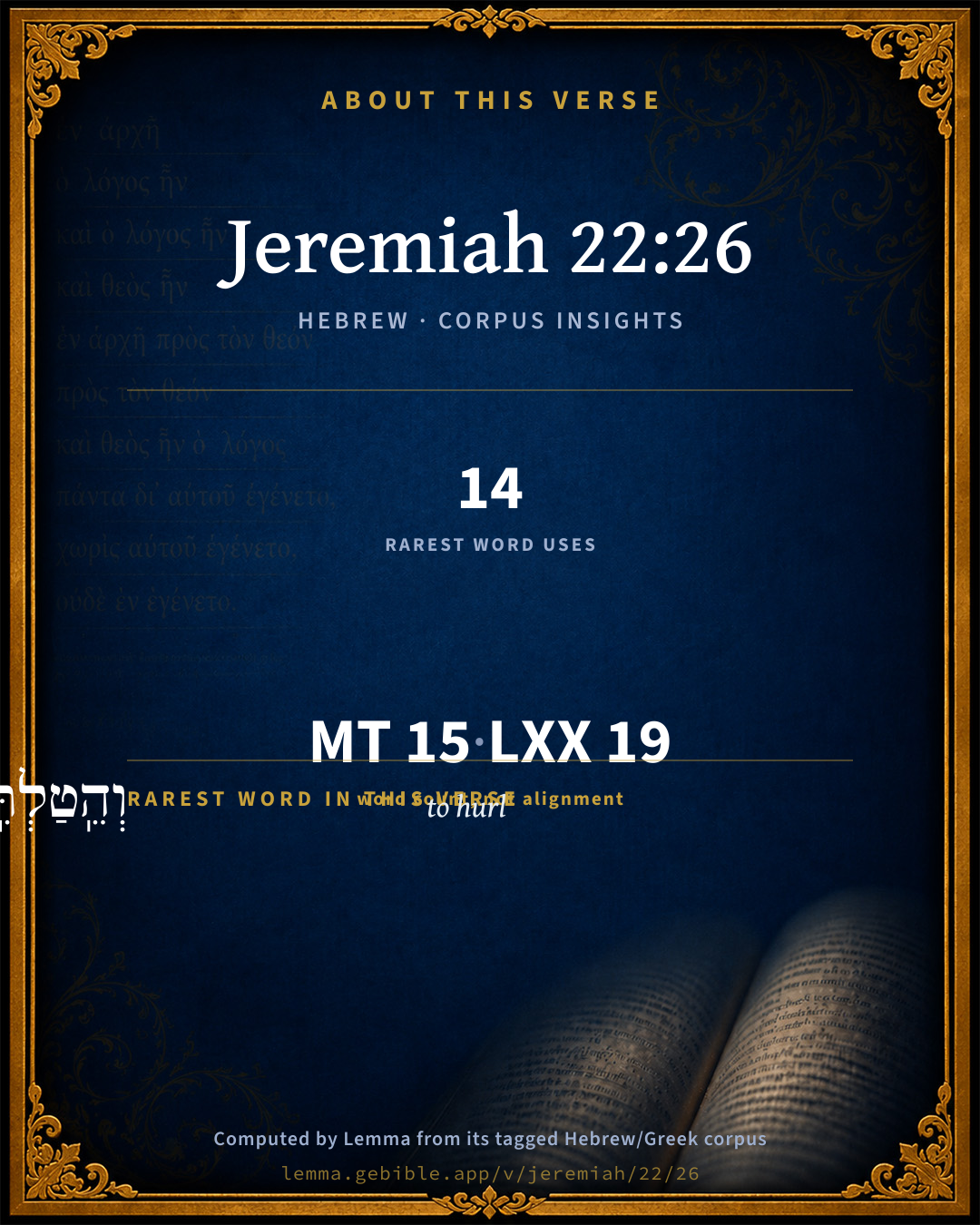
The rarest word here is וְהֵֽטַלְתִּ֣י to hurl H2904 — appearing just 14 times in the whole Hebrew Bible.

Shared distinctive vocabulary

וְהֵֽטַלְתִּ֣י to hurl H2904 occurs in 14 verses of the Hebrew Bible. Also found in:

Grammatical profile

  • 4 verbs
  • 2 nouns
  • 1 adjective
  • 1 preposition
  • 2 adverbs
  • 5 particles

Verb forms

  • וְהֵֽטַלְתִּ֣י Hiphil · Sequential Perfect
  • יְלָדַ֔תְךָ Qal · Perfect
  • יֻלַּדְתֶּ֖ם Pual · Perfect
  • תָּמֽוּתוּ Qal · Imperfect

Repetition

Words recur within this verse — often emphatic in Hebrew:

  • יְלָדַ֔תְךָ to bear H3205 ×2
  • שָׁ֑ם there H8033 ×2
  • אֲשֶׁ֣ר which H834 ×2

Hebrew & Septuagint length

In the original languages it is 15 Hebrew tokens and 19 Greek tokens — but the two are counted differently (Hebrew bundles its prefixes and suffixes into one token; the Greek is in lemma form), so that isn’t a like-for-like length.

Cross-references

6

Topical passages linked to Jeremiah 22:26 in the Treasury of Scripture Knowledge — connected by theme and wording, ordered by reader-vote popularity; previews shown in the World English Bible.

  • 2 Kings 24:15 He carried away Jehoiachin to Babylon; and the king's mother, and the king's wives, and his officers, and the chief men of the land, carried he into captivity from Jerusalem to Babylon.
  • 2 Kings 24:8 Jehoiachin was eighteen years old when he began to reign; and he reigned in Jerusalem three months: and his mother's name was Nehushta the daughter of Elnathan of Jerusalem.
  • Isaiah 22:17 Behold, Yahweh, like a [strong] man, will hurl you away violently; yes, he will wrap you up closely.
  • Jeremiah 15:2–4 It shall happen, when they tell you, Where shall we go forth? then you shall tell them, Thus says Yahweh: Such as are for death, to death; and such as are for the sword, to the sword; and such as are for the famine, to the famine; and such as are for captivity, to captivity.
  • 2 Chronicles 36:9–10 Jehoiachin was eight years old when he began to reign; and he reigned three months and ten days in Jerusalem: and he did that which was evil in the sight of Yahweh.
  • Ezekiel 19:9–14 They put him in a cage with hooks, and brought him to the king of Babylon; they brought him into strongholds, that his voice should no more be heard on the mountains of Israel.

Cross-references courtesy of OpenBible.info (CC BY 4.0).

Hebrew and Greek witnesses Masoretic Hebrew ↔ Greek Septuagint

The same verse in the two great witnesses to the Old Testament, shown verse-for-verse.

These are two independent witnesses, not word-aligned to each other, and the Septuagint is shown in lemma (dictionary) form.

Hebrew Jeremiah 22:26 Masoretic · Westminster Leningrad Codex

וְהֵֽטַלְתִּ֣י אֹתְךָ֗ וְאֶֽת אִמְּךָ֙ אֲשֶׁ֣ר יְלָדַ֔תְךָ עַ֚ל הָאָ֣רֶץ אַחֶ֔רֶת אֲשֶׁ֥ר לֹֽא יֻלַּדְתֶּ֖ם שָׁ֑ם וְשָׁ֖ם תָּמֽוּתוּ

I will cast you out, and your mother who bore you, into another country, where you were not born; and there shall you die.

World English Bible · Public Domain

Greek LXX Structure differs

In the Septuagint, Jeremiah is about an eighth shorter than the Hebrew and arranges its material differently — the Oracles Against the Nations (Hebrew chapters 46–51) appear in the middle of the Greek book, after 25:13. Because the chapter and verse boundaries do not line up, a verse-for-verse comparison with the Hebrew is not shown.

A verse-for-verse comparison isn’t shown here because the chapters and verses don’t line up. Switch to the LXX edition with the MT / LXX toggle above to read the Greek directly.

Hebrew: Westminster Leningrad Codex (CC BY 4.0). Greek: Septuagint (public domain); English from a public-domain English Septuagint. How the Septuagint differs from the Hebrew →

Targum (Aramaic paraphrase)

1

The Targum is the ancient Jewish Aramaic paraphrase of the Hebrew Scriptures — an interpretive translation, not the Hebrew text itself. Onkelos (literal) and Pseudo-Jonathan (expansive) render the Torah, and Jonathan the Prophets. Coverage is partial: where no permissively-licensed English translation exists for a verse, only the Aramaic is shown. This is verse-level text, not a word-by-word alignment to the Hebrew.

  1. Targum Jonathan Prophets (Joshua–Malachi)
    וַאֲטַלְטֵיל יָתָךְ וְיַת אַמָךְ דְיַלְדְתָךְ לַאֲרַע אוֹחֲרֵי דְלָא אִתְיַלֵידְתּוּן תַּמָן וְתַמָן תְּמוּתוּן:

    (no public-domain English translation for this verse)

    Targum Jonathan — Aramaic: “Mikraot Gedolot” (public domain). English: “Sefaria Community Translation” (CC0 1.0 (public-domain dedication)); “London "Chaldee Paraphrase," 1871” (public domain). Text via Sefaria.

Commentary

Notes on Jeremiah 22:26 from classic Christian and Jewish commentators (each source and its license shown beneath its notes). The classic Christian expositions comment on the surrounding passage and are grouped to its opening verse, so a note may address several verses; the Jewish commentaries on the Tanakh (Rashi and others) are per-verse, so they appear only where the commentator wrote on this verse.

Lemma curates 59 commentaries, every one of them public domain or Creative Commons licensed, each selected and text-cleaned for this edition rather than reprinted as found. About our sources →

Trapp's Complete Commentary

John Trapp

Jer 22:26 And I will cast thee out, and thy mother that bare thee, into another country, where ye were not born; and there shall ye die.

Ver. 26. And I will cast thee out.] Heb., I will hurl thee out. To be held captive by idolaters in a strange country is no small misery. Poor Zegedine found it so among the Turks.

John Trapp, A Commentary or Exposition upon All the Books of the Old and New Testament (1647–1656) — public domain. Text from a community e-Sword module.

Jamieson, Fausset & Brown

Robert Jamieson, A. R. Fausset & David Brown

thy mother--Nehushta, the queen dowager (Kg2 24:6, Kg2 24:8, Kg2 24:15; see Jer 13:18).

Jamieson, Fausset & Brown — Commentary Critical and Explanatory on the Whole Bible (1871) — public domain (CC PDM 1.0). Text via the HelloAO Bible API.

Adam Clarke's Commentary

Verse 26. I will cast thee out, and thy mother] See all this fulfilled, 2Kg 24:12-13. All were carried by Nebuchadnezzar into captivity together.

Adam Clarke's Commentary on the Bible (1810–1826) — public domain. Text from a community e-Sword/MySword module.

John Calvin's Commentaries

Here, again, the Prophet confirms what he had said of the severe vengeance which God would take on Jeconiah. And though he was in his thirty-seventh year brought out of prison, and admitted unto the royal table, among other princes, he yet died in exile; and perhaps it would have been better for him to continue in prison till his death than to have been corrupted by allurements when he became one of the princes, for he thus defiled himself. However this may have been, he died in exile together with his mother Nehusta.

The Prophet then enhanced the grievousness of his punishment by saying, I will cause thee to migrate, or cast thee out, and thy mother who bare thee. It is added, for the sake of indignity, that the mother of the king would be led captive with him; for the female sex is often spared, and she was also advanced in years. But God executed upon her his judgment, because she was his associate in impiety: “I will remove you,” he says, “into foreign lands, in which ye were not born, and there ye shall die.”

John Calvin's Commentaries (1540-1563) — public domain. Text from the Calvin Translation Society English edition (1840s-50s) via the Christian Classics Ethereal Library (ccel.org). Calvin's coverage is partial (roughly two-thirds of the Bible); uncommented books and verses are honest gaps, never fabricated. The 19th-century editor's footnotes and remarks are omitted so the notes are faithfully Calvin's own voice.

Ellicott's Commentary for English Readers

(26) Thy mother that bare thee.—The youth of Coniah probably led to his mother assuming the authority of a queen-regent. She directed the policy of his brief reign, and shared in his downfall. Her name, Nehushta, is given in 2Ki_24:8, and in Jer_29:2 she is named as the gebirah, the “great lady “or” princess-queen.”

A Bible Commentary for English Readers, edited by Charles John Ellicott (1878–1897) — public domain. Text from a community e-Sword module.

The Cambridge Bible for Schools and Colleges

gen. ed. J. J. S. Perowne

26. thy mother] See on Jer_13:18.

and there shall ye die] For his history in exile see Jer_52:31 ff.; 2Ki_25:27 ff.

The Cambridge Bible for Schools and Colleges (gen. ed. J. J. S. Perowne; Cambridge University Press, 1878–1918) — public domain. Text from a community e-Sword module.

John Gill's Exposition

And I will cast thee out,.... Out of his palace, out of the city of Jerusalem, and out of the land of Judea:

and thy mother that bare thee; who very probably was a bad woman, and had brought up her son in an evil way, and had led him on and encouraged him in it, by her own example, and had been a partner with him in his sins: her name was Nehushta, a daughter of Elnathan of Jerusalem; and as it was here predicted of her, so it was accomplished, Kg2 24:8; it is very likely Jeconiah had no children before the captivity, since no mention is made of them, only of his mother that was cast out with him:

into another country, where ye were not born; the land of Chaldea, which was not the native place neither of him nor his mother; being both, as it seems probable, horn in Jerusalem, or however in Judea:

and there shall ye die; both he and his mother; and so the Arabic version expresses it, "and there shall ye both die"; as no doubt they did, though we have no particular account of their death; as for Jeconiah, he lived a long time in captivity; it was in the "thirty seventh" year of his captivity that Evilmerodach king of Babylon showed favour to him above all the captive kings that were with him, and continued it to his death; but how long after that was is not known; see Jer 52:31.

John Gill's Exposition of the Whole Bible (1746–1763) — public domain (CC PDM 1.0). Text via the HelloAO Bible API.

Albert Barnes' Notes on the Bible

Mother - See Jer 13:18. It was her relationship, not to the dead king, but to the king regnant, which made her powerful.

Albert Barnes' Notes on the Bible (1834–1885) — public domain. Text from a community e-Sword/MySword module.

Haydock's Catholic Bible Commentary

Mother; Nohesta, (4 Kings xxiv. 8.) who perverted, (Calmet) or did not correct him in his youth. (Haydock)

George Leo Haydock (1774–1849), Haydock's Catholic Family Bible and Commentary, 1859 edition — public domain. Excludes Psalms (Douay-Rheims chapter numbering differs from Protestant) and Deuterocanonical books (Catholic canon only).

Matthew Poole's English Annotations

Jeconiah’s mother was Nehushta, the daughter of Elnathan of Jerusalem, 2Ki 24:8; Jer 22:12, the fulfilling of this prophecy is recorded; and it is said that Jehoiachin the king of Judah went out to the king of Babylon, he, and his mother, and his servants, &c., so Jer 22:15, together with eight thousand prisoners of the meaner sort, besides princes and nobles.

Matthew Poole's English Annotations on the Holy Bible (1683–1685) — public domain. Text from a community e-Sword/MySword module.

Whedon's Commentary on the Bible

Daniel D. Whedon

26. Thy mother — See 2Ki_24:8, and Jer_29:2. On the fulfilment of this threatening, see 2Ki_24:12; 2Ki_24:15, and Jer_24:1; Jer_29:2.

Daniel D. Whedon (gen. ed.), Commentary on the Old and New Testaments (1874–1909) — public domain. Text from a community e-Sword module.

The Pulpit Commentary

Cast thee out. The Hebrew is stronger thee". (comp. Isa_22:17, Hebrew) And thy mother; i.e. the queen-mother Nehushta. (comp. Jer_29:2 2Ki_24:8) She seems to have been particularly influential (see introduction to Jeremiah 13)

The Pulpit Commentary (1880–1919), ed. H.D.M. Spence-Jones & Joseph S. Exell — public domain. Text from a community e-Sword module.

Rashi

Rabbi Shlomo Yitzchaki (Rashi)

And I will cast an expression of throwing.

Rashi on the Tanakh — English translations: “The Judaica Press complete Tanach with Rashi, translated by A. J. Rosenberg” (CC BY 4.0); “Pentateuch with Rashi's commentary by M. Rosenbaum and A.M. Silbermann, 1929-1934” (public domain); “The Metsudah Tanach series, Lakewood, N.J” (CC BY 4.0); and “The Book of Joshua, Metsudah Publications, 1997” (CC BY 4.0). Text via Sefaria.

Lesson kit

Teaching starters — assembled from the data on this page, not authored interpretation. Every prompt links to the verse data it draws on. Edit before teaching.

Jeremiah, in the Prophets, opens this verse with 15 words (11 distinct Hebrew lemmas). Its most distinctive word is ṭûwl (“to hurl”). A historical commentator’s framing appears above. Read the whole chapter for the surrounding context.

Discussion questions

  1. What does “to hurl” (ṭûwl) contribute to the verse as a whole?
  2. How does 1 Samuel 18:11, which shares the word «to hurl», read alongside this verse?
  3. What does the repetition of “to bear” (2× in this one verse) do in this verse?
  4. These translations render this verse differently. What is at stake in choosing one wording over another?
  5. «וְהֵֽטַלְתִּ֣י» is a Hiphil Sequential Perfect verb. How does that grammatical form shape the action described?
  6. Compare how Trapp's Complete Commentary and Jamieson, Fausset & Brown read this verse. Where do they agree or differ?

Things to notice

Reading settings

Reading text

Shown beneath each verse's original-language words.

Old Testament
Old Testament edition

Read the OT as the Masoretic Hebrew (MT) or the Greek Septuagint (LXX).

English shown for the Greek Septuagint (in the Hebrew ↔ Greek comparison).

Comparing translations? Open the Compare panel on any verse page to stack up to four side by side.