
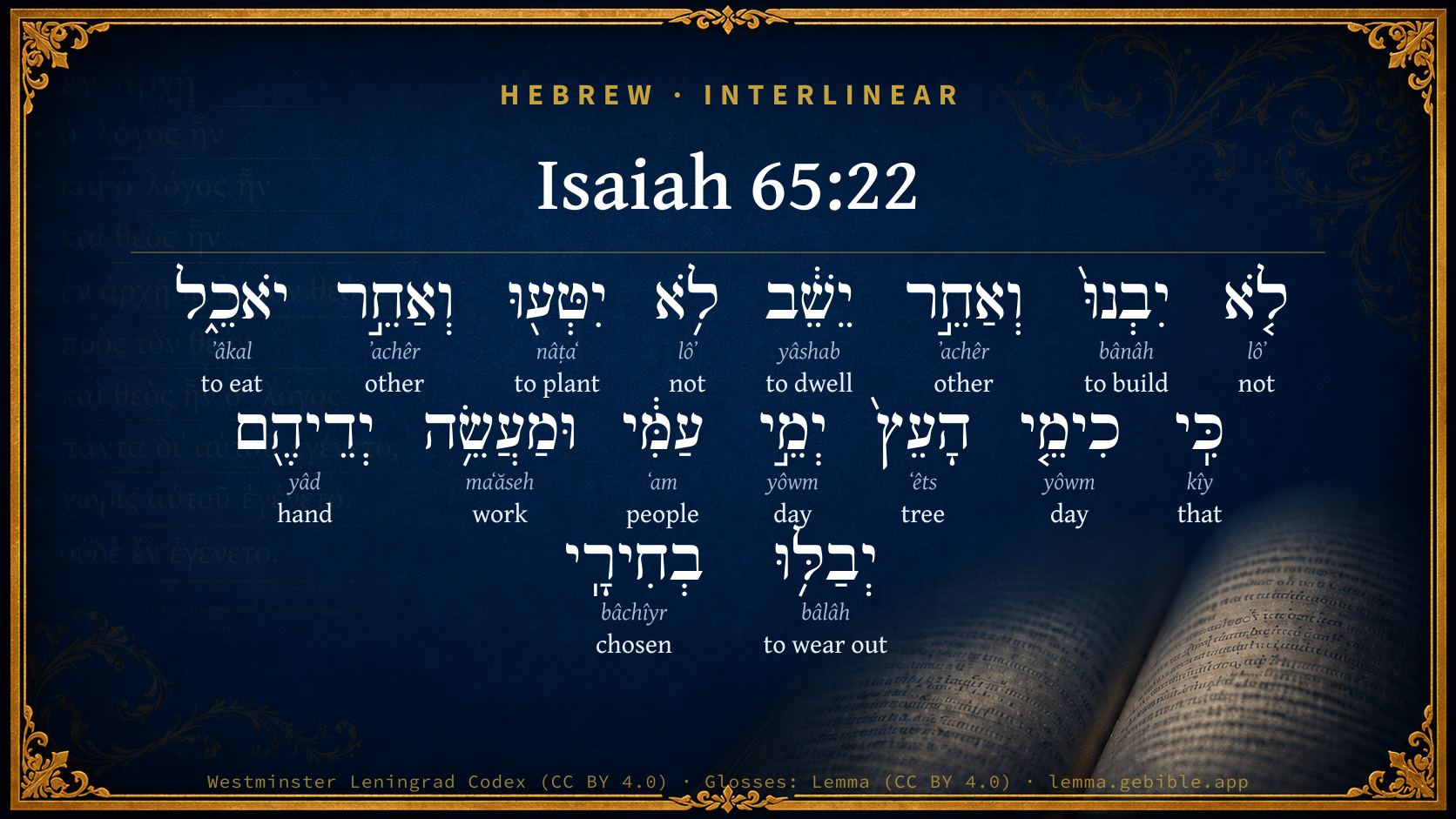
Isaiah 65:22

Hebrew (Westminster Leningrad Codex) Isaiah 65:22 appears in the Hebrew Old Testament. The text above is from the Westminster Leningrad Codex. Each word links to its Strong’s number, a concise gloss, and parsing drawn from the Open Scriptures Hebrew Bible morphology. Click any word for its full Brown-Driver-Briggs (BDB) entry.
Download image
Cite this verse

Isaiah 65:22 (World English Bible). Public Domain. Lemma interlinear Bible study tool, https://lemma.gebible.app/v/isaiah/65/22.

Show BibTeX & RIS
BibTeX
RIS
English Translation
They shall not build, and another inhabit; they shall not plant, and another eat: for as the days of a tree shall be the days of my people, and my chosen shall long enjoy the work of their hands.
World English Bible · Public Domain
Download a study sheet

One document with this verse’s original text, its word-by-word gloss line, the meaning frame, cross-references with their text, attributed commentary, and full source and license credits — printable, and it pastes into notes with its structure intact.

This verse Autodidact and up

Study sheet (.html) Plain text (.txt)

A passage Seminary Student

Up to 50 verses in one chapter. A passage sheet keeps up to 6 commentary sources and 12 cross-references per verse, in the order this page ranks them, and says so on the sheet whenever that leaves anything out. Ask for a single verse and you get the Autodidact verse sheet above.

Everything on this page stays free to read, with no account — the sheet is a download of what is already on screen, not access to it.

Want to remove ads? Support Godless Engineer
Compare translations 3

The same verse in 3 English versions, stacked beneath the original-language interlinear above. Click any original word for its lexicon entry.

Each is an independent rendering of the whole verse — the interlinear is not word-aligned to these translations.

Highlighted words mark where these versions differ — a whole-verse word diff, not a word-by-word alignment.

  • World English Bible Public Domain
    They shall not build, and another inhabit; they shall not plant, and another eat: for as the days of a tree shall be the days of my people, and my chosen shall long enjoy the work of their hands.
  • King James Version Public Domain
    They shall not build, and another inhabit; they shall not plant, and another eat: for as the days of a tree are the days of my people, and mine elect shall long enjoy the work of their hands.
  • unfoldingWord Literal Text CC BY-SA 4.0
    They will not build and another will dwell; they will not plant and another will eat. For the days of my people like the days of a tree, and my chosen ones will wear out the work of their hands.

unfoldingWord Literal Text — © unfoldingWord, licensed CC BY-SA 4.0. Word-aligned USFM3 via Door43 (git.door43.org/unfoldingWord/en_ult).

Versions to compare (up to 4)

3 of 4 selected

Show all 18 translations

Every available English version of this verse, each an independent rendering of the whole verse.

  • World English Bible Public Domain
    They shall not build, and another inhabit; they shall not plant, and another eat: for as the days of a tree shall be the days of my people, and my chosen shall long enjoy the work of their hands.
  • Berean Standard Bible Public Domain
    No longer will they build houses for others to inhabit, nor plant for others to eat. For as is the lifetime of a tree, so will be the days of My people, and My chosen ones will fully enjoy the work of their hands.
  • Majority Standard Bible Public Domain
    No longer will they build houses for others to inhabit, nor plant for others to eat. For as is the lifetime of a tree, so will be the days of My people, and My chosen ones will fully enjoy the work of their hands.
  • King James Version Public Domain
    They shall not build, and another inhabit; they shall not plant, and another eat: for as the days of a tree are the days of my people, and mine elect shall long enjoy the work of their hands.
  • American Standard Version (1901) Public Domain
    They shall not build, and another inhabit; they shall not plant, and another eat: for as the days of a tree shall be the days of my people, and my chosen shall long enjoy the work of their hands.
  • Revised Version (1885) Public Domain
    They shall not build, and another inhabit; they shall not plant, and another eat: for as the days of a tree shall be the days of my people, and my chosen shall long enjoy the work of their hands.
  • Geneva Bible (1599) Public Domain
    They shall not build, and another inhabite: they shall not plant, and another eate: for as the dayes of the tree are the dayes of my people, and mine elect shall inioye in olde age the worke of their handes.
  • Douay-Rheims (1899) Public Domain
    They shall not build, and another inhabit; they shall not plant, and another eat: for as the days of a tree, so shall be the days of my people, and the works of their hands shall be of long continuance.
  • Young's Literal Translation Public Domain
    They do not build, and another inhabit, They do not plant, and another eat, For as the days of a tree `are' the days of My people, And the work of their hands wear out do My chosen ones.
  • Literal Standard Version CC BY-SA 4.0
    They do not build, and another inhabit, || They do not plant, and another eat, || For as the days of a tree [are] the days of My people, || And My chosen wear out the work of their hands.
  • Unlocked Literal Bible CC BY-SA 4.0
    No longer will they build a house and another live in it; they will not plant, and another eat; for as the days of trees will be the days of my people. My chosen will fully outlive the work of their hands.
  • unfoldingWord Literal Text CC BY-SA 4.0
    They will not build and another will dwell; they will not plant and another will eat. For the days of my people like the days of a tree, and my chosen ones will wear out the work of their hands.
  • Darby Bible Public Domain
    they shall not build, and another inhabit; they shall not plant, and another eat: for as the days of a tree shall be the days of my people, and mine elect shall long enjoy the work of their hands.
  • World Messianic Bible Public Domain
    They will not build and another inhabit. They will not plant and another eat; for the days of my people will be like the days of a tree, and my chosen will long enjoy the work of their hands.
  • Webster's Bible Public Domain
    They shall not build, and another inhabit; they shall not plant, and another eat: for as the days of a tree are the days of my people, and my elect shall long enjoy the work of their hands.
  • Free Bible Version CC BY-SA 4.0
    No longer will they build houses for others to live in; no longer will they plant for others to eat. For my people will live as long as trees do; my chosen ones will live long enough to enjoy all they've worked for.
  • Bible in Basic English Public Domain
    They will no longer be building for the use of others, or planting for others to have the fruit: for the days of my people will be like the days of a tree, and my loved ones will have joy in full measure in the work of their hands.
  • JPS Tanakh (1917) Public Domain
    They shall not build, and another inhabit, they shall not plant, and another eat; for as the days of a tree shall be the days of My people, and Mine elect shall long enjoy the work of their hands.

Literal Standard Version (2020), Covenant Press — licensed CC BY-SA 4.0. Text via the HelloAO Bible API (eBible.org). Unlocked Literal Bible (unfoldingWord) — licensed CC BY-SA 4.0. Text via the HelloAO Bible API (eBible.org). unfoldingWord Literal Text — © unfoldingWord, licensed CC BY-SA 4.0. Word-aligned USFM3 via Door43 (git.door43.org/unfoldingWord/en_ult). Free Bible Version, Dr. Jonathan Gallagher — licensed CC BY-SA 4.0. Text via the HelloAO Bible API (eBible.org).

Word by word

More ways to search: Search by grammar → Find every occurrence → Compare this word →

Practice this passage: Drill this verse → Learn its vocabulary →

בְחִירָֽי
bâchîyr
H972
“chosen · my”
Adjective, Adjective, Masculine, Plural, Construct + Suffix, Personal, 1st Person, Common, Singular
Part of Speech
Adjective
Type
Adjective
Gender
Masculine
Number
Plural
State
Construct
Full BDB Definition

Origin: from H977

TWOT: 231c

chosen, choice one, chosen one, elect (of God)
  1. לֹ֤א lôʼ H3808 “not” Particle, Negative
  2. יִבְנוּ֙ bânâh H1129 “to build” Verb, Qal, Imperfect, 3rd Person, Masculine, Plural
  3. וְאַחֵ֣ר ʼachêr H312 “and · other” Conjunction + Adjective, Adjective, Masculine, Singular, Absolute
  4. יֵשֵׁ֔ב yâshab H3427 “to dwell” Verb, Qal, Imperfect, 3rd Person, Masculine, Singular
  5. לֹ֥א lôʼ H3808 “not” Particle, Negative
  6. יִטְּע֖וּ nâṭaʻ H5193 “to plant” Verb, Qal, Imperfect, 3rd Person, Masculine, Plural
  7. וְאַחֵ֣ר ʼachêr H312 “and · other” Conjunction + Adjective, Adjective, Masculine, Singular, Absolute
  8. יֹאכֵ֑ל ʼâkal H398 “to eat” Verb, Qal, Imperfect, 3rd Person, Masculine, Singular
  9. כִּֽי kîy H3588 “that” Conjunction
  10. כִימֵ֤י yôwm H3117 “like/as · days of” Preposition + Noun, Common, Masculine, Plural, Construct
  11. הָעֵץ֙ ʻêts H6086 “the · tree” Particle, Definite Article + Noun, Common, Masculine, Singular, Absolute
  12. יְמֵ֣י yôwm H3117 “days of” Noun, Common, Masculine, Plural, Construct
  13. עַמִּ֔י ʻam H5971 “people · my” Noun, Common, Masculine, Singular, Construct + Suffix, Personal, 1st Person, Common, Singular
  14. וּמַעֲשֵׂ֥ה maʻăseh H4639 “and · work of” Conjunction + Noun, Common, Masculine, Singular, Construct
  15. יְדֵיהֶ֖ם yâd H3027 “hands · their” Noun, Common, Both, Dual, Construct + Suffix, Personal, 3rd Person, Masculine, Plural
  16. יְבַלּ֥וּ bâlâh H1086 “to wear out” Verb, Piel, Imperfect, 3rd Person, Masculine, Plural

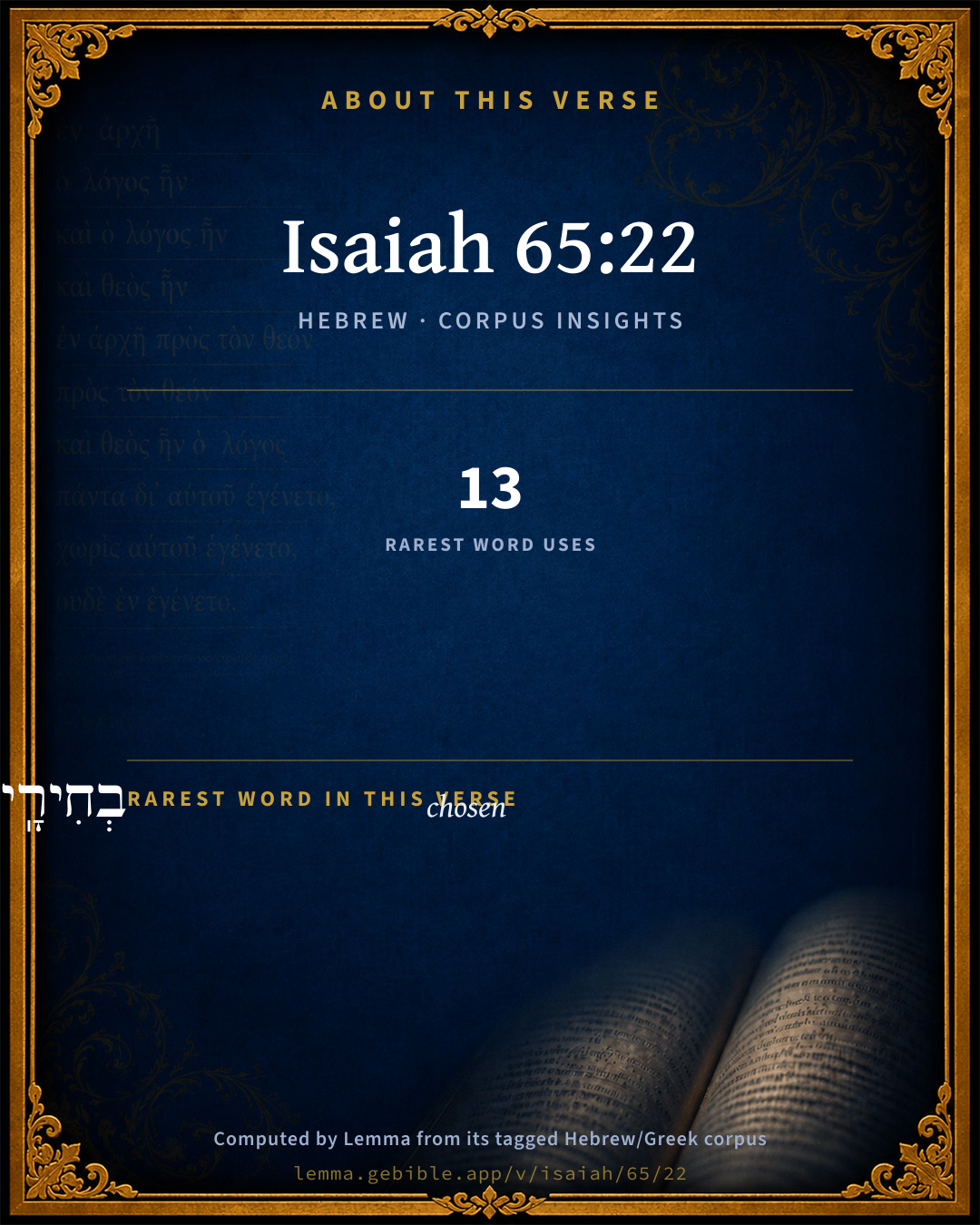
About this verse

These counts appear in no published source. They are computed here, from the morphology-tagged text and Lemma’s own curated glosses. What Lemma adds →

17
words
14
distinct lemmas
Prophets
section

Notable vocabulary

The rarest word here is בְחִירָֽי chosen H972 — appearing just 13 times in the whole Hebrew Bible.

Shared distinctive vocabulary

בְחִירָֽי chosen H972 occurs in 13 verses of the Hebrew Bible. Also found in:

Grammatical profile

  • 5 verbs
  • 6 nouns
  • 3 adjectives
  • 1 conjunction
  • 2 particles

Verb forms

  • יִבְנוּ֙ Qal · Imperfect
  • יֵשֵׁ֔ב Qal · Imperfect
  • יִטְּע֖וּ Qal · Imperfect
  • יֹאכֵ֑ל Qal · Imperfect
  • יְבַלּ֥וּ Piel · Imperfect

Repetition

Words recur within this verse — often emphatic in Hebrew:

  • וְאַחֵ֣ר other H312 ×2
  • כִימֵ֤י day H3117 ×2
  • לֹ֤א not H3808 ×2

Hebrew & Septuagint length

In English translation the verse runs 39 words from the Hebrew and 44 from the Septuagint (LXX English) — closely comparable.

A rough comparison of the two English renderings, which tokenize alike — not a word-level alignment.

Word counts can differ between the Hebrew and the Greek without any difference in meaning — e.g. the Hebrew direct-object marker אֵת has no separate Greek word, and Greek often adds the article ὁ.

Cross-references

8

Topical passages linked to Isaiah 65:22 in the Treasury of Scripture Knowledge — connected by theme and wording, ordered by reader-vote popularity; previews shown in the World English Bible.

  • Psalms 92:12–14 The righteous shall flourish like the palm tree. He will grow like a cedar in Lebanon.
  • Psalms 91:16 I will satisfy him with long life, And show him my salvation."
  • Psalms 21:4 He asked life of you, you gave it to him, Even length of days forever and ever.
  • Isaiah 65:15 You shall leave your name for a curse to my chosen; and the Lord Yahweh will kill you; and he will call his servants by another name:
  • Isaiah 65:9 I will bring forth a seed out of Jacob, and out of Judah an inheritor of my mountains; and my chosen shall inherit it, and my servants shall dwell there.
  • Genesis 5:5 All the days that Adam lived were nine hundred thirty years, then he died.
  • Genesis 5:27 All the days of Methuselah were nine hundred sixty-nine years, then he died.
  • Leviticus 26:16 I also will do this to you: I will appoint terror over you, even consumption and fever, that shall consume the eyes, and make the soul to pine away; and you will sow your seed in vain, for your enemies will eat it.

Cross-references courtesy of OpenBible.info (CC BY 4.0).

Hebrew and Greek witnesses Masoretic Hebrew ↔ Greek Septuagint

The same verse in the two great witnesses to the Old Testament, shown verse-for-verse.

These are two independent witnesses, not word-aligned to each other, and the Septuagint is shown in lemma (dictionary) form.

Hebrew Isaiah 65:22 Masoretic · Westminster Leningrad Codex

לֹ֤א יִבְנוּ֙ וְאַחֵ֣ר יֵשֵׁ֔ב לֹ֥א יִטְּע֖וּ וְאַחֵ֣ר יֹאכֵ֑ל כִּֽי כִימֵ֤י הָעֵץ֙ יְמֵ֣י עַמִּ֔י וּמַעֲשֵׂ֥ה יְדֵיהֶ֖ם יְבַלּ֥וּ בְחִירָֽי

They shall not build, and another inhabit; they shall not plant, and another eat: for as the days of a tree shall be the days of my people, and my chosen shall long enjoy the work of their hands.

World English Bible · Public Domain

Greek LXX Isaiah 65:22 Septuagint · lemma form

καί οὐ μή οἰκοδομέω καί ἄλλος ἐνοἰκέω καί οὐ μή φυτεύω καί ἄλλος ἐσθίω κατά γάρ ὁ ἡμέρα ὁ ξύλον ὁ ζωή εἰμί ὁ ἡμέρα ὁ λαός ἐγώ ὁ ἔργον ὁ πόνος αὐτός παλαιόω

They shall by no means build, and others inhabit; and they shall by no means plant, and others eat: for as the days of the tree of life shall be the days of my people, they shall long enjoy the fruits of their labors.

LXX2012 (modern English Septuagint) · Public Domain

On this verse, John Gill's Exposition discusses the Septuagint’s reading. Read the note in Commentary ↓

Hebrew: Westminster Leningrad Codex (CC BY 4.0). Greek: Septuagint (public domain); English from LXX2012 (modern English Septuagint) (Public Domain). How the Septuagint differs from the Hebrew →

Targum (Aramaic paraphrase)

1

The Targum is the ancient Jewish Aramaic paraphrase of the Hebrew Scriptures — an interpretive translation, not the Hebrew text itself. Onkelos (literal) and Pseudo-Jonathan (expansive) render the Torah, and Jonathan the Prophets. Coverage is partial: where no permissively-licensed English translation exists for a verse, only the Aramaic is shown. This is verse-level text, not a word-by-word alignment to the Hebrew.

  1. Targum Jonathan Prophets (Joshua–Malachi)
    לָא יִבְנוֹן וְאָחְרִין יָתְבוּן לָא יִצְבוּן וְאוֹחֲרָנִין יֵכְלוּן אֲרֵי כְיוֹמֵי אִילָן חַיַיָא יוֹמֵי עַמִי וְעוֹבֵד יְדֵיהוֹן יְבַלוּן בְּחִירָי:

    They shall not build, and others inhabit; they shall not plant, and others eat: for as the days of the tree of life are the days of my people, and mine elect shall wear out the work of their hands.

    Targum Jonathan — Aramaic: “Mikraot Gedolot” (public domain). English: “Sefaria Community Translation” (CC0 1.0 (public-domain dedication)); “London "Chaldee Paraphrase," 1871” (public domain). Text via Sefaria.

Commentary

Notes on Isaiah 65:22 from classic Christian and Jewish commentators (each source and its license shown beneath its notes). The classic Christian expositions comment on the surrounding passage and are grouped to its opening verse, so a note may address several verses; the Jewish commentaries on the Tanakh (Rashi and others) are per-verse, so they appear only where the commentator wrote on this verse.

Lemma curates 59 commentaries, every one of them public domain or Creative Commons licensed, each selected and text-cleaned for this edition rather than reprinted as found. About our sources →

Trapp's Complete Commentary

John Trapp

Isa 65:22 They shall not build, and another inhabit; they shall not plant, and another eat: for as the days of a tree [are] the days of my people, and mine elect shall long enjoy the work of their hands.

Ver. 22. They shall not build, and another inhabit.] They shall not provide for posterity alone, but live a long while to take benefit of their own labours.

For as the days of a tree are the days of my people,] i.e., Robusti atque diuturni; they shall be hearty, healthy, and long lasting, {Psa 52:9; Psa 92:13} even as if they had eaten of that tree of life in paradise.

John Trapp, A Commentary or Exposition upon All the Books of the Old and New Testament (1647–1656) — public domain. Text from a community e-Sword module.

The Biblical Illustrator

Joseph S. Exell

Isa_65:22

As the days of a tree

Trees

Of all natural objects trees have the closest fellowship with man.

When growing together in dense primeval forests they indeed exclude his presence, and the gloom and solitude produce an awe as of the supernatural world. But in the open cultivated spaces around his home they become domesticated, and are regarded with a sentiment akin to affection. God first talked with man under their shadow; mans first worship was helped, if not inspired, by the solemn sights and sounds of the grove, the flitting lights and shades as of mysterious shapes, and the whispered secrets of the leaves; and the pillared aisles and groined interlacing of branches first suggested to him the ideas of architectural beauty which grew into permanent shape in the house of prayer. The heart twines around them some of its most fragrant memories; and at the end of every vista of the vanished years we see through the golden light a favourite tree associated with some cherished Incident of the past. Trees are often planted as memorials of visits to celebrated scenes, or at the birth of an heir to an estate. (H. Macmillan, D. D.)

As the days of a tree

These human associations give to the emblem of the prophet a touching significance. It is a very appropriate emblem. The comparison between the two kinds of life is very close. In every particular connected with organic existence, in the laws of their development, decay and reproduction, trees and human beings are complete counterparts of one another. Even their structure to a certain extent is similar. The leaves correspond to the lungs and digestive organs; the blossoms represent the distinctions of sex; and the names of trunk, arms, and limbs are given indiscriminately to similar parts of both organisms. But if we inquire what a tree really is, we shall find in the emblem a correspondence still more profound. A tree is generally supposed to be a single individual, in the same sense that a man is an individual. It passes through a period of youth, maturity and old age. It has a fixed limit of size and age. It gradually loses its vital properties, and ceases to perform its vital functions. But this popular view is altogether erroneous. A tree is not a single individual; it is an aggregate of separate, independent individuals, a composite organism in which there is no centralization of life, and all the parts are frequently repeated: there being as many lungs as there are leaves, and as many organs of reproduction as there are blossoms. Each shoot is a distinct plant performing the functions of nutrition and propagation by and for itself, but, by virtue of its organic union with the rest of the tree, contributing to the general welfare, and helping to build up the common fabric. Cut off--its removal would not virtually injure the tree, nor impair its own vitality; and planted in the soil, it would strike root and in course of time grow to the same size as its parent. A tree may thus be said to be a colony of plants growing vertically instead of horizontally. Regarding a tree, then, as a body corporate, consisting of an aggregate of living and dead plants, the dead enclosed and preserved in the tissues of the living, and the living continually reproducing and grafting themselves upon one another, it follows necessarily that there is no physical limit to the size it may attain, or to the age it may reach. From its very nature a tree is immortal. It may go on growing and enlarging for ages, and after thousands of years be still in the full vigour of its existence. Even in Europe, where man has so long held sway, and has ever been destroying the woods and forests, individual trees have survived since the commencement of the Christian era, and their vigorous hold of life seems to secure them a longevity in comparison with which the period already passed may be no more than their early youth; while in other less-known parts of the world trees are to be found whose enormous size would indicate that they reached back to the origin of the existing state of the globe. From the nature of a tree as a composite social organism, it also necessarily follows that it is exempt from death by old age. The individual plants whose combination constitutes the corporate body, being only annuals, may be said to die of old age in autumn, when the leaves fade and fall. But as regards the whole organism there is no such thing as old age. (H. Macmillan, D. D.)

The tree of life

These considerations help us to understand more clearly why a tree should have been chosen as the sacrament or symbol of immortality in Eden, and why it should represent the eternal felicity of the redeemed in the heavenly paradise. The expression tree of life, acquires a new and deeper significance when we remember that there is nothing else with life that bridges across the centuries, connects departed dynasties and systems of religion with modern governments and fresh creeds and binds the sympathies of the human heart with the sorrows and joys of other ages dead and gone. (H. Macmillan, D. D.)

As the days of a tree: the Jews

How truly applicable to the marvellous history of the Jews! As trees are the oldest of living organisms, so the Jews are the oldest of living races. Though the least of all people, unable to compete in the arts of life with the nations of antiquity, they have outlived the wisest and most powerful of them. The people that oppressed and led them captive have perished, leaving behind only a few nameless ruins; the kingdoms whose glory overshadowed theirs have vanished, and left not even a wreck behind. But the Jews have still lived on. Like their own cedars of Lebanon they have survived the storms and vicissitudes of ages, and endured while all else has perished around them. Although the trunk and main stem of the Jews may be withered away, and only a fragment remain, yet this fragment is as full of life, is as green and flourishing, as in the brightest days of prosperity. And from this fragment will spring up a new and glorious tree. The tree, rather than the everlasting ,hills, may have been chosen by the prophet as the symbol of the perpetuity of Gods people, not only because it has life, and is therefore a more appropriate emblem of life, not only because of its power of indefinite longevity and increase, but also, as Dr. Harvey has suggested, because it is possessed only of a contingent perpetuity. In its own nature a tree is immortal, but it is subject to accidents which impair its vitality and lead to decay and death. Most trees die of mechanical injuries; a storm breaks off a branch and inflicts a wound which exposes the inner heart-wood to the weather, decay takes place, the inside of the trunk becomes hollow, and, incapable of offering resistance, it is hurled to the ground by a fiercer blast of wind than usual. Many trees are placed in unsuitable situations, where they are too much crowded by other trees, or too much exposed to the wind, or where the soil does not afford sufficient nourishment to them, and they die of hunger. Their own growth, by hardening and compressing their tissues, prevents the roots of the young shoots from growing, and the sap from rising freely upwards, and thus they are choked out of life. Add to these causes the manifold destructive influences of nature and the necessities and caprices of men, and it will be at once seen that the great majority of trees must perish ere they have reached their prime, and that even the oldest and largest must finally disappear. This circumstance may have been meant to infuse a salutary warning into the gracious assurance of the text. The days of Gods people would be like the days of a tree so long as they obeyed the laws of truth and righteousness, by which the stability of a nation is maintained; but, like the tree, their days would be cut short prematurely, if they exposed themselves by disobedience to the forces which inevitably bring all that is evil to an end. (H. Macmillan, D. D.)

The tree of life

Many of the ablest scholars, ancient and modern, hold to the opinion that the true rendering of the passage is this: As the days of the tree, are the days of My people--as the days, that is, of the tree of life! And there is very much to be said in favour of this rendering. The Tree of Life in Eden--that first of sacraments--was designed to sustain and refresh the life infused into man at his creation. To us, however, there is another Tree of Life, even the Cross of Christ. The body broken, and the blood shed upon that Tree, are to us the means of resurrection and immortality. And, again, there is another Tree of Life, to which as yet we can only look in faith, that, namely, which is fast beside the river that issues forth beneath the throne of God and of the Lamb--which bears its twelvefold fruit twelve times within the twelvemonth, and whose leaves are for the healing of the nations. As the days of the Tree, are the days of My people. Their destiny is to feed on the Tree of Life in the midst of the Paradise of God; and as the days of that Tree are never ending, never darkened, so shall the days of Gods people be. (H. Macmillan, D. D.)

Christian life imaged by the trees of the earth

I. THE DURABILITY OF THE CHURCH, of which the Saviour has said, The gates of hell, of death, shall not prevail against it. That which is true of the Church collectively is true of the humblest living member of the Church; for he shall reign, shall share in the rule of his Saviour, for ever and ever.

II. THE CONDITION OF THE CHURCH AND OF EVERY CHRISTIAN IS TO BE ONE OF DAILY, NOISELESS GROWTH. Nurtured by the sunshine and the rain, by sorrow and joy, by temptation and quiet, exposed to all, and strengthened by all, flourishing like a palm-tree amidst the summer heats, and growing amid snows like a cedar in Lebanon (Psa_92:12).

III. NOT ONLY GROWING AMID THE CHANGES OF EARTH, BUT DRAWING NOURISHMENT FROM ALL. The Christian is planted here, has his allotted duties here (Psa_92:13), as the tree is rooted in earth. Both derive nourishment from the earth. Trials, affliction, spiritual and fleshly temptations, and the winds of false doctrine, should but strengthen the Christian.

IV. IT IS FRUIT-BEARING. (W. Denton, M. A.)

The Biblical Illustrator, edited by Joseph S. Exell (c. 1880s–1900s) — public domain. Text from a community e-Sword module.

The Preacher's Complete Homiletical Commentary

Joseph S. Exell (gen. ed.)

THE WORK AND ENJOYMENT OF GOD’S PEOPLE

Isa_65:22. Mine elect shall long enjoy the work of their hands.

Connection of the text—

I. THE CHARACTER AND RELATION OF BELIEVERS. They are God’s people by creation, purchase, consecration, and in virtue of the purpose of God.

II. THE WORK IN WHICH THEY ARE ENGAGED.

1. The law of labour pervades the universe.

2. The law applies to religion; God’s people have work to do,—the work of repentance, faith, glorifying God, &c.

3. The law is universally applicable, the man of one talent as well as the one of ten—each and all.

III. THE ENJOYMENT THEY HAPPILY SHARE. There is enjoyment—

1. In doing the work.

2. In the Divine presence and aid.

3. Resulting from the work.

V. THE PERPETUITY OF THEIR JOY.

1. Individuals long enjoy the fruit of piety.

2. The Church will long enjoy and live and labour for posterity.

3. The redeemed in eternity will enjoy the fruit of time.—Geo. Smith, D.D.

The Preacher's Complete Homiletical Commentary (gen. ed. Joseph S. Exell; Funk & Wagnalls, c. 1892) — public domain (pre-1929). A full-Bible homiletical/sermon-outline anthology covering 65 of 66 books (2 John is absent from the source module). Text from a community e-Sword module.

Jamieson, Fausset & Brown

Robert Jamieson, A. R. Fausset & David Brown

They shall not experience the curse pronounced (Lev 26:16; Deu 28:30).

tree--among the most long-lived of objects in nature. They shall live as long as the trees they "plant" (compare Isa 61:3, end of verse; Psa 92:12).

enjoy--Hebrew, "consume," "wear out"; they shall live to enjoy the last of it (Isa 62:9).

Jamieson, Fausset & Brown — Commentary Critical and Explanatory on the Whole Bible (1871) — public domain (CC PDM 1.0). Text via the HelloAO Bible API.

Adam Clarke's Commentary

Verse 22. They shall not build, and another inhabit] The reverse of the curse denounced on the disobedient, De 28:30: "Thou shalt build a house, and thou shalt not dwell therein; thou shalt plant a vineyard, and shalt not gather the grapes thereof."

For as the days of a tree] It is commonly supposed that the oak, one of the most longlived of the trees, lasts about a thousand years; being five hundred years growing to full perfection, and as many decaying: which seems to be a moderate and probable computation. See Evelyn, Sylva, B. III. chap. iii. The present emperor of China, in his very ingenious and sensible poem entitled Eloge de Moukden, a translation of which in French was published at Paris, 1770, speaks of a tree in his country which lives more than a hundred ages: and another, which after fourscore ages is only in its prime, pp. 37, 38. But his imperial majesty's commentators, in their note on the place, carry the matter much farther; and quote authority, which affirms, that the tree last mentioned by the emperor, the immortal tree, after having lived ten thousand years, is still only in its prime. I suspect that the Chinese enlarge somewhat in their national chronology, as well as in that of their trees. See Chou King. Preface, by Mons. de Guignes. The prophet's idea seems to be, that they shall live to the age of the antediluvians; which seems to be very justly expressed by the days of a tree, according to our notions. The rabbins have said that this refers to the tree of life, which endures five hundred years. - L.

Adam Clarke's Commentary on the Bible (1810–1826) — public domain. Text from a community e-Sword/MySword module.

Ellicott's Commentary for English Readers

(22) As the days of a tree . . .—We may think of the cedars of Lebanon or the oaks of Bashan as furnishing the prophet with the ideal standard of longevity. Commonly, as by Homer and other poets, the lives of men have been compared to that of the leaves of deciduous trees; here they are compared to the life of the tree itself. The prophet is still speaking, not of national, but of individual life.

A Bible Commentary for English Readers, edited by Charles John Ellicott (1878–1897) — public domain. Text from a community e-Sword module.

John Gill's Exposition

They shall not build, and another inhabit,.... As the Canaanites did, whose houses the Israelites inhabited; but they shall inhabit the houses they have built, and shall not be dispossessed by an enemy:

they shall not plant, and another eat; the fruit of the vines, olives, fig trees, or others, planted by them:

for as the days of a tree are the days of my people; not as of a leaf which falls every year, but as of a tree, and as of such that last long, as oaks, cedars, and the like; though perhaps a tree bearing fruit fit to eat is meant; and the sense be, that the Lord's people should live as long as the trees planted by them, and so should eat the fruit thereof, and not leave them to others to partake of. The Targum, Septuagint, and Arabic versions, render it,

"as the days of the tree of life;''

which, some of the Rabbins say, were five hundred years. The allusion may be to the tree of life in paradise, and may be expressive of the long life of good men in this state; and as the tree of life was typical of Christ, who is a tree of life to them that lay hold upon him, it may denote that eternal life his people have by him.

And mine elect shall long enjoy the work of their hands; what they have built and planted; they shall live long in their houses, and for many years partake of the fruit of their vineyards. The blessing of long life is carried on with the promises of all other instances of outward happiness.

John Gill's Exposition of the Whole Bible (1746–1763) — public domain (CC PDM 1.0). Text via the HelloAO Bible API.

Albert Barnes' Notes on the Bible

They shall not build, and another inhabit - Every man shall enjoy the avails of his labor.

For as the days I of a tree are the days of my people - That is, in that future time, such shall be the length of the lives of the people (see Isa 65:21). The Septuagint renders this, ‘The days of the tree of life.’ The Syriac, ‘As the days of trees.’ The Chaldee as the Septuagint. The idea is, that the lives of his people would be greatly prolonged (see the notes at Isa 65:20). A tree is among the most long-lived of material objects. The oak, the terebinth, the cypress, the cedar, the banyan, attain to a great age. Many trees also live to a much longer period than a thousand years. The Baobab tree of Senegal (Adansonia digitata) is supposed to attain the age of several thousand years. Adanson inferred that one which he measured, and found to be thirty feet in diameter, had attained the age of 5150 years. Having made an incision to a certain depth, he first counted three hundred rings of annual growth, and observed what thickness the tree had gained in that period. The average rate of growth of younger trees, of the same species, was then ascertained, and the calculation made according to a supposed mean rate of increase. De Candolle considers it not improbable that the celebrated Taxodium, of Chapultepec, in Mexico, which is 117 feet in circumference, may be still more aged. In Macartney’s Embassy to China, i. 131, an account is given of a tree of this description, which was found to be at the base no less than fifty-six feet in girth. On the longevity of trees, see Bibliotheca Univ., May 1831, quoted in Lyell’s Geology, ii. 261. The idea here is, simply, that his people would attain to an age like that of the trees of the forest; that is, that the state of things under the Messiah would be as if human life were greatly prolonged (see the notes at Isa 65:20).

And mine elect shall long enjoy the work of their hands - Margin, ‘Make them continue long,’ or ‘wear out.’ The word used here (יבלוּ yeballû from בלה bâlâh) means properly to fall, to fall away, to fail; to wear out, to wax old Deu 8:4; Deu 29:4; Isa 50:9; Isa 51:6; hence, in Piel, to consume. The idea here is, that they would live to consume; that is, to enjoy the productions of their own labor. Their property should not be wrested from them by injurious taxation, or by plunder; but they would be permitted long to possess it, until they should wear it out, or until it should be consumed. Vulgate, ‘The works of their hands shall be of long continuance (inveterabunt),’ or shall be kept a long time. The Septuagint, ‘For the works of their labors (των πόνων tōn ponōn) shall become old, or of long continuance (παλαιώσου palaiōsousin).’ See the notes at Isa 62:8-9.

Albert Barnes' Notes on the Bible (1834–1885) — public domain. Text from a community e-Sword/MySword module.

Haydock's Catholic Bible Commentary

A tree. Septuagint, "of the tree of life," Jeremias xviii. 8. (Calmet) --- Continuance. Hebrew, "My elect shall long enjoy the works," &c. (Haydock) --- They shall not build for others to enjoy.

George Leo Haydock (1774–1849), Haydock's Catholic Family Bible and Commentary, 1859 edition — public domain. Excludes Psalms (Douay-Rheims chapter numbering differs from Protestant) and Deuterocanonical books (Catholic canon only).

Matthew Poole's English Annotations

Duration and perpetuity are promised to them in their happy estate.

Matthew Poole's English Annotations on the Holy Bible (1683–1685) — public domain. Text from a community e-Sword/MySword module.

The Pulpit Commentary

As the days of a tree are the days of my people. Trees endure for many hundreds, perhaps for thousands of years. The cedars of Lebanon, the oaks of Bashan, were known to have an antiquity of centuries. Isaiah may have had a knowledge of other trees to which attached the tradition of a yet longer existence. In our own day Brazil and California have furnished proofs of vegetable growths exceeding a millennium. Mine elect shall long enjoy; literally, shall wear out; i.e. have the full use and enjoyment of the work of their hands.

The Pulpit Commentary (1880–1919), ed. H.D.M. Spence-Jones & Joseph S. Exell — public domain. Text from a community e-Sword module.

unfoldingWord translationNotes

Door43 World Missions Community

General Information:

Yahweh continues speaking about his faithful people.

for as the days of trees will be the days of my people

"for my people will live as long as trees live"

they are the children of those blessed by Yahweh

This can be stated in active form. AT: "they are the children of those whom Yahweh blessed" (See: Active or Passive)

translationWords

house

life

people of God

chosen one

hand

labor

vain

children

bless

Yahweh

descend

unfoldingWord translationNotes — © Distant Shores Media and the Door43 World Missions Community, licensed CC BY-SA 4.0. Source: git.door43.org/Door43/en_tn.

Rashi

Rabbi Shlomo Yitzchaki (Rashi)

like the days of the tree Jonathan renders: the tree of life.

Rashi on the Tanakh — English translations: “The Judaica Press complete Tanach with Rashi, translated by A. J. Rosenberg” (CC BY 4.0); “Pentateuch with Rashi's commentary by M. Rosenbaum and A.M. Silbermann, 1929-1934” (public domain); “The Metsudah Tanach series, Lakewood, N.J” (CC BY 4.0); and “The Book of Joshua, Metsudah Publications, 1997” (CC BY 4.0). Text via Sefaria.

Ibn Ezra

Rabbi Abraham ibn Ezra

As the days of the tree that lives for a long time, as the Carob and similar trees.

And mine elect shall outlive the work of their hands. Many works of man retain still their new appearance, while man has already become old, as e.g. a building, a book. The pronoun their refers to mine elect, the subject of the sentence.

Ibn Ezra on the Tanakh — English translations: “Sefaria Community Translation” (CC0 1.0 (public-domain dedication)); “Yalkut, Sifsei Chachomim Chumash, Metsudah Publications, 2009” (CC BY 4.0); and “Commentary of Ibn Ezra on Isaiah - trans. by M. Friedlander, 1873” (public domain). Text via Sefaria.

Lesson kit

Teaching starters — assembled from the data on this page, not authored interpretation. Every prompt links to the verse data it draws on. Edit before teaching.

Isaiah, in the Prophets, opens this verse with 17 words (14 distinct Hebrew lemmas). Its most distinctive word is bâchîyr (“chosen”). A historical commentator’s framing appears above. Read the whole chapter for the surrounding context.

Discussion questions

  1. How does “chosen” (bâchîyr) shape what this verse is saying?
  2. 2 Samuel 21:6 shares the word «chosen» with this verse. How do the two illuminate each other?
  3. “other” occurs 2× in this one verse. What is the effect of the repetition?
  4. The translations on this page render this verse differently — a whole-verse word diff, not a word-by-word alignment. What might account for the different wordings?
  5. The verb «יִבְנוּ֙» is Qal Imperfect. How does its form color the action?
  6. Reading how Trapp's Complete Commentary and The Biblical Illustrator read this verse, where do the two commentators agree and where do they part?

Things to notice

Reading settings

Reading text

Shown beneath each verse's original-language words.

Old Testament
Old Testament edition

Read the OT as the Masoretic Hebrew (MT) or the Greek Septuagint (LXX).

English shown for the Greek Septuagint (in the Hebrew ↔ Greek comparison).

Comparing translations? Open the Compare panel on any verse page to stack up to four side by side.