
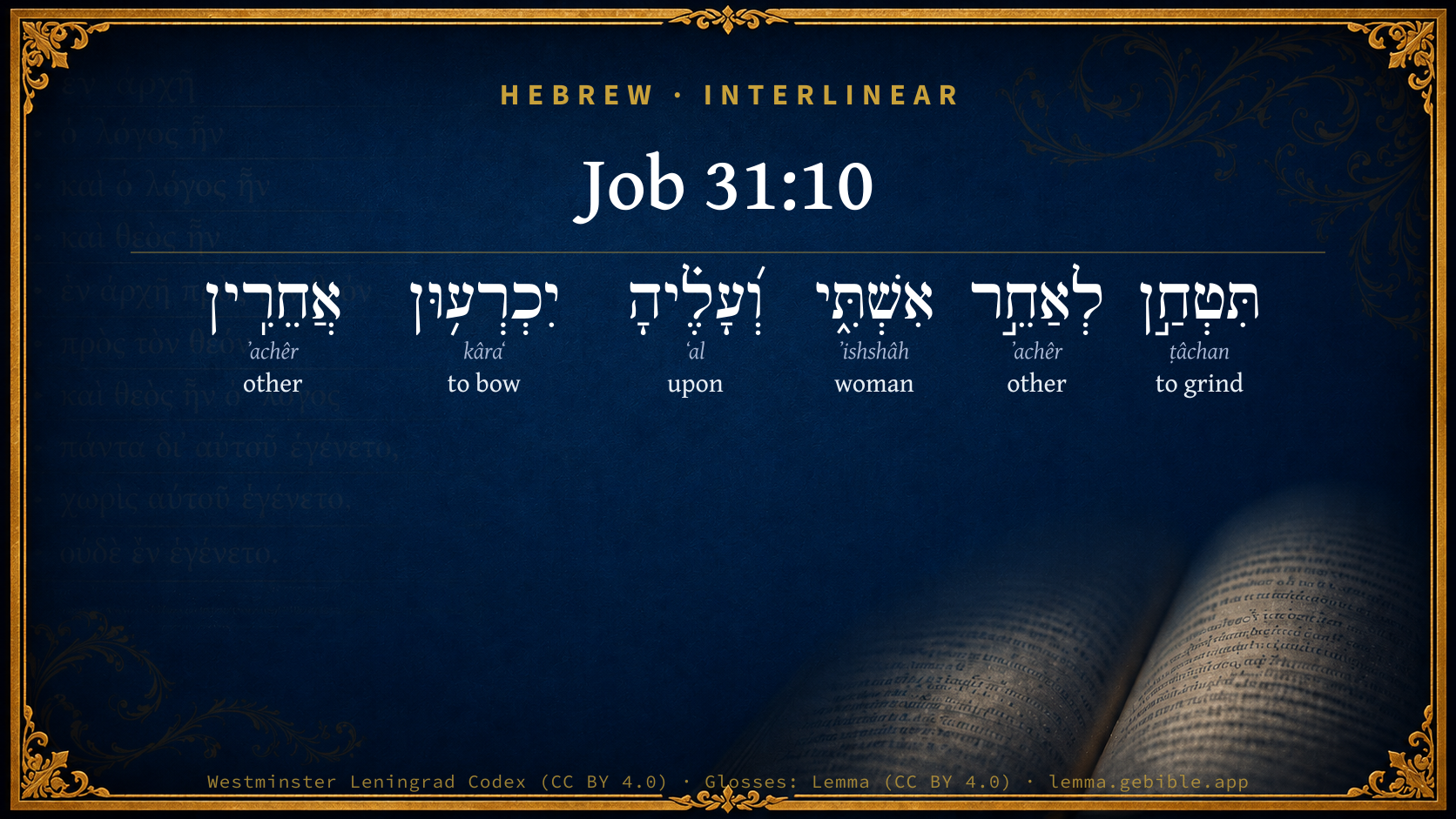
Job 31:10

Hebrew (Westminster Leningrad Codex) Job 31:10 appears in the Hebrew Old Testament. The text above is from the Westminster Leningrad Codex. Each word links to its Strong’s number, a concise gloss, and parsing drawn from the Open Scriptures Hebrew Bible morphology. Click any word for its full Brown-Driver-Briggs (BDB) entry.
Download image
Cite this verse

Job 31:10 (World English Bible). Public Domain. Lemma interlinear Bible study tool, https://lemma.gebible.app/v/job/31/10.

Show BibTeX & RIS
BibTeX
RIS
English Translation
Then let my wife grind for another, And let others sleep with her.
World English Bible · Public Domain
Download a study sheet

One document with this verse’s original text, its word-by-word gloss line, the meaning frame, cross-references with their text, attributed commentary, and full source and license credits — printable, and it pastes into notes with its structure intact.

This verse Autodidact and up

Study sheet (.html) Plain text (.txt)

A passage Seminary Student

Up to 50 verses in one chapter. A passage sheet keeps up to 6 commentary sources and 12 cross-references per verse, in the order this page ranks them, and says so on the sheet whenever that leaves anything out. Ask for a single verse and you get the Autodidact verse sheet above.

Everything on this page stays free to read, with no account — the sheet is a download of what is already on screen, not access to it.

Want to remove ads? Support Godless Engineer
Compare translations 3

The same verse in 3 English versions, stacked beneath the original-language interlinear above. Click any original word for its lexicon entry.

Each is an independent rendering of the whole verse — the interlinear is not word-aligned to these translations.

Highlighted words mark where these versions differ — a whole-verse word diff, not a word-by-word alignment.

  • World English Bible Public Domain
    Then let my wife grind for another, And let others sleep with her.
  • King James Version Public Domain
    Then let my wife grind unto another, and let others bow down upon her.
  • unfoldingWord Literal Text CC BY-SA 4.0
    may my wife grind for another, and may others bow down upon her.

unfoldingWord Literal Text — © unfoldingWord, licensed CC BY-SA 4.0. Word-aligned USFM3 via Door43 (git.door43.org/unfoldingWord/en_ult).

Versions to compare (up to 4)

3 of 4 selected

Show all 18 translations

Every available English version of this verse, each an independent rendering of the whole verse.

  • World English Bible Public Domain
    Then let my wife grind for another, And let others sleep with her.
  • Berean Standard Bible Public Domain
    then may my own wife grind grain for another, and may other men sleep with her.
  • Majority Standard Bible Public Domain
    then may my own wife grind grain for another, and may other men sleep with her.
  • King James Version Public Domain
    Then let my wife grind unto another, and let others bow down upon her.
  • American Standard Version (1901) Public Domain
    Then let my wife grind unto another, And let others bow down upon her.
  • Revised Version (1885) Public Domain
    Then let my wife grind unto another, and let others bow down upon her.
  • Geneva Bible (1599) Public Domain
    Let my wife grinde vnto another man, and let other men bow downe vpon her:
  • Douay-Rheims (1899) Public Domain
    Let my wife be the harlot of another, and let other men lie with her.
  • Young's Literal Translation Public Domain
    Grind to another let my wife, And over her let others bend.
  • Literal Standard Version CC BY-SA 4.0
    Let my wife grind to another, || And let others bend over her.
  • Unlocked Literal Bible CC BY-SA 4.0
    then let my wife grind grain for another, and let others bow down on her.
  • unfoldingWord Literal Text CC BY-SA 4.0
    may my wife grind for another, and may others bow down upon her.
  • Darby Bible Public Domain
    Let my wife grind for another, and let others bow down upon her.
  • World Messianic Bible Public Domain
    then let my wife grind for another, and let others sleep with her.
  • Webster's Bible Public Domain
    Then let my wife grind to another, and let others bow down upon her.
  • Free Bible Version CC BY-SA 4.0
    then let my wife serve another, let other men sleep with her.
  • Bible in Basic English Public Domain
    Then let my wife give pleasure to another man and let others make use of her body.
  • JPS Tanakh (1917) Public Domain
    Then let my wife grind unto another, and let others bow down upon her.

Literal Standard Version (2020), Covenant Press — licensed CC BY-SA 4.0. Text via the HelloAO Bible API (eBible.org). Unlocked Literal Bible (unfoldingWord) — licensed CC BY-SA 4.0. Text via the HelloAO Bible API (eBible.org). unfoldingWord Literal Text — © unfoldingWord, licensed CC BY-SA 4.0. Word-aligned USFM3 via Door43 (git.door43.org/unfoldingWord/en_ult). Free Bible Version, Dr. Jonathan Gallagher — licensed CC BY-SA 4.0. Text via the HelloAO Bible API (eBible.org).

Word by word

More ways to search: Search by grammar → Find every occurrence → Compare this word →

Practice this passage: Drill this verse → Learn its vocabulary →

About this verse

These counts appear in no published source. They are computed here, from the morphology-tagged text and Lemma’s own curated glosses. What Lemma adds →

6
words
5
distinct lemmas
Wisdom
section

Notable vocabulary

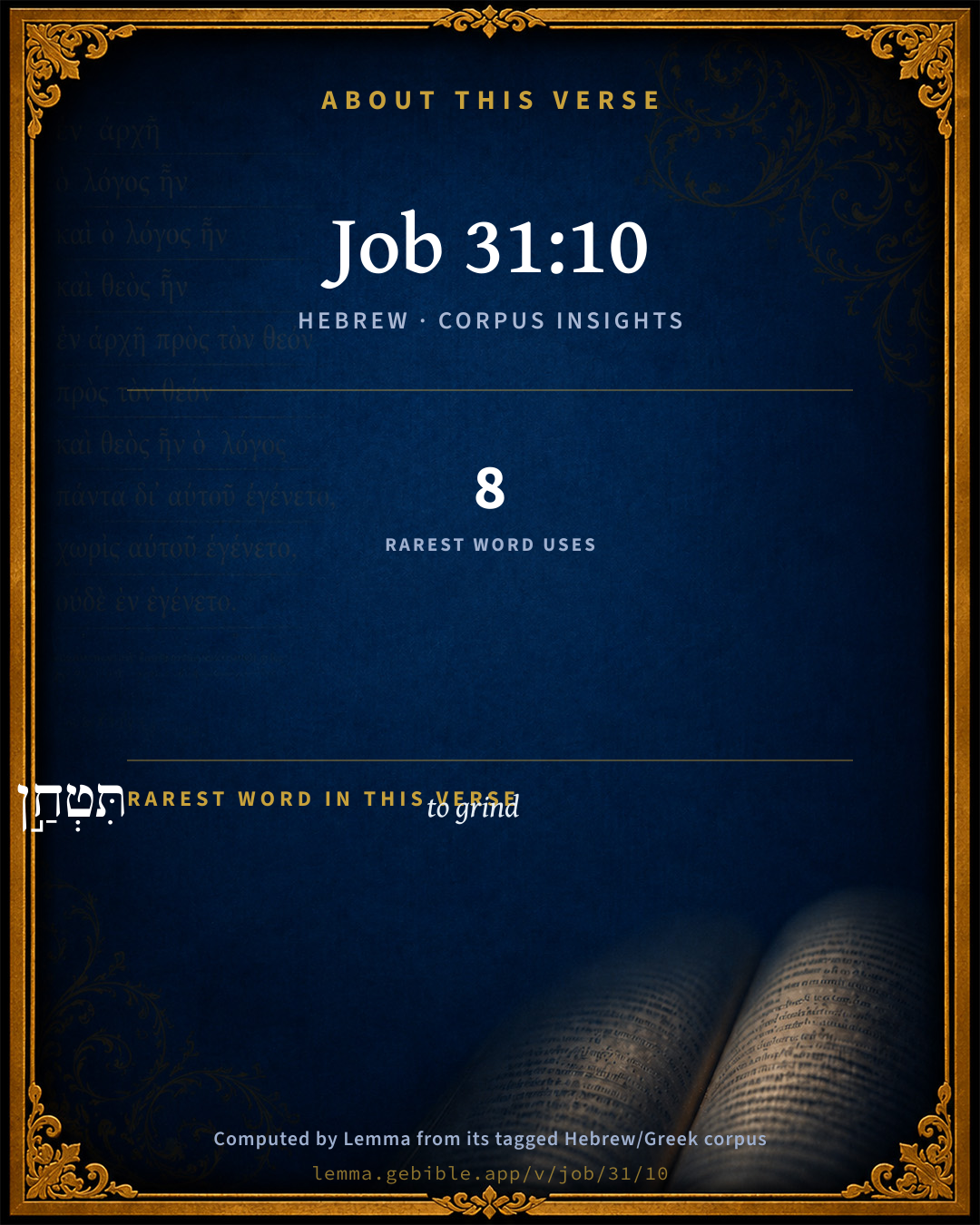
The rarest word here is תִּטְחַ֣ן to grind H2912 — appearing just 8 times in the whole Hebrew Bible.

Shared distinctive vocabulary

תִּטְחַ֣ן to grind H2912 occurs in 8 verses of the Hebrew Bible. Also found in:

Grammatical profile

  • 2 verbs
  • 1 noun
  • 2 adjectives
  • 1 preposition

Verb forms

  • תִּטְחַ֣ן Qal · Imperfect
  • יִכְרְע֥וּן Qal · Imperfect

Repetition

A word recurs within this verse — often emphatic in Hebrew:

  • לְאַחֵ֣ר other H312 ×2

Hebrew & Septuagint length

In English translation the verse runs 13 words from the Hebrew and 14 from the Septuagint (LXX English) — closely comparable.

A rough comparison of the two English renderings, which tokenize alike — not a word-level alignment.

Word counts can differ between the Hebrew and the Greek without any difference in meaning — e.g. the Hebrew direct-object marker אֵת has no separate Greek word, and Greek often adds the article ὁ.

Cross-references

7

Topical passages linked to Job 31:10 in the Treasury of Scripture Knowledge — connected by theme and wording, ordered by reader-vote popularity; previews shown in the World English Bible.

  • Jeremiah 8:10 Therefore will I give their wives to others, and their fields to those who shall possess them: for everyone from the least even to the greatest is given to covetousness; from the prophet even to the priest every one deals falsely.
  • 2 Samuel 12:11 This is what Yahweh says: 'Behold, I will raise up evil against you out of your own house; and I will take your wives before your eyes, and give them to your neighbor, and he will lie with your wives in the sight of this sun.
  • Isaiah 47:2 Take the millstones, and grind meal; remove your veil, strip off the train, uncover the leg, pass through the rivers.
  • Exodus 11:5 and all the firstborn in the land of Egypt shall die, from the firstborn of Pharaoh who sits on his throne, even to the firstborn of the maid-servant who is behind the mill; and all the firstborn of cattle.
  • Deuteronomy 28:30 You shall betroth a wife, and another man shall lie with her: you shall build a house, and you shall not dwell therein: you shall plant a vineyard, and shall not use the fruit of it.
  • Hosea 4:13–14 They sacrifice on the tops of the mountains, And burn incense on the hills, under oaks and poplars and terebinths, Because its shade is good. Therefore your daughters play the prostitute, And your brides commit adultery.
  • Matthew 24:41 two women grinding at the mill, one will be taken and one will be left.

Cross-references courtesy of OpenBible.info (CC BY 4.0).

Hebrew and Greek witnesses Masoretic Hebrew ↔ Greek Septuagint

The same verse in the two great witnesses to the Old Testament, shown verse-for-verse.

These are two independent witnesses, not word-aligned to each other, and the Septuagint is shown in lemma (dictionary) form.

Hebrew Job 31:10 Masoretic · Westminster Leningrad Codex

תִּטְחַ֣ן לְאַחֵ֣ר אִשְׁתִּ֑י וְ֝עָלֶ֗יהָ יִכְרְע֥וּן אֲחֵרִֽין

Then let my wife grind for another, And let others sleep with her.

World English Bible · Public Domain

Greek LXX Job 31:10 Septuagint · lemma form

ἀρέσκω ἄρα καί ὁ γυνή ἐγώ ἕτερος ὁ δέ νήπιος ἐγώ ταπεινόω

then let my wife also please another, and let my children be brought low.

LXX2012 (modern English Septuagint) · Public Domain

On this verse, Albert Barnes' Notes on the Bible discusses the Septuagint’s reading. Read the note in Commentary ↓

Hebrew: Westminster Leningrad Codex (CC BY 4.0). Greek: Septuagint (public domain); English from LXX2012 (modern English Septuagint) (Public Domain). How the Septuagint differs from the Hebrew →

Commentary

Notes on Job 31:10 from classic Christian and Jewish commentators (each source and its license shown beneath its notes). The classic Christian expositions comment on the surrounding passage and are grouped to its opening verse, so a note may address several verses; the Jewish commentaries on the Tanakh (Rashi and others) are per-verse, so they appear only where the commentator wrote on this verse.

Lemma curates 59 commentaries, every one of them public domain or Creative Commons licensed, each selected and text-cleaned for this edition rather than reprinted as found. About our sources →

Trapp's Complete Commentary

John Trapp

Job 31:10 [Then] let my wife grind unto another, and let others bow down upon her.

Ver. 10. Then let my wife grind unto another] i.e. Let her be his slave, as Lam 5:13 Exo 11:5 Mat 24:41; or rather, let her be his whore; and may my sin, which hath served her for example, serve her also for excuse. Not that Job would hereby license his wife to commit filthiness (as those Lituanians, who have their connubii adiutores, co-helpers in wedlock, and prize them far above all their acquaintance, as Maginus relateth, Alienas permolere uxores (Horat.). Sic μυλλειν, i.e. molere, apud Theocrit. est coire; and as some wits among us, panders to their own beds, who, either for gain or for a quiet life, wink at their wives’ disloyalty; and, as woodculvers or silly hedge sparrows, hatch and bring up that which cuckoos lay in their nests), but to set forth by this horrible imprecation how extremely he abhorred the sin of adultery.

And let others bow down upon her] A clean expression of an unclean act. Some Borborologi podicem ex ore faciunt, being like ducks, that ever have their noses puddling in puddles: sic hi spurcitias Veneris eliminant, delight in ribaldry and obscene language; as did Proculus, the emperor, and before him, that beast Tiberius. These are to be avoided as pests and botches of human society. So also are stage plays for that very cause, as the brothels of bawdry, the corrupters of youth, the canker of the commonwealth, as Plato, a heathen, complained. Filthiness and fornication should not be once named among Christians, Eph 5:3. Groves were flatly forbidden by God to be planted near the places of his worship; in detestation of that heathenish custom of Priapus’s worshippers, promiscuously satisfying their lusts in a thicket after they had sacrificed; thereby, as they conceived, best pleasing their god.

John Trapp, A Commentary or Exposition upon All the Books of the Old and New Testament (1647–1656) — public domain. Text from a community e-Sword module.

Geneva Bible (1599)

Geneva Bible translators

Let her be made a slave.

Geneva Bible (1599) marginal notes — public domain. Text via Bolls.life.

Jamieson, Fausset & Brown

Robert Jamieson, A. R. Fausset & David Brown

grind--turn the handmill. Be the most abject slave and concubine (Isa 47:2; Sa2 12:11).

Jamieson, Fausset & Brown — Commentary Critical and Explanatory on the Whole Bible (1871) — public domain (CC PDM 1.0). Text via the HelloAO Bible API.

Adam Clarke's Commentary

Verse 10. Let my wife grind unto another] Let her work at the handmill, grinding corn; which was the severe work of the meanest slave. In this sense the passage is understood both by the Syriac and Arabic. See Ex 11:5, and Isa 47:2; and see at the end of the chapter. See Clarke on Job 31:40.

And let others bow down upon her.] Let her be in such a state as to have no command of her own person; her owner disposing of her person as he pleases. In Asiatic countries slaves were considered so absolutely the property of their owners, that they not only served themselves of them in the way of scortation and concubinage, but they were accustomed to accommodate their guests with them! Job is so conscious of his own innocence, that he is willing it should be put to the utmost proof; and if found guilty, that he may be exposed to the most distressing and humiliating punishment; even to that of being deprived of his goods, bereaved of his children, his wife made a slave, and subjected to all indignities in that state.

Adam Clarke's Commentary on the Bible (1810–1826) — public domain. Text from a community e-Sword/MySword module.

Ellicott's Commentary for English Readers

(10) Then let my wife grind—i.e., perform all menial offices, like a slave.

A Bible Commentary for English Readers, edited by Charles John Ellicott (1878–1897) — public domain. Text from a community e-Sword module.

The Cambridge Bible for Schools and Colleges

gen. ed. J. J. S. Perowne

10. To “grind unto another,” i. e. at the mill, is to be the slave of another, Isa_47:2. The slave was at the same time usually the concubine of her master, and the curse means, Let my wife be the slave (first clause) and the concubine (second clause) of others. It is probable, however, that in usage the language of the first clause carried the same sense as the second.

The Cambridge Bible for Schools and Colleges (gen. ed. J. J. S. Perowne; Cambridge University Press, 1878–1918) — public domain. Text from a community e-Sword module.

John Gill's Exposition

For this is an heinous crime,.... Adultery; it is contrary to the light of nature, and is condemned by it as a great sin, Gen 20:9; as well as contrary to the express will and law of God, Exo 20:14; and, though all sin is a transgression of the law of God, and deserving of death; yet there are some sins greater and more heinous than others, being attended with aggravating circumstances; and such is this sin, it is a breach of the marriage contract and covenant between man and wife; it is doing injury to a man's property, and to that which is the nearest and dearest to him, and is what introduces confusion into families, kingdoms, and states; and therefore it follows:

yea, it is an iniquity to he punished by the judges; who might take cognizance of it, examine into it, and pass sentence for it, and execute it; and, if they neglect do their duty, God, the Judge of all the earth, will punish for it in the world to come, unless repented of: "for whoremongers and adulterers God will judge", Heb 13:4; the punishment of adultery was death by the law of God, and that by stoning, as appears from Lev 20:10; and it is remarkable, that the Heathens, who were ignorant of this law, enjoined the same punishment for it; so Homer (e) introduces Hector reproving Paris for this sin, and suggests to him, that if he had his deserved punishment, he would have been clothed with a "stone coat", as he beautifully expresses it; which Suidas (f) explains, by being overwhelmed with stones, or stoned; as Eustathius (g).

(e) Iliad. 3. v. 57. (f) In voce (g) In Homer. ibid.

John Gill's Exposition of the Whole Bible (1746–1763) — public domain (CC PDM 1.0). Text via the HelloAO Bible API.

Albert Barnes' Notes on the Bible

Then let my wife grined unto another - Let her be subjected to the deepest humiliation and degradation. Probably Job could not have found language which would have more emphatically expressed his sense of the enormity of this crime, or his perfect consciousness of innocence. The last thing which a man would imprecate on himself, would be that which is specified in this verse. The word “grind” (טחן ṭâchan) means to crush, to beat small; then to grind, as in a handmill; Jdg 16:21; Num 11:8. This was usually the work of females and slaves; see the notes at Isa 47:2. The meaning here is, “Let my wife be the mill-wench to another; be his abject slave, and be treated by him with the deepest indignity.” This passage has been understood by many in a different sense, which the parallelism might seem to demand, but which is not necessarily the true interpretation. The sense referred to is this: Cogatur uxor mea ad patiendum alius concubitum, ut verbum molendi hoc loco eodem sensu sumatur, quo non raro a Latinis usurpatur ut in illo Horatii (Satyr. L. i. Ecl. ii. verse 35), alienas permolere uxores.

In this sense the rabbinic writers understand Jdg 16:21 and Lam 5:13. So also the Chaldee renders the phrase before us (חורן תשמשעם אנתתי) coeat cure alio uxor mea; and so the Septuagint seems to have understood it - ἀρέσαι ἄρα κὰι ἡ γυνή μου ἑτέρῳ aresai ara kai hē gunē mou heterō. But probably Job meant merely that his wife should be reduced to the condition of servitude, and be compelled to labor in the employ of another. We may find here an answer to the opinion of Prof. Lee (in his notes at Job 31:1), that the wife of Job was at this time dead, and that he was meditating the question about marrying again. May we not here also find an instance of the fidelity and forgiving spirit of Job toward a wife who is represented in the early part of this book as manifesting few qualities which could win the heart of an husband? There is no expression of impatience at her temper and her words on the part of Job, and he here speaks of it as the most serious of all calamities that could happen; the most painful of all punishments, that that same wife should be reduced to a condition of servitude and degradation.

Albert Barnes' Notes on the Bible (1834–1885) — public domain. Text from a community e-Sword/MySword module.

Haydock's Catholic Bible Commentary

Let. Hebrew, "Let my wife grind for another, and let others bend over her," urging her to work like the meanest slave. (Calmet) --- Septuagint, "Let my wife please (Grabe substitutes Greek: l of Greek: r, and reads Greek: alesai, grind for) another, and my little children be brought low." (Haydock) --- Yet the sense of the Vulgate is most followed, Ecclesiasticus xlvii. 21., and Lamentations v. 13. Ausonius (epig. 5) says, molitur per utramque cavernam. (Calmet)

George Leo Haydock (1774–1849), Haydock's Catholic Family Bible and Commentary, 1859 edition — public domain. Excludes Psalms (Douay-Rheims chapter numbering differs from Protestant) and Deuterocanonical books (Catholic canon only).

Matthew Poole's English Annotations

Let my wife grind unto another; either,

1. Let her be taken captive, and made a slave to grind in other men’s mills; which was a sore and vile servitude, Exo 11:5; Jdg 16:21; Isa 47:2; Mat 24:41. Or rather,

2. Let her be defiled by another man, as the next words expound it, and as the Hebrews understand it, and as this very phrase is used by very ancient, both Greek and Latin, authors of which see my Latin Synopsis on this place. And this is to be cautiously understood, not as if Job desired or would permit a requital in the same kind, but only, that if in that case God should give up his wife to such a wickedness, he should acknowledge his justice in it, and (though with abhorrency of the sin) accept of that punishment of it.

Let others bow down upon her; another modest expression of a filthy action; whereby the Holy Ghost gives us a pattern and a precept to avoid not only unclean actions, but also all immodest expressions.

Matthew Poole's English Annotations on the Holy Bible (1683–1685) — public domain. Text from a community e-Sword/MySword module.

Whedon's Commentary on the Bible

Daniel D. Whedon

10. Grind — Burckhardt, speaking of the people of Medina, says, “The women of the cultivators and of the inhabitants of the suburbs serve in the families of the towns-people as domestics, principally to grind corn in the hand-mills.” — Arabia, 2:265. The oldest versions understand the word to express a deeper degradation, in illustration of which Dr. Clarke gives an excursus. The second clause is explained by Job_24:15.

Daniel D. Whedon (gen. ed.), Commentary on the Old and New Testaments (1874–1909) — public domain. Text from a community e-Sword module.

The Pulpit Commentary

Then let my wife grind unto another; i.e. "let the wife of my bosom be brought so low as to be compelled to do the servile work of grinding the corn in the household of another woman." The condition of the female slaves who ground the corn was regarded as the lowest point in domestic slavery. (see Exo_11:5 Isa_47:2) And let others bow down upon her. Let them, i.e., claim the master"s right, and reduce her to the extremest degradation There would be a just nemesis in this punishment of an adulterer. (see 2Sa_12:11)

The Pulpit Commentary (1880–1919), ed. H.D.M. Spence-Jones & Joseph S. Exell — public domain. Text from a community e-Sword module.

John Wesley's Explanatory Notes

Then - Not as if Job desired this; but that if God should give up his wife to such wickedness, he should acknowledge his justice in it.

John Wesley, Explanatory Notes Upon the Whole Bible (1754–1765) — public domain. Text via the GEBible commentary corpus.

Rashi

Rabbi Shlomo Yitzchaki (Rashi)

may my wife grind for someone else Our Sages explained this as an expression of sexual intercourse, as in (Jud. 16:21), “and he did grind in the prison house.”

Rashi on the Tanakh — English translations: “The Judaica Press complete Tanach with Rashi, translated by A. J. Rosenberg” (CC BY 4.0); “Pentateuch with Rashi's commentary by M. Rosenbaum and A.M. Silbermann, 1929-1934” (public domain); “The Metsudah Tanach series, Lakewood, N.J” (CC BY 4.0); and “The Book of Joshua, Metsudah Publications, 1997” (CC BY 4.0). Text via Sefaria.

Lesson kit

Teaching starters — assembled from the data on this page, not authored interpretation. Every prompt links to the verse data it draws on. Edit before teaching.

Job, in the Wisdom, opens this verse with 6 words (5 distinct Hebrew lemmas). Its most distinctive word is ṭâchan (“to grind”). A historical commentator’s framing appears above. Read the whole chapter for the surrounding context.

Discussion questions

  1. The word ṭâchan carries the sense “to grind.” How does it shape the verse?
  2. Exodus 32:20 shares the word «to grind» with this verse. How do the two illuminate each other?
  3. “other” occurs 2× in this one verse. What is the effect of the repetition?
  4. These translations render this verse differently. What is at stake in choosing one wording over another?
  5. The verb «תִּטְחַ֣ן» is Qal Imperfect. How does its form color the action?
  6. Reading how Trapp's Complete Commentary and Geneva Bible (1599) read this verse, where do the two commentators agree and where do they part?

Things to notice

  • These translations choose different wording for 6 words in this verse.
  • “other” occurs 2× in this single verse.
  • 5 distinct Hebrew lemmas span 6 words in this verse.

Reading settings

Reading text

Shown beneath each verse's original-language words.

Old Testament
Old Testament edition

Read the OT as the Masoretic Hebrew (MT) or the Greek Septuagint (LXX).

English shown for the Greek Septuagint (in the Hebrew ↔ Greek comparison).

Comparing translations? Open the Compare panel on any verse page to stack up to four side by side.