
2 Kings 1:11

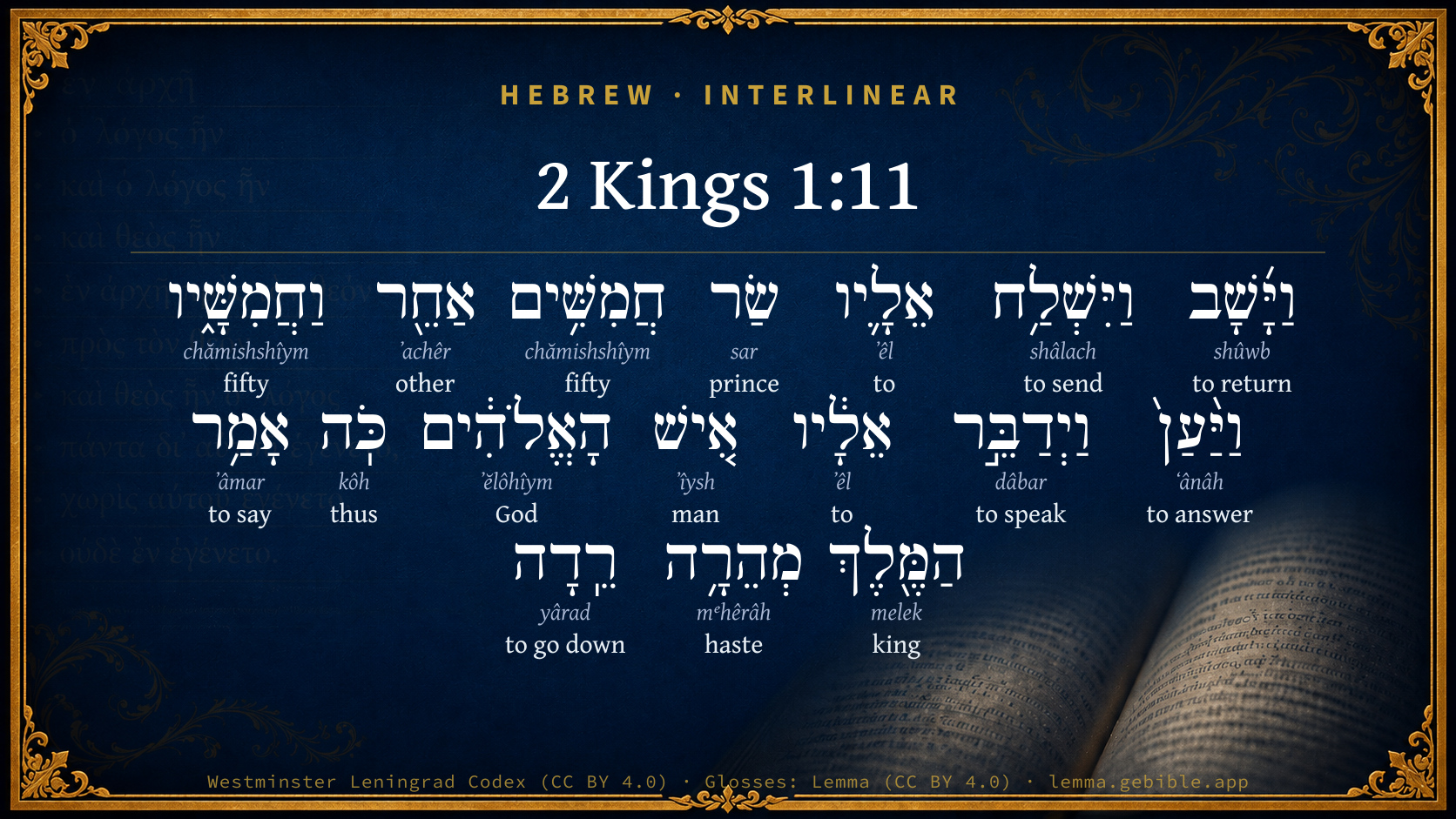
Hebrew (Westminster Leningrad Codex) 2 Kings 1:11 appears in the Hebrew Old Testament. The text above is from the Westminster Leningrad Codex. Each word links to its Strong’s number, a concise gloss, and parsing drawn from the Open Scriptures Hebrew Bible morphology. Click any word for its full Brown-Driver-Briggs (BDB) entry.
Download image
Cite this verse

2 Kings 1:11 (World English Bible). Public Domain. Lemma interlinear Bible study tool, https://lemma.gebible.app/v/2-kings/1/11.

Show BibTeX & RIS
BibTeX
RIS
English Translation
Again he sent to him another captain of fifty and his fifty. He answered him, man of God, thus has the king said, Come down quickly.
World English Bible · Public Domain
Download a study sheet

One document with this verse’s original text, its word-by-word gloss line, the meaning frame, cross-references with their text, attributed commentary, and full source and license credits — printable, and it pastes into notes with its structure intact.

This verse Autodidact and up

Study sheet (.html) Plain text (.txt)

A passage Seminary Student

Up to 50 verses in one chapter. A passage sheet keeps up to 6 commentary sources and 12 cross-references per verse, in the order this page ranks them, and says so on the sheet whenever that leaves anything out. Ask for a single verse and you get the Autodidact verse sheet above.

Everything on this page stays free to read, with no account — the sheet is a download of what is already on screen, not access to it.

Want to remove ads? Support Godless Engineer
Compare translations 3

The same verse in 3 English versions, stacked beneath the original-language interlinear above. Click any original word for its lexicon entry.

Each is an independent rendering of the whole verse — the interlinear is not word-aligned to these translations.

Highlighted words mark where these versions differ — a whole-verse word diff, not a word-by-word alignment.

  • World English Bible Public Domain
    Again he sent to him another captain of fifty and his fifty. He answered him, man of God, thus has the king said, Come down quickly.
  • King James Version Public Domain
    Again also he sent unto him another captain of fifty with his fifty. And he answered and said unto him, O man of God, thus hath the king said, Come down quickly.
  • unfoldingWord Literal Text CC BY-SA 4.0
    And he returned and sent to him another captain of fifty and his fifty. And he answered and said to him, “Man of God, thus says the king, ‘Come down quickly!’”

unfoldingWord Literal Text — © unfoldingWord, licensed CC BY-SA 4.0. Word-aligned USFM3 via Door43 (git.door43.org/unfoldingWord/en_ult).

Versions to compare (up to 4)

3 of 4 selected

Show all 18 translations

Every available English version of this verse, each an independent rendering of the whole verse.

  • World English Bible Public Domain
    Again he sent to him another captain of fifty and his fifty. He answered him, man of God, thus has the king said, Come down quickly.
  • Berean Standard Bible Public Domain
    So the king sent to Elijah another captain with his fifty men. And the captain said to Elijah, “Man of God, the king declares, ‘Come down at once!’”
  • Majority Standard Bible Public Domain
    So the king sent to Elijah another captain with his fifty men. And the captain said to Elijah, “Man of God, the king declares, ‘Come down at once!’”
  • King James Version Public Domain
    Again also he sent unto him another captain of fifty with his fifty. And he answered and said unto him, O man of God, thus hath the king said, Come down quickly.
  • American Standard Version (1901) Public Domain
    And again he sent unto him another captain of fifty and his fifty. And he answered and said unto him, O man of God, thus hath the king said, Come down quickly.
  • Revised Version (1885) Public Domain
    And again he sent unto him another captain of fifty with his fifty. And he answered and said unto him, O man of God, thus hath the king said, Come down quickly.
  • Geneva Bible (1599) Public Domain
    Againe also he sent vnto him another captaine ouer fiftie, with his fiftie. Who spake, and saide vnto him, O man of God, thus the King commandeth, Come downe quickely.
  • Douay-Rheims (1899) Public Domain
    And again he sent to him another captain of fifty men, and his fifty with him. And he said to him: Man of God, thus saith the king: Make haste and come down.
  • Young's Literal Translation Public Domain
    And he turneth and sendeth unto him another head of fifty and his fifty, and he answereth and speaketh unto him, `O man of God, thus said the king, Haste, come down.'
  • Literal Standard Version CC BY-SA 4.0
    And he turns and sends to him another head of fifty and his fifty, and he answers and speaks to him, “O man of God, thus said the king: Hurry, come down.”
  • Unlocked Literal Bible CC BY-SA 4.0
    Again King Ahaziah sent to Elijah another captain with fifty soldiers. This captain also said to Elijah, “You, man of God, the king says, 'Come down quickly.'”
  • unfoldingWord Literal Text CC BY-SA 4.0
    And he returned and sent to him another captain of fifty and his fifty. And he answered and said to him, “Man of God, thus says the king, ‘Come down quickly!’”
  • Darby Bible Public Domain
    And again he sent to him another captain of fifty with his fifty. And he spoke and said to him, Man of God, thus says the king: Come down quickly!
  • World Messianic Bible Public Domain
    Again he sent to him another captain of fifty with his fifty. He answered him, “Man of God, the king has said, ‘Come down quickly!’”
  • Webster's Bible Public Domain
    Again also he sent to him another captain of fifty with his fifty. And he answered and said to him, O man of God, thus hath the king said, Come down quickly.
  • Free Bible Version CC BY-SA 4.0
    So the king sent another captain with his fifty men to Elijah. The captain said to Elijah, “Man of God, the king orders you, ‘Come down immediately!’”
  • Bible in Basic English Public Domain
    Then the king sent another captain of fifty with his fifty men; and he said to Elijah, O man of God, the king says, Come down quickly.
  • JPS Tanakh (1917) Public Domain
    And again he sent unto him another captain of fifty with his fifty. And he answered and said unto him: 'O man of God, thus hath the king said: Come down quickly.'

Literal Standard Version (2020), Covenant Press — licensed CC BY-SA 4.0. Text via the HelloAO Bible API (eBible.org). Unlocked Literal Bible (unfoldingWord) — licensed CC BY-SA 4.0. Text via the HelloAO Bible API (eBible.org). unfoldingWord Literal Text — © unfoldingWord, licensed CC BY-SA 4.0. Word-aligned USFM3 via Door43 (git.door43.org/unfoldingWord/en_ult). Free Bible Version, Dr. Jonathan Gallagher — licensed CC BY-SA 4.0. Text via the HelloAO Bible API (eBible.org).

Word by word

More ways to search: Search by grammar → Find every occurrence → Compare this word →

Practice this passage: Drill this verse → Learn its vocabulary →

מְהֵרָ֥ה
mᵉhêrâh
H4120
“haste”
Noun, Common, Feminine, Singular, Absolute
Part of Speech
Noun
Type
Common
Gender
Feminine
Number
Singular
State
Absolute
Full BDB Definition

Origin: from H4118

TWOT: 1152d

haste, speed - hastily, speedily (as adverb) - in haste (with preposition)
  1. וַיָּ֜שָׁב shûwb H7725 “and · to return” Conjunction + Verb, Qal, Sequential Imperfect, 3rd Person, Masculine, Singular
  2. וַיִּשְׁלַ֥ח shâlach H7971 “and · to send” Conjunction + Verb, Qal, Sequential Imperfect, 3rd Person, Masculine, Singular
  3. אֵלָ֛יו ʼêl H413 “to · him” Preposition + Suffix, Personal, 3rd Person, Masculine, Singular
  4. שַׂר sar H8269 “prince of” Noun, Common, Masculine, Singular, Construct
  5. חֲמִשִּׁ֥ים chămishshîym H2572 “fifty” Adjective, Cardinal number, Both, Plural, Absolute
  6. אַחֵ֖ר ʼachêr H312 “other” Adjective, Adjective, Masculine, Singular, Absolute
  7. וַחֲמִשָּׁ֑יו chămishshîym H2572 “and · fifty · his” Conjunction + Adjective, Cardinal number, Both, Plural, Construct + Suffix, Personal, 3rd Person, Masculine, Singular
  8. וַיַּ֨עַן֙ ʻânâh H6030 “and · to answer” Conjunction + Verb, Qal, Sequential Imperfect, 3rd Person, Masculine, Singular
  9. וַיְדַבֵּ֣ר dâbar H1696 “and · to speak” Conjunction + Verb, Piel, Sequential Imperfect, 3rd Person, Masculine, Singular
  10. אֵלָ֔יו ʼêl H413 “to · him” Preposition + Suffix, Personal, 3rd Person, Masculine, Singular
  11. אִ֚ישׁ ʼîysh H376 “man of” Noun, Common, Masculine, Singular, Construct
  12. הָאֱלֹהִ֔ים ʼĕlôhîym H430 “the · God(s)” Particle, Definite Article + Noun, Common, Masculine, Plural, Absolute
  13. כֹּֽה kôh H3541 “thus” Adverb
  14. אָמַ֥ר ʼâmar H559 “to say” Verb, Qal, Perfect, 3rd Person, Masculine, Singular
  15. הַמֶּ֖לֶךְ melek H4428 “the · king” Particle, Definite Article + Noun, Common, Masculine, Singular, Absolute
  16. רֵֽדָה yârad H3381 “go down” Verb, Qal, Imperative, 2nd Person, Masculine, Singular + Suffix, h

About this verse

These counts appear in no published source. They are computed here, from the morphology-tagged text and Lemma’s own curated glosses. What Lemma adds →

17
words
15
distinct lemmas
Historical
section

Notable vocabulary

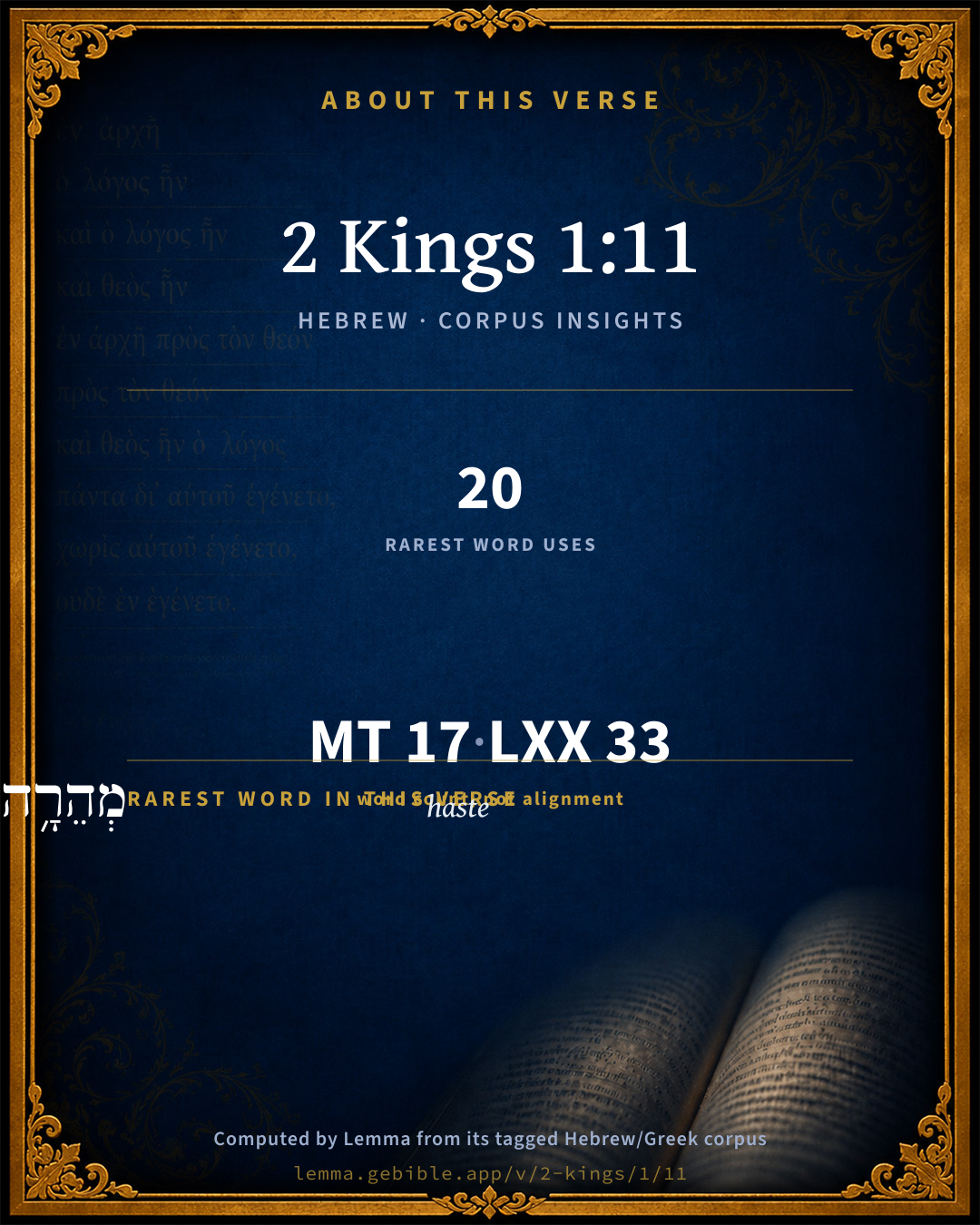
The rarest word here is מְהֵרָ֥ה haste H4120 — appearing just 20 times in the whole Hebrew Bible.

Shared distinctive vocabulary

מְהֵרָ֥ה haste H4120 occurs in 20 verses of the Hebrew Bible. Also found in:

Grammatical profile

  • 6 verbs
  • 5 nouns
  • 3 adjectives
  • 2 prepositions
  • 1 adverb

Verb forms

  • וַיָּ֜שָׁב Qal · Sequential Imperfect
  • וַיִּשְׁלַ֥ח Qal · Sequential Imperfect
  • וַיַּ֨עַן֙ Qal · Sequential Imperfect
  • וַיְדַבֵּ֣ר Piel · Sequential Imperfect
  • אָמַ֥ר Qal · Perfect
  • רֵֽדָה Qal · Imperative

Repetition

Words recur within this verse — often emphatic in Hebrew:

  • חֲמִשִּׁ֥ים fifty H2572 ×2
  • אֵלָ֛יו to H413 ×2

Hebrew & Septuagint length

In English translation the verse runs 26 words from the Hebrew and 37 from the Septuagint (LXX English) — the Septuagint runs noticeably longer here. See the side-by-side →

A rough comparison of the two English renderings, which tokenize alike — not a word-level alignment.

Word counts can differ between the Hebrew and the Greek without any difference in meaning — e.g. the Hebrew direct-object marker אֵת has no separate Greek word, and Greek often adds the article ὁ.

In the original languages it is 17 Hebrew tokens and 33 Greek tokens — but the two are counted differently (Hebrew bundles its prefixes and suffixes into one token; the Greek is in lemma form), so that isn’t a like-for-like length.

Cross-references

11

Topical passages linked to 2 Kings 1:11 in the Treasury of Scripture Knowledge — connected by theme and wording, ordered by reader-vote popularity; previews shown in the World English Bible.

  • Numbers 16:41 But on the next day all the congregation of the children of Israel murmured against Moses and against Aaron, saying, You have killed the people of Yahweh.
  • 1 Samuel 6:9 Behold; if it goes up by the way of its own border to Beth-shemesh, then he has done us this great evil: but if not, then we shall know that it is not his hand that struck us; it was a chance that happened to us."
  • 1 Samuel 22:17–19 The king said to the guard who stood about him, Turn, and kill the priests of Yahweh; because their hand also is with David, and because they knew that he fled, and didn't disclose it to me. But the servants of the king wouldn't put forth their hand to fall on the priests of Yahweh.
  • Proverbs 29:12 If a ruler listens to lies, All of his officials are wicked.
  • Isaiah 26:11 Yahweh, your hand is lifted up, yet they don't see: but they shall see [your] zeal for the people, and be disappointed; yes, fire shall devour your adversaries.
  • Isaiah 32:7 The instruments of the churl are evil: he devises wicked devices to destroy the humble with lying words, even when the needy speaks right.
  • Jeremiah 5:3 O Yahweh, don't your eyes look on truth? you have stricken them, but they were not grieved; you have consumed them, but they have refused to receive correction: they have made their faces harder than a rock; they have refused to return.
  • Matthew 2:16 Then Herod, when he saw that he was mocked by the wise men, was exceedingly angry, and sent out, and killed all the male children who were in Bethlehem and in all the surrounding countryside, from two years old and under, according to the exact time which he had learned from the wise men.
  • Luke 22:63–64 The men who held Jesus mocked him and beat him.
  • John 18:5–12 They answered him, "Jesus of Nazareth." Jesus said to them, "I AM." Judas also, who betrayed him, was standing with them.
  • Acts 4:16–17 saying, "What shall we do to these men? Because indeed a notable miracle has been done through them, as can be plainly seen by all who dwell in Jerusalem, and we can't deny it.

Cross-references courtesy of OpenBible.info (CC BY 4.0).

Hebrew and Greek witnesses Masoretic Hebrew ↔ Greek Septuagint

The same verse in the two great witnesses to the Old Testament, shown verse-for-verse.

Here the Septuagint runs noticeably longer than the Hebrew — LXX2012 (modern English Septuagint) 37 words vs World English Bible 26. A rough length comparison of the two English translations, not a word-level alignment — read both below.

These are two independent witnesses, not word-aligned to each other, and the Septuagint is shown in lemma (dictionary) form.

Hebrew 2 Kings 1:11 Masoretic · Westminster Leningrad Codex

וַיָּ֜שָׁב וַיִּשְׁלַ֥ח אֵלָ֛יו שַׂר חֲמִשִּׁ֥ים אַחֵ֖ר וַחֲמִשָּׁ֑יו וַיַּ֨עַן֙ וַיְדַבֵּ֣ר אֵלָ֔יו אִ֚ישׁ הָאֱלֹהִ֔ים כֹּֽה אָמַ֥ר הַמֶּ֖לֶךְ מְהֵרָ֥ה רֵֽדָה

Again he sent to him another captain of fifty and his fifty. He answered him, man of God, thus has the king said, Come down quickly.

World English Bible · Public Domain

Greek LXX 2 Kings 1:11 Septuagint · lemma form

καί προςτίθημι ὁ βασιλεύς καί ἀποστέλλω πρός αὐτός ἄλλος πεντηκόνταρχος καί ὁ πεντήκοντα αὐτός καί ἀναβαίνω καί λαλέω ὁ πεντηκόνταρχος πρός αὐτός καί εἶπον ἄνθρωπος ὁ θεός ὅδε λέγω ὁ βασιλεύς ταχέως καταβαίνω

And the king sent a second time to him another captain of fifty, and his fifty. And the captain of fifty spoke to him, and said, O man of God, thus says the king, Come down quickly.

LXX2012 (modern English Septuagint) · Public Domain

On this verse, Ellicott's Commentary for English Readers discusses the Septuagint’s reading. Read the note in Commentary ↓

Hebrew: Westminster Leningrad Codex (CC BY 4.0). Greek: Septuagint (public domain); English from LXX2012 (modern English Septuagint) (Public Domain). How the Septuagint differs from the Hebrew →

Targum (Aramaic paraphrase)

1

The Targum is the ancient Jewish Aramaic paraphrase of the Hebrew Scriptures — an interpretive translation, not the Hebrew text itself. Onkelos (literal) and Pseudo-Jonathan (expansive) render the Torah, and Jonathan the Prophets. Coverage is partial: where no permissively-licensed English translation exists for a verse, only the Aramaic is shown. This is verse-level text, not a word-by-word alignment to the Hebrew.

  1. Targum Jonathan Prophets (Joshua–Malachi)
    וְתַב וּשְׁלַח לְוָתֵיהּ רַב חַמְשִׁין אוֹחֲרָנִין וְחַמְשִׁין דְעִמֵיהּ וַאֲתֵיב וּמַלֵיל עִמֵיהּ נְבִיָא דַייָ כִּדְנַן אֲמַר מַלְכָּא אוֹחִי חוּת:

    (no public-domain English translation for this verse)

    Targum Jonathan — Aramaic: “Mikraot Gedolot” (public domain). English: “Sefaria Community Translation” (CC0 1.0 (public-domain dedication)); “London "Chaldee Paraphrase," 1871” (public domain). Text via Sefaria.

Commentary

Notes on 2 Kings 1:11 from classic Christian and Jewish commentators (each source and its license shown beneath its notes). The classic Christian expositions comment on the surrounding passage and are grouped to its opening verse, so a note may address several verses; the Jewish commentaries on the Tanakh (Rashi and others) are per-verse, so they appear only where the commentator wrote on this verse.

Lemma curates 59 commentaries, every one of them public domain or Creative Commons licensed, each selected and text-cleaned for this edition rather than reprinted as found. About our sources →

Trapp's Complete Commentary

John Trapp

2Ki 1:11 Again also he sent unto him another captain of fifty with his fifty. And he answered and said unto him, O man of God, thus hath the king said, Come down quickly.

Ver. 11. And he answered, and said.] This fellow was more impudent and obstinate than the former; he is therefore worthily made an example, seeing he would not take example.

Come down quickly.] Or I will bring thee down. Satis hoc fuit pro imperio.

John Trapp, A Commentary or Exposition upon All the Books of the Old and New Testament (1647–1656) — public domain. Text from a community e-Sword module.

Joseph Benson's Commentary

2Ki 1:11. Thus hath the king said, Come down quickly — This man was more insolent than the former, charging the prophet to obey without delay, and not make him stay, nor think to dally with him: in which words, he doubtless spoke the sense of the whole company. Whereas the fate of those that went before them, might, and ought to have instructed them that the thing they were attempting to do was displeasing to God.

Joseph Benson's Commentary on the Old and New Testaments (1811–1818) — public domain. Text from a community e-Sword module.

Tyndale Open Study Notes

Tyndale Open Resources

1:11-13 Report of what happened to the previous contingent had apparently reached the king.

Tyndale Open Study Notes — © Tyndale Open Resources, licensed CC BY-SA 4.0. Text via the HelloAO Bible API.

Geneva Bible (1599)

Geneva Bible translators

He spake this in mockery, and therefore provoked God’s wrath so much the more.

Geneva Bible (1599) marginal notes — public domain. Text via Bolls.life.

Ellicott's Commentary for English Readers

(11) Again also he sent.—Although he had heard what had befallen his former envoys.

He answered.—LXX., “went up” (way-ya’al for way-ya’an), as in 2Ki_1:9; 2Ki_1:13.

And said.—Heb., spake. Yet some MSS., and Vulgate, Syriac, Arabic, as Authorised Version.

Thus hath the king said.—Or, commanded (’âmar).

Come down quickly.—“Impudentior fuit hic . . . priore; tum quia audito ejus supplicio non resipuit, tum quia auxit impudentiam addendo ‘Festina’” (a Lapide). (But see Note on 2Ki_1:12.)

A Bible Commentary for English Readers, edited by Charles John Ellicott (1878–1897) — public domain. Text from a community e-Sword module.

The Cambridge Bible for Schools and Colleges

gen. ed. J. J. S. Perowne

11. Again also [R.V. And again] he sent] Ahaziah has no regard for the lives that have been sacrificed. Josephus pictures him as ‘exceedingly angry when the destruction of these fifty was made known to him’ (Ant. IX. 2. 1). Probably also his fierceness was aggravated by his hopeless sickness.

And he answered] The verbs which signify ‘to answer’ are used both in Hebrew and in Greek for remarks made where, as here, no question has been asked.

Come down quickly] The second captain goes in the spirit of the king and adds to the message of the first the demand of speedy obedience. We may therefore consider that his punishment was more deserved than that of the former. But the narrative makes it quite clear that both by the king and his people Jehovah was forgotten, and that some signal mark of His anger was called for to check the wandering after other gods, which had grown up out of Jeroboam’s sin.

The Cambridge Bible for Schools and Colleges (gen. ed. J. J. S. Perowne; Cambridge University Press, 1878–1918) — public domain. Text from a community e-Sword module.

John Gill's Exposition

Again also he sent unto him another captain of fifty with his fifty,.... The king, not being at all terrified with the awful judgment upon the former, sends another:

and he answered and said unto him, O man of God, thus hath the king said, come down quickly; he flouts the prophet in the same manner as the former, and in the king's name commands him to come down, and that immediately; which the king added to his orders, or he himself, signifying he would not be trifled with, if he did not come down directly, he would force him.

John Gill's Exposition of the Whole Bible (1746–1763) — public domain (CC PDM 1.0). Text via the HelloAO Bible API.

Haydock's Catholic Bible Commentary

Another, not knowing what was become of the first, or why he did not return; as Ochozias was eager to have the prophet in his power. (Menochius) --- If he were acquainted with his fate, (Haydock) this second captain was guilty of greater insolence. But there are such generally to be found at courts; men who are ready to execute the king’s orders, without considering whether they be contrary to God’s law or not.

George Leo Haydock (1774–1849), Haydock's Catholic Family Bible and Commentary, 1859 edition — public domain. Excludes Psalms (Douay-Rheims chapter numbering differs from Protestant) and Deuterocanonical books (Catholic canon only).

Matthew Poole's English Annotations

Wherein he discovers more petulancy and impudence than the former, and shows how little he was moved or affrighted by the former example.

Matthew Poole's English Annotations on the Holy Bible (1683–1685) — public domain. Text from a community e-Sword/MySword module.

Whedon's Commentary on the Bible

Daniel D. Whedon

11. Come down quickly — The manner of this second captain towards the prophet is even more insolent than that of the other.

Daniel D. Whedon (gen. ed.), Commentary on the Old and New Testaments (1874–1909) — public domain. Text from a community e-Sword module.

The Pulpit Commentary

Again also; rather, and again (see the Revised Version). He answered and said; rather, he spoke and said (ejlahse kai eite, LXX). Come down quickly. The king has grown impatient. It is conceivable that the death of the first captain with his band of fifty had been kept from him, and that he was only aware of an unaccountable delay. He therefore changes his order from "Come down" to Come down quickly."

The Pulpit Commentary (1880–1919), ed. H.D.M. Spence-Jones & Joseph S. Exell — public domain. Text from a community e-Sword module.

John Wesley's Explanatory Notes

And said - He discovers more petulancy than the former; and shews, how little he was moved by the former example.

John Wesley, Explanatory Notes Upon the Whole Bible (1754–1765) — public domain. Text via the GEBible commentary corpus.

Keil & Delitzsch

C. F. Keil & F. Delitzsch

The same fate befell a second captain, whom the king sent after the death of the first. He was more insolent than the first, "both because he was not brought to his senses by hearing of his punishment, and because he increased his impudence by adding make haste (מהרה)." - C. a Lap. For וידבּר ויּען the lxx (Cod. Alex.) have καὶ ἀνέβη καὶ ἐλάλησε, so that they read ויּעל. The correctness of this reading, according to which ויּען would be an error of the pen, is favoured not only by ויּעל in Kg2 1:9 and Kg2 1:13, but also by וידבּר which follows; for, as a general rule, ויּען would be followed by ויּאמר. The repetition of this judicial miracle was meant to show in the most striking manner not only the authority which rightfully belonged to the prophet, but also the help and protection which the Lord gave to His servants. At the same time, the question as to the "morality of the miracle," about which some have had grave doubts, is not set at rest by the remark of Thenius, that "the soldiers who were sent come into consideration here purely as instruments of a will acting in opposition to Jehovah." The third captain also carried out he ungodly command of the king, and he was not slain (Kg2 1:13.). The first two must therefore have been guilty of some crime, which they and their people had to expiate with their death. This crime did not consist merely in their addressing him as "man of God," for the third addressed Elijah in the same way (Kg2 1:13), but in their saying "Man of God, come down." This summons to the prophet, to allow himself to be led as a prisoner before the king, involved a contempt not only of the prophetic office in the person of Elijah, but also of the Lord, who had accredited him by miracles as His servant. The two captains who were first sent not only did what they were bound to do as servants of the king, but participated in the ungodly disposition of their lord (συμβαίνοντες τῷ σκοπῷ τοῦ πεπομφότος - Theodoret); they attacked the Lord with reckless daring in the person of the prophet, and the second captain, with his "Come down quickly," did it even more strongly than the first. This sin was punished, and that not by the prophet, but by the Lord Himself, who fulfilled the word of His servant.

(Note: Οἱ τοῦ προφήτου κατηγοροῦντες κατὰ τοῦ Θεοῦ τοῦ προφήτου κινοῦσι τὰς γλώττας, as Theodoret very aptly observes.)

What Elijah here did was an act of holy zeal for the honour of the Lord, in the spirit of the old covenant, under which God destroyed the insolent despisers of His name with fire and sword, to manifest the energy of His holy majesty by the side of the dead idols of the heathen. But this act cannot be transferred to the times of the new covenant, as is clearly shown in Luk 9:54-55, where Christ does not blame Elijah for what he did, but admonishes His disciples, who overlooked the difference between the economy of the law and that of the gospel, and in their carnal zeal wanted to imitate what Elijah had done in divine zeal for the honour of the Lord, which had been injured in his own person.

Keil & Delitzsch — Biblical Commentary on the Old Testament (1861–1891) — public domain (CC PDM 1.0). Text via the HelloAO Bible API. (Old Testament only.)

unfoldingWord translationNotes

Door43 World Missions Community

fifty soldiers

"50 soldiers" (See: Numbers)

If I am a man of God, let fire come down from heaven

The captain had called Elijah a man of God, but the captain and the king did not show Elijah proper respect. Elijah said this so that fire would come down from heaven, and this would prove that Elijah really was a man of God and he deserved their respect. See how you translated this phrase in 2 Kings 1:10. AT: "Since I am a man of God, let fire come down from heaven" or "If I am a man of God as you have said, let fire come down from heaven"

fire of God

This means that the fire came from God. AT: "fire from God" (See: Possession)

unfoldingWord translationNotes — © Distant Shores Media and the Door43 World Missions Community, licensed CC BY-SA 4.0. Source: git.door43.org/Door43/en_tn.

Lesson kit

Teaching starters — assembled from the data on this page, not authored interpretation. Every prompt links to the verse data it draws on. Edit before teaching.

2 Kings, in the Historical, opens this verse with 17 words (15 distinct Hebrew lemmas). Its most distinctive word is mᵉhêrâh (“haste”). The Greek Septuagint runs longer here. A historical commentator’s framing appears above. Read the whole chapter for the surrounding context.

Discussion questions

  1. The word mᵉhêrâh carries the sense “haste.” How does it shape the verse?
  2. How does Numbers 16:46, which shares the word «haste», read alongside this verse?
  3. What does the repetition of “fifty” (2× in this one verse) do in this verse?
  4. The Septuagint runs longer here than the Hebrew. What might account for the difference?
  5. These translations render this verse differently; the difference is in the English rendering, not the original. What questions does that raise?
  6. «וַיָּ֜שָׁב» is a Qal Sequential Imperfect verb. How does that grammatical form shape the action described?
  7. Compare how Trapp's Complete Commentary and Joseph Benson's Commentary read this verse. Where do they agree or differ?

Things to notice

Reading settings

Reading text

Shown beneath each verse's original-language words.

Old Testament
Old Testament edition

Read the OT as the Masoretic Hebrew (MT) or the Greek Septuagint (LXX).

English shown for the Greek Septuagint (in the Hebrew ↔ Greek comparison).

Comparing translations? Open the Compare panel on any verse page to stack up to four side by side.