
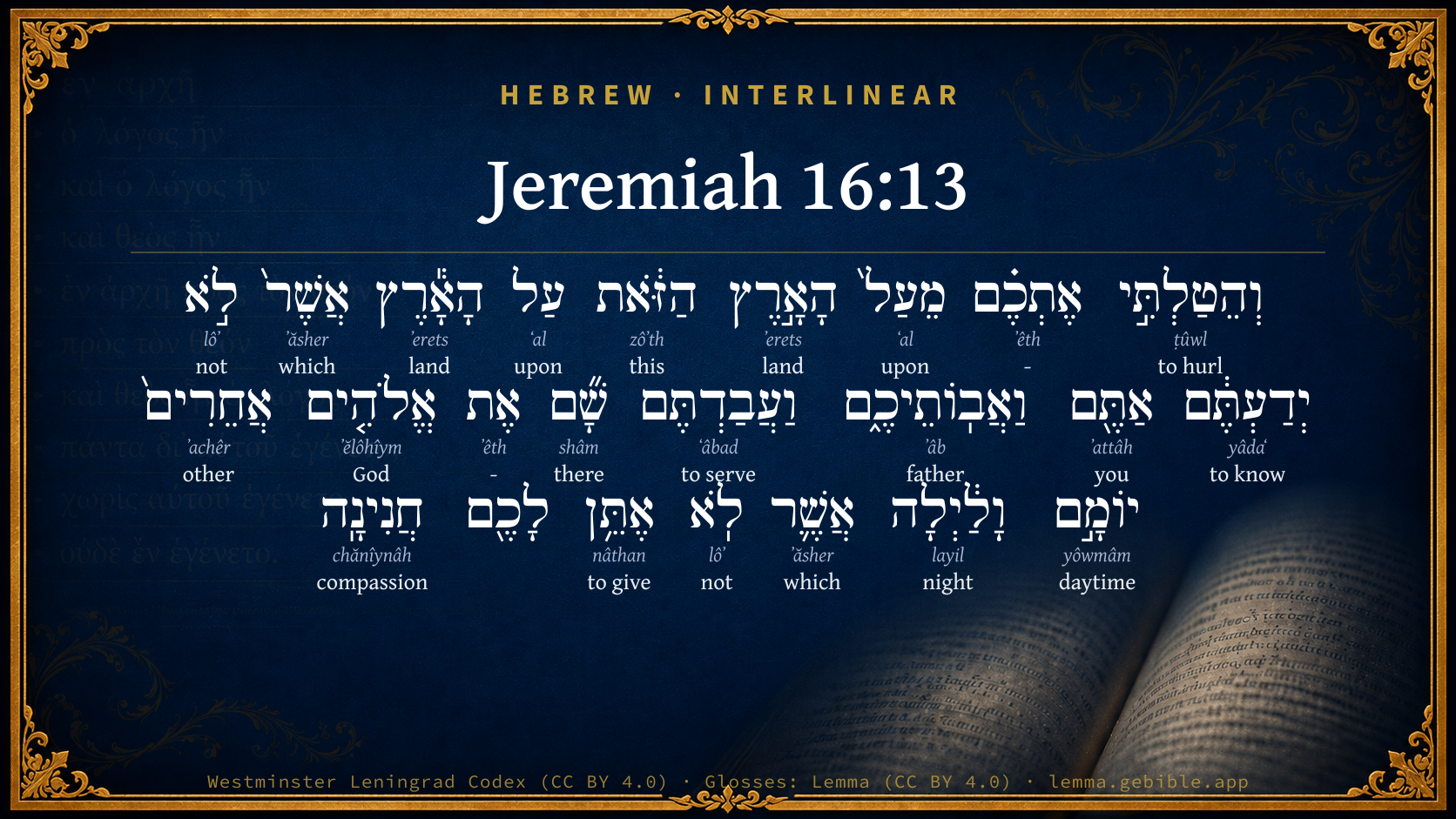
Jeremiah 16:13

Hebrew (Westminster Leningrad Codex) Jeremiah 16:13 appears in the Hebrew Old Testament. The text above is from the Westminster Leningrad Codex. Each word links to its Strong’s number, a concise gloss, and parsing drawn from the Open Scriptures Hebrew Bible morphology. Click any word for its full Brown-Driver-Briggs (BDB) entry.
Download image
Cite this verse

Jeremiah 16:13 (World English Bible). Public Domain. Lemma interlinear Bible study tool, https://lemma.gebible.app/v/jeremiah/16/13.

Show BibTeX & RIS
BibTeX
RIS
English Translation
therefore will I cast you forth out of this land into the land that you have not known, neither you nor your fathers; and there shall you serve other gods day and night; for I will show you no favor.
World English Bible · Public Domain
Highlights
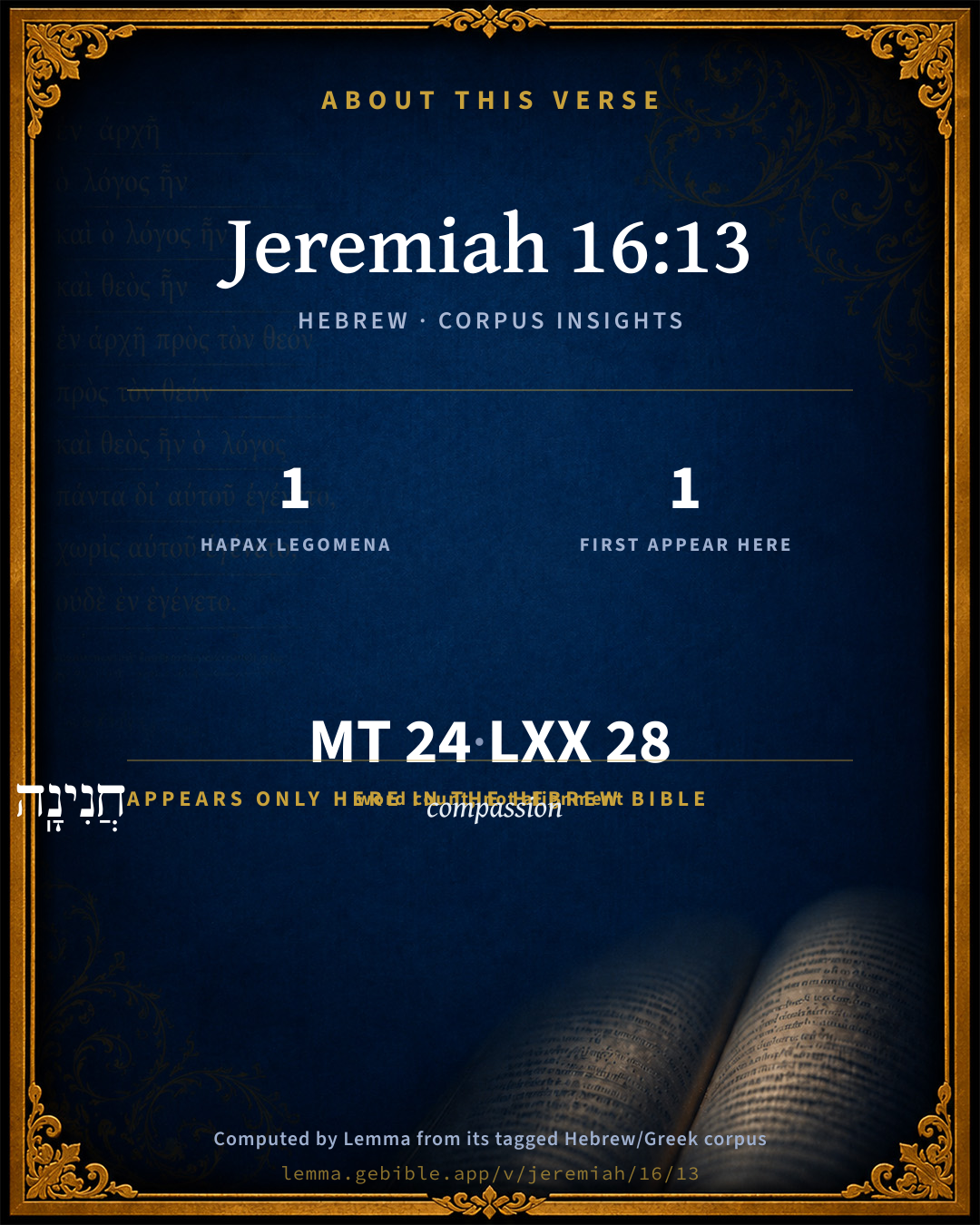
  • 1 hapax legomenon — only here in the Hebrew Bible
  • 1 first appearance in the Hebrew Bible
Full analysis ↓
Download a study sheet

One document with this verse’s original text, its word-by-word gloss line, the meaning frame, cross-references with their text, attributed commentary, and full source and license credits — printable, and it pastes into notes with its structure intact.

This verse Autodidact and up

Study sheet (.html) Plain text (.txt)

A passage Seminary Student

Up to 50 verses in one chapter. A passage sheet keeps up to 6 commentary sources and 12 cross-references per verse, in the order this page ranks them, and says so on the sheet whenever that leaves anything out. Ask for a single verse and you get the Autodidact verse sheet above.

Everything on this page stays free to read, with no account — the sheet is a download of what is already on screen, not access to it.

Want to remove ads? Support Godless Engineer
Compare translations 3

The same verse in 3 English versions, stacked beneath the original-language interlinear above. Click any original word for its lexicon entry.

Each is an independent rendering of the whole verse — the interlinear is not word-aligned to these translations.

Highlighted words mark where these versions differ — a whole-verse word diff, not a word-by-word alignment.

  • World English Bible Public Domain
    therefore will I cast you forth out of this land into the land that you have not known, neither you nor your fathers; and there shall you serve other gods day and night; for I will show you no favor.
  • King James Version Public Domain
    Therefore will I cast you out of this land into a land that ye know not, neither ye nor your fathers; and there shall ye serve other gods day and night; where I will not shew you favour.
  • unfoldingWord Literal Text CC BY-SA 4.0
    So I will throw you far out of this land into a land that you have not known, you nor your fathers, and you shall serve other gods there by day and night, for I will not show favor to you.’

unfoldingWord Literal Text — © unfoldingWord, licensed CC BY-SA 4.0. Word-aligned USFM3 via Door43 (git.door43.org/unfoldingWord/en_ult).

Versions to compare (up to 4)

3 of 4 selected

Show all 18 translations

Every available English version of this verse, each an independent rendering of the whole verse.

  • World English Bible Public Domain
    therefore will I cast you forth out of this land into the land that you have not known, neither you nor your fathers; and there shall you serve other gods day and night; for I will show you no favor.
  • Berean Standard Bible Public Domain
    So I will cast you out of this land into a land that neither you nor your fathers have known. There you will serve other gods day and night, for I will show you no favor.’
  • Majority Standard Bible Public Domain
    So I will cast you out of this land into a land that neither you nor your fathers have known. There you will serve other gods day and night, for I will show you no favor.’
  • King James Version Public Domain
    Therefore will I cast you out of this land into a land that ye know not, neither ye nor your fathers; and there shall ye serve other gods day and night; where I will not shew you favour.
  • American Standard Version (1901) Public Domain
    therefore will I cast you forth out of this land into the land that ye have not known, neither ye nor your fathers; and there shall ye serve other gods day and night; for I will show you no favor.
  • Revised Version (1885) Public Domain
    therefore will I cast you forth out of this land into the land that ye have not known, neither ye nor your fathers; and there shall ye serve other gods day and night; for I will shew you no favour.
  • Geneva Bible (1599) Public Domain
    Therefore will I driue you out of this land into a lande that ye knowe not, neither you, nor your fathers, and there shall ye serue other gods day and night: for I will shew you no grace.
  • Douay-Rheims (1899) Public Domain
    So I will cast you forth out of this land, into a land which you know not, nor you fathers: and there you shall serve strange gods day and night, which shall not give you any rest.
  • Young's Literal Translation Public Domain
    And I have cast you from off this land, On to a land that ye have not known, Ye and your fathers, And ye have served there other gods by day and by night, Where I do not give to you grace.
  • Literal Standard Version CC BY-SA 4.0
    And I have cast you from off this land, || On to a land that you have not known, || You and your fathers, || And you have served other gods there by day and by night, || Where I do not give grace to you.
  • Unlocked Literal Bible CC BY-SA 4.0
    So I will throw you from this land to a land that you have not known, neither you nor your ancestors, and you will worship other gods there by day and night, for I will not give any favor to you.'
  • unfoldingWord Literal Text CC BY-SA 4.0
    So I will throw you far out of this land into a land that you have not known, you nor your fathers, and you shall serve other gods there by day and night, for I will not show favor to you.’
  • Darby Bible Public Domain
    and I will cast you forth out of this land, into a land that ye know not, ye nor your fathers; and there shall ye serve other gods day and night: because I will shew you no favour.
  • World Messianic Bible Public Domain
    Therefore I will cast you out of this land into the land that you have not known, neither you nor your fathers. There you will serve other gods day and night, for I will show you no favor.’
  • Webster's Bible Public Domain
    Therefore will I cast you out of this land into a land that ye know not, neither ye nor your fathers; and there shall ye serve other gods day and night; where I will not show you favor.
  • Free Bible Version CC BY-SA 4.0
    So I'm going to throw you out of this country and exile you in a country unfamiliar to you and your forefathers. There you'll serve other gods day and night, because I won't help you at all.
  • Bible in Basic English Public Domain
    For this reason I will send you away out of this land into a land which is strange to you, to you and to your fathers; there you will be the servants of other gods day and night, and you will have no mercy from me.
  • JPS Tanakh (1917) Public Domain
    therefore will I cast you out of this land into a land that ye have not known, neither ye nor your fathers; and there shall ye serve other gods day and night; forasmuch as I will show you no favour.'

Literal Standard Version (2020), Covenant Press — licensed CC BY-SA 4.0. Text via the HelloAO Bible API (eBible.org). Unlocked Literal Bible (unfoldingWord) — licensed CC BY-SA 4.0. Text via the HelloAO Bible API (eBible.org). unfoldingWord Literal Text — © unfoldingWord, licensed CC BY-SA 4.0. Word-aligned USFM3 via Door43 (git.door43.org/unfoldingWord/en_ult). Free Bible Version, Dr. Jonathan Gallagher — licensed CC BY-SA 4.0. Text via the HelloAO Bible API (eBible.org).

Word by word

More ways to search: Search by grammar → Find every occurrence → Compare this word →

Practice this passage: Drill this verse → Learn its vocabulary →

חֲנִינָֽה
chănîynâh
H2594
“compassion”
Noun, Common, Feminine, Singular, Absolute
Part of Speech
Noun
Type
Common
Gender
Feminine
Number
Singular
State
Absolute
Full BDB Definition

Origin: from H2603

TWOT: TWOT- 694e

favour, compassion
  1. וְהֵטַלְתִּ֣י ṭûwl H2904 “and · to hurl” Conjunction + Verb, Hiphil, Sequential Perfect, 1st Person, Common, Singular
  2. אֶתְכֶ֗ם ʼêth H853 “- · you” Particle, Direct Object + Suffix, Personal, 2nd Person, Masculine, Plural
  3. מֵעַל֙ ʻal H5921 “from · upon” Preposition + Preposition
  4. הָאָ֣רֶץ ʼerets H776 “the · land” Particle, Definite Article + Noun, Common, Both, Singular, Absolute
  5. הַזֹּ֔את zôʼth H2063 “the · this” Particle, Definite Article + Pronoun, Demonstrative, Feminine, Singular
  6. עַל ʻal H5921 “upon” Preposition
  7. הָאָ֕רֶץ ʼerets H776 “the · land” Particle, Definite Article + Noun, Common, Both, Singular, Absolute
  8. אֲשֶׁר֙ ʼăsher H834 “which” Particle, Relative
  9. לֹ֣א lôʼ H3808 “not” Particle, Negative
  10. יְדַעְתֶּ֔ם yâdaʻ H3045 “to know” Verb, Qal, Perfect, 2nd Person, Masculine, Plural
  11. אַתֶּ֖ם ʼattâh H859 “you” Pronoun, Personal, 2nd Person, Masculine, Plural
  12. וַאֲבֽוֹתֵיכֶ֑ם ʼâb H1 “and · fathers · your” Conjunction + Noun, Common, Masculine, Plural, Construct + Suffix, Personal, 2nd Person, Masculine, Plural
  13. וַעֲבַדְתֶּם ʻâbad H5647 “and · to serve” Conjunction + Verb, Qal, Sequential Perfect, 2nd Person, Masculine, Plural
  14. שָׁ֞ם shâm H8033 “there” Adverb
  15. אֶת ʼêth H853 “-” Particle, Direct Object
  16. אֱלֹהִ֤ים ʼĕlôhîym H430 “God(s)” Noun, Common, Masculine, Plural, Absolute
  17. אֲחֵרִים֙ ʼachêr H312 “other” Adjective, Adjective, Masculine, Plural, Absolute
  18. יוֹמָ֣ם yôwmâm H3119 “daytime” Adverb
  19. וָלַ֔יְלָה layil H3915 “and · night” Conjunction + Noun, Common, Masculine, Singular, Absolute
  20. אֲשֶׁ֛ר ʼăsher H834 “which” Particle, Relative
  21. לֹֽא lôʼ H3808 “not” Particle, Negative
  22. אֶתֵּ֥ן nâthan H5414 “to give” Verb, Qal, Imperfect, 1st Person, Common, Singular

About this verse

These counts appear in no published source. They are computed here, from the morphology-tagged text and Lemma’s own curated glosses. What Lemma adds →

24
words
18
distinct lemmas
Prophets
section

Notable vocabulary

1 hapax legomenon — a word that appears only here in the entire Hebrew Bible:

  • חֲנִינָֽה compassion H2594

First appearance in Scripture

This word makes its first canonical appearance in the Hebrew Bible here:

  • חֲנִינָֽה compassion H2594

Shared distinctive vocabulary

וְהֵטַלְתִּ֣י to hurl H2904 occurs in 14 verses of the Hebrew Bible. Also found in:

Grammatical profile

  • 4 verbs
  • 6 nouns
  • 1 adjective
  • 2 pronouns
  • 3 prepositions
  • 2 adverbs
  • 6 particles

Verb forms

  • וְהֵטַלְתִּ֣י Hiphil · Sequential Perfect
  • יְדַעְתֶּ֔ם Qal · Perfect
  • וַעֲבַדְתֶּם Qal · Sequential Perfect
  • אֶתֵּ֥ן Qal · Imperfect

Repetition

Words recur within this verse — often emphatic in Hebrew:

  • מֵעַל֙ upon H5921 ×2
  • הָאָ֣רֶץ land H776 ×2
  • אֲשֶׁר֙ which H834 ×2
  • לֹ֣א not H3808 ×2

Hebrew & Septuagint length

In the original languages it is 24 Hebrew tokens and 28 Greek tokens — but the two are counted differently (Hebrew bundles its prefixes and suffixes into one token; the Greek is in lemma form), so that isn’t a like-for-like length.

Cross-references

16

Topical passages linked to Jeremiah 16:13 in the Treasury of Scripture Knowledge — connected by theme and wording, ordered by reader-vote popularity; previews shown in the World English Bible.

  • Deuteronomy 28:36 Yahweh will bring you, and your king whom you shall set over you, to a nation that you have not known, you nor your fathers; and there shall you serve other gods, wood and stone.
  • Deuteronomy 4:26–28 I call heaven and earth to witness against you this day, that you shall soon utterly perish from off the land whereunto you go over the Jordan to possess it; you shall not prolong your days on it, but shall utterly be destroyed.
  • Jeremiah 15:14 I will make [them] to pass with your enemies into a land which you don't know; for a fire is kindled in my anger, which shall burn on you.
  • Jeremiah 17:4 You, even of yourself, shall discontinue from your heritage that I gave you; and I will cause you to serve your enemies in the land which you don't know: for you have kindled a fire in my anger which shall burn forever.
  • 2 Chronicles 7:20 then will I pluck them up by the roots out of my land which I have given them; and this house, which I have made holy for my name, will I cast out of my sight, and I will make it a proverb and a byword among all peoples.
  • Leviticus 18:27–28 (for all these abominations have the men of the land done, that were before you, and the land became defiled);
  • Deuteronomy 30:17–18 But if your heart turn away, and you will not hear, but shall be drawn away, and worship other gods, and serve them;
  • Deuteronomy 28:63–65 It shall happen that as Yahweh rejoiced over you to do you good, and to multiply you, so Yahweh will rejoice over you to cause you to perish, and to destroy you; and you shall be plucked from off the land where you go in to possess it.
  • Deuteronomy 29:28 and Yahweh rooted them out of their land in anger, and in wrath, and in great indignation, and cast them into another land, as at this day.
  • Joshua 23:15–16 It shall happen, that as all the good things are come on you of which Yahweh your God spoke to you, so will Yahweh bring on you all the evil things, until he have destroyed you from off this good land which Yahweh your God has given you.
  • Psalms 81:12 So I let them go after the stubbornness of their hearts, That they might walk in their own counsels.
  • Jeremiah 5:19 It shall happen, when you shall say, Why has Yahweh our God done all these things to us? then shall you say to them, Like as you have forsaken me, and served foreign gods in your land, so shall you serve strangers in a land that is not yours.
  • Jeremiah 6:15 Were they ashamed when they had committed abomination? nay, they were not at all ashamed, neither could they blush: therefore they shall fall among those who fall; at the time that I visit them they shall be cast down, says Yahweh.
  • Jeremiah 14:8 You hope of Israel, the Savior of it in the time of trouble, why should you be as a foreigner in the land, and as a wayfaring man who turns aside to stay for a night?
  • Jeremiah 15:4 I will cause them to be tossed back and forth among all the kingdoms of the earth, because of Manasseh, the son of Hezekiah, king of Judah, for that which he did in Jerusalem.
  • Jeremiah 22:28 Is this man Coniah a despised broken vessel? is he a vessel in which none delights? why are they cast out, he and his seed, and are cast into the land which they don't know?

Cross-references courtesy of OpenBible.info (CC BY 4.0).

Hebrew and Greek witnesses Masoretic Hebrew ↔ Greek Septuagint

The same verse in the two great witnesses to the Old Testament, shown verse-for-verse.

These are two independent witnesses, not word-aligned to each other, and the Septuagint is shown in lemma (dictionary) form.

Hebrew Jeremiah 16:13 Masoretic · Westminster Leningrad Codex

וְהֵטַלְתִּ֣י אֶתְכֶ֗ם מֵעַל֙ הָאָ֣רֶץ הַזֹּ֔את עַל הָאָ֕רֶץ אֲשֶׁר֙ לֹ֣א יְדַעְתֶּ֔ם אַתֶּ֖ם וַאֲבֽוֹתֵיכֶ֑ם וַעֲבַדְתֶּם שָׁ֞ם אֶת אֱלֹהִ֤ים אֲחֵרִים֙ יוֹמָ֣ם וָלַ֔יְלָה אֲשֶׁ֛ר לֹֽא אֶתֵּ֥ן לָכֶ֖ם חֲנִינָֽה

therefore will I cast you forth out of this land into the land that you have not known, neither you nor your fathers; and there shall you serve other gods day and night; for I will show you no favor.

World English Bible · Public Domain

Greek LXX Structure differs

In the Septuagint, Jeremiah is about an eighth shorter than the Hebrew and arranges its material differently — the Oracles Against the Nations (Hebrew chapters 46–51) appear in the middle of the Greek book, after 25:13. Because the chapter and verse boundaries do not line up, a verse-for-verse comparison with the Hebrew is not shown.

A verse-for-verse comparison isn’t shown here because the chapters and verses don’t line up. Switch to the LXX edition with the MT / LXX toggle above to read the Greek directly.

Hebrew: Westminster Leningrad Codex (CC BY 4.0). Greek: Septuagint (public domain); English from a public-domain English Septuagint. How the Septuagint differs from the Hebrew →

Targum (Aramaic paraphrase)

1

The Targum is the ancient Jewish Aramaic paraphrase of the Hebrew Scriptures — an interpretive translation, not the Hebrew text itself. Onkelos (literal) and Pseudo-Jonathan (expansive) render the Torah, and Jonathan the Prophets. Coverage is partial: where no permissively-licensed English translation exists for a verse, only the Aramaic is shown. This is verse-level text, not a word-by-word alignment to the Hebrew.

  1. Targum Jonathan Prophets (Joshua–Malachi)
    וַאֲטַלְטֵל יַתְכוֹן מֵעַל אַרְעָא הָדָא לְאַרְעָא דְלָא יְדַעְתּוּן אַתּוּן וַאֲבָהָתְכוֹן וְתִפְלְחוּן תַּמָן לְעַמְמַיָא פָּלְחֵי טַעֲוָתָא יְמָם וְלֵילֵי דְלָא יְהֵי לְכוֹן רַחֲמִין:

    (no public-domain English translation for this verse)

    Targum Jonathan — Aramaic: “Mikraot Gedolot” (public domain). English: “Sefaria Community Translation” (CC0 1.0 (public-domain dedication)); “London "Chaldee Paraphrase," 1871” (public domain). Text via Sefaria.

Commentary

Notes on Jeremiah 16:13 from classic Christian and Jewish commentators (each source and its license shown beneath its notes). The classic Christian expositions comment on the surrounding passage and are grouped to its opening verse, so a note may address several verses; the Jewish commentaries on the Tanakh (Rashi and others) are per-verse, so they appear only where the commentator wrote on this verse.

Lemma curates 59 commentaries, every one of them public domain or Creative Commons licensed, each selected and text-cleaned for this edition rather than reprinted as found. About our sources →

Trapp's Complete Commentary

John Trapp

Jer 16:13 Therefore will I cast you out of this land into a land that ye know not, [neither] ye nor your fathers; and there shall ye serve other gods day and night; where I will not shew you favour.

Ver. 13. Therefore I will cast you.] Jer 10:18. Because ye have sinned wilfully and willingly, ye shall be cast out of this land, though full sore against your wills.

And there shall ye serve other gods.] {a} Will ye nill ye (for a just punishment of your voluntary idolatries); being compelled by your imperious enemies so to do, except ye will taste of the whip, as now the Turks’ galley slaves.

Where I will not show you favour.] This was a cutting speech, and far worse than their captivity; like as that was a sweet promise, "They shall be as if I had not cast them off, and I will hear them." {Zec 10:6}

{a} Notatur poena talionis.

John Trapp, A Commentary or Exposition upon All the Books of the Old and New Testament (1647–1656) — public domain. Text from a community e-Sword module.

Joseph Benson's Commentary

Jer 16:13. There shall ye serve other gods day and night — The opportunities of frequenting the public worship of the true God shall be taken from you, as a just judgment upon you for your neglect of his service in your own country; and you shall be exposed to the peril of being seduced by the Chaldeans to the worship of idols: see Deu 4:28; Deu 28:36, where Moses utters a similar prediction. Compare also 1Sa 26:19.

Joseph Benson's Commentary on the Old and New Testaments (1811–1818) — public domain. Text from a community e-Sword module.

Jamieson, Fausset & Brown

Robert Jamieson, A. R. Fausset & David Brown

serve other gods--That which was their sin in their own land was their punishment in exile. Retribution in kind. They voluntarily forsook God for idols at home; they were not allowed to serve God, if they wished it, in captivity (Dan 3:12; Dan 6:7).

day and night--irony. You may there serve idols, which ye are so mad after, even to satiety, and without intermission.

Jamieson, Fausset & Brown — Commentary Critical and Explanatory on the Whole Bible (1871) — public domain (CC PDM 1.0). Text via the HelloAO Bible API.

Adam Clarke's Commentary

Verse 13. Will I cast you out of this land] See Jer 7:15; Jer 9:15.

Adam Clarke's Commentary on the Bible (1810–1826) — public domain. Text from a community e-Sword/MySword module.

John Calvin's Commentaries

Then follows a commination, I will eject you, he says, or remove you, from this land to a land which ye know not, nor your fathers, for they had followed unknown gods, and went after inventions of their own and of others. God now declares that he would be the vindicator of his own glory, by driving them to a land unknown to them and to their fathers. He immediately adds, There shall ye serve other gods day and night We must take notice of this kind of punishment, for nothing could have happened worse to the Jews than to be constrained to adopt false and corrupt forms of worship, as it was a denial of God and of true religion. As this appears at the first view hard, some mitigate it, as though the worship of strange gods would be that servitude into which they were reduced when they became subject to idolators: but this is too remote. I therefore do not doubt but that God abandoned them, because they had violated true and pure worship, and had gone after the many abominations of the heathens; and thus he shews that they were worthy to be thus dealt with, who had in every way contaminated themselves, and as it were plunged themselves into the depth of every thing abominable: and it is certainly probable that they were led by constraint into ungodly ceremonies, when the Chaldeans had the power to treat them, as they usually did, as slaves, without any measure of humanity. It is then hence a probable conjecture that they were drawn to superstitions, and that interminably; so that they were not only forced to worship false gods, but were also constrained to do so by way of sport, as they daily triumphed over them as their conquerors.

And he confirms this clause by what follows, For I will not, etc., for the relative אשר asher, is here to be taken for a causative particle, For I will not shew you favor, or mercy; that is, I will not turn the hearts of your enemies so as to be propitious or kind to you. By these words God shews that he would not only punish them by subjecting them to their enemies, or by suffering them to be driven into exile; but that there would be an additional punishment by rendering their enemies cruel to them; for God can either tame the ferocity of men, or, when he pleases, can rouse them to greater rage and cruelty, when it is his purpose to use them as scourges.

We now then understand the whole design of what the Prophet says, that the Jews who had refused to worship God in their own land would be led away to Chaldea, where they would be constrained, wining or unwining, to worship strange gods, and that without end or limits. It now follows —

John Calvin's Commentaries (1540-1563) — public domain. Text from the Calvin Translation Society English edition (1840s-50s) via the Christian Classics Ethereal Library (ccel.org). Calvin's coverage is partial (roughly two-thirds of the Bible); uncommented books and verses are honest gaps, never fabricated. The 19th-century editor's footnotes and remarks are omitted so the notes are faithfully Calvin's own voice.

Ellicott's Commentary for English Readers

(13) There shall ye serve other gods day and night.—The words are spoken in the bitterness of irony: “You have chosen to serve the gods of other nations here in your own land; therefore, by a righteous retribution, you shall serve them in another sense, as being in bondage to their worshippers, and neither night nor day shall give you respite.”

Where I will not shew you favour.—Better, since, or for, I will not shew you favour.

A Bible Commentary for English Readers, edited by Charles John Ellicott (1878–1897) — public domain. Text from a community e-Sword module.

The Cambridge Bible for Schools and Colleges

gen. ed. J. J. S. Perowne

13. there shall ye serve other gods] The original thought of Jehovah as a national Deity led to the feeling that change of country involved a loss of His protection. Cp. Jdg_11:24; 1Sa_26:19. “Large numbers of the exiles probably felt that the destruction of the State had snapped the tie which bound them to Yahweh.” Pe.

for] perhaps as mg. where.

The Cambridge Bible for Schools and Colleges (gen. ed. J. J. S. Perowne; Cambridge University Press, 1878–1918) — public domain. Text from a community e-Sword module.

John Gill's Exposition

Therefore, behold, the days come, saith the Lord,.... Or nevertheless, "notwithstanding" (d) their sins and iniquities, and the punishment brought upon them for them: or "surely", verily; for Jarchi says it is an oath, with which the Lord swore he would redeem them, though they had behaved so ill unto him:

that it shall no more be said, the Lord liveth, that brought up the children of Israel out of the land of Egypt; this was the form of an oath with the Jews, when a man, as Kimchi observes, used to swear by the living God that brought Israel out of Egypt; or this was a fact which they used frequently to make mention of, and relate to their children; and observe to them the power and goodness of God in it; and so the Targum,

"there shall be no more any declaring the power of the Lord who brought up, &c.''

(d) So Noldius, Concord. Ebr. p. 507.

John Gill's Exposition of the Whole Bible (1746–1763) — public domain (CC PDM 1.0). Text via the HelloAO Bible API.

Albert Barnes' Notes on the Bible

And there shall ye ... - Ironical, and “there ye may serve other gods day and night, since I will shew you no favor.”

Albert Barnes' Notes on the Bible (1834–1885) — public domain. Text from a community e-Sword/MySword module.

Haydock's Catholic Bible Commentary

Gods. Elohim, "masters," &c., chap. xvii. 4. Chaldean, "idolatrous nations."

George Leo Haydock (1774–1849), Haydock's Catholic Family Bible and Commentary, 1859 edition — public domain. Excludes Psalms (Douay-Rheims chapter numbering differs from Protestant) and Deuterocanonical books (Catholic canon only).

Matthew Poole's English Annotations

You would not hearken to me to obey my voice in that good land which I gave you, and which you have known and inherited now many years; therefore I will throw you out into a land which you know not, and which your fathers knew not. You would not serve me in this land, but chose to serve other gods in my land; you shall serve other gods in a strange land, you shall there have no such opportunities as you have here-at Jerusalem to worship me the true God, according to the prescription and direction of my word; ye shall there have no gods else but idols to worship, and what is now matter of choice to you shall then be forced upon you, the governors of those countries into which you shall be carried shall force you to fall down and to worship their idols, which was verified afterward by Nebuchadnezzar, Da 3, &c.

Matthew Poole's English Annotations on the Holy Bible (1683–1685) — public domain. Text from a community e-Sword/MySword module.

The Pulpit Commentary

A grim irony. In me foreign land ye shall serve your idols to your hearts" content, day and night if ye will, "because, not, where I will not have mercy upon you" (by delivering you, and so calling you from your idols).

Sin a tyrannous and exhaustive service.

I THAT WHICH WAS AT FIRST A FREE CHOICE WILL IN TIME BECOME A COMPULSORY SERVICE. The waywardness and capricious eclecticism of the idolatrous Jews was to be sternly visited upon them. They had toyed and compromised with idols; soon it would be discovered that that dalliance could not be prolonged.

1. Jehovah will not continue to accept a half-hearted service. It was only his forbearance that had suffered it so long. Whilst it might appear possible that Judah would repent, the imperfection of its service was overlooked; but when that imperfection seemed likely to be stereotyped, or when it was increasing with the growth of idolatrous practices, it was no longer to be endured. A mixed worship is dishonoring to God. He refuses to accept half a heart. It is impossible to serve him aright with divided attention and interest. Permission to worship and know him even in part is a privilege which may be withdrawn. The "idolater" would not always be able to walk on the heights of critical spiritual eclecticism. The time would come when what he thought so irksome would be taken away. God would send upon him "strong delusion to believe a lie." And this is rather to be looked upon as a repudiation of Judah by God than as a departure from Jehovah permitted by him to his own hurt. Spiritual power and hallowed circumstance would alike be forfeited, and God would cast off the idolaters. For:

2. Sinful tendency, when let alone, confirms and strengthens itself. Daily contact with the obligations and influence of the Law and the temple was a real benefit to the Israelites. It kept them from settling down utterly into idolatrous habits. That religious observance which is so wearisome to the sinner is his safeguard; it keeps him from complete abandonment to the inner depravity of his nature. He is alarmed, warned, disturbed, whenever he is inclined to more than ordinary license; and even his ordinary lax and sinful life is constantly judged and corrected by the truth which he hears. The Spirit of God continues to plead and wrestle with him, and although he does not wholly yield himself to its influence, he is prevented from wandering quite beyond recall. But let this restraining influence of grace once be withdrawn, the natural impulse to evil, all unchecked, will begin to develop and gradually overmaster the entire nature. This is the explanation of many a life that seems to linger long upon the debatable line between duty and sinful inclination it is the Spirit of God that has not ceased to strive with it, and not the mere power of the man over his own desires and habits.

3. The circumstances and opportunities of Divine worship, if persistently neglected and abused, will be withdrawn. Palestine under the theocracy was a breathing-space for the spiritual aspirations of man. It was a school of purest affection and the most exalted righteousness. Divine power outside of, and also working within, Israel had defended it against the most tremendous invading forces. Let that power be withdrawn, the possibility of every man worshipping God under his own vine and fig tree would be taken away. The Jews would be overpowered by the laws and customs of the idolatrous nations amongst whom they would be dispersed. How much do we owe to the political, social, and personal influences that make for righteousness around us! How slowly and at what infinite cost have they been acquired! And they depend upon unceasing effort for their support and advancement. Civilization is the product of long, manifold, and harmonious effort and growth. It is a gossamer fabric which a day might destroy. Yet is it but an outwork and coarse expression of religion. The latter is the breath and inspiration of the Holy Ghost. Let that breath be withdrawn, and it ceases to live; and its most characteristic and essential institutions gradually become obsolete and sink into a mockery and a snare. We shall probably never know how much we owe to the mere circumstance of religion that surrounds us. Freedom to worship God, encouragement to obey him, and sustaining power to give effect to our spiritual desires, all result from the favorable position in which we are placed. Let us, therefore, seek to foster the institutions and increase the social and political influence of Christianity in the world. Without its presence amongst men, and the hallowed institutions, customs, and observances that embody its spirit, we should find it infinitely more difficult to serve God with conscientious and honest service.

II THIS SERVICE WILL AFFORD NO REAL SATISFACTION OR PEACE. The exhaustive and absorbing devotion which idolatry entails is not the sign of spontaneous enthusiasm. It arises from the nature of the idols, as senseless, helpless blocks. They, indeed, must cry loudly who would be heard by such gods. In proportion as ritual is more laborious than righteousness, so is idolatry more exacting than true religion. But "the idol is nothing," only the representative of the lusts and ignorance of its worshippers. It is in reality the latter that receive and demand the service. All sin is idolatry in some form or other, and will prove as exacting of the attention and labor of the sinner. Who is not willing to admit that sin is a hard taskmaster? And yet, what are its rewards? The poor soul, hurried and driven by its own overmastering lusts and passions, has no rest, and no solid residuum of comfort is secured; nay, rather a sense of deepening gloom, indefinite, unquenchable craving, and a foreboding of the final wrath of him whom it has insulted and disobeyed. To the victims of wicked habit, etc., as to the devotees of a false religion, the words of Christ are addressed, "Come unto me, all ye that labor and are heavy laden," etc. M.

The Pulpit Commentary (1880–1919), ed. H.D.M. Spence-Jones & Joseph S. Exell — public domain. Text from a community e-Sword module.

John Wesley's Explanatory Notes

Ye shall serve - What is now matter of choice to you, shall then be forced upon you.

John Wesley, Explanatory Notes Upon the Whole Bible (1754–1765) — public domain. Text via the GEBible commentary corpus.

Rashi

Rabbi Shlomo Yitzchaki (Rashi)

and you will serve there other gods Jonathan paraphrases: And you will serve there nations that worship idols day and night.

Rashi on the Tanakh — English translations: “The Judaica Press complete Tanach with Rashi, translated by A. J. Rosenberg” (CC BY 4.0); “Pentateuch with Rashi's commentary by M. Rosenbaum and A.M. Silbermann, 1929-1934” (public domain); “The Metsudah Tanach series, Lakewood, N.J” (CC BY 4.0); and “The Book of Joshua, Metsudah Publications, 1997” (CC BY 4.0). Text via Sefaria.

Lesson kit

Teaching starters — assembled from the data on this page, not authored interpretation. Every prompt links to the verse data it draws on. Edit before teaching.

Jeremiah, in the Prophets, opens this verse with 24 words (18 distinct Hebrew lemmas). Its most distinctive word is chănîynâh (“compassion”). A historical commentator’s framing appears above. Read the whole chapter for the surrounding context.

Discussion questions

  1. What does “compassion” (chănîynâh) contribute to the verse as a whole?
  2. This verse holds 1 word here found nowhere else in the Hebrew Bible. What might the rare word draw attention to?
  3. The word “compassion” first appears here in Scripture. What is being introduced at this debut?
  4. 1 Samuel 18:11 shares the word «to hurl» with this verse. How do the two illuminate each other?
  5. “upon” occurs 2× in this one verse. What is the effect of the repetition?
  6. These translations render this verse differently. What is at stake in choosing one wording over another?
  7. The verb «וְהֵטַלְתִּ֣י» is Hiphil Sequential Perfect. How does its form color the action?
  8. Reading how Trapp's Complete Commentary and Joseph Benson's Commentary read this verse, where do the two commentators agree and where do they part?

Things to notice

  • 1 word in this verse appears nowhere else in the Hebrew Bible.
  • 1 word makes its first canonical appearance in Scripture here.
  • This verse counts 24 Hebrew ↔ 28 Greek words.
  • These translations choose different wording for 14 words in this verse.
  • “upon” occurs 2× in this single verse.

Reading settings

Reading text

Shown beneath each verse's original-language words.

Old Testament
Old Testament edition

Read the OT as the Masoretic Hebrew (MT) or the Greek Septuagint (LXX).

English shown for the Greek Septuagint (in the Hebrew ↔ Greek comparison).

Comparing translations? Open the Compare panel on any verse page to stack up to four side by side.