2 Kings 6:29

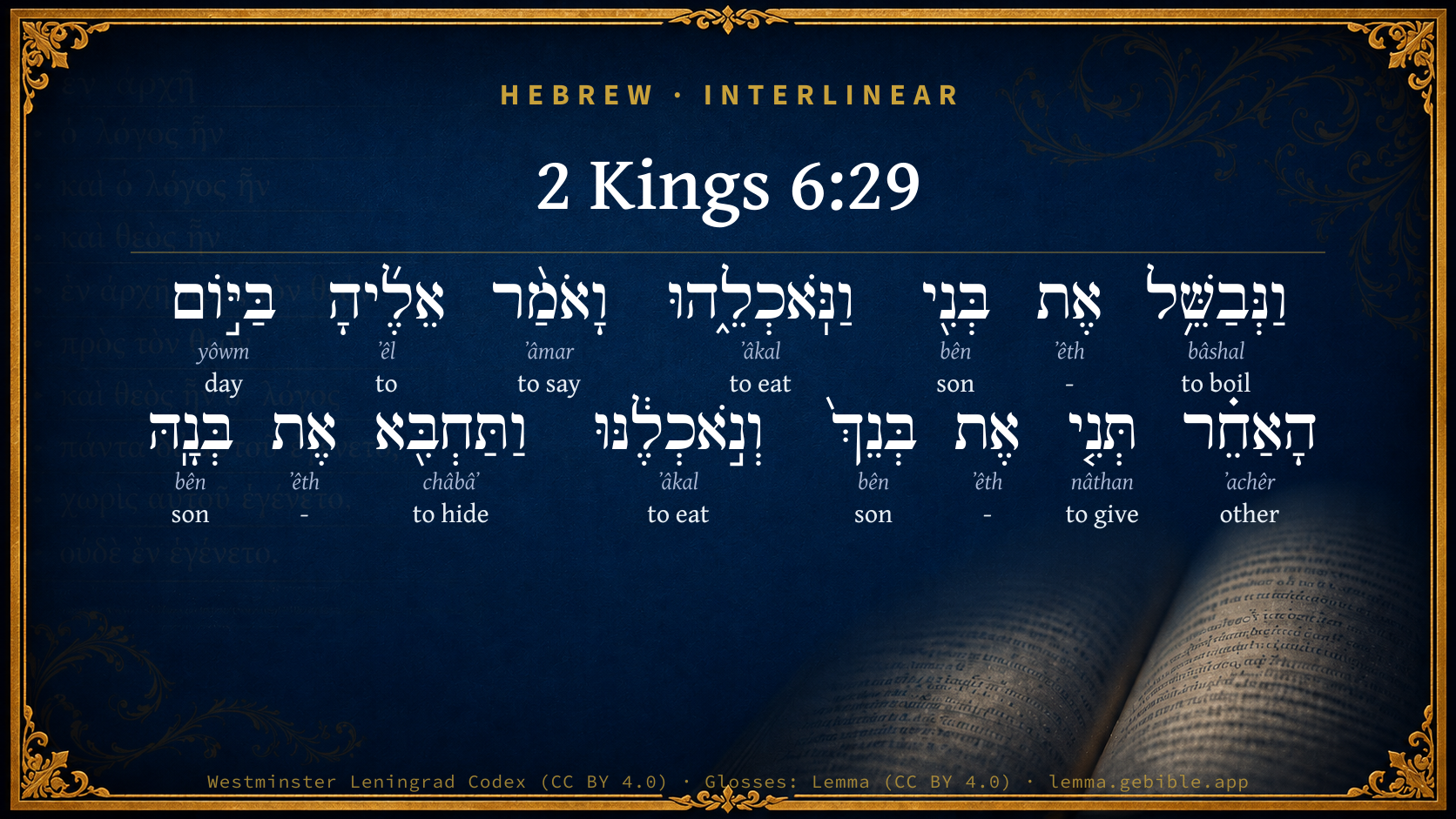
Hebrew (Westminster Leningrad Codex) 2 Kings 6:29 appears in the Hebrew Old Testament. The text above is from the Westminster Leningrad Codex. Each word links to its Strong’s number, a concise gloss, and parsing drawn from the Open Scriptures Hebrew Bible morphology. Click any word for its full Brown-Driver-Briggs (BDB) entry.
Download image
Cite this verse

2 Kings 6:29 (World English Bible). Public Domain. Lemma interlinear Bible study tool, https://lemma.gebible.app/v/2-kings/6/29.

Show BibTeX & RIS
BibTeX
RIS
English Translation
So we boiled my son, and ate him: and I said to her on the next day, Give your son, that we may eat him; and she has hid her son.
World English Bible · Public Domain
Download a study sheet

One document with this verse’s original text, its word-by-word gloss line, the meaning frame, cross-references with their text, attributed commentary, and full source and license credits — printable, and it pastes into notes with its structure intact.

This verse Autodidact and up

Study sheet (.html) Plain text (.txt)

A passage Seminary Student

Up to 50 verses in one chapter. A passage sheet keeps up to 6 commentary sources and 12 cross-references per verse, in the order this page ranks them, and says so on the sheet whenever that leaves anything out. Ask for a single verse and you get the Autodidact verse sheet above.

Everything on this page stays free to read, with no account — the sheet is a download of what is already on screen, not access to it.

Want to remove ads? Support Godless Engineer
Compare translations 3

The same verse in 3 English versions, stacked beneath the original-language interlinear above. Click any original word for its lexicon entry.

Each is an independent rendering of the whole verse — the interlinear is not word-aligned to these translations.

Highlighted words mark where these versions differ — a whole-verse word diff, not a word-by-word alignment.

  • World English Bible Public Domain
    So we boiled my son, and ate him: and I said to her on the next day, Give your son, that we may eat him; and she has hid her son.
  • King James Version Public Domain
    So we boiled my son, and did eat him: and I said unto her on the next day, Give thy son, that we may eat him: and she hath hid her son.
  • unfoldingWord Literal Text CC BY-SA 4.0
    So we boiled my son, and we ate him. And I said to her on the next day, ‘Give your son, and we will eat him.’ But she hid her son.”

unfoldingWord Literal Text — © unfoldingWord, licensed CC BY-SA 4.0. Word-aligned USFM3 via Door43 (git.door43.org/unfoldingWord/en_ult).

Versions to compare (up to 4)

3 of 4 selected

Show all 18 translations

Every available English version of this verse, each an independent rendering of the whole verse.

  • World English Bible Public Domain
    So we boiled my son, and ate him: and I said to her on the next day, Give your son, that we may eat him; and she has hid her son.
  • Berean Standard Bible Public Domain
    So we boiled my son and ate him, and the next day I said to her, ‘Give up your son, that we may eat him.’ But she had hidden her son.”
  • Majority Standard Bible Public Domain
    So we boiled my son and ate him, and the next day I said to her, ‘Give up your son, that we may eat him.’ But she had hidden her son.”
  • King James Version Public Domain
    So we boiled my son, and did eat him: and I said unto her on the next day, Give thy son, that we may eat him: and she hath hid her son.
  • American Standard Version (1901) Public Domain
    So we boiled my son, and did eat him: and I said unto her on the next day, Give thy son, that we may eat him; and she hath hid her son.
  • Revised Version (1885) Public Domain
    So we boiled my son, and did eat him: and I said unto her on the next day, Give thy son, that we may eat him: and she hath hid her son.
  • Geneva Bible (1599) Public Domain
    So we sod my sonne, and did eate him: and I saide to her the day after, Giue thy sonne, that we may eate him, but she hath hid her sonne.
  • Douay-Rheims (1899) Public Domain
    So we boiled my son, and ate him. And I said to her on the next day: Give thy son that we may eat him. And she hath hid her son.
  • Young's Literal Translation Public Domain
    and we boil my son and eat him, and I say unto her on the next day, Give thy son, and we eat him; and she hideth her son.'
  • Literal Standard Version CC BY-SA 4.0
    and we boil my son and eat him, and I say to her on the next day, Give your son, and we eat him; and she hides her son.”
  • Unlocked Literal Bible CC BY-SA 4.0
    So we boiled my son and ate him, and I said to her on the next day, “Give your son that we may eat him, but she has hidden her son.”
  • unfoldingWord Literal Text CC BY-SA 4.0
    So we boiled my son, and we ate him. And I said to her on the next day, ‘Give your son, and we will eat him.’ But she hid her son.”
  • Darby Bible Public Domain
    And we boiled my son, and ate him: and I said to her on the next day, Give thy son, that we may eat him; and she has hidden her son.
  • World Messianic Bible Public Domain
    So we boiled my son and ate him; and I said to her on the next day, ‘Give up your son, that we may eat him;’ and she has hidden her son.”
  • Webster's Bible Public Domain
    So we boiled my son, and ate him: and I said to her on the next day, Give thy son, that we may eat him: and she hath hid her son.
  • Free Bible Version CC BY-SA 4.0
    “So we cooked my son and we ate him. The next day I said to her, ‘Give up your son so we can eat him,’ but she's hidden her son.”
  • Bible in Basic English Public Domain
    So, boiling my son, we had a meal of him; and on the day after I said to her, Now give your son for our food; but she has put her son in a secret place.
  • JPS Tanakh (1917) Public Domain
    So we boiled my son, and did eat him; and I said unto her on the next day: Give thy son, that we may eat him; and she hath hid her son.'

Literal Standard Version (2020), Covenant Press — licensed CC BY-SA 4.0. Text via the HelloAO Bible API (eBible.org). Unlocked Literal Bible (unfoldingWord) — licensed CC BY-SA 4.0. Text via the HelloAO Bible API (eBible.org). unfoldingWord Literal Text — © unfoldingWord, licensed CC BY-SA 4.0. Word-aligned USFM3 via Door43 (git.door43.org/unfoldingWord/en_ult). Free Bible Version, Dr. Jonathan Gallagher — licensed CC BY-SA 4.0. Text via the HelloAO Bible API (eBible.org).

Word by word

More ways to search: Search by grammar → Find every occurrence → Compare this word →

Practice this passage: Drill this verse → Learn its vocabulary →

וַנְּבַשֵּׁ֥ל
bâshal
H1310
“and · to boil”
Conjunction + Verb, Piel, Sequential Imperfect, 1st Person, Common, Plural
Part of Speech
Conjunction + Verb
Stem
Piel
Form
Sequential Imperfect
Person
1st Person
Gender
Common
Number
Plural
Full BDB Definition

Origin: a primitive root

TWOT: 292

to boil, cook, bake, roast, ripen, grow ripe - (Qal) - to boil, cook - to grow ripe, ripen - (Piel) - to boil - to cook - (Pual) - to be boiled - to be sodden - (Hiphil) - to ripen - ripen, brought to ripeness
  1. אֶת ʼêth H853 “-” Particle, Direct Object
  2. בְּנִ֖י bên H1121 “son · my” Noun, Common, Masculine, Singular, Construct + Suffix, Personal, 1st Person, Common, Singular
  3. וַנֹּֽאכְלֵ֑הוּ ʼâkal H398 “and · to eat · him” Conjunction + Verb, Qal, Sequential Imperfect, 1st Person, Common, Plural + Suffix, Personal, 3rd Person, Masculine, Singular
  4. וָאֹמַ֨ר ʼâmar H559 “and · to say” Conjunction + Verb, Qal, Sequential Imperfect, 1st Person, Common, Singular
  5. אֵלֶ֜יהָ ʼêl H413 “to · her” Preposition + Suffix, Personal, 3rd Person, Feminine, Singular
  6. בַּיּ֣וֹם yôwm H3117 “in/at the · day” Preposition, Determined + Noun, Common, Masculine, Singular, Absolute
  7. הָאַחֵ֗ר ʼachêr H312 “the · other” Particle, Definite Article + Adjective, Adjective, Masculine, Singular, Absolute
  8. תְּנִ֤י nâthan H5414 “give” Verb, Qal, Imperative, 2nd Person, Feminine, Singular
  9. אֶת ʼêth H853 “-” Particle, Direct Object
  10. בְּנֵךְ֙ bên H1121 “son · your” Noun, Common, Masculine, Singular, Construct + Suffix, Personal, 2nd Person, Feminine, Singular
  11. וְנֹ֣אכְלֶ֔נּוּ ʼâkal H398 “and · to eat · him” Conjunction + Verb, Qal, Imperfect, 1st Person, Common, Plural + Suffix, Personal, 3rd Person, Masculine, Singular
  12. וַתַּחְבִּ֖א châbâʼ H2244 “and · to hide” Conjunction + Verb, Hiphil, Sequential Imperfect, 3rd Person, Feminine, Singular
  13. אֶת ʼêth H853 “-” Particle, Direct Object
  14. בְּנָֽהּ bên H1121 “son · her” Noun, Common, Masculine, Singular, Construct + Suffix, Personal, 3rd Person, Feminine, Singular

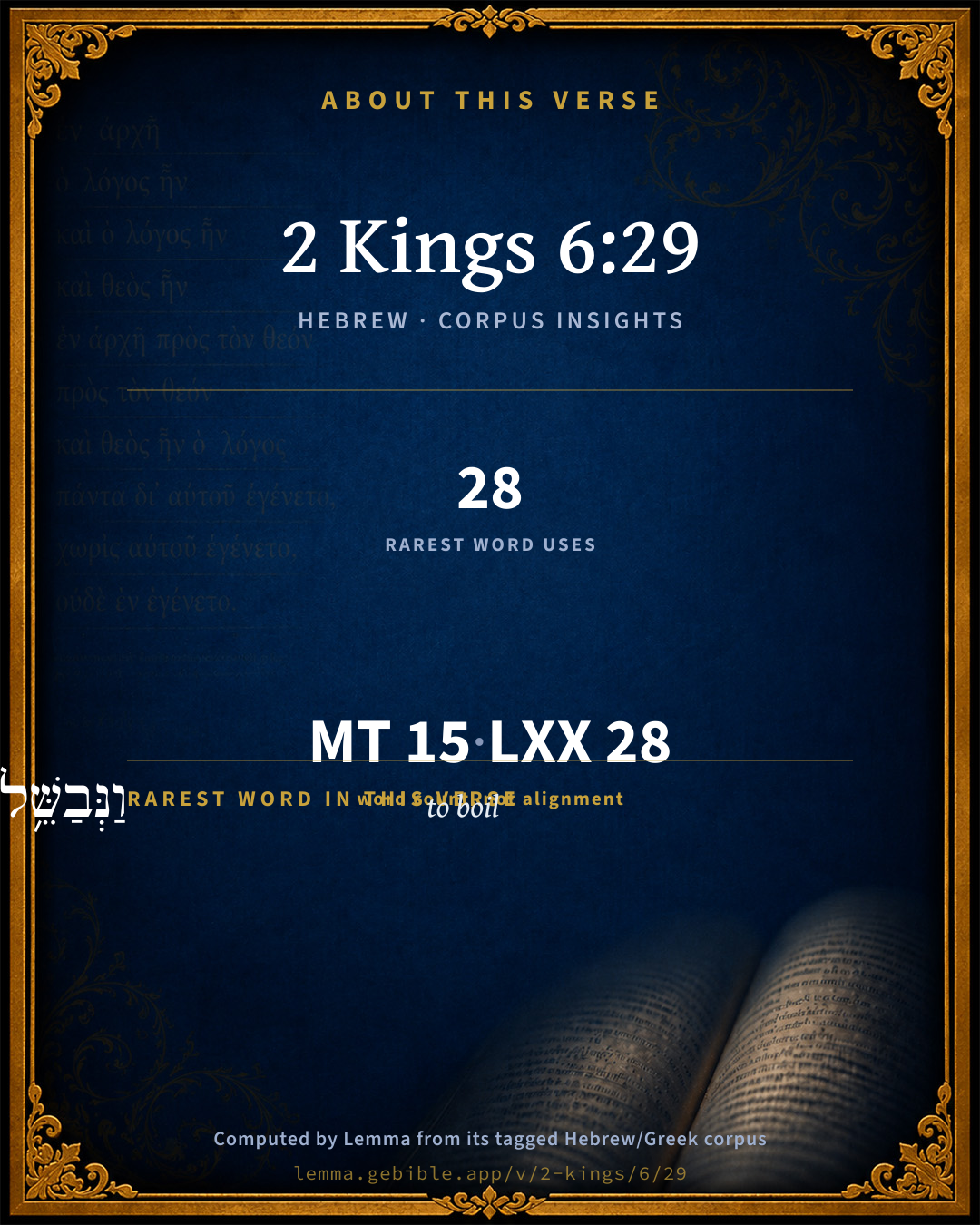
About this verse

These counts appear in no published source. They are computed here, from the morphology-tagged text and Lemma’s own curated glosses. What Lemma adds →

15
words
10
distinct lemmas
Historical
section

Shared distinctive vocabulary

וַנְּבַשֵּׁ֥ל to boil H1310 occurs in 24 verses of the Hebrew Bible. Also found in:

Grammatical profile

  • 6 verbs
  • 4 nouns
  • 1 adjective
  • 1 preposition
  • 3 particles

Verb forms

  • וַנְּבַשֵּׁ֥ל Piel · Sequential Imperfect
  • וַנֹּֽאכְלֵ֑הוּ Qal · Sequential Imperfect
  • וָאֹמַ֨ר Qal · Sequential Imperfect
  • תְּנִ֤י Qal · Imperative
  • וְנֹ֣אכְלֶ֔נּוּ Qal · Imperfect
  • וַתַּחְבִּ֖א Hiphil · Sequential Imperfect

Repetition

Words recur within this verse — often emphatic in Hebrew:

  • בְּנִ֖י son H1121 ×3
  • וַנֹּֽאכְלֵ֑הוּ to eat H398 ×2

Hebrew & Septuagint length

In English translation the verse runs 31 words from the Hebrew and 31 from the Septuagint (LXX English) — the same length.

A rough comparison of the two English renderings, which tokenize alike — not a word-level alignment.

Word counts can differ between the Hebrew and the Greek without any difference in meaning — e.g. the Hebrew direct-object marker אֵת has no separate Greek word, and Greek often adds the article ὁ.

In the original languages it is 15 Hebrew tokens and 28 Greek tokens — but the two are counted differently (Hebrew bundles its prefixes and suffixes into one token; the Greek is in lemma form), so that isn’t a like-for-like length.

Cross-references

6

Topical passages linked to 2 Kings 6:29 in the Treasury of Scripture Knowledge — connected by theme and wording, ordered by reader-vote popularity; previews shown in the World English Bible.

  • Leviticus 26:29 You will eat the flesh of your sons, and you will eat the flesh of your daughters.
  • Deuteronomy 28:53 You shall eat the fruit of your own body, the flesh of your sons and of your daughters, whom Yahweh your God has given you, in the siege and in the distress with which your enemies shall distress you.
  • Deuteronomy 28:57 and toward her young one who comes out from between her feet, and toward her children whom she shall bear; for she shall eat them for want of all things secretly, in the siege and in the distress with which your enemy shall distress you in your gates.
  • 1 Kings 3:26 Then spoke the woman whose the living child was to the king, for her heart yearned over her son, and she said, Oh, my lord, give her the living child, and in no way kill it. But the other said, It shall be neither mine nor yours; divide it.
  • Isaiah 49:15 Can a woman forget her sucking child, that she should not have compassion on the son of her womb? yes, these may forget, yet I will not forget you.
  • Isaiah 66:13 As one whom his mother comforts, so will I comfort you; and you shall be comforted in Jerusalem.

Cross-references courtesy of OpenBible.info (CC BY 4.0).

Hebrew and Greek witnesses Masoretic Hebrew ↔ Greek Septuagint

The same verse in the two great witnesses to the Old Testament, shown verse-for-verse.

These are two independent witnesses, not word-aligned to each other, and the Septuagint is shown in lemma (dictionary) form.

Hebrew 2 Kings 6:29 Masoretic · Westminster Leningrad Codex

וַנְּבַשֵּׁ֥ל אֶת בְּנִ֖י וַנֹּֽאכְלֵ֑הוּ וָאֹמַ֨ר אֵלֶ֜יהָ בַּיּ֣וֹם הָאַחֵ֗ר תְּנִ֤י אֶת בְּנֵךְ֙ וְנֹ֣אכְלֶ֔נּוּ וַתַּחְבִּ֖א אֶת בְּנָֽהּ

So we boiled my son, and ate him: and I said to her on the next day, Give your son, that we may eat him; and she has hid her son.

World English Bible · Public Domain

Greek LXX 2 Kings 6:29 Septuagint · lemma form

καί ἕψω ὁ υἱός ἐγώ καί ἐσθίω αὐτός καί εἶπον πρός αὐτός ὁ ἡμέρα ὁ δεύτερος δίδωμι ὁ υἱός σύ καί ἐσθίω αὐτός καί κρύπτω ὁ υἱός αὐτός

So we boiled my son, and ate him; and I said to her on the second day, Give your son, and let us eat him: and she has hidden her son.

LXX2012 (modern English Septuagint) · Public Domain

Hebrew: Westminster Leningrad Codex (CC BY 4.0). Greek: Septuagint (public domain); English from LXX2012 (modern English Septuagint) (Public Domain). How the Septuagint differs from the Hebrew →

Targum (Aramaic paraphrase)

1

The Targum is the ancient Jewish Aramaic paraphrase of the Hebrew Scriptures — an interpretive translation, not the Hebrew text itself. Onkelos (literal) and Pseudo-Jonathan (expansive) render the Torah, and Jonathan the Prophets. Coverage is partial: where no permissively-licensed English translation exists for a verse, only the Aramaic is shown. This is verse-level text, not a word-by-word alignment to the Hebrew.

  1. Targum Jonathan Prophets (Joshua–Malachi)
    וּבַשֵׁילְנָא יַת בְּרִי וַאֲכַלְנוּהִי וַאֲמַרִית לָהּ בְּיוֹמָא אוֹחֲרָנָא הָבִי יַת בְּרִיךְ וְנֵיכְלִינֵיהּ וְאַטְמָרַת יַת בְּרָהּ:

    (no public-domain English translation for this verse)

    Targum Jonathan — Aramaic: “Mikraot Gedolot” (public domain). English: “Sefaria Community Translation” (CC0 1.0 (public-domain dedication)); “London "Chaldee Paraphrase," 1871” (public domain). Text via Sefaria.

Commentary

Notes on 2 Kings 6:29 from classic Christian and Jewish commentators (each source and its license shown beneath its notes). The classic Christian expositions comment on the surrounding passage and are grouped to its opening verse, so a note may address several verses; the Jewish commentaries on the Tanakh (Rashi and others) are per-verse, so they appear only where the commentator wrote on this verse.

Lemma curates 59 commentaries, every one of them public domain or Creative Commons licensed, each selected and text-cleaned for this edition rather than reprinted as found. About our sources →

Trapp's Complete Commentary

John Trapp

2Ki 6:29 So we boiled my son, and did eat him: and I said unto her on the next day, Give thy son, that we may eat him: and she hath hid her son.

Ver. 29. So we boiled my son, and did eat him.] Male suada fames, made her require of her child that life, which not long before she had given it; laying him not in her bosom, but in her bowels. This was forethreatened. {Lev 26:29}

John Trapp, A Commentary or Exposition upon All the Books of the Old and New Testament (1647–1656) — public domain. Text from a community e-Sword module.

Jamieson, Fausset & Brown

Robert Jamieson, A. R. Fausset & David Brown

we boiled my son, and did eat him--(See on Deu 28:53).

Jamieson, Fausset & Brown — Commentary Critical and Explanatory on the Whole Bible (1871) — public domain (CC PDM 1.0). Text via the HelloAO Bible API.

Adam Clarke's Commentary

Verse 29. So we boiled my son] This is horrible; but for the sake of humanity we must allow that the children died through hunger, and then became food for their starved, desperate parents.

She hath hid her son.] He was already dead, says Jarchi; and she hid him, that she might eat him alone.

This very evil Moses had foretold should come upon them if they forsook God; see De 28:53; De 28:57. The same evil came upon this wretched people when besieged by Nebuchadnezzar; see Eze 5:10. And also when Titus besieged Jerusalem; see Josephus, De Bell. Judaic. lib. vi., cap. 3, and Clarke's notes on "Mt 24:19".

Adam Clarke's Commentary on the Bible (1810–1826) — public domain. Text from a community e-Sword/MySword module.

Ellicott's Commentary for English Readers

(29) she hath hid her son.—Perhaps to save him. (Comp. 1Ki_3:26.)

A Bible Commentary for English Readers, edited by Charles John Ellicott (1878–1897) — public domain. Text from a community e-Sword module.

The Cambridge Bible for Schools and Colleges

gen. ed. J. J. S. Perowne

29. she hath hid her son] So hath famine changed the nature of those whom Jeremiah calls ‘the pitiful women’. The king cannot answer such an appeal, though starvation have made the mother feel that it is a just one.

The Cambridge Bible for Schools and Colleges (gen. ed. J. J. S. Perowne; Cambridge University Press, 1878–1918) — public domain. Text from a community e-Sword module.

John Gill's Exposition

Then he said, God do so and more also to me,.... He swore and made dreadful imprecations:

if the head of Elisha the son of Shaphat shall stand on him this day; imputing the sore famine to him, because he had foretold it, and did not pray for the removal of it, as he might; and perhaps had advised and encouraged the king to hold out the siege, which had brought them to this extremity, and therefore was enraged at him.

John Gill's Exposition of the Whole Bible (1746–1763) — public domain (CC PDM 1.0). Text via the HelloAO Bible API.

Albert Barnes' Notes on the Bible

The prophecy alluded to in the marginal references was now fulfilled, probably for the first time. It had a second accomplishment when Jerusalem was besieged by Nebuchadnezzar Lam 4:10, and a third in the final siege of the same city by Titus.

Albert Barnes' Notes on the Bible (1834–1885) — public domain. Text from a community e-Sword/MySword module.

Haydock's Catholic Bible Commentary

Eat him. Strange cruelty! foretold [in] Deuteronomy xxviii. 53, and again verified at Jerusalem, Ezechiel v. 10.

George Leo Haydock (1774–1849), Haydock's Catholic Family Bible and Commentary, 1859 edition — public domain. Excludes Psalms (Douay-Rheims chapter numbering differs from Protestant) and Deuterocanonical books (Catholic canon only).

Matthew Poole's English Annotations

We boiled my son, and did eat him; a dreadful judgment, threatened to them in case of their apostacy, Deu 28:56,57, in which they were now deeply plunged. Compare Eze 5:10.

She hath hid her son; either that she might eat him alone; or rather, that she might save him from death; her bowels yearning towards him, and her hunger being in great measure satisfied.

Matthew Poole's English Annotations on the Holy Bible (1683–1685) — public domain. Text from a community e-Sword/MySword module.

Whedon's Commentary on the Bible

Daniel D. Whedon

29. We boiled my son — Probably after the child had himself died from hunger. This statement is another evidence of the awful extremity and starvation to which the Samaritans were driven by this siege of Ben-hadad.

This strife between these two mothers also shows how, in the bitterest hour of human misery, the lower passions will revel uncontrolled. But these were the very woes which Moses had foretold would come in case of disobedience. See Deu_28:53.

Daniel D. Whedon (gen. ed.), Commentary on the Old and New Testaments (1874–1909) — public domain. Text from a community e-Sword module.

The Pulpit Commentary

So we boiled my son, Lam_4:10, "The hands of the pitiful woman have sodden their own children" and did eat him: and I said unto her on the next day, Give thy son, that we may eat him: and she hath hid her son. Some have supposed that the woman concealed her child in order to consume it alone; but it is more probable that, when the time came for carrying out her agreement, she found that she could not give it up, and hid it in order to save it.

The Pulpit Commentary (1880–1919), ed. H.D.M. Spence-Jones & Joseph S. Exell — public domain. Text from a community e-Sword module.

John Wesley's Explanatory Notes

We boiled - A dreadful judgment threatened to them in case of their apostacy, Deut. xxviii, 56, 57, in which they were now deeply plunged.

John Wesley, Explanatory Notes Upon the Whole Bible (1754–1765) — public domain. Text via the GEBible commentary corpus.

Rashi

Rabbi Shlomo Yitzchaki (Rashi)

But she has hidden her son. [Who was] dead, and she wants to eat him by herself.

Rashi on the Tanakh — English translations: “The Judaica Press complete Tanach with Rashi, translated by A. J. Rosenberg” (CC BY 4.0); “Pentateuch with Rashi's commentary by M. Rosenbaum and A.M. Silbermann, 1929-1934” (public domain); “The Metsudah Tanach series, Lakewood, N.J” (CC BY 4.0); and “The Book of Joshua, Metsudah Publications, 1997” (CC BY 4.0). Text via Sefaria.

Lesson kit

Teaching starters — assembled from the data on this page, not authored interpretation. Every prompt links to the verse data it draws on. Edit before teaching.

2 Kings, in the Historical, opens this verse with 15 words (10 distinct Hebrew lemmas). Its most distinctive word is bâshal (“to boil”). A historical commentator’s framing appears above. Read the whole chapter for the surrounding context.

Discussion questions

  1. What does “to boil” (bâshal) contribute to the verse as a whole?
  2. How does Genesis 40:10, which shares the word «to boil», read alongside this verse?
  3. What does the repetition of “son” (3× in this one verse) do in this verse?
  4. These translations render this verse differently. What is at stake in choosing one wording over another?
  5. «וַנְּבַשֵּׁ֥ל» is a Piel Sequential Imperfect verb. How does that grammatical form shape the action described?
  6. Compare how Trapp's Complete Commentary and Jamieson, Fausset & Brown read this verse. Where do they agree or differ?

Things to notice

Reading settings

Reading text

Shown beneath each verse's original-language words.

Old Testament
Old Testament edition

Read the OT as the Masoretic Hebrew (MT) or the Greek Septuagint (LXX).

English shown for the Greek Septuagint (in the Hebrew ↔ Greek comparison).

Comparing translations? Open the Compare panel on any verse page to stack up to four side by side.