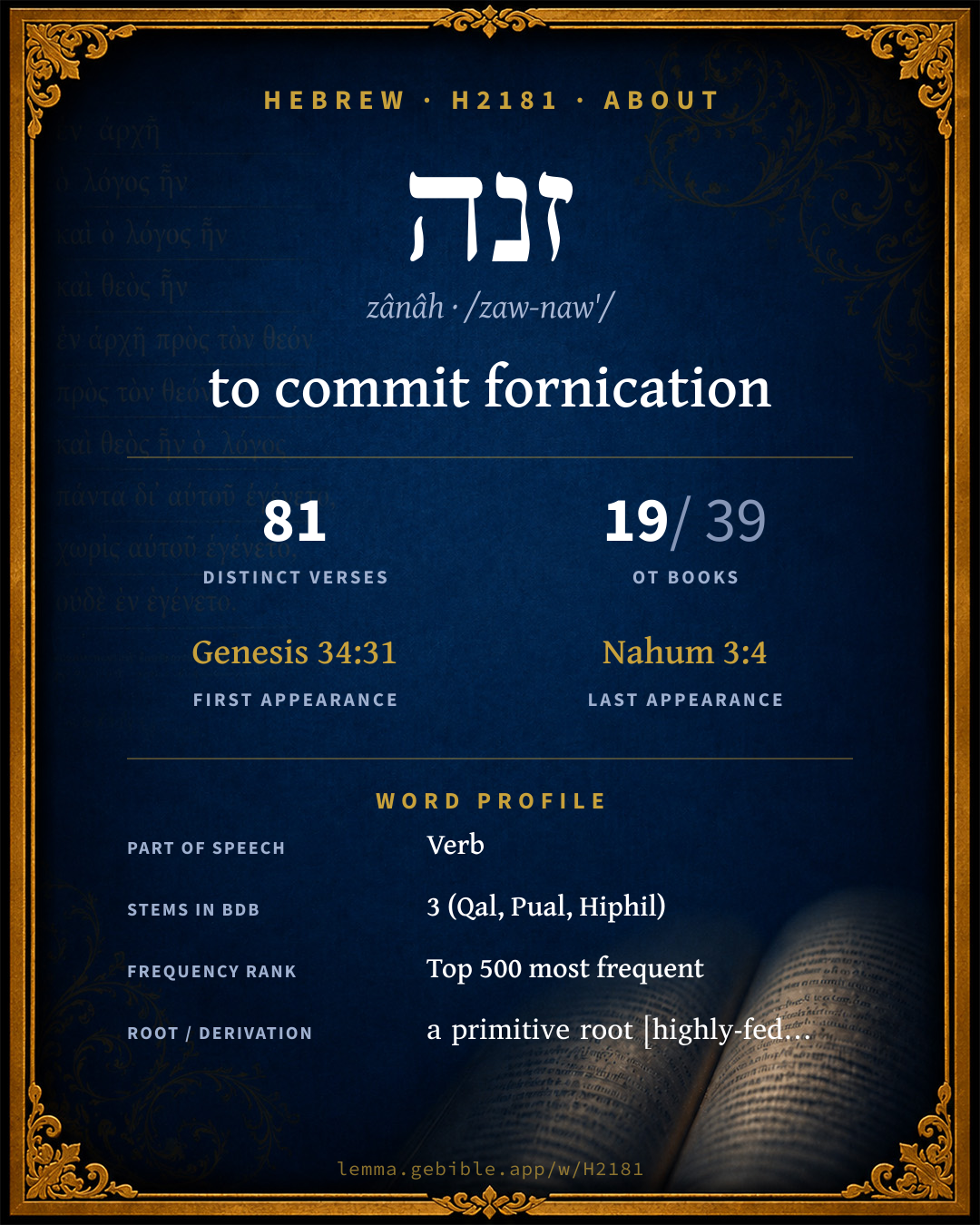
זָנָה
to commit fornication
also: be a harlot, play the harlot fuller range ↓
Full lexicon entry — Brown-Driver-Briggs (BDB)
From Brown-Driver-Briggs (BDB)
Where this word appears
See every Qal verb in the Hebrew Bible →
Grammar key — what these labels mean
Part of speech
- Verb
- An action or state-of-being word.
- Noun
- A naming word — a person, place, thing, or idea.
Noun type
- Common
- A common noun — a general class of person, place, or thing (“king,” “city,” “water”), not a specific name.
Stem
- Qal
- The basic, simple active stem — the plain form of the verb (“he wrote”). Here: ‘be or act as a harlot’
- Hiphil
- The causative active stem (“he caused / brought about”). Here: ‘cause to commit fornication’
- Pual
- The passive counterpart of the Piel.
Form
- Participle Active
- A verbal adjective expressing ongoing or characteristic action (“writing / one who writes”).
- Sequential Imperfect
- An imperfect with prefixed waw — the standard past-narrative form (waw-consecutive imperfect).
- Infinitive Construct
- A bound verbal noun, frequently with prepositions (“to write / in writing”).
- Imperfect
- An incomplete, ongoing, or future action (“he will / would write”).
- Perfect
- A completed action or state — Hebrew marks aspect (completeness) more than strict tense (“he wrote”).
- Sequential Perfect
- A perfect with prefixed waw continuing a preceding imperfect or command (waw-consecutive perfect).
- Infinitive Absolute
- An unbound verbal noun, often intensifying or standing in for a finite verb.
State
- Absolute
- The independent form of a noun, not bound to a following word.
Person
- 2nd Person
- The one addressed (“you”).
- 3rd Person
- The one spoken about (“he / she / it / they”).
Gender
- Feminine
- Grammatically feminine.
- Masculine
- Grammatically masculine.
- Common
- Either gender — not distinguished for this form.
Number
- Singular
- One.
- Plural
- More than one (in Hebrew, generally three or more).
Grammatical forms 29 distinct
- Verb, Qal, Participle Active, Feminine, Singular, Absolute 26 times (28%)
- Verb, Qal, Sequential Imperfect, 2nd Person, Feminine, Singular 7 times (8%)
- Verb, Qal, Infinitive Construct 6 times (6%)
- Verb, Qal, Sequential Imperfect, 3rd Person, Masculine, Plural 5 times (5%)
- Verb, Qal, Sequential Imperfect, 3rd Person, Feminine, Singular 4 times (4%)
- Verb, Qal, Participle Active, Masculine, Plural, Absolute 4 times (4%)
- Verb, Qal, Perfect, 3rd Person, Common, Plural 4 times (4%)
- Verb, Qal, Participle Active, Feminine, Plural, Absolute 4 times (4%)
+21 more forms (33 occurrences)
Parsed forms decoded from the imported morphology (morphhb / Westminster Leningrad Codex — WLC text public domain, morphhb tagging CC BY 4.0), counted across 93 parsed occurrences — not distinct verses.
Every verse where H2181 appears — 81 distinct verses across 19 books. Click any verse to open its interlinear word-by-word view. Verse text shown in the World English Bible for context — . Each verse’s Hebrew form is shown with its reference; the English is not keyword-highlighted, since the data carries no word-level English alignment. Use “Compare translations” on any verse to read it across multiple English versions. This concordance covers the Hebrew Bible; Septuagint (Greek Old Testament) occurrences are not indexed here.
Genesis 3 verses
- Genesis 34:31 הַ/כְ/זוֹנָ֕ה ptcl inter + prep + Qal ptcp.act fs They said, "Should he deal with our sister as with a prostitute?"
- Genesis 38:15 לְ/זוֹנָ֑ה prep + Qal ptcp.act fs When Judah saw her, he thought that she was a prostitute, for she had covered her face.
- Genesis 38:24 זָֽנְתָה֙ Qal pf 3fs It happened about three months later, that it was told Judah, saying, "Tamar, your daughter-in-law, has played the prostitute; and moreover, behold, she is with child by prostitution." Judah said, "Bring her forth, and let her be burnt."
Exodus 2 verses
- Exodus 34:15 וְ/זָנ֣וּ conj + Qal pf 3cp Don't make a covenant with the inhabitants of the land, lest they play the prostitute after their gods, and sacrifice to their gods, and one call you and you eat of his sacrifice;
- Exodus 34:16 וְ/זָנ֣וּ וְ/הִזְנוּ֙ conj + Qal pf 3cp conj + Hiphil pf 3cp and you take of their daughters to your sons, and their daughters play the prostitute after their gods, and make your sons play the prostitute after their gods.
Leviticus 7 verses
- Leviticus 17:7 זֹנִ֖ים Qal ptcp.act mp They shall no more sacrifice their sacrifices to the goat idols, after which they play the prostitute. This shall be a statute forever to them throughout their generations.'
- Leviticus 19:29 לְ/הַזְנוֹתָ֑/הּ תִזְנֶ֣ה prep + Hiphil inf.cs + sfx pers 3fs Qal impf 3fs Don't profane your daughter, to make her a prostitute; lest the land fall to prostitution, and the land become full of wickedness.
- Leviticus 20:5 הַ/זֹּנִ֣ים לִ/זְנ֛וֹת ptcl def.art + Qal ptcp.act mp prep + Qal inf.cs then I will set my face against that man, and against his family, and will cut him off, and all who play the prostitute after him, to play the prostitute with Molech, from among their people.
- Leviticus 20:6 לִ/זְנ֖וֹת prep + Qal inf.cs "'The person that turns to those who are mediums, and to the wizards, to play the prostitute after them, I will even set my face against that person, and will cut him off from among his people.
- Leviticus 21:7 זֹנָ֤ה n c fs "'They shall not marry a woman who is a prostitute, or profane; neither shall they marry a woman divorced from her husband: for he is holy to his God.
- Leviticus 21:9 לִ/זְנ֑וֹת prep + Qal inf.cs "'The daughter of any priest, if she profanes herself by playing the prostitute, she profanes her father: she shall be burned with fire.
- Leviticus 21:14 זֹנָ֔ה n c fs A widow, or one divorced, or a woman who has been defiled, or a prostitute, these he shall not marry: but a virgin of his own people shall he take as a wife.
Numbers 2 verses
- Numbers 15:39 זֹנִ֖ים Qal ptcp.act mp and it shall be to you for a fringe, that you may look on it, and remember all the commandments of Yahweh, and do them; and that you not follow after your own heart and your own eyes, after which you use to play the prostitute;
- Numbers 25:1 לִ/זְנ֖וֹת prep + Qal inf.cs Israel abode in Shittim; and the people began to play the prostitute with the daughters of Moab:
Deuteronomy 3 verses
- Deuteronomy 22:21 לִ/זְנ֖וֹת prep + Qal inf.cs then they shall bring out the young lady to the door of her father's house, and the men of her city shall stone her to death with stones, because she has done folly in Israel, to play the prostitute in her father's house: so shall you put away the evil from the midst of you.
- Deuteronomy 23:18 זוֹנָ֜ה Qal ptcp.act fs You shall not bring the hire of a prostitute, or the wages of a dog, into the house of Yahweh your God for any vow: for even both these are an abomination to Yahweh your God.
- Deuteronomy 31:16 וְ/זָנָ֣ה conj + Qal wpf 3ms Yahweh said to Moses, Behold, you shall sleep with your fathers; and this people will rise up, and play the prostitute after the strange gods of the land, where they go to be among them, and will forsake me, and break my covenant which I have made with them.
Joshua 4 verses
- Joshua 2:1 זוֹנָ֛ה Qal ptcp.act fs Joshua the son of Nun sent out of Shittim two men as spies secretly, saying, Go, view the land, and Jericho. They went and came into the house of a prostitute whose name was Rahab, and lay there.
- Joshua 6:17 הַ/זּוֹנָ֜ה ptcl def.art + Qal ptcp.act fs The city shall be devoted, even it and all that is therein, to Yahweh: only Rahab the prostitute shall live, she and all who are with her in the house, because she hid the messengers that we sent.
- Joshua 6:22 הַ/זּוֹנָ֑ה ptcl def.art + Qal ptcp.act fs Joshua said to the two men who had spied out the land, Go into the prostitute's house, and bring out there the woman, and all that she has, as you swore to her.
- Joshua 6:25 הַ֠/זּוֹנָה ptcl def.art + Qal ptcp.act fs But Rahab the prostitute, and her father's household, and all that she had, did Joshua save alive; and she lived in the midst of Israel to this day, because she hid the messengers, whom Joshua sent to spy out Jericho.
Judges 6 verses
- Judges 2:17 זָנ֗וּ Qal pf 3cp Yet they didn't listen to their judges; for they played the prostitute after other gods, and bowed themselves down to them: they turned aside quickly out of the way in which their fathers walked, obeying the commandments of Yahweh; [but] they didn't do so.
- Judges 8:27 וַ/יִּזְנ֧וּ conj + Qal wimpf 3mp Gideon made an ephod of it, and put it in his city, even in Ophrah: and all Israel played the prostitute after it there; and it became a snare to Gideon, and to his house.
- Judges 8:33 וַ/יִּזְנ֖וּ conj + Qal wimpf 3mp It happened, as soon as Gideon was dead, that the children of Israel turned again, and played the prostitute after the Baals, and made Baal Berith their god.
- Judges 11:1 זוֹנָ֑ה Qal ptcp.act fs Now Jephthah the Gileadite was a mighty man of valor, and he was the son of a prostitute: and Gilead became the father of Jephthah.
- Judges 16:1 זוֹנָ֔ה Qal ptcp.act fs Samson went to Gaza, and saw there a prostitute, and went in to her.
- Judges 19:2 וַ/תִּזְנֶ֤ה conj + Qal wimpf 3fs His concubine played the prostitute against him, and went away from him to her father's house to Bethlehem Judah, and was there the space of four months.
1 Chronicles 1 verse
2 Chronicles 2 verses
- 2 Chronicles 21:11 וַ/יֶּ֨זֶן֙ conj + Hiphil wimpf 3ms Moreover he made high places in the mountains of Judah, and made the inhabitants of Jerusalem to play the prostitute, and led Judah astray.
- 2 Chronicles 21:13 וַ/תַּזְנֶ֤ה כְּ/הַזְנ֖וֹת conj + Hiphil wimpf 2ms prep + Hiphil inf.cs but have walked in the way of the kings of Israel, and have made Judah and the inhabitants of Jerusalem to play the prostitute, like as the house of Ahab did, and also have slain your brothers of your father's house, who were better than yourself:
Psalms 2 verses
Proverbs 4 verses
- Proverbs 6:26 זוֹנָ֗ה Qal ptcp.act fs For a prostitute reduces you to a piece of bread. The adulteress hunts for your precious life.
- Proverbs 7:10 ז֝וֹנָ֗ה Qal ptcp.act fs Behold, there a woman met him with the attire of a prostitute, And with crafty intent.
- Proverbs 23:27 זוֹנָ֑ה Qal ptcp.act fs For a prostitute is a deep pit; And a wayward wife is a narrow well.
- Proverbs 29:3 ז֝וֹנ֗וֹת Qal ptcp.act fp Whoever loves wisdom brings joy to his father; But a companion of prostitutes squanders his wealth.
Isaiah 5 verses
- Isaiah 1:21 לְ/זוֹנָ֔ה prep + Qal ptcp.act fs How the faithful city has become a prostitute! She was full of justice; righteousness lodged in her, But now murderers.
- Isaiah 23:15 הַ/זּוֹנָֽה ptcl def.art + Qal ptcp.act fs It shall come to pass in that day, that Tyre shall be forgotten seventy years, according to the days of one king: after the end of seventy years it shall be to Tyre as in the song of the prostitute.
- Isaiah 23:16 זוֹנָ֣ה Qal ptcp.act fs Take a harp, go about the city, you prostitute that has been forgotten; make sweet melody, sing many songs, that you may be remembered.
- Isaiah 23:17 וְ/זָֽנְתָ֛ה conj + Qal wpf 3fs It shall happen after the end of seventy years, that Yahweh will visit Tyre, and she shall return to her hire, and shall play the prostitute with all the kingdoms of the world on the surface of the earth.
- Isaiah 57:3 וַ/תִּזְנֶֽה conj + Qal wimpf 3fs But draw near here, you sons of the sorceress, the seed of the adulterer and the prostitute.
Jeremiah 6 verses
- Jeremiah 2:20 זֹנָֽה Qal ptcp.act fs For of old time I have broken your yoke, and burst your bonds; and you said, I will not serve; for on every high hill and under every green tree you did bow yourself, playing the prostitute.
- Jeremiah 3:1 זָנִית֙ Qal pf 2fs They say, If a man put away his wife, and she go from him, and become another man's, will he return to her again? Won't that land be greatly polluted? But you have played the prostitute with many lovers; yet return again to me, says Yahweh.
- Jeremiah 3:3 זוֹנָה֙ Qal ptcp.act fs Therefore the showers have been withheld, and there has been no latter rain; yet you have a prostitute's forehead, you refused to be ashamed.
- Jeremiah 3:6 וַ/תִּזְנִי conj + Qal wimpf 2fs Moreover Yahweh said to me in the days of Josiah the king, Have you seen that which backsliding Israel has done? she is gone up on every high mountain and under every green tree, and there has played the prostitute.
- Jeremiah 3:8 וַ/תִּ֥זֶן conj + Qal wimpf 3fs I saw, when, for this very cause that backsliding Israel had committed adultery, I had put her away and given her a bill of divorce, yet treacherous Judah, her sister, didn't fear; but she also went and played the prostitute.
- Jeremiah 5:7 זוֹנָ֖ה Qal ptcp.act fs How can I pardon you? your children have forsaken me, and sworn by them that are no gods: when I had fed them to the full, they committed adultery, and assembled themselves in troops at the prostitutes' houses.
Ezekiel 19 verses
- Ezekiel 6:9 הַ/זּוֹנֶ֗ה הַ/זֹּנ֕וֹת ptcl def.art + Qal ptcp.act ms ptcl def.art + Qal ptcp.act fp Those of you that escape shall remember me among the nations where they shall be carried captive, how that I have been broken with their lewd heart, which has departed from me, and with they eyes, which play the prostitute after their idols: and they shall loathe themselves in their own sight for the evils which they have committed in all their abominations.
- Ezekiel 16:15 וַ/תִּזְנִ֖י conj + Qal wimpf 2fs But you did trust in your beauty, and played the prostitute because of your renown, and poured out your prostitution on everyone who passed by; his it was.
- Ezekiel 16:16 וַ/תִּזְנִ֖י conj + Qal wimpf 2fs You took of your garments, and made for yourselves high places decked with various colors, and played the prostitute on them: [the like things] shall not come, neither shall it be [so].
- Ezekiel 16:17 וַ/תִּזְנִי conj + Qal wimpf 2fs You also took your beautiful jewels of my gold and of my silver, which I had given you, and made for yourself images of men, and played the prostitute with them;
- Ezekiel 16:26 וַ/תִּזְנִ֧י conj + Qal wimpf 2fs You have also committed sexual immorality with the Egyptians, your neighbors, great of flesh; and have multiplied your prostitution, to provoke me to anger.
- Ezekiel 16:28 וַ/תִּזְנִי֙ וַ/תִּזְנִ֕י/ם conj + Qal wimpf 2fs conj + Qal wimpf 2fs + sfx pers 3mp You have played the prostitute also with the Assyrians, because you were insatiable; yes, you have played the prostitute with them, and yet you weren't satisfied.
- Ezekiel 16:30 זוֹנָ֖ה Qal ptcp.act fs How weak is your heart, says the Lord Yahweh, seeing you do all these things, the work of an impudent prostitute;
- Ezekiel 16:31 כַּ/זּוֹנָ֖ה prep det + Qal ptcp.act fs in that you build your vaulted place at the head of every way, and make your lofty place in every street, and have not been as a prostitute, in that you scorn pay.
- Ezekiel 16:33 זֹנ֖וֹת Qal ptcp.act fp They give gifts to all prostitutes; but you give your gifts to all your lovers, and bribe them, that they may come to you on every side for your prostitution.
- Ezekiel 16:34 זוּנָּ֑ה Pual pf 3ms You are different from [other] women in your prostitution, in that none follows you to play the prostitute; and whereas you give hire, and no hire is given to you, therefore you are different.
- Ezekiel 16:35 זוֹנָ֔ה Qal ptcp.act fs Therefore, prostitute, hear the word of Yahweh:
- Ezekiel 16:41 מִ/זּוֹנָ֔ה prep + Qal ptcp.act fs They shall burn your houses with fire, and execute judgments on you in the sight of many women; and I will cause you to cease from playing the prostitute, and you shall also give no hire any more.
- Ezekiel 20:30 זֹנִֽים Qal ptcp.act mp Therefore tell the house of Israel, Thus says the Lord Yahweh: Do you pollute yourselves after the manner of your fathers? and play you the prostitute after their abominations?
- Ezekiel 23:3 וַ/תִּזְנֶ֣ינָה זָנ֑וּ conj + Qal wimpf 3fp Qal pf 3cp and they played the prostitute in Egypt; they played the prostitute in their youth; there were their breasts pressed, and there was handled the bosom of their virginity.
- Ezekiel 23:5 וַ/תִּ֥זֶן conj + Qal wimpf 3fs Oholah played the prostitute when she was mine; and she doted on her lovers, on the Assyrians [her] neighbors,
- Ezekiel 23:19 זָנְתָ֖ה Qal pf 3fs Yet she multiplied her prostitution, remembering the days of her youth, in which she had played the prostitute in the land of Egypt.
- Ezekiel 23:30 בִּ/זְנוֹתֵ/ךְ֙ prep + Qal inf.cs + sfx pers 2fs These things shall be done to you, because you have played the prostitute after the nations, and because you are polluted with their idols.
- Ezekiel 23:43 יזנה יִזְנ֥וּ Qal impf 3ms Qal impf 3mp Then said I of her who was old in adulteries, Now will they play the prostitute with her, and she [with them].
- Ezekiel 23:44 זוֹנָ֑ה Qal ptcp.act fs They went in to her, as they go in to a prostitute: so went they in to Oholah and to Oholibah, the lewd women.
Hosea 11 verses
- Hosea 1:2 זָנֹ֤ה תִזְנֶה֙ Qal inf.abs Qal impf 3fs When Yahweh spoke at the first by Hosea, Yahweh said to Hosea, "Go, take for yourself a wife of prostitution and children of unfaithfulness; for the land commits great adultery against from Yahweh."
- Hosea 2:5 זָֽנְתָה֙ Qal pf 3fs For their mother has played the prostitute. She who conceived them has done shamefully; For she said, 'I will go after my lovers, Who give me my bread and my water, My wool and my flax, My oil and my drink.'
- Hosea 3:3 תִזְנִ֔י Qal impf 2fs I said to her, "You shall stay with me many days. You shall not play the prostitute, and you shall not be with any other man. I will also be so toward you."
- Hosea 4:10 הִזְנ֖וּ Hiphil pf 3cp They will eat, and not have enough. They will play the prostitute, and will not increase; Because they have abandoned giving to Yahweh.
- Hosea 4:12 וַ/יִּזְנ֖וּ conj + Qal wimpf 3mp My people consult with their wooded idol, And answer to a stick of wood. Indeed the spirit of prostitution has led them astray, And they have been unfaithful to their God.
- Hosea 4:13 תִּזְנֶ֨ינָה֙ Qal impf 3fp They sacrifice on the tops of the mountains, And burn incense on the hills, under oaks and poplars and terebinths, Because its shade is good. Therefore your daughters play the prostitute, And your brides commit adultery.
- Hosea 4:14 תִזְנֶ֗ינָה הַ/זֹּנ֣וֹת Qal impf 3fp ptcl def.art + Qal ptcp.act fp I will not punish your daughters when they play the prostitute, Nor your brides when they commit adultery; Because the men consort with prostitutes, And they sacrifice with the shrine prostitutes; And the people that does not understand will come to ruin.
- Hosea 4:15 זֹנֶ֤ה Qal ptcp.act ms "Though you, Israel, play the prostitute, Yet don't let Judah offend; And don't come to Gilgal, Neither go up to Beth Aven, Nor swear, 'As Yahweh lives.'
- Hosea 4:18 הַזְנֵ֣ה הִזְנ֔וּ Hiphil inf.abs Hiphil pf 3cp Their drink has become sour. They play the prostitute continually. Her rulers dearly love their shameful way.
- Hosea 5:3 הִזְנֵ֣יתָ Hiphil pf 2ms I know Ephraim, And Israel is not hidden from me; For now, Ephraim, you have played the prostitute. Israel is defiled.
- Hosea 9:1 זָנִ֖יתָ Qal pf 2ms Don't rejoice, Israel, to jubilation like the nations; For you were unfaithful to your God. You love the wages of a prostitute at every grain threshing floor.
Joel 1 verse
Amos 1 verse
Micah 1 verse
Nahum 1 verse
About this entry
At a glance — auto-summarized from this page’s data, not written by a person. Every figure links to its source below. This summary describes the numbers; it doesn’t interpret them.
At its core, זנה (zânâh) means “to commit fornication.” Its English rendering has broadened — “harlot” classically, “prostitute” (Berean Standard Bible) in modern versions; see the renderings breakdown. Spanning 81 verses in 19 books, it ranks among the moderately common words of the Hebrew Bible. It first appears in Genesis 34:31. The verb spans 3 stems, from Qal to Pual. Each statement above links to its evidence; the full detail follows below.
Gloss history
Strong's 1890 vs modern scholarship
About this word
Strong's H2181 catalogs a Hebrew word from the Hebrew Old Testament.
These counts are not copied from any lexicon or concordance. They are computed here, from the morphology-tagged Hebrew Old Testament. What Lemma adds →
- 81
- distinct verses
- The word appears in 81 distinct verses.
- 19 / 39
- OT books
- The word appears in 19 of 39 Old Testament books.
- #446
- by frequency
- Top 500 most frequent Hebrew words (rank 446 of 8,640 Hebrew words by occurrence).
View all 81 occurrences in the concordance →
By section of the Old Testament
By traditional corpus
Conventional, traditional groupings — biblical authorship is debated, so this is a traditional corpus grouping, not an authorship claim. Each share is this word’s portion of its verses in that division of the Hebrew canon. Each figure is a share of the word’s 81 distinct verses.
- Prophets (Nevi'im) 55 verses · 68%
- Torah (Pentateuch) 17 verses · 21%
- Writings (Ketuvim) 9 verses · 11%
How translations render this word
Counts come from each version’s own published word-to-Strong’s tagging or interlinear alignment — an approximate guide to how each version renders this word, not a word-level alignment the data otherwise carries. Because each total is that version’s own tagged count, the per-version totals vary from one another and need not match the appearance or distinct-verse counts above. These counts may also differ from a printed concordance because Lemma counts each distinctly tagged rendering and does not collapse phrase taggings into a single head-word total. This is a fixed set of word-tagged versions (KJV, ASV, BSB, ULT) and does not change with the reading translation you choose elsewhere. Each version’s license is shown beside its name below (and on Sources).
- King James Version: Harlot 9×, Go a whoring 6×, Hath played the harlot 3×
- American Standard Version: Harlot 16×, Play the harlot 9×, Played the harlot 6×
- Berean Standard Bible: Prostitute 16×, Prostitutes 7×, Harlot 5×
- unfoldingWord Literal Text: Prostitute 27×, Prostituting 6×, Themselves 4×
King James Version Public Domain
Renders H2181 across 92 tagged occurrences — most commonly:
Plus other, less common renderings. Plus 51 renderings that appear only once — usually multi-word phrases or single function words the recovered tagging swept in, not distinct renderings. Not rendered by a distinct English word in 2 further occurrences.
American Standard Version Public Domain
Renders H2181 across 92 tagged occurrences — most commonly:
Plus 40 renderings that appear only once — usually multi-word phrases or single function words the recovered tagging swept in, not distinct renderings.
Berean Standard Bible Public Domain
Renders H2181 across 88 tagged occurrences — most commonly:
Plus 38 renderings that appear only once — usually multi-word phrases or single function words the recovered tagging swept in, not distinct renderings. Not rendered by a distinct English word in 6 further occurrences.
unfoldingWord Literal Text CC BY-SA 4.0
Renders H2181 across 114 tagged occurrences — most commonly:
Plus other, less common renderings. Plus 44 renderings that appear only once — usually multi-word phrases or single function words the recovered tagging swept in, not distinct renderings.
13 senses and sub-senses in the full BDB
Hebrew verbs can shift meaning by stem (binyan): Qal is the basic action, Niphal is often passive or reflexive, Piel often intensifies or makes it factitive, and Hiphil is typically causative. The senses below are grouped under the stem BDB assigns to each. This entry also uses Pual (the passive of Piel).
What do BDB’s symbols mean?
BDB uses these scholarly abbreviations:
| Symbol | Meaning |
|---|---|
| 𝔊 | the Septuagint (the ancient Greek translation, LXX) |
| 𝔙 | the Vulgate (the Latin translation) |
| 𝔖 | the Syriac version (the Peshitta) |
| 𝔗 | the Targum (the Aramaic translation) |
| ψ | the Psalms |
| √ | root (the underlying root or stem) |
| ‖ | parallel passage (a synonymous or contrasted parallel) |
| † | the dagger: every passage where the word occurs is cited |
The 13 senses and sub-senses the full Brown-Driver-Briggs lexicon distinguishes for this word, in lexicon order (not ranked by frequency), with BDB’s own verbatim wording and sub-sense lettering. Shown in Hebrew script with BDB’s own scholarly abbreviations. The condensed entry is in the Lexicon Entry tab. See also the Forms in the corpus table below.
Qal
- Pf. ז׳ Dt 31:16, זָֽנְתָה Gn 38:24 + 3 times, etc.; Impf. יִזְנֶ֯ה (Kt) Ez 23:43; תִּזְנֶה Lv 19:29 + 4 times; וַתּ֫זֶן Je 3:8 Ez 23:5; תִּזְנִי Ho 3:3; וַתִּזְנִי Je 3:6 (but read prob. וַתִּזֶן: וַתִּזְנִי is not Aramaic form of 3 fs., v. Köi 540 Kau§ 47 g b) Ez 16:15 + 4 times; וַתִּזְנִים Ez 16:28; יִזְנוּ (Qr) Ez 23:43; וַיִּזְנוּ Ju 8:27 + 4 times; תִּזְנֶינָה Ho 4:13, 14; וַתִּזְנֶינָה Ez 23:3; Inf. abs. זָנֹה Ho 1:2; cstr. לִזְנוֹת Lv 20:5 + 3 times; לִזְנֹת Lv 20:6; sf. בִּזְנוֹתֵךְ Ez 23:30; Pt. זוֹנֶה ψ 73:27 Ez 6:9; זֹנֶה Ho 4:15; pl. זֹנִים Lv 17:7 + 3 times; זוֹנָה Dt 23:19 + 25 times; זֹנָה Lv 21:7 + 2 times; זוֹנוֹת Pr 29:3; זֹנוֹת Ho 4:14 + 4 times— e.g. Deuteronomy 31:16
- 1. be or act as a harlot, abs. Gn 38:24 (J), Dt 22:21 (D), Lv 21:9 (H), Ho 4:13, 14 Am 7:17; זונה + (ה)אשׁה Jos 2:1; 6:22 (J), Lv 21:7 (H), Ju 11:1; 16:1 Pr 6:26 Je 3:3 Ez 16:30; 23:44; זוֹנָה Gn 34:31; 38:15 Jos 6:17, 25 (all J), Dt 23:19 Lv 21:14 (H), Pr 7:10; 23:27 Is 23:15, 16 Jo 4:3 Mi 1:7(×2) Ez 16:31; נָשִׁים זֹנוֹת 1 K 3:16; ז(ו)נות 1 K 22:38 Pr 29:3 Ho 3:3; 4:14 Ez 16:33; בית זונה Je 5:7; commit fornication, man’s act ז׳ אל Nu 25:1 (J); metaphorically of a land given to harlotry Lv 19:29. e.g. Genesis 38:24
- 2. fig. of improper intercourse with foreign nations with acc. pers. Je 3:1 Ex 16:28; ז׳ את Is 23:17; אחרי Ez 23:30; אל Ez 16:26, 28(×2); ז׳ תַזְנוּתיה Ez 23:43 Na 3:4; וַתִּזֶן אָהֳלָה תַחְתָּ֑י and Ohola committed fornication (whilst) under me Ez 23:5 (cf. Nu 5:19). e.g. Jeremiah 3:1
- 3. of intercourse with other deities, considered as harlotry, sometimes involving actual prostitution, ז׳ אחרי Ex 34:15, 16 Dt 31:16 (all J), Lv 17:7; 20:5(×2) (all H), Ju 2:17; 8:27, 33 1 Ch 5:25 Ez 6:9; 20:30; after אֹבֹת, etc. Lv 20:6 (H), one’s own heart & eyes Nu 15:39 (H); especially of Isr., Judah, and Jerus. under fig. of lewd woman Ez 16:15 (abs.) v 16 (על במות), v 17 (ז׳ בְ), 23:3(×2), 19 (abs.), Je 3:1 (c. acc.); v 6, 8 (abs.); abs. elsewhere Ho 2:7; 4:15 Is 57:3 ψ 106:39; as leaving י׳, sq. מֵעַל Ho 9:1; מאחרי 1:2(×2); מתחת 4:12; sq. מן alone ψ 73:27; ז(ו)נה Je 2:20 Ez 16:35, 41; בית זונה Je 5:7; לִבָּם הַזּוֹנֶה their whorish heart Ez 6:9. e.g. Exodus 34:15
- 4. זונה of moral defection Is 1:21. e.g. Isaiah 1:21
Pual
- Pf. 3 ms. אַחֲרַיִךְ לֹא זוּנָּה fornication was not done (in going) after thee Ez 16:34 (but del. Co). e.g. Ezekiel 16:34
Hiphil
- Pf. 2 ms. הִזְנֵיתָ Ho 5:3; 3 pl. הִזְנוּ Ho 4:10, 18 Ex 34:16; Impf. וַיֶּ֫זֶן 2 Ch 21:11; וַתַּזְנֶה 2 Ch 21:13; Inf. abs. הַזְנֵה Ho 4:18; cstr. הַזְגוֹת 2 Ch 21:13; sf. לְהַזְנוֹתָהּ Lv 19:29. e.g. Hosea 5:3
- 1. cause to commit fornication:
- a. sexual Lv 19:29 (H). e.g. Leviticus 19:29
- b. religious Ex 34:16 (J), 2 Ch 21:11, 13(×2). e.g. Exodus 34:16
- 2. commit fornication:
- a. sexual Ho 4:10. e.g. Hosea 4:10
- b. religious Ho 4:18(×2); 5:3. e.g. Hosea 4:18
Senses from the full Brown-Driver-Briggs lexicon (Brown, Driver, Briggs; Oxford 1906 — public domain), digitized via Sefaria, supplemented by the OpenScriptures HebrewLexicon (CC BY 4.0). Full attribution on Sources.
Word origin
vb. commit fornication, be a harlot (Arabic زَنَى commit fornication, Aramaic ܙܢܳܐ, זנא; cf. Ethiopic ዝንየት effusio seminis virilis, semen effusum, Di1055; on this and ዘመወ (comp. by Ges al.) v. PrätBAS i.32, Anm.)—
— Brown-Driver-Briggs (Oxford 1906, public domain), digitized via Sefaria, supplemented by the OpenScriptures HebrewLexicon (CC BY 4.0). See Sources.
Origin: a primitive root [highly-fed and therefore wanton]
Jastrow Dictionary
A second Hebrew/Aramaic lexicon for comparison, covering Aramaic and post-biblical (Talmudic, Targumic, Midrashic) usage that the biblical-Hebrew BDB does not. Matched by lemma rather than by Strong’s number, so a lemma may carry more than one Jastrow headword (shown separately below), and the entries cover usage well beyond the Bible.
זָנָה
- , v. זני
זני
- (b. h.)
- 1. [to run to and fro, wander;] (with אחר) to run after, (with מאחרי) to run away from; esp. to run about as a prostitute, to be faithless, be unchaste (cmp. ch. נפקת ברא for זוֹנָה, a. טעי for our w.). Sabb. 55ᵇ (play on פ̇ח̇ז̇, Gen. XLIX, 4) פ̇סעת … ח̇טאת זָ֗נִיתָ thou hast trespassed upon religion, sinned, been unchaste (v. זוּל).—Snh. 100ᵇ שמא תִזְנֶה lest she may go astray (be seduced); a. v. fr. e.g. Genesis 49:4
- 2. to commit an offense. Gitt. 6ᵇ explain. ותזנה עליו, Jud. XIX, 2, cmp. Targ. a. l. e.g. Judges 19:2
- same, also to invite faithlessness, to excite the senses. Sabb. 88ᵇ עלובה כלה מְזַנָּה בתוך חופתה (v. Rabb. D. S. a. l.) bold is the bride who thinks of faithlessness while getting married; Gitt. 36ᵇ שזִינְּתָה בקרב וכ׳. Sot. 10ᵃ כל המְזַנֶּה … מְזַנֶּנֶת עליו if a man is lewd, his wife will think of faithlessness against him; Yalk. Job 918 מְזַנָּה תחתיו. Meg. 15ᵃ רחב בשמה זִינְּתָה וכ׳ Raḥab suggested impure thoughts by her name (Raḥab hazzonah), Jael with her call (Jud. IV, 18) &c., v. זְכִירָה; a. fr.—Trnsf. (of plants) to degenerate. Gen. R. s. 28, end אף הארץ זינתה the earth, too, became degenerated in her produces; v. זוֹנַיָּיא. Y. Kil. I, beg. 26ᵈ הפירות מְזַנִּין the produces may degenerate (ref. to Lev. XIX, 29). e.g. Judges 4:18
A Dictionary of the Targumim, the Talmud Babli and Yerushalmi, and the Midrashic Literature (Marcus Jastrow; London, Luzac, 1903) — Public Domain. Digitized via Sefaria. Digitized via Sefaria. Full attribution on Sources.
Forms in the corpus
The 77 distinct written forms H2181 takes in the Hebrew Bible, most frequent first — each parse links to that stem’s occurrences in the concordance. Hebrew forms include their vowel points and cantillation, so a single lemma takes many written forms.
The 60 most common forms are shown; 17 rarer forms follow in the full concordance.
Same root — word family
Other BDB entries built from the same root as H2181, grouped by Strong’s listed origin. These share a root / origin per the lexicon — not necessarily a shared meaning. Each links to that word’s own entry.
Derived from this word
Compare all same-root words → They share a root, not necessarily a meaning.
Septuagint verse parallels
This word appears in 80 verses that also exist in the Greek Old Testament (Septuagint), out of the 81 Hebrew verses it occurs in. You can read those verses in Greek by switching the Old Testament edition to the Septuagint.
Read these verses in the Septuagint
- Genesis 34:31
- Exodus 34:15
- Leviticus 17:7
- Numbers 15:39
- Deuteronomy 22:21
- Joshua 2:1
- Judges 2:17
- 1 Chronicles 5:25
- 2 Chronicles 21:11
- Psalms 106:39
- Proverbs 6:26
- Isaiah 1:21
This is a verse-level parallel only — the same verses exist in both the Hebrew and Greek Old Testaments. No word-level Hebrew↔Greek correspondence is claimed: the data carries no such alignment, so no Greek word is shown as this Hebrew word’s translation. Coverage is not total — the Septuagint omits the deuterocanon and renumbers the Psalms, so some Hebrew verses have no direct Greek parallel.