
Joshua 6:22

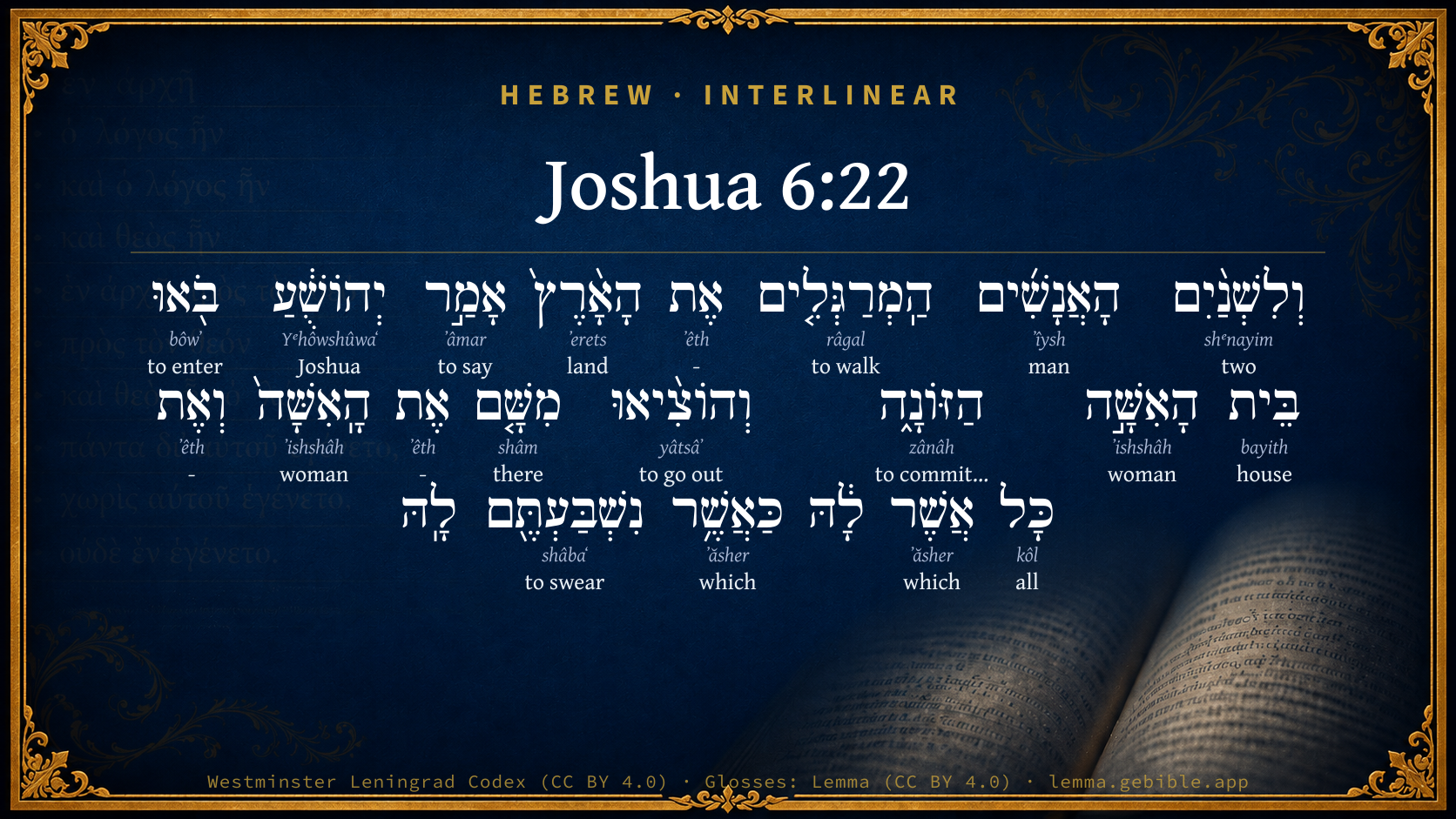
Hebrew (Westminster Leningrad Codex) Joshua 6:22 appears in the Hebrew Old Testament. The text above is from the Westminster Leningrad Codex. Each word links to its Strong’s number, a concise gloss, and parsing drawn from the Open Scriptures Hebrew Bible morphology. Click any word for its full Brown-Driver-Briggs (BDB) entry.
Download image
Cite this verse

Joshua 6:22 (World English Bible). Public Domain. Lemma interlinear Bible study tool, https://lemma.gebible.app/v/joshua/6/22.

Show BibTeX & RIS
BibTeX
RIS
English Translation
Joshua said to the two men who had spied out the land, Go into the prostitute's house, and bring out there the woman, and all that she has, as you swore to her.
World English Bible · Public Domain
Download a study sheet

One document with this verse’s original text, its word-by-word gloss line, the meaning frame, cross-references with their text, attributed commentary, and full source and license credits — printable, and it pastes into notes with its structure intact.

This verse Autodidact and up

Study sheet (.html) Plain text (.txt)

A passage Seminary Student

Up to 50 verses in one chapter. A passage sheet keeps up to 6 commentary sources and 12 cross-references per verse, in the order this page ranks them, and says so on the sheet whenever that leaves anything out. Ask for a single verse and you get the Autodidact verse sheet above.

Everything on this page stays free to read, with no account — the sheet is a download of what is already on screen, not access to it.

Want to remove ads? Support Godless Engineer
Compare translations 3

The same verse in 3 English versions, stacked beneath the original-language interlinear above. Click any original word for its lexicon entry.

Each is an independent rendering of the whole verse — the interlinear is not word-aligned to these translations.

Highlighted words mark where these versions differ — a whole-verse word diff, not a word-by-word alignment.

  • World English Bible Public Domain
    Joshua said to the two men who had spied out the land, Go into the prostitute's house, and bring out there the woman, and all that she has, as you swore to her.
  • King James Version Public Domain
    But Joshua had said unto the two men that had spied out the country, Go into the harlot's house, and bring out thence the woman, and all that she hath, as ye sware unto her.
  • unfoldingWord Literal Text CC BY-SA 4.0
    And Joshua said to the two men having spied out the land, “Enter the house of the woman, the prostitute, and bring out from there the woman and all who to her, just as you swore to her.”

unfoldingWord Literal Text — © unfoldingWord, licensed CC BY-SA 4.0. Word-aligned USFM3 via Door43 (git.door43.org/unfoldingWord/en_ult).

Versions to compare (up to 4)

3 of 4 selected

Show all 18 translations

Every available English version of this verse, each an independent rendering of the whole verse.

  • World English Bible Public Domain
    Joshua said to the two men who had spied out the land, Go into the prostitute's house, and bring out there the woman, and all that she has, as you swore to her.
  • Berean Standard Bible Public Domain
    Meanwhile, Joshua told the two men who had spied out the land, “Go into the house of the prostitute and bring out the woman and all who are with her, just as you promised her.”
  • Majority Standard Bible Public Domain
    Meanwhile, Joshua told the two men who had spied out the land, “Go into the house of the prostitute and bring out the woman and all who are with her, just as you promised her.”
  • King James Version Public Domain
    But Joshua had said unto the two men that had spied out the country, Go into the harlot's house, and bring out thence the woman, and all that she hath, as ye sware unto her.
  • American Standard Version (1901) Public Domain
    And Joshua said unto the two men that had spied out the land, Go into the harlot's house, and bring out thence the woman, and all that she hath, as ye sware unto her.
  • Revised Version (1885) Public Domain
    And Joshua said unto the two men that had spied out the land, Go into the harlot’s house, and bring out thence the woman, and all that she hath, as ye sware unto her.
  • Geneva Bible (1599) Public Domain
    But Ioshua had said vnto the two men that had spied out the countrey, Go into the harlots house, and bring out thence the woman, and all that she hath, as ye sware to her.
  • Douay-Rheims (1899) Public Domain
    But Josue said to the two men that had been sent for spies: Go into the harlot's house, and bring her out, and all things that are hers, as you assured her by oath.
  • Young's Literal Translation Public Domain
    And to the two men who are spying the land Joshua said, `Go into the house of the woman, the harlot, and bring out thence the woman, and all whom she hath, as ye have sworn to her.'
  • Literal Standard Version CC BY-SA 4.0
    And Joshua said to the two men who are spying out the land, “Go into the house of the woman, the harlot, and bring out the woman from there, and all whom she has, as you have sworn to her.”
  • Unlocked Literal Bible CC BY-SA 4.0
    Then Joshua said to the two men who had spied out the land, “Go into the prostitute's house. Bring out the woman and all who are with her, as you swore to her.”
  • unfoldingWord Literal Text CC BY-SA 4.0
    And Joshua said to the two men having spied out the land, “Enter the house of the woman, the prostitute, and bring out from there the woman and all who to her, just as you swore to her.”
  • Darby Bible Public Domain
    And Joshua said to the two men that had spied out the country, Go into the harlot's house and bring out thence the woman, and all that she has, as ye swore unto her.
  • World Messianic Bible Public Domain
    Joshua said to the two men who had spied out the land, “Go into the prostitute’s house, and bring the woman and all that she has out from there, as you swore to her.”
  • Webster's Bible Public Domain
    But Joshua had said to the two men that spied out the country, Go into the harlot's house, and bring out thence the woman, and all that she hath, as ye swore to her.
  • Free Bible Version CC BY-SA 4.0
    Joshua had told the two men who had gone to explore the land, “Go to the house of Rahab the prostitute and bring her out together with all her family, as you promised.”
  • Bible in Basic English Public Domain
    Then Joshua said to the two men who had been sent to make a search through the land, Go into the house of the loose woman, and get her out, and all who are with her, as you gave her your oath.
  • JPS Tanakh (1917) Public Domain
    And Joshua said unto the two men that had spied out the land: 'Go into the harlot's house, and bring out thence the woman, and all that she hath, as ye swore unto her.'

Literal Standard Version (2020), Covenant Press — licensed CC BY-SA 4.0. Text via the HelloAO Bible API (eBible.org). Unlocked Literal Bible (unfoldingWord) — licensed CC BY-SA 4.0. Text via the HelloAO Bible API (eBible.org). unfoldingWord Literal Text — © unfoldingWord, licensed CC BY-SA 4.0. Word-aligned USFM3 via Door43 (git.door43.org/unfoldingWord/en_ult). Free Bible Version, Dr. Jonathan Gallagher — licensed CC BY-SA 4.0. Text via the HelloAO Bible API (eBible.org).

Word by word

More ways to search: Search by grammar → Find every occurrence → Compare this word →

Practice this passage: Drill this verse → Learn its vocabulary →

הַֽמְרַגְּלִ֤ים
râgal
H7270
“the · walking”
Particle, Definite Article + Verb, Piel, Participle Active, Masculine, Plural, Absolute
Part of Speech
Particle + Verb
Stem
Piel
Form
Participle Active
Gender
Masculine
Number
Plural
State
Absolute
Full BDB Definition

Origin: a primitive root

TWOT: 2113

to go on foot, spy out, foot it, go about, walk along, move the feet - (Qal) to be a tale-bearer, slander, go about - (Piel) - to slander - to go about as explorer, spy - (Tiphel) to teach to walk
  1. וְלִשְׁנַ֨יִם shᵉnayim H8147 “and · to/for · two” Conjunction + Preposition + Adjective, Cardinal number, Masculine, Dual, Absolute
  2. הָאֲנָשִׁ֜ים ʼîysh H376 “the · men” Particle, Definite Article + Noun, Common, Masculine, Plural, Absolute
  3. אֶת ʼêth H853 “-” Particle, Direct Object
  4. הָאָ֨רֶץ֙ ʼerets H776 “the · land” Particle, Definite Article + Noun, Common, Both, Singular, Absolute
  5. אָמַ֣ר ʼâmar H559 “to say” Verb, Qal, Perfect, 3rd Person, Masculine, Singular
  6. יְהוֹשֻׁ֔עַ Yᵉhôwshûwaʻ H3091 “Joshua” Noun, Proper
  7. בֹּ֖אוּ bôwʼ H935 “enter” Verb, Qal, Imperative, 2nd Person, Masculine, Plural
  8. בֵּית bayith H1004 “house of” Noun, Common, Masculine, Singular, Construct
  9. הָאִשָּׁ֣ה ʼishshâh H802 “the · woman” Particle, Definite Article + Noun, Common, Feminine, Singular, Absolute
  10. הַזּוֹנָ֑ה zânâh H2181 “the · committing fornication” Particle, Definite Article + Verb, Qal, Participle Active, Feminine, Singular, Absolute
  11. וְהוֹצִ֨יאוּ yâtsâʼ H3318 “and · go out” Conjunction + Verb, Hiphil, Imperative, 2nd Person, Masculine, Plural
  12. מִשָּׁ֤ם shâm H8033 “from · there” Preposition + Adverb
  13. אֶת ʼêth H853 “-” Particle, Direct Object
  14. הָֽאִשָּׁה֙ ʼishshâh H802 “the · woman” Particle, Definite Article + Noun, Common, Feminine, Singular, Absolute
  15. וְאֶת ʼêth H853 “and · -” Conjunction + Particle, Direct Object
  16. כָּל kôl H3605 “all of” Noun, Common, Masculine, Singular, Construct
  17. אֲשֶׁר ʼăsher H834 “which” Particle, Relative
  18. כַּאֲשֶׁ֥ר ʼăsher H834 “like/as · which” Preposition + Particle, Relative
  19. נִשְׁבַּעְתֶּ֖ם shâbaʻ H7650 “to swear” Verb, Niphal, Perfect, 2nd Person, Masculine, Plural

About this verse

These counts appear in no published source. They are computed here, from the morphology-tagged text and Lemma’s own curated glosses. What Lemma adds →

22
words
16
distinct lemmas
Historical
section

Notable vocabulary

The rarest word here is הַֽמְרַגְּלִ֤ים to walk H7270 — appearing just 25 times in the whole Hebrew Bible.

Shared distinctive vocabulary

הַֽמְרַגְּלִ֤ים to walk H7270 occurs in 24 verses of the Hebrew Bible. Also found in:

Grammatical profile

  • 6 verbs
  • 7 nouns
  • 1 adjective
  • 2 prepositions
  • 1 adverb
  • 5 particles

Verb forms

  • הַֽמְרַגְּלִ֤ים Piel · Participle Active
  • אָמַ֣ר Qal · Perfect
  • בֹּ֖אוּ Qal · Imperative
  • הַזּוֹנָ֑ה Qal · Participle Active
  • וְהוֹצִ֨יאוּ Hiphil · Imperative
  • נִשְׁבַּעְתֶּ֖ם Niphal · Perfect

Repetition

Words recur within this verse — often emphatic in Hebrew:

  • הָאִשָּׁ֣ה woman H802 ×2
  • אֲשֶׁר which H834 ×2

Hebrew & Septuagint length

In English translation the verse runs 33 words from the Hebrew and 30 from the Septuagint (LXX English) — closely comparable.

A rough comparison of the two English renderings, which tokenize alike — not a word-level alignment.

Word counts can differ between the Hebrew and the Greek without any difference in meaning — e.g. the Hebrew direct-object marker אֵת has no separate Greek word, and Greek often adds the article ὁ.

In the original languages it is 22 Hebrew tokens and 22 Greek tokens — but the two are counted differently (Hebrew bundles its prefixes and suffixes into one token; the Greek is in lemma form), so that isn’t a like-for-like length.

Cross-references

11

Topical passages linked to Joshua 6:22 in the Treasury of Scripture Knowledge — connected by theme and wording, ordered by reader-vote popularity; previews shown in the World English Bible.

  • Hebrews 11:31 By faith, Rahab the prostitute, didn't perish with those who were disobedient, having received the spies in peace.
  • Joshua 6:17 The city shall be devoted, even it and all that is therein, to Yahweh: only Rahab the prostitute shall live, she and all who are with her in the house, because she hid the messengers that we sent.
  • Ezekiel 17:18–19 For he has despised the oath by breaking the covenant; and behold, he had given his hand, and yet has done all these things; he shall not escape.
  • Psalms 15:4 In whose eyes a vile man is despised, But who honors those who fear Yahweh; He who keeps an oath even when it hurts, and doesn't change;
  • Ezekiel 17:13 and he took of the seed royal, and made a covenant with him; he also brought him under an oath, and took away the mighty of the land;
  • Ezekiel 17:16 As I live, says the Lord Yahweh, surely in the place where the king dwells who made him king, whose oath he despised, and whose covenant he broke, even with him in the midst of Babylon he shall die.
  • Joshua 2:1–24 Joshua the son of Nun sent out of Shittim two men as spies secretly, saying, Go, view the land, and Jericho. They went and came into the house of a prostitute whose name was Rahab, and lay there.
  • Joshua 9:15 Joshua made peace with them, and made a covenant with them, to let them live: and the princes of the congregation swore to them.
  • Joshua 9:18–20 The children of Israel didn't strike them, because the princes of the congregation had sworn to them by Yahweh, the God of Israel. All the congregation murmured against the princes.
  • 2 Samuel 21:2 The king called the Gibeonites, and said to them (now the Gibeonites were not of the children of Israel, but of the remnant of the Amorites; and the children of Israel had sworn to them: and Saul sought to kill them in his zeal for the children of Israel and Judah);
  • 2 Samuel 21:7 But the king spared Mephibosheth, the son of Jonathan the son of Saul, because of Yahweh's oath that was between them, between David and Jonathan the son of Saul.

Cross-references courtesy of OpenBible.info (CC BY 4.0).

Hebrew and Greek witnesses Masoretic Hebrew ↔ Greek Septuagint

The same verse in the two great witnesses to the Old Testament, shown verse-for-verse.

These are two independent witnesses, not word-aligned to each other, and the Septuagint is shown in lemma (dictionary) form.

Hebrew Joshua 6:22 Masoretic · Westminster Leningrad Codex

וְלִשְׁנַ֨יִם הָאֲנָשִׁ֜ים הַֽמְרַגְּלִ֤ים אֶת הָאָ֨רֶץ֙ אָמַ֣ר יְהוֹשֻׁ֔עַ בֹּ֖אוּ בֵּית הָאִשָּׁ֣ה הַזּוֹנָ֑ה וְהוֹצִ֨יאוּ מִשָּׁ֤ם אֶת הָֽאִשָּׁה֙ וְאֶת כָּל אֲשֶׁר לָ֔הּ כַּאֲשֶׁ֥ר נִשְׁבַּעְתֶּ֖ם לָֽהּ

Joshua said to the two men who had spied out the land, Go into the prostitute's house, and bring out there the woman, and all that she has, as you swore to her.

World English Bible · Public Domain

Greek LXX Joshua 6:22 Septuagint · lemma form

καί ὁ δύο νεανίσκος ὁ κατασκοπεύω εἶπον ἰησοῦς εἰςἔρχομαι εἰς ὁ οἰκία ὁ γυνή καί ἐκἄγω αὐτός ἐκεῖθεν καί ὅσος εἰμί αὐτός

And Joshua said to the two young men who had acted a spies, Go into the house of the woman, and bring her out thence, and all that she has.

LXX2012 (modern English Septuagint) · Public Domain

Hebrew: Westminster Leningrad Codex (CC BY 4.0). Greek: Septuagint (public domain); English from LXX2012 (modern English Septuagint) (Public Domain). How the Septuagint differs from the Hebrew →

Targum (Aramaic paraphrase)

1

The Targum is the ancient Jewish Aramaic paraphrase of the Hebrew Scriptures — an interpretive translation, not the Hebrew text itself. Onkelos (literal) and Pseudo-Jonathan (expansive) render the Torah, and Jonathan the Prophets. Coverage is partial: where no permissively-licensed English translation exists for a verse, only the Aramaic is shown. This is verse-level text, not a word-by-word alignment to the Hebrew.

  1. Targum Jonathan Prophets (Joshua–Malachi)
    וְלִתְרֵין גַבְרַיָא דְאַלִילוּ יַת אַרְעָא אֲמַר יְהוֹשֻׁעַ עֲלוּ לְבֵית אִתְּתָא פּוּנְדְקִיתָא וְאַפִּיקוּ מִתַּמָן יַת אִתְּתָא וְיַת כָּל דִי לָהּ כְמָא דְקַיֵמְתּוּן לָהּ:

    (no public-domain English translation for this verse)

    Targum Jonathan — Aramaic: “Mikraot Gedolot” (public domain). English: “Sefaria Community Translation” (CC0 1.0 (public-domain dedication)); “London "Chaldee Paraphrase," 1871” (public domain). Text via Sefaria.

Commentary

Notes on Joshua 6:22 from classic Christian and Jewish commentators (each source and its license shown beneath its notes). The classic Christian expositions comment on the surrounding passage and are grouped to its opening verse, so a note may address several verses; the Jewish commentaries on the Tanakh (Rashi and others) are per-verse, so they appear only where the commentator wrote on this verse.

Lemma curates 59 commentaries, every one of them public domain or Creative Commons licensed, each selected and text-cleaned for this edition rather than reprinted as found. About our sources →

Jamieson, Fausset & Brown

Robert Jamieson, A. R. Fausset & David Brown

RAHAB IS SAVED. (Jos 6:22-25)

Joshua had said . . . Go into the harlot's house, and bring out thence the woman, and all that she hath--It is evident that the town walls were not demolished universally, at least all at once, for Rahab's house was allowed to stand until her relatives were rescued according to promise.

Jamieson, Fausset & Brown — Commentary Critical and Explanatory on the Whole Bible (1871) — public domain (CC PDM 1.0). Text via the HelloAO Bible API.

Trapp's Complete Commentary

John Trapp

Jos 6:22 But Joshua had said unto the two men that had spied out the country, Go into the harlot’s house, and bring out thence the woman, and all that she hath, as ye sware unto her.

Ver. 22. As ye sware unto her.] Romanis promittere promptum est: promissis autem, quanquam iuramento firmatis, minime stare, said Mirchanes, the Persian general in Procopius. {a} But Joshua was none such.

{a} Lib. i., De Bell Persic.

John Trapp, A Commentary or Exposition upon All the Books of the Old and New Testament (1647–1656) — public domain. Text from a community e-Sword module.

Joseph Benson's Commentary

Jos 6:22-25. The harlot’s house — Which, together with the wall upon which it leaned, was left standing, by a special favour of God to her. Left them without the camp of Israel — Till they were cleansed from the impurities of their Gentile state, and instructed in the Jewish religion, and solemnly admitted into that church, for which Rahab’s good counsel and example had doubtless prepared them. Joshua saved Rahab alive — For that general command to root out the Canaanites seems to have had some exceptions, in case any of them had sincerely and seasonably cast off their idolatry and wickedness, submitted to the Israelites, and become members of the church of God. She dwelleth in Israel unto this day — This shows that the book of Joshua was written while Rahab was alive.

Joseph Benson's Commentary on the Old and New Testaments (1811–1818) — public domain. Text from a community e-Sword module.

Whedon's Commentary on the Bible

Daniel D. Whedon

THE SALVATION OF RAHAB, Jos_6:22-25.

22. Joshua had said — The indefinite past tense of the original is here very properly rendered by our pluperfect, had said. See Jos_6:17, where these instructions are given.

Daniel D. Whedon (gen. ed.), Commentary on the Old and New Testaments (1874–1909) — public domain. Text from a community e-Sword module.

Tyndale Open Study Notes

Tyndale Open Resources

6:22-23 The two spies fulfilled Joshua’s command and their oath to Rahab. Through the actions of God’s people, a pagan household saw that God is trustworthy. • the prostitute’s house: See study note on 2:1. • Moving Rahab and her family near the camp of Israel provided security.

Tyndale Open Study Notes — © Tyndale Open Resources, licensed CC BY-SA 4.0. Text via the HelloAO Bible API.

John Calvin's Commentaries

22. But Joshua had said unto the two men, etc The good faith of Joshua in keeping promises, and his general integrity, are apparent in the anxious care here taken. But as the whole city had been placed under anathema, a question might be raised as to this exception of one family. No mortal man was at liberty to make any change on the decision of God. Still as it was only by the suggestion of the Spirit that Rahab had bargained for her impunity, I conclude that Joshua, in preserving her, did only what was considerate and prudent.

We may add, that the messengers were not yet under any contrary obligation, as the complete destruction of the city had not been declared. It is true, they had heard in general, that all those nations were to be destroyed, but they were still at liberty to make a compact with a single woman, who had voluntarily abandoned her countrymen. But we shall afterwards meet with a far easier solution, namely, that while the Israelites, by the divine command, exhorted all whom they attacked, to surrender, by holding out the hope of pardon, the blinded nations obstinately refused the peace thus offered, because God had decreed to destroy all of them. But while all, in general, were hardened to their destruction, it follows that Rahab was exempted by special privilege, and might escape in safety, while the others perished. Joshua, therefore, judged wisely, that a woman who had voluntarily gone over to the Church, was rescued thus early, not without the special grace of God. The case of the father and the whole family is, indeed, different, but seeing they all spontaneously abjure their former state, they confirm the stipulation which Rahab had made for their safety, by the promptitude of their obedience.

Moreover, let us learn from the example of Joshua, that we do not sufficiently attest our probity, by refraining from violating our promise intentionally and of set purpose, unless we also diligently exert ourselves to secure its performance. He not only allows Rahab to be delivered by her guests, but is careful to guard against her sustaining any injury in the first tumult; and to make the messengers more diligent in performing their office, he reminds them that they had promised with the intervention of an oath.

John Calvin's Commentaries (1540-1563) — public domain. Text from the Calvin Translation Society English edition (1840s-50s) via the Christian Classics Ethereal Library (ccel.org). Calvin's coverage is partial (roughly two-thirds of the Bible); uncommented books and verses are honest gaps, never fabricated. The 19th-century editor's footnotes and remarks are omitted so the notes are faithfully Calvin's own voice.

The Cambridge Bible for Schools and Colleges

gen. ed. J. J. S. Perowne

22–25. The Rescue of Rahab

22. Go into the harlot’s house] We are told that Rahab’s house was upon the town wall, and that she dwelt upon the wall. But though the walls of Jericho fell down flat, her house was preserved. They fell by faith, and she was saved by faith (Heb_11:30-31).

as ye sware unto her] See above, Jos_2:14.

The Cambridge Bible for Schools and Colleges (gen. ed. J. J. S. Perowne; Cambridge University Press, 1878–1918) — public domain. Text from a community e-Sword module.

John Gill's Exposition

But Joshua had said unto the two men that had spied out the country,.... Whom he had sent on that errand, Jos 2:1; and what follows he had said unto them before the people entered into the city, and perhaps before the walls of it fell; and indeed from Jos 6:16, it appears to have been said at the time he gave the people orders to shout:

go into the harlot's house: he does not mention her name but they full well knew who he meant:

and bring out thence the woman, and all that she hath; not so much her substance, as her father's household, she had got together there, that they might be saved, as had been promised her:

as ye sware unto her; so that this order was partly on account of her kindness to them, Jos 6:17; and partly on account of the oath which they had taken, and which Joshua would have inviolably kept.

John Gill's Exposition of the Whole Bible (1746–1763) — public domain (CC PDM 1.0). Text via the HelloAO Bible API.

Matthew Poole's English Annotations

The harlot’s house, together with the wall upon which it leaned, was left standing, either by a special favour of God to her, or for the reason alleged upon Jos 6:5.

Matthew Poole's English Annotations on the Holy Bible (1683–1685) — public domain. Text from a community e-Sword/MySword module.

The Pulpit Commentary

RAHAB"S DELIVERANCE. THE CURSE ON JERICHO.

Had said. Here we have an instance of the use of the perfect as a pluperfect. We can hardly suppose, as Keil observes, that Joshua gave these orders in the midst of the turmoil and confusion attendant on the sack of the city. (see above, Jos_1:11 Jos_2:1) Go into the harlot"s house.

The preservation of Rahab"s house must have been a part of the miracle, since it was upon the city wall. (cf. Heb_11:30, Heb_11:31)

Vers. 22-27. Salvation: its Cause and Effects

1. The first lesson we learn from this portion of the narrative is salvation by faith. Had Rahab not believed in God, she would not have saved the sides; and had she not saved the spies, she would not have been saved herself. We have St. James"s authority (Jos_2:2-5) for citing this passage as an illustration of the connection between faith and works.

I WORKS "DO SPRING NECESSARILY OUT OF A LIVELY FAITH." Had Rahab not believed as she did, she would not have acted as she did. Her works were the direct result of her belief. On the other hand, had she not acted as she did, she would have proved that, whatever her profession to the spies might have been, she did not really believe what she pretended to believe about the power of Jehovah, and the ultimate success of Israel. Here we may discern a clue to the labyrinth of the controversy about the efficacy of faith and works respectively in the scheme of salvation. For

(a) a man who believes is naturally inclined to act upon what he believes. If he believes that he is saved through Christ, he will act as if he were saved through Christ. And

(b) it becomes important to ask, From what is he saved through Christ? And the Scripture tells us that he is not saved merely from the punishment of sin, but from sin itself. The scheme of salvation through Christ involves a belief in a "full, perfect, and sufficient sacrifice, oblation, and satisfaction, for the sins of the whole world." But it also leads us on from that reconciliation with God to the idea of an indwelling in Christ through His Spirit, which shall enable us to "put off," to "slay," to "crucify" the "flesh" or "old man," and to rise up to a renewed life of sanctity and holiness. A man who believes this must begin to do it. He must, as a matter of course, gird himself up to a conflict with all within him which is not subdued to God"s will, as revealed in Christ. If he does not undertake this conflict, it is because he does not believe that he is redeemed through Christ, and that that redemption leads on to sanctification by a necessary law, that of union with Christ. Thus we learn

(c) that all whose life is avowedly and systematically inconsistent with their Christian profession, who do not try to root out all evil and to practise all kinds of good, or who set up another standard before them in their actions than that set up in God"s Word, are not real believers in Christ, let their profession be what it may.

II THERE IS NO SALVATION FOR THOSE WHO DO NOT MANIFEST THEIR FAITH BY THEIR WORKS. Had Rahab not shown her faith in God by delivering the spies, there could not have been any escape for her. Whatever her private belief might have been, she would have been involved in the general destruction that overtook the whole city. And thus St. Paul and St. James alike insist upon the necessity of our Christian conduct being the manifestation of our inward belief. If it be asked how our faith should be manifested, it may be replied that there must be

(a) an abiding sense of God"s goodness as displayed in the forgiveness of sins, and

(b) an earnest striving after likeness to Christ in every action of life.

And this last will stir us up to deeds of active loving kindness like that of Rahab, who, as we have seen forgot herself and the dangers that beset her in the anxious desire to befriend first the messengers of God, and next those who were near and dear to herself. If we do not these things we are none of Christ"s, and, despite our loud profession that we have always belonged to Him, He will have no other greeting for us at the last than, "Depart from me, ye workers of iniquity.

III SALVATION IS BY CHRIST"S BLOOD ALONE. Had Rahab not hung the scarlet cord in the window, she would have perished as surely, though she had saved the spies, as if she had done nothing. So our good deeds avail nothing without faith in God"s mercy through Christ. They are but the deeds of the Pharisees, unless coupled with the deepest sense of our own unworthiness. We must own that when we have done all, we are unprofitable servants. "Not of works, lest any man should boast." Thus no trace of self satisfaction must mingle with our obedience, or all will be worthless. This was the fatal mistake of the Pharisees, and this was the reason of the anger of the Lord against them. The deepest humility, combined with the most absolute reliance upon the atoning merits of the Saviour, are among the first requisites of the regenerate life. This thought alone will preserve to the greatest saint that indispensable grace of humility which is the salt that prevents his religious profession from corruption. This alone will maintain those relations with the Author of our salvation which are necessary to keep His life present within us. If we are numbered among God s saints, if we are raised to high places in Israel, if we are the means of salvation to others, it is all due to the scarlet cord in the window.

2. A second lesson taught by this part of the narrative is that salvation works results in those who are saved.

I RAHAB"S FAITH WAS THE CAUSE OF THE SALVATION OF OTHERS. Had she not believed in God, her relatives would have shared the fate of Jericho. So in all other cases. Faith is an expansive principle. It is not content with doing good to its possessor; it stirs him up to benefit others. Jesus sent forth those who believed in Him to "preach the gospel to every creature." And all faithful Christians are their successors. They must needs "show forth the praises of him who called them out of darkness into his own marvellous light." They must strive to benefit others

(a) by trying to proclaim the gospel to the heathen abroad, or the worse than heathen at home;

(b) by intercessory prayer for all good works; and

(c) by active works of love to all who are in any way within their reach.

II RAHAB, ONCE SAVED, WAS EXALTED TO GREAT HONOUR. She became a "mother in Israel," and espoused one of its princes. She attained in ages far remote the immortal honour of being mentioned as one of the progenitors of the King of kings. Thus we learn

(a) that the "cup of cold water" does not lose its reward. Every kind action done for the love of God and Christ shall be repaid a thousandfold. We are also taught

(b) that no amount of previous sin shall be weighed in the balance against us when we have truly repented. Rahab"s sin was thought no more of when she was saved from the slaughter of Jericho. And so God"s forgiveness is full and free, through Christ, when its condition, true repentance, is attained. Though He may see fit to leave us to the discipline of the natural consequences of our sin awhile, it is for our good. He does not cast our past sins in our teeth when we have returned to Him. lie will not listen to our request to be as the least and lowest of His hired servants. He puts the best robe upon us, and rings on our fingers, in token of His joy at our return. When our heart is once more whole with Him, we are as truly His dear children as if we had never left Him, and may sun ourselves as fearlessly as they in the light of His mercy. Lastly

(c), though we may not exactly go so far as to say "the greater the sinner, the greater the saint," we may at least say that there is no reason why a great, sinner may not become a great saint. We ought not to be deterred by our past sins, grievous and (but for God"s mercy) unpardonable as they are, from pressing forward to the utmost heights of holiness that are within our reach. We are taught to forget those things that are behind, and reach forth unto the things that are before. The records of God"s Church are full of such histories. From Mary Magdalene, and after her St. Augustine, to our own day the examples of men steeped to the lips in sin, who have repented and advanced to great heights of holiness, are before us to teach the sinner not to despair, but to trust in His loving kindness who hath raised "the poor out of the mire, that he may set him with the princes, even with the princes of his people.

3. The third lesson this narrative contains is the exceeding sinfulness of sin. Jericho was a sinful city, and therefore it was a devoted city. God had plainly stated (Deu_9:5) that the Israelites were the ministers of His vengeance against sin; that for no virtue of their own, but for the appalling crimes which had called down vengeance from on high upon the Phoenician nations, they had been selected to drive them out. Many interesting questions arise here, some regarding the idea of God, some regarding the true nature of sin, indicated to us in this passage.

I IS GOD UNRIGHTEOUS THAT TAKETH VENGEANCE? As this question is fully discussed in the Introduction to this Book, a few hints will be all that is necessary here. We may observe

(a) that whatever difficulties attach to the command given to Joshua. apply equally to every idea of God that we can form. He, the All wise and All good, has at least permitted these chastisements upon men for their sin. We might go further. We might say that lie has enjoined them. God has clearly made it a law of our humanity that nations wallowing in the indulgence of sensual passion, permitting themselves to enjoy unchecked the pleasures of injustice, oppression, rapine, cruelty, have in the end been punished by being made the victims of similar cruelty. The Almighty Disposer of events has allowed man again and again to inflict cruelties as severe upon other nations, for their sins, as Joshua did upon the Canaanites. Thus whatever objections (see Butler"s "Analogy" here) may be raised to the possibility of God giving such a commission to His servant as that narrated in this Book, apply with equal force to the facts of history. Either, therefore, there is no God at all, or He is not good, or He can, consistently with truth and justice, incite man to exercise His vengeance upon those who have sinned. We may further observe

(b) that physical suffering does not seem so terrible a thing in God"s eyes as it does in ours. Famines, wars, pestilences, accidents, shipwrecks, with all their attendant horrors and miseries, have happened, and will still continue to happen. And God seems not to heed. But is it not because He sees the whole, while we see but a part of His doings? Were this the only world, we must come to the conclusion that God is not goodness, but cruelty; not justice, but the most gross and aggravated injustice. "If in this life only we have hope in Christ, we are of all men most miserable." But granted flint there is another world, in which all that goes amiss here will be set right, and these difficulties disappear. The sorrows of this life will seem but a momentary pang as we live through the ages of eternity. And in that good land we shall smile at the doubts of God"s perfections which have caused us such uneasiness here. Again

(c) we may note that history now shows that the Hittites were once a great and flourishing people. Yet until lately they had been so entirely forgotten that their very names were unknown. Why this complete obliteration, as it were, from the map of humanity? Why, but because they had sinned against the Lord, and He must destroy them? Israel was not the only instrument of His vengeance. Far to the northward of the Holy Land, where their empire flourished on the banks of the Orontes and in Asia Minor, He sent the Egyptians and Assyrians against them, till their name was blotted out from among the nations of the earth. And so will it be till time shall be no more. The nation which holds not God in remembrance shall be cut away from His hand.

II TOUCH NOT THE UNCLEAN THING. This lesson will be yet farther enforced in the next chapter. Yet here we may note that the Christian is to have no dealings whatever with ungodliness and its treasures. The good things of this life, save as things to be used for God, are to be steadfastly renounced. The desire of possessing them is not to be a motive for action. They who serve God for filthy lucre"s sake are unsparingly condemned under the gospel. It is, of course, a difficult task to decide how far innocent pleasures may be enjoyed, or rewards, honours, wealth, accepted, when God seems to have put them in our way. All the cities were not devoted to God, but Jericho only. Yet it may safely be said that in these days of a widely diffused profession of Christianity, the verdict of Christian society on these points is too lenient a one. The love of money and of the good things of this life is too free]y admitted as a motive for action. The deliberate preference of a life of poverty and self-denial is too often looked down upon with disdain, though it is recommended to us by the example of Christ. Nay, it may even be doubted how far St. Paul"s rule of excommunication of the covetous man (1Co_5:11) is carried out by the Christian Church, even when money has been made or honours attained by unfair means. The man who, as director of a public company, gives his sanction, by carelessness or weakness, to acts which, as a private individual, he would not have committed the man who by bribery obtains a position among the law makers of this great empire the man who amasses a vast fortune by indirect means is he courted or condemned by the collective Christian conscience in these days? It may be doubted whether, among all the advances we have unquestionably made of late in Christian principle, the spirit of Achan, rather than Joshua, does not predominate among us still.

III WHAT GOD HAS PROMISED WILL SURELY COME TO PASS. The ungodly often cry, "Tush, God hath forgotten; he hideth his face and he will never see it." But it comes to pass just the same. The wicked Hiel laughed Joshua"s prophecy to scorn. Yet it came true. And so do many thoughtless persons now laugh to scorn the declarations of God"s Word. They ridicule the idea of chastisement for national sins; they will not hear of days of humiliation for national misfortunes; they tell us all things are ordered by invariable law. But God punished nations of old for their sins, and He does so still. Nor does He act otherwise with individuals. He has declared that sin brings punishment in its train; but men sin wantonly, and hope to escape its necessary consequences. But either in this world or the next these consequences arrive. What God has said will surely come to pass. And then man wishes in vain that he had never offended Him. As in Hiel"s ease, so now, God fulfils to the very letter the predictions He has uttered. Let us be wise in time, and so avoid the misfortunes which a presumptuous contempt of God"s Word is sure to bring on us.

HOMILIES BY R. GLOVER Vers. 22-24. A city of destruction.

If any city ever was such a "City of Destruction" as Bunyan fancied, it was Jericho. Itself and all within it were devoted to destruction, only Rahab, like another Noah, with her family escaping. It is an awful fact to contemplate the destruction of a whole city. No escape, and little warning! Old and young, one day in possession of wealth, ease, comfort, and the next day captured and destroyed. The judicial principles on which God acts and on which He here commands the destruction of Jericho, are beyond us, but some of the lessons are clear and useful. Study these:

I THERE IS A PENALTY FOR SIN. There is nothing wanton in God"s ways. Israel was God"s chosen, and the nations of Canaan His rejected, because morally the former, with all its faults, infinitely surpassed the latter. You get glimpses of the evil of the primitive races with their religious in the story of Baal-Peor; in the vice and atrocity which perpetually mark every relapse of Israel into idolatry; in the nameless defilements of modern heathenism. Dr. Arnold, no narrow theologian, defends the destruction of the Canaanites as a great gain to the welfare of humanity. It is these cruelties and abominations of heathenism which required and explain the destruction of the Canaanites. For God punishes sin. There is no truth more undeniable, and none the knowledge of which is more widely spread. We suffer for every fault we commit. As root and fruit, so wrong and wretchedness, go together. However subtle the fault, God"s providence operates in penalties still more subtle. The eating of any forbidden fruit always has its two penalties loss of power, and loss of some sort of Eden. Sins of sinners have their penalties. And God"s people receive "double for all their sins a heavier stroke for the less excusable transgression. It is not because God is wrathful that He punishes, but because He is gracious. God is love, and therefore will not let us harm ourselves or others. His infinite love impels Him to "stamp out" evil by penalty. It is blasphemy to think God can sit still and see, with indifferent eye, the poison of sin working its mischief in the world. For love is neither in God nor man a merely sentimental thing. It is wise, it is strong, it is stern. "Love is inexorable," says one of our greatest teachers (George Macdonald). So God"s love makes Him "a consuming fire." He pardons sin, when His grace working penitence has got it out of us, but punishes it until we deplore and loathe it. The creed of Jericho was probably a very free and easy one. But as God"s facts do not accommodate themselves to our creeds, it is better to adjust our creed to God"s facts. Your sins will not pass unpunished. Blessed be God"s name, He loves us too well for that. There will be an element of correction in all penalty, until correction becomes impossible; and then, in mercy at once to ourselves and others, God steps in to prevent the further accumulation of guilt by us, and the further infliction of mischief on others. The city of sin is a city of destruction, and your sin will receive the penalty due to it, however secure you may feel in yore" power to evade it.

II PENALTY IS OFTEN LONG DEFERRED, AND IS THEN SUDDENLY INFLICTED. Jericho had, I suppose, stood long. The destruction of the cities of the plain had not extended to it. It is possible that, alike from the calamities of war as well as those of nature it had been free. And its prosperity and wealth, its abounding trade with East and West, suggested that there was really no reason to be afraid of God"s judgments. Yet suddenly, like a thunderbolt out of a clear sky, destruction fell on them. There is often delay in inflicting a punishment. God prolongs opportunity. "This year also" He spares the barren fig tree, reluctant to destroy what might produce fruit. He is not willing that any should perish, lie is "slow to anger." His long suffering is salvation. He lengthens "the days of tranquillity" that we may at last repent. But when all delay is abused, and the postponement of doom only awakes presumption, at last the stroke comes," suddenly and without remedy." The flood came suddenly, and so did the destruction of Sodom, so did that of Jezebel and Nabal, and Belshazzar, and Herod, and Judas, and that of multitudes that cannot be numbered. Do not mistake postponement of penalty for pardon of sin. Of all our unrepented sin that has not yet been smitten, the punishment is only suspended. We cannot dig so deep but God will find us, nor strengthen our defence so stoutly as to defy His power. Be wise and use the days of reprieve for repentance. "Seek the Lord while he may be found," as we are here taught there is a penalty for every sin, and that, long suspended, it yet at last falls suddenly. So observe also lastly

III THEY WHO WOULD AVOID DESTRUCTION MUST BECOME FOLLOWERS OF THE GOD OF ISRAEL. Only one woman with her relatives seems to have done this. We do not read of any persons fleeing from the city of doom, or making any provision for capitulation or escape. The enervation of luxury and immorality is on them. They alternately sink in despair or are puffed up in the confidence of their walls. But one person, rising in repentance from the guilt of a long neglect, sees the glory of God and chooses Him as her hope and Master. When she cannot save the city with her, she saves herself, and, expecting the wonderful works of God, enlists in His service. Repent thou, and take Jesus Christ as thy Lord, ending with serious change of thought and action all the evil of your life. And then the infinite love which weeps when it can only smite will pardon the sin that you forsake, and give you "a place amongst the children," and the great salvation which you long to enjoy. G.

The Pulpit Commentary (1880–1919), ed. H.D.M. Spence-Jones & Joseph S. Exell — public domain. Text from a community e-Sword module.

John Wesley's Explanatory Notes

Harlot's house - Which together with the wall upon which it leaned, was left standing, by a special favour of God to her.

John Wesley, Explanatory Notes Upon the Whole Bible (1754–1765) — public domain. Text via the GEBible commentary corpus.

unfoldingWord translationNotes

Door43 World Missions Community

translationWords

Joshua

prostitute

house

oath

unfoldingWord translationNotes — © Distant Shores Media and the Door43 World Missions Community, licensed CC BY-SA 4.0. Source: git.door43.org/Door43/en_tn.

Lesson kit

Teaching starters — assembled from the data on this page, not authored interpretation. Every prompt links to the verse data it draws on. Edit before teaching.

Joshua, in the Historical, opens this verse with 22 words (16 distinct Hebrew lemmas). Its most distinctive word is râgal (“to walk”). A historical commentator’s framing appears above. Read the whole chapter for the surrounding context.

Discussion questions

  1. What does “to walk” (râgal) contribute to the verse as a whole?
  2. Genesis 42:9 shares the word «to walk» with this verse. How do the two illuminate each other?
  3. “woman” occurs 2× in this one verse. What is the effect of the repetition?
  4. These translations render this verse differently; the difference is in the English rendering, not the original. What questions does that raise?
  5. The verb «הַֽמְרַגְּלִ֤ים» is Piel Participle Active. How does its form color the action?
  6. Reading how Jamieson, Fausset & Brown and Trapp's Complete Commentary read this verse, where do the two commentators agree and where do they part?

Things to notice

Reading settings

Reading text

Shown beneath each verse's original-language words.

Old Testament
Old Testament edition

Read the OT as the Masoretic Hebrew (MT) or the Greek Septuagint (LXX).

English shown for the Greek Septuagint (in the Hebrew ↔ Greek comparison).

Comparing translations? Open the Compare panel on any verse page to stack up to four side by side.