
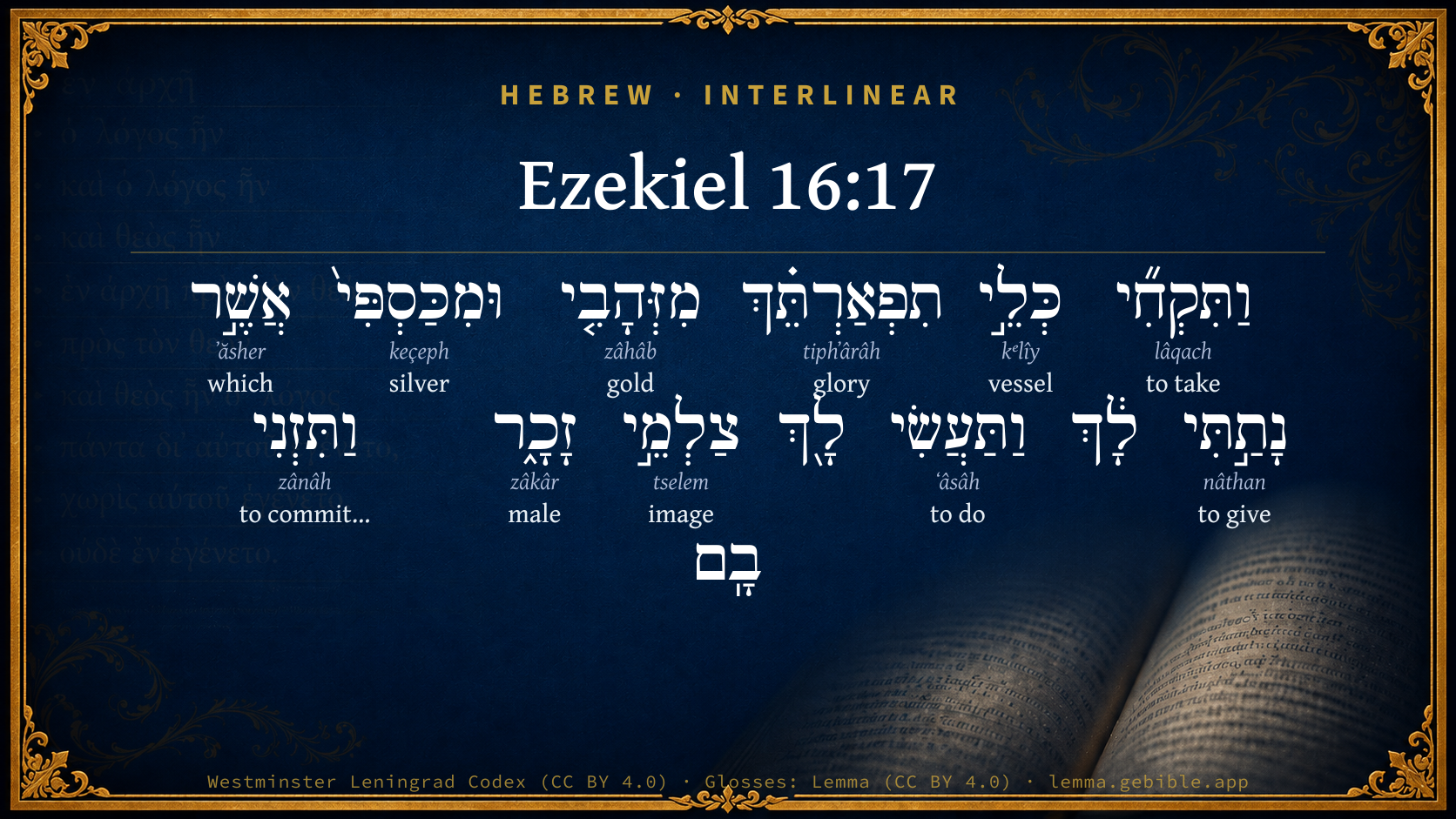
Ezekiel 16:17

Hebrew (Westminster Leningrad Codex) Ezekiel 16:17 appears in the Hebrew Old Testament. The text above is from the Westminster Leningrad Codex. Each word links to its Strong’s number, a concise gloss, and parsing drawn from the Open Scriptures Hebrew Bible morphology. Click any word for its full Brown-Driver-Briggs (BDB) entry.
Download image
Cite this verse

Ezekiel 16:17 (World English Bible). Public Domain. Lemma interlinear Bible study tool, https://lemma.gebible.app/v/ezekiel/16/17.

Show BibTeX & RIS
BibTeX
RIS
English Translation
You also took your beautiful jewels of my gold and of my silver, which I had given you, and made for yourself images of men, and played the prostitute with them;
World English Bible · Public Domain
Download a study sheet

One document with this verse’s original text, its word-by-word gloss line, the meaning frame, cross-references with their text, attributed commentary, and full source and license credits — printable, and it pastes into notes with its structure intact.

This verse Autodidact and up

Study sheet (.html) Plain text (.txt)

A passage Seminary Student

Up to 50 verses in one chapter. A passage sheet keeps up to 6 commentary sources and 12 cross-references per verse, in the order this page ranks them, and says so on the sheet whenever that leaves anything out. Ask for a single verse and you get the Autodidact verse sheet above.

Everything on this page stays free to read, with no account — the sheet is a download of what is already on screen, not access to it.

Want to remove ads? Support Godless Engineer
Compare translations 3

The same verse in 3 English versions, stacked beneath the original-language interlinear above. Click any original word for its lexicon entry.

Each is an independent rendering of the whole verse — the interlinear is not word-aligned to these translations.

Highlighted words mark where these versions differ — a whole-verse word diff, not a word-by-word alignment.

  • World English Bible Public Domain
    You also took your beautiful jewels of my gold and of my silver, which I had given you, and made for yourself images of men, and played the prostitute with them;
  • King James Version Public Domain
    Thou hast also taken thy fair jewels of my gold and of my silver, which I had given thee, and madest to thyself images of men, and didst commit whoredom with them,
  • unfoldingWord Literal Text CC BY-SA 4.0
    You took the fine jewels of the gold and silver that I gave you, and you made for yourself male figures, and you did with them as a prostitute would do.

unfoldingWord Literal Text — © unfoldingWord, licensed CC BY-SA 4.0. Word-aligned USFM3 via Door43 (git.door43.org/unfoldingWord/en_ult).

Versions to compare (up to 4)

3 of 4 selected

Show all 18 translations

Every available English version of this verse, each an independent rendering of the whole verse.

  • World English Bible Public Domain
    You also took your beautiful jewels of my gold and of my silver, which I had given you, and made for yourself images of men, and played the prostitute with them;
  • Berean Standard Bible Public Domain
    You also took the fine jewelry of gold and silver I had given you, and you made male idols with which to prostitute yourself.
  • Majority Standard Bible Public Domain
    You also took the fine jewelry of gold and silver I had given you, and you made male idols with which to prostitute yourself.
  • King James Version Public Domain
    Thou hast also taken thy fair jewels of my gold and of my silver, which I had given thee, and madest to thyself images of men, and didst commit whoredom with them,
  • American Standard Version (1901) Public Domain
    Thou didst also take thy fair jewels of my gold and of my silver, which I had given thee, and madest for thee images of men, and didst play the harlot with them;
  • Revised Version (1885) Public Domain
    Thou didst also take thy fair jewels of my gold and of my silver, which I had given thee, and madest for thee images of men, and didst play the harlot with them;
  • Geneva Bible (1599) Public Domain
    Thou hast also taken thy faire iewels made of my golde and of my siluer, which I had giuen thee, and madest to thy selfe images of men, and didest commit whoredome with them,
  • Douay-Rheims (1899) Public Domain
    And thou tookest thy beautiful vessels, of my gold, and my silver, which I gave thee, and thou madest thee images of men, and hast committed fornication with them.
  • Young's Literal Translation Public Domain
    And thou dost take thy beauteous vessels Of My gold and My silver that I gave to thee, And dost make to thee images of a male, And dost go a-whoring with them,
  • Literal Standard Version CC BY-SA 4.0
    And you take your beautiful vessels || Of My gold and My silver that I gave to you, || And make images of a male for yourself, || And go whoring with them,
  • Unlocked Literal Bible CC BY-SA 4.0
    You took the fine jewels of the gold and silver that I gave you, and you made for yourself male figures, and you did with them as a prostitute would do.
  • unfoldingWord Literal Text CC BY-SA 4.0
    You took the fine jewels of the gold and silver that I gave you, and you made for yourself male figures, and you did with them as a prostitute would do.
  • Darby Bible Public Domain
    And thou didst take thy fair jewels of my gold and of my silver, which I had given thee, and madest to thyself images of males, and didst commit fornication with them.
  • World Messianic Bible Public Domain
    You also took your beautiful jewels of my gold and of my silver, which I had given you, and made for yourself images of men, and played the prostitute with them.
  • Webster's Bible Public Domain
    Thou hast also taken thy fair jewels of my gold and of my silver, which I had given thee, and hast made to thyself images of men, and hast committed lewdness with them.
  • Free Bible Version CC BY-SA 4.0
    You also used the beautiful gold and silver jewelry I gave you to make male idols and you prostituted yourself with them.
  • Bible in Basic English Public Domain
    And you took the fair jewels, my silver and gold which I had given to you, and made for yourself male images, acting like a loose woman with them;
  • JPS Tanakh (1917) Public Domain
    Thou didst also take thy fair jewels of My gold and of My silver, which I had given thee, and madest for thee images of men, and didst play the harlot with them;

Literal Standard Version (2020), Covenant Press — licensed CC BY-SA 4.0. Text via the HelloAO Bible API (eBible.org). Unlocked Literal Bible (unfoldingWord) — licensed CC BY-SA 4.0. Text via the HelloAO Bible API (eBible.org). unfoldingWord Literal Text — © unfoldingWord, licensed CC BY-SA 4.0. Word-aligned USFM3 via Door43 (git.door43.org/unfoldingWord/en_ult). Free Bible Version, Dr. Jonathan Gallagher — licensed CC BY-SA 4.0. Text via the HelloAO Bible API (eBible.org).

Word by word

More ways to search: Search by grammar → Find every occurrence → Compare this word →

Practice this passage: Drill this verse → Learn its vocabulary →

צַלְמֵ֣י
tselem
H6754
“images of”
Noun, Common, Masculine, Plural, Construct
Part of Speech
Noun
Type
Common
Gender
Masculine
Number
Plural
State
Construct
Full BDB Definition

Origin: from an unused root meaning to shade

TWOT: 1923a

image - images (of tumours, mice, heathen gods) - image, likeness (of resemblance) - mere, empty, image, semblance (figuratively)
  1. וַתִּקְחִ֞י lâqach H3947 “and · to take” Conjunction + Verb, Qal, Sequential Imperfect, 2nd Person, Feminine, Singular
  2. כְּלֵ֣י kᵉlîy H3627 “vessels of” Noun, Common, Masculine, Plural, Construct
  3. תִפְאַרְתֵּ֗ךְ tiphʼârâh H8597 “glory · your” Noun, Common, Feminine, Singular, Construct + Suffix, Personal, 2nd Person, Feminine, Singular
  4. מִזְּהָבִ֤י zâhâb H2091 “from · gold · my” Preposition + Noun, Common, Masculine, Singular, Construct + Suffix, Personal, 1st Person, Common, Singular
  5. וּמִכַּסְפִּי֙ keçeph H3701 “and · from · silver · my” Conjunction + Preposition + Noun, Common, Masculine, Singular, Construct + Suffix, Personal, 1st Person, Common, Singular
  6. אֲשֶׁ֣ר ʼăsher H834 “which” Particle, Relative
  7. נָתַ֣תִּי nâthan H5414 “to give” Verb, Qal, Perfect, 1st Person, Common, Singular
  8. וַתַּעֲשִׂי ʻâsâh H6213 “and · to do” Conjunction + Verb, Qal, Sequential Imperfect, 2nd Person, Feminine, Singular
  9. זָכָ֑ר zâkâr H2145 “male” Adjective, Adjective, Masculine, Singular, Absolute
  10. וַתִּזְנִי zânâh H2181 “and · to commit fornication” Conjunction + Verb, Qal, Sequential Imperfect, 2nd Person, Feminine, Singular

About this verse

These counts appear in no published source. They are computed here, from the morphology-tagged text and Lemma’s own curated glosses. What Lemma adds →

14
words
11
distinct lemmas
Prophets
section

Notable vocabulary

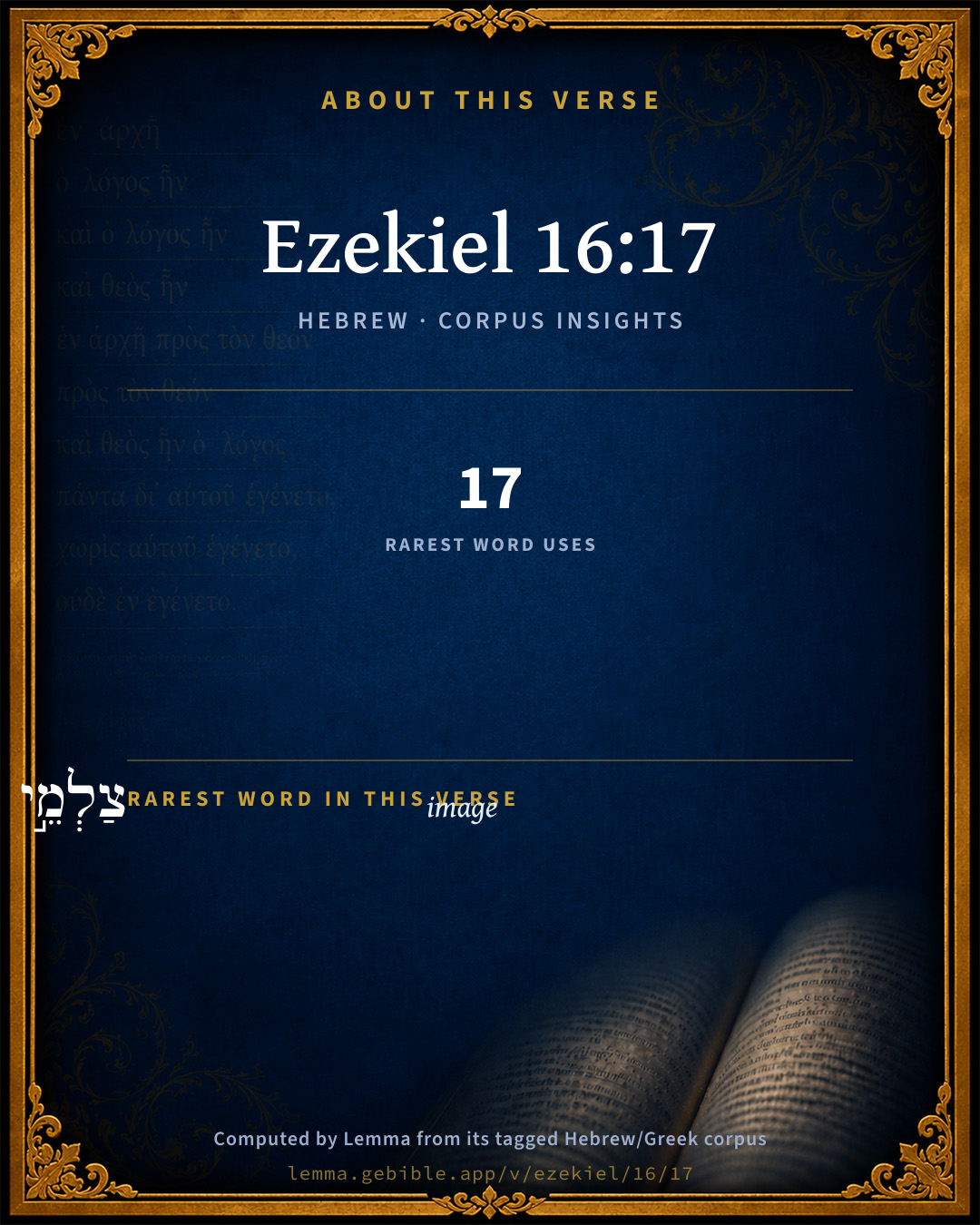
The rarest word here is צַלְמֵ֣י image H6754 — appearing just 17 times in the whole Hebrew Bible.

Shared distinctive vocabulary

צַלְמֵ֣י image H6754 occurs in 15 verses of the Hebrew Bible. Also found in:

Grammatical profile

  • 4 verbs
  • 5 nouns
  • 1 adjective
  • 3 prepositions
  • 1 particle

Verb forms

  • וַתִּקְחִ֞י Qal · Sequential Imperfect
  • נָתַ֣תִּי Qal · Perfect
  • וַתַּעֲשִׂי Qal · Sequential Imperfect
  • וַתִּזְנִי Qal · Sequential Imperfect

Hebrew & Septuagint length

In English translation the verse runs 31 words from the Hebrew and 32 from the Septuagint (LXX English) — closely comparable.

A rough comparison of the two English renderings, which tokenize alike — not a word-level alignment.

Word counts can differ between the Hebrew and the Greek without any difference in meaning — e.g. the Hebrew direct-object marker אֵת has no separate Greek word, and Greek often adds the article ὁ.

Cross-references

10

Topical passages linked to Ezekiel 16:17 in the Treasury of Scripture Knowledge — connected by theme and wording, ordered by reader-vote popularity; previews shown in the World English Bible.

  • Ezekiel 23:14–21 She increased her prostitution; for she saw men portrayed on the wall, the images of the Chaldeans portrayed with vermilion,
  • Exodus 32:1–4 When the people saw that Moses delayed to come down from the mountain, the people gathered themselves together to Aaron, and said to him, "Come, make us gods, which shall go before us; for as for this Moses, the man who brought us up out of the land of Egypt, we don't know what has become of him."
  • Isaiah 44:19–20 None calls to mind, neither is there knowledge nor understanding to say, I have burned part of it in the fire; yes, also I have baked bread on the coals of it; I have roasted flesh and eaten it: and shall I make the residue of it an abomination? shall I fall down to the stock of a tree?
  • Isaiah 57:7–8 On a high and lofty mountain have you set your bed; there also you went up to offer sacrifice.
  • Jeremiah 2:27–28 who tell a stock, You are my father; and to a stone, You have brought me forth: for they have turned their back to me, and not their face; but in the time of their trouble they will say, Arise, and save us.
  • Jeremiah 3:9 It happened through the lightness of her prostitution, that the land was polluted, and she committed adultery with stones and with stocks.
  • Ezekiel 7:19–20 They shall cast their silver in the streets, and their gold shall be as an unclean thing; their silver and their gold shall not be able to deliver them in the day of the wrath of Yahweh: they shall not satisfy their souls, neither fill their bowels; because it has been the stumbling block of their iniquity.
  • Ezekiel 16:11 I decked you with ornaments, and I put bracelets on your hands, and a chain on your neck.
  • Hosea 2:13 I will visit on her the days of the Baals, To which she burned incense, When she decked herself with her earrings and her jewels, And went after her lovers, And forgot me," says Yahweh.
  • Hosea 10:1 Israel is a luxuriant vine that puts forth his fruit. According to the abundance of his fruit he has multiplied his altars. As their land has prospered, they have adorned their sacred stones.

Cross-references courtesy of OpenBible.info (CC BY 4.0).

Hebrew and Greek witnesses Masoretic Hebrew ↔ Greek Septuagint

The same verse in the two great witnesses to the Old Testament, shown verse-for-verse.

These are two independent witnesses, not word-aligned to each other, and the Septuagint is shown in lemma (dictionary) form.

Hebrew Ezekiel 16:17 Masoretic · Westminster Leningrad Codex

וַתִּקְחִ֞י כְּלֵ֣י תִפְאַרְתֵּ֗ךְ מִזְּהָבִ֤י וּמִכַּסְפִּי֙ אֲשֶׁ֣ר נָתַ֣תִּי לָ֔ךְ וַתַּעֲשִׂי לָ֖ךְ צַלְמֵ֣י זָכָ֑ר וַתִּזְנִי בָֽם

You also took your beautiful jewels of my gold and of my silver, which I had given you, and made for yourself images of men, and played the prostitute with them;

World English Bible · Public Domain

Greek LXX Ezekiel 16:17 Septuagint · lemma form

καί λαμβάνω ὁ σκεῦος ὁ καύχησις σύ ἐκ ὁ χρυσίον ἐγώ καί ἐκ ὁ ἀργύριον ἐγώ ἐκ ὅς δίδωμι σύ καί ποιέω σεαυτοῦ εἰκών ἀρσενικός καί ἐκπορνεύω ἐν αὐτός

And you took your fair ornaments of my gold and of my silver, of what I gave you, and you made to yourself male images, and you did commit whoredom with them.

LXX2012 (modern English Septuagint) · Public Domain

Hebrew: Westminster Leningrad Codex (CC BY 4.0). Greek: Septuagint (public domain); English from LXX2012 (modern English Septuagint) (Public Domain). How the Septuagint differs from the Hebrew →

Targum (Aramaic paraphrase)

1

The Targum is the ancient Jewish Aramaic paraphrase of the Hebrew Scriptures — an interpretive translation, not the Hebrew text itself. Onkelos (literal) and Pseudo-Jonathan (expansive) render the Torah, and Jonathan the Prophets. Coverage is partial: where no permissively-licensed English translation exists for a verse, only the Aramaic is shown. This is verse-level text, not a word-by-word alignment to the Hebrew.

  1. Targum Jonathan Prophets (Joshua–Malachi)
    וּנְסֵיבְתְּ מָנַי תוּשְׁבַּחְתִּיךְ מִדַהֲבֵי וּמִכַּסְפִּי דִי יְהָבֵית לִיךְ וַעֲבֵידְתְּ לִיךְ צַלְמֵי דְכוּרָא וּטְעֵית בְּהוֹן:

    (no public-domain English translation for this verse)

    Targum Jonathan — Aramaic: “Mikraot Gedolot” (public domain). English: “Sefaria Community Translation” (CC0 1.0 (public-domain dedication)); “London "Chaldee Paraphrase," 1871” (public domain). Text via Sefaria.

Commentary

Notes on Ezekiel 16:17 from classic Christian and Jewish commentators (each source and its license shown beneath its notes). The classic Christian expositions comment on the surrounding passage and are grouped to its opening verse, so a note may address several verses; the Jewish commentaries on the Tanakh (Rashi and others) are per-verse, so they appear only where the commentator wrote on this verse.

Lemma curates 59 commentaries, every one of them public domain or Creative Commons licensed, each selected and text-cleaned for this edition rather than reprinted as found. About our sources →

Trapp's Complete Commentary

John Trapp

Eze 16:17 Thou hast also taken thy fair jewels of my gold and of my silver, which I had given thee, and madest to thyself images of men, and didst commit whoredom with them,

Ver. 17. Images of men.] To be thy gallants, with whom thou mightest adulterise and idolise. Vah scelus! Surely he is a rare man that hath not some or other idol whereon he bestows pains and cost, "Little children, keep yourselves from idols." {1Jn 5:21}

John Trapp, A Commentary or Exposition upon All the Books of the Old and New Testament (1647–1656) — public domain. Text from a community e-Sword module.

The Biblical Illustrator

Joseph S. Exell

Eze_16:17-22

Thou hast also taken thy fair Jewels of My gold.

The degrading nature of sin

Manton says, If you saw a man labouring in filthy ditches, and soiling himself as poor men do, would you believe that he was heir-apparent to a crown, called to inherit a kingdom? Who will believe in your heavenly calling when you stick in the mud of worldly pleasures, and are carried away with carking care for secular interests? Princes should behave as princes. Their haunts should be in palaces, and not amid dung heaps. How, then, is it that some who profess and call themselves Christians are found raking in questionable amusements to discover pleasure, and many others groping amid sordid avarice to find satisfaction in wealth? What are they at to be thus disgracing the blood royal? How dare they drag the name of the Blessed and only Potentate through the mire? A prince of the blood acting as a beggar would dishonour not only himself but all the royal house. Nobility has obligations. Grace, which is the eminent nobility of saints, lays them under heavy bonds to act as the true aristocracy of the universe. (C. H. Spurgeon.)

God ill requited for all His love

I remember William Huntingdon says in his autobiography that one of the sharpest sensations of pain that he felt after he had been quickened by Divine grace was this, He felt such pity for God. I do not know that I ever met with the expression elsewhere, but it is a very expressive one; although I might prefer to say sympathy with God, and grief that He should be so ill-treated. Many a man has been slandered and abused, but never was man abused as God has been. (C. H. Spurgeon.)

The Biblical Illustrator, edited by Joseph S. Exell (c. 1880s–1900s) — public domain. Text from a community e-Sword module.

Geneva Bible (1599)

Geneva Bible translators

Thou hast converted my vessels and instruments, which I gave thee to serve me with, to the use of thine idols.

Geneva Bible (1599) marginal notes — public domain. Text via Bolls.life.

Jamieson, Fausset & Brown

Robert Jamieson, A. R. Fausset & David Brown

my gold . . . my silver-- (Hag 2:8).

images of men--rather, "of the phallus," the Hindu lingam, or membrum virile [HAVERNICK], deified as the emblem of fecundity; man making his lust his god. English Version, however, is appropriate; Israel being represented as a woman playing the harlot with "male images," that is, images of male gods, as distinguished from female deities.

Jamieson, Fausset & Brown — Commentary Critical and Explanatory on the Whole Bible (1871) — public domain (CC PDM 1.0). Text via the HelloAO Bible API.

Adam Clarke's Commentary

Verse 17. And madest to thyself images of men] צלמי זכר tsalmey zachar, male images. Priapi are here meant, which were carried about in the ceremonies of Osiris, Bacchus, and Adonis; and were something like the lingam among the Hindoos. Herodotus, lib. ii, c. 48, 49, gives us an account of these male images: Πηχυαια αγαλματα νευροσπαστα, τα περιφορεουσι κατα κωμας ται γυναικες, νευον το αιδοιον, ου πολλῳ τεῳ ελασσον εον του αλλου σωματος. This was done at the worship of Bacchus in Egypt: and they who wish to see more may consult Herodotus as above. In this phallic worship the women were principally concerned.

Adam Clarke's Commentary on the Bible (1810–1826) — public domain. Text from a community e-Sword/MySword module.

John Calvin's Commentaries

The Prophet reproves them because they used silver and gold in making idols for themselves. He not only condemns idolatry, but ingratitude, since they turned to God’s dishonor the gifts which he had bestowed. First, the profanation of his gifts was base; besides this, they had rashly and purposely abused his liberality to his dishonor, and that was not to be endured. He reproves at the same time their blind intemperance, since they willingly gave themselves up to licentiousness, and buried themselves in their superstitions. But he does not say that they simply took gold and silver, but vessels of elegance or beauty of gold and silver. Whence it appears that they were blinded by furious lusts, as we have seen. He still pursues the simile of fornication, when he calls these manufactured deities images of males; and it seems obliquely to mark the excess of lust in having to do with shadows; by which he means that they were hurried away about nothing by their unbridled appetites, just as a woman feeds her passion by the mere picture of her paramour. It now follows —

John Calvin's Commentaries (1540-1563) — public domain. Text from the Calvin Translation Society English edition (1840s-50s) via the Christian Classics Ethereal Library (ccel.org). Calvin's coverage is partial (roughly two-thirds of the Bible); uncommented books and verses are honest gaps, never fabricated. The 19th-century editor's footnotes and remarks are omitted so the notes are faithfully Calvin's own voice.

The Cambridge Bible for Schools and Colleges

gen. ed. J. J. S. Perowne

17. Cf. Hos_2:8, I multiplied unto her silver and gold, which they used for Baal.

images of men] Jerusalem being an unfaithful wife the idols are “men.” The images were of gods; and this prophet probably saw little distinction between an image of Jehovah and that of any other deity. It is likely that, apart from the calf-images, the symbols of Jehovah as well as of the other gods were of the human form; cf. as to the Teraphim, 1Sa_19:13. The supposition hazarded by some that the “male images” (marg.) were representations of the Phallus has little to support it. It is true that Jerome considers the “gruesome object” set up by Maacah the mother of Asa to be simulacrum Priapi (2Ch_15:16, cf. 1Ki_15:13), but this is mere conjecture; and the passage Isa_57:8 is too obscure to be depended upon (cf. Prof. W. R. Smith, Rel. of Sem. p. 437).

broidered … coveredst them] Cf. Eze_16:10; Eze_16:13. The practice of clothing the idols is illustrated by Jer_10:9, “There is silver beaten into plates … blue and purple for their clothing; they are all the work of cunning men.”

hast set mine oil] didst set. The ref. is to the offerings made to the idols. The Lord calls it “mine” because due to him, or rather because given by him to Israel, Hos_2:8, “she did not know that I gave her corn and wine and oil … I will take back my corn in the time thereof.”

The Cambridge Bible for Schools and Colleges (gen. ed. J. J. S. Perowne; Cambridge University Press, 1878–1918) — public domain. Text from a community e-Sword module.

John Gill's Exposition

And tookest thy broidered garments, and coveredst them,.... The images of men, the idols they worshipped; see Jer 10:4; so the Papists at this day cover their idols, the images of the Virgin Mary, and other saints, with rich apparel, to draw the attention, admiration, and reverence of the people to them:

and thou hast set mine oil and mine incense before them; the oil which the Lord gave them for food, the land of Canaan being a land of oil olive; or which was to light the lamps in the temple with; or was used in sacrifice to the Lord, particularly in the meat offerings; and the incense, which was offered unto him on the altar of incense; these were set upon the altars of idols, and before them, the male images before mentioned; see Hos 2:8.

John Gill's Exposition of the Whole Bible (1746–1763) — public domain (CC PDM 1.0). Text via the HelloAO Bible API.

Albert Barnes' Notes on the Bible

Possibly an allusion to the custom of bearing about shrines. Compare Amo 5:26; Act 7:43.

Albert Barnes' Notes on the Bible (1834–1885) — public domain. Text from a community e-Sword/MySword module.

Haydock's Catholic Bible Commentary

My gold, for the temple, or thy most precious ornaments, which were sacrificed to gratify thy lubricity, (Calmet) or to form the golden calf, &c., Exodus xxxii. (Haydock) --- Obscene representations were also used in the worship of Osiris. (Herodotus ii. 48.)

George Leo Haydock (1774–1849), Haydock's Catholic Family Bible and Commentary, 1859 edition — public domain. Excludes Psalms (Douay-Rheims chapter numbering differs from Protestant) and Deuterocanonical books (Catholic canon only).

Matthew Poole's English Annotations

Thy fair jewels; she forgot the property was in God, she reckoned them her own. The word in Hebrew is of larger extent, and includes vessels, instruments, furniture of all sorts, with which, she was abundantly stored, even from their departure out of Egypt, when they spoiled the Egyptians, Exo 11:2, where the selfsame phrase is used, and more since Solomon made gold and silver so common in Jerusalem, with which they made vessels for use, and furniture of all sorts for ornament.

My gold: the greater was the sin of this harlot, her ingratitude, and her injustice, that she robbed God, committed sacrilege, that she might have idols with which to defile herself by her idolatry.

I had given thee: had she received them of any other hand, the wrong had been the less; but she received them, every one of them, of the hand of God: lie gave her what the Egyptians lent, what David won from enemies, and what Solomon brought in by traffic; so Ho 2 aggravates Israel’s idolatry.

Madest; brutish stupidity! to make an idol, and account it a god!

Images; statues, molten and graven images; not one single image, but many; so idolatry, as adultery, is boundless.

Of men: idolaters had male and female idols; and this idolatress here, as mostly they did, doted on male idols. It is not unlike to that Eze 8:14, which see. And possibly the Egyptian idolatry with Osiris or Adonis may be noted, or some more lewd image or portrait of Priapus, which might be confirmed from Eze 16:26; 23:19,20.

Didst commit whoredom with them; provoked by such representations to speculative uncleanness, and prepared for bodily uncleanness also, and proceeding to spiritual adultery with these shameful images.

Matthew Poole's English Annotations on the Holy Bible (1683–1685) — public domain. Text from a community e-Sword/MySword module.

Whedon's Commentary on the Bible

Daniel D. Whedon

17. Images of men — This does not refer to phallic worship (as Movers), but to images of Baalim (as Hos_2:8; Hos_2:13; compare 1Ki_15:13).

Daniel D. Whedon (gen. ed.), Commentary on the Old and New Testaments (1874–1909) — public domain. Text from a community e-Sword module.

The Pulpit Commentary

Images of men, etc.; Hebrew, as falling in with the symbolism of the history, "male images." The words point to the teraphim, the penates, or household gods, of which we read in Gen_31:19; Jud_1:18:14; 1Sa_19:13; Hos_3:4; and which, like the statues of Baal-peor, may have exhibited the phallic type of idolatry.

The Pulpit Commentary (1880–1919), ed. H.D.M. Spence-Jones & Joseph S. Exell — public domain. Text from a community e-Sword module.

John Wesley's Explanatory Notes

Images - Statues, molten and graven images. Commit whoredom - Idolatry, spiritual adultery. And possibly here is an allusion to the rites of Adonis, or the images of Priapus.

John Wesley, Explanatory Notes Upon the Whole Bible (1754–1765) — public domain. Text via the GEBible commentary corpus.

unfoldingWord translationNotes

Door43 World Missions Community

General Information:

Yahweh continues to speak about Jerusalem as if the city were his unfaithful wife. The city represents the people who live there. (See: Metaphor and Metonymy)

male figures

"statues of men" or "idols that look like men"

you did with them as a prostitute would do

Possible meanings are 1) this is a polite way to say the young woman was sleeping with the male figures. AT: "you slept with them" or 2) this is a metaphor in which Yahweh speaks of her worshiping the figures as if she were sleeping with them. AT: "you worshiped them" (See: Euphemism and Metaphor)

made with fine flour, oil, and honey

This can be stated in active form. AT: "bread that I made with fine flour, oil, and honey" (See: Active or Passive)

set before them

"placed as an offering in front of them"

translationWords

gold

silver

prostitute

oil

bread

honey

Lord Yahweh

declare

unfoldingWord translationNotes — © Distant Shores Media and the Door43 World Missions Community, licensed CC BY-SA 4.0. Source: git.door43.org/Door43/en_tn.

Rashi

Rabbi Shlomo Yitzchaki (Rashi)

male images Since he compares her to a female harlot, he compares the image to a male who fornicates with her.

Rashi on the Tanakh — English translations: “The Judaica Press complete Tanach with Rashi, translated by A. J. Rosenberg” (CC BY 4.0); “Pentateuch with Rashi's commentary by M. Rosenbaum and A.M. Silbermann, 1929-1934” (public domain); “The Metsudah Tanach series, Lakewood, N.J” (CC BY 4.0); and “The Book of Joshua, Metsudah Publications, 1997” (CC BY 4.0). Text via Sefaria.

Lesson kit

Teaching starters — assembled from the data on this page, not authored interpretation. Every prompt links to the verse data it draws on. Edit before teaching.

Ezekiel, in the Prophets, opens this verse with 14 words (11 distinct Hebrew lemmas). Its most distinctive word is tselem (“image”). A historical commentator’s framing appears above. Read the whole chapter for the surrounding context.

Discussion questions

  1. What does “image” (tselem) contribute to the verse as a whole?
  2. Genesis 1:26 shares the word «image» with this verse. How do the two illuminate each other?
  3. The translations on this page render this verse differently — a whole-verse word diff, not a word-by-word alignment. What might account for the different wordings?
  4. The verb «וַתִּקְחִ֞י» is Qal Sequential Imperfect. How does its form color the action?
  5. Reading how Trapp's Complete Commentary and The Biblical Illustrator read this verse, where do the two commentators agree and where do they part?

Things to notice

Reading settings

Reading text

Shown beneath each verse's original-language words.

Old Testament
Old Testament edition

Read the OT as the Masoretic Hebrew (MT) or the Greek Septuagint (LXX).

English shown for the Greek Septuagint (in the Hebrew ↔ Greek comparison).

Comparing translations? Open the Compare panel on any verse page to stack up to four side by side.