
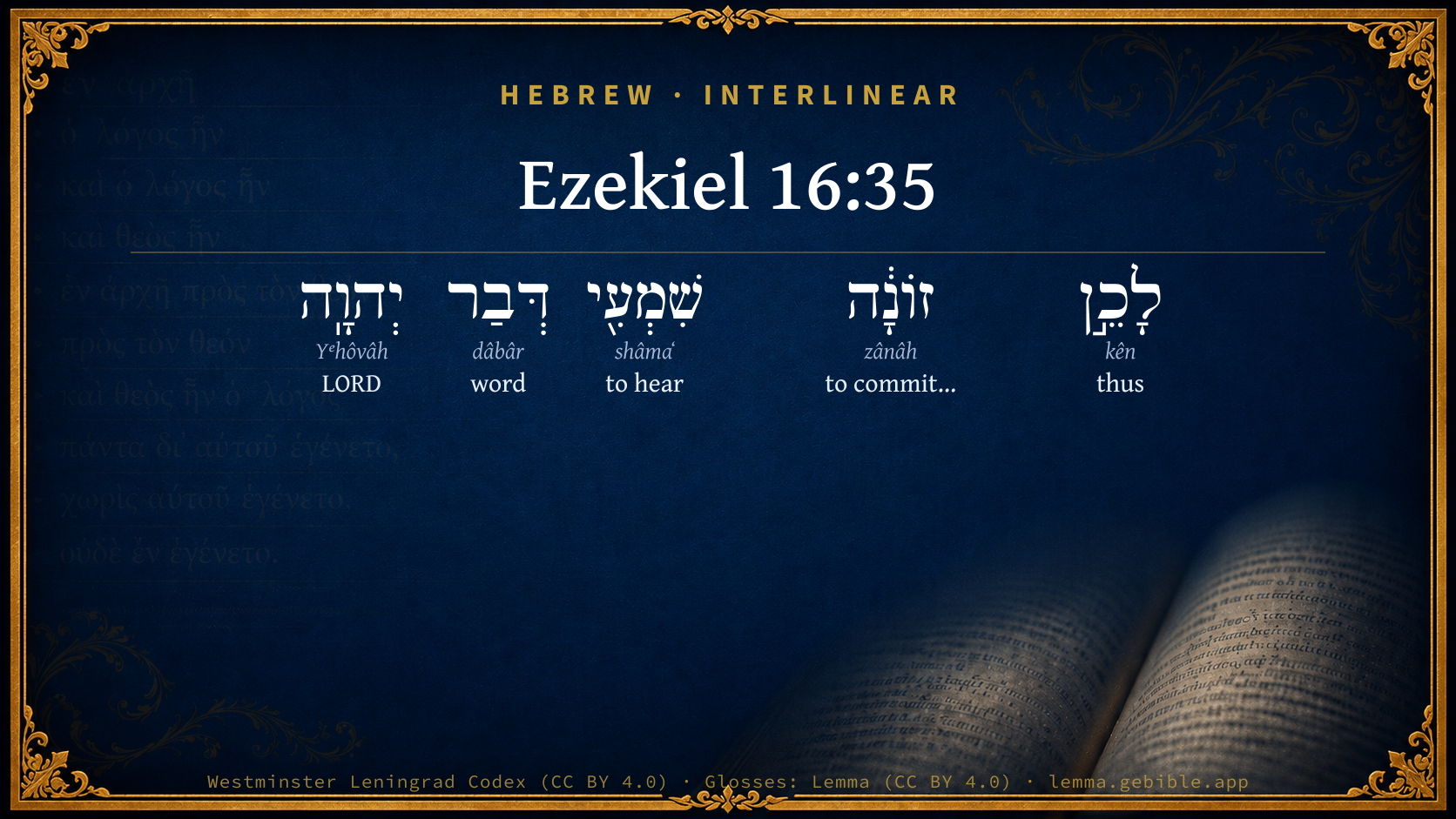
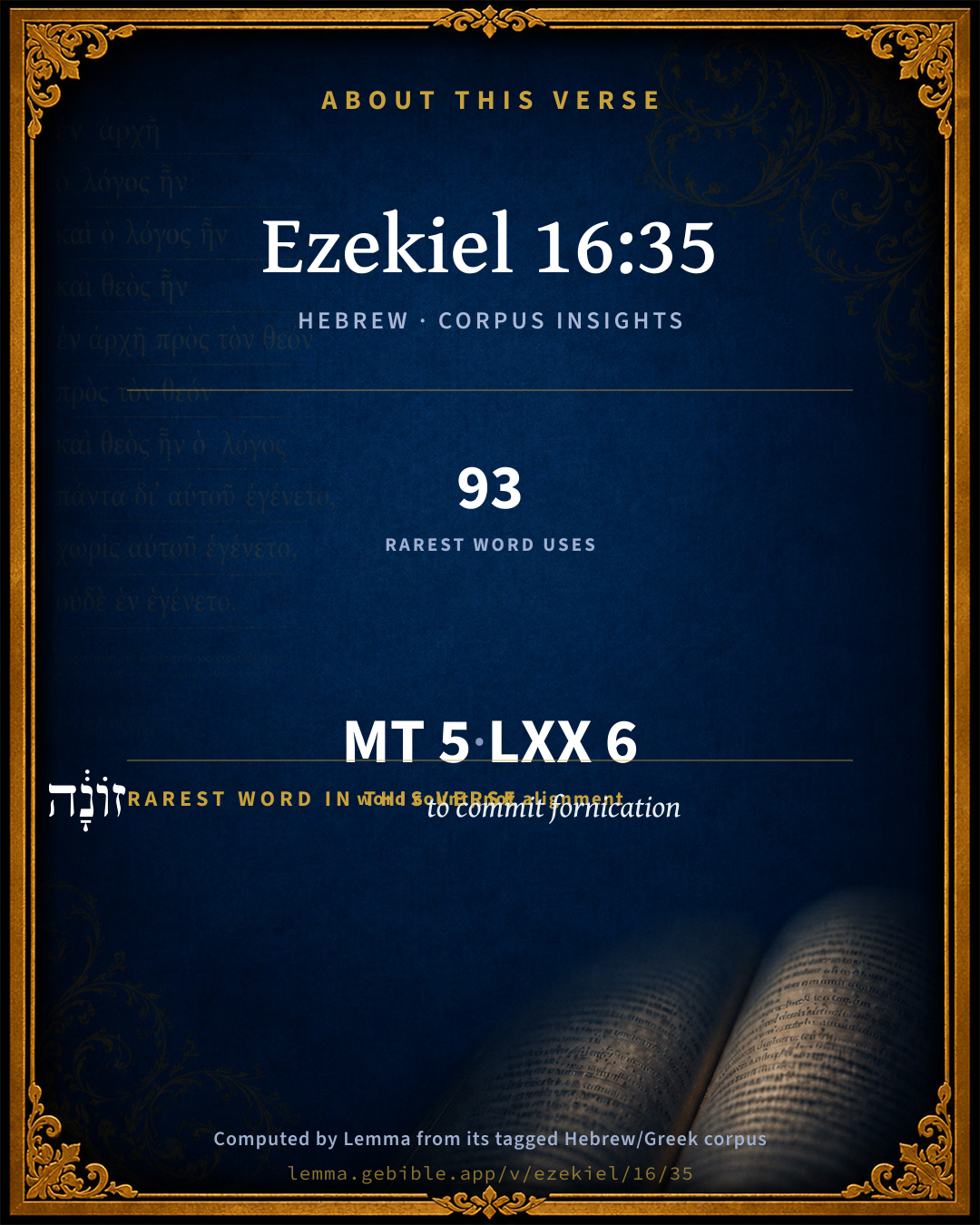
Ezekiel 16:35

Hebrew (Westminster Leningrad Codex) Ezekiel 16:35 appears in the Hebrew Old Testament. The text above is from the Westminster Leningrad Codex. Each word links to its Strong’s number, a concise gloss, and parsing drawn from the Open Scriptures Hebrew Bible morphology. Click any word for its full Brown-Driver-Briggs (BDB) entry.
Download image
Cite this verse

Ezekiel 16:35 (World English Bible). Public Domain. Lemma interlinear Bible study tool, https://lemma.gebible.app/v/ezekiel/16/35.

Show BibTeX & RIS
BibTeX
RIS
English Translation
Therefore, prostitute, hear the word of Yahweh:
World English Bible · Public Domain
Download a study sheet

One document with this verse’s original text, its word-by-word gloss line, the meaning frame, cross-references with their text, attributed commentary, and full source and license credits — printable, and it pastes into notes with its structure intact.

This verse Autodidact and up

Study sheet (.html) Plain text (.txt)

A passage Seminary Student

Up to 50 verses in one chapter. A passage sheet keeps up to 6 commentary sources and 12 cross-references per verse, in the order this page ranks them, and says so on the sheet whenever that leaves anything out. Ask for a single verse and you get the Autodidact verse sheet above.

Everything on this page stays free to read, with no account — the sheet is a download of what is already on screen, not access to it.

Want to remove ads? Support Godless Engineer
Compare translations 3

The same verse in 3 English versions, stacked beneath the original-language interlinear above. Click any original word for its lexicon entry.

Each is an independent rendering of the whole verse — the interlinear is not word-aligned to these translations.

Highlighted words mark where these versions differ — a whole-verse word diff, not a word-by-word alignment.

  • World English Bible Public Domain
    Therefore, prostitute, hear the word of Yahweh:
  • King James Version Public Domain
    Wherefore, O harlot, hear the word of the LORD:
  • unfoldingWord Literal Text CC BY-SA 4.0
    Therefore, you prostitute, listen to the word of Yahweh.

unfoldingWord Literal Text — © unfoldingWord, licensed CC BY-SA 4.0. Word-aligned USFM3 via Door43 (git.door43.org/unfoldingWord/en_ult).

Versions to compare (up to 4)

3 of 4 selected

Show all 18 translations

Every available English version of this verse, each an independent rendering of the whole verse.

  • World English Bible Public Domain
    Therefore, prostitute, hear the word of Yahweh:
  • Berean Standard Bible Public Domain
    Therefore, O prostitute, hear the word of the LORD!
  • Majority Standard Bible Public Domain
    Therefore, O prostitute, hear the word of the LORD!
  • King James Version Public Domain
    Wherefore, O harlot, hear the word of the LORD:
  • American Standard Version (1901) Public Domain
    Wherefore, O harlot, hear the word of Jehovah:
  • Revised Version (1885) Public Domain
    Wherefore, O harlot, hear the word of the LORD:
  • Geneva Bible (1599) Public Domain
    Wherefore, O harlot, heare the worde of the Lord.
  • Douay-Rheims (1899) Public Domain
    Therefore, O harlot, hear the word of the Lord.
  • Young's Literal Translation Public Domain
    Therefore, O whore, hear a word of Jehovah,
  • Literal Standard Version CC BY-SA 4.0
    Therefore, O whore, hear a word of YHWH!
  • Unlocked Literal Bible CC BY-SA 4.0
    Therefore, you prostitute, listen to the word of Yahweh.
  • unfoldingWord Literal Text CC BY-SA 4.0
    Therefore, you prostitute, listen to the word of Yahweh.
  • Darby Bible Public Domain
    Therefore, O harlot, hear the word of Jehovah.
  • World Messianic Bible Public Domain
    “Therefore, prostitute, hear the LORD’s word:
  • Webster's Bible Public Domain
    Wherefore, O harlot, hear the word of the LORD:
  • Free Bible Version CC BY-SA 4.0
    So, you prostitute, listen to the message from the Lord!
  • Bible in Basic English Public Domain
    For this cause, O loose woman, give ear to the voice of the Lord:
  • JPS Tanakh (1917) Public Domain
    Wherefore, O harlot, hear the word of the LORD!

Literal Standard Version (2020), Covenant Press — licensed CC BY-SA 4.0. Text via the HelloAO Bible API (eBible.org). Unlocked Literal Bible (unfoldingWord) — licensed CC BY-SA 4.0. Text via the HelloAO Bible API (eBible.org). unfoldingWord Literal Text — © unfoldingWord, licensed CC BY-SA 4.0. Word-aligned USFM3 via Door43 (git.door43.org/unfoldingWord/en_ult). Free Bible Version, Dr. Jonathan Gallagher — licensed CC BY-SA 4.0. Text via the HelloAO Bible API (eBible.org).

Word by word

More ways to search: Search by grammar → Find every occurrence → Compare this word →

Practice this passage: Drill this verse → Learn its vocabulary →

זוֹנָ֔ה
zânâh
H2181
“committing fornication”
Verb, Qal, Participle Active, Feminine, Singular, Absolute
Part of Speech
Verb
Stem
Qal
Form
Participle Active
Gender
Feminine
Number
Singular
State
Absolute
Full BDB Definition

Origin: a primitive root [highly-fed and therefore wanton]

TWOT: 563

to commit fornication, be a harlot, play the harlot - (Qal) - to be a harlot, act as a harlot, commit fornication - to commit adultery - to be a cult prostitute - to be unfaithful (to God) (figuratively) - (Pual) to play the harlot - (Hiphil) - to cause to commit adultery - to force into prostitution - to commit fornication
  1. לָכֵ֣ן kên H3651 “to/for · thus” Preposition + Adverb
  2. שִׁמְעִ֖י shâmaʻ H8085 “hear” Verb, Qal, Imperative, 2nd Person, Feminine, Singular
  3. דְּבַר dâbâr H1697 “word of” Noun, Common, Masculine, Singular, Construct
  4. יְהוָֽה Yᵉhôvâh H3068 “LORD” Noun, Proper

About this verse

These counts appear in no published source. They are computed here, from the morphology-tagged text and Lemma’s own curated glosses. What Lemma adds →

5
words
5
distinct lemmas
Prophets
section

Grammatical profile

  • 2 verbs
  • 2 nouns
  • 1 adverb

Verb forms

  • זוֹנָ֔ה Qal · Participle Active
  • שִׁמְעִ֖י Qal · Imperative

Hebrew & Septuagint length

In English translation the verse runs 7 words from the Hebrew and 8 from the Septuagint (LXX English) — closely comparable.

A rough comparison of the two English renderings, which tokenize alike — not a word-level alignment.

Word counts can differ between the Hebrew and the Greek without any difference in meaning — e.g. the Hebrew direct-object marker אֵת has no separate Greek word, and Greek often adds the article ὁ.

In the original languages it is 5 Hebrew tokens and 6 Greek tokens — but the two are counted differently (Hebrew bundles its prefixes and suffixes into one token; the Greek is in lemma form), so that isn’t a like-for-like length.

Cross-references

17

Topical passages linked to Ezekiel 16:35 in the Treasury of Scripture Knowledge — connected by theme and wording, ordered by reader-vote popularity; previews shown in the World English Bible.

  • 1 Kings 22:19 [Micaiah] said, Therefore hear you the word of Yahweh: I saw Yahweh sitting on his throne, and all the host of heaven standing by him on his right hand and on his left.
  • Isaiah 1:10 Hear the word of Yahweh, you rulers of Sodom! Listen to the law of our God, you people of Gomorrah!
  • Isaiah 1:21 How the faithful city has become a prostitute! She was full of justice; righteousness lodged in her, But now murderers.
  • Isaiah 23:15–16 It shall come to pass in that day, that Tyre shall be forgotten seventy years, according to the days of one king: after the end of seventy years it shall be to Tyre as in the song of the prostitute.
  • Isaiah 28:14 Why hear the word of Yahweh, you scoffers, that rule this people that is in Jerusalem:
  • Jeremiah 3:1 They say, If a man put away his wife, and she go from him, and become another man's, will he return to her again? Won't that land be greatly polluted? But you have played the prostitute with many lovers; yet return again to me, says Yahweh.
  • Jeremiah 3:6–8 Moreover Yahweh said to me in the days of Josiah the king, Have you seen that which backsliding Israel has done? she is gone up on every high mountain and under every green tree, and there has played the prostitute.
  • Ezekiel 13:2 Son of man, prophesy against the prophets of Israel who prophesy, and say you to those who prophesy out of their own heart, Hear you the word of Yahweh:
  • Ezekiel 20:47 and tell the forest of the South, Hear the word of Yahweh: Thus says the Lord Yahweh, Behold, I will kindle a fire in you, and it shall devour every green tree in you, and every dry tree: the flaming flame shall not be quenched, and all faces from the south to the north shall be burnt thereby.
  • Ezekiel 34:7 Therefore, you shepherds, hear the word of Yahweh:
  • Hosea 2:5 For their mother has played the prostitute. She who conceived them has done shamefully; For she said, 'I will go after my lovers, Who give me my bread and my water, My wool and my flax, My oil and my drink.'
  • Hosea 4:1 Hear the word of Yahweh, you children of Israel; For Yahweh has a charge against the inhabitants of the land: "Indeed there is no truth, Nor goodness, Nor knowledge of God in the land.
  • Amos 7:16 Now therefore listen to the word of Yahweh: 'You say, Don't prophesy against Israel, and don't preach against the house of Isaac.'
  • Nahum 3:4 because of the multitude of the prostitution of the alluring prostitute, the mistress of witchcraft, who sells nations through her prostitution, and families through her witchcraft.
  • John 4:10 Jesus answered her, "If you knew the gift of God, and who it is who says to you, 'Give me a drink,' you would have asked him, and he would have given you living water."
  • John 4:18 for you have had five husbands; and he whom you now have is not your husband. This you have said truly."
  • Revelation 17:5 And on her forehead a name was written, "MYSTERY, BABYLON THE GREAT, THE MOTHER OF THE PROSTITUTES AND OF THE ABOMINATIONS OF THE EARTH."

Cross-references courtesy of OpenBible.info (CC BY 4.0).

Hebrew and Greek witnesses Masoretic Hebrew ↔ Greek Septuagint

The same verse in the two great witnesses to the Old Testament, shown verse-for-verse.

These are two independent witnesses, not word-aligned to each other, and the Septuagint is shown in lemma (dictionary) form.

Hebrew Ezekiel 16:35 Masoretic · Westminster Leningrad Codex

לָכֵ֣ן זוֹנָ֔ה שִׁמְעִ֖י דְּבַר יְהוָֽה

Therefore, prostitute, hear the word of Yahweh:

World English Bible · Public Domain

Greek LXX Ezekiel 16:35 Septuagint · lemma form

διά οὗτος πόρνη ἀκούω λόγος κύριος

Therefore, harlot, hear the word of the Lord:

LXX2012 (modern English Septuagint) · Public Domain

On this verse, Keil & Delitzsch discusses the Septuagint’s reading. Read the note in Commentary ↓

Hebrew: Westminster Leningrad Codex (CC BY 4.0). Greek: Septuagint (public domain); English from LXX2012 (modern English Septuagint) (Public Domain). How the Septuagint differs from the Hebrew →

Targum (Aramaic paraphrase)

1

The Targum is the ancient Jewish Aramaic paraphrase of the Hebrew Scriptures — an interpretive translation, not the Hebrew text itself. Onkelos (literal) and Pseudo-Jonathan (expansive) render the Torah, and Jonathan the Prophets. Coverage is partial: where no permissively-licensed English translation exists for a verse, only the Aramaic is shown. This is verse-level text, not a word-by-word alignment to the Hebrew.

  1. Targum Jonathan Prophets (Joshua–Malachi)
    בְּכֵן דְעוֹבְדָהָא כְּנַפְקַת בָּרָא כְּנִשְׁתָּא דְיִשְׂרָאֵל קַבִּילוּ פִּתְגָמָא דַיָי:

    (no public-domain English translation for this verse)

    Targum Jonathan — Aramaic: “Mikraot Gedolot” (public domain). English: “Sefaria Community Translation” (CC0 1.0 (public-domain dedication)); “London "Chaldee Paraphrase," 1871” (public domain). Text via Sefaria.

Commentary

Notes on Ezekiel 16:35 from classic Christian and Jewish commentators (each source and its license shown beneath its notes). The classic Christian expositions comment on the surrounding passage and are grouped to its opening verse, so a note may address several verses; the Jewish commentaries on the Tanakh (Rashi and others) are per-verse, so they appear only where the commentator wrote on this verse.

Lemma curates 59 commentaries, every one of them public domain or Creative Commons licensed, each selected and text-cleaned for this edition rather than reprinted as found. About our sources →

Matthew Henry's Commentary

Adultery was by the law of Moses made a capital crime. This notorious adulteress, the criminal at the bar, being in the foregoing verses found guilty, here has sentence passed upon her. It is ushered in with solemnity, Eze 16:35. The prophet, as the judge, in God's name calls to her, O harlot! hear the word of the Lord. Our Saviour preached to harlots, for their conversion, to bring them into the kingdom of God, not as the prophet here, to expel them out of it. Note, An apostate church is a harlot. Jerusalem is so if she become idolatrous. How has the faithful city become a harlot! Rome is so represented in the Revelation, when it is marked for ruin, as Jerusalem here. Rev 17:1, Come, and I will show thee the judgments of the great whore. Those who will not hear the commanding word of the Lord and obey it shall be made to hear the condemning word of the Lord and shall tremble at it. Let us attend while judgment is given.

I. The crime is stated and the articles of the charge are summed up (Eze 16:36) and (as is usual) with the attendant aggravations (Eze 16:43); for when God speaks in wrath he will be justified, and clear when he judges, clear when he is judged; and sinners, when they are condemned, shall have their sins so set in order before them that their mouth shall be stopped and they shall not have a word to object against the equity of the sentence. The crimes which this harlot stands convicted of, and is now to be condemned for, are, 1. The violation of the first two commandments of the first table by idolatry, which is here called her whoredoms with her lovers (so she called them, Hos 2:12, because she loved them as if they had been indeed her benefactors), that is, with all the idols of her abominations, the abominable idols which she served and worshipped. This was the sin which provoked God to jealousy. 2. The violation of the first two commandments of the second table by the murder of their own innocent infants: The blood of thy children which thou didst give unto them. It is not strange if those that have cast off God and his fear break through the strongest and most sacred bonds of natural affection. Their sins are aggravated from the consideration, (1.) Of the dishonour they had thereby done to themselves: "Hereby thy filthiness was poured out; the uncleanness that was in thy heart was hereby discovered and brought to light, and thy nakedness was exposed to view, and thou wast thereby exposed to contempt." God is displeased with his professing people for shaming themselves by their sins. (2.) Their base ingratitude is another aggravation of their sins: "Thou hast not remembered the days of thy youth, and the kindness that was done thee then, when otherwise thou wouldst have perished," Eze 16:43. And, (3.) The vexation which their sins gave to God, whom they ought to have pleased: "Thou hast fretted me in all these things, not only angered me, but grieved me." It is a strange expression, and, one would think, enough to melt a heart of stone, that the great God, who cannot admit any uneasiness, is pleased to speak of the sins and follies of his professing people as fretting to him. Forty years long was I grieved with this generation.

II. The sentence is passed in general: I will judge thee as women that break wedlock and shed blood are judged (Eze 16:38), and those two crimes were punished with death, with an ignominious death. "Thou hast shed blood, and therefore I will give thee blood; thou hast broken wedlock, and therefore I will give it thee, not only in justice, but in jealousy, not only as a righteous Judge, but as an injured and incensed husband, who will not spare in the day of vengeance," Pro 6:34, Pro 6:35. He will recompense their way upon their head, Eze 16:43. In all the judgments God executes upon sinners we must see their own way recompensed upon their head; they are dealt with not only as they deserved, but as they procured. It is the end which their sin, as a way, had a direct tendency to. More particularly, 1. This criminal must be (as is usually done with criminals) exposed to public shame, Eze 16:37. Malefactors are not executed privately, but are made a spectacle to the world. Care is here taken to bring spectators together: "All those whom thou hast loved, with whom thou hast taken pleasure, shall come to be witnesses of the execution, that they may take warning and prevent their own like ruin; and those also whom thou hast hated, who will insult over thee and triumph in thy fall." Both ways the calamities of Jerusalem will be aggravated, that they will be the grief of her friends and the joy of her foes. These shall not only be gathered around her, but gathered against her; even those with whom she took unlawful pleasure, with whom she contracted unlawful leagues, the Egyptians and Assyrians, shall now contribute to her ruin. As, when a man's ways please the Lord, he makes even his enemies to be at peace with him, so when a man's ways displease the Lord he makes even his friends to be at war with him; and justly makes those a scourge and a plague to sinners, and instruments of their destruction, who were their tempters, and with whom they were partakers in wickedness. Those whom they have suffered to strip them of their virtue shall see them stripped, and perhaps help to strip them, of all their other ornaments; to see the nakedness of the land will they come. It is added, to the same purport (Eze 16:41), I will execute judgments upon thee in the sight of many women; thou shalt be made an example of in terrorem - that others may see and fear and do no more presumptuously. 2. The criminal is condemned to die, for her sins are such as death is the wages of (Eze 16:40): They shall bring up a company (that is, a company shall be brought up) against thee, and they shall stone thee with stones, and thrust thee through with their swords; so great a death, so many deaths in one, is this adulteress adjudged to. When the walls of Jerusalem were battered down with stones shot against them, and the inhabitants of Jerusalem were put to the sword, then this sentence was executed in the letter of it. 3. The estate of the criminal is confiscated, and all that belonged to her destroyed with her (Eze 16:39): They shall throw down thy eminent place, and (Eze 16:41) they shall burn thy houses, as the habitations of bad women are destroyed, in detestation of their lewdness. Their high places, erected in honour of their idols, by which they thought to ingratiate themselves with their neighbours, shall be an offence to them, and even they shall break them down. It was long the complaint, even in some of the best reigns of the kings of Judah, that the high places were not taken away; but now the army of the Chaldeans, when they lay all waste, shall break them down. If iniquity be not taken away by the justice of the nation, it shall be taken away by the judgments of God upon the nation. 4. Thus both the sin and the sinners shall be abolished together, and an end put to both: Thou shalt cease from playing the harlot; there shall be no remainders of idolatry in the land, because the inhabitants shall be wholly extirpated, and they shall give no more hire because they shall have no more to give. Some that will not leave their sins live till their sins leave them. When all that with which they honoured their idols is taken from them they shall not give hire any more (Eze 16:41): "Then thou shalt not commit this lewdness of sacrificing thy children, which was a crime provoking above all thy abominations, for thy children shall all be cut off by the sword or carried into captivity, so that thou shalt have none to sacrifice," Eze 16:43. Or it may be meant of the reformation of those of them that escape and survive the punishment; they shall take warning, and shall do no more presumptuously. The captivity in Babylon made the people of Israel to cease for ever from playing the harlot; it effectually cured them of their inclination to idolatry. And then all shall be well, when this is the fruit, even the taking away of sin; then (Eze 16:42) my jealousy shall depart. I will be quiet, and no more angry. When we begin to be at war with sin God will be at peace with us; for he continues the affliction no longer than till it has done its work. When sin departs God's jealousy will soon depart, for he is never jealous but when we give him just cause to be so. Yet some understand this as a threatening of utter ruin, that God will make a full end and the fire of his anger shall burn as long as there is any fuel for it. His fury shall rest upon them, and not remove. Compare this with that doom of unbelievers, Joh 3:36. The wrath of God abideth on them. They shall drink the dregs of the cup, and then God will be no more angry, for he is eased of his adversaries (Isa 1:24), is satisfied in the abandoning of them, and therefore will be no more angry, because there are no more for his anger to fasten upon. They had fretted him, when judgment and mercy were contesting; but now he is quiet, as he will be in the eternal damnation of sinners, wherein he will be glorified, and therefore he will be satisfied.

Matthew Henry's Commentary on the Whole Bible (1708–1710) — public domain (CC PDM 1.0). Text via the HelloAO Bible API.

Trapp's Complete Commentary

John Trapp

Eze 16:35 Wherefore, O harlot, hear the word of the LORD:

Ver. 35. Wherefore, O harlot.] A name good enough for such an odious housewife, the shame of her sex. He is not worthy of an honest name whose deeds are not honest.

Hear the word of the Lord.] Hear thy doom, thy sentence: stoned thou shalt be as an adulteress, slain with the sword as a murderess, burned with fire as an incendiary, because thou hast burned thy children in honour of Moloch. {a}

{a} απ εργων ου καλων ουκ εστιν επη καλα.

John Trapp, A Commentary or Exposition upon All the Books of the Old and New Testament (1647–1656) — public domain. Text from a community e-Sword module.

The Preacher's Complete Homiletical Commentary

Joseph S. Exell (gen. ed.)

ISRAEL’S PUNISHMENT WILL CORRESPOND WITH HER SINS. (Eze_16:35-42)

EXEGETICAL NOTES.—Eze_16:35-36. “Because thy filthiness was poured out.” Heb. “Because thy brass has been lavished.” Brass is used here to signify money. Israel had spent the wealth which God had given her in the servise of idolatry. “That the Jews, at least those in the exile, as well as classic antiquity, had copper money, follows even from our passage, and is confirmed by Mat_10:9, Mar_12:41, where brass occurs directly for money. The paramours are, according to what follows, pre-eminently the world-powers themselves. Along with them are named the heathen gods, whose worship was a consequence of political dependence.—(Hengstenberg.) “And by the blood of thy children which thou didst give unto them.” They were also guilty of murder in sacrificing their children to Moloch (Eze_16:20.)

Eze_16:37. “I will gather all thy lovers.” Chiefly those of Assyria and Babylon. “With all them that thou hast hated.” These were the surrounding nations who were always lying in wait for an occasion against Israel. God would gather friend and foe against Jerusalem and use them as instruments to execute His judgments. Israel is to be punished in kind. She had cultivated friendship with the heathen and partaken of their iniquities, and now she shall be given up altogether into their power. “I will even gather them round about against thee, and will discover thy nakedness unto them, that they may see all thy nakedness.” “The public judgment. First of all, the assembling of the lovers as witnesses. She who has dishonoured and brought herself to shame becomes now, by the interposition of God, to the one party an object of loathing, to the other an object of mockery. The last attraction, and what might still have been an object of regard, vanishes. Hävernick refers to the procedure in the case of a married woman suspected of adultery (Num_5:18).”—(Lange.)

Eze_16:38. “And I will judge thee, as women that break wedlock and shed blood are judged.” This is the explanation of the figurative language employed in the last verse. Israel was to be punished with the punishment of adulterers and murderers. “And I will give thee blood in fury and jealousy.” “Thou shalt be turned into blood, so that nothing but blood may be left of thee, and that the blood of fury and jealousy, as the working of the wrath and jealousy of God (compare Eze_16:42). To this end the heathen will destroy all the objects of idolatry, then take from the harlot both clothes and jewellery, and leave her naked, i.e. plunder Jerusalem and lay it waste, and, lastly, execute upon her the punishment of death by stoning and by sword; in other words, destroy both city and kingdom.”—(Keil.)

Eze_16:39. “And leave thee naked and bare.” “As thou wast before the Lord had mercy on thee (Eze_16:7). The unfaithful use of the gifts of God inevitably brings on their loss. God cannot be mocked.”—(Hengstenberg.)

Eze_16:40. “They shall also bring up a company against thee.” “This may be explained from the ancient mode of administering justice, according to which the popular assembly (Pro_5:14) sat in judgment on cases of adultery and capital crimes, and executed the sentence, as the law for stoning expressly enjoins (Lev_20:2; Num_15:36; Deu_22:21). But they are also applicable to the foes, who would march against Jerusalem” (Keil). “And they shall stone thee with stones.” The usual mode of capital punishment under the Mosaic law, and which was inflicted for the crimes of idolatry, adultery, and murder. This doom pronounced upon Jerusalem was accomplished literally, for she was “stoned” before she was burned (Jer_33:4). “With their swords.” Slaying with the sword was a mode of punishment adopted when there were many criminals to be put to death. It was also the doom of those who seduced men to apostacy (Deu_13:12-15).

Eze_16:41. “And execute judgments upon thee in the sight of many women.” “The many women are the many heathen nations, according to the description of Jerusalem or Israel as an unfaithful wife.”—(Keil.) “As it is the greatest punishment to an adulterous woman to be exposed in her sin before the eyes of other women; so will the severest portion of Israel’s punishment be, that it will stand exposed in its sin before the eyes of all other nations.”—(Klieforth.) Concerning the burning of the houses of Jerusalem with fire, see 2Ki_25:8-9. “And thou also shalt give no hire any more.” “Because thou wilt have no more lovers; wilt, on the whole, after the dissolution of thy national independence, be no more in a condition which admits of impure intercourse with the world-powers.”—(Hengstenberg.)

Eze_16:42. “So will I make my fury toward thee to rest, and my jealousy shall depart from thee.” “The jealousy ceases because it has found its satisfaction in their punishment, and exhausted itself therein, as the fire ceases when it has consumed its fuel.”—(Hengstenberg.) “The Divine justice comes to an end in its character of jealousy—in other words, as the injured faithfulness and love of Israel’s husband. The departing of the jealousy might, perhaps, by comparison with Isa_11:13, show grace in the background; but the connection with what follows requires rather a thought like Hos_2:4. Jehovah gives up the adulterous whorish wife.”—(Lange.)

HOMILETICS

THE PUNISHMENT OF APOSTACY

I. The loathsome nature of the sin is made manifest. The sin which the children of Israel had committed by their idolatry is called by its right name. It was the breaking of the sacred marriage-covenant into which God had entered with His people. All what whoredom and adultery is in the social state, all what filthiness is in the morals and manners of a people, such was their sin in the sight of God (Eze_16:38). Israel was guilty of unfaithfulness of the worst kind. God had given the nation the privileges of an espoused wife, but she sinned with many lovers, thus despising the great grace which had called her to such distinction and honour. God’s punishments sometimes begin by revealing our sin to us in all its real vileness. The very conviction of sin is a painful wound—the arrows of the Almighty within our spirit.

II. The very objects of sinful desire are turned into the instruments of punishment. “I will gather all thy lovers with whom thou hast taken pleasure, and all them that thou hast loved, with all them that thou hast hated; I will even gather them round about against thee, and will discover thy nakedness unto them, that they may see all thy nakedness” (Eze_16:37). Those who contributed to her sin shall be made the instruments of her punishment. Sinful love, sooner or later, changes into hate. The boon companions of the profligate turn out to be his bitterest enemies. They thus become a scourge in the hands of God to chastise him for his iniquity. There is no true honour amongst transgressors, for their life is founded upon a falsehood. And as God employed as a scourge for His people those who once were friends, He will also employ for chastisement those who were always enemies. “And with them that thou hast hated.” Those with whom the children of Israel sinned would make common cause with their enemies for their punishment.

III. The punishment will correspond with the sin.

1. In degree. They were to be punished as murderers and adulterers, for they had sinned “as women that break wedlock and shed blood” (Eze_16:38). Stoning was the punishment of adultery, and this threat was literally fulfilled upon Jerusalem, for she was stoned before she was burned (Jer_33:4). Their sin was great, and therefore their punishment, so great that even God’s fury is represented as being satisfied upon them, and quite brought to a pause (Eze_16:42). They could no further go in iniquity, and so God’s fury is represented as ceasing; by which we are to understand that it rested upon them. He left them to their fate. God can bring it about that we shall be able to sin no further.

2. In kind. Their sin was public, and so their shame and their judgment were public. Their sin was unfaithfulness towards God, and they are punished by the unfaithfulness of men. They cast God off, and men cast them off. That law which is true of individual man is true also of nations, that the very things which they sow they shall also reap.

(Eze_16:39-42)

1. God’s hatred is so great, against idolatry and idolators that He will not endure the places where they have used idolatrous worship. The places where they sinned must be destroyed, broken, utterly razed and ruined. Hezekiah is commended for four things; and the first is for removing the high places; then for breaking the images, cutting down the groves, and breaking the brazen serpent.

2. When we abuse the mercies of God, we give Him cause to take them away. They decked their high places with their garments (Eze_16:16); they made images of their jewels (Eze_16:17). Here God threatens to take away both the one and the other. He would give them into their hands who should rob them of their fair jewels, and strip them of all their clothes (Isa_42:22). “And leave thee naked and bare.” Before, in Eze_16:8, it is said, that God covered her nakedness. He found her naked, and now He would leave her naked and bare.

3. When God hath showed much kindness to a people, and they have been ungrateful, He will reduce them to their former condition. God did much for Ephraim, yet he was ungrateful, forgot God, went out to other lovers (Hos_2:2-3). God had spread His skirt over this Jewish woman, clothed her with embroidered silk and fine linen, decked her with choice ornaments and jewels, put His comeliness upon her; but she abused all His bounty and love, proved ungrateful and whorish, and therefore He would put her into her first condition, strip her of all, and leave her naked. She came out of captivity, she should now go into captivity; she was cast out, and now she should be cast out again; she was poor, beggarly, and had nothing, and should be made so again.

4. When judgments are executed upon a backsliding people, then God is at rest and is satisfied. When this woman, this Jewish state, fell into the hands of enemies, was plundered and spoiled, and all her glory laid in the dust; then God caused His fury to rest, His jealousy to depart, then He was quiet, and angry no more. Before judgment be thoroughly executed, God is troubled and restless; but when it is done, He is pacified, comforted, as it is in Eze_5:13. Before Jonah had judgment passed upon him, there was a great wind, and a mighty tempest in the sea. The Lord’s anger was let out. But when Jonah was sent, and cast into the sea—justice done—it is said the sea ceased from her raging. The Lord first ceased from His fury, He was pacified, and manifested it by stilling of the seas. God would bring the Assyrians upon the Jews; and what then? “The indignation shall cease, and mine anger in their destruction” (Isa_10:25).—(Greenhill.)

This dire judgment is just; for Israel has not only forgotten God’s undeserved favour to her in her election, but has even surpassed both Samaria and Sodom in her abominations.

The Preacher's Complete Homiletical Commentary (gen. ed. Joseph S. Exell; Funk & Wagnalls, c. 1892) — public domain (pre-1929). A full-Bible homiletical/sermon-outline anthology covering 65 of 66 books (2 John is absent from the source module). Text from a community e-Sword module.

Keil & Delitzsch

C. F. Keil & F. Delitzsch

As Israel has been worse than all the heathen, Jehovah will punish it notwithstanding its election, so that its shame shall be uncovered before all the nations (Eze 16:36-42), and the justice of the judgment to be inflicted upon it shall be made manifest (Eze 16:43-52). According to these points of view, the threat of punishment divides itself into two parts in the following manner: - In the first (Eze 16:35-42) we have, first of all (in Eze 16:36), a recapitulation of the guilty conduct described in vv. 16-34; and secondly, an announcement of the punishment corresponding to the guilt, as the punishment of adultery and murder (Eze 16:37 and Eze 16:48), and a picture of its infliction, as retribution for the enormities committed (Eze 16:39-42). In the second part (Eze 16:43-52) there follows a proof of the justice of this judgment.

Eze 16:35-42

The punishment will correspond to the sin. - Eze 16:35. Therefore, O harlot, hear the word of Jehovah! Eze 16:36. Thus saith the Lord Jehovah, Because thy brass has been lavished, and thy shame exposed in thy whoredom with thy lovers, and because of all the idols of thine abominations, and according to the blood of thy sons, which thou hast given them; Eze 16:37. Therefore, behold, I will gather together all thy lovers, whom thou hast pleased, and all whom thou hast loved, together with all whom thou hast hated, and will gather them against thee from round about, and will expose thy shame to them, that they may see all thy shame. Eze 16:38. I will judge thee according to the judgment of adulteresses and murderesses, and make thee into blood of wrath and jealousy. Eze 16:39. And I will give thee into their hand, that they may destroy thy arches, and pull down thy heights; that they may strip thy clothes off thee, and take thy splendid jewellery, and leave thee naked and bare. Eze 16:40. And they shall bring up a company against thee, and stone thee, and cut thee in pieces with their swords. Eze 16:41. And they shall burn thy houses with fire, and execute judgment upon thee before the eyes of many women. Thus do I put an end to thy whoredom.; and thou wilt also give payment no more. Eze 16:42. And I quiet my fury toward thee, and will turn away my jealousy from thee, that I may repose and vex myself no more. - In the brief summary of the guilt of the whore, the following objects are singled out, as those for which she is to be punished: (1) the pouring out of her brass and the exposure of her shame; (2) the idols of her abominations (with על before the noun, corresponding to יען before the infinitive); (3) the blood of her sons, with the preposition כּ, according to, to indicate the measure of her punishment. Two things are mentioned as constituting the first ground of punishment. The first is, "because thy brass has been poured out." Most of the commentators have explained this correctly, as referring to the fact that Israel had squandered the possessions received from the Lord, viz., gold, silver, jewellery, clothing, and food (Eze 16:10-13 and Eze 16:16-19), upon idolatry. The only difficulty connected with this is the use of the word nechōsheth, brass or copper, in the general sense of money or metal, as there are no other passages to support this use of the word. At the same time, the objection raised to this, namely, that nechōsheth cannot signify money, because the Hebrews had no copper coin, is an assertion without proof, since all that can be affirmed with certainty is, that the use of copper or brass as money is not mentioned anywhere in the Old Testament, with the exception of the passage before us. But we cannot infer with certainty from this that it was not then in use. As soon as the Hebrews began to stamp coins, bronze or copper coins were stamped as well as the silver shekels, and specimens of these are still in existence from the time of the Maccabees, with the inscription "Simon, prince of Israel" (cf. Cavedoni, Bibl. Numismatik, transl. by Werlhof, p. 20ff.). Judging from their size, these coins were in all probability worth a whole, a half, and a quarter gerah (Caved. pp. 50, 51). If, then, the silver shekel of the value of 21 grains contained twenty gerahs in Moses' time, and they had already silver pieces of the weight of a shekel and half shekel, whilst quarter shekels are also mentioned in the time of Samuel, there would certainly be metal coins in use of the value of a gerah for the purposes of trade and commerce, and these would in all probability be made of brass, copper, or bronze, as silver coins of the value of a penny would have been found too small. Consequently it cannot be positively denied that brass or copper may have been used as coin for the payment of a gerah, and therefore that the word nechōsheth may have been applied to money. We therefore adhere to the explanation that brass stands for money, which has been already adopted by the lxx and Jerome; and we do so all the more, because every attempt that has been made to fasten another meaning upon nechōsheth, whether by allegorical interpretation (Rabb.), or from the Arabic, or by altering the text, is not only arbitrary, but does not even yield a meaning that suits the context.

השׁפך, to be poured out = squandered or lavished. To the squandering of the possessions bestowed by the Lord upon His congregation, there was added the exposure of its shame, i.e., the disgraceful sacrifice of the honour and dignity of the people of God, of which Israel had made itself guilty by its whoredom with idols, i.e., by falling into idolatry, and adopting heathen ways. על־מאהביך, to (towards), i.e., with thy lovers (על standing for אל, according to later usage: vid., Ewald, 217i, p. 561), is to be explained after the analogy of זנה אל, as signifying to commit adultery towards a person, i.e., with him. But it was not enough to sacrifice the gifts of the Lord, i.e., His possessions and His glory, to the heathen and their idols; Israel also made for itself כּל־גּלּוּלי תּועבות, all kinds of logs of abominations, i.e., of idols, upon which it hung its ornaments, and before which it set oil and incense, meal and honey (Eze 16:18 and Eze 16:19). And it was not even satisfied with this, but gave to its idols the blood of its sons, by slaying its children to Moloch (Eze 16:20). Therefore (Eze 16:37.) the Lord will uncover the shame of His people before all the nations. He will gather them together, both friend and foe, against Jerusalem, and let them execute the judgment. The punishment will correspond to the sin. Because Israel has cultivated friendship with the heathen, it shall now be given up altogether into their power. On the uncovering of the nakedness as a punishment, compare Hos 2:12. The explanation of the figure follows in Eze 16:38. The heathen nations shall inflict upon Jerusalem the punishment due to adultery and bloodshed. Jerusalem (i.e., Israel) had committed this twofold crime. It had committed adultery, by falling away from Jehovah into idolatry; and bloodshed, by the sacrifices offered to Moloch. The punishment for adultery was death by stoning (see the comm. on Eze 16:40); and blood demanded blood (Gen 9:6; Exo 21:12). 'וּנתתּיך דּם וגו' does not mean, "I will put blood in thee" (Ros.), or "I will cause thy blood to be shed in anger" (De Wette, Maurer, etc.); but I make thee into blood; which we must not soften down, as Hitzig proposes, into cause thee to bleed. The thought is rather the following: thou shalt be turned into blood, so that nothing but blood may be left of thee, and that the blood of fury and jealousy, as the working of the wrath and jealousy of God (compare Eze 16:42). To this end the heathen will destroy all the objects of idolatry (גּב and רמות, Eze 16:39, as in Eze 16:24, Eze 16:25), then take from the harlot both clothes and jewellery, and leave her naked, i.e., plunder Jerusalem and lay it waste, and, lastly, execute upon her the punishment of death by stoning and by sword; in other words, destroy both city and kingdom. The words 'העלוּ , they bring (up) against thee an assembly, may be explained from the ancient mode of administering justice, according to which the popular assembly (qâhâl, cf. Pro 5:14) sat in judgment on cases of adultery and capital crimes, and executed the sentence, as the law for stoning expressly enjoins (Lev 20:2; Num 15:36; Deu 22:21; compare my Bibl. Archol. II. p. 257). But they are also applicable to the foes, who would march against Jerusalem (for qâhâl in this sense, compare Eze 17:17). The punishment of adultery (according to Lev 20:10) was death by stoning, as we may see from Lev 20:2-27 and Deu 22:24 compared with Joh 8:5. This was the usual mode of capital punishment under the Mosaic law, when judicial sentence of death was pronounced upon individuals (see my Archol. II. p. 264). The other form of punishment, slaying by the sword, was adopted when there were many criminals to be put to death, and was not decapitation, but cutting down or stabbing (bâthaq, to hew in pieces) with the sword (see my Archol. l.c.). The punishment of death was rendered more severe by the burning of the corpse (Lev 20:14; Lev 21:9). Consequently the burning of the houses in Eze 16:41 is also to be regarded as intensifying the punishment; and it is in the same light that the threat is to be regarded, that the judgment would be executed "before the eyes of many women." The many women are the many heathen nations, according to the description of Jerusalem or Israel as an unfaithful wife. "As it is the greatest punishment to an adulterous woman to be exposed in her sin before the eyes of other women; so will the severest portion of Israel's punishment be, that it will stand exposed in its sin before the eyes of all other nations" (Kliefoth). This is the way in which God will put an end to the fornication, and appease His wrath and jealousy upon the harlot (Eze 16:41 and Eze 16:42). השׁבּית, with מן, to cause a person to cease to be or do anything. For Eze 16:42, compare Eze 5:13. By the execution of the judgment the jealousy (קנאה) of the injured husband is appeased.

Eze 16:43-52

This judgment is perfectly just; for Israel has not only forgotten the grace of its God manifested towards it in its election, but has even surpassed both Samaria and Sodom in its abominations. - Eze 16:43. Because thou hast not remembered the days of thy youth, and hast raged against me in all this; behold, I also give thy way upon thy head, is the saying of the Lord Jehovah, that I may not do that which is wrong above all thine abominations. Eze 16:44. Behold, every one that useth proverbs will use this proverb concerning thee: as the mother, so the daughter. Eze 16:45. Thou art the daughter of thy mother, who casteth off her husband and her children; and thou art the sister of thy sisters, who cast off their husbands and their children. Your mother is a Hittite, and your father an Amorite. Eze 16:46. And thy great sister is Samaria with her daughters, who dwelleth at thy left; and thy sister, who is smaller than thou, who dwelleth at thy right, is Sodom with her daughters. Eze 16:47. But thou hast not walked in their ways and done according to their abominations a little only; thou didst act more corruptly than they in all thy ways. Eze 16:48. As I live, is the saying of the Lord Jehovah, Sodom thy sister, she with her daughters hath not done as thou hast done with thy daughters. Eze 16:49. Behold, this was the sin of Sodom, thy sister: pride, superabundance of food, and rest undisturbed had she with her daughters, and the hand of the poor and needy she did not hold. Eze 16:50. They were haughty, and did abominations before me; and I swept them away when I saw it. Eze 16:51. And Samaria, she hath not sinned to the half of thy sins; thou hast increased thine abominations more than they, and hast made thy sisters righteous by all thine abominations which thou hast done. Eze 16:52. Bear, then, also thy shame, which thou hast adjudged to thy sisters. Through thy sins, which thou hast committed more abominably than they, they become more righteous than thou. Be thou, then, also put to shame, and bear thy disgrace, as thou hast justified thy sisters. - יען אשׁר, which corresponds to יען in Eze 16:36, introduces a new train of thought. Most of the commentators take Eze 16:43 in connection with what precedes, and place the pause at Eze 16:44. But the perfect נתתּי shows that this is wrong. If Eze 16:43 simply contained a recapitulation, or a concluding summary, of the threat of judgment in Eze 16:35-42, the punishment would be announced in the future tense, as it is in Eze 16:37. By the perfect נתתּי, on the contrary, the punishment is exhibited as a completed fact, and further reasons are then assigned in vindication of the justice of the divine procedure, which we find in Eze 16:44. To this end the guilt of Jerusalem is mentioned once more: "thou didst not remember the days of thy youth," i.e., what thou didst experience in thy youth; the misery in which thou didst find thyself, and out of which I rescued thee and exalted thee to glory (Eze 16:4-14). To this there was added rage against Jehovah, which manifested itself in idolatrous acts. רגז , to be excited upon or against any person, to rage; thus in Hithpael with אל in Kg2 19:27-28. For נתן דּרך , compare Eze 9:10. The last clause of Eze 16:43, 'ולא עשׂיתי וגו, has been misinterpreted in many ways. According to the Masoretic pointing, עשׂיתי is the second person; but this does not yield a suitable meaning. For עשׂה זמּה is not used in the sense adopted by the Targum, upon which the Masoretic pointing is undoubtedly based, and which Raschi, Kimchi, and Rosenmller retain, viz., cogitationem facere: "thou hast not take any thought concerning all thy abominations," i.e., has not felt any remorse. The true meaning is to commit a crime, a wrong, and is used for the most part of unnatural offences (cf. Jdg 20:6; Hos 6:9). There is all the more reason for retaining this meaning, that זמּה (apart from the plural זמּוה = מזמּות) only occurs sensu malo, and for the most part in the sense of an immoral action (vid., Job 31:11). Consequently we should have to adopt the rendering: and thou no longer committest this immorality above all thine abominations. But in that case not only would עוד have to be supplied, but a distinction would be drawn between the abominations committed by Israel and the sin of lewdness, i.e., adultery, which is quite foreign to the connection and to the contents of the entire chapter; for, according to these, the abominations of Israel consisted in adultery or the sin of lewdness. We must therefore take עשׂיתי as the first person, as Symm. and Jerome have done, and explain the words from Lev 19:29, where the toleration by a father of the whoredom of a daughter is designated as zimmâh. If we adopt this interpretation, Jehovah says that He has punished the spiritual whoredom of Israel, in order that He may not add another act of wrong to the abominations of Israel by allowing such immorality to go on unpunished. If He did not punish, He would commit a zimmâh Himself, - in other words, would make Himself accessory to the sins of Israel.

The concluding characteristic of the moral degradation of Israel fits in very appropriately here in Eze 16:44., in which Jerusalem is compared to Samaria and Sodom, both of which had been punished long ago with destruction on account of their sins. This characteristic is expressed in the form of proverbial sayings. Every one who speaks in proverbs (mōsheel, as in Num 21:27) will then say over thee: as the mother, so her daughter. Her abominable life is so conspicuous, that it strikes every one, and furnishes occasion for proverbial sayings. אמּה may be a feminine form of אם, as לבּה is of לב (Eze 16:30); or it may also be a Raphe form for אמהּ: as her (the daughter's) mother, so her (the mother's) daughter (cf. Ewald, 174e, note, with 21, 223). The daughter is of course Jerusalem, as the representative of Israel. The mother is the Canaanitish race of Hittites and Amorites, whose immoral nature had been adopted by Israel (cf. Eze 16:3 and Eze 16:45). In Eze 16:45 the sisterly relation is added to the maternal, to carry out the thought still further. Some difficulty arises here from the statement, that the mothers and the sisters despise their husbands and their children, or put them away. For it is unquestionable that the participle גּעלת belongs to אמּך, and not to בּת, from the parallel relative clause אשׁר גּעלוּ, which applies to the sisters. The husband of the wife Jerusalem is Jehovah, as the matrimonial head of the covenant nation or congregation of Israel. The children of the wives, viz., the mother, her daughter, and her sisters, are the children offered in sacrifice to Moloch. The worship of Moloch was found among the early Canaanites, and is here attributed to Samaria and Sodom also, though we have no other proofs of its existence there than the references made to it in the Old Testament. The husband, whom the mother and sisters have put away, cannot therefore be any other than Jehovah; from which it is evident that Ezekiel regarded idolatry generally as apostasy from Jehovah, and Jehovah as the God not only of the Israelites, but of the heathen also.

(Note: Theodoret has explained it correctly in this way: "He shows by this, that He is not the God of Jews only, but of Gentiles also; for God once gave oracles to them, before they chose the abomination of idolatry. Therefore he says that they also put away both the husband and the children by denying God, and slaying the children to demons.")

אחותך (Eze 16:45) is a plural noun, as the relative clause which follows and Eze 16:46 clearly show, and therefore is a contracted form of אחותיך (Eze 16:51) or אחיותך (Eze 16:52; vid., Ewald, 212b, p. 538). Samaria and Sodom are called sisters of Jerusalem, not because both cities belonged to the same mother-land of Canaan, for the origin of the cities does not come into consideration here at all, and the cities represent the kingdoms, as the additional words "her daughters," that is to say, the cities of a land or kingdom dependent upon the capital, clearly prove. Samaria and Sodom, with the daughter cities belonging to them, are sisters of Jerusalem in a spiritual sense, as animated by the same spirit of idolatry. Samaria is called the great (greater) sister of Jerusalem, and Sodom the smaller sister. This is not equivalent to the older and the younger, for Samaria was not more deeply sunk in idolatry than Sodom, nor was her idolatry more ancient than that of Sodom (Theodoret and Grotius); and Hvernick's explanation, that "the finer form of idolatry, the mixture of the worship of Jehovah with that of nature, as represented by Samaria, was the first to find an entrance into Judah, and this was afterwards followed by the coarser abominations of heathenism," is unsatisfactory, for the simple reason that, according to the historical books of the Old Testament, the coarser forms of idolatry forced their way into Judah at quite as early a period as the more refined. The idolatry of the time of Rehoboam and Abijam was not merely a mixture of Jehovah-worship with the worship of nature, but the introduction of heathen idols into Judah, along with which there is no doubt that the syncretistic worship of the high places was also practised. גּדול and קטן do not generally mean old and young, but great and small. The transferred meaning old and young can only apply to men and animals, when greatness and littleness are really signs of a difference in age; but it is altogether inapplicable to kingdoms or cities, the size of which is by no means dependent upon their age. Consequently the expressions great and small simply refer to the extent of the kingdoms or states here named, and correspond to the description given of their situation: "at the left hand," i.e., to the north, and "at the right hand," i.e., to the south of Jerusalem and Judah.

Jerusalem had not only equalled these sisters in sins and abominations, but had acted more corruptly than they (Eze 16:47). The first hemistich of this verse, "thou walkest not in their ways," etc., is more precisely defined by ותּשׁחתי מהן in the second half. The link of connection between the two statements is formed by כּמעט קט yb d. This is generally rendered, "soon was there disgust," i.e., thou didst soon feel disgust at walking in their ways, and didst act still worse. But apart from the fact that while disgust at the way of the sisters might very well constitute a motive for forsaking those ways, i.e., relinquishing their abominations, it could not furnish a motive for surpassing those abominations. This explanation is exposed to the philological difficulty, that קט by itself cannot signify taeduit te, and the impersonal use of קוּט would at all events require לך, which could not be omitted, even if קט were intended for a substantive. These difficulties fall away if we interpret קט from the Arabic qaṭṭ omninô tantum, as Alb. Schultens has done, and connect the definition "a little only" with the preceding clause. We then obtain this very appropriate thought: thou didst walk in the ways of thy sisters; and that not a little only, but thou didst act still more corruptly than they. This is proved in Eze 16:48. by an enumeration of the sins of Sodom. They were pride, satiety, - i.e., superabundance of bread (vid., Pro 30:9), - and careless rest or security, which produce haughtiness and harshness, or uncharitableness, towards the poor and wretched. In this way Sodom and her daughters (Gomorrah, Admah, and Zeboim) became proud and haughty, and committed abominations לפני, i.e., before Jehovah (alluding to Gen 18:21); and God destroyed them when He saw this. The sins of Samaria (Eze 16:51) are not specially mentioned, because the principal sin of this kingdom, namely, image-worship, was well known. It is simply stated, therefore, that she did not sin half so much as Jerusalem; and in fact, if we except the times of Ahab and his dynasty, pure heathenish idolatry did not exist in the kingdom of the ten tribes, so that Samaria seemed really a righteous city in comparison with the idolatry of Jerusalem and Judah, more especially from the time of Ahaz onward (vid., Jer 3:11). The punishment of Samaria by the destruction of the kingdom of the ten tribes is also passed over as being well known to every Israelite; and in Eze 16:52 the application is directly made to Jerusalem, i.e., to Judah: "Thou also, bear thy shame, thou who hast adjudged to thy sisters," - sc. by pronouncing an uncharitable judgment upon them, thinking thyself better than they, whereas thou hast sinned more abominably, so that they appear more righteous than thou. צדק, to be righteous, and צדּק, to justify, are used in a comparative sense. In comparison with the abominations of Jerusalem, the sins of Sodom and Samaria appeared perfectly trivial. After וגם אתּ , the announcement of punishment is repeated for the sake of emphasis, and that in the form of a consequence resulting from the sentence with regard to the nature of the sin: therefore be thou also put to shame, and bear thy disgrace.

Keil & Delitzsch — Biblical Commentary on the Old Testament (1861–1891) — public domain (CC PDM 1.0). Text via the HelloAO Bible API. (Old Testament only.)

Tyndale Open Study Notes

Tyndale Open Resources

16:35-38 Since Jerusalem behaved like an adulteress, it was fitting that she should face an adulteress’s death sentence. God would strip her naked in a symbolic act of divorce, thus reversing the clothing metaphor of marriage (see 16:8; Hos 2:2-3). Then the people would stone her (Lev 20:10; Deut 22:22). Since this would cover her naked body with blood, she would leave the world just as she came into it. This metaphor was fulfilled when the Babylonians destroyed the city in 586 BC.

Tyndale Open Study Notes — © Tyndale Open Resources, licensed CC BY-SA 4.0. Text via the HelloAO Bible API.

Jamieson, Fausset & Brown

Robert Jamieson, A. R. Fausset & David Brown

Here begins the threat of wrath to be poured out on her.

Jamieson, Fausset & Brown — Commentary Critical and Explanatory on the Whole Bible (1871) — public domain (CC PDM 1.0). Text via the HelloAO Bible API.

John Calvin's Commentaries

After God has inveighed against the people’s sins, and treated the whole nation as guilty, he now pronounces judgment on their wickedness. He repeats shortly what he had said, as a judge explains the reason of his sentence. Since, says he, the lower parts of thy body and thy disgrace has been discovered before thy lovers. This is the reason of the judgment, whence it is collected that God is induced to treat his people harshly for just and necessary causes. It now follows: therefore, says he, I will assemble all thy lovers, with those also whom you hate, I will assemble them, and uncover thy shame before them. We may now see what the Jews are threatened with, namely, a disgraceful destruction, so that they become a common laughingstock without any one to succor them; for the diction is metaphorical when he speaks of lovers and of parts of the body; for by lovers he here means the Egyptians, Assyrians, and Chaldeeans. Whence their opinion is refuted who think that the Prophet treats only of superstitions. Nor can this language be transferred to idols, since we know that false gods were not spectators of the punishment which the Prophet denounces against the Jews. Whence it follows that this language will only suit those persons to whose protection the Jews trusted, so as to treat God’s help as useless. Since, then, such is the metaphorical sense of the passage, we understand that shame means spoliation and slaughter; nay, the destruction of both the kingdom and city, and even of the temple. Thus the nation was a common laughingstock, and in this way like a foul and aged harlot. Now we understand the Prophet’s intention. As to Jerome translating “wealth,” it is altogether adverse to the Prophet’s meaning; there is no doubt that he means the lower part of the body, and it follows in the same sense, thy shame was uncovered. But at the same time God expresses why it was done, namely, for fornication, as if an abandoned woman were to act so disgracefully. He now says it was done towards your lovers, towards the idols of your abominations: על, gnel, is here taken for towards or against. He distinguishes between lovers and idols. Those who think that the Prophet treats only of superstitious think the copula superfluous; but there is no doubt that the Prophet means, on one side, the Assyrians, and Egyptians, and Chaldeeans; and on the other, false gods.

And in bloods, says he. He here adds another crime, namely, that of barbarous cruelty, because they did not spare their own sons, as we saw before: many offered up their children, and some were found so excited as to cast them into the fire: it was indeed a monstrous crime when they hesitated not to rage against their own offspring: but they were so carried away by insane zeal that they burnt, up their children when others only drew them through the fire. Hence the Prophet again accuses them of cruelty for offering their children to idols, and so pouring forth innocent blood. Now follows the punishment. Behold, says he, I collect all thy lovers. We said that this ought to be understood of the Egyptians, Assyrians, and Chaldreans, all of whom looked upon the slaughter of that perverse and perfidious nation, but none of them helped her. God therefore pronounces the destruction of the people just like that of a harlot abandoned by her lovers, and perishing through hunger, want, and other miseries: for it very often happens that a person under the impulse of love prefers a harlot to his own life; for he will throw off all regard for his wife; he will be disrespectful to both his father and mother, and will break through every restraint to enjoy her company: but when such persons are grown old, and their hair becomes white, which represents the winter of life, and when wrinkles deform the face, then they are despised, and especially if they suffer through disease. So also the Prophet now says that the Jews would be despised by all, so that their lovers should be compelled to behold that example; and meanwhile they scarcely deign to look at the foul appearance which had formerly sweetly delighted them.

Then he proceeds further, namely, that their enemies should behold their ignominy: we know that the Jews were surrounded on all sides by enemies, and that all their neighbors were hostile to them. The Prophet now says that the nations disgrace should be exposed before their lovers, that is, the Egyptians, the Assyrians, Chaldaeans, Philistilles, Edomites, and other nations. This passage teaches us, that although the reason for God’s judgments does not always clearly appear, yet they are never too severe; and when he condescends to afford us a reason, he grants us a gratuitous indulgence. But when he silently executes his judgments, let us learn to acquiesce in his justice, and not to cry out if he exceeds moderation; because when he has once explained that his severity is only justice, hence we must gather the general rule, that whenever he seems to treat his people too severely and harshly, yet he has just reasons for it. Let us learn, also, that the Jews only suffered a just recompense when God so cursed all their counsels. They thought themselves very provident and circumspect when they engaged in alliances with Egyptians and Assyrians. But all their plans turned out unhappily for them, since they consulted their own will contrary to that of God. Let us learn, then, if we wish to promote our own salvation, and to obtain a prosperous result, to do nothing without God’s permission, and not to undertake any deliberations except those which God has dictated and suggested by his word and Spirit. For here every future event is shown to us as in a glass when we wish to be wiser than they ought, and than God permits them. It now follows —

John Calvin's Commentaries (1540-1563) — public domain. Text from the Calvin Translation Society English edition (1840s-50s) via the Christian Classics Ethereal Library (ccel.org). Calvin's coverage is partial (roughly two-thirds of the Bible); uncommented books and verses are honest gaps, never fabricated. The 19th-century editor's footnotes and remarks are omitted so the notes are faithfully Calvin's own voice.

The Cambridge Bible for Schools and Colleges

gen. ed. J. J. S. Perowne

35–43. Punishment of the adulterous wife, and child-murderer

This punishment is described in somewhat mixed figures: first, Eze_16:36-39, in a figure which tends to pass into a literal account of the destruction of Jerusalem; and secondly, Eze_16:40-43, in a figure suggested by the punishment of the ordinary adulteress.

The Cambridge Bible for Schools and Colleges (gen. ed. J. J. S. Perowne; Cambridge University Press, 1878–1918) — public domain. Text from a community e-Sword module.

John Gill's Exposition

Thus saith the Lord God, because thy filthiness was poured out,.... Or, "thy brass" (p). The word is used by the Rabbins (q) for the bottom of a thing; and is here accordingly, by Kimchi and Ben Melech, interpreted of a woman's lower part; the same with her nakedness next mentioned; and from whence, by reason of her inordinate lust, and the frequent exercise of it, and that with many different persons, a gonorrhoea, as Jarchi explains it, or a filthy flux flowed, and was poured out on her lovers; from whence the filthy disease, the "lues venerea":

and thy nakedness discovered through thy whoredoms with thy lovers; which she discovered or exposed to view herself, in order to entice her lovers to lie with her, and for the sake thereof; see Eze 16:25;

and with all the idols of thine abominations; or abominable idols, which were so in themselves, were abominable to God, and made the worshippers of them so likewise; these are distinguished from her lovers, the Egyptians and Assyrians, her confederates, and by means of whose alliance she fell into idolatry:

and by the blood of thy children, which thou didst give unto them; the idols, to whom they were dedicated and sacrificed; and for whose sake, and for the worship of them, they were caused to pass through the fire, and were burnt in it; and by such shocking murders, as well as idolatrous practices, the depravity of their nature, the wickedness of their hearts, their hypocrisy, treachery, and infidelity, were discovered and made known.

(p) , Sept. "aes tuum", Montanus, Vatablus, Calvin, Tigurine version, Starckius; "virus tuum", Junius & Tremellius, Polanus, Piscator, Grotius; "aerugo tua", Cocceius. (q) Misn. Celim, c. 8. sect. 3. Vid. T. Bab. Nidda, fol. 41. 2. & Gloss. in ib.

John Gill's Exposition of the Whole Bible (1746–1763) — public domain (CC PDM 1.0). Text via the HelloAO Bible API.

Albert Barnes' Notes on the Bible

Judah is now represented as undergoing the punishment adjudged to an adulteress and murderess. Only in her utter destruction shall the wrath of the Lord, the jealous God, cease.

Eze 16:36

Filthiness - Or, brass, i. e., money, is lavished. The Hebrews generally speak of money as gold Isa 46:6, but brass coins were not unknown in the time of the Maccabees. Compare Mat 10:9; Mar 12:41. Ezekiel may here have put brass for gold contemptuously. Compare Isa 1:22-25; Isa 48:10.

Eze 16:38

I will give thee blood in fury - Rather, “I will make thee a bloody sacrifice to fury and jealousy.” By the Law of Moses, death was the penalty for murder Exo 21:12, and for adultery (Lev 20:10; e. g., by stoning, Eze 16:40). The circumstances of the siege of Jerusalem corresponded with the punishment of the adulteress; the company gathered around her were the surrounding armies, the fury of the jealous husband was the fury of the attacking army, the stripping off her ornaments was the rapine of the siege, the stoning the battering-rams, the bloody death being the slaughter in the battle.

Eze 16:42

So ... rest - Or, “My fury shall not rest until thou art utterly ruined.”

Eze 16:43

Thou shalt not ... abominations - Others render it: “I will not do wickedly because of all thine etc.” i. e., by allowing jerusalem to remain unpunished

Albert Barnes' Notes on the Bible (1834–1885) — public domain. Text from a community e-Sword/MySword module.

Matthew Poole's English Annotations

Her indictment and notoriety of all the charge against her we have heard; her crimes she was guilty of, with the aggravations of them; now follows sentence of condemnation against her.

Hear the word of just condemnation which thou must submit to, though thou refusedst the word of counsel and precept.

Matthew Poole's English Annotations on the Holy Bible (1683–1685) — public domain. Text from a community e-Sword/MySword module.

The Pulpit Commentary

From the task of painting the guilt of Judah the prophet proceeds to that of denouncing its punishment.

Vers. 35-43. Judicial verdict.

It is a great kindness done by any one if he disclose to us the real nature of our sin. Light from any quarter should be welcomed. To demonstrate to the Hebrews that their idolatry was the worst form of adultery was an act of condescension on the part of God. By their own state law they knew that this sin incurred the penalty of death. With all the circumstance of judicial solemnity, the Supreme Judge summons the attention of the culprit: "O harlot, hear the word of the Lord!

I THE JUDICIAL SUMMING UP. The accusations against Israel were twofold.

1. Conjugal infidelity. The covenant made between Jehovah and Israel the covenant more sacred than between bridegroom and bride had been wantonly broken. Of this proof was furnished in abundance. It was openly displayed. Shameless publicity marked the dead.

2. Murder of children. The children created by God, and on whom he had set peculiar affection, were cruelly sacrificed unto the insatiable idols. It was murder of the worst sort murder of innocent and helpless victims. No language of man could exaggerate or over colour the crime.

II THE RIGHTEOUS SENTENCE. "I will judge thee, as women that break wedlock and that shed blood are judged.

1. The criminal is condemned to public shame. She had openly beasted of her sin; she shall be openly exposed. She shall be made a spectacle to the world. Care shall be taken to bring her companions and paramours to the sight. The most secret intrigue shall be set in the clear light of day. Friends and foes alike shall witness the disgrace.

2. Forfeiture of all possessions. "They shall take thy fair jewels." All the instruments of sin shall be sequestered. The illicit gains of iniquity soon turn to loss. "The wages of sin is death.

3. Summary death. "They shall stone thee with stones." This was the penalty assigned to adultery in the Jewish code. This was the penalty for an individual culprit. But for a community, the punishment ordained was the sword. Therefore it is added, "They shall thrust thee through with their swords." In God"s world neither adultery nor idolatry shall long be tolerated.

4. It was an equitable recompense. "I will recompense thy way upon thy head." The entire punishment proceeded in the most natural way; ay, it proceeded in the way of nature. No strange portent appeared in heaven or earth. To the carnal eye no hand nor sword of God was manifest; yet full execution of the sentence was done. As at the creation every plant had the latent power to propagate itself, equally every sin carries in itself suitable and adequate punishment. Death is only ripe sin.

5. It was a satisfaction to eternal righteousness. "I will be quiet, and will be no more angry." The righteousness of God is a force of tremendous energy, and can only be quieted by adequate repentance or adequate retribution. As the sea cannot be calm while a tempest of wind sweeps over its surface, no more can the justice of God be complacent while sin is rampant. But when sin is atoned for, there is profoundest peace an eternal calm. D.

Vers. 35-43. A picture of righteous retribution because of apostasy.

O harlot, hear the word of the Lord: Thus saith the Lord God; Because thy filthiness was poured out," etc. The scope and meaning of this paragraph is clearly and forcibly stated in the "Speaker"s Commentary:" "The punishment of Judah is represented by the same figure as her sin. She has been portrayed as an adulteress and a murderess. She is now represented as undergoing the punishment adjudged to an adulteress and murderess. The scene is a court of justice, before which the Lord himself appears to arraign the guilty woman. There are present those who are now her lovers, and those whom she has loved and deserted (the idolatrous nations with whom Judah has had guilty intercourse), to witness, to share, or to exult in, her disgrace. In proportion to her former honour shall be her present shame. As a woman suspected of infidelity to her husband had her head uncovered by way of disgrace, so this convicted adulteress shall be stripped bare, exposed to utter shame, shall be stoned and slain, and her house shall be made desolate. Only in her utter destruction shall the wrath of the Lord, the jealous God, cease." In our text

I THE SINS OF WHICH THE PEOPLE OF JERUSALEM WERE GUILTY ARE STATED. These have been set forth at length in the preceding paragraph, and we have considered them here. And, indeed, all the important points in the section now before us have come under our notice in earlier portions of the writings of Ezekiel, most of them more than once; a brief consideration of them will therefore be sufficient in this place. The sins of which the people are here convicted are these.

1. Sinful forgetfulness of their early history. "Thou hast not remembered the days of thy youth" (ver. 43; cf. ver. 22). They forgot the low estate in which the Lord found them in Egypt, and from which he had raised them into a condition of national life, prosperity, and power. This forgetfulness involved base ingratitude.

2. Shameful apostasy from God. "Thus saith the Lord God; Because thy filthiness was poured out, and thy nakedness discovered," etc. The "filthiness" of the Authorized Version should be "brass." The word is used either "for metals of all kinds, or goods and chattels generally, or money in particular It is put instead of the "whoredoms" of ver. 15, because, according to ver. 33, these were purchased by means of presents" (Schroder).

3. The idolatrous and cruel sacrifice of their own children. "The blood of thy children which thou didst give unto them" (ver. 36; cf. vers. 20, 21).

II THE SENTENCE ON ACCOUNT OF THESE SINS IS PRONOUNCED.

1. The end of their prosperity and the destruction of their city. "I will also give thee into their hand, and they shall throw down thine eminent place," etc. (vers. 39, 41). There is unmistakable reference here to the siege of Jerusalem, and to the destruction, loss, and misery connected therewith. The people had abused their prosperity to the dishonour of God, and he would completely strip them of prosperity, deprive them of power, and leave them naked and bare as they were when the Lord first interposed for them (ver. 7). "The unfaithful use of the gifts of God inevitably brings on their loss. God cannot be mocked.

2. Their violent death for their spiritual adultery and physical murder. "I will judge thee as women that break wedlock and shed blood are judged; and I will give thee blood in fury and jealousy They shall also bring up a company against thee," etc. (vers. 38, 40). According to the Law of Moses, adultery was to be punished with death by stoning (Deu_22:24; Joh_8:5) death was also the penalty of murder. (Exo_21:12) Such were the judgments of adulteresses and of murderers; and in the siege and capture of Jerusalem by Nebuchadnezzar such judgments were inflicted upon the guilty people of that city.

3. Their violent death in the presence of and inflicted by the nations with whom they had sinned. (Vers. 37, 41). The "many women" of ver. 41 are the neighbouring nations. These nations should behold the downfall and degradation, the shame and misery, of the apostate people; and the Chaldeans should be the instruments for accomplishing their overthrow, into whose hands they were given by the Lord. It is often so ordered, in the providence of God, that the companions of sinners in their sins become the weapons by which they am punished for those sins. "This is the curse of sin," says Schroder, "that those with whom we have sinned make common cause with our enemies for our punishment .... Friends may in certain circumstances be the most painful rods in God"s hand.

III THE RIGHTEOUSNESS OF THE SENTENCE IS INDICATED. "I will recompense thy way upon thine head, saith the Lord God" (ver. 43). The Revised Version is more correct: "I also will bring thy way upon thine head." Sinners "are dealt with not only as they deserved, but as they procured. It is the end which their sin, as a way, had a direct tendency to," which God will bring upon their head.

CONCLUSION. Our subject utters solemn warning against sin, especially on the part of those who have been much blessed by God; for the heinousness of sin is proportionate with the greatness of privilege, and the severity of punishment will correspond with the heinousness of sin. W.J.

The Pulpit Commentary (1880–1919), ed. H.D.M. Spence-Jones & Joseph S. Exell — public domain. Text from a community e-Sword module.

Kretzmann's Popular Commentary

Paul E. Kretzmann

The Punishment of the Lord Announced

v. 35. Wherefore, O harlot, hear the word of the Lord:

v. 36. Thus saith the Lord God, the sovereign Ruler of the universe, Because thy filthiness was poured out, literally, "thy brass was emptied out," figurative of a free abandonment to filthy lewdness in spiritual adultery, and thy nakedness discovered, that is, uncovered, made known, through thy whoredoms with thy lovers, the various heathen nations with which she had allied herself, and with all the idols of thy abominations, and by the blood of the children which thou didst give unto them, v. 20:

v. 37. behold, therefore I will gather all thy lovers with whom thou hast taken pleasure, the very ones whom she had sought with shameless overtures, and all them that thou hast loved, with all them that thou hast hated, who would, of course, also gloat over her downfall; I will even gather them round about against thee, as witnesses, and will discover thy nakedness unto them that they may see all thy nakedness. By the punishment of God, Israel became an object of loathing to its former allies and an object of mockery to its enemies.

v. 38. And I will judge thee as women that break wedlock, the sentence pronounced upon adulteresses being carried out in her case, Lev 20:10; Deu 22:22 and [as those who] shed blood are judged, the latter sin being charged against Israel on account of the sacrifices to Moloch; and I will give thee blood in fury and jealousy, to be dissolved into blood as a consequence of such fury and jealousy.

v. 39. And I will also give thee into their hand, so that the former witnesses would be executors of the Lord’s sentence, and they shall throw down thine eminent place and shall break down thy high places, the temples and tire objects of idolatry; they shall strip thee also of thy clothes and shall take thy fair jewels, the articles of splendor with which she bedecked herself, and leave thee naked and bare, deprived of the honor and dignity which belonged to the people of God by virtue of their election to this position.

v. 40. They shall also bring up a company against thee, both witnesses and executioners, and they shall stone thee with stones, in keeping with the picture of the execution of an adulteress, and thrust thee through with their swords.

v. 41. And they shall burn thine houses with fire and execute judgments upon thee in the sight of many women; and I will cause thee to cease from playing the harlot, and thou also shalt give no hire any more.

v. 42. So will I make My fury toward thee to rest, being satisfied with the punishment meted out, and My jealousy, the jealous rage of a wronged husband, shall depart from thee, and I will be quiet and will be no more angry. Since His justice had exacted the full penalty in keeping with the measure of her guilt, He would rest in anticipation of its beneficial effects.

v. 43. Because thou hast not remembered the days of thy youth, with the blessings which the Lord poured out upon her at that time, but hast fretted Me in all these things, raging against Jehovah with her idolatrous behavior, behold, therefore I also will recompense thy way upon thine head, so that His punishment would bear down upon her like a heavy load, saith the Lord God; and thou shalt not commit this lewdness above all thine abominations, literally, "lest I commit the misdeed above all thy abominations," that is, if the Lord should permit the wickedness of Israel to continue unpunished, He Himself would add an abominable deed, since, by a false leniency, He would become guilty of the same wickedness, become a partaker in the idolatry of Israel.

v. 44. Behold, every one that useth proverbs shall use this proverb against thee, rightly applying it to the children of Israel, saying, As is the mother, so is her daughter, Jerusalem being considered here as the daughter of ancient heathenish Canaan.

v. 45. Thou art the mother’s daughter, that loatheth her husband and her children, rejecting the knowledge of the true God, just as the nations of Canaan had done, although He had still been known in their midst, as the example of Melchizedek shows; and thou art the sister of thy sisters, akin in guilt to Samaria and Sodom, which loathed their husbands and their children. Your mother was an Hittite and your father an Amorite, and they had all inherited the spiritual make-up of these heathen nations, partly due to the fact that they did not exterminate the heathen as the Lord had bidden them do.

v. 46. And thine elder sister is Samaria, so called because she was in a moral respect more nearly related to Judah, she and her daughters that dwell at thy left hand, to the north; and thy younger sister, the smaller and in many respects not so nearly related to Judah, that dwelleth at thy right hand, toward the south, is Sodom and her daughters, that is, Ammon and Moab with their towns.

v. 47. Yet hast thou not walked after their ways nor done after their abominations, not even being satisfied with the deeds of wickedness for which these cities were known; but, as if that were a very little thing, as if their idolatrous conduct were not sufficiently wicked, thou wast corrupted more than they in all thy ways, exceeding even the heathen in the measure of idolatry and the evils connected with idolatrous worship.

v. 48. As I live, saith the Lord God, in the most solemn oath which He could swear, Sodom, thy sister, hath not done, she nor her daughters, any of the smaller cities belonging to her city-state, as thou hast done, thou and thy daughters, the guilt of the heathen cities being less great than that of Jerusalem.

v. 49. Behold, this was the iniquity of thy sister Sodom, in these forms of transgression she excelled: pride, Cf Gen 18:21, fullness of bread, that is, more than an abundance of material wealth, and abundance of idleness, a security far removed from all anxiety, was in her and in her daughters, the result being a haughty arrogance; neither did she strengthen the hand of the poor and needy, for that is the way of such as are puffed up with their prosperity.

v. 50. And they were haughty and committed abomination before Me, their transgression being so heinous as to call out to the Lord for punishment; therefore I took them away as I saw good, by the terrible catastrophe of the overthrow of their city. Yet Sodom was not as Wicked as Jerusalem had now become.

v. 51. Neither hath Samaria committed half of thy sins, it was, in fact, not particularly conspicuous in its heathenism after the time of Ahab; but thou hast multiplied thine abominations more than they and hast justified thy sisters in all thine abominations which thou hast done, making them actually appear righteous by comparison with her own wickedness.

v. 52. Thou also, which hast judged thy sisters, condemning them for their transgressions and, with hypocritical demeanor, considering herself better than they, bear thine own shame for thy sins that thou hast committed more abominable than they, being committed in spite of Jerusalem’s possession of the Law of God; they are more righteous than thou, namely, by way of comparison; yea, be thou confounded also and bear thy shame in that thou hast justified thy sisters, making them appear almost innocent in comparison with her own guilt. It is always a greater and deeper fall if people who have been in possession of the truth, who have enjoyed unusual advantages in the matter of God’s mercy, fall away from the path of righteousness than if those unacquainted with God’s holy will live in the sins which they have always followed, with little or no idea of the better way.

Paul E. Kretzmann, Popular Commentary of the Bible (1921–1924) — public domain. Text from a community e-Sword module.

unfoldingWord translationNotes

Door43 World Missions Community

General Information:

Yahweh continues to speak about Jerusalem as if the city were his unfaithful wife. The city represents the people who live there. (See: Metaphor and Metonymy)

you have poured out your lust

Yahweh speaks of Jerusalem's lust as if it were liquid and of committing actions repeatedly to gratify that lust as if it were pouring that liquid from a container. AT: "you repeatedly committed actions to gratify your lust" (See: Metaphor)

poured out your lust

Some modern versions translate "poured your wealth out."

you gave them your children's blood

This refers to killing children as a sacrifice to idols.

behold

The word "behold" here alerts us to pay attention to the surprising information that follows.

so they see all your nakedness

Stripping a person naked in front of others was an action intended to humiliate the person. The word "nakedness" can be translated as an adjective. AT: "so they can see you completely naked" (See: Assumed Knowledge and Implicit Information and Abstract Nouns)

translationWords

prostitute

word of God

Lord Yahweh

lust

false god

blood

children

love

unfoldingWord translationNotes — © Distant Shores Media and the Door43 World Missions Community, licensed CC BY-SA 4.0. Source: git.door43.org/Door43/en_tn.

Lesson kit

Teaching starters — assembled from the data on this page, not authored interpretation. Every prompt links to the verse data it draws on. Edit before teaching.

Ezekiel, in the Prophets, opens this verse with 5 words (5 distinct Hebrew lemmas). Its most distinctive word is zânâh (“to commit fornication”). A historical commentator’s framing appears above. Read the whole chapter for the surrounding context.

Discussion questions

  1. How does “to commit fornication” (zânâh) shape what this verse is saying?
  2. 1 Kings 22:19 shares this passage’s theme. How do the two illuminate each other?
  3. These translations render this verse differently. What is at stake in choosing one wording over another?
  4. The verb «זוֹנָ֔ה» is Qal Participle Active. How does its form color the action?
  5. Reading how Matthew Henry's Commentary and Trapp's Complete Commentary read this verse, where do the two commentators agree and where do they part?

Things to notice

Reading settings

Reading text

Shown beneath each verse's original-language words.

Old Testament
Old Testament edition

Read the OT as the Masoretic Hebrew (MT) or the Greek Septuagint (LXX).

English shown for the Greek Septuagint (in the Hebrew ↔ Greek comparison).

Comparing translations? Open the Compare panel on any verse page to stack up to four side by side.