
Judges 8:27

Hebrew (Westminster Leningrad Codex) Judges 8:27 appears in the Hebrew Old Testament. The text above is from the Westminster Leningrad Codex. Each word links to its Strong’s number, a concise gloss, and parsing drawn from the Open Scriptures Hebrew Bible morphology. Click any word for its full Brown-Driver-Briggs (BDB) entry.
Download image
Cite this verse

Judges 8:27 (World English Bible). Public Domain. Lemma interlinear Bible study tool, https://lemma.gebible.app/v/judges/8/27.

Show BibTeX & RIS
BibTeX
RIS
English Translation
Gideon made an ephod of it, and put it in his city, even in Ophrah: and all Israel played the prostitute after it there; and it became a snare to Gideon, and to his house.
World English Bible · Public Domain
Download a study sheet

One document with this verse’s original text, its word-by-word gloss line, the meaning frame, cross-references with their text, attributed commentary, and full source and license credits — printable, and it pastes into notes with its structure intact.

This verse Autodidact and up

Study sheet (.html) Plain text (.txt)

A passage Seminary Student

Up to 50 verses in one chapter. A passage sheet keeps up to 6 commentary sources and 12 cross-references per verse, in the order this page ranks them, and says so on the sheet whenever that leaves anything out. Ask for a single verse and you get the Autodidact verse sheet above.

Everything on this page stays free to read, with no account — the sheet is a download of what is already on screen, not access to it.

Want to remove ads? Support Godless Engineer
Compare translations 3

The same verse in 3 English versions, stacked beneath the original-language interlinear above. Click any original word for its lexicon entry.

Each is an independent rendering of the whole verse — the interlinear is not word-aligned to these translations.

Highlighted words mark where these versions differ — a whole-verse word diff, not a word-by-word alignment.

  • World English Bible Public Domain
    Gideon made an ephod of it, and put it in his city, even in Ophrah: and all Israel played the prostitute after it there; and it became a snare to Gideon, and to his house.
  • King James Version Public Domain
    And Gideon made an ephod thereof, and put it in his city, even in Ophrah: and all Israel went thither a whoring after it: which thing became a snare unto Gideon, and to his house.
  • unfoldingWord Literal Text CC BY-SA 4.0
    Then Gideon made it into an ephod and placed it in his city, in Ophrah, and all of Israel whored after it there. And it was for a snare to Gideon and to his house.

unfoldingWord Literal Text — © unfoldingWord, licensed CC BY-SA 4.0. Word-aligned USFM3 via Door43 (git.door43.org/unfoldingWord/en_ult).

Versions to compare (up to 4)

3 of 4 selected

Show all 18 translations

Every available English version of this verse, each an independent rendering of the whole verse.

  • World English Bible Public Domain
    Gideon made an ephod of it, and put it in his city, even in Ophrah: and all Israel played the prostitute after it there; and it became a snare to Gideon, and to his house.
  • Berean Standard Bible Public Domain
    From all this Gideon made an ephod, which he placed in Ophrah, his hometown. But soon all Israel prostituted themselves by worshiping it there, and it became a snare to Gideon and his household.
  • Majority Standard Bible Public Domain
    From all this Gideon made an ephod, which he placed in Ophrah, his hometown. But soon all Israel prostituted themselves by worshiping it there, and it became a snare to Gideon and his household.
  • King James Version Public Domain
    And Gideon made an ephod thereof, and put it in his city, even in Ophrah: and all Israel went thither a whoring after it: which thing became a snare unto Gideon, and to his house.
  • American Standard Version (1901) Public Domain
    And Gideon made an ephod thereof, and put it in his city, even in Ophrah: and all Israel played the harlot after it there; and it became a snare unto Gideon, and to his house.
  • Revised Version (1885) Public Domain
    And Gideon made an ephod thereof, and put it in his city, even in Ophrah: and all Israel went a whoring after it there: and it became a snare unto Gideon, and to his house.
  • Geneva Bible (1599) Public Domain
    And Gideon made an Ephod thereof, and put it in Ophrah his citie: and all Israel went a whoring there after it, which was the destruction of Gideon and his house.
  • Douay-Rheims (1899) Public Domain
    And Gedeon made an ephod thereof, and put it in his city Ephra. And all Israel committed fornication with it, and it became a ruin to Gedeon and to all his house.
  • Young's Literal Translation Public Domain
    and Gideon maketh it into an ephod, and setteth it up in his city, in Ophrah, and all Israel go a-whoring after it there, and it is to Gideon and to his house for a snare.
  • Literal Standard Version CC BY-SA 4.0
    and Gideon makes it into an ephod, and sets it up in his city, in Ophrah, and all Israel go whoring after it there, and it is for a snare to Gideon and to his house.
  • Unlocked Literal Bible CC BY-SA 4.0
    Gideon made an ephod out of the earrings and put it in his city, in Ophrah, and all Israel prostituted themselves by worshiping it there. It became a trap for Gideon and for those in his house.
  • unfoldingWord Literal Text CC BY-SA 4.0
    Then Gideon made it into an ephod and placed it in his city, in Ophrah, and all of Israel whored after it there. And it was for a snare to Gideon and to his house.
  • Darby Bible Public Domain
    And Gideon made an ephod of it and put it in his city, in Ophrah; and all Israel played the harlot after it there, and it became a snare to Gideon and to his family.
  • World Messianic Bible Public Domain
    Gideon made an ephod out of it, and put it in Ophrah, his city. Then all Israel played the prostitute with it there; and it became a snare to Gideon and to his house.
  • Webster's Bible Public Domain
    And Gideon made of it an ephod, and put it in his city, even in Ophrah: and all Israel went thither astray after it: which thing became a snare to Gideon, and to his house.
  • Free Bible Version CC BY-SA 4.0
    From the gold Gideon made an ephod, which he placed in his hometown of Ophrah. All Israel prostituted themselves there by worshiping it as an idol, and it became a trap to Gideon and his family.
  • Bible in Basic English Public Domain
    And Gideon made an ephod from them and put it up in his town Ophrah; and all Israel went after it there and were false to the Lord; and it became a cause of sin to Gideon and his house.
  • JPS Tanakh (1917) Public Domain
    And Gideon made an ephod thereof, and put it in his city, even in Ophrah; and all Israel went astray after it there; and it became a snare unto Gideon, and to his house.

Literal Standard Version (2020), Covenant Press — licensed CC BY-SA 4.0. Text via the HelloAO Bible API (eBible.org). Unlocked Literal Bible (unfoldingWord) — licensed CC BY-SA 4.0. Text via the HelloAO Bible API (eBible.org). unfoldingWord Literal Text — © unfoldingWord, licensed CC BY-SA 4.0. Word-aligned USFM3 via Door43 (git.door43.org/unfoldingWord/en_ult). Free Bible Version, Dr. Jonathan Gallagher — licensed CC BY-SA 4.0. Text via the HelloAO Bible API (eBible.org).

Word by word

More ways to search: Search by grammar → Find every occurrence → Compare this word →

Practice this passage: Drill this verse → Learn its vocabulary →

בְּעָפְרָ֔ה
ʻOphrâh
H6084
“in/at · Ophrah”
Preposition + Noun, Proper
Part of Speech
Preposition + Noun
Type
Proper
Full BDB Definition

Origin: fem. of H6082

TWOT: None

Ophrah = "fawn" - a Judaite, son of Meonothai (noun proper masculine) - a town of Benjamin approximately 5 miles (8 kilometers) east of Bethel (noun proper locative) - a place in Manasseh, native place of Gideon; probably located close to Shechem (noun proper locative)
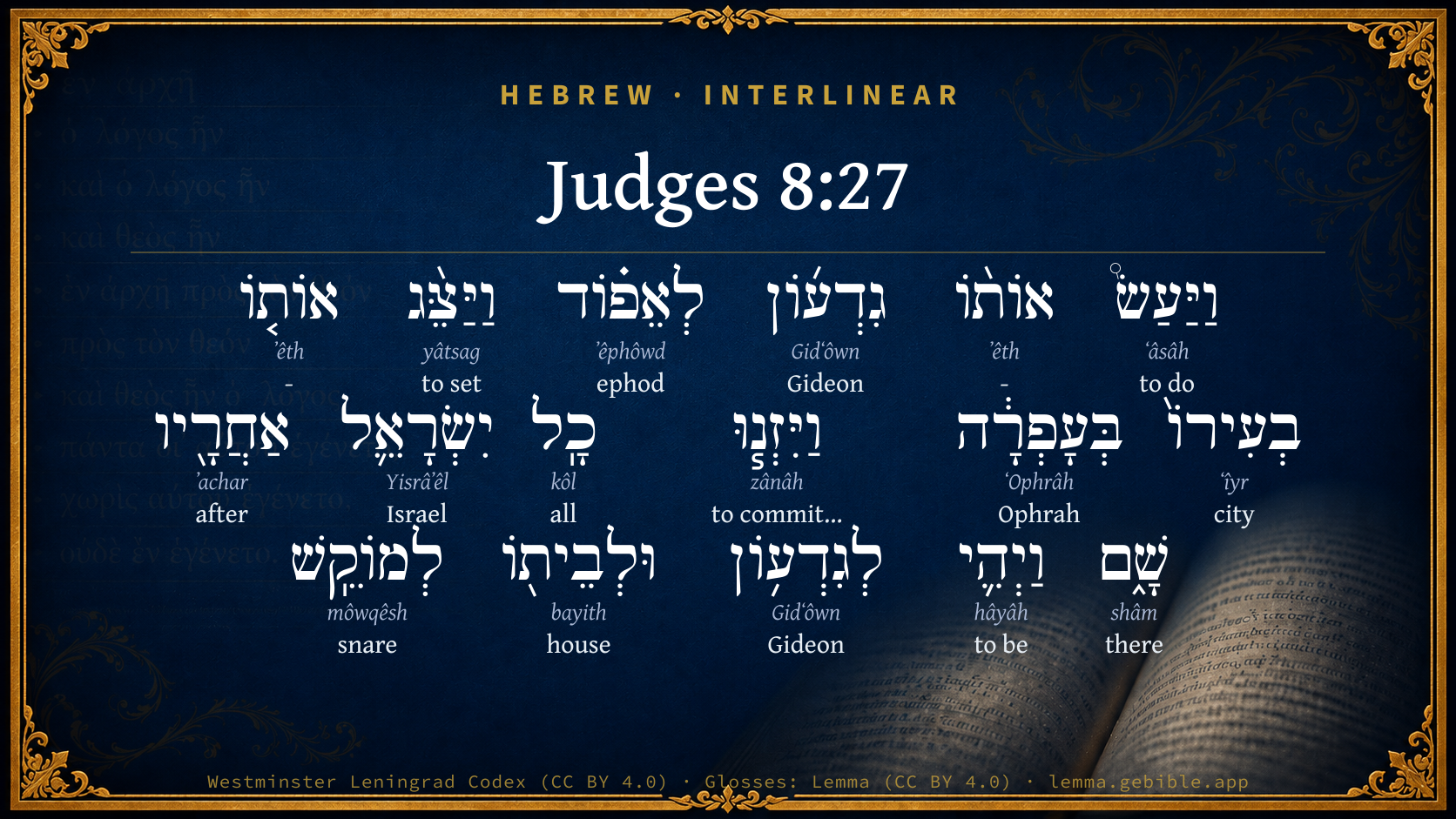
  1. וַיַּעַשׂ֩ ʻâsâh H6213 “and · to do” Conjunction + Verb, Qal, Sequential Imperfect, 3rd Person, Masculine, Singular
  2. אוֹת֨וֹ ʼêth H853 “- · him” Particle, Direct Object + Suffix, Personal, 3rd Person, Masculine, Singular
  3. גִדְע֜וֹן Gidʻôwn H1439 “Gideon” Noun, Proper
  4. לְאֵפ֗וֹד ʼêphôwd H646 “to/for · ephod” Preposition + Noun, Common, Masculine, Singular, Absolute
  5. וַיַּצֵּ֨ג yâtsag H3322 “and · to set” Conjunction + Verb, Hiphil, Sequential Imperfect, 3rd Person, Masculine, Singular
  6. אוֹת֤וֹ ʼêth H853 “- · him” Particle, Direct Object + Suffix, Personal, 3rd Person, Masculine, Singular
  7. בְעִירוֹ֙ ʻîyr H5892 “in/at · city · his” Preposition + Noun, Common, Feminine, Singular, Construct + Suffix, Personal, 3rd Person, Masculine, Singular
  8. וַיִּזְנ֧וּ zânâh H2181 “and · to commit fornication” Conjunction + Verb, Qal, Sequential Imperfect, 3rd Person, Masculine, Plural
  9. כָֽל kôl H3605 “all of” Noun, Common, Masculine, Singular, Construct
  10. יִשְׂרָאֵ֛ל Yisrâʼêl H3478 “Israel” Noun, Proper
  11. אַחֲרָ֖יו ʼachar H310 “after · him” Preposition + Suffix, Personal, 3rd Person, Masculine, Singular
  12. שָׁ֑ם shâm H8033 “there” Adverb
  13. וַיְהִ֛י hâyâh H1961 “and · to be” Conjunction + Verb, Qal, Sequential Imperfect, 3rd Person, Masculine, Singular
  14. לְגִדְע֥וֹן Gidʻôwn H1439 “to/for · Gideon” Preposition + Noun, Proper
  15. וּלְבֵית֖וֹ bayith H1004 “and · to/for · house · his” Conjunction + Preposition + Noun, Common, Masculine, Singular, Construct + Suffix, Personal, 3rd Person, Masculine, Singular
  16. לְמוֹקֵֽשׁ môwqêsh H4170 “to/for · snare” Preposition + Noun, Common, Masculine, Singular, Absolute

About this verse

These counts appear in no published source. They are computed here, from the morphology-tagged text and Lemma’s own curated glosses. What Lemma adds →

17
words
15
distinct lemmas
Historical
section

Notable vocabulary

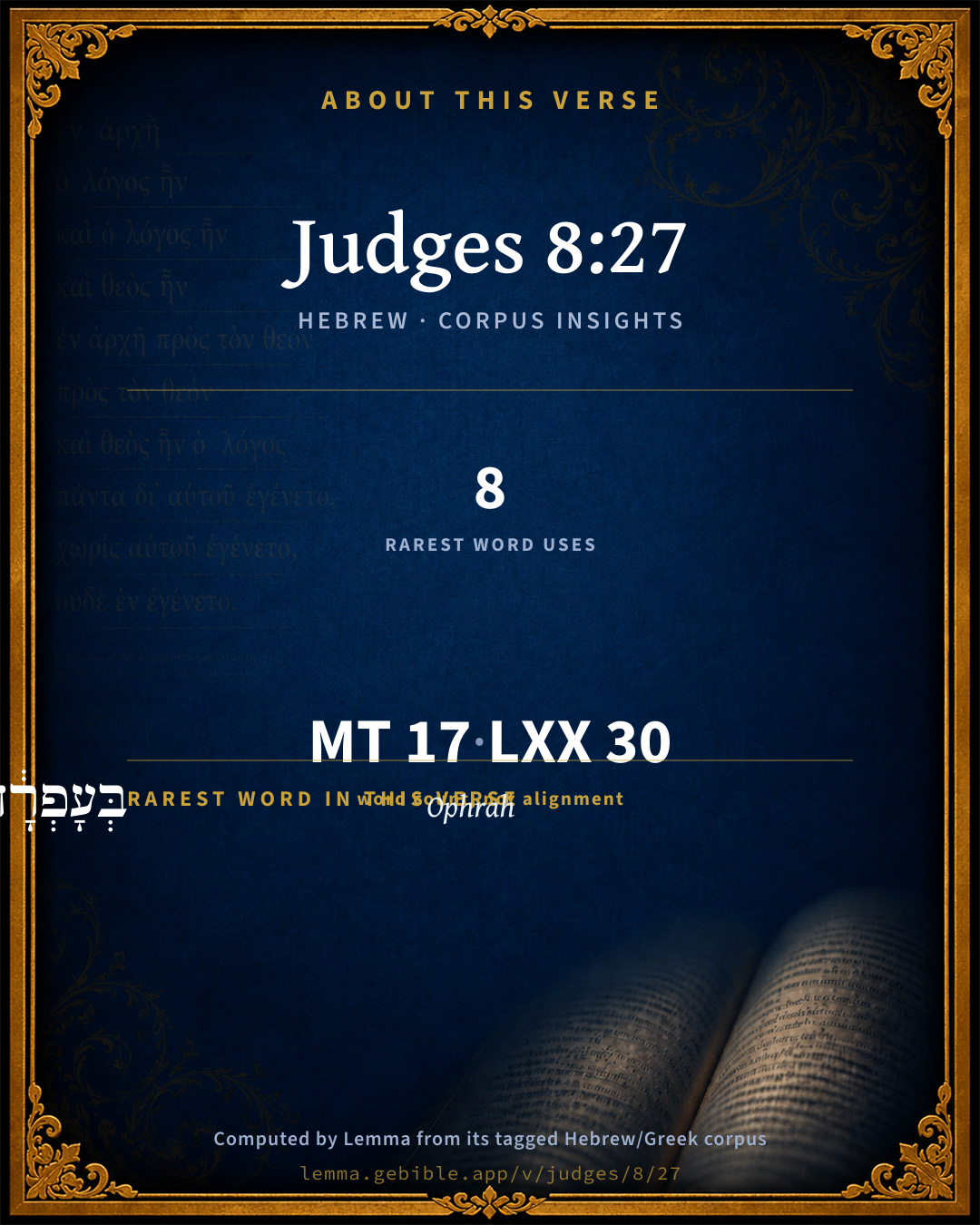
The rarest word here is בְּעָפְרָ֔ה Ophrah H6084 — appearing just 8 times in the whole Hebrew Bible.

Shared distinctive vocabulary

בְּעָפְרָ֔ה Ophrah H6084 occurs in 8 verses of the Hebrew Bible. Also found in:

Grammatical profile

  • 4 verbs
  • 9 nouns
  • 1 preposition
  • 1 adverb
  • 2 particles

Verb forms

  • וַיַּעַשׂ֩ Qal · Sequential Imperfect
  • וַיַּצֵּ֨ג Hiphil · Sequential Imperfect
  • וַיִּזְנ֧וּ Qal · Sequential Imperfect
  • וַיְהִ֛י Qal · Sequential Imperfect

Repetition

A word recurs within this verse — often emphatic in Hebrew:

  • גִדְע֜וֹן Gideon H1439 ×2

Hebrew & Septuagint length

In English translation the verse runs 35 words from the Hebrew and 35 from the Septuagint (LXX English) — the same length.

A rough comparison of the two English renderings, which tokenize alike — not a word-level alignment.

Word counts can differ between the Hebrew and the Greek without any difference in meaning — e.g. the Hebrew direct-object marker אֵת has no separate Greek word, and Greek often adds the article ὁ.

In the original languages it is 17 Hebrew tokens and 30 Greek tokens — but the two are counted differently (Hebrew bundles its prefixes and suffixes into one token; the Greek is in lemma form), so that isn’t a like-for-like length.

Cross-references

16

Topical passages linked to Judges 8:27 in the Treasury of Scripture Knowledge — connected by theme and wording, ordered by reader-vote popularity; previews shown in the World English Bible.

  • Psalms 106:39 Thus were they defiled with their works, And prostituted themselves in their deeds.
  • Deuteronomy 7:16 You shall consume all the peoples who Yahweh your God shall deliver to you; your eye shall not pity them: neither shall you serve their gods; for that will be a snare to you.
  • Judges 17:5 The man Micah had a house of gods, and he made an ephod, and teraphim, and consecrated one of his sons, who became his priest.
  • Judges 18:14 Then the five men who went to spy out the country of Laish answered, and said to their brothers, Do you know that there is in these houses an ephod, and teraphim, and an engraved image, and a molten image? now therefore consider what you have to do.
  • Judges 18:17 The five men who went to spy out the land went up, and came in there, and took the engraved image, and the ephod, and the teraphim, and the molten image: and the priest stood by the entrance of the gate with the six hundred men girt with weapons of war.
  • Exodus 23:33 They shall not dwell in your land, lest they make you sin against me, for if you serve their gods, it will surely be a snare to you."
  • Judges 6:24 Then Gideon built an altar there to Yahweh, and called it Yahweh-shalom: to this day it is yet in Ophrah of the Abiezrites.
  • Exodus 28:6–35 "They shall make the ephod of gold, of blue, and purple, scarlet, and fine twined linen, the work of the skillful workman.
  • Deuteronomy 12:5 But to the place which Yahweh your God shall choose out of all your tribes, to put his name there, even to his habitation shall you seek, and there you shall come;
  • Judges 6:11 The angel of Yahweh came, and sat under the oak which was in Ophrah, that pertained to Joash the Abiezrite: and his son Gideon was beating out wheat in the winepress, to hide it from the Midianites.
  • Judges 8:32–33 Gideon the son of Joash died in a good old age, and was buried in the tomb of Joash his father, in Ophrah of the Abiezrites.
  • 1 Samuel 23:9–10 David knew that Saul was devising mischief against him; and he said to Abiathar the priest, Bring here the ephod.
  • Psalms 73:27 For, behold, those who are far from you shall perish. You have destroyed all those who are unfaithful to you.
  • Isaiah 8:20 To the law and to the testimony! if they don't speak according to this word, surely there is no morning for them.
  • Hosea 2:2 Contend with your mother! Contend, for she is not my wife, Neither am I her husband; And let her put away her prostitution from her face, And her adulteries from between her breasts;
  • Hosea 4:12–14 My people consult with their wooded idol, And answer to a stick of wood. Indeed the spirit of prostitution has led them astray, And they have been unfaithful to their God.

Cross-references courtesy of OpenBible.info (CC BY 4.0).

Hebrew and Greek witnesses Masoretic Hebrew ↔ Greek Septuagint

The same verse in the two great witnesses to the Old Testament, shown verse-for-verse.

These are two independent witnesses, not word-aligned to each other, and the Septuagint is shown in lemma (dictionary) form.

Hebrew Judges 8:27 Masoretic · Westminster Leningrad Codex

וַיַּעַשׂ֩ אוֹת֨וֹ גִדְע֜וֹן לְאֵפ֗וֹד וַיַּצֵּ֨ג אוֹת֤וֹ בְעִירוֹ֙ בְּעָפְרָ֔ה וַיִּזְנ֧וּ כָֽל יִשְׂרָאֵ֛ל אַחֲרָ֖יו שָׁ֑ם וַיְהִ֛י לְגִדְע֥וֹן וּלְבֵית֖וֹ לְמוֹקֵֽשׁ

Gideon made an ephod of it, and put it in his city, even in Ophrah: and all Israel played the prostitute after it there; and it became a snare to Gideon, and to his house.

World English Bible · Public Domain

Greek LXX Judges 8:27 Septuagint · lemma form

καί ποιέω αὐτός γεδεων εἰς εφωθ καί ἵστημι αὐτός ἐν πόλις αὐτός εφραθα καί ἐκπορνεύω πᾶς ἰσραήλ ὀπίσω αὐτός ἐκεῖ καί γίγνομαι ὁ γεδεων καί ὁ οἶκος αὐτός εἰς σκῶλον

And Gedeon made an ephod of it, an set it in his city in Ephratha; and all Israel went there a whoring after it, and it became a stumbling block to Gedeon and his house.

LXX2012 (modern English Septuagint) · Public Domain

On this verse, Ellicott's Commentary for English Readers discusses the Septuagint’s reading. Read the note in Commentary ↓

Hebrew: Westminster Leningrad Codex (CC BY 4.0). Greek: Septuagint (public domain); English from LXX2012 (modern English Septuagint) (Public Domain). How the Septuagint differs from the Hebrew →

Targum (Aramaic paraphrase)

1

The Targum is the ancient Jewish Aramaic paraphrase of the Hebrew Scriptures — an interpretive translation, not the Hebrew text itself. Onkelos (literal) and Pseudo-Jonathan (expansive) render the Torah, and Jonathan the Prophets. Coverage is partial: where no permissively-licensed English translation exists for a verse, only the Aramaic is shown. This is verse-level text, not a word-by-word alignment to the Hebrew.

  1. Targum Jonathan Prophets (Joshua–Malachi)
    וַעֲבַד יָתֵיה גִדְעוֹן לְאֵיפוֹדָא וַאֲקֵים יָתֵיהּ בְּקַרְתֵּיהּ בְּעָפְרָה וּטְעוֹ כָל יִשְׂרָאֵל בַּתְרוֹהִי לְתַמָן וַהֲוָה לְגִדְעוֹן וּלְבֵיתֵיהּ לְתַקָלָא:

    (no public-domain English translation for this verse)

    Targum Jonathan — Aramaic: “Mikraot Gedolot” (public domain). English: “Sefaria Community Translation” (CC0 1.0 (public-domain dedication)); “London "Chaldee Paraphrase," 1871” (public domain). Text via Sefaria.

Commentary

Notes on Judges 8:27 from classic Christian and Jewish commentators (each source and its license shown beneath its notes). The classic Christian expositions comment on the surrounding passage and are grouped to its opening verse, so a note may address several verses; the Jewish commentaries on the Tanakh (Rashi and others) are per-verse, so they appear only where the commentator wrote on this verse.

Lemma curates 59 commentaries, every one of them public domain or Creative Commons licensed, each selected and text-cleaned for this edition rather than reprinted as found. About our sources →

Trapp's Complete Commentary

John Trapp

Jdg 8:27 And Gideon made an ephod thereof, and put it in his city, [even] in Ophrah: and all Israel went thither a whoring after it: which thing became a snare unto Gideon, and to his house.

Ver. 27. And Gideon made an ephod thereof.] Of a good intention likely; but without a good warrant from God. A good aim doth not make a good action: but men nmst "come to the light, that their deeds may be made manifest that they are wrought in God." {Joh 3:21}

And all Israel went thither a whoring after it,] sc., After Gideon’s death. So they did also after the brazen serpent. {2Ki 18:4}

Which thing became a snare.] The cause of all those tragic accidents that befell his house after his death. Good, therefore, is the wise man’s counsel, Pro 3:4-6.

John Trapp, A Commentary or Exposition upon All the Books of the Old and New Testament (1647–1656) — public domain. Text from a community e-Sword module.

Joseph Benson's Commentary

Jdg 8:27. Gideon made an ephod thereof — Not of all of it; for then it would have been too heavy for use; but of part of it, the rest being probably employed about other things appertaining to it; which elsewhere are comprehended under the name of the ephod, as Jdg 17:5. Put it in his city — Not as a monument of the victory, for such monuments were neither proper nor usual; but for religious use, for which alone the ephod was appointed. The case seems to be this: Gideon having by God’s command erected an altar in his own city, Ophrah, (Jdg 6:24,) for an extraordinary time and occasion, thought it might be continued for ordinary use; and therefore as he intended to procure priests, so he designed to make priestly garments, and especially an ephod, which was the chief and most costly; which, besides its use in sacred ministrations, was also the instrument by which the mind of God was inquired and discovered, 1Sa 26:6-9; and it might seem necessary for the judge to have this at hand, that he might consult with God upon all occasions. Israel went a whoring — Committed idolatry with it; or went thither to inquire the will of God, whereby they were drawn from the true ephod, instituted by God for this end, which was to be worn by the high-priest only. Which thing became a snare — An occasion of sin and ruin to him and his as the next chapter shows. Though Gideon was a good man, and did this with an honest mind, and a desire to set up religion in his own city and family, yet here seem to be many sins in it: 1st, Superstition and will- worship, worshipping God by a device of his own, which was expressly forbidden: 2d, Presumption, in wearing, or causing other priests to wear this kind of ephod, which was peculiar to the high-priest: 3d, Transgression of a plain command, of worshipping God ordinarily but at one place and one altar, Deu 12:5; Deu 12:11-14 : 4th, Making a division among the people: 5th, Laying a stumbling-block, or an occasion of idolatry, before that people, whom he knew to be too prone to it.

Joseph Benson's Commentary on the Old and New Testaments (1811–1818) — public domain. Text from a community e-Sword module.

Geneva Bible (1599)

Geneva Bible translators

That is, such things as pertained to the use of the Tabernacle. See more of Ephod, Exod. 28:4,6; 1 Sam. 2:18 and 2 Sam. 6:14 and Judg. 17:5.

Geneva Bible (1599) marginal notes — public domain. Text via Bolls.life.

Jamieson, Fausset & Brown

Robert Jamieson, A. R. Fausset & David Brown

Gideon made an ephod thereof, and put it in his city, . . . Ophrah--That no idolatrous use was in view, nor any divisive course from Shiloh contemplated, is manifest from Jdg 8:33. Gideon proposed, with the gold he received, to make an ephod for his use only as a civil magistrate or ruler, as David did (Ch1 15:27), and a magnificent pectoral or breastplate also. It would seem, from the history, that he was not blamable in making this ephod, as a civil robe or ornament merely, but that it afterward became an object to which religious ideas were attached; whereby it proved a snare, and consequently an evil, by perversion, to Gideon and his house [TAYLOR, Fragments].

Jamieson, Fausset & Brown — Commentary Critical and Explanatory on the Whole Bible (1871) — public domain (CC PDM 1.0). Text via the HelloAO Bible API.

Adam Clarke's Commentary

Verse 27. Gideon made an ephod thereof] That is, he made an ephod out of this mass of gold; but he could not employ it all in making this one garment, for it is not likely that any man could wear a coat of nearly one hundred pounds weight. It is likely that he made a whole tabernacle service in miniature out of this gold.

All Israel went thither a whoring after it] This form of speech often occurs, and has been often explained. The whole Jewish nation is represented as being united to God as a wife is to her husband. Any act of idolatry is considered as a breach of their covenant with God, as an act of whoredom is the breach of the marriage agreement between man and wife. God calls himself the husband of the Jewish nation, and their idolatries acts of whoredom, adultery, and fornication. All Israel paid idolatrous worship to the ephod or sacerdotal establishment made by Gideon at Ophrah, and this is called going a whoring after it; see on Jdg 8:33. For a description of the ephod, see Ex 25:7; and for the other garments of the priests, see Ex 28:4, &c.

Adam Clarke's Commentary on the Bible (1810–1826) — public domain. Text from a community e-Sword/MySword module.

Ellicott's Commentary for English Readers

(27) Made an ephod.—The high priest’s ephod is described in Exo_28:6-14. It was a sleeveless coat of gold, blue, purple, scarlet, and fine twined linen, with two ouches of onyx on the shoulders, bound by a rich girdle. Over this was worn the splendid jewelled breastplate, the choshen, with the Urim and Thummim. This ephod, with its “oracular gems,” was by far the most splendid and sacred adjunct of worship which the Israelites possessed, and hence was regarded with extreme reverence (1Sa_21:9; 1Sa_23:9; 1Sa_30:7), and it seems clear that Gideon’s object was to provide a counter-attraction to it in an ephod of equally precious materials. It is a mistake to suppose (as Gesenius and others do, following the Peshito and Arabic versions) that ephod here means an idol or some unauthorised symbol of Jehovah, like the later “calves.” Ewald, too (Alterthümer, p. 232), assumes that the “ephod” was really “a gilded household idol.” But we may hope that Gideon, though guilty of a great sin, had not sunk quite so low as Jeroboam did. On the other hand, we cannot believe, with the Rabbis, that his ephod was only intended as a memorial of his victory.

Thereof.—This does not necessarily imply that he devoted the whole of his mass of gold to this object. In Hos_2:13, “decking herself with earrings” is one of the signs of the “days of Baalim.” Hence, perhaps, an earring is called in Chaldee kaddisha.

Put it in his city, even in Ophrah.—This gives us a clue to Gideon’s motive. Shiloh, the national sanctuary, was in the precincts of the fierce tribe of Ephraim, and Gideon may have been as anxious as Jeroboam afterwards was to keep some direct hold on the nation’s worship, as one of the secrets of political power. It was the endeavour to secure and perpetuate by unworthy political expedients a power which he had received by Divine appointment.

Went thither a whoring after it.—The phrase and the metaphor are sufficiently explained in Jdg_8:33, Jdg_2:12; Lev_17:7, Lev_20:5; Hos_1:2; Psa_106:39, &c. As to the nature of the schismatic service we are told nothing further. The strange narrative of Judges 18 shows us the decadence and disintegration of the national worship at this period, and it is far from improbable that Gideon may have associated his worship with an unauthorised priesthood and modes of diviuation, if not with teraphim, &c. (Jdg_17:5; Hos_3:4). (See on Jdg_17:3.) His already existing altar (Jdg_6:24) would promote his object. It does not seem likely that the high priest at Shiloh would abandon the use of his own proper “breastplate of judgment;” but his acquiescence during this epoch of oppression would go far to invalidate his authority. If Hierombalos be meant for Jerubbaal (see Jdg_6:32), he is represented as having been a priest.

A snare.—The word used is mokesh, which implies not only a stumbling-block (LXX., skandalon), but also “a cause of ruin” (in ruinam., Vulg., Exo_10:7; Exo_23:33).

A Bible Commentary for English Readers, edited by Charles John Ellicott (1878–1897) — public domain. Text from a community e-Sword module.

The Cambridge Bible for Schools and Colleges

gen. ed. J. J. S. Perowne

27. made an ephod thereof] i.e. out of a large amount of precious metal—the gold of the earrings 26a, not of the ornaments in 26b. Gideon dedicated his spoil to Jehovah, cf. 2Sa_8:11, Mic_4:13, Moabite St. ll. 12 f., 17 f. (Mesha‘ dedicates his spoil from Israel to Kĕmôsh).

The ephod we find associated with terâphim in Jdg_17:5, Jdg_18:14 ff., Hos_3:4, and in connexion with the Urim and Thummim or sacred lots, 1Sa_14:18 cf. 1Sa_14:41 LXX; it was carried, not ‘worn,’ by the priest, 1Sa_2:28; 1Sa_14:3; 1Sa_14:18 LXX (see RVm., but render carried), 1Sa_22:18 (omit linen with LXX. cod. B, and render carry), 1Sa_23:6, 1Sa_30:7; we gather, therefore, that it was used in consulting Jehovah to obtain an oracle. But what the ephod was itself is not so clear. It may have been a rich vestment or embroidered loin-cloth, such as we see in Egyptian paintings, which the priest put on when he consulted Jehovah; this may explain the amount of gold which Gideon devoted to its making. In the sanctuary at Nob the ephod stood or hung near the wall, but free from it; and here Gideon set or placed his ephod in the sanctuary at Ophrah. The root apparently means ‘to sheathe,’ and a derivative is used in Isa_30:22 for ‘the plating of thy molten images of gold’; hence many suppose that it must have been an image, but it is very doubtful whether the plating of the image could come to mean the image itself. Different in some way from the oracular ephod was the ephod of linen with which Samuel and David were girt when performing religious functions: a closely fitting garment is what the meaning of the root implies. A richer development of this was the ephod of the High-Priest described in Exo_28:6-12 P, shaped like a kind of waistcoat, over which he wore the jewelled pouch or breastplate containing the Urim and Thummim; in its latest development the ephod thus maintained its association with the divine oracle. See esp. Sellin, Orient. Studien Theodor Nöldeke … gewidmet 1906, ii. 701 f. and Benzinger, Hebr. Arch.2, 347 f., 359; Driver, Exodus, p. 312.

went a whoring after it] Cf. Jdg_8:33 and Jdg_2:17 n. In Gideon’s day there was no wide-spread objection to an image in Jehovah’s sanctuary; the prohibition in Exo_20:4, though it may have been laid down by Moses, was not observed by the people generally. A later age, however, trained in more spiritual conceptions, took offence at Gideon’s action and saw in it the cause of the disaster which befell his family.

The Cambridge Bible for Schools and Colleges (gen. ed. J. J. S. Perowne; Cambridge University Press, 1878–1918) — public domain. Text from a community e-Sword module.

John Gill's Exposition

And Gideon made an ephod thereof,.... That is, of some of this gold; for such a quantity could never have been expanded on an ephod only, even taking it not for a linen ephod, but such an one as the high priest wore, made of gold, of blue, purple, and scarlet, and fine twined linen, with curious work, together with a curious girdle of the same work; unless we suppose such a breastplate with it, of twelve precious stones, as Aaron had; and with little images of teraphim or cherubim in it, as Dr. Spencer thinks (i). The Jewish commentators generally understand this ephod to be made as a memorial of the great salvation God had wrought by his hands for Israel, and of the wonderful things done by him; so Jarchi, Kimchi, and Ben Gersom; but such a garment, whether worn by him, or hung up in some certain place, seems not so proper and pertinent to perpetuate the memory of his victories, as a monument or pillar would have been; it looks therefore more likely to be done with a religious view, which afterwards was perverted to superstitious uses; and whereas Gideon had built an altar already by the command of God, and had sacrificed upon it, he might think himself authorized as a priest, and therefore provided this ephod for himself; or however for a priest he might think of taking into his family, and so use it as an oracle to consult upon special occasions, without going to Shiloh, the Ephraimites having displeased him in their rough expostulations with him; and so R. Isaiah interprets it of a kind of divination or oracle which gave answers:

and put it in his city, even in Ophrah; hung it up in some proper place as a monument of his victories, as is generally thought; or in a structure built on purpose for it, to which he might resort as to an oracle:

and all Israel went thither a whoring after it: made an idol of it and worshipped it, and so committed spiritual fornication, which is idolatry. Some render it, "after him" (k); not after the ephod, but after Gideon; that is, after his death, so Jarchi; no ill use was made of it in Gideon's time, though he cannot be altogether excused from sin and weakness in making it; but after his death it was soon made an ill use of:

which thing proved a snare to Gideon and to his house; it was a snare to him if he consulted it as an oracle, which could not be without sin, since the only Urim and Thummim to be consulted were in the breastplate of the high priest at the tabernacle; and it was what led his family into idolatry, and was the ruin of it, as well as it reflected great discredit and disgrace upon so good and brave a man: some read the words (l): "to Gideon, that is, to his house"; or family; he being so good a man himself, it is not thought that he could be ensnared into idolatry itself; though it is apparent that men as wise and as good have fallen into it, as particularly Solomon.

(i) De leg. Heb. l. 3. c. 3. Dissert. 7. sect. 5. (k) "post ipsum", Vatablus. (l) So Junius & Tremellius, Noldius, p. 280. No. 1205.

John Gill's Exposition of the Whole Bible (1746–1763) — public domain (CC PDM 1.0). Text via the HelloAO Bible API.

Albert Barnes' Notes on the Bible

The ephod was that particular part of the high priest’s dress which was necessary to be worst when he inquired of God by Urim and Thummim. It seems that Gideon being now the civil ruler, desired to have an ephod of his own, kept in his own city, to he worn by the priest whenever Gideon might summon him to inquire of the Lord for him. His relations with the tribe of Ephraim probably made him unwilling to resort to Shiloh. Compare the act of Jeroboam 1Ki 12:28.

Albert Barnes' Notes on the Bible (1834–1885) — public domain. Text from a community e-Sword/MySword module.

Haydock's Catholic Bible Commentary

An ephod. A priestly garment; which Gedeon made with a good design: but the Israelites, after his death, abused it by making it an instrument of their idolatrous worship, (Challoner) and perhaps consulting their idols with it. No law forbad the making of such a garment. (Menochius) --- It was not peculiar to the high priest, since we find that Samuel and David occasionally wore the ephod, (2 Kings vi. 14,) and probably Gedeon would, on public occasions, do the like with this most costly one, which would serve to remind the people of the victory which they had gained over Madian. The chief judge in Egypt wore a great golden chain and collar, adorned with curious figures, as a mark of his dignity. (Diodorus ii. 3.) This monument of the victory, and of the dignity of Gedeon, became, after his death, an occasion of superstition to the people, who foolishly imagined that they might consult the Lord, wherever an ephod was found. See chap. xvii. 5., and Exodus xxv. 7. The began to neglect the tabernacle, and to form a religion of their own choice. Many think that Gedeon was guilty of indiscretion in making it. (St. Augustine, q. xli.; Lyranus; Estius) --- But the thing was in itself indifferent. He did not intend to arrogate to himself the privileges of the Levitical tribe. The Scripture nowhere condemns him, but speaks of his faith and of his death with honour, ver. 32., and Hebrews xi. 3. --- With it. Hebrew, "after it or him," which may either signify that this superstition took place after the death of Gedeon, (Septuagint; Pagnin; Menochius) or in consequence of the making of the ephod. (Jonathan; Drusius; Protestants; &c. versions; Calmet) --- And to. This explains how it affected Gedeon, who was probably dead. He suffered in the ruin of his family, (Haydock) as it is explained in the following chapter. (Menochius)

George Leo Haydock (1774–1849), Haydock's Catholic Family Bible and Commentary, 1859 edition — public domain. Excludes Psalms (Douay-Rheims chapter numbering differs from Protestant) and Deuterocanonical books (Catholic canon only).

Matthew Poole's English Annotations

Made an ephod thereof; not of all of it, for then it would have been too heavy for use; but of part of it, the rest being probably employed about other things agreeable and appertaining to it; which elsewhere are comprehended under the name of the ephod, as Jdg 17:5; 18:14,18; Ho 3:4.

Put it in his city; not as a monument of the victory, for such monuments were neither proper nor usual; but for religious use, for which alone the ephod was appointed. The case seems to be this, Gideon having by God’s command erected an altar in his own city, Ophrah, Jdg 6:26, for an extraordinary time and occasion, thought it might be continued for ordinary use; and therefore as he intended to procure priests, so he designed to make priestly garments, and especially an ephod, which was the chief and most costly; which besides its use in sacred ministrations, was also the instrument by which the mind of God was inquired and discovered, 1Sa 23:6,9; 30:7, which might seem necessary for the judge to have at hand, that he might consult with God upon all occasions.

All Israel went thither a whoring after it; committing superstition or idolatry with it; or going thither to inquire the will of God; whereby they were drawn from the true ephod, instituted by God for this end, which was to be worn by the high priest only.

A snare; an occasion of sin and ruin to him and his, as the next chapter showeth. Though Gideon was a good man, and did this with an honest mind, and a desire to set up religion in his own city and family; yet here seems to be many sins in it.

1. Superstition and willworship, worshipping God by a device of his own, which was frequently and expressly forbidden.

2. Presumption, in wearing, or causing other priests to wear, this kind of ephod, which was peculiar to the high priest.

3. Transgression of a plain command, of worshipping God ordinarily but at one place, and one altar, Deu 12:5,11,14, and withdrawing people from that place to his.

4. Making a fearful schism or division among the people.

5. Laying a stumbling-block, or an occasion of superstition or idolatry, before that people, whom he knew to be too prone to it.

Matthew Poole's English Annotations on the Holy Bible (1683–1685) — public domain. Text from a community e-Sword/MySword module.

Whedon's Commentary on the Bible

Daniel D. Whedon

27. Made an ephod thereof — The ephod was a sacred garment to be worn by the High Priest. Its form is described in Exo_28:6-12, where see notes, and also note and cut at Mat_26:3. There is no sufficient reason to suppose that ephod may here mean an image or statue of an idol, (as Gesenius,) nor that Gideon established a new sanctuary at Ophrah, and made, besides the ephod, a graven image and teraphim, as did Micah, Jdg_17:4-5. Gideon made out of the Midianite spoils a splendid ephod, every way, probably, resembling the high priest’s ephod as described in Exo_28:6-12. It was probably worked or woven throughout with golden threads, and adorned with precious stones, and perhaps had also a breastplate attached to it with chains and rings, as had the high priest’s ephod. See Exo_28:15-29. It is not necessary to suppose that the whole of the gold was used in making the ephod; for, besides the amount necessary for the garment itself, a sum sufficient for the payment of the labour and the purchase of the precious stones had also to be provided.

But what was Gideon’s object in making this costly ephod? First of all, we think, he wished to distinguish his native city with the possession of this splendid garment, which would naturally be a wonder to the people, and draw admiring crowds to see it. He would thus, also, ostensibly consecrate the spoils of his great national victory to a religious object. Next to the ark of the covenant, the chief vestment of the high priest was ranked among the most sacred things connected with the worship of Israel. But we are not to suppose that Gideon meant to introduce idolatry into Israel, or set up this ephod as an object of worship. Keil’s supposition has much to support it, “that Gideon himself put on the ephod, and wore it as a priest, when he wished to inquire and learn the will of the Lord. It is also possible that he sacrificed to the Lord upon the altar that was built at Ophrah.

Jdg_6:24. The germ of his error lay in the fact that the high-priesthood had probably lost its worth in the eyes of the people on account of the worthlessness of its representatives, so that they no longer regarded the high priest as the sole or principal medium of divine revelation; and therefore Gideon, to whom the Lord had manifested himself directly, as he had not to any judge or leader of the people since the time of Joshua, might suppose that he was not acting in violation of the law when he had an ephod made as a means for inquiring the will of the Lord. His sin, therefore, consisted chiefly in his invading the prerogatives of the Aaronic priesthood, drawing away the people from the one legitimate sanctuary, and thereby not only undermining the theocratic unity of Israel, but also giving an impetus to the relapse of the nation into the worship of Baal after his death.” So, again, at a later period, the calf-worship established by Jeroboam was not designed to introduce idolatry, but for all that proved a snare to Israel. Note, 1Ki_12:26.

Put it in his city — Kept it there as a trophy of his victory, and as a medium through which he vainly imagined he might inquire of the Lord.

All Israel went thither — They were seduced by the evil example of the great deliverer. He who had grace and modesty to decline a crown and a throne corrupts a people by his foul private example. He will not rule the nation, but he invades the sacred prerogative of the priesthood.

A whoring — A metaphor referring to the vile conduct of a faithless wife, who, having plighted her love and devotion to her husband, forgets or breaks her vows, and holds unlawful intercourse with other men. By this figure the sacred writers often depict the idolatries of Israel.

Became a snare — A trap to take them unawares. They did not intend evil, but by wilful and open neglect of the law they fell into idolatry, as into a snare.

Daniel D. Whedon (gen. ed.), Commentary on the Old and New Testaments (1874–1909) — public domain. Text from a community e-Sword module.

The Pulpit Commentary

Gideon made an ephod thereof. There is great difference of opinion among commentators as to the significance of this statement. This (Exo_28:4, Exo_28:6-30) was that part of the high priest"s dress (1Sa_14:3 1Sa_21:9) which covered the breast in front, and the upper part of the back behind, the two parts being clasped together by two large onyx stones, one on each shoulder, and kept together by the curious girdle, just above which was fastened the breastplate of judgment. In a modified form the "linen ephod" was worn by all priests; but it was especially worn by the high priest when he inquired of God by Urim and Thummim. (1Sa_23:9 1Sa_30:7) Hence it was also connected with idolatrous worship, as we see by Jud_1:17:5, and Hos_3:4, being probably used for purposes of divination, as we know that idolatrous kings of Israel, instead of inquiring of the Lord, inquired of the false gods. (2Ki_1:2, 2Ki_1:3) What, then, was Gideon"s purpose in making this costly ephod? We may infer from his proved piety that at all events his intention was to do honour to the Lord, who had given him the victory. Then, as he was now at the head of the State, though he had declined the regal office, and as it was the special prerogative of the head of the State to "inquire of the Lord", (1Sa_22:13 1Sa_23:2, 1Sa_23:4, etc.; 1Sa_28:6, etc.) he may have thought it his right, as well as a matter of great importance to the people, that he should have the means ready at hand of inquiring of God. His relations with the great tribe of Ephraim may have made it inconvenient to go to Shiloh to consult the high priest there, and therefore he would have the ephod at his own city of Ophrah, just as Jephthah made Mizpeh his religious centre. (Jud_1:11:11) Whether he sent for the high priest to come to Ophrah, or whether he made use of the ministry of some other priest, we have no means of deciding. The people, however, always prone to idolatry, made an idol of the ephod, and Gideon, either because it was a source of gain or of dignity to his house, or thinking it was a means of keeping the people from Baal-worship (ver. 33), seems to have connived at it. This seems to be the explanation best supported by the little we know of the circumstances of the ease. A snare, i.e. as in Jud_1:2:3, that which leads a person to eventual destruction. See Exo_10:7, where Pharaoh"s servants say of Moses, How long shall this man be a snare unto us? See also Exo_23:33 Exo_34:12 Deu_7:16 1Sa_18:21, etc. Observe in this verse how the narrative runs on far beyond the present time, to return again at ver. 28. (see note to Jud 2:1-6 7:25 8:4)

The Pulpit Commentary (1880–1919), ed. H.D.M. Spence-Jones & Joseph S. Exell — public domain. Text from a community e-Sword module.

John Wesley's Explanatory Notes

Thereof - Not of all of it; for then it would have been too heavy for use; but of part of it, the rest being probably employed about other things appertaining to it; which elsewhere are comprehended under the name of the ephod, as chap. xvii, 5. Put it - Not as a monument of the victory, for such monuments were neither proper nor usual; but for religious use, for which alone the ephod was appointed. The case seems to be this; Gideon having by God's command erected an altar in his own city, Ophrah, ch. vi, 24, for an extraordinary time and occasion, thought it might be continued for ordinary use; and therefore as he intended to procure priests, so he designed to make priestly garments, and especially an ephod, which was the chief and most costly; which besides its use in sacred ministrations, was also the instrument by which the mind of God was inquired and discovered, 1 Sam. xxvi, 6, 9, and it might seen necessary for the judge to have this at hand, that he might consult with God upon all occasions. Went a whoring - Committed idolatry with it; or went thither to inquire the will of God; whereby they were drawn from the true ephod, instituted by God for this end, which was to be worn by the high- priest only. A snare - An occasion of sin and ruin to him and his, as the next chapter sheweth. Though Gideon was a good man, and did this with an honest mind, and a desire to set up religion in his own city and family; yet here seem to be many sins in it;

1. Superstition and will-worship, worshipping God by a device of his own, which was expressly forbidden.

2. Presumption, in wearing or causing other priests to wear this kind of ephod, which was peculiar to the high-priest.

3. Transgression of a plain command, of worshipping God ordinarily but at one place, and one altar, Deut. xii, 5, 11, 14.

4. Making a division among the people.

5. Laying a stumbling-block, or an occasion of idolatry before that people, whom he knew to be too prone to it.

John Wesley, Explanatory Notes Upon the Whole Bible (1754–1765) — public domain. Text via the GEBible commentary corpus.

Keil & Delitzsch

C. F. Keil & F. Delitzsch

"And Gideon made it into an ephod," i.e., used the gold of the rings obtained from the booty for making an ephod. There is no necessity, however, to understand this as signifying that 1700 shekels or 50 lbs. of gold had been used for the ephod itself, but simply that the making of the ephod was accomplished with this gold. The word ephod does not signify an image of Jehovah, or an idol, as Gesenius and others maintain, but the shoulder-dress of the high priest, no doubt including the choshen belonging to it, with the Urim and Thummim, as in Sa1 14:3; Sa1 21:10; Sa1 23:6, Sa1 23:9, etc. The material for this was worked throughout with gold threads; and in addition to that there were precious stones set in gold braid upon the shoulder-pieces of the ephod and upon the choshen, and chains made of gold twist for fastening the choshen upon the ephod (see Ex 28:6-30). Now, if 50 lbs. of gold could not be used for these things, there were also fourteen precious stones to be procured, and the work itself to be paid for, so that 50 lbs. of gold might easily be devoted to the preparation of this state dress. The large quantity of gold, therefore, does not warrant us in introducing arbitrarily into the text the establishment of a formal sanctuary, and the preparation of a golden image of Jehovah in the form of a bull, as Bertheau has done, since there is no reference to פּסל or מסכה, as in Judg 17-18; and even the other words of the text do not point to the founding of a sanctuary and the setting up of an image of Jehovah.

(Note: Oehler has correctly observed in Herzog's Cyclopaedia, that Bertheau acts very arbitrarily when he represents Gideon as setting up the image of a bull, as Jeroboam did afterwards, since there is nothing to sustain it in the account itself. Why cannot Gideon have worshipped without any image of Jehovah, with the help of the altar mentioned in Jdg 6:24, which was a symbol of Jehovah's presence, and remained standing till the historian's own time?)

The expression which follows, אתו ויּצּג, does not affirm that "he set it up," but may also mean, "he kept it in his city of Ophrah." הצּג is never used to denote the setting up of an image or statue, and signifies not only to put up, but also to lay down (e.g., Jdg 6:37), and to let a thing stand, or leave behind (Gen 33:15). The further remark of the historian, "and all Israel went thither a whoring after it, and it became a snare to Gideon and his house," does not presuppose the founding of a sanctuary or temple in Ophrah, and the setting up of a golden calf there. In what the whoring of Israel after the ephod, i.e., the idolatry of the Israelites with Gideon's ephod which was kept in Ophrah, consisted, cannot be gathered or determined from the use of the ephod in the worship of Jehovah under the Mosaic law. "The breastplate upon the coat, and the holy lot, were no doubt used in connection with idolatry" (Oehler), and Gideon had an ephod made in his town of Ophrah, that he might thereby obtain revelations from the Lord. We certainly are not for a moment to think of an exposure of the holy coat for the people to worship. It is far more probable that Gideon put on the ephod and wore it as a priest, when he wished to inquire and learn the will of the Lord. It is possible that he also sacrificed to the Lord upon the altar that was built at Ophrah (Jdg 6:24). The motive by which he was led to do this was certainly not merely ambition, as Bertheau supposes, impelling the man who, along with his followers, and maintained an independent attitude towards the tribe of Ephraim in the war itself (Jdg 8:1.), to act independently of the common sanctuary of the congregation which was within the territory of Ephraim, and also of the office of the high priest in the time of peace as well. For there is not the slightest trace to be found of such ambition as this in anything that he did during the conflict with the Midianites. The germs of Gideon's error, which became a snare to him and to his house, lie unquestionably deeper than this, namely, in the fact that the high-priesthood had probably lost its worth in the eyes of the people on account of the worthlessness of its representatives, so that they no longer regarded the high priest as the sole or principal medium of divine revelation; and therefore Gideon, to whom the Lord had manifested himself directly, as He had not to any judge or leader of the people since the time of Joshua, might suppose that he was not acting in violation of the law, when he had an ephod made, and thus provided himself with a substratum or vehicle for inquiring the will of the Lord. His sin therefore consisted chiefly in his invading the prerogative of the Aaronic priesthood, drawing away the people from the one legitimate sanctuary, and thereby not only undermining the theocratic unity of Israel, but also giving an impetus to the relapse of the nation into the worship of Baal after his death. This sin became a snare to him and to his house.

Keil & Delitzsch — Biblical Commentary on the Old Testament (1861–1891) — public domain (CC PDM 1.0). Text via the HelloAO Bible API. (Old Testament only.)

unfoldingWord translationNotes

Door43 World Missions Community

Gideon made an ephod out of the earrings

"Gideon used the gold from the earrings to make an ephod"

Ophrah

Translate the name of this city as you did in Judges 6:11.

all Israel prostituted themselves by worshiping it there

This speaks of worshiping a false god as if it were prostitution. AT: "the Israelites sinned against Yahweh by worshiping the ephod there" (See: Metaphor)

all Israel

Here "all" is an exaggeration to emphasize that very many worshiped the garment. AT: "very many people in Israel worshiped the garment" (See: Hyperbole and Generalization)

It became a trap for Gideon and for those in his house

This speaks of Gideon and his family being tempted to worship the ephod as if the ephod were a hunter's snare that would trap them. AT: "It became a temptation for Gideon and his family" or "Gideon and his family sinned by worshiping it" (See: Metaphor)

for those in his house

Here "his house" represents Gideon's family. AT: "for his family" (See: Metonymy)

So Midian was subdued before the people of Israel

This can be stated in active form. AT: "So Yahweh subdued the Midianites before the people of Israel" or "So Yahweh helped the Israelites defeat the Midianites" (See: Active or Passive)

they did not raise their heads up again

This is an idiom. AT: "they did not attack Israel again" (See:Idiom)

So the land had peace

Here "land" represents the people of Israel. AT: "So the Israelites lived peacefully" (See: Metonymy)

forty years

"40 years" (See: Numbers)

in the days of Gideon

"during the life of Gideon"

translationWords

Gideon

ephod

Israel

prostitute

worship

snare

house

peace

unfoldingWord translationNotes — © Distant Shores Media and the Door43 World Missions Community, licensed CC BY-SA 4.0. Source: git.door43.org/Door43/en_tn.

Rashi

Rabbi Shlomo Yitzchaki (Rashi)

Gidon fashioned it into an apron as a memorial to the the great salvation, demonstrating how enormous their forces were, as the nose rings of their eminent men contained so much gold.

All of Yisroel were perverted towards it after Gidon's demise.

Rashi on the Tanakh — English translations: “The Judaica Press complete Tanach with Rashi, translated by A. J. Rosenberg” (CC BY 4.0); “Pentateuch with Rashi's commentary by M. Rosenbaum and A.M. Silbermann, 1929-1934” (public domain); “The Metsudah Tanach series, Lakewood, N.J” (CC BY 4.0); and “The Book of Joshua, Metsudah Publications, 1997” (CC BY 4.0). Text via Sefaria.

Lesson kit

Teaching starters — assembled from the data on this page, not authored interpretation. Every prompt links to the verse data it draws on. Edit before teaching.

Judges, in the Historical, opens this verse with 17 words (15 distinct Hebrew lemmas). Its most distinctive word is ʻOphrâh (“Ophrah”). A historical commentator’s framing appears above. Read the whole chapter for the surrounding context.

Discussion questions

  1. How does “Ophrah” (ʻOphrâh) shape what this verse is saying?
  2. How does Joshua 18:23, which shares the word «Ophrah», read alongside this verse?
  3. What does the repetition of “Gideon” (2× in this one verse) do in this verse?
  4. These translations render this verse differently. What is at stake in choosing one wording over another?
  5. «וַיַּעַשׂ֩» is a Qal Sequential Imperfect verb. How does that grammatical form shape the action described?
  6. Compare how Trapp's Complete Commentary and Joseph Benson's Commentary read this verse. Where do they agree or differ?

Things to notice

Reading settings

Reading text

Shown beneath each verse's original-language words.

Old Testament
Old Testament edition

Read the OT as the Masoretic Hebrew (MT) or the Greek Septuagint (LXX).

English shown for the Greek Septuagint (in the Hebrew ↔ Greek comparison).

Comparing translations? Open the Compare panel on any verse page to stack up to four side by side.