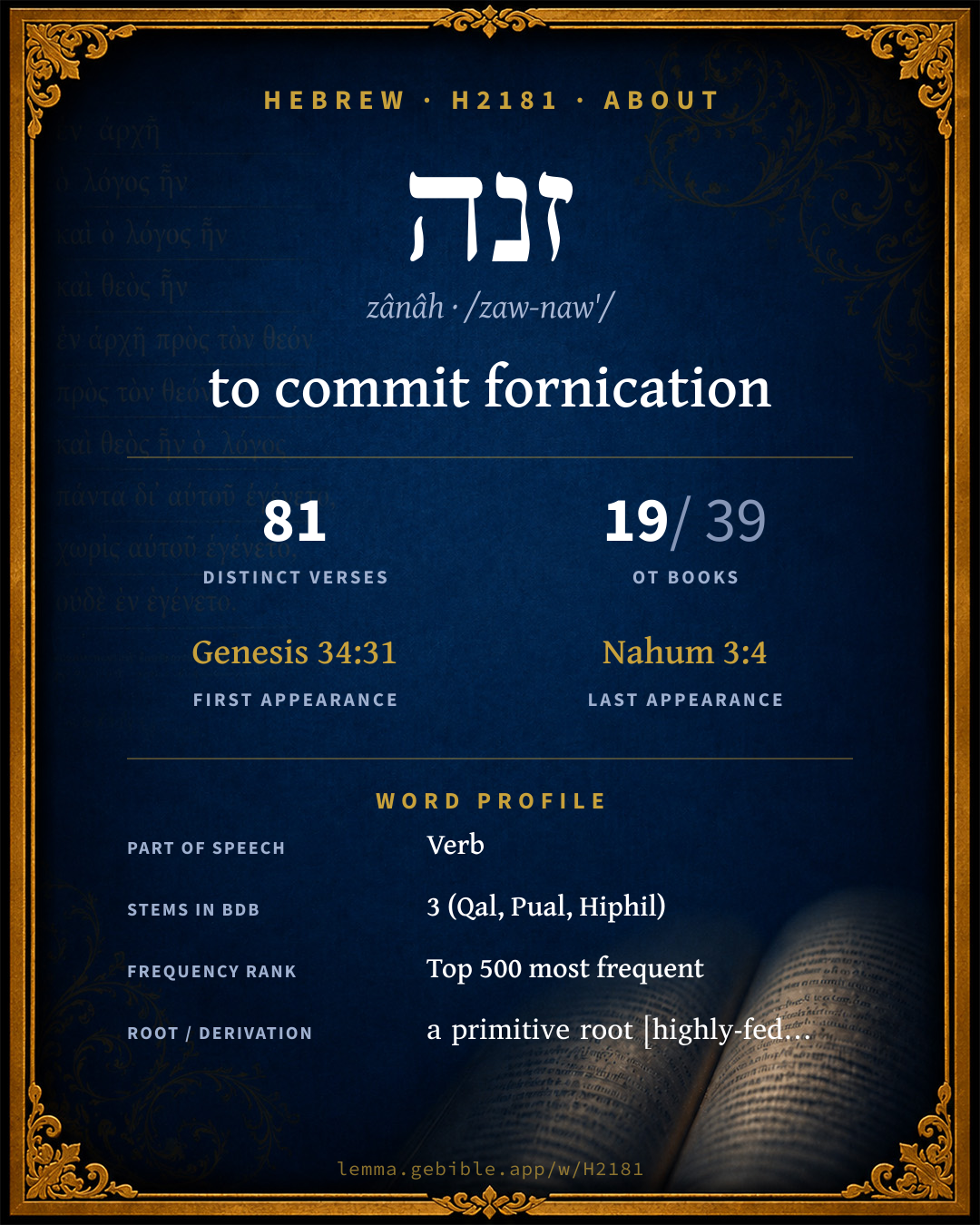
זָנָה
to commit fornication
also: be a harlot, play the harlot fuller range ↓
Full lexicon entry — Brown-Driver-Briggs (BDB)
From Brown-Driver-Briggs (BDB)
Where this word appears
See every Qal verb in the Hebrew Bible →
Grammar key — what these labels mean
Part of speech
- Verb
- An action or state-of-being word.
- Noun
- A naming word — a person, place, thing, or idea.
Noun type
- Common
- A common noun — a general class of person, place, or thing (“king,” “city,” “water”), not a specific name.
Stem
- Qal
- The basic, simple active stem — the plain form of the verb (“he wrote”). Here: ‘be or act as a harlot’
- Hiphil
- The causative active stem (“he caused / brought about”). Here: ‘cause to commit fornication’
- Pual
- The passive counterpart of the Piel.
Form
- Participle Active
- A verbal adjective expressing ongoing or characteristic action (“writing / one who writes”).
- Sequential Imperfect
- An imperfect with prefixed waw — the standard past-narrative form (waw-consecutive imperfect).
- Infinitive Construct
- A bound verbal noun, frequently with prepositions (“to write / in writing”).
- Imperfect
- An incomplete, ongoing, or future action (“he will / would write”).
- Perfect
- A completed action or state — Hebrew marks aspect (completeness) more than strict tense (“he wrote”).
- Sequential Perfect
- A perfect with prefixed waw continuing a preceding imperfect or command (waw-consecutive perfect).
- Infinitive Absolute
- An unbound verbal noun, often intensifying or standing in for a finite verb.
State
- Absolute
- The independent form of a noun, not bound to a following word.
Person
- 2nd Person
- The one addressed (“you”).
- 3rd Person
- The one spoken about (“he / she / it / they”).
Gender
- Feminine
- Grammatically feminine.
- Masculine
- Grammatically masculine.
- Common
- Either gender — not distinguished for this form.
Number
- Singular
- One.
- Plural
- More than one (in Hebrew, generally three or more).
Every verse where H2181 appears in the Book of Ezekiel — 19 distinct verses. Click any verse to open its interlinear word-by-word view. Verse text shown in the World English Bible for context — . Each verse’s Hebrew form is shown with its reference; the English is not keyword-highlighted, since the data carries no word-level English alignment. Use “Compare translations” on any verse to read it across multiple English versions. This concordance covers the Hebrew Bible; Septuagint (Greek Old Testament) occurrences are not indexed here.
Ezekiel
- Ezekiel 6:9 הַ/זּוֹנֶ֗ה הַ/זֹּנ֕וֹת ptcl def.art + Qal ptcp.act ms ptcl def.art + Qal ptcp.act fp Those of you that escape shall remember me among the nations where they shall be carried captive, how that I have been broken with their lewd heart, which has departed from me, and with they eyes, which play the prostitute after their idols: and they shall loathe themselves in their own sight for the evils which they have committed in all their abominations.
- Ezekiel 16:15 וַ/תִּזְנִ֖י conj + Qal wimpf 2fs But you did trust in your beauty, and played the prostitute because of your renown, and poured out your prostitution on everyone who passed by; his it was.
- Ezekiel 16:16 וַ/תִּזְנִ֖י conj + Qal wimpf 2fs You took of your garments, and made for yourselves high places decked with various colors, and played the prostitute on them: [the like things] shall not come, neither shall it be [so].
- Ezekiel 16:17 וַ/תִּזְנִי conj + Qal wimpf 2fs You also took your beautiful jewels of my gold and of my silver, which I had given you, and made for yourself images of men, and played the prostitute with them;
- Ezekiel 16:26 וַ/תִּזְנִ֧י conj + Qal wimpf 2fs You have also committed sexual immorality with the Egyptians, your neighbors, great of flesh; and have multiplied your prostitution, to provoke me to anger.
- Ezekiel 16:28 וַ/תִּזְנִי֙ וַ/תִּזְנִ֕י/ם conj + Qal wimpf 2fs conj + Qal wimpf 2fs + sfx pers 3mp You have played the prostitute also with the Assyrians, because you were insatiable; yes, you have played the prostitute with them, and yet you weren't satisfied.
- Ezekiel 16:30 זוֹנָ֖ה Qal ptcp.act fs How weak is your heart, says the Lord Yahweh, seeing you do all these things, the work of an impudent prostitute;
- Ezekiel 16:31 כַּ/זּוֹנָ֖ה prep det + Qal ptcp.act fs in that you build your vaulted place at the head of every way, and make your lofty place in every street, and have not been as a prostitute, in that you scorn pay.
- Ezekiel 16:33 זֹנ֖וֹת Qal ptcp.act fp They give gifts to all prostitutes; but you give your gifts to all your lovers, and bribe them, that they may come to you on every side for your prostitution.
- Ezekiel 16:34 זוּנָּ֑ה Pual pf 3ms You are different from [other] women in your prostitution, in that none follows you to play the prostitute; and whereas you give hire, and no hire is given to you, therefore you are different.
- Ezekiel 16:35 זוֹנָ֔ה Qal ptcp.act fs Therefore, prostitute, hear the word of Yahweh:
- Ezekiel 16:41 מִ/זּוֹנָ֔ה prep + Qal ptcp.act fs They shall burn your houses with fire, and execute judgments on you in the sight of many women; and I will cause you to cease from playing the prostitute, and you shall also give no hire any more.
- Ezekiel 20:30 זֹנִֽים Qal ptcp.act mp Therefore tell the house of Israel, Thus says the Lord Yahweh: Do you pollute yourselves after the manner of your fathers? and play you the prostitute after their abominations?
- Ezekiel 23:3 וַ/תִּזְנֶ֣ינָה זָנ֑וּ conj + Qal wimpf 3fp Qal pf 3cp and they played the prostitute in Egypt; they played the prostitute in their youth; there were their breasts pressed, and there was handled the bosom of their virginity.
- Ezekiel 23:5 וַ/תִּ֥זֶן conj + Qal wimpf 3fs Oholah played the prostitute when she was mine; and she doted on her lovers, on the Assyrians [her] neighbors,
- Ezekiel 23:19 זָנְתָ֖ה Qal pf 3fs Yet she multiplied her prostitution, remembering the days of her youth, in which she had played the prostitute in the land of Egypt.
- Ezekiel 23:30 בִּ/זְנוֹתֵ/ךְ֙ prep + Qal inf.cs + sfx pers 2fs These things shall be done to you, because you have played the prostitute after the nations, and because you are polluted with their idols.
- Ezekiel 23:43 יזנה יִזְנ֥וּ Qal impf 3ms Qal impf 3mp Then said I of her who was old in adulteries, Now will they play the prostitute with her, and she [with them].
- Ezekiel 23:44 זוֹנָ֑ה Qal ptcp.act fs They went in to her, as they go in to a prostitute: so went they in to Oholah and to Oholibah, the lewd women.
About this entry
At a glance — auto-summarized from this page’s data, not written by a person. Every figure links to its source below. This summary describes the numbers; it doesn’t interpret them.
At its core, זנה (zânâh) means “to commit fornication.” Its English rendering has broadened — “harlot” classically, “prostitute” (Berean Standard Bible) in modern versions; see the renderings breakdown. Spanning 81 verses in 19 books, it ranks among the moderately common words of the Hebrew Bible. It first appears in Genesis 34:31. The verb spans 3 stems, from Qal to Pual. Each statement above links to its evidence; the full detail follows below.
Gloss history
Strong's 1890 vs modern scholarship
About this word
Strong's H2181 catalogs a Hebrew word from the Hebrew Old Testament.
These counts are not copied from any lexicon or concordance. They are computed here, from the morphology-tagged Hebrew Old Testament. What Lemma adds →
- 81
- distinct verses
- The word appears in 81 distinct verses.
- 19 / 39
- OT books
- The word appears in 19 of 39 Old Testament books.
- #446
- by frequency
- Top 500 most frequent Hebrew words (rank 446 of 8,640 Hebrew words by occurrence).
View all 81 occurrences in the concordance →
By section of the Old Testament
By traditional corpus
Conventional, traditional groupings — biblical authorship is debated, so this is a traditional corpus grouping, not an authorship claim. Each share is this word’s portion of its verses in that division of the Hebrew canon. Each figure is a share of the word’s 81 distinct verses.
- Prophets (Nevi'im) 55 verses · 68%
- Torah (Pentateuch) 17 verses · 21%
- Writings (Ketuvim) 9 verses · 11%
How translations render this word
Counts come from each version’s own published word-to-Strong’s tagging or interlinear alignment — an approximate guide to how each version renders this word, not a word-level alignment the data otherwise carries. Because each total is that version’s own tagged count, the per-version totals vary from one another and need not match the appearance or distinct-verse counts above. These counts may also differ from a printed concordance because Lemma counts each distinctly tagged rendering and does not collapse phrase taggings into a single head-word total. This is a fixed set of word-tagged versions (KJV, ASV, BSB, ULT) and does not change with the reading translation you choose elsewhere. Each version’s license is shown beside its name below (and on Sources).
- King James Version: Harlot 9×, Go a whoring 6×, Hath played the harlot 3×
- American Standard Version: Harlot 16×, Play the harlot 9×, Played the harlot 6×
- Berean Standard Bible: Prostitute 16×, Prostitutes 7×, Harlot 5×
- unfoldingWord Literal Text: Prostitute 27×, Prostituting 6×, Themselves 4×
King James Version Public Domain
Renders H2181 across 92 tagged occurrences — most commonly:
Plus other, less common renderings. Plus 51 renderings that appear only once — usually multi-word phrases or single function words the recovered tagging swept in, not distinct renderings. Not rendered by a distinct English word in 2 further occurrences.
American Standard Version Public Domain
Renders H2181 across 92 tagged occurrences — most commonly:
Plus 40 renderings that appear only once — usually multi-word phrases or single function words the recovered tagging swept in, not distinct renderings.
Berean Standard Bible Public Domain
Renders H2181 across 88 tagged occurrences — most commonly:
Plus 38 renderings that appear only once — usually multi-word phrases or single function words the recovered tagging swept in, not distinct renderings. Not rendered by a distinct English word in 6 further occurrences.
unfoldingWord Literal Text CC BY-SA 4.0
Renders H2181 across 114 tagged occurrences — most commonly:
Plus other, less common renderings. Plus 44 renderings that appear only once — usually multi-word phrases or single function words the recovered tagging swept in, not distinct renderings.
13 senses and sub-senses in the full BDB
Hebrew verbs can shift meaning by stem (binyan): Qal is the basic action, Niphal is often passive or reflexive, Piel often intensifies or makes it factitive, and Hiphil is typically causative. The senses below are grouped under the stem BDB assigns to each. This entry also uses Pual (the passive of Piel).
What do BDB’s symbols mean?
BDB uses these scholarly abbreviations:
| Symbol | Meaning |
|---|---|
| 𝔊 | the Septuagint (the ancient Greek translation, LXX) |
| 𝔙 | the Vulgate (the Latin translation) |
| 𝔖 | the Syriac version (the Peshitta) |
| 𝔗 | the Targum (the Aramaic translation) |
| ψ | the Psalms |
| √ | root (the underlying root or stem) |
| ‖ | parallel passage (a synonymous or contrasted parallel) |
| † | the dagger: every passage where the word occurs is cited |
The 13 senses and sub-senses the full Brown-Driver-Briggs lexicon distinguishes for this word, in lexicon order (not ranked by frequency), with BDB’s own verbatim wording and sub-sense lettering. Shown in Hebrew script with BDB’s own scholarly abbreviations. The condensed entry is in the Lexicon Entry tab. See also the Forms in the corpus table below.
Qal
- Pf. ז׳ Dt 31:16, זָֽנְתָה Gn 38:24 + 3 times, etc.; Impf. יִזְנֶ֯ה (Kt) Ez 23:43; תִּזְנֶה Lv 19:29 + 4 times; וַתּ֫זֶן Je 3:8 Ez 23:5; תִּזְנִי Ho 3:3; וַתִּזְנִי Je 3:6 (but read prob. וַתִּזֶן: וַתִּזְנִי is not Aramaic form of 3 fs., v. Köi 540 Kau§ 47 g b) Ez 16:15 + 4 times; וַתִּזְנִים Ez 16:28; יִזְנוּ (Qr) Ez 23:43; וַיִּזְנוּ Ju 8:27 + 4 times; תִּזְנֶינָה Ho 4:13, 14; וַתִּזְנֶינָה Ez 23:3; Inf. abs. זָנֹה Ho 1:2; cstr. לִזְנוֹת Lv 20:5 + 3 times; לִזְנֹת Lv 20:6; sf. בִּזְנוֹתֵךְ Ez 23:30; Pt. זוֹנֶה ψ 73:27 Ez 6:9; זֹנֶה Ho 4:15; pl. זֹנִים Lv 17:7 + 3 times; זוֹנָה Dt 23:19 + 25 times; זֹנָה Lv 21:7 + 2 times; זוֹנוֹת Pr 29:3; זֹנוֹת Ho 4:14 + 4 times— e.g. Deuteronomy 31:16
- 1. be or act as a harlot, abs. Gn 38:24 (J), Dt 22:21 (D), Lv 21:9 (H), Ho 4:13, 14 Am 7:17; זונה + (ה)אשׁה Jos 2:1; 6:22 (J), Lv 21:7 (H), Ju 11:1; 16:1 Pr 6:26 Je 3:3 Ez 16:30; 23:44; זוֹנָה Gn 34:31; 38:15 Jos 6:17, 25 (all J), Dt 23:19 Lv 21:14 (H), Pr 7:10; 23:27 Is 23:15, 16 Jo 4:3 Mi 1:7(×2) Ez 16:31; נָשִׁים זֹנוֹת 1 K 3:16; ז(ו)נות 1 K 22:38 Pr 29:3 Ho 3:3; 4:14 Ez 16:33; בית זונה Je 5:7; commit fornication, man’s act ז׳ אל Nu 25:1 (J); metaphorically of a land given to harlotry Lv 19:29. e.g. Genesis 38:24
- 2. fig. of improper intercourse with foreign nations with acc. pers. Je 3:1 Ex 16:28; ז׳ את Is 23:17; אחרי Ez 23:30; אל Ez 16:26, 28(×2); ז׳ תַזְנוּתיה Ez 23:43 Na 3:4; וַתִּזֶן אָהֳלָה תַחְתָּ֑י and Ohola committed fornication (whilst) under me Ez 23:5 (cf. Nu 5:19). e.g. Jeremiah 3:1
- 3. of intercourse with other deities, considered as harlotry, sometimes involving actual prostitution, ז׳ אחרי Ex 34:15, 16 Dt 31:16 (all J), Lv 17:7; 20:5(×2) (all H), Ju 2:17; 8:27, 33 1 Ch 5:25 Ez 6:9; 20:30; after אֹבֹת, etc. Lv 20:6 (H), one’s own heart & eyes Nu 15:39 (H); especially of Isr., Judah, and Jerus. under fig. of lewd woman Ez 16:15 (abs.) v 16 (על במות), v 17 (ז׳ בְ), 23:3(×2), 19 (abs.), Je 3:1 (c. acc.); v 6, 8 (abs.); abs. elsewhere Ho 2:7; 4:15 Is 57:3 ψ 106:39; as leaving י׳, sq. מֵעַל Ho 9:1; מאחרי 1:2(×2); מתחת 4:12; sq. מן alone ψ 73:27; ז(ו)נה Je 2:20 Ez 16:35, 41; בית זונה Je 5:7; לִבָּם הַזּוֹנֶה their whorish heart Ez 6:9. e.g. Exodus 34:15
- 4. זונה of moral defection Is 1:21. e.g. Isaiah 1:21
Pual
- Pf. 3 ms. אַחֲרַיִךְ לֹא זוּנָּה fornication was not done (in going) after thee Ez 16:34 (but del. Co). e.g. Ezekiel 16:34
Hiphil
- Pf. 2 ms. הִזְנֵיתָ Ho 5:3; 3 pl. הִזְנוּ Ho 4:10, 18 Ex 34:16; Impf. וַיֶּ֫זֶן 2 Ch 21:11; וַתַּזְנֶה 2 Ch 21:13; Inf. abs. הַזְנֵה Ho 4:18; cstr. הַזְגוֹת 2 Ch 21:13; sf. לְהַזְנוֹתָהּ Lv 19:29. e.g. Hosea 5:3
- 1. cause to commit fornication:
- a. sexual Lv 19:29 (H). e.g. Leviticus 19:29
- b. religious Ex 34:16 (J), 2 Ch 21:11, 13(×2). e.g. Exodus 34:16
- 2. commit fornication:
- a. sexual Ho 4:10. e.g. Hosea 4:10
- b. religious Ho 4:18(×2); 5:3. e.g. Hosea 4:18
Senses from the full Brown-Driver-Briggs lexicon (Brown, Driver, Briggs; Oxford 1906 — public domain), digitized via Sefaria, supplemented by the OpenScriptures HebrewLexicon (CC BY 4.0). Full attribution on Sources.
Word origin
vb. commit fornication, be a harlot (Arabic زَنَى commit fornication, Aramaic ܙܢܳܐ, זנא; cf. Ethiopic ዝንየት effusio seminis virilis, semen effusum, Di1055; on this and ዘመወ (comp. by Ges al.) v. PrätBAS i.32, Anm.)—
— Brown-Driver-Briggs (Oxford 1906, public domain), digitized via Sefaria, supplemented by the OpenScriptures HebrewLexicon (CC BY 4.0). See Sources.
Origin: a primitive root [highly-fed and therefore wanton]
Jastrow Dictionary
A second Hebrew/Aramaic lexicon for comparison, covering Aramaic and post-biblical (Talmudic, Targumic, Midrashic) usage that the biblical-Hebrew BDB does not. Matched by lemma rather than by Strong’s number, so a lemma may carry more than one Jastrow headword (shown separately below), and the entries cover usage well beyond the Bible.
זָנָה
- , v. זני
זני
- (b. h.)
- 1. [to run to and fro, wander;] (with אחר) to run after, (with מאחרי) to run away from; esp. to run about as a prostitute, to be faithless, be unchaste (cmp. ch. נפקת ברא for זוֹנָה, a. טעי for our w.). Sabb. 55ᵇ (play on פ̇ח̇ז̇, Gen. XLIX, 4) פ̇סעת … ח̇טאת זָ֗נִיתָ thou hast trespassed upon religion, sinned, been unchaste (v. זוּל).—Snh. 100ᵇ שמא תִזְנֶה lest she may go astray (be seduced); a. v. fr. e.g. Genesis 49:4
- 2. to commit an offense. Gitt. 6ᵇ explain. ותזנה עליו, Jud. XIX, 2, cmp. Targ. a. l. e.g. Judges 19:2
- same, also to invite faithlessness, to excite the senses. Sabb. 88ᵇ עלובה כלה מְזַנָּה בתוך חופתה (v. Rabb. D. S. a. l.) bold is the bride who thinks of faithlessness while getting married; Gitt. 36ᵇ שזִינְּתָה בקרב וכ׳. Sot. 10ᵃ כל המְזַנֶּה … מְזַנֶּנֶת עליו if a man is lewd, his wife will think of faithlessness against him; Yalk. Job 918 מְזַנָּה תחתיו. Meg. 15ᵃ רחב בשמה זִינְּתָה וכ׳ Raḥab suggested impure thoughts by her name (Raḥab hazzonah), Jael with her call (Jud. IV, 18) &c., v. זְכִירָה; a. fr.—Trnsf. (of plants) to degenerate. Gen. R. s. 28, end אף הארץ זינתה the earth, too, became degenerated in her produces; v. זוֹנַיָּיא. Y. Kil. I, beg. 26ᵈ הפירות מְזַנִּין the produces may degenerate (ref. to Lev. XIX, 29). e.g. Judges 4:18
A Dictionary of the Targumim, the Talmud Babli and Yerushalmi, and the Midrashic Literature (Marcus Jastrow; London, Luzac, 1903) — Public Domain. Digitized via Sefaria. Digitized via Sefaria. Full attribution on Sources.
Forms in the corpus
The 77 distinct written forms H2181 takes in the Hebrew Bible, most frequent first — each parse links to that stem’s occurrences in the concordance. Hebrew forms include their vowel points and cantillation, so a single lemma takes many written forms.
The 60 most common forms are shown; 17 rarer forms follow in the full concordance.
Same root — word family
Other BDB entries built from the same root as H2181, grouped by Strong’s listed origin. These share a root / origin per the lexicon — not necessarily a shared meaning. Each links to that word’s own entry.
Derived from this word
Compare all same-root words → They share a root, not necessarily a meaning.
Septuagint verse parallels
This word appears in 80 verses that also exist in the Greek Old Testament (Septuagint), out of the 81 Hebrew verses it occurs in. You can read those verses in Greek by switching the Old Testament edition to the Septuagint.
Read these verses in the Septuagint
- Genesis 34:31
- Exodus 34:15
- Leviticus 17:7
- Numbers 15:39
- Deuteronomy 22:21
- Joshua 2:1
- Judges 2:17
- 1 Chronicles 5:25
- 2 Chronicles 21:11
- Psalms 106:39
- Proverbs 6:26
- Isaiah 1:21
This is a verse-level parallel only — the same verses exist in both the Hebrew and Greek Old Testaments. No word-level Hebrew↔Greek correspondence is claimed: the data carries no such alignment, so no Greek word is shown as this Hebrew word’s translation. Coverage is not total — the Septuagint omits the deuterocanon and renumbers the Psalms, so some Hebrew verses have no direct Greek parallel.