Ezekiel 23:44

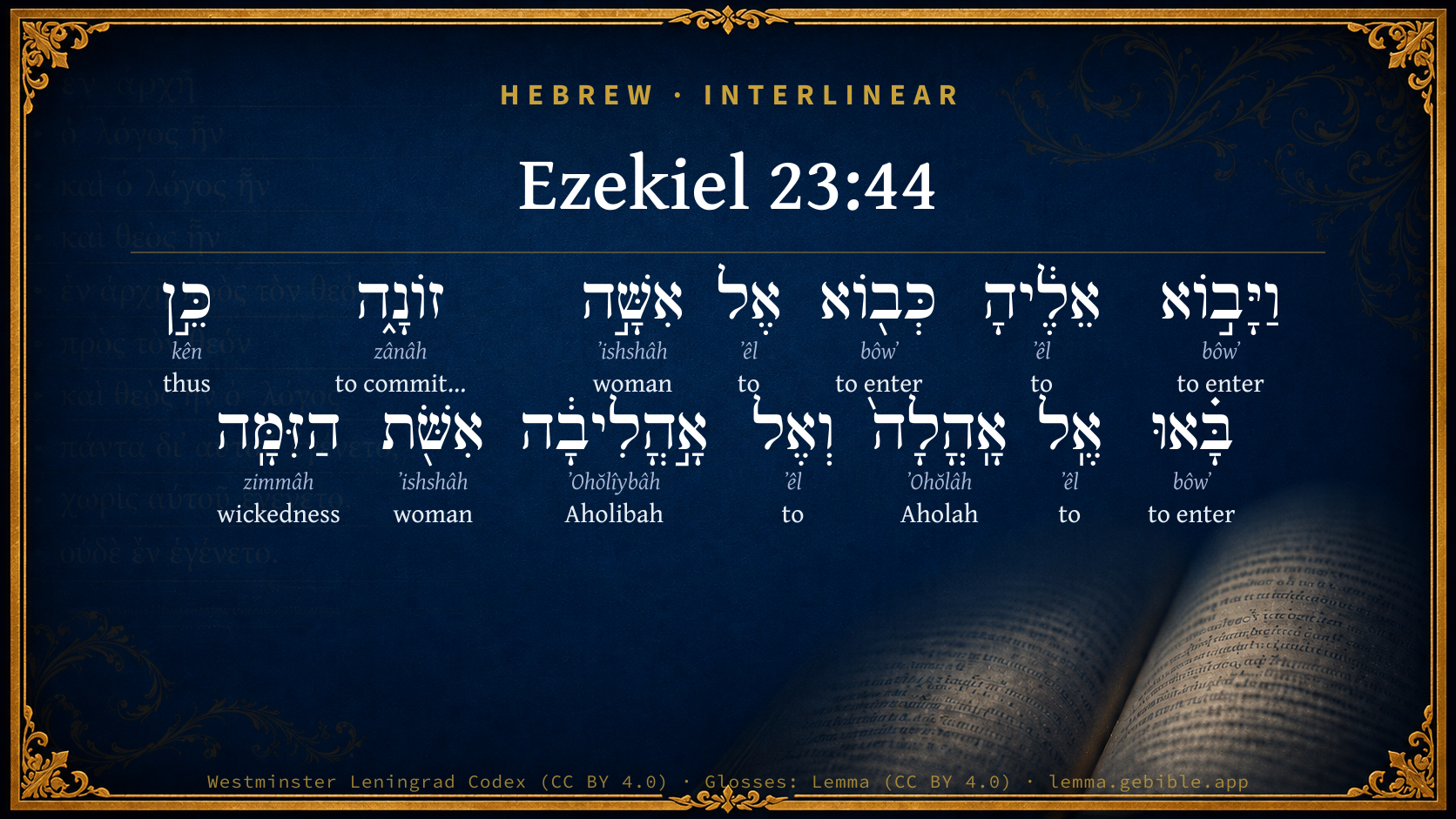
Hebrew (Westminster Leningrad Codex) Ezekiel 23:44 appears in the Hebrew Old Testament. The text above is from the Westminster Leningrad Codex. Each word links to its Strong’s number, a concise gloss, and parsing drawn from the Open Scriptures Hebrew Bible morphology. Click any word for its full Brown-Driver-Briggs (BDB) entry.
Download image
Cite this verse

Ezekiel 23:44 (World English Bible). Public Domain. Lemma interlinear Bible study tool, https://lemma.gebible.app/v/ezekiel/23/44.

Show BibTeX & RIS
BibTeX
RIS
English Translation
They went in to her, as they go in to a prostitute: so went they in to Oholah and to Oholibah, the lewd women.
World English Bible · Public Domain
Download a study sheet

One document with this verse’s original text, its word-by-word gloss line, the meaning frame, cross-references with their text, attributed commentary, and full source and license credits — printable, and it pastes into notes with its structure intact.

This verse Autodidact and up

Study sheet (.html) Plain text (.txt)

A passage Seminary Student

Up to 50 verses in one chapter. A passage sheet keeps up to 6 commentary sources and 12 cross-references per verse, in the order this page ranks them, and says so on the sheet whenever that leaves anything out. Ask for a single verse and you get the Autodidact verse sheet above.

Everything on this page stays free to read, with no account — the sheet is a download of what is already on screen, not access to it.

Want to remove ads? Support Godless Engineer
Compare translations 3

The same verse in 3 English versions, stacked beneath the original-language interlinear above. Click any original word for its lexicon entry.

Each is an independent rendering of the whole verse — the interlinear is not word-aligned to these translations.

Highlighted words mark where these versions differ — a whole-verse word diff, not a word-by-word alignment.

  • World English Bible Public Domain
    They went in to her, as they go in to a prostitute: so went they in to Oholah and to Oholibah, the lewd women.
  • King James Version Public Domain
    Yet they went in unto her, as they go in unto a woman that playeth the harlot: so went they in unto Aholah and unto Aholibah, the lewd women.
  • unfoldingWord Literal Text CC BY-SA 4.0
    They went in to her, as men go in to a prostitute. In this way they went in to Oholah and Oholibah, immoral women.

unfoldingWord Literal Text — © unfoldingWord, licensed CC BY-SA 4.0. Word-aligned USFM3 via Door43 (git.door43.org/unfoldingWord/en_ult).

Versions to compare (up to 4)

3 of 4 selected

Show all 18 translations

Every available English version of this verse, each an independent rendering of the whole verse.

  • World English Bible Public Domain
    They went in to her, as they go in to a prostitute: so went they in to Oholah and to Oholibah, the lewd women.
  • Berean Standard Bible Public Domain
    And they slept with her as with a prostitute; they slept with Oholah and Oholibah, those lewd women.
  • Majority Standard Bible Public Domain
    And they slept with her as with a prostitute; they slept with Oholah and Oholibah, those lewd women.
  • King James Version Public Domain
    Yet they went in unto her, as they go in unto a woman that playeth the harlot: so went they in unto Aholah and unto Aholibah, the lewd women.
  • American Standard Version (1901) Public Domain
    And they went in unto her, as they go in unto a harlot: so went they in unto Oholah and unto Oholibah, the lewd women.
  • Revised Version (1885) Public Domain
    And they went in unto her, as they go in unto an harlot: so went they in unto Oholah and unto Oholibah, the lewd women.
  • Geneva Bible (1599) Public Domain
    And they went in vnto her as they goe to a common harlot: so went they to Aholah and Aholibah the wicked women.
  • Douay-Rheims (1899) Public Domain
    And they went in to her, as to a harlot: so went they in unto Oolla, and Ooliba, wicked women.
  • Young's Literal Translation Public Domain
    And they come in unto her, As the coming in unto a whorish woman, So they have come in unto Aholah, And unto Aholibah -- the wicked women.
  • Literal Standard Version CC BY-SA 4.0
    And they come in to her, || As the coming in to a whorish woman, || So they have come in to Aholah, || And to Aholibah—the wicked women.
  • Unlocked Literal Bible CC BY-SA 4.0
    They went in to her and slept with her as men go in to be with a prostitute. In this way they slept with Oholah and Oholibah, who were immoral women.
  • unfoldingWord Literal Text CC BY-SA 4.0
    They went in to her, as men go in to a prostitute. In this way they went in to Oholah and Oholibah, immoral women.
  • Darby Bible Public Domain
    And they went in unto her, as they go in unto a whorish woman: so went they in unto Oholah and unto Oholibah the lewd women.
  • World Messianic Bible Public Domain
    They went in to her, as they go in to a prostitute. So they went in to Oholah and to Oholibah, the lewd women.
  • Webster's Bible Public Domain
    Yet they went in to her, as they go in to a woman that playeth the harlot: so they went in to Aholah and to Aholibah, the lewd women.
  • Free Bible Version CC BY-SA 4.0
    So they had sex with her like a prostitute. They had sex with Oholah and Oholibah, those immoral women.
  • Bible in Basic English Public Domain
    And they went in to her, as men go to a loose woman: so they went in to Oholibah, the loose woman.
  • JPS Tanakh (1917) Public Domain
    For every one went in unto her, as men go in unto a harlot; so went they in unto Oholah and unto Oholibah, the lewd women.

Literal Standard Version (2020), Covenant Press — licensed CC BY-SA 4.0. Text via the HelloAO Bible API (eBible.org). Unlocked Literal Bible (unfoldingWord) — licensed CC BY-SA 4.0. Text via the HelloAO Bible API (eBible.org). unfoldingWord Literal Text — © unfoldingWord, licensed CC BY-SA 4.0. Word-aligned USFM3 via Door43 (git.door43.org/unfoldingWord/en_ult). Free Bible Version, Dr. Jonathan Gallagher — licensed CC BY-SA 4.0. Text via the HelloAO Bible API (eBible.org).

Word by word

More ways to search: Search by grammar → Find every occurrence → Compare this word →

Practice this passage: Drill this verse → Learn its vocabulary →

אָֽהֳלָה֙
ʼOhŏlâh
H170
“Aholah”
Noun, Proper
Part of Speech
Noun
Type
Proper
Full BDB Definition

Origin: in form a f of H168 , but in fact for 'Oholahh o-hol-aw'

TWOT: 32b

Aholah = "her own tent" - Samaria as an adulteress with Assyria (metaphorically)
  1. וַיָּב֣וֹא bôwʼ H935 “and · to enter” Conjunction + Verb, Qal, Sequential Imperfect, 3rd Person, Masculine, Singular
  2. אֵלֶ֔יהָ ʼêl H413 “to · her” Preposition + Suffix, Personal, 3rd Person, Feminine, Singular
  3. כְּב֖וֹא bôwʼ H935 “like/as · to enter” Preposition + Verb, Qal, Infinitive Construct
  4. אֶל ʼêl H413 “to” Preposition
  5. אִשָּׁ֣ה ʼishshâh H802 “woman” Noun, Common, Feminine, Singular, Absolute
  6. זוֹנָ֑ה zânâh H2181 “committing fornication” Verb, Qal, Participle Active, Feminine, Singular, Absolute
  7. כֵּ֣ן kên H3651 “thus” Particle, Demonstrative
  8. בָּ֗אוּ bôwʼ H935 “to enter” Verb, Qal, Perfect, 3rd Person, Common, Plural
  9. אֶֽל ʼêl H413 “to” Preposition
  10. וְאֶל ʼêl H413 “and · to” Conjunction + Preposition
  11. אָ֣הֳלִיבָ֔ה ʼOhŏlîybâh H172 “Aholibah” Noun, Proper
  12. אִשֹּׁ֖ת ʼishshâh H802 “women of” Noun, Common, Feminine, Plural, Construct
  13. הַזִּמָּֽה zimmâh H2154 “the · wickedness” Particle, Definite Article + Noun, Common, Feminine, Singular, Absolute

About this verse

These counts appear in no published source. They are computed here, from the morphology-tagged text and Lemma’s own curated glosses. What Lemma adds →

14
words
8
distinct lemmas
Prophets
section

Notable vocabulary

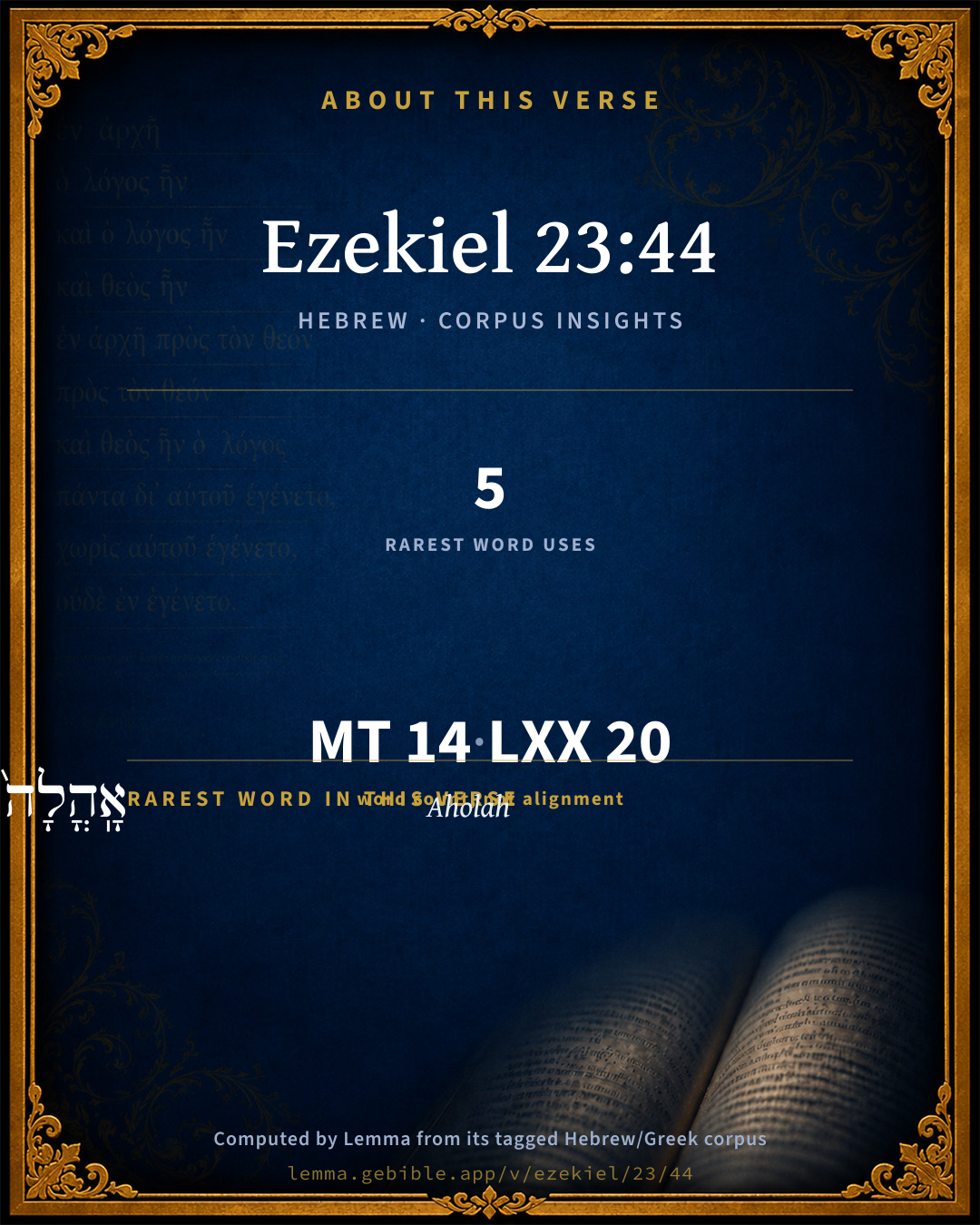
The rarest word here is אָֽהֳלָה֙ Aholah H170 — appearing just 5 times in the whole Hebrew Bible.

Shared distinctive vocabulary

אָֽהֳלָה֙ Aholah H170 occurs in 4 verses of the Hebrew Bible. Also found in:

Grammatical profile

  • 4 verbs
  • 5 nouns
  • 4 prepositions
  • 1 particle

Verb forms

  • וַיָּב֣וֹא Qal · Sequential Imperfect
  • כְּב֖וֹא Qal · Infinitive Construct
  • זוֹנָ֑ה Qal · Participle Active
  • בָּ֗אוּ Qal · Perfect

Repetition

Words recur within this verse — often emphatic in Hebrew:

  • וַיָּב֣וֹא to enter H935 ×3
  • אִשָּׁ֣ה woman H802 ×2
  • אֵלֶ֔יהָ to H413 ×4

Hebrew & Septuagint length

In English translation the verse runs 24 words from the Hebrew and 25 from the Septuagint (LXX English) — closely comparable.

A rough comparison of the two English renderings, which tokenize alike — not a word-level alignment.

Word counts can differ between the Hebrew and the Greek without any difference in meaning — e.g. the Hebrew direct-object marker אֵת has no separate Greek word, and Greek often adds the article ὁ.

In the original languages it is 14 Hebrew tokens and 20 Greek tokens — but the two are counted differently (Hebrew bundles its prefixes and suffixes into one token; the Greek is in lemma form), so that isn’t a like-for-like length.

Cross-references

2

Topical passages linked to Ezekiel 23:44 in the Treasury of Scripture Knowledge — connected by theme and wording, ordered by reader-vote popularity; previews shown in the World English Bible.

  • Ezekiel 23:3 and they played the prostitute in Egypt; they played the prostitute in their youth; there were their breasts pressed, and there was handled the bosom of their virginity.
  • Ezekiel 23:9–13 Therefore I delivered her into the hand of her lovers, into the hand of the Assyrians, on whom she doted.

Cross-references courtesy of OpenBible.info (CC BY 4.0).

Hebrew and Greek witnesses Masoretic Hebrew ↔ Greek Septuagint

The same verse in the two great witnesses to the Old Testament, shown verse-for-verse.

These are two independent witnesses, not word-aligned to each other, and the Septuagint is shown in lemma (dictionary) form.

Hebrew Ezekiel 23:44 Masoretic · Westminster Leningrad Codex

וַיָּב֣וֹא אֵלֶ֔יהָ כְּב֖וֹא אֶל אִשָּׁ֣ה זוֹנָ֑ה כֵּ֣ן בָּ֗אוּ אֶֽל אָֽהֳלָה֙ וְאֶל אָ֣הֳלִיבָ֔ה אִשֹּׁ֖ת הַזִּמָּֽה

They went in to her, as they go in to a prostitute: so went they in to Oholah and to Oholibah, the lewd women.

World English Bible · Public Domain

Greek LXX Ezekiel 23:44 Septuagint · lemma form

καί εἰςπορεύομαι πρός αὐτός ὅς τρόπος εἰςπορεύομαι πρός γυνή πόρνη οὕτως εἰςπορεύομαι πρός οολα καί πρός οολιβα ὁ ποιέω ἀνομία

And they went in to her, as men go in to a harlot; so they went in to Oola and to Ooliba to work iniquity.

LXX2012 (modern English Septuagint) · Public Domain

On this verse, The Cambridge Bible for Schools and Colleges discusses the Septuagint’s reading. Read the note in Commentary ↓

Hebrew: Westminster Leningrad Codex (CC BY 4.0). Greek: Septuagint (public domain); English from LXX2012 (modern English Septuagint) (Public Domain). How the Septuagint differs from the Hebrew →

Targum (Aramaic paraphrase)

1

The Targum is the ancient Jewish Aramaic paraphrase of the Hebrew Scriptures — an interpretive translation, not the Hebrew text itself. Onkelos (literal) and Pseudo-Jonathan (expansive) render the Torah, and Jonathan the Prophets. Coverage is partial: where no permissively-licensed English translation exists for a verse, only the Aramaic is shown. This is verse-level text, not a word-by-word alignment to the Hebrew.

  1. Targum Jonathan Prophets (Joshua–Malachi)
    וְעָלוּ לְוָתָהּ כְּמָא דְעָלִין לְוַת אִיתְּתָא פּוּנְדְקִיתָא כֵּן עָלוּ לְאָהֳלָה וּלְאָהֳלִיבָה מְזִינְתָא דְעֵיצַתְהוֹן חֶטְאִין:

    (no public-domain English translation for this verse)

    Targum Jonathan — Aramaic: “Mikraot Gedolot” (public domain). English: “Sefaria Community Translation” (CC0 1.0 (public-domain dedication)); “London "Chaldee Paraphrase," 1871” (public domain). Text via Sefaria.

Commentary

Notes on Ezekiel 23:44 from classic Christian and Jewish commentators (each source and its license shown beneath its notes). The classic Christian expositions comment on the surrounding passage and are grouped to its opening verse, so a note may address several verses; the Jewish commentaries on the Tanakh (Rashi and others) are per-verse, so they appear only where the commentator wrote on this verse.

Lemma curates 59 commentaries, every one of them public domain or Creative Commons licensed, each selected and text-cleaned for this edition rather than reprinted as found. About our sources →

Trapp's Complete Commentary

John Trapp

Eze 23:44 Yet they went in unto her, as they go in unto a woman that playeth the harlot: so went they in unto Aholah and unto Aholibah, the lewd women.

Ver. 44. Yet they went in unto her.] They committed idolatry without mean or measure, being woefully hardened and habituated therein.

John Trapp, A Commentary or Exposition upon All the Books of the Old and New Testament (1647–1656) — public domain. Text from a community e-Sword module.

Tyndale Open Study Notes

Tyndale Open Resources

23:44-49 The sisters’ enemies would stone them like adulteresses and kill them with swords as an invading army would do. In the typical pattern of invasion, not only the prostitutes but also their sons and daughters would die, and the enemy would burn their homes. Those who rebelled against the Lord and pursued idolatry would suffer the full penalty of death.

Tyndale Open Study Notes — © Tyndale Open Resources, licensed CC BY-SA 4.0. Text via the HelloAO Bible API.

Ellicott's Commentary for English Readers

(44) Unto Aholah and unto Aholibah.—From Eze_23:11-35 the discourse has been altogether of Aholibah, as the one now immediately concerned; but from Eze_23:36-44, in the enumeration of their sins, both are included, though in the greater part of these verses the singular number is used, because Aholibah was most prominent in the prophet’s thoughts. In the denunciation of judgment, with which the prophecy closes (Eze_23:45-49), both are again spoken of in the plural, because, although Aholah had long since suffered, it was important to show that common sin involved both in common punishment.

A Bible Commentary for English Readers, edited by Charles John Ellicott (1878–1897) — public domain. Text from a community e-Sword module.

The Cambridge Bible for Schools and Colleges

gen. ed. J. J. S. Perowne

44. Yet they went] and they. The verse sums up all that precedes.

the lewd women] The form of plur. “women” does not occur again, though the usual one in Assyr. LXX., to work lewdness.

The Cambridge Bible for Schools and Colleges (gen. ed. J. J. S. Perowne; Cambridge University Press, 1878–1918) — public domain. Text from a community e-Sword module.

John Gill's Exposition

Yet they went in unto her,.... Made a league with one another, and joined in idolatrous worship:

as they go in unto a woman that playeth the harlot; with the same heat of lust, with the same greediness and eager desire as young men do when they go into a brothel house where a beautiful harlot lives:

so went they in unto Aholah and unto Aholibah; the lewd women, the ten tribes of Israel, and the two tribes of Judah and Benjamin, which apostatized from God, and committed idolatry; with these the Sabeans before mentioned, and other nations, joined in idolatrous worship.

John Gill's Exposition of the Whole Bible (1746–1763) — public domain (CC PDM 1.0). Text via the HelloAO Bible API.

Matthew Poole's English Annotations

This resolves the doubt of the former verse. In this metaphor the prophet expresseth the confederacy of the Jews, against God’s express command, with the nations round about them. The Jews enter league with these robbers, and admit their idols, and so commit whoredom with them; and these Sabeans probably admit some of the Jews’ idols too, and so commit whoredom with her, expressed in the last words of the 43rd verse.

Matthew Poole's English Annotations on the Holy Bible (1683–1685) — public domain. Text from a community e-Sword/MySword module.

Rashi

Rabbi Shlomo Yitzchaki (Rashi)

And he came to her whoever so desired

the lewd women [Heb. אִשֹׁתהַזִמָּה,] [like] נְשֵׁי הַזִמָּה, women of lewdness.

Rashi on the Tanakh — English translations: “The Judaica Press complete Tanach with Rashi, translated by A. J. Rosenberg” (CC BY 4.0); “Pentateuch with Rashi's commentary by M. Rosenbaum and A.M. Silbermann, 1929-1934” (public domain); “The Metsudah Tanach series, Lakewood, N.J” (CC BY 4.0); and “The Book of Joshua, Metsudah Publications, 1997” (CC BY 4.0). Text via Sefaria.

Lesson kit

Teaching starters — assembled from the data on this page, not authored interpretation. Every prompt links to the verse data it draws on. Edit before teaching.

Ezekiel, in the Prophets, opens this verse with 14 words (8 distinct Hebrew lemmas). Its most distinctive word is ʼOhŏlâh (“Aholah”). A historical commentator’s framing appears above. Read the whole chapter for the surrounding context.

Discussion questions

  1. How does “Aholah” (ʼOhŏlâh) shape what this verse is saying?
  2. Ezekiel 23:4 shares the word «Aholah» with this verse. How do the two illuminate each other?
  3. “to enter” occurs 3× in this one verse. What is the effect of the repetition?
  4. These translations render this verse differently. What is at stake in choosing one wording over another?
  5. The verb «וַיָּב֣וֹא» is Qal Sequential Imperfect. How does its form color the action?
  6. Reading how Trapp's Complete Commentary and Tyndale Open Study Notes read this verse, where do the two commentators agree and where do they part?

Things to notice

Reading settings

Reading text

Shown beneath each verse's original-language words.

Old Testament
Old Testament edition

Read the OT as the Masoretic Hebrew (MT) or the Greek Septuagint (LXX).

English shown for the Greek Septuagint (in the Hebrew ↔ Greek comparison).

Comparing translations? Open the Compare panel on any verse page to stack up to four side by side.