
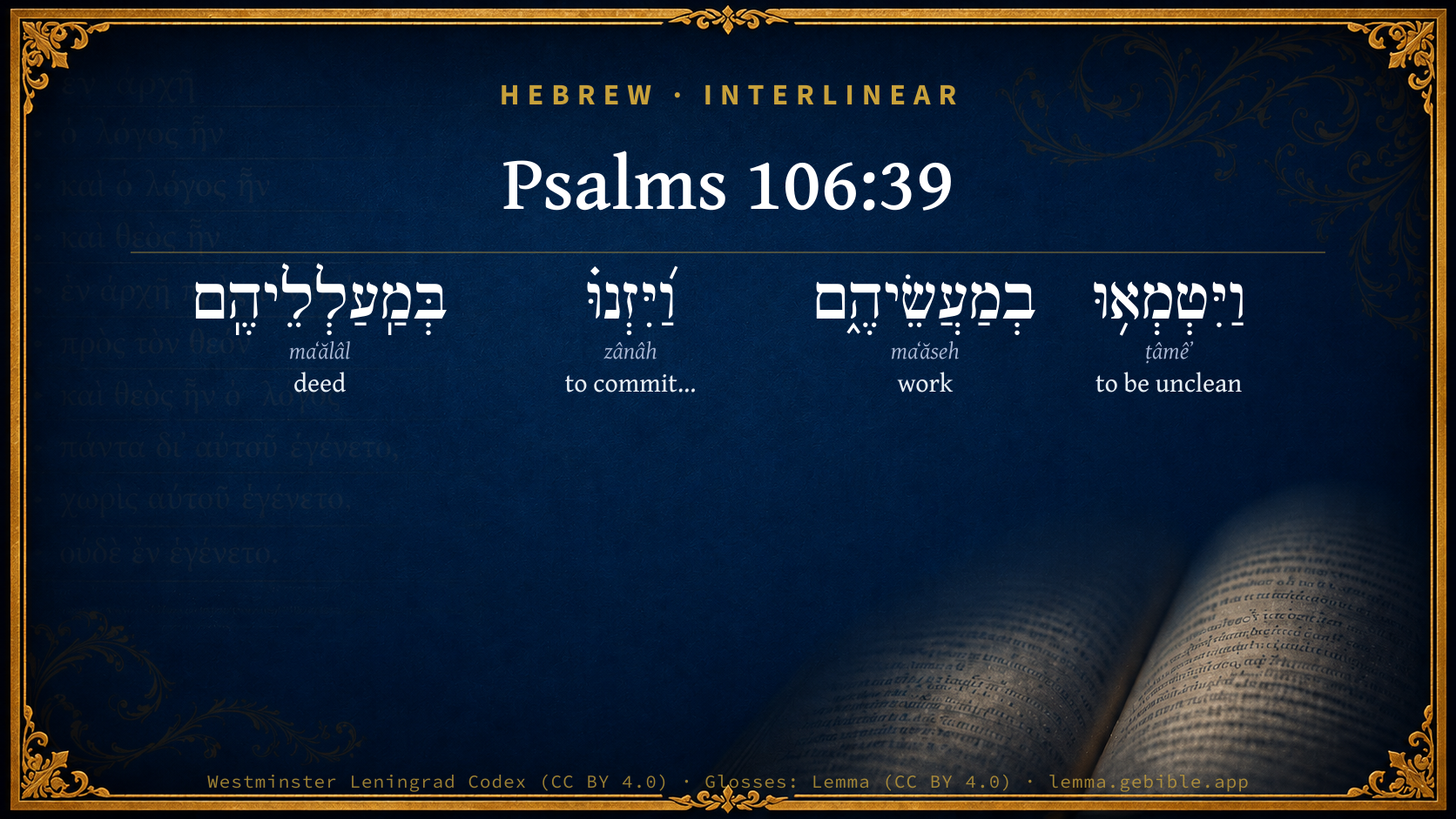
Psalms 106:39

Hebrew (Westminster Leningrad Codex) Psalms 106:39 appears in the Hebrew Old Testament. The text above is from the Westminster Leningrad Codex. Each word links to its Strong’s number, a concise gloss, and parsing drawn from the Open Scriptures Hebrew Bible morphology. Click any word for its full Brown-Driver-Briggs (BDB) entry.
Download image
Cite this verse

Psalms 106:39 (World English Bible). Public Domain. Lemma interlinear Bible study tool, https://lemma.gebible.app/v/psalms/106/39.

Show BibTeX & RIS
BibTeX
RIS
English Translation
Thus were they defiled with their works, And prostituted themselves in their deeds.
World English Bible · Public Domain
Download a study sheet

One document with this verse’s original text, its word-by-word gloss line, the meaning frame, cross-references with their text, attributed commentary, and full source and license credits — printable, and it pastes into notes with its structure intact.

This verse Autodidact and up

Study sheet (.html) Plain text (.txt)

A passage Seminary Student

Up to 50 verses in one chapter. A passage sheet keeps up to 6 commentary sources and 12 cross-references per verse, in the order this page ranks them, and says so on the sheet whenever that leaves anything out. Ask for a single verse and you get the Autodidact verse sheet above.

Everything on this page stays free to read, with no account — the sheet is a download of what is already on screen, not access to it.

Want to remove ads? Support Godless Engineer
Compare translations 3

The same verse in 3 English versions, stacked beneath the original-language interlinear above. Click any original word for its lexicon entry.

Each is an independent rendering of the whole verse — the interlinear is not word-aligned to these translations.

Highlighted words mark where these versions differ — a whole-verse word diff, not a word-by-word alignment.

  • World English Bible Public Domain
    Thus were they defiled with their works, And prostituted themselves in their deeds.
  • King James Version Public Domain
    Thus were they defiled with their own works, and went a whoring with their own inventions.
  • unfoldingWord Literal Text CC BY-SA 4.0
    And they became unclean by their deeds; and they prostituted themselves by their actions.

unfoldingWord Literal Text — © unfoldingWord, licensed CC BY-SA 4.0. Word-aligned USFM3 via Door43 (git.door43.org/unfoldingWord/en_ult).

Versions to compare (up to 4)

3 of 4 selected

Show all 18 translations

Every available English version of this verse, each an independent rendering of the whole verse.

  • World English Bible Public Domain
    Thus were they defiled with their works, And prostituted themselves in their deeds.
  • Berean Standard Bible Public Domain
    They defiled themselves by their actions and prostituted themselves by their deeds.
  • Majority Standard Bible Public Domain
    They defiled themselves by their actions and prostituted themselves by their deeds.
  • King James Version Public Domain
    Thus were they defiled with their own works, and went a whoring with their own inventions.
  • American Standard Version (1901) Public Domain
    Thus were they defiled with their works, And played the harlot in their doings.
  • Revised Version (1885) Public Domain
    Thus were they defiled with their works, and went a whoring in their doings.
  • Geneva Bible (1599) Public Domain
    Thus were they steined with their owne woorkes, and went a whoring with their owne inuentions.
  • Douay-Rheims (1899) Public Domain
    and was defiled with their works: and they went aside after their own inventions.
  • Young's Literal Translation Public Domain
    And they are defiled with their works, And commit whoredom in their habitual doings.
  • Literal Standard Version CC BY-SA 4.0
    And they are defiled with their works, || And commit whoredom in their habitual doings.
  • Unlocked Literal Bible CC BY-SA 4.0
    They were defiled by their deeds; in their actions they were like prostitutes.
  • unfoldingWord Literal Text CC BY-SA 4.0
    And they became unclean by their deeds; and they prostituted themselves by their actions.
  • Darby Bible Public Domain
    And they were defiled with their works, and went a-whoring in their doings.
  • World Messianic Bible Public Domain
    Thus they were defiled with their works, and prostituted themselves in their deeds.
  • Webster's Bible Public Domain
    Thus were they defiled with their own works, and went astray with their own inventions.
  • Free Bible Version CC BY-SA 4.0
    They also defiled themselves by what they did: their actions were spiritual adultery.
  • Bible in Basic English Public Domain
    So they became unclean through their works, going after their evil desires.
  • JPS Tanakh (1917) Public Domain
    Thus were they defiled with their works, and went astray in their doings.

Literal Standard Version (2020), Covenant Press — licensed CC BY-SA 4.0. Text via the HelloAO Bible API (eBible.org). Unlocked Literal Bible (unfoldingWord) — licensed CC BY-SA 4.0. Text via the HelloAO Bible API (eBible.org). unfoldingWord Literal Text — © unfoldingWord, licensed CC BY-SA 4.0. Word-aligned USFM3 via Door43 (git.door43.org/unfoldingWord/en_ult). Free Bible Version, Dr. Jonathan Gallagher — licensed CC BY-SA 4.0. Text via the HelloAO Bible API (eBible.org).

Word by word

More ways to search: Search by grammar → Find every occurrence → Compare this word →

Practice this passage: Drill this verse → Learn its vocabulary →

About this verse

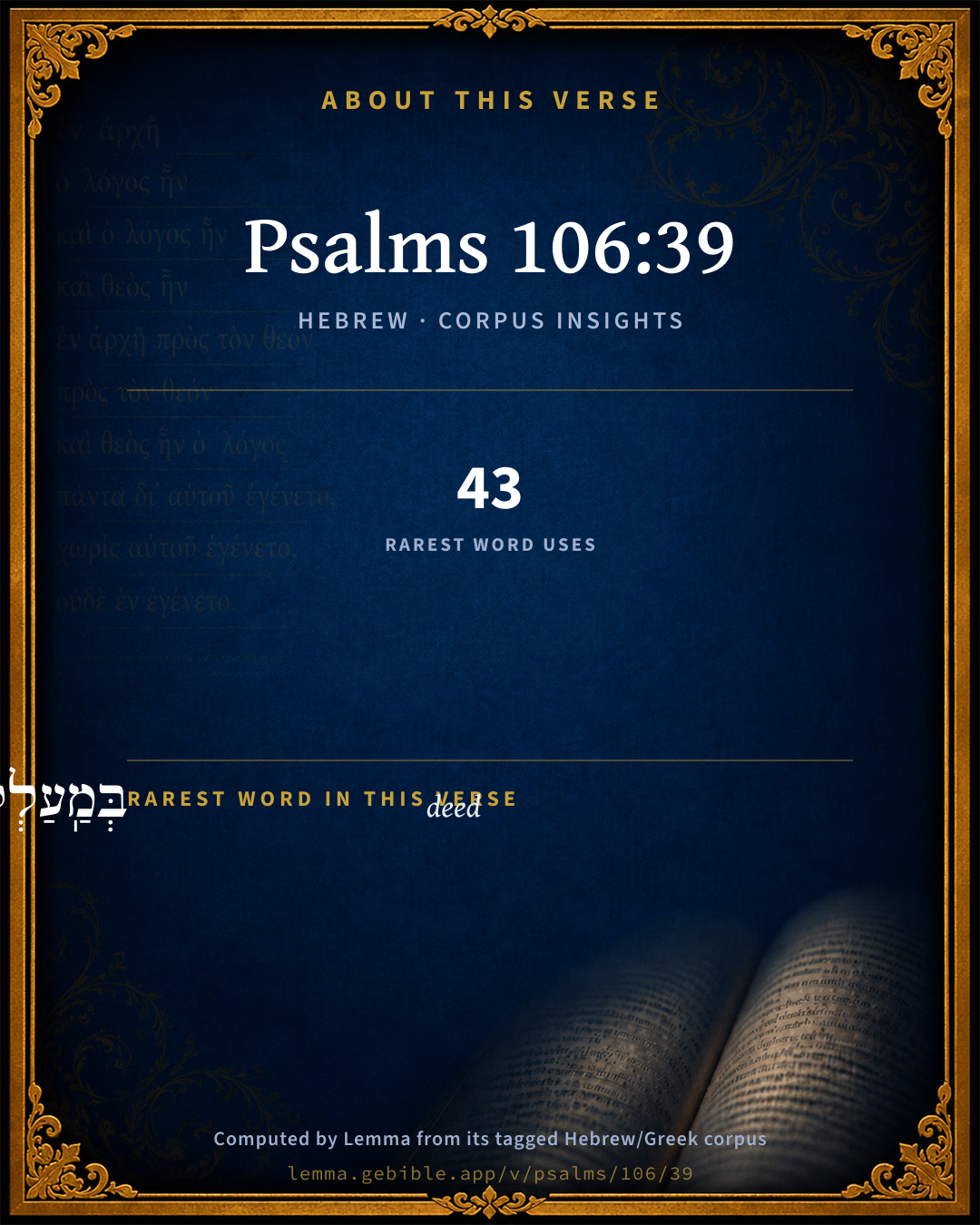
These counts appear in no published source. They are computed here, from the morphology-tagged text and Lemma’s own curated glosses. What Lemma adds →

4
words
4
distinct lemmas
Wisdom
section

Shared distinctive vocabulary

בְּמַֽעַלְלֵיהֶֽם deed H4611 occurs in 41 verses of the Hebrew Bible. Also found in:

Grammatical profile

  • 2 verbs
  • 2 nouns

Verb forms

  • וַיִּטְמְא֥וּ Qal · Sequential Imperfect
  • וַ֝יִּזְנוּ֗ Qal · Sequential Imperfect

Hebrew & Septuagint length

In English translation the verse runs 13 words from the Hebrew and 15 from the Septuagint (LXX English) — closely comparable.

A rough comparison of the two English renderings, which tokenize alike — not a word-level alignment.

Word counts can differ between the Hebrew and the Greek without any difference in meaning — e.g. the Hebrew direct-object marker אֵת has no separate Greek word, and Greek often adds the article ὁ.

Cross-references

15

Topical passages linked to Psalms 106:39 in the Treasury of Scripture Knowledge — connected by theme and wording, ordered by reader-vote popularity; previews shown in the World English Bible.

  • Ezekiel 20:18 I said to their children in the wilderness, Don't you walk in the statutes of your fathers, neither observe their ordinances, nor defile yourselves with their idols.
  • Leviticus 17:7 They shall no more sacrifice their sacrifices to the goat idols, after which they play the prostitute. This shall be a statute forever to them throughout their generations.'
  • Numbers 15:39 and it shall be to you for a fringe, that you may look on it, and remember all the commandments of Yahweh, and do them; and that you not follow after your own heart and your own eyes, after which you use to play the prostitute;
  • Isaiah 24:5–6 The earth also is polluted under the inhabitants of it; because they have transgressed the laws, violated the statutes, broken the everlasting covenant.
  • Isaiah 59:3 For your hands are defiled with blood, and your fingers with iniquity; your lips have spoken lies, your tongue mutters wickedness.
  • Ezekiel 20:30–31 Therefore tell the house of Israel, Thus says the Lord Yahweh: Do you pollute yourselves after the manner of your fathers? and play you the prostitute after their abominations?
  • Ezekiel 20:43 There shall you remember your ways, and all your doings, in which you have polluted yourselves; and you shall loathe yourselves in your own sight for all your evils that you have committed.
  • Hosea 9:1 Don't rejoice, Israel, to jubilation like the nations; For you were unfaithful to your God. You love the wages of a prostitute at every grain threshing floor.
  • Revelation 17:1–6 One of the seven angels who had the seven bowls came and spoke with me, saying, "Come here. I will show you the judgment of the great prostitute who sits on many waters,
  • Exodus 34:16 and you take of their daughters to your sons, and their daughters play the prostitute after their gods, and make your sons play the prostitute after their gods.
  • Leviticus 20:5–6 then I will set my face against that man, and against his family, and will cut him off, and all who play the prostitute after him, to play the prostitute with Molech, from among their people.
  • Jeremiah 3:1–2 They say, If a man put away his wife, and she go from him, and become another man's, will he return to her again? Won't that land be greatly polluted? But you have played the prostitute with many lovers; yet return again to me, says Yahweh.
  • Jeremiah 3:6–9 Moreover Yahweh said to me in the days of Josiah the king, Have you seen that which backsliding Israel has done? she is gone up on every high mountain and under every green tree, and there has played the prostitute.
  • Ezekiel 16:15–63 But you did trust in your beauty, and played the prostitute because of your renown, and poured out your prostitution on everyone who passed by; his it was.
  • Ezekiel 23:3–49 and they played the prostitute in Egypt; they played the prostitute in their youth; there were their breasts pressed, and there was handled the bosom of their virginity.

Cross-references courtesy of OpenBible.info (CC BY 4.0).

Hebrew and Greek witnesses Masoretic Hebrew ↔ Greek Septuagint

The same verse in the two great witnesses to the Old Testament, shown verse-for-verse.

You’re reading Greek Psalm 105 (Hebrew Psalm 106). The Septuagint counts the superscription, so verse numbers can differ from the Hebrew — chapter-level alignment, not verse-by-verse. Numbering follows Rahlfs.

These are two independent witnesses, not word-aligned to each other, and the Septuagint is shown in lemma (dictionary) form.

Hebrew Psalms 106:39 Masoretic · Westminster Leningrad Codex

וַיִּטְמְא֥וּ בְמַעֲשֵׂיהֶ֑ם וַ֝יִּזְנוּ֗ בְּמַֽעַלְלֵיהֶֽם

Thus were they defiled with their works, And prostituted themselves in their deeds.

World English Bible · Public Domain

Greek LXX Greek Psalm 105:39 Septuagint · lemma form

καί μιαίνω ἐν ὁ ἔργον αὐτός καί πορνεύω ἐν ὁ ἐπιτήδευμα αὐτός

and was polluted with their works; and they went a whoring with their own devices.

LXX2012 (modern English Septuagint) · Public Domain

Hebrew: Westminster Leningrad Codex (CC BY 4.0). Greek: Septuagint (public domain); English from LXX2012 (modern English Septuagint) (Public Domain). How the Septuagint differs from the Hebrew →

Commentary

Notes on Psalms 106:39 from classic Christian and Jewish commentators (each source and its license shown beneath its notes). The classic Christian expositions comment on the surrounding passage and are grouped to its opening verse, so a note may address several verses; the Jewish commentaries on the Tanakh (Rashi and others) are per-verse, so they appear only where the commentator wrote on this verse.

Lemma curates 59 commentaries, every one of them public domain or Creative Commons licensed, each selected and text-cleaned for this edition rather than reprinted as found. About our sources →

Trapp's Complete Commentary

John Trapp

Psa 106:39 Thus were they defiled with their own works, and went a whoring with their own inventions.

Ver. 39. Thus were they defiled] Great sins do greatly pollute; neither are men by anything more disadvantaged than by doting upon their own devices.

And went a whoring] They followed it earnestly, and with delight.

John Trapp, A Commentary or Exposition upon All the Books of the Old and New Testament (1647–1656) — public domain. Text from a community e-Sword module.

J. A. Alexander on Psalms

Joseph Addison Alexander

39. (Psa 106:39) And they were polluted by their own doings, and went a whoring by their own crimes. They defiled not only the land of promise but themselves. Or rather, this verse is explanatory of the last clause of Psa 106:38, and shews that the.pollution of the land was nothing more nor less than that of its inhabitants. The figure of spiritual whoredom or adultery is often used to signify the violation, by' the chosen people, of their covenant with God, which is constantly described as a conjugal relation. See above, on Psalms 45, and compare Psa 73:27. This is not stated as an additional offence, but as an aggravating circumstance attending the iniquities already mentioned.

Joseph Addison Alexander, The Psalms Translated and Explained (1850) — public domain. Text from a community e-Sword module.

Tyndale Open Study Notes

Tyndale Open Resources

106:39 Idolatry, like adultery, defiles God’s people (see Lev 18:24; Hos 5:3).

Tyndale Open Study Notes — © Tyndale Open Resources, licensed CC BY-SA 4.0. Text via the HelloAO Bible API.

Geneva Bible (1599)

Geneva Bible translators

Then true chastity is to cleave wholly and only unto God.

Geneva Bible (1599) marginal notes — public domain. Text via Bolls.life.

Adam Clarke's Commentary

Verse 39. And went a whoring.] By fornication, whoredom, and idolatry, the Scripture often expresses idolatry and idolatrous acts. I have given the reason of this in other places. Besides being false to the true God, to whom they are represented as betrothed and married, (and their acts of idolatry were breaches of this solemn engagement,) the worship of idols was frequently accompanied with various acts of impurity.

The translation in the Anglo-Saxon is very remarkable: [A.S.] and they fornicated. In Anglo-Saxon, [A.S.] signifies to fire, to ignite; [A.S.] to commit adultery. So [A.S.] is a prostitute, a whore; and [A.S.] is to go a whoring, to fornicate; probably from [A.S.], or [A.S.] to fire, and [A.S.], to lie, or [A.S.], a glutton; - one who lies with fire, who is ignited by it, who is greedily intent upon the act by which he is inflamed. And do not the words themselves show that in former times whoredom was punished, as it is now, by a disease which produces the sensation of burning in the unhappy prostitutes, whether male or female? And to this meaning the following seems particularly to be applicable.

Adam Clarke's Commentary on the Bible (1810–1826) — public domain. Text from a community e-Sword/MySword module.

John Calvin's Commentaries

39 And they were polluted with their own works He now concludes by stating generally, that the Jews, in adopting the abominable practices of the heathen, were become wholly filthy; because in all the devices of men there is nothing else than impurity. He denominates as the works of men all the false worship which they devise without the Divine sanction; as if he should say, that the holiness, which is truly connected with the worship of God, comes from his word, and that all human inventions and admixtures in religion are profane, and tend to corrupt the service of God. Doubtless it was the intention of the Israelites to serve God, but the Holy Spirit declares that all the fruit of their burning zeal was their becoming more abominable in God’s sight by their lewd inventions. For a strict adherence to the word of God constitutes spiritual chastity.

John Calvin's Commentaries (1540-1563) — public domain. Text from the Calvin Translation Society English edition (1840s-50s) via the Christian Classics Ethereal Library (ccel.org). Calvin's coverage is partial (roughly two-thirds of the Bible); uncommented books and verses are honest gaps, never fabricated. The 19th-century editor's footnotes and remarks are omitted so the notes are faithfully Calvin's own voice.

The Cambridge Bible for Schools and Colleges

gen. ed. J. J. S. Perowne

39. So they were defiled in their works,

And went a whoring in their doings.

As the relation of Israel to Jehovah is expressed by the figure of marriage (Hos_2:2 ff., and often), the abandonment of Jehovah for other gods is described as infidelity to the marriage vow. Cp. Exo_34:15-16; Deu_31:16 : &c.

The Cambridge Bible for Schools and Colleges (gen. ed. J. J. S. Perowne; Cambridge University Press, 1878–1918) — public domain. Text from a community e-Sword module.

John Gill's Exposition

Therefore was the wrath of the Lord kindled against his people,.... Sin is the cause of wrath, which is compared to fire kindled by the breath of the Almighty, and is intolerable; this shows that the offence must be very great, as to incense the Lord against a people he had chosen above all others to be his peculiar people; as well as it was an aggravation, of their sin, so highly to provoke the Lord, whom they had vouched to be their God. There may be appearances of wrath for sin against those who are the Lord's people in the highest and best sense.

Insomuch that he abhorred his own inheritance; the people of Israel, whom he had chosen for his inheritance, and were his portion, and the lot of his inheritance. This must be understood of the body of the people, not of every individual; not of the remnant according to the election of grace among them, of which there were some in all ages; for this would be contrary to his love, and the unchangeableness of it: and however not of the persons of his people, but of their sins; and of the appearances of his providence towards them, which look like wrath, indignation, and abhorrence; for God will not cast off his people, nor forsake his inheritance, Psa 94:14 the following verses explain this wrath and abhorrence. The Targum in the king's Bible is,

"the Word of the Lord abhorred,''

&c. see Zac 11:8.

John Gill's Exposition of the Whole Bible (1746–1763) — public domain (CC PDM 1.0). Text via the HelloAO Bible API.

Albert Barnes' Notes on the Bible

Thus were they defiled with their own works - By their very attempts to deliver themselves from sin. They were corrupt, and the consciousness that they were sinners led them to the commission of even greater enormities in attempting to expiate their guilt, even by the sacrifice of their own sons and daughters. Thus all the religions of the pagan begin in sin, and end in sin. The consciousness of sin only leads to the commission of greater sin; to all the abominations of idol-worship; to the sacrifice - the murder - of the innocent, with the vain hope of thus making expiation for their crimes. Sinners have never yet been able to devise a way by which they may make themselves pure. It is only the great Sacrifice made on the cross which meets the case; which provides expiation; and which saves from future sin.

And went a whoring - Apostacy from God and backsliding are ofen illustrated in the Scriptures by the violation of the marriage compact, as the relation between God and his people is often compared with the relation between a husband and wife. Compare Isa 62:5; Jer 3:14; Jer 7:9; Jer 13:27; Eze 16:20, Eze 16:22, Eze 16:25, Eze 16:33-34; Eze 23:17.

With their own inventions - More literally, With their own works. See the notes at Psa 106:29.

Albert Barnes' Notes on the Bible (1834–1885) — public domain. Text from a community e-Sword/MySword module.

Matthew Poole's English Annotations

Committed spiritual whoredom, by worshipping those idols which were but human inventions, and that in such an unnatural and bloody manner, as they had devised.

Matthew Poole's English Annotations on the Holy Bible (1683–1685) — public domain. Text from a community e-Sword/MySword module.

The Treasury of David

Charles H. Spurgeon

Ver. 39. Thus were they defiled with their own works, and went a whoring with their own inventions. Not only the land but the inhabitants of it were polluted. They broke the marriage bond between them and the Lord, and fell into spiritual adultery. The language is strong, but the offence could not be fitly described in less forcible words. As a husband is deeply dishonoured and sorely wounded should his wife become unchaste and run riot with many paramours in his own house, so was the Lord incensed at his people for setting up gods many and lords many in his own land. They made and invented new gods, and then worshipped what they had made. What a folly! Their novel deities were loathsome monsters and cruel demons, and yet they paid them homage. What wickedness! And to commit this folly and wickedness they cast off the true God, whose miracles they had seen, and whose people they were. This was provocation of the severest sort.

Ver. 39. And went a whoring with their own inventions. As harlotry is one of the most abominable of sins that can be committed by a daughter or a wife; so often in the Scriptures turning from God and especially the practice of idolatry is called whoredom and fornication, Ps 73:27 Ex 34:15-16. William S. Plumer.

Psalms 106:40*

Ver. 40 Therefore was the wrath of the LORD kindled against his people, in so much that he abhorred his own inheritance. Not that even then he broke his covenant or utterly cast off his offending people, but he felt the deepest indignation, and even looked upon them with abhorrence. The feeling described is like to that of a husband who still loves his guilty wife, and yet when he thinks of her lewdness feels his whole nature rising in righteous anger at her, so that the very sight of her afflicts his soul. How far the divine wrath can burn against those whom he yet loves in his heart it were hard to say, but certainly Israel pushed the experiment to the extreme.

And he gave them into the hand of the heathen. This was the manifestation of his abhorrence. He gave them a taste of the result of sin; they spared the heathen, mixed with them and imitated them, and soon they had to smart from them, for hordes of invaders were let loose upon them to spoil them at their pleasure. Men make rods for their own backs. Their own inventions become their punishments.

And they that hated them ruled over them. And who could wonder? Sin never creates true love. They joined the heathen in their wickedness, and they did not win their hearts, but rather provoked their contempt. If we mix with men of the world they will soon become our masters and our tyrants, and we cannot want worse.

Charles H. Spurgeon's The Treasury of David (1869–1885) — public domain. Psalms only. Text from a community e-Sword/MySword module.

Whedon's Commentary on the Bible

Daniel D. Whedon

39. Thus were they defiled—See Jdg_2:11-13

Daniel D. Whedon (gen. ed.), Commentary on the Old and New Testaments (1874–1909) — public domain. Text from a community e-Sword module.

The Pulpit Commentary

Thus were they defiled with their own works. The heathen "works," which they adopted from them (ver. 35), had become "their own works," and made them a "defiled" and "polluted" people. And went a-whoring with their own inventions; i.e. "became spiritually adulterous," deserted God, and were unfaithful to him. (comp. Eze_23:2-21 Hos_2:2-5)

The Pulpit Commentary (1880–1919), ed. H.D.M. Spence-Jones & Joseph S. Exell — public domain. Text from a community e-Sword module.

Lesson kit

Teaching starters — assembled from the data on this page, not authored interpretation. Every prompt links to the verse data it draws on. Edit before teaching.

Psalms, in the Wisdom, opens this verse with 4 words (4 distinct Hebrew lemmas). Its most distinctive word is maʻălâl (“deed”). A historical commentator’s framing appears above. Read the whole chapter for the surrounding context.

Discussion questions

  1. The word maʻălâl carries the sense “deed.” How does it shape the verse?
  2. How does Deuteronomy 28:20, which shares the word «deed», read alongside this verse?
  3. These translations render this verse differently. What is at stake in choosing one wording over another?
  4. «וַיִּטְמְא֥וּ» is a Qal Sequential Imperfect verb. How does that grammatical form shape the action described?
  5. Compare how Trapp's Complete Commentary and J. A. Alexander on Psalms read this verse. Where do they agree or differ?

Things to notice

Reading settings

Reading text

Shown beneath each verse's original-language words.

Old Testament
Old Testament edition

Read the OT as the Masoretic Hebrew (MT) or the Greek Septuagint (LXX).

English shown for the Greek Septuagint (in the Hebrew ↔ Greek comparison).

Comparing translations? Open the Compare panel on any verse page to stack up to four side by side.