Ezekiel 16:28

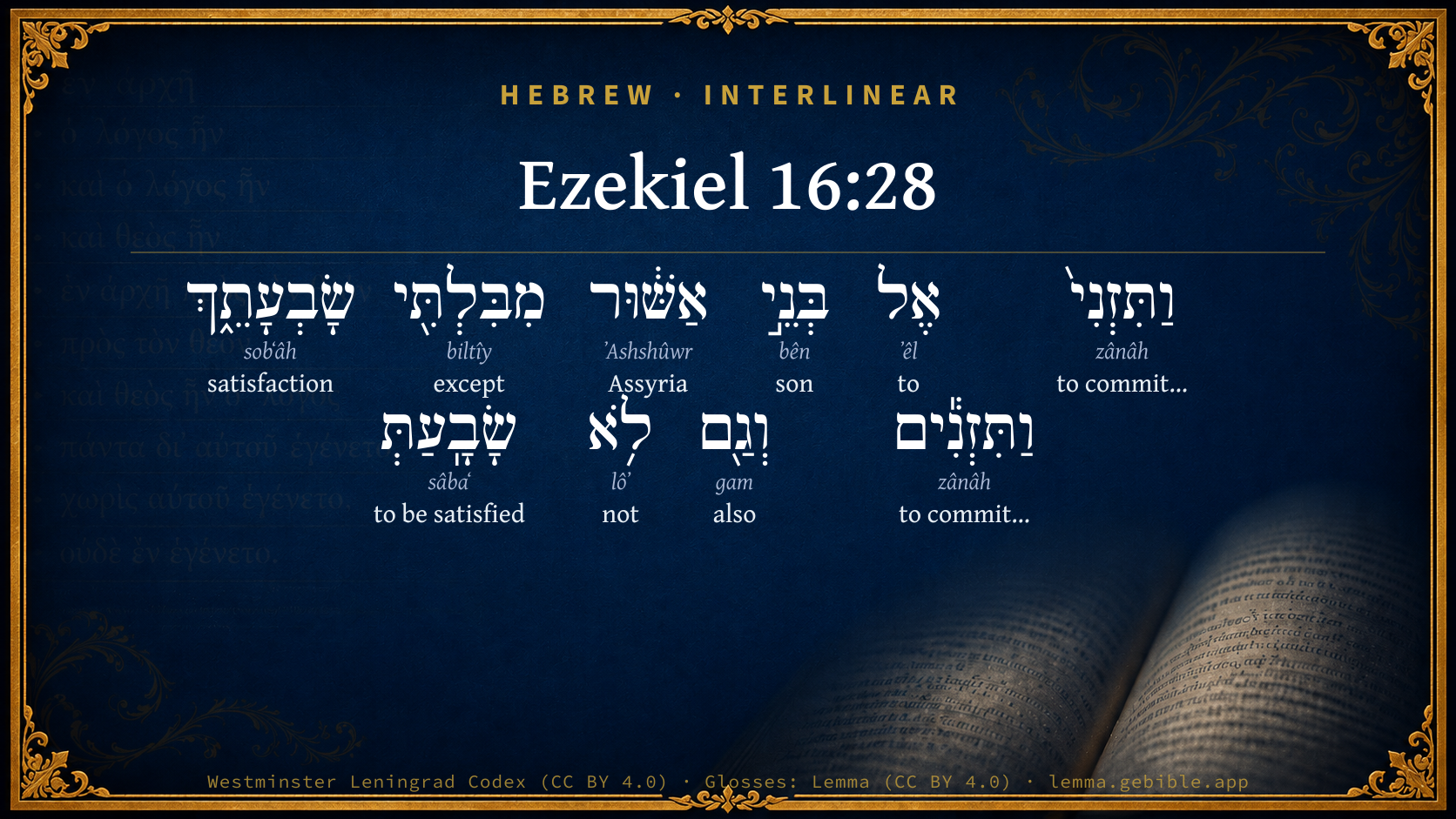
Hebrew (Westminster Leningrad Codex) Ezekiel 16:28 appears in the Hebrew Old Testament. The text above is from the Westminster Leningrad Codex. Each word links to its Strong’s number, a concise gloss, and parsing drawn from the Open Scriptures Hebrew Bible morphology. Click any word for its full Brown-Driver-Briggs (BDB) entry.
Download image
Cite this verse

Ezekiel 16:28 (World English Bible). Public Domain. Lemma interlinear Bible study tool, https://lemma.gebible.app/v/ezekiel/16/28.

Show BibTeX & RIS
BibTeX
RIS
English Translation
You have played the prostitute also with the Assyrians, because you were insatiable; yes, you have played the prostitute with them, and yet you weren't satisfied.
World English Bible · Public Domain
Download a study sheet

One document with this verse’s original text, its word-by-word gloss line, the meaning frame, cross-references with their text, attributed commentary, and full source and license credits — printable, and it pastes into notes with its structure intact.

This verse Autodidact and up

Study sheet (.html) Plain text (.txt)

A passage Seminary Student

Up to 50 verses in one chapter. A passage sheet keeps up to 6 commentary sources and 12 cross-references per verse, in the order this page ranks them, and says so on the sheet whenever that leaves anything out. Ask for a single verse and you get the Autodidact verse sheet above.

Everything on this page stays free to read, with no account — the sheet is a download of what is already on screen, not access to it.

Want to remove ads? Support Godless Engineer
Compare translations 3

The same verse in 3 English versions, stacked beneath the original-language interlinear above. Click any original word for its lexicon entry.

Each is an independent rendering of the whole verse — the interlinear is not word-aligned to these translations.

Highlighted words mark where these versions differ — a whole-verse word diff, not a word-by-word alignment.

  • World English Bible Public Domain
    You have played the prostitute also with the Assyrians, because you were insatiable; yes, you have played the prostitute with them, and yet you weren't satisfied.
  • King James Version Public Domain
    Thou hast played the whore also with the Assyrians, because thou wast unsatiable; yea, thou hast played the harlot with them, and yet couldest not be satisfied.
  • unfoldingWord Literal Text CC BY-SA 4.0
    You have acted like a prostitute with the Assyrians because you could not be satisfied. You acted like a prostitute and still were not satisfied.

unfoldingWord Literal Text — © unfoldingWord, licensed CC BY-SA 4.0. Word-aligned USFM3 via Door43 (git.door43.org/unfoldingWord/en_ult).

Versions to compare (up to 4)

3 of 4 selected

Show all 18 translations

Every available English version of this verse, each an independent rendering of the whole verse.

  • World English Bible Public Domain
    You have played the prostitute also with the Assyrians, because you were insatiable; yes, you have played the prostitute with them, and yet you weren't satisfied.
  • Berean Standard Bible Public Domain
    Then you prostituted yourself with the Assyrians, because you were not yet satisfied. Even after that, you were still not satisfied.
  • Majority Standard Bible Public Domain
    Then you prostituted yourself with the Assyrians, because you were not yet satisfied. Even after that, you were still not satisfied.
  • King James Version Public Domain
    Thou hast played the whore also with the Assyrians, because thou wast unsatiable; yea, thou hast played the harlot with them, and yet couldest not be satisfied.
  • American Standard Version (1901) Public Domain
    Thou hast played the harlot also with the Assyrians, because thou wast insatiable; yea, thou hast played the harlot with them, and yet thou wast not satisfied.
  • Revised Version (1885) Public Domain
    Thou hast played the harlot also with the Assyrians, because thou wast unsatiable; yea, thou hast played the harlot with them, and yet thou wast not satisfied.
  • Geneva Bible (1599) Public Domain
    Thou hast played the whore also with the Assyrians, because thou wast insaciable: yea, thou hast played the harlot with them, and yet couldest not be satisfied.
  • Douay-Rheims (1899) Public Domain
    Thou hast also committed fornication with the Assyrians, because thou wast not yet satisfied: and after thou hadst played the harlot with them, even so thou wast not contented.
  • Young's Literal Translation Public Domain
    And thou goest a-whoring unto sons of Asshur, Without thy being satisfied, And thou dost go a-whoring with them, And also -- thou hast not been satisfied.
  • Literal Standard Version CC BY-SA 4.0
    And you go whoring to sons of Asshur, || Without your being satisfied, || And you go whoring with them, || And also—you have not been satisfied.
  • Unlocked Literal Bible CC BY-SA 4.0
    You have acted like a prostitute with the Assyrians because you could not be satisfied. You acted like a prostitute and still were not satisfied.
  • unfoldingWord Literal Text CC BY-SA 4.0
    You have acted like a prostitute with the Assyrians because you could not be satisfied. You acted like a prostitute and still were not satisfied.
  • Darby Bible Public Domain
    And thou didst commit fornication with the Assyrians, because thou wast insatiable; yea, thou didst commit fornication with them, and yet couldest not be satisfied.
  • World Messianic Bible Public Domain
    You have played the prostitute also with the Assyrians, because you were insatiable; yes, you have played the prostitute with them, and yet you weren’t satisfied.
  • Webster's Bible Public Domain
    Thou hast played the harlot also with the Assyrians, because thou wast insatiable; yes, thou hast played the harlot with them, and yet couldst not be satisfied.
  • Free Bible Version CC BY-SA 4.0
    Because you weren't satisfied you prostituted yourself with the Assyrians. But even then you weren't satisfied.
  • Bible in Basic English Public Domain
    And you went with the Assyrians, because of your desire which was without measure; you were acting like a loose woman with them, and still you had not enough.
  • JPS Tanakh (1917) Public Domain
    Thou hast played the harlot also with the Assyrians, without having enough; yea, thou hast played the harlot with them, and yet thou wast not satisfied.

Literal Standard Version (2020), Covenant Press — licensed CC BY-SA 4.0. Text via the HelloAO Bible API (eBible.org). Unlocked Literal Bible (unfoldingWord) — licensed CC BY-SA 4.0. Text via the HelloAO Bible API (eBible.org). unfoldingWord Literal Text — © unfoldingWord, licensed CC BY-SA 4.0. Word-aligned USFM3 via Door43 (git.door43.org/unfoldingWord/en_ult). Free Bible Version, Dr. Jonathan Gallagher — licensed CC BY-SA 4.0. Text via the HelloAO Bible API (eBible.org).

Word by word

More ways to search: Search by grammar → Find every occurrence → Compare this word →

Practice this passage: Drill this verse → Learn its vocabulary →

שָׂבְעָתֵ֑ךְ
sobʻâh
H7654
“satisfaction · your”
Noun, Common, Feminine, Singular, Construct + Suffix, Personal, 2nd Person, Feminine, Singular
Part of Speech
Noun
Type
Common
Gender
Feminine
Number
Singular
State
Construct
Full BDB Definition

Origin: from H7648

TWOT: 2231b

satisfaction, satiety, one's fill
  1. וַתִּזְנִי֙ zânâh H2181 “and · to commit fornication” Conjunction + Verb, Qal, Sequential Imperfect, 2nd Person, Feminine, Singular
  2. אֶל ʼêl H413 “to” Preposition
  3. בְּנֵ֣י bên H1121 “sons of” Noun, Common, Masculine, Plural, Construct
  4. אַשּׁ֔וּר ʼAshshûwr H804 “Assyria” Noun, Proper
  5. מִבִּלְתִּ֖י biltîy H1115 “from · except” Preposition + Particle, Negative
  6. וַתִּזְנִ֕ים zânâh H2181 “and · to commit fornication · them” Conjunction + Verb, Qal, Sequential Imperfect, 2nd Person, Feminine, Singular + Suffix, Personal, 3rd Person, Masculine, Plural
  7. וְגַ֖ם gam H1571 “and · also” Conjunction + Particle, Accusative
  8. לֹ֥א lôʼ H3808 “not” Particle, Negative
  9. שָׂבָֽעַתְּ sâbaʻ H7646 “to be satisfied” Verb, Qal, Perfect, 2nd Person, Feminine, Singular

About this verse

These counts appear in no published source. They are computed here, from the morphology-tagged text and Lemma’s own curated glosses. What Lemma adds →

10
words
9
distinct lemmas
Prophets
section

Notable vocabulary

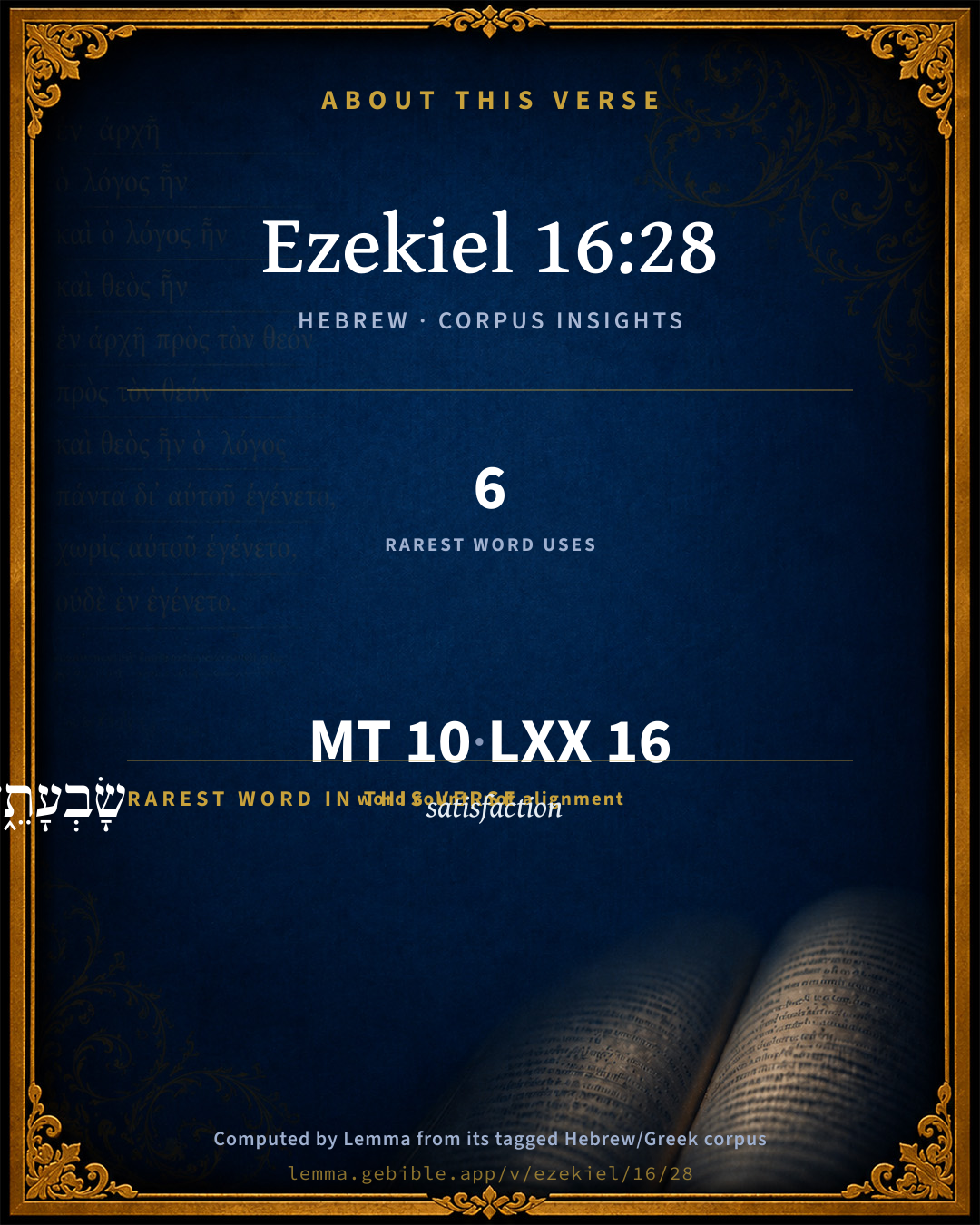
The rarest word here is שָׂבְעָתֵ֑ךְ satisfaction H7654 — appearing just 6 times in the whole Hebrew Bible.

Shared distinctive vocabulary

שָׂבְעָתֵ֑ךְ satisfaction H7654 occurs in 6 verses of the Hebrew Bible. Also found in:

Grammatical profile

  • 3 verbs
  • 3 nouns
  • 1 preposition
  • 3 particles

Verb forms

  • וַתִּזְנִי֙ Qal · Sequential Imperfect
  • וַתִּזְנִ֕ים Qal · Sequential Imperfect
  • שָׂבָֽעַתְּ Qal · Perfect

Repetition

A word recurs within this verse — often emphatic in Hebrew:

  • וַתִּזְנִי֙ to commit fornication H2181 ×2

Hebrew & Septuagint length

In English translation the verse runs 26 words from the Hebrew and 26 from the Septuagint (LXX English) — the same length.

A rough comparison of the two English renderings, which tokenize alike — not a word-level alignment.

Word counts can differ between the Hebrew and the Greek without any difference in meaning — e.g. the Hebrew direct-object marker אֵת has no separate Greek word, and Greek often adds the article ὁ.

In the original languages it is 10 Hebrew tokens and 16 Greek tokens — but the two are counted differently (Hebrew bundles its prefixes and suffixes into one token; the Greek is in lemma form), so that isn’t a like-for-like length.

Cross-references

12

Topical passages linked to Ezekiel 16:28 in the Treasury of Scripture Knowledge — connected by theme and wording, ordered by reader-vote popularity; previews shown in the World English Bible.

  • 2 Kings 16:7 So Ahaz sent messengers to Tiglath Pileser king of Assyria, saying, I am your servant and your son: come up, and save me out of the hand of the king of Syria, and out of the hand of the king of Israel, who rise up against me.
  • 2 Kings 16:10–18 King Ahaz went to Damascus to meet Tiglath Pileser king of Assyria, and saw the altar that was at Damascus; and king Ahaz sent to Urijah the priest the fashion of the altar, and the pattern of it, according to all the workmanship of it.
  • Jeremiah 2:18 Now what have you to do in the way to Egypt, to drink the waters of the Shihor? or what have you to do in the way to Assyria, to drink the waters of the River?
  • Jeremiah 2:36 Why go you about so much to change your way? you shall be ashamed of Egypt also, as you were ashamed of Assyria.
  • Hosea 10:6 It also will be carried to Assyria for a present to a great king. Ephraim will receive shame, And Israel will be ashamed of his own counsel.
  • 2 Chronicles 28:23 For he sacrificed to the gods of Damascus, which struck him; and he said, Because the gods of the kings of Syria helped them, [therefore] will I sacrifice to them, that they may help me. But they were the ruin of him, and of all Israel.
  • Judges 10:6 The children of Israel again did that which was evil in the sight of Yahweh, and served the Baals, and the Ashtaroth, and the gods of Syria, and the gods of Sidon, and the gods of Moab, and the gods of the children of Ammon, and the gods of the Philistines; and they forsook Yahweh, and didn't serve him.
  • 2 Kings 21:11 Because Manasseh king of Judah has done these abominations, and has done wickedly above all that the Amorites did, who were before him, and has made Judah also to sin with his idols;
  • 2 Chronicles 28:16 At that time did king Ahaz send to the kings of Assyria to help him.
  • 2 Chronicles 28:20–21 Tilgath Pilneser king of Assyria came to him, and distressed him, but didn't strengthen him.
  • Ezekiel 23:5–9 Oholah played the prostitute when she was mine; and she doted on her lovers, on the Assyrians [her] neighbors,
  • Ezekiel 23:12–21 She doted on the Assyrians, governors and rulers, [her] neighbors, clothed most gorgeously, horsemen riding on horses, all of them desirable young men.

Cross-references courtesy of OpenBible.info (CC BY 4.0).

Hebrew and Greek witnesses Masoretic Hebrew ↔ Greek Septuagint

The same verse in the two great witnesses to the Old Testament, shown verse-for-verse.

These are two independent witnesses, not word-aligned to each other, and the Septuagint is shown in lemma (dictionary) form.

Hebrew Ezekiel 16:28 Masoretic · Westminster Leningrad Codex

וַתִּזְנִי֙ אֶל בְּנֵ֣י אַשּׁ֔וּר מִבִּלְתִּ֖י שָׂבְעָתֵ֑ךְ וַתִּזְנִ֕ים וְגַ֖ם לֹ֥א שָׂבָֽעַתְּ

You have played the prostitute also with the Assyrians, because you were insatiable; yes, you have played the prostitute with them, and yet you weren't satisfied.

World English Bible · Public Domain

Greek LXX Ezekiel 16:28 Septuagint · lemma form

καί ἐκπορνεύω ἐπί ὁ θυγάτηρ ασσουρ καί οὐδέ οὕτως ἐνπίμπλημι καί ἐκπορνεύω καί οὐ ἐν ἐπιπλέω

And you did go a-whoring to the daughters of Assur, and not even thus was you satisfied; yes, you did go a-whoring, and was not satisfied.

LXX2012 (modern English Septuagint) · Public Domain

Hebrew: Westminster Leningrad Codex (CC BY 4.0). Greek: Septuagint (public domain); English from LXX2012 (modern English Septuagint) (Public Domain). How the Septuagint differs from the Hebrew →

Targum (Aramaic paraphrase)

1

The Targum is the ancient Jewish Aramaic paraphrase of the Hebrew Scriptures — an interpretive translation, not the Hebrew text itself. Onkelos (literal) and Pseudo-Jonathan (expansive) render the Torah, and Jonathan the Prophets. Coverage is partial: where no permissively-licensed English translation exists for a verse, only the Aramaic is shown. This is verse-level text, not a word-by-word alignment to the Hebrew.

  1. Targum Jonathan Prophets (Joshua–Malachi)
    וּטְעֵית בָּתַר בְּנֵי אַתּוּר מִדְלָא יְדַעַתְּ אוֹרַיְתָא וּטְעֵית בְּהוֹן וְאַף לָא יְדַעַתְּ תְּיוּבְתָּא:

    (no public-domain English translation for this verse)

    Targum Jonathan — Aramaic: “Mikraot Gedolot” (public domain). English: “Sefaria Community Translation” (CC0 1.0 (public-domain dedication)); “London "Chaldee Paraphrase," 1871” (public domain). Text via Sefaria.

Commentary

Notes on Ezekiel 16:28 from classic Christian and Jewish commentators (each source and its license shown beneath its notes). The classic Christian expositions comment on the surrounding passage and are grouped to its opening verse, so a note may address several verses; the Jewish commentaries on the Tanakh (Rashi and others) are per-verse, so they appear only where the commentator wrote on this verse.

Lemma curates 59 commentaries, every one of them public domain or Creative Commons licensed, each selected and text-cleaned for this edition rather than reprinted as found. About our sources →

Trapp's Complete Commentary

John Trapp

Eze 16:28 Thou hast played the whore also with the Assyrians, because thou wast unsatiable; yea, thou hast played the harlot with them, and yet couldest not be satisfied.

Ver. 28. Thou hast played the whore also with the Assyrians.] By making sinful leagues, and gadding so much about to change thy way. {Jer 2:36}

And yet couldest not be satisfied.] It is as easy to quench the fire of Etna as the thoughts set on fire by lust.

John Trapp, A Commentary or Exposition upon All the Books of the Old and New Testament (1647–1656) — public domain. Text from a community e-Sword module.

Jamieson, Fausset & Brown

Robert Jamieson, A. R. Fausset & David Brown

unsatiable--Not satisfied with whoredoms with neighbors, thou hast gone off to the distant Assyrians, that is, hast sought a league with them, and with it adopted their idolatries.

Jamieson, Fausset & Brown — Commentary Critical and Explanatory on the Whole Bible (1871) — public domain (CC PDM 1.0). Text via the HelloAO Bible API.

John Calvin's Commentaries

I interpret this verse also of the covenant by which the Jews had entangled themselves, when they willingly joined themselves to the Assyrians; for this was a sure sign of distrust, when they so desired foreign aid, as if they had been deprived of God’s protection. And it would be absurd to explain this verse of idolatries, since the prophets were not accustomed to speak in this way, that the people committed fornication with the Assyrians, because they imitated their superstitions and perverse worship. As, therefore, we formerly saw that the Jews had defiled themselves with idols, and prostituted themselves to impious ceremonies, forgetful of God’s law; so now the Prophet accuses them of a different kind of pollution, since they eagerly sought for aid from all quarters, as if God had not sufficient strength for their protection. For otherwise there was no religious reason for their not making peace with the Assyrians; but when they saw themselves oppressed by the kings of Israel and Syria, then they thought of sending for the Assyrians; and this was like thrusting God from his place. (2 Kings 16:7-9.) For God was willing to defend the land with extended wings, and to cherish the Jews as a hen does her brood, as Moses says, (Deuteronomy 32:11.) Now, in thinking themselves exposed to any danger, they really throw off the help of God. It is not surprising, then, that the Prophet says, that they had polluted themselves with the Assyrians, because they were not satisfied. He pursues the simile on which we have dwelt sufficiently; for he blames the Jews for their insatiable lust, just as when a woman is not content with a single follower, and attracting a crowd obtrudes herself without modesty or delicacy, and sells herself to wickedness. Such was the licentiousness of the Jews, that they united many acts of pollution together. They had already departed from the true faith in making a treaty with the Egyptians, and they added another imagination, that it was useful to have the Assyrians in alliance with them: hence that unbridled lust which the Prophet metaphorically rebukes. It follows —

John Calvin's Commentaries (1540-1563) — public domain. Text from the Calvin Translation Society English edition (1840s-50s) via the Christian Classics Ethereal Library (ccel.org). Calvin's coverage is partial (roughly two-thirds of the Bible); uncommented books and verses are honest gaps, never fabricated. The 19th-century editor's footnotes and remarks are omitted so the notes are faithfully Calvin's own voice.

Ellicott's Commentary for English Readers

(28) With the Assyrians.—The Assyrians and Egyptians were for many centuries in deadly hostility against each other, and it would seem that Israel could hardly have formed alliances with and adopted the idolatries of both. Nevertheless they had done so, and in addition to their Egyptian idolatries, had gone to the extent, in the time of Ahaz, of displacing the altar in the court of the Temple, and putting in its stead an altar of the gods of Assyria (2 Kings 16.

A Bible Commentary for English Readers, edited by Charles John Ellicott (1878–1897) — public domain. Text from a community e-Sword module.

The Cambridge Bible for Schools and Colleges

gen. ed. J. J. S. Perowne

28. Infidelity with Assyria.

The historical tense “didst play” is better. Already Amo_5:26 appears to mention the names of Assyrian gods, for the passage can hardly refer to any time but his own. Jer_2:18; Jer_2:36.

The Cambridge Bible for Schools and Colleges (gen. ed. J. J. S. Perowne; Cambridge University Press, 1878–1918) — public domain. Text from a community e-Sword module.

John Gill's Exposition

Thou hast moreover multiplied thy fornication in the land of Canaan,.... Or, "with the land of Canaan" (l); with the inhabitants of it, doing the same evils, committing the same idolatries, as the old inhabitants of Canaan did; and so the Targum,

"and thou hast multiplied thine idols, that thou mightest be joined to the people of Canaan:''

or, "to the land of Canaan" (m); like to the land of Canaan; according to the abominations of the Canaanites, doing as they did. Jarchi takes the word Canaan to signify a "merchant", as it does in Hos 12:7; and the land of Canaan to be the same with the land of Chaldea, called a land of traffic, and Babylon the city of merchants, Eze 17:4; since it follows,

unto Chaldea: but the sense is, that the Jews were not content with the idolatries in the land of Canaan, but sent even to Chaldea, a remote country, to fetch new idols from thence; see Eze 23:14. The Targum is,

"to walk in the laws of the Chaldeans;''

their religious ones, their rites and ceremonies respecting idolatrous worship:

and yet thou wast not satisfied herewith; but still wanted other idols and modes of worship; not being content with the gods of the Egyptians, nor of the Assyrians, nor of the Canaanites, nor of the Chaldeans.

(l) "cum terra Canaan", Munster, so some in Vatablus, Tigurine version, Noldius, p. 39. No. 288. (m) "ad terram Canaan", so some in Vatablus. Approved by Kimchi and Ben Melech.

John Gill's Exposition of the Whole Bible (1746–1763) — public domain (CC PDM 1.0). Text via the HelloAO Bible API.

Albert Barnes' Notes on the Bible

Compare the marginal reference. Idolatry, spiritual adultery, invariably accompanied these unholy alliances, and brought with it disaster and ruin.

Albert Barnes' Notes on the Bible (1834–1885) — public domain. Text from a community e-Sword/MySword module.

Haydock's Catholic Bible Commentary

Assyrians, adoring the sun, Baal, &c. (Calmet)

George Leo Haydock (1774–1849), Haydock's Catholic Family Bible and Commentary, 1859 edition — public domain. Excludes Psalms (Douay-Rheims chapter numbering differs from Protestant) and Deuterocanonical books (Catholic canon only).

Matthew Poole's English Annotations

Thou hast courted their friendship and alliance, and to obtain it hast entertained their religion, manners, and impieties, been all idolatress with them, and committed adulteries with them, though they were far from thee. When thou didst wickedly with thy neighbours, it might admit some little colour of excuse, but it is inexcusable to run to remotest nations.

Because thou wast unsatiable; without satisfying thyself (and so the Hebrew may be read); but our interpreters refer it to the boundless lusts of this lewd adulteress, and not to the issue and event of her practices; and in the endless lustings of a wicked heart idolaters and adulterers do agree.

Yea, thou hast played the harlot; it is repeated to shame her, and make her blush and repent.

Couldst not be satisfied; or, wast not satisfied. Assyrian gods proved, as other idols, a snare and a lie to the Jews, 2Ki 16:9,10; Jer 2:18,36; Ho 7:11,12; 14:3.

Matthew Poole's English Annotations on the Holy Bible (1683–1685) — public domain. Text from a community e-Sword/MySword module.

Whedon's Commentary on the Bible

Daniel D. Whedon

28, 29. Hast played… hast… multiplied — Literally, didst play, didst multiply. Not content with having adopted the worst features of Canaanitish and Egyptian idolatry (Eze_16:20; Eze_16:26), she turns for novelties of wickedness to the Assyrians and Chaldeans. “Thou hast provoked me in all these ways, adding one sin upon another, because thy whoredoms were too few for thee.” — Mosheh Ben Shesheth.

In the land of Canaan unto Chaldea — Literally, unto the merchants’ land, even unto Chaldea. (Compare Eze_17:4.)

Daniel D. Whedon (gen. ed.), Commentary on the Old and New Testaments (1874–1909) — public domain. Text from a community e-Sword module.

The Pulpit Commentary

With the Assyrians. Here also the words include political alliances like that of Ahaz with Tiglath-Pileser, (2Ki_16:7) as well as the adoption of idolatrous worship. The latter probably followed under Ahaz as a consequence of the former, and afterwards spread through the influence of the Assyrian colonists each nation with its own deities in Samaria. (2Ki_17:24) The culture of the queen of heaven, (Jer_44:17) i.e. of the Assyrian Ishtar, may have had this origin. Yet couldest not be satisfied. One is reminded once more of Juvenal ("Sat.," 6:130).

The Pulpit Commentary (1880–1919), ed. H.D.M. Spence-Jones & Joseph S. Exell — public domain. Text from a community e-Sword module.

Rashi

Rabbi Shlomo Yitzchaki (Rashi)

because you were not sated Because you were not sated with the abominations of Egypt.

and you played the harlot with them Heb. וַתִּזְנִים, from the term for harlotry (זְנוּת), e ansera[s] a els.

Rashi on the Tanakh — English translations: “The Judaica Press complete Tanach with Rashi, translated by A. J. Rosenberg” (CC BY 4.0); “Pentateuch with Rashi's commentary by M. Rosenbaum and A.M. Silbermann, 1929-1934” (public domain); “The Metsudah Tanach series, Lakewood, N.J” (CC BY 4.0); and “The Book of Joshua, Metsudah Publications, 1997” (CC BY 4.0). Text via Sefaria.

Lesson kit

Teaching starters — assembled from the data on this page, not authored interpretation. Every prompt links to the verse data it draws on. Edit before teaching.

Ezekiel, in the Prophets, opens this verse with 10 words (9 distinct Hebrew lemmas). Its most distinctive word is sobʻâh (“satisfaction”). A historical commentator’s framing appears above. Read the whole chapter for the surrounding context.

Discussion questions

  1. What does “satisfaction” (sobʻâh) contribute to the verse as a whole?
  2. Isaiah 23:18 shares the word «satisfaction» with this verse. How do the two illuminate each other?
  3. “to commit fornication” occurs 2× in this one verse. What is the effect of the repetition?
  4. The translations on this page render this verse differently — a whole-verse word diff, not a word-by-word alignment. What might account for the different wordings?
  5. The verb «וַתִּזְנִי֙» is Qal Sequential Imperfect. How does its form color the action?
  6. Reading how Trapp's Complete Commentary and Jamieson, Fausset & Brown read this verse, where do the two commentators agree and where do they part?

Things to notice

Reading settings

Reading text

Shown beneath each verse's original-language words.

Old Testament
Old Testament edition

Read the OT as the Masoretic Hebrew (MT) or the Greek Septuagint (LXX).

English shown for the Greek Septuagint (in the Hebrew ↔ Greek comparison).

Comparing translations? Open the Compare panel on any verse page to stack up to four side by side.