
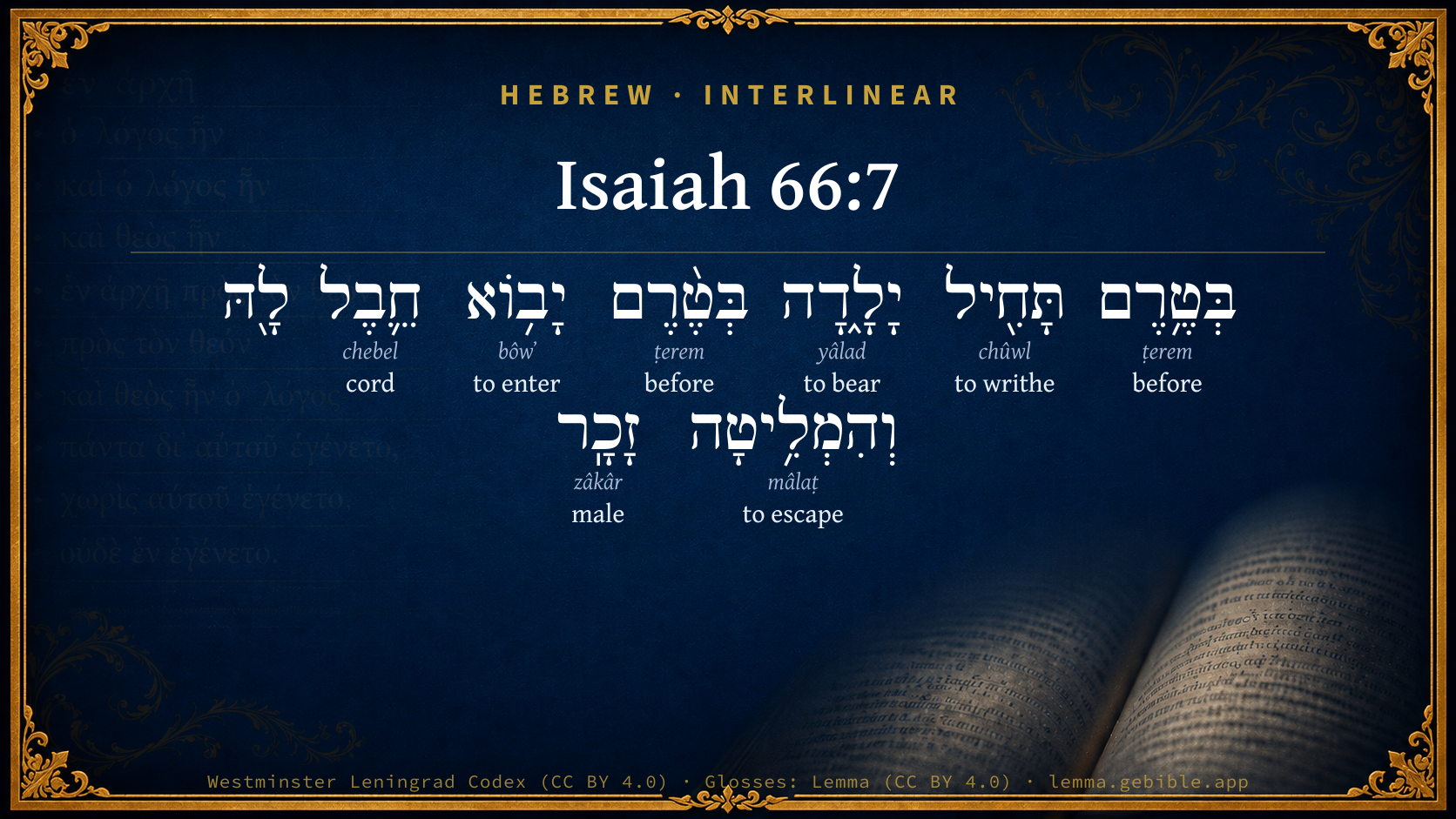
Isaiah 66:7

Hebrew (Westminster Leningrad Codex) Isaiah 66:7 appears in the Hebrew Old Testament. The text above is from the Westminster Leningrad Codex. Each word links to its Strong’s number, a concise gloss, and parsing drawn from the Open Scriptures Hebrew Bible morphology. Click any word for its full Brown-Driver-Briggs (BDB) entry.
Download image
Cite this verse

Isaiah 66:7 (World English Bible). Public Domain. Lemma interlinear Bible study tool, https://lemma.gebible.app/v/isaiah/66/7.

Show BibTeX & RIS
BibTeX
RIS
English Translation
Before she travailed, she brought forth; before her pain came, she was delivered of a man-child.
World English Bible · Public Domain
Download a study sheet

One document with this verse’s original text, its word-by-word gloss line, the meaning frame, cross-references with their text, attributed commentary, and full source and license credits — printable, and it pastes into notes with its structure intact.

This verse Autodidact and up

Study sheet (.html) Plain text (.txt)

A passage Seminary Student

Up to 50 verses in one chapter. A passage sheet keeps up to 6 commentary sources and 12 cross-references per verse, in the order this page ranks them, and says so on the sheet whenever that leaves anything out. Ask for a single verse and you get the Autodidact verse sheet above.

Everything on this page stays free to read, with no account — the sheet is a download of what is already on screen, not access to it.

Want to remove ads? Support Godless Engineer
Compare translations 3

The same verse in 3 English versions, stacked beneath the original-language interlinear above. Click any original word for its lexicon entry.

Each is an independent rendering of the whole verse — the interlinear is not word-aligned to these translations.

Highlighted words mark where these versions differ — a whole-verse word diff, not a word-by-word alignment.

  • World English Bible Public Domain
    Before she travailed, she brought forth; before her pain came, she was delivered of a man-child.
  • King James Version Public Domain
    Before she travailed, she brought forth; before her pain came, she was delivered of a man child.
  • unfoldingWord Literal Text CC BY-SA 4.0
    Before she writhes, she births; before pain comes to her, then she delivers a male.

unfoldingWord Literal Text — © unfoldingWord, licensed CC BY-SA 4.0. Word-aligned USFM3 via Door43 (git.door43.org/unfoldingWord/en_ult).

Versions to compare (up to 4)

3 of 4 selected

Show all 18 translations

Every available English version of this verse, each an independent rendering of the whole verse.

  • World English Bible Public Domain
    Before she travailed, she brought forth; before her pain came, she was delivered of a man-child.
  • Berean Standard Bible Public Domain
    “Before she was in labor, she gave birth; before she was in pain, she delivered a boy.
  • Majority Standard Bible Public Domain
    “Before she was in labor, she gave birth; before she was in pain, she delivered a boy.
  • King James Version Public Domain
    Before she travailed, she brought forth; before her pain came, she was delivered of a man child.
  • American Standard Version (1901) Public Domain
    Before she travailed, she brought forth; before her pain came, she was delivered of a man-child.
  • Revised Version (1885) Public Domain
    Before she travailed, she brought forth; before her pain came, she was delivered of a man child.
  • Geneva Bible (1599) Public Domain
    Before she trauailed, she brought foorth: and before her paine came, she was deliuered of a man childe.
  • Douay-Rheims (1899) Public Domain
    Before she was in labour, she brought forth; before her time came to be delivered, she brought forth a man child.
  • Young's Literal Translation Public Domain
    Before she is pained she hath brought forth, Before a pang cometh to her, She hath delivered a male.
  • Literal Standard Version CC BY-SA 4.0
    “Before she is pained she has brought forth, || Before a pang comes to her, || She has delivered a male.
  • Unlocked Literal Bible CC BY-SA 4.0
    Before she goes into labor, she gives birth; before pain is upon her, she gave birth to a son.
  • unfoldingWord Literal Text CC BY-SA 4.0
    Before she writhes, she births; before pain comes to her, then she delivers a male.
  • Darby Bible Public Domain
    Before she travailed, she brought forth; before her pain came, she was delivered of a man-child.
  • World Messianic Bible Public Domain
    “Before she travailed, she gave birth. Before her pain came, she delivered a son.
  • Webster's Bible Public Domain
    Before she travailed, she brought forth; before her pain came, she was delivered of a male child.
  • Free Bible Version CC BY-SA 4.0
    She gave birth before she went into labor, she delivered a boy before the pains came.
  • Bible in Basic English Public Domain
    Before her pains came, she gave birth; before her pains, she gave birth to a man-child.
  • JPS Tanakh (1917) Public Domain
    Before she travailed, she brought forth; before her pain came, she was delivered of a man-child.

Literal Standard Version (2020), Covenant Press — licensed CC BY-SA 4.0. Text via the HelloAO Bible API (eBible.org). Unlocked Literal Bible (unfoldingWord) — licensed CC BY-SA 4.0. Text via the HelloAO Bible API (eBible.org). unfoldingWord Literal Text — © unfoldingWord, licensed CC BY-SA 4.0. Word-aligned USFM3 via Door43 (git.door43.org/unfoldingWord/en_ult). Free Bible Version, Dr. Jonathan Gallagher — licensed CC BY-SA 4.0. Text via the HelloAO Bible API (eBible.org).

Word by word

More ways to search: Search by grammar → Find every occurrence → Compare this word →

Practice this passage: Drill this verse → Learn its vocabulary →

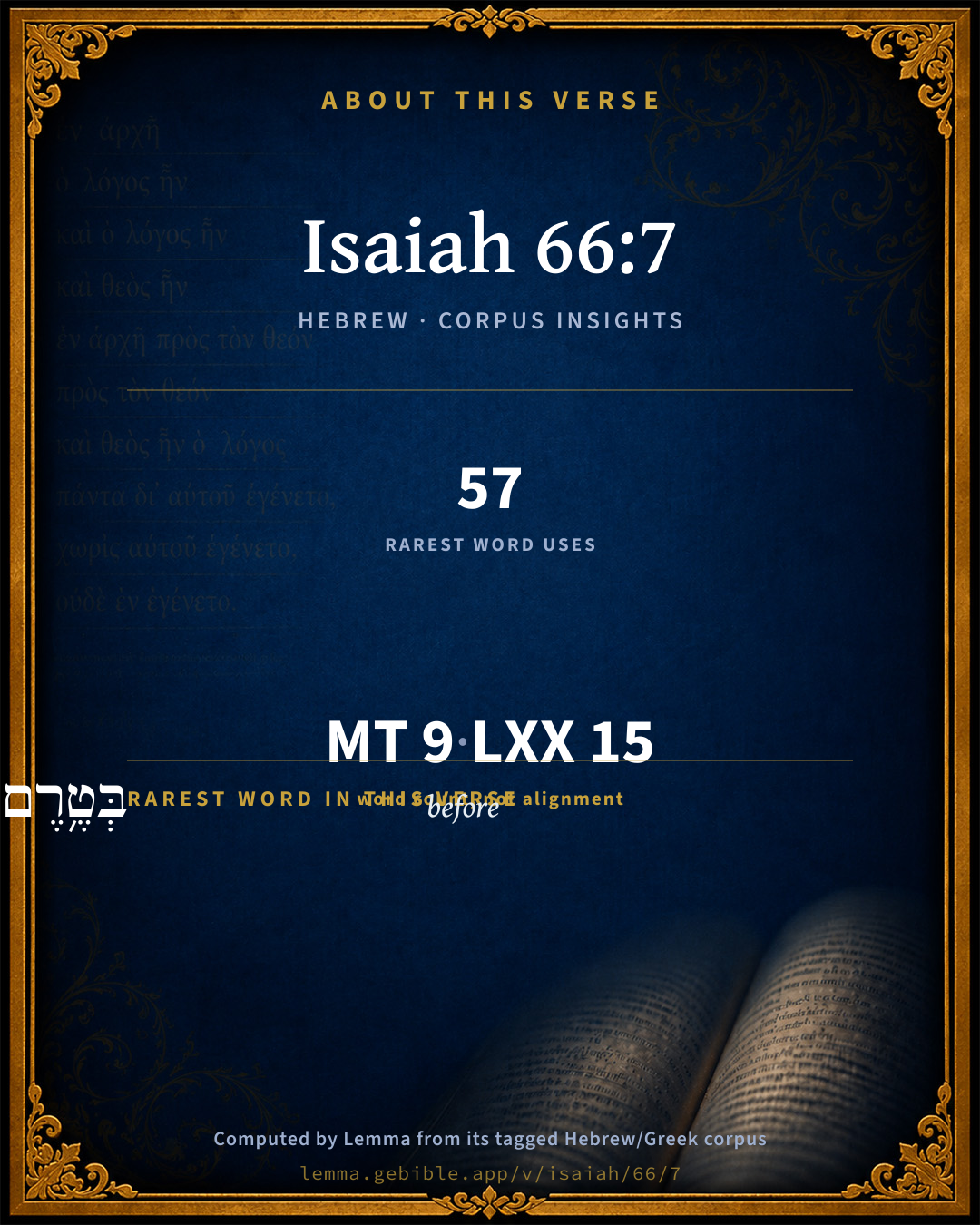
About this verse

These counts appear in no published source. They are computed here, from the morphology-tagged text and Lemma’s own curated glosses. What Lemma adds →

9
words
7
distinct lemmas
Prophets
section

Shared distinctive vocabulary

בְּטֶ֥רֶם before H2962 occurs in 50 verses of the Hebrew Bible. Also found in:

Grammatical profile

  • 4 verbs
  • 1 noun
  • 1 adjective
  • 1 preposition
  • 2 adverbs

Verb forms

  • תָּחִ֖יל Qal · Imperfect
  • יָלָ֑דָה Qal · Perfect
  • יָב֥וֹא Qal · Imperfect
  • וְהִמְלִ֥יטָה Hiphil · Sequential Perfect

Repetition

A word recurs within this verse — often emphatic in Hebrew:

  • בְּטֶ֥רֶם before H2962 ×2

Hebrew & Septuagint length

In English translation the verse runs 16 words from the Hebrew and 19 from the Septuagint (LXX English) — closely comparable.

A rough comparison of the two English renderings, which tokenize alike — not a word-level alignment.

Word counts can differ between the Hebrew and the Greek without any difference in meaning — e.g. the Hebrew direct-object marker אֵת has no separate Greek word, and Greek often adds the article ὁ.

In the original languages it is 9 Hebrew tokens and 15 Greek tokens — but the two are counted differently (Hebrew bundles its prefixes and suffixes into one token; the Greek is in lemma form), so that isn’t a like-for-like length.

Cross-references

2

Topical passages linked to Isaiah 66:7 in the Treasury of Scripture Knowledge — connected by theme and wording, ordered by reader-vote popularity; previews shown in the World English Bible.

  • Revelation 12:1–5 A great sign was seen in heaven: a woman clothed with the sun, and the moon under her feet, and on her head a crown of twelve stars.
  • Galatians 4:26 But the Jerusalem that is above is free, which is the mother of us all.

Cross-references courtesy of OpenBible.info (CC BY 4.0).

Hebrew and Greek witnesses Masoretic Hebrew ↔ Greek Septuagint

The same verse in the two great witnesses to the Old Testament, shown verse-for-verse.

These are two independent witnesses, not word-aligned to each other, and the Septuagint is shown in lemma (dictionary) form.

Hebrew Isaiah 66:7 Masoretic · Westminster Leningrad Codex

בְּטֶ֥רֶם תָּחִ֖יל יָלָ֑דָה בְּטֶ֨רֶם יָב֥וֹא חֵ֛בֶל לָ֖הּ וְהִמְלִ֥יטָה זָכָֽר

Before she travailed, she brought forth; before her pain came, she was delivered of a man-child.

World English Bible · Public Domain

Greek LXX Isaiah 66:7 Septuagint · lemma form

πρίν ἤ ὁ ὠδίνω τίκτω πρίν ἔρχομαι ὁ πόνος ὁ ὠδίν ἐκφεύγω καί τίκτω ἄρσην

Before she that travailed brought forth, before the travail-pain came on, she escaped it and brought forth a male.

LXX2012 (modern English Septuagint) · Public Domain

Hebrew: Westminster Leningrad Codex (CC BY 4.0). Greek: Septuagint (public domain); English from LXX2012 (modern English Septuagint) (Public Domain). How the Septuagint differs from the Hebrew →

Targum (Aramaic paraphrase)

1

The Targum is the ancient Jewish Aramaic paraphrase of the Hebrew Scriptures — an interpretive translation, not the Hebrew text itself. Onkelos (literal) and Pseudo-Jonathan (expansive) render the Torah, and Jonathan the Prophets. Coverage is partial: where no permissively-licensed English translation exists for a verse, only the Aramaic is shown. This is verse-level text, not a word-by-word alignment to the Hebrew.

  1. Targum Jonathan Prophets (Joshua–Malachi)
    עַד לָא מֵיתֵי עָקָא לָהּ תִּתְפְּרִיק עַד לָא יֵיתֵי לָהּ זִיעַ בְּחֶבְלִין עַל יְלִידָה יִתְגְלֵי מַלְכָּהּ:

    Before distress cometh upon her, she shall be redeemed; and before trembling cometh upon her, like the pains upon a woman in child-bearing, her King shall be revealed.

    Targum Jonathan — Aramaic: “Mikraot Gedolot” (public domain). English: “Sefaria Community Translation” (CC0 1.0 (public-domain dedication)); “London "Chaldee Paraphrase," 1871” (public domain). Text via Sefaria.

Commentary

Notes on Isaiah 66:7 from classic Christian and Jewish commentators (each source and its license shown beneath its notes). The classic Christian expositions comment on the surrounding passage and are grouped to its opening verse, so a note may address several verses; the Jewish commentaries on the Tanakh (Rashi and others) are per-verse, so they appear only where the commentator wrote on this verse.

Lemma curates 59 commentaries, every one of them public domain or Creative Commons licensed, each selected and text-cleaned for this edition rather than reprinted as found. About our sources →

Trapp's Complete Commentary

John Trapp

Isa 66:7 Before she travailed, she brought forth; before her pain came, she was delivered of a man child.

Ver. 7. Before she travailed, she brought forth.] Quum nondum parturiret peperit; understand it of Zion, or of the Church Christian, which receiveth her children, that is, converts, suddenly on a cluster before she thought to have done, and in far greater numbers than she could ever have believed. {a} That lady that brought forth as many at a birth as are days in the year {b} was nothing to her: nor those Hebrew women. {Exo 1:10}

She was delivered of a man child.] For the which there is so great joy, {Joh 16:21} and which is usually more able and active than a woman child. So, good and bold Christians, strong in faith; unless he meaneth Christ himself, saith Diodat, who is formed by faith in every believer’s heart. {Gal 4:19}

{a} Subito ac simul. Suddenly and at the same time.

{b} Margaret, Countess of Henneburg.

John Trapp, A Commentary or Exposition upon All the Books of the Old and New Testament (1647–1656) — public domain. Text from a community e-Sword module.

The Biblical Illustrator

Joseph S. Exell

Isa_66:7-9

Before she travailed, she brought forth

The new Israel

The predictive message of our prophet is now so far advanced that the future promised is at the door; the Church of the future is already like a child ripe for birth, and about to separate from the womb of Zion hitherto barren.

The God, who has already prepared everything so far, will suddenly make Zion a mother; a man-child, i.e a whole nation after Jehovahs heart, will suddenly lie in her lap; and this new-born Israel, not the corrupt mass, will build Jehovah a Temple. (F. Delitzsch, D. D.)

The birth of the Gentile Church

It is perfectly sufficient to understand the parturition as a figure for the whole eventful crisis of the change of dispensations, and the consequent change in the condition of the Church. This indestructible ideal person, when she might have seemed to be reduced to nothing by the defection of the natural Israel, is vastly and suddenly augmented by the introduction of the Gentiles, a succession of events which is here most appropriately represented as the birth of a male child without the pains of child-birth. (J. A. Alexander.)

The birth of the Christian Church

The children born to Christ were so numerous, and so suddenly and easily produced, that they were rather like the dew from the mornings womb than like the son from the mothers womb (Psalm Exo_3:1-22). (M. Henry.)

The Biblical Illustrator, edited by Joseph S. Exell (c. 1880s–1900s) — public domain. Text from a community e-Sword module.

Joseph Benson's Commentary

Isa 66:7-8. Here begins a new paragraph of the prophet’s discourse, containing a description of the sudden and great increase of the Christian Church, upon God’s rejecting the Jews, and destroying their temple and worship: “the very destruction of the Jewish polity making way for the reception and spread of the gospel, inasmuch as it abated that opposition which the Jewish zealots all along made to its progress; and the abolishing the Jewish worship contributed very much to the abrogating the law of Moses, and burying it with silence and decency.” See Rom 11:11, and Lowth. This paragraph, however, is not unconnected with what precedes. “It is,” as Vitringa observes, “another consolatory argument, directed to those who reverenced the word of Jehovah, and formed the true Zion, taken from the rapid and wonderful increase of the church among the Gentiles, superior to all human thought, all expectation. For when in the former section Isaiah had done two things; first, had predicted the calling of the Gentiles, (chap. 65:1,) and then the punishment of the ungodly, and such as rejected the gospel; in this section, after he had repeated the indignation conceived by God against the hypocrites and those who did not obey the gospel, he in the same manner comforts the pious Jews, from the unexpected event of the most wished-for success of the calling of the Gentiles, who, joined with them in one body, should form one church, and inherit the earth.” Before she travailed she brought forth — The church is represented here as a travailing woman, the mother of all true believers: see Isa 54:1; Gal 4:26. The whole verse is expressive of a great and sudden salvation which God would work for his church, like the delivery of a woman, and that before her travail, and without pain, of a man-child. It undoubtedly refers to the introduction of the gospel, and its rapid and unexpected progress. Who hath heard such a thing? — The prophet here calls either to the whole world, or to such as feared God among the Jews, to admire his stupendous work of providence and grace, in the sudden erection and wonderful enlargement of the gospel church. Who hath seen such things? — Who hath witnessed such an extraordinary event? Shall the earth be made to bring forth in one day, or shall a nation, &c. — “The suddenness of this event is as surprising as if the fruits of the earth, which are brought to perfection by slow degrees, should blossom and ripen all in one day. And the fruitfulness of this spiritual increase is as wonderful as if a whole nation were born at once, or by one woman.” For as soon as Zion travailed — As soon as the fulness of time came for erecting the gospel church; she brought forth her children — In great multitudes, without pain or difficulty, no inauspicious circumstance occurring to prevent their birth: see Act 2:41; and Act 4:4.

Joseph Benson's Commentary on the Old and New Testaments (1811–1818) — public domain. Text from a community e-Sword module.

Lange's Commentary on the Holy Scriptures

7. THE WONDERFUL PRODUCTIVE POWER OF THE NEW PRINCIPAL OF LIFE.

Isa_66:7-9

7          Before she travailed, she brought forth;

Before her pain came, she was delivered of a man child.

8     Who hath heard such a thing?

Who hath seen such things?

14Shall the earth be made to bring forth in one day?

Or shall a nation be born at once?

For as soon as Zion travailed, she brought forth her children.

9     Shall I bring to the birth, and not 15cause to bring forth? saith the Lord:

16Shall I cause to bring forth, and shut the womb? saith thy God.

EXEGETICAL AND CRITICAL

1. With wonderful rapidity Zion will be surrounded by the blessing of numerous children (Isa_66:7). In other cases a long time is needed for a land to be peopled, for a family to expand into a nation. But in the case of Zion this will happen with incredible quickness (Isa_66:8). Such is the power inherent in that new principle of life which Jehovah cannot possibly in a forced and artificial way restrain (Isa_66:9).—[Our author speaks of a new principle of life and its wonderful power. The Prophet, however, makes no mention of this new principle of life, but of the working of Jehovah Himself.—D. M.]

2. Before she travailed—saith thy God, Isa_66:7-9.—[While the immediately preceding verses speak of judgment falling on the disobedient and rebellious mass of the people, we learn here how the Israel of God shall receive a sudden and unexampled enlargement. Vitringa sees here a prophecy of the vocation of the Gentiles and of their accession to the Church, while the unbelieving Jews are cast off.—D. M.]—We have here in the main the same thought which the Prophet had expressed, Isa_49:18 sqq.; Isa_54:1 sqq.; Isa_60:4 sqq. Here he makes specially prominent the rapidity and suddenness with which, contrary to the ordinary Jaws of nature, Zion will be enlarged, and this he does most ingeniously and in a manner characteristic of Isaiah. הִמְלִיט, to let slip away, is used as Piel Isa_34:15 (comp. Job_21:10). זָכָר must in this connection be primarily chosen to intimate that the birth takes place easily and quickly, though the child is a male. For male children are wont to be larger and stronger; hence their birth is attended with more difficulty. But it is just as certain that the Prophet does not think of the birth of a single child in a literal sense. In Isa_66:8 he puts בָּנֶיהָ for זָכָר. He means, therefore, that זָכָר should be taken collectively, and at the same time wishes to indicate that this collective birth is a male child strong and vigorous. This seems to be the meaning put upon our place in Rev_12:5, which latter passage evidently refers to the one before us. However erroneous it would be to apply this solely to the birth of Christ, it would in my opinion be equally one-sided to exclude the latter. For does not the whole New Testament blessing of abundance of children begirt with the birth of Christ? Without the birth of Christ this blessing could not be realized. “Unto us a child is born, unto us a son is given,” the Prophet had said Isa_9:5. And to this child is promised “increase of government,” consequently, a populous and mighty kingdom,—this child, with what belongs to it, is it not a male, strong child? I look upon it as possible that the Prophet had here before him his earlier utterance Isa_9:5. [This view is in accordance with the Targum: “Before distress cometh upon her, she shall be redeemed: and before trembling cometh upon her, as travail upon a woman with child, her king shall be revealed.”—D. M.]. Such a case never before occurred that a land (אֶרֶץ must denote here both land and people, the idea of the people being predominant, and hence the word is used as a masculine, comp. on Isa_14:17) or nation suddenly, all at once arose. [“The causative sense given to יוּחַל in the English and some other versions is not approved by the later lexicographers, who make it a simple passive.” Alexander.]. How comes it that in the case of Zion, travailing and bringing forth her children coincided? Everything was well arranged beforehand for the birth. The time was fulfilled. The proper moment had come. Peter’s speech on the day of Pentecost and the conversion of the three thousand are facts in which the rapidity of that process of bringing forth is mirrored. And when such an astonishing and rapid success is founded in the nature of the case, can the Lord interfere to check and restrain? This is the meaning of Isa_66:8. [Dr. Naegelsbach interprets the first part of Isa_66:9 by describing the process of parturition with a particularity which some would think hardly in accordance with good taste. It is sufficient to give the explanation of Gesenius in his Lexicon: “Shall I cause to break open (the womb), and not cause to bring forth?” D. M.]. The second hemistich of Isa_66:9 repeats according to the law of the Parallelismus membrorum the same thought in another form. עָצַר is often used of the closing of the uterus, i. e., of the barrenness of a woman. But here it is not the making unfruitful, but the hindering of the birth that is spoken of. It is, therefore, better to take עָצַר in the sense of cohibere, retinere, in which it occurs frequently elsewhere (comp. e.g., Jdg_13:15-16). [The words of Hezekiah are here almost taken up Isa_37:3.” Shall that long and painful national history not have for its issue the birth of a true Israel?” Kay. “The meaning of the whole is, that God designed the great and sudden increase of His Church; that the plan was long laid; and that having done this, He would not abandon it, but would certainly effect His designs.” Barnes. D. M.]. In regard to the alternating יאֹמַר וגו׳ and אָמַר א׳ in Isa_66:9, I refer in general to the remarks on Isa_40:1. In the place before us, the Prophet has certainly no other reason for the change than a rhetorical one.

Lange's Commentary on the Holy Scriptures (Critical, Doctrinal, and Homiletical), ed. John Peter Lange, English translation edited by Philip Schaff (1864–1880) — public domain. Text from a community e-Sword module.

Scofield Reference Notes

C. I. Scofield

travailed

Isa 66:7; Isa 66:8. (See Scofield "Mic 5:1")

The Scofield Reference Bible (1917 edition), notes by C. I. Scofield — public domain. Text from a community e-Sword module.

Tyndale Open Study Notes

Tyndale Open Resources

66:7 birth pains . . . gives birth to a son: See 9:6-7; 54:1-3.

Tyndale Open Study Notes — © Tyndale Open Resources, licensed CC BY-SA 4.0. Text via the HelloAO Bible API.

Geneva Bible (1599)

Geneva Bible translators

Meaning, that the restoration of the Church should be so sudden and contrary to all men’s opinions, as when a woman is delivered before she looked for it, and that without pain in travail.

Geneva Bible (1599) marginal notes — public domain. Text via Bolls.life.

Jamieson, Fausset & Brown

Robert Jamieson, A. R. Fausset & David Brown

she--Zion.

Before . . . travailed . . . brought forth--The accession of numbers, and of prosperity to her, shall be sudden beyond all expectation and unattended with painful effort (Isa 54:1, Isa 54:4-5). Contrast with this case of the future Jewish Church the travail-pains of the Christian Church in bringing forth "a man child" (Rev 12:2, Rev 12:5). A man child's birth is in the East a matter of special joy, while that of a female is not so; therefore, it here means the manly sons of the restored Jewish Church, the singular being used collectively for the plural: or the many sons being regarded as one under Messiah, who shall then be manifested as their one representative Head.

Jamieson, Fausset & Brown — Commentary Critical and Explanatory on the Whole Bible (1871) — public domain (CC PDM 1.0). Text via the HelloAO Bible API.

Ellicott's Commentary for English Readers

(7) Before she travailed . . .—The mother, as the next verse shows, is Zion; the man-child, born at last without the travail-pangs of sorrow, is the new Israel, the true Israel of God. The same figure has met us in Isa_49:17-21; Isa_54:1, and is implied in Mat_24:8. Its antithesis is found in Isa_37:3.

A Bible Commentary for English Readers, edited by Charles John Ellicott (1878–1897) — public domain. Text from a community e-Sword module.

The Cambridge Bible for Schools and Colleges

gen. ed. J. J. S. Perowne

7–9. The sudden repopulation of the city by her children. The figure is taken from ch. Isa_49:17-21, Isa_54:1; the fact set forth being the instantaneous return of the exiled Israelites, by which, without effort, the poor and struggling Jewish community becomes at once a great nation.

The Cambridge Bible for Schools and Colleges (gen. ed. J. J. S. Perowne; Cambridge University Press, 1878–1918) — public domain. Text from a community e-Sword module.

John Gill's Exposition

Before she travailed, she brought forth,.... That is, Zion, as appears from the following verse: lest it should be thought that the interest of Christ would be swallowed up and lost in the destruction of the Jews, this, and what follows, are said concerning the conversion of many of that people, both in the first times of the Gospel, and in the latter day, as well as concerning the calling of the Gentiles, and the uniting of both in one church state. Zion, or the church of God, is here compared to a pregnant woman, that brings forth suddenly and easily, without feeling any pain, or going through any travail, or having any birth throes; at least, feeling very little pain and travail, and having very few pangs, and those, as soon as they come, are gone, and an immediate delivery ensues:

before her pain came, she was delivered of a man child; like a woman before she is scarcely sensible of any pain; as soon as ever she perceives the least uneasiness of this kind, is delivered of a son, to her great joy, and the joy of all about her. This is to be understood, not of the sudden and easy deliverance of the Jews from the Babylonish captivity, by the proclamation of Cyrus, which occasioned great joy; much less of the birth of Christ, of the Virgin Mary at the inn, and in the stable, which is the sense of some Popish interpreters; much better do some Jewish writers interpret it of the birth and appearance of Christ, before the troubles of their nation came on; so the Targum,

"before distress comes to her, she shall be redeemed; and before trembling comes upon her, her King shall be revealed;''

that is, the King Messiah; and so some copies have it, according to Galatinus (r); who also makes mention of another exposition of this passage, by R. Moses Haddarsan, if it may be depended on,

"before he should be born that should bring Israel into the last captivity, the Redeemer should be born;''

that is, as he explains it, before the birth of Titus, who destroyed the temple and city of Jerusalem, the Messiah should be born; but the passage refers not to his natural but mystical birth, or the regeneration of a spiritual seed in his church; or of the conversion of the first Christians both in Judea and in the Gentile world; who were like a man child, strong and robust, able to bear and did endure great hardships for the sake of Christ, and do him much work and service, in which they persevered to the end; see Gal 4:26, as the first Christians did through various persecutions, until the times of Constantine, by whom they were delivered from them, and who is prophesied of as the church's man child, as in Rev 12:2.

(r) De Arcan. Cathol. Ver. I. 4. c. 11. p. 219.

John Gill's Exposition of the Whole Bible (1746–1763) — public domain (CC PDM 1.0). Text via the HelloAO Bible API.

Albert Barnes' Notes on the Bible

Before she travailed, she brought forth - That is, Zion. The idea here is, that there would be a great and sudden increase of her numbers. Zion is here represented, as it often is, as a female (see Isa 1:8), and as the mother of spiritual children (compare Isa 54:1; Isa 49:20-21). The particular idea here is, that the increase would be sudden - as if a child were born without the usual delay and pain of parturition. If the interpretation given of Isa 66:6 be correct, then this refers probably to the sudden increase of the church when the Messiah came, and to the great revivals of religion which attended the first preaching of the gospel. Three thousand were converted on a single day Acts 2, and the gospel was speedily propagated almost all over the known world. Vitringa supposes that it refers to the sudden conversion of the Gentiles, and their accession to the church.

She was delivered of a man child - Jerome understands this of the Messiah. who was descended from the Jewish church. Grotius supposes that the whole verse refers to Judas Maccabeus, and to the liberation of Judea under him before anyone could have hoped for it! Calvin (Commentary in loc.) supposes that the word male here, or manchild, denotes the manly or generous nature of those who should be converted to the church; that they would be vigorous and active, not effeminate and delicate (generosam prolem, non mollem aut effeminatam). Vitringa refers it to the character and rank of those who should be converted, and applies it particularly to Constantine, and to the illustrious philosophers, orators, and senators, who were early brought under the influence of the gospel. The Hebrew word probably denotes a male, or a man-child, and it seems to me that it is applied here to denote the character of the early converts to the Christian faith. They would not be feeble and effeminate; but vigorous, active, energetic. It may, perhaps, also be suggested, that, among the Orientals, the birth of a son was deemed of much more importance, and was regarded as much more a subject of congratulation than the birth of a female. If an allusion be had to that fact, then the idea is, that the increase of the church would be such as would be altogether a subject of exultation and joy.

Albert Barnes' Notes on the Bible (1834–1885) — public domain. Text from a community e-Sword/MySword module.

Haydock's Catholic Bible Commentary

Before, &c. This relates to the conversion of the Gentiles, who were born as it were all on a sudden to the Church of God. (Challoner) --- Sion furnished the first preachers of the Gospel. (Haydock)

George Leo Haydock (1774–1849), Haydock's Catholic Family Bible and Commentary, 1859 edition — public domain. Excludes Psalms (Douay-Rheims chapter numbering differs from Protestant) and Deuterocanonical books (Catholic canon only).

Matthew Poole's English Annotations

The whole verse is expressive of a great and sudden salvation, which God would work for his church, like the delivery of a woman, and that of a

man child, before her travail, and without pain. The only doubt is, whether it referreth to the deliverance of the people out of Babylon, or the world’s surprisal with the Messiah, and the sudden and strange propagation of the gospel, and it is a question not easily determined. The delivery of the Jews out of Babylon, indeed, was without strugglings or any pain; not like their deliverance from Egypt, after the wasting of their enemies by ten successive plagues, but by the kind proclamation of Cyrus. But it seems not to have been sudden, only as to the day, and hour, and manner; for Daniel understood by books that the time was come, Dan 9:2, and the people had a prospect of it seventy years before, Jer 25:12; 29:10. The prophecy therefore seems rather to refer to the coming of Christ, and the sudden propagation of the gospel. The popish interpreters applying it to the Virgin Mary bringing forth Christ, is like other of their fond dreams.

Matthew Poole's English Annotations on the Holy Bible (1683–1685) — public domain. Text from a community e-Sword/MySword module.

Whedon's Commentary on the Bible

Daniel D. Whedon

7-9. Before she — That is, Zion. Before she came to such throes as described above, she brought forth a man child. Some suppose the birth of Jesus Christ is here intended. Others, more consistently, hold, in accordance with Isa_49:18-23, where the thought is substantially the same as here, that Zion already is beginning to be the joyful mother of a strong host of converts from Jews and Gentiles.

Who hath heard such a thing — Such an increase of Zion’s children is a marvel.

Shall a nation be born at once — It has never before so occurred. In the prophet’s eye the world, according to the divine order, is soon to be ready for such an event.

Bring to the birth — On his part God has conducted human history so as to fully inaugurate the gospel age through and among all peoples.

Man child — Every one of the human kind now entitled to the benefits of Christ’s salvation. The new dispensation takes in all mankind collectively as the one “man child.” Faithful co-operation between man and Messiah shall now be fruitful of grandest ingatherings to Jehovah, and of universal joy through earth and heaven.

Daniel D. Whedon (gen. ed.), Commentary on the Old and New Testaments (1874–1909) — public domain. Text from a community e-Sword module.

The Pulpit Commentary

Vers. 7, 8. Before she travailed, etc. Without any long delay, without any labour pains, Zion will bring forth a man-child a whole nation, which wilt be born at once, and not grow up by slow degrees. The occupation of Jerusalem by the great body of the returned exiles (Ezr_2:1 Ezr_3:1) is intended. Such a second birth of a nation was strange, and without precedent. (comp. Isa_42:9 Isa_43:19) Shall the earth be made to bring forth in one day? rather, can a land be brought forth in one day? It is not only a people, but a country, that is born anew; not only the Jews, but Judaea.

The Pulpit Commentary (1880–1919), ed. H.D.M. Spence-Jones & Joseph S. Exell — public domain. Text from a community e-Sword module.

John Wesley's Explanatory Notes

Before - The whole verse is expressive of a great and sudden salvation, which God would work for his church, like the delivery of a woman, and that of a man-child, before her travail, and without pain. Doubtless it refers to the coming of Christ, and the sudden propagation of the gospel.

John Wesley, Explanatory Notes Upon the Whole Bible (1754–1765) — public domain. Text via the GEBible commentary corpus.

Keil & Delitzsch

C. F. Keil & F. Delitzsch

All of these fall victims to the judgment; and yet Zion is not left either childless or without population. "Before she travailed she brought forth; before pains came upon her, she was delivered of a boy. Who hath heard such a thing? Who hath seen anything like it? Are men delivered of a land in one day? or is a nation begotten at once? For Zion hath travailed, yea, hath brought forth her children. Should I bring to the birth, and not cause to bring forth? saith Jehovah: or should I, who cause to bring forth, shut it? saith thy God." Before Zion travaileth, before any labour pains come upon her (chēbhel with tzere), she has already given birth, or brought with ease into the world a male child (hı̄mlit like millēt, in Isa 34:15, to cause to glide out). This boy, of whom she is delivered with such marvellous rapidity, is a whole land full of men, an entire nation. The seer exclaims with amazement, like Zion herself in Isa 49:21, "who hath heard such a thing, or seen anything like it? is a land brought to the birth (hăyūchal followed by 'erets for hăthūchal, as in Gen 13:6; Isa 9:18; Ges. 147), i.e., the population of a whole land (as in Jdg 18:30), and that in one day, or a nation born all at once (yivvâlēd, with munach attached to the kametz, and metheg to the tzere)? This unheard-of event has taken place now, for Zion has travailed, yea, has also brought forth her children," - not one child, but her children, a whole people that calls her mother.

(Note: There is a certain similarity in the saying, with which a talmudic teacher roused up the sleepy scholars of the Beth ha-Midrash: "There was once a woman, who was delivered of 600,000 children in one day," viz., Jochebed, who, when she gave birth to Moses, brought 600,000 to the light of freedom (Exo 12:37).)

"For" (kı̄) presupposes the suppressed thought, that this unexampled event has now occurred: yâledâh follows châlâh with gam, because chı̄l signifies strictly parturire; yâl, parere. Zion, the mother, is no other than the woman of the sun in Rev 12; but the child born of her there is the shepherd of the nations, who proceeds from her at the end of the days, whereas here it is the new Israel of the last days; for the church, which is saved through all her tribulations, is both the mother of the Lord, by whom Babel is overthrown, and the mother of that Israel which inherits the promises, that the unbelieving mass have failed to obtain. Isa 66:9 follows with an emphatic confirmation of the things promised. Jehovah inquires: "Should I create the delivery (cause the child to break through the matrix) and not the birth (both hiphil, causative), so that although the child makes an effort to pass the opening of the womb, it never comes to the light of day? Or should I be one to bring it to the birth, and then to have closed, viz., the womb, so that the word of bringing forth should remain ineffectual, when all that is required is the last effort to bring to the light the fruit of the womb?" From the expression "thy God," we see that the questions are addressed to Zion, whose faith they are intended to strengthen. According to Hofmann (Schriftbeweis, ii. 1, 149, 150), the future יאמר affirms what Jehovah will say, when the time for bringing forth arrives, and the perfect אמר what He is saying now: "Should I who create the bringing forth have shut up?" And He comforts the now barren daughter Zion (Isa 54:1) with the assurance, that her barrenness is not meant to continue for ever. "The prediction," says Hofmann, "which is contained in ה יאמר, of the ultimate issue of the fate of Zion, is so far connected with the consolation administered for the time present, that she who is barren now is exhorted to anticipate the time when the former promise shall be fulfilled." But this change in the standpoint is artificial, and contrary to the general use of the expression ה יאמר elsewhere (see at Isa 40:1). Moreover, the meaning of the two clauses, which constitute here as elsewhere a disjunctive double question in form more than in sense, really runs into one. The first member affirms that Jehovah will complete the bringing to the birth; the second, that He will not ultimately frustrate what He has almost brought to completion: an ego sum is qui parere faciat et (uterum) occluserim (occludam)? There is no other difference between יאמר and אמר, than that the former signifies the word of God which is sounding at the present moment, the latter the word that has been uttered and is resounding still. The prophetic announcement of our prophet has advanced so far, that the promised future is before the door. The church of the future is already like the fruit of the body ripe for the birth, and about to separate itself from the womb of Zion, which has been barren until now. The God by whom everything has been already so far prepared, will suddenly cause Zion to become a mother - a boy, viz., a whole people after Jehovah's own heart, will suddenly lie in her lap, and this new-born Israel, not the corrupt mass, will build a temple for Jehovah.

Keil & Delitzsch — Biblical Commentary on the Old Testament (1861–1891) — public domain (CC PDM 1.0). Text via the HelloAO Bible API. (Old Testament only.)

J. A. Alexander on Isaiah

Joseph Addison Alexander

“Before she travailed she brought forth, before her pain came she was delivered of a male.” All interpreters agree that the mother here described is Zion, that the figure is essentially the same as in Isa 49:21, and that in both cases an increase of numbers is represented as a birth, while in that before us the additional idea of suddenness is expressed by the figure of an unexpected birth. The difference between the cases is that in the other a plurality of children is described, while in this the whole increase is represented in the aggregate as a single birth. As to the specification of the sex, some regard it as a mere illustration of the oriental predilection for male children, not intended to have any special emphasis, while others make it significant of strength as well as numbers in the increase of the people. As to the application of the passage there is nothing in the terms employed which can determine it, but it must follow the sense put upon the foregoing context or the general hypothesis of the interpreter. The parturition is a figure for the whole eventful crisis of the change of dispensations, and the consequent change in the condition of the church. This indestructible ideal person, when she might have seemed to be reduced to nothing by the defection of the natural Israel, is vastly and suddenly augmented by the introduction of the Gentiles, a succession of events which is here most appropriately represented as the birth of a male child without the pains of childbirth.

Joseph Addison Alexander, The Prophecies of Isaiah (1846–1847; New York: Scribner, 1870–1878) — public domain. Text from a community e-Sword module.

unfoldingWord translationNotes

Door43 World Missions Community

General Information:

Yahweh continues speaking.

Before she goes into labor, she gives birth; before pain is upon her, she gave birth to a son

Yahweh speaks about Zion as if it were a woman who is about to give birth. Although Zion was destroyed and the people no longer lived there, Yahweh promises that without delay and with little effort an entire nation will come from her. (See: Metaphor)

Who has heard of such a thing? Who has seen such things? Will a land be born in one day? Can a nation be established in one moment?

Yahweh uses questions to emphasize how unique this event will be. The series of questions builds tension until Zion is finally mentioned. (See: Rhetorical Question)

translationWords

labor pains

nation

Zion

children

unfoldingWord translationNotes — © Distant Shores Media and the Door43 World Missions Community, licensed CC BY-SA 4.0. Source: git.door43.org/Door43/en_tn.

Rashi

Rabbi Shlomo Yitzchaki (Rashi)

When she has not yet travailed When Zion has not yet travailed with birth pangs, she has borne her children; that is to say that her children will gather into her midst, which was desolate and bereft of them, and it is as though she bore them now without birth pangs, for all the nations will bring them into her midst.

she has been delivered of a male child Heb. וְהִמְלִיטָה. Any emerging of an embedded thing is called הַמְלָטָה. And הַמְלָטָה is esmoucer, or eschamocier in O.F., to allow to escape.

Rashi on the Tanakh — English translations: “The Judaica Press complete Tanach with Rashi, translated by A. J. Rosenberg” (CC BY 4.0); “Pentateuch with Rashi's commentary by M. Rosenbaum and A.M. Silbermann, 1929-1934” (public domain); “The Metsudah Tanach series, Lakewood, N.J” (CC BY 4.0); and “The Book of Joshua, Metsudah Publications, 1997” (CC BY 4.0). Text via Sefaria.

Ibn Ezra

Rabbi Abraham ibn Ezra

תחיל She travailed. Comp. חיל trembling (Ps. 45:7). Before she travailed she brought forth. This is a figurative expression, indicating, that the Israelites will return to Zion, without any difficulty, like a woman, that bears children without troubles.

והמליטה זכר She was delivered of a man child. Comp. תְּמַלֵּט she will lay eggs (34:15), though of a different conjugation. —The Israelites will suddenly come together, without much exertion, from all quarters; it will be as though Zion had conceived and born her children in one day, and that is wonderful.

Ibn Ezra on the Tanakh — English translations: “Sefaria Community Translation” (CC0 1.0 (public-domain dedication)); “Yalkut, Sifsei Chachomim Chumash, Metsudah Publications, 2009” (CC BY 4.0); and “Commentary of Ibn Ezra on Isaiah - trans. by M. Friedlander, 1873” (public domain). Text via Sefaria.

Lesson kit

Teaching starters — assembled from the data on this page, not authored interpretation. Every prompt links to the verse data it draws on. Edit before teaching.

Isaiah, in the Prophets, opens this verse with 9 words (7 distinct Hebrew lemmas). Its most distinctive word is ṭerem (“before”). A historical commentator’s framing appears above. Read the whole chapter for the surrounding context.

Discussion questions

  1. The word ṭerem carries the sense “before.” How does it shape the verse?
  2. Genesis 2:5 shares the word «before» with this verse. How do the two illuminate each other?
  3. “before” occurs 2× in this one verse. What is the effect of the repetition?
  4. These translations render this verse differently; the difference is in the English rendering, not the original. What questions does that raise?
  5. The verb «תָּחִ֖יל» is Qal Imperfect. How does its form color the action?
  6. Reading how Trapp's Complete Commentary and The Biblical Illustrator read this verse, where do the two commentators agree and where do they part?

Things to notice

Reading settings

Reading text

Shown beneath each verse's original-language words.

Old Testament
Old Testament edition

Read the OT as the Masoretic Hebrew (MT) or the Greek Septuagint (LXX).

English shown for the Greek Septuagint (in the Hebrew ↔ Greek comparison).

Comparing translations? Open the Compare panel on any verse page to stack up to four side by side.