Ezra 8:13

Hebrew (Westminster Leningrad Codex) Ezra 8:13 appears in the Hebrew Old Testament. The text above is from the Westminster Leningrad Codex. Each word links to its Strong’s number, a concise gloss, and parsing drawn from the Open Scriptures Hebrew Bible morphology. Click any word for its full Brown-Driver-Briggs (BDB) entry.
Download image
Cite this verse

Ezra 8:13 (World English Bible). Public Domain. Lemma interlinear Bible study tool, https://lemma.gebible.app/v/ezra/8/13.

Show BibTeX & RIS
BibTeX
RIS
English Translation
Of the sons of Adonikam, [who were] the last; and these are their names: Eliphelet, Jeuel, and Shemaiah; and with them sixty males.
World English Bible · Public Domain
Download a study sheet

One document with this verse’s original text, its word-by-word gloss line, the meaning frame, cross-references with their text, attributed commentary, and full source and license credits — printable, and it pastes into notes with its structure intact.

This verse Autodidact and up

Study sheet (.html) Plain text (.txt)

A passage Seminary Student

Up to 50 verses in one chapter. A passage sheet keeps up to 6 commentary sources and 12 cross-references per verse, in the order this page ranks them, and says so on the sheet whenever that leaves anything out. Ask for a single verse and you get the Autodidact verse sheet above.

Everything on this page stays free to read, with no account — the sheet is a download of what is already on screen, not access to it.

Want to remove ads? Support Godless Engineer
Compare translations 3

The same verse in 3 English versions, stacked beneath the original-language interlinear above. Click any original word for its lexicon entry.

Each is an independent rendering of the whole verse — the interlinear is not word-aligned to these translations.

Highlighted words mark where these versions differ — a whole-verse word diff, not a word-by-word alignment.

  • World English Bible Public Domain
    Of the sons of Adonikam, [who were] the last; and these are their names: Eliphelet, Jeuel, and Shemaiah; and with them sixty males.
  • King James Version Public Domain
    And of the last sons of Adonikam, whose names are these, Eliphelet, Jeiel, and Shemaiah, and with them threescore males.
  • unfoldingWord Literal Text CC BY-SA 4.0
    And from the last sons of Adonikam, and these were their names: Eliphelet, Jeuel, and Shemaiah, and with them were 60 males.

unfoldingWord Literal Text — © unfoldingWord, licensed CC BY-SA 4.0. Word-aligned USFM3 via Door43 (git.door43.org/unfoldingWord/en_ult).

Versions to compare (up to 4)

3 of 4 selected

Show all 18 translations

Every available English version of this verse, each an independent rendering of the whole verse.

  • World English Bible Public Domain
    Of the sons of Adonikam, [who were] the last; and these are their names: Eliphelet, Jeuel, and Shemaiah; and with them sixty males.
  • Berean Standard Bible Public Domain
    from the later descendants of Adonikam, these were their names: Eliphelet, Jeiel, and Shemaiah, and with them 60 men;
  • Majority Standard Bible Public Domain
    from the later descendants of Adonikam, these were their names: Eliphelet, Jeiel, and Shemaiah, and with them 60 men;
  • King James Version Public Domain
    And of the last sons of Adonikam, whose names are these, Eliphelet, Jeiel, and Shemaiah, and with them threescore males.
  • American Standard Version (1901) Public Domain
    And of the sons of Adonikam, `that were' the last; and these are their names: Eliphelet, Jeuel, and Shemaiah; and with them threescore males.
  • Revised Version (1885) Public Domain
    And of the sons of Adonikam, that were the last; and these are their names, Eliphelet, Jeuel, and Shemaiah, and with them threescore males.
  • Geneva Bible (1599) Public Domain
    And of the sonnes of Adonikam, that were the last, whose names are these: Eliphelet, Iehiel and Shemaiah, and with them three score males.
  • Douay-Rheims (1899) Public Domain
    Of the sons of Adonicam, who were the last: and these are their names: Eliphelet, and Jehiel, and Samaias, and with them sixty men.
  • Young's Literal Translation Public Domain
    And from the younger sons of Adonikam -- and these `are' their names -- Eliphelet, Jeiel, and Shemaiah, and with them sixty who are males.
  • Literal Standard Version CC BY-SA 4.0
    And from the younger sons of Adonikam—and these [are] their names—Eliphelet, Jeiel, and Shemaiah, and with them sixty who are males.
  • Unlocked Literal Bible CC BY-SA 4.0
    Those of the descendants of Adonikam came later. These were their names: Eliphelet, Jeuel, and Shemaiah and with them came sixty males.
  • unfoldingWord Literal Text CC BY-SA 4.0
    And from the last sons of Adonikam, and these were their names: Eliphelet, Jeuel, and Shemaiah, and with them were 60 males.
  • Darby Bible Public Domain
    And of the children of Adonikam, the last ones, whose names are these: Eliphelet, Jeiel, and Shemaiah, and with them sixty males.
  • World Messianic Bible Public Domain
    Of the sons of Adonikam, who were the last, their names are: Eliphelet, Jeuel, and Shemaiah; and with them sixty males.
  • Webster's Bible Public Domain
    And of the last sons of Adonikam, whose names are these, Eliphelet, Jeiel, and Shemaiah, and with them sixty males.
  • Free Bible Version CC BY-SA 4.0
    From the sons of Adonikam, those who were last, their names being Eliphelet, Jeuel, and Shemaiah, and with them 60 men.
  • Bible in Basic English Public Domain
    And of the sons of Adonikam, the last, whose names were Eliphelet, Jeuel, and Shemaiah; and with them sixty males.
  • JPS Tanakh (1917) Public Domain
    And of the sons of Adonikam, that were the last; and these are their names, Eliphelet, Jeiel, and Shemaiah; and with them threescore males.

Literal Standard Version (2020), Covenant Press — licensed CC BY-SA 4.0. Text via the HelloAO Bible API (eBible.org). Unlocked Literal Bible (unfoldingWord) — licensed CC BY-SA 4.0. Text via the HelloAO Bible API (eBible.org). unfoldingWord Literal Text — © unfoldingWord, licensed CC BY-SA 4.0. Word-aligned USFM3 via Door43 (git.door43.org/unfoldingWord/en_ult). Free Bible Version, Dr. Jonathan Gallagher — licensed CC BY-SA 4.0. Text via the HelloAO Bible API (eBible.org).

Word by word

More ways to search: Search by grammar → Find every occurrence → Compare this word →

Practice this passage: Drill this verse → Learn its vocabulary →

אֲדֹנִיקָם֮
ʼĂdônîyqâm
H140
“Adonikam”
Noun, Proper
Part of Speech
Noun
Type
Proper
Full BDB Definition

Origin: from H113 and H6965

TWOT: None

Adonikam = "my lord arose" - the head of an Israelite clan who returned from exile
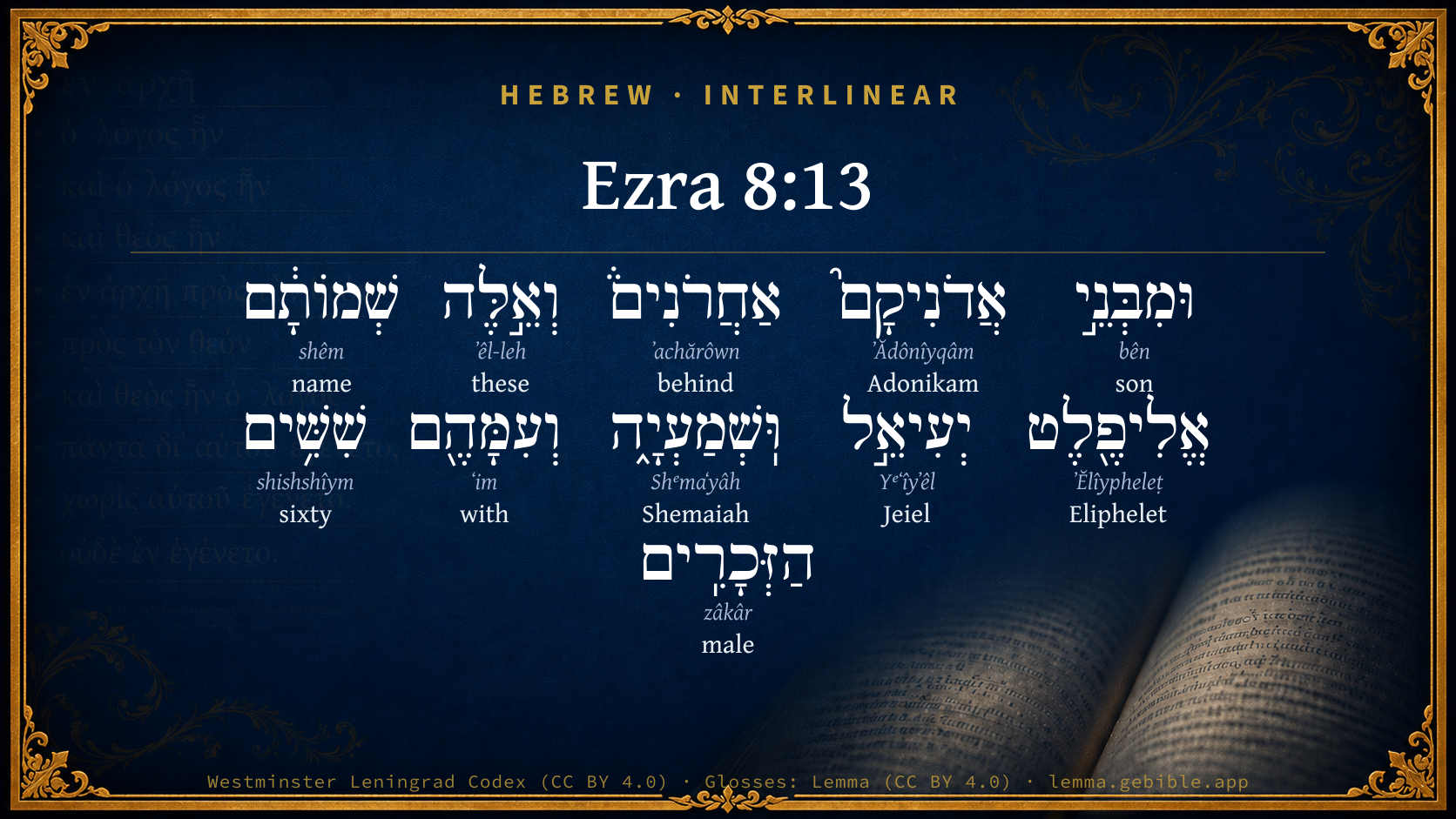
  1. וּמִבְּנֵ֣י bên H1121 “and · from · sons of” Conjunction + Preposition + Noun, Common, Masculine, Plural, Construct
  2. אַחֲרֹנִים֒ ʼachărôwn H314 “behind” Adjective, Adjective, Masculine, Plural, Absolute
  3. וְאֵ֣לֶּה ʼêl-leh H428 “and · these” Conjunction + Pronoun, Demonstrative, Common, Plural
  4. שְׁמוֹתָ֔ם shêm H8034 “names · their” Noun, Common, Masculine, Plural, Construct + Suffix, Personal, 3rd Person, Masculine, Plural
  5. אֱלִיפֶ֖לֶט ʼĔlîypheleṭ H467 “Eliphelet” Noun, Proper
  6. יְעִיאֵ֣ל Yᵉʻîyʼêl H3273 “Jeiel” Noun, Proper
  7. וּֽשְׁמַעְיָ֑ה Shᵉmaʻyâh H8098 “and · Shemaiah” Conjunction + Noun, Proper
  8. וְעִמָּהֶ֖ם ʻim H5973 “and · with · them” Conjunction + Preposition + Suffix, Personal, 3rd Person, Masculine, Plural
  9. שִׁשִּׁ֥ים shishshîym H8346 “sixty” Adjective, Cardinal number, Both, Plural, Absolute
  10. הַזְּכָרִֽים zâkâr H2145 “the · males” Particle, Definite Article + Noun, Common, Masculine, Plural, Absolute

About this verse

These counts appear in no published source. They are computed here, from the morphology-tagged text and Lemma’s own curated glosses. What Lemma adds →

11
words
11
distinct lemmas
Historical
section

Notable vocabulary

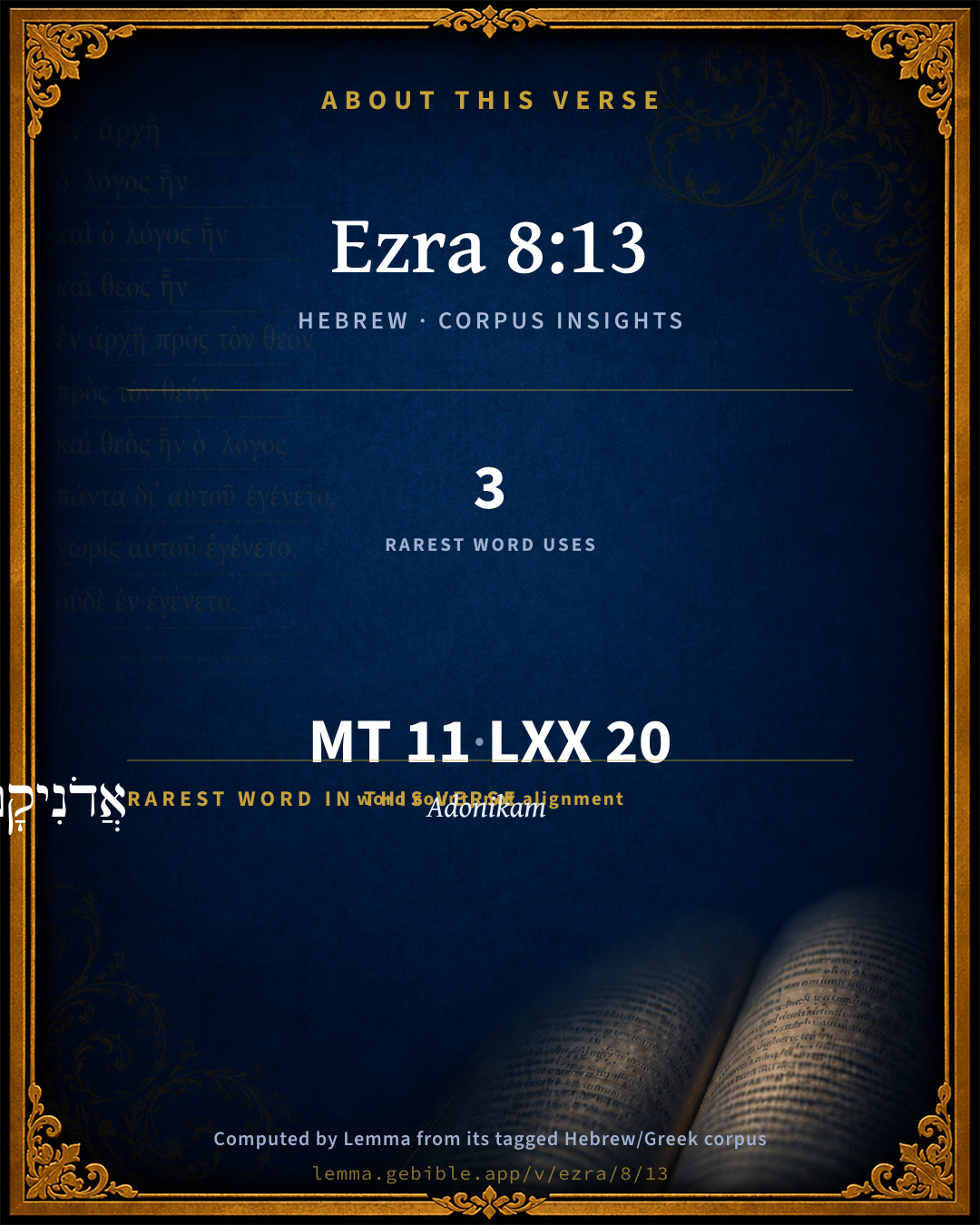
The rarest word here is אֲדֹנִיקָם֮ Adonikam H140 — appearing just 3 times in the whole Hebrew Bible.

Shared distinctive vocabulary

אֲדֹנִיקָם֮ Adonikam H140 occurs in 3 verses of the Hebrew Bible. Also found in:

Grammatical profile

  • 7 nouns
  • 2 adjectives
  • 1 pronoun
  • 1 preposition

Hebrew & Septuagint length

In English translation the verse runs 23 words from the Hebrew and 23 from the Septuagint (LXX English) — the same length.

A rough comparison of the two English renderings, which tokenize alike — not a word-level alignment.

Word counts can differ between the Hebrew and the Greek without any difference in meaning — e.g. the Hebrew direct-object marker אֵת has no separate Greek word, and Greek often adds the article ὁ.

In the original languages it is 11 Hebrew tokens and 20 Greek tokens — but the two are counted differently (Hebrew bundles its prefixes and suffixes into one token; the Greek is in lemma form), so that isn’t a like-for-like length.

Cross-references

2

Topical passages linked to Ezra 8:13 in the Treasury of Scripture Knowledge — connected by theme and wording, ordered by reader-vote popularity; previews shown in the World English Bible.

  • Ezra 2:13 The children of Adonikam, six hundred sixty-six.
  • Nehemiah 7:18 The children of Adonikam, six hundred sixty-seven.

Cross-references courtesy of OpenBible.info (CC BY 4.0).

Hebrew and Greek witnesses Masoretic Hebrew ↔ Greek Septuagint

The same verse in the two great witnesses to the Old Testament, shown verse-for-verse.

These are two independent witnesses, not word-aligned to each other, and the Septuagint is shown in lemma (dictionary) form.

Hebrew Ezra 8:13 Masoretic · Westminster Leningrad Codex

וּמִבְּנֵ֣י אֲדֹנִיקָם֮ אַחֲרֹנִים֒ וְאֵ֣לֶּה שְׁמוֹתָ֔ם אֱלִיפֶ֖לֶט יְעִיאֵ֣ל וּֽשְׁמַעְיָ֑ה וְעִמָּהֶ֖ם שִׁשִּׁ֥ים הַזְּכָרִֽים

Of the sons of Adonikam, [who were] the last; and these are their names: Eliphelet, Jeuel, and Shemaiah; and with them sixty males.

World English Bible · Public Domain

Greek LXX Ezra 8:13 Septuagint · lemma form

καί ἀπό υἱός αδωνικαμ ἔσχατος καί οὗτος ὁ ὄνομα αὐτός αλιφαλατ ιιηλ καί σαμαια καί μετά αὐτός ἑξήκοντα ὁ ἀρσενικός

And of the sons of Adonicam were the last, and these were their names, Eliphalat, Jeel, and Samaea, and with them sixty males.

LXX2012 (modern English Septuagint) · Public Domain

In the Septuagint this is one book — Esdras B (2 Esdras): Ezra is chapters 1–10, Nehemiah 11–23.

Hebrew: Westminster Leningrad Codex (CC BY 4.0). Greek: Septuagint (public domain); English from LXX2012 (modern English Septuagint) (Public Domain). How the Septuagint differs from the Hebrew →

Commentary

Notes on Ezra 8:13 from classic Christian and Jewish commentators (each source and its license shown beneath its notes). The classic Christian expositions comment on the surrounding passage and are grouped to its opening verse, so a note may address several verses; the Jewish commentaries on the Tanakh (Rashi and others) are per-verse, so they appear only where the commentator wrote on this verse.

Lemma curates 59 commentaries, every one of them public domain or Creative Commons licensed, each selected and text-cleaned for this edition rather than reprinted as found. About our sources →

Trapp's Complete Commentary

John Trapp

Ezr 8:13 And of the last sons of Adonikam, whose names [are] these, Eliphelet, Jeiel, and Shemaiah, and with them threescore males.

Ver. 13. And of the sons of Adonikam] Some of his sons went up before with Zerubbabel, Ezr 2:13. These not till now, together with Ezra. They might want either age or hearts to go at first with their brethren, E posteris posterioribus (Tremell.). Second thoughts are best many times; and Nunquam sero, si serio. Never sorry if cultivated. That son, in the Gospel, who, being bidden go work to-day in the vineyard, answered and said, I will not, but afterwards repented and went, wanted not his commendation, Mat 21:29. A learned man notes thus upon this text: The lot of Adonikam was below his brethren, because he was the last that set foot forward toward their return.

John Trapp, A Commentary or Exposition upon All the Books of the Old and New Testament (1647–1656) — public domain. Text from a community e-Sword module.

Joseph Benson's Commentary

Ezr 8:13. Of the last sons of Adonikam — It seems the rest went before, so that now all the sons of that family returned.

Joseph Benson's Commentary on the Old and New Testaments (1811–1818) — public domain. Text from a community e-Sword module.

Geneva Bible (1599)

Geneva Bible translators

That came to go with Ezra.

Geneva Bible (1599) marginal notes — public domain. Text via Bolls.life.

Ellicott's Commentary for English Readers

(13) And of the last sons.—The younger branches, the elder being reported in Ezr_2:13.

A Bible Commentary for English Readers, edited by Charles John Ellicott (1878–1897) — public domain. Text from a community e-Sword module.

The Cambridge Bible for Schools and Colleges

gen. ed. J. J. S. Perowne

13. of the last sons of Adonikam, whose names are these] R.V. Of the sons of Adonikam, that were the last; and these are their names.

‘The sons of Adonikam, that were the last’. (Acheronim) is a peculiar expression. It is generally supposed that the elder branches of this house had joined with Zerubbabel (Ezr_2:13) and that the younger branches (‘the last’) returned with Ezra.

Others have supposed that the sons of Adonikam attached themselves ‘late’, last of all, to Ezra’s company.

It is noteworthy that this ‘household’, is represented not by one name, but by three. Perhaps we have here the names of three families, Eliphelet, Jeuel and Shemaiah, who had but recently attached themselves to the Adonikam ‘house’. It may be conjectured that these ‘last’ sons of Adonikam had not yet become sufficiently united to have a single representative.

The Cambridge Bible for Schools and Colleges (gen. ed. J. J. S. Perowne; Cambridge University Press, 1878–1918) — public domain. Text from a community e-Sword module.

Haydock's Catholic Bible Commentary

Last. Coming after their brethren, chap. ii. 13.

George Leo Haydock (1774–1849), Haydock's Catholic Family Bible and Commentary, 1859 edition — public domain. Excludes Psalms (Douay-Rheims chapter numbering differs from Protestant) and Deuterocanonical books (Catholic canon only).

Whedon's Commentary on the Bible

Daniel D. Whedon

13. The last sons of Adonikam — Other sons, to the number of six hundred and sixty-six, went up with Zerubbabel, (Ezr_2:13,) and some think the sons here mentioned are called the last in reference to those who had previously accompanied Zerubbabel. But it is, perhaps, better to understand the last sons to be Eliphelet, Jeiel, and Shemaiah, who were the latest born immediate sons of Adonikam, and thus distinguished from other sons of fathers mentioned in the list, who were not immediate sons, but grandsons, or still more remote descendants.

Daniel D. Whedon (gen. ed.), Commentary on the Old and New Testaments (1874–1909) — public domain. Text from a community e-Sword module.

The Pulpit Commentary

The last sons of Adonikam are probably his younger sons, whose descendants returned with Ezra, their elder brethren"s families having returned with Zerubbabel.

DETAILS OF EZRA"S JOURNEY FROM BABYLON TO JERUSALEM. (Ezr_8:15-31) We gather from scattered statements in this passage

1. That Ezra, with his companions, after a journey of nine days" duration, reached Ahava from Babylon on the ninth day of the first month;

2. That he rested three days at Ahava, and proclaimed a fast;

3. That he was there joined by a small number of Levites and a considerable body of Nethinims from the immediate neighbourhood;

4. That, on the twelfth day of the first month, he resumed his journey, and, though threatened by some opposition upon the way, arrived safely at his destination fourteen weeks after he quitted Ahava, and exactly four months after he had started from Babylon. The only other important fact mentioned is, that at Ahava twelve of the principal priests were selected by Ezra, and the royal offering of silver, gold, and vessels handed over to them for safe custody, after having been carefully weighed. The weights are recorded with Ezra"s usual exactness in vers. 26, 27.

The Pulpit Commentary (1880–1919), ed. H.D.M. Spence-Jones & Joseph S. Exell — public domain. Text from a community e-Sword module.

John Wesley's Explanatory Notes

Whose names are, &c. - It seems the rest came before; so that now all the sons of that family returned.

John Wesley, Explanatory Notes Upon the Whole Bible (1754–1765) — public domain. Text via the GEBible commentary corpus.

Rashi

Rabbi Shlomo Yitzchaki (Rashi)

the last ones who were the last ones to go after Ezra.

Rashi on the Tanakh — English translations: “The Judaica Press complete Tanach with Rashi, translated by A. J. Rosenberg” (CC BY 4.0); “Pentateuch with Rashi's commentary by M. Rosenbaum and A.M. Silbermann, 1929-1934” (public domain); “The Metsudah Tanach series, Lakewood, N.J” (CC BY 4.0); and “The Book of Joshua, Metsudah Publications, 1997” (CC BY 4.0). Text via Sefaria.

Lesson kit

Teaching starters — assembled from the data on this page, not authored interpretation. Every prompt links to the verse data it draws on. Edit before teaching.

Ezra, in the Historical, opens this verse with 11 words (11 distinct Hebrew lemmas). Its most distinctive word is ʼĂdônîyqâm (“Adonikam”). A historical commentator’s framing appears above. Read the whole chapter for the surrounding context.

Discussion questions

  1. The word ʼĂdônîyqâm carries the sense “Adonikam.” How does it shape the verse?
  2. Ezra 2:13 shares the word «Adonikam» with this verse. How do the two illuminate each other?
  3. The translations on this page render this verse differently — a whole-verse word diff, not a word-by-word alignment. What might account for the different wordings?
  4. Reading how Trapp's Complete Commentary and Joseph Benson's Commentary read this verse, where do the two commentators agree and where do they part?

Things to notice

Reading settings

Reading text

Shown beneath each verse's original-language words.

Old Testament
Old Testament edition

Read the OT as the Masoretic Hebrew (MT) or the Greek Septuagint (LXX).

English shown for the Greek Septuagint (in the Hebrew ↔ Greek comparison).

Comparing translations? Open the Compare panel on any verse page to stack up to four side by side.