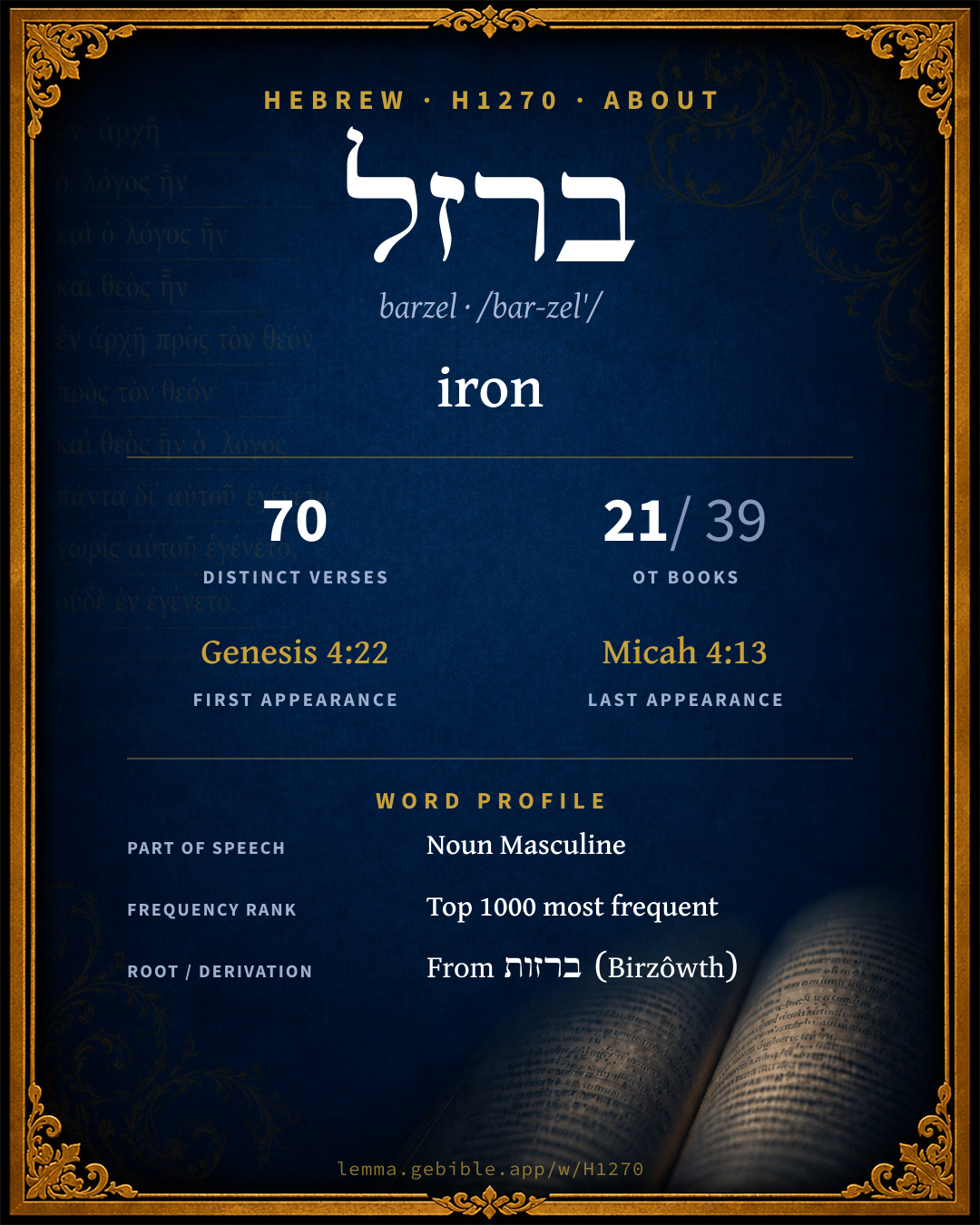
בַּרְזֶל
iron
‘iron’ is one of 3 main senses fuller range ↓
Full lexicon entry — Brown-Driver-Briggs (BDB)
From Brown-Driver-Briggs (BDB)
Where this word appears
Grammar key — what these labels mean
Part of speech
- Noun
- A naming word — a person, place, thing, or idea.
Noun type
- Common
- A common noun — a general class of person, place, or thing (“king,” “city,” “water”), not a specific name.
State
- Absolute
- The independent form of a noun, not bound to a following word.
Gender
- Masculine
- Grammatically masculine.
Number
- Singular
- One.
Every verse where H1270 appears — 70 distinct verses across 21 books. Click any verse to open its interlinear word-by-word view. Verse text shown in the World English Bible for context — . Each verse’s Hebrew form is shown with its reference; the English is not keyword-highlighted, since the data carries no word-level English alignment. Use “Compare translations” on any verse to read it across multiple English versions. This concordance covers the Hebrew Bible; Septuagint (Greek Old Testament) occurrences are not indexed here.
Genesis 1 verse
Leviticus 1 verse
Numbers 2 verses
Deuteronomy 8 verses
- Deuteronomy 3:11 בַּרְזֶ֔ל n c ms (For only Og king of Bashan remained of the remnant of the Rephaim; behold, his bedstead was a bedstead of iron; isn't it in Rabbah of the children of Ammon? nine cubits was the length of it, and four cubits the breadth of it, after the cubit of a man.)
- Deuteronomy 4:20 הַ/בַּרְזֶ֖ל ptcl def.art + n c ms But Yahweh has taken you, and brought you forth out of the iron furnace, out of Egypt, to be to him a people of inheritance, as at this day.
- Deuteronomy 8:9 בַרְזֶ֔ל n c ms a land in which you shall eat bread without scarceness, you shall not lack anything in it; a land whose stones are iron, and out of whose hills you may dig copper.
- Deuteronomy 19:5 הַ/בַּרְזֶל֙ ptcl def.art + n c ms as when a man goes into the forest with his neighbor to hew wood, and his hand fetches a stroke with the axe to cut down the tree, and the head slips from the handle, and lights on his neighbor, so that he dies; he shall flee to one of these cities and live:
- Deuteronomy 27:5 בַּרְזֶֽל n c ms There shall you build an altar to Yahweh your God, an altar of stones: you shall lift up no iron [tool] on them.
- Deuteronomy 28:23 בַּרְזֶֽל n c ms Your sky that is over your head shall be brass, and the earth that is under you shall be iron.
- Deuteronomy 28:48 בַּרְזֶל֙ n c ms therefore shall you serve your enemies whom Yahweh shall send against you, in hunger, and in thirst, and in nakedness, and in want of all things: and he shall put a yoke of iron on your neck, until he have destroyed you.
- Deuteronomy 33:25 בַּרְזֶ֥ל n c ms Your bars shall be iron and brass; As your days, so shall your strength be.
Joshua 6 verses
- Joshua 6:19 וּ/בַרְזֶ֔ל conj + n c ms But all the silver, and gold, and vessels of brass and iron, are holy to Yahweh: they shall come into the treasury of Yahweh.
- Joshua 6:24 וְ/הַ/בַּרְזֶ֔ל conj + ptcl def.art + n c ms They burnt the city with fire, and all that was therein; only the silver, and the gold, and the vessels of brass and of iron, they put into the treasury of the house of Yahweh.
- Joshua 8:31 בַּרְזֶ֑ל n c ms as Moses the servant of Yahweh commanded the children of Israel, as it is written in the book of the law of Moses, an altar of uncut stones, on which no man had lifted up any iron: and they offered thereon burnt offerings to Yahweh, and sacrificed peace-offerings.
- Joshua 17:16 בַּרְזֶ֗ל n c ms The children of Joseph said, The hill-country is not enough for us: and all the Canaanites who dwell in the land of the valley have chariots of iron, both they who are in Beth-shean and its towns, and they who are in the valley of Jezreel.
- Joshua 17:18 בַּרְזֶל֙ n c ms but the hill-country shall be yours; for though it is a forest, you shall cut it down, and the goings out of it shall be yours; for you shall drive out the Canaanites, though they have chariots of iron, and though they are strong.
- Joshua 22:8 וּ/בְ/בַרְזֶ֛ל conj + prep + n c ms and spoke to them, saying, Return with much wealth to your tents, and with very much cattle, with silver, and with gold, and with brass, and with iron, and with very much clothing: divide the spoil of your enemies with your brothers.
Judges 3 verses
- Judges 1:19 בַּרְזֶ֖ל n c ms Yahweh was with Judah; and drove out [the inhabitants of] the hill-country; for he could not drive out the inhabitants of the valley, because they had chariots of iron.
- Judges 4:3 בַּרְזֶל֙ n c ms The children of Israel cried to Yahweh: for he had nine hundred chariots of iron; and twenty years he mightily oppressed the children of Israel.
- Judges 4:13 בַּרְזֶ֔ל n c ms Sisera gathered together all his chariots, even nine hundred chariots of iron, and all the people who were with him, from Harosheth of the Gentiles, to the river Kishon.
1 Samuel 1 verse
2 Samuel 2 verses
- 2 Samuel 12:31 הַ/בַּרְזֶ֜ל הַ/בַּרְזֶ֗ל ptcl def.art + n c ms ptcl def.art + n c ms He brought forth the people who were therein, and put them under saws, and under harrows of iron, and under axes of iron, and made them pass through the brick kiln: and thus did he to all the cities of the children of Ammon. David and all the people returned to Jerusalem.
- 2 Samuel 23:7 בַרְזֶ֖ל n c ms But the man who touches them Must be armed with iron and the staff of a spear: They shall be utterly burned with fire in [their] place
1 Kings 3 verses
- 1 Kings 6:7 בַרְזֶ֔ל n c ms The house, when it was in building, was built of stone made ready at the quarry; and there was neither hammer nor axe nor any tool of iron heard in the house, while it was in building.
- 1 Kings 8:51 הַ/בַּרְזֶֽל ptcl def.art + n c ms (for they are your people, and your inheritance, which you brought forth out of Egypt, from the midst of the furnace of iron);
- 1 Kings 22:11 בַרְזֶ֑ל n c ms Zedekiah the son of Chenaanah made him horns of iron, and said, Thus says Yahweh, With these shall you push the Syrians, until they be consumed.
2 Kings 2 verses
- 2 Kings 6:5 הַ/בַּרְזֶ֖ל ptcl def.art + n c ms But as one was felling a beam, the axe head fell into the water; and he cried, and said, Alas, my master! for it was borrowed.
- 2 Kings 6:6 הַ/בַּרְזֶֽל ptcl def.art + n c ms The man of God said, Where fell it? He shown him the place. He cut down a stick, and cast it in there, and made the iron to swim.
1 Chronicles 6 verses
- 1 Chronicles 20:3 הַ/בַּרְזֶל֙ ptcl def.art + n c ms He brought forth the people who were therein, and cut [them] with saws, and with harrows of iron, and with axes. Thus did David to all the cities of the children of Ammon. David and all the people returned to Jerusalem.
- 1 Chronicles 22:3 וּ/בַרְזֶ֣ל conj + n c ms David prepared iron in abundance for the nails for the doors of the gates, and for the couplings; and brass in abundance without weight;
- 1 Chronicles 22:14 וְ/לַ/בַּרְזֶל֙ conj + prep det + n c ms Now, behold, in my affliction I have prepared for the house of Yahweh one hundred thousand talents of gold, and one thousand thousand talents of silver, and of brass and iron without weight; for it is in abundance: timber also and stone have I prepared; and you may add to them.
- 1 Chronicles 22:16 וְ/לַ/בַּרְזֶ֖ל conj + prep det + n c ms of the gold, the silver, and the brass, and the iron, there is no number. Arise and be doing, and Yahweh be with you.
- 1 Chronicles 29:2 הַ/בַּרְזֶל֙ לַ/בַּרְזֶ֔ל ptcl def.art + n c ms prep det + n c ms Now I have prepared with all my might for the house of my God the gold for the [things of] gold, and the silver for the [things of] silver, and the brass for the [things of] brass, the iron for the [things of] iron, and wood for the [things of] wood; onyx stones, and [stones] to be set, stones for inlaid work, and of various colors, and all manner of precious stones, and marble stones in abundance.
- 1 Chronicles 29:7 וּ/בַרְזֶ֖ל conj + n c ms and they gave for the service of the house of God of gold five thousand talents and ten thousand darics, and of silver ten thousand talents, and of brass eighteen thousand talents, and of iron a hundred thousand talents.
2 Chronicles 4 verses
- 2 Chronicles 2:7 וּ/בַ/בַּרְזֶ֗ל conj + prep det + n c ms Now therefore send me a man skillful to work in gold, and in silver, and in brass, and in iron, and in purple, and crimson, and blue, and who knows how to engrave [all manner of] engravings, [to be] with the skillful men who are with me in Judah and in Jerusalem, whom David my father did provide.
- 2 Chronicles 2:14 בַּ/בַּרְזֶ֜ל prep det + n c ms the son of a woman of the daughters of Dan; and his father was a man of Tyre, skillful to work in gold, and in silver, in brass, in iron, in stone, and in timber, in purple, in blue, and in fine linen, and in crimson, also to engrave any manner of engraving, and to devise any device; that there may be [a place] appointed to him with your skillful men, and with the skillful men of my lord David your father.
- 2 Chronicles 18:10 בַרְזֶ֑ל n c ms Zedekiah the son of Chenaanah made him horns of iron, and said, Thus says Yahweh, With these shall you push the Syrians, until they be consumed.
- 2 Chronicles 24:12 בַרְזֶל֙ n c ms The king and Jehoiada gave it to such as did the work of the service of the house of Yahweh; and they hired masons and carpenters to restore the house of Yahweh, and also such as worked iron and brass to repair the house of Yahweh.
Job 5 verses
- Job 19:24 בַּרְזֶ֥ל n c ms That with an iron pen and lead They were engraved in the rock forever!
- Job 20:24 בַּרְזֶ֑ל n c ms He shall flee from the iron weapon. The bronze arrow shall strike him through.
- Job 28:2 בַּ֭רְזֶל n c ms Iron is taken out of the earth, And copper is smelted out of the ore.
- Job 40:18 בַּרְזֶֽל n c ms His bones are like tubes of brass. His limbs are like bars of iron.
- Job 41:27 בַּרְזֶ֑ל n c ms He counts iron as straw; And brass as rotten wood.
Psalms 5 verses
- Psalms 2:9 בַּרְזֶ֑ל n c ms You shall break them with a rod of iron. You shall dash them in pieces like a potter's vessel."
- Psalms 105:18 בַּ֝רְזֶ֗ל n c ms They bruised his feet with shackles. His neck was locked in irons,
- Psalms 107:10 וּ/בַרְזֶֽל conj + n c ms Some sat in darkness and in the shadow of death, Being bound in affliction and iron,
- Psalms 107:16 בַרְזֶ֣ל n c ms For he has broken the gates of brass, And cut through bars of iron.
- Psalms 149:8 בַרְזֶֽל n c ms To bind their kings with chains, And their nobles with fetters of iron;
Proverbs 1 verse
Ecclesiastes 1 verse
Isaiah 5 verses
- Isaiah 10:34 בַּ/בַּרְזֶ֑ל prep det + n c ms He will cut down the thickets of the forest with iron, and Lebanon shall fall by a mighty one.
- Isaiah 44:12 בַּרְזֶל֙ n c ms The smith [makes] an axe, and works in the coals, and fashions it with hammers, and works it with his strong arm: yes, he is hungry, and his strength fails; he drinks no water, and is faint.
- Isaiah 45:2 בַרְזֶ֖ל n c ms I will go before you, and make the rough places smooth; I will break in pieces the doors of brass, and cut in sunder the bars of iron;
- Isaiah 48:4 בַּרְזֶל֙ n c ms Because I knew that you are obstinate, and your neck is an iron sinew, and your brow brass;
- Isaiah 60:17 הַ/בַּרְזֶל֙ בַּרְזֶ֑ל ptcl def.art + n c ms n c ms For brass I will bring gold, and for iron I will bring silver, and for wood brass, and for stones iron. I will also make your officers peace, and righteousness your ruler.
Jeremiah 7 verses
- Jeremiah 1:18 בַּרְזֶ֛ל n c ms For, behold, I have made you this day a fortified city, and an iron pillar, and brazen walls, against the whole land, against the kings of Judah, against the princes of it, against the priests of it, and against the people of the land.
- Jeremiah 6:28 וּ/בַרְזֶ֑ל conj + n c ms They are all grievous rebels, going about with slanders; they are brass and iron: they all of them deal corruptly.
- Jeremiah 11:4 הַ/בַּרְזֶ֜ל ptcl def.art + n c ms which I commanded your fathers in the day that I brought them forth out of the land of Egypt, out of the iron furnace, saying, Obey my voice, and do them, according to all which I command you: so shall you be my people, and I will be your God;
- Jeremiah 15:12 בַּרְזֶ֧ל בַּרְזֶ֛ל n c ms n c ms Can one break iron, even iron from the north, and brass?
- Jeremiah 17:1 בַּרְזֶ֖ל n c ms The sin of Judah is written with a pen of iron, [and] with the point of a diamond: it is engraved on the tablet of their heart, and on the horns of your altars;
- Jeremiah 28:13 בַּרְזֶֽל n c ms Go, and tell Hananiah, saying, Thus says Yahweh: You have broken the bars of wood; but you have made in their place bars of iron.
- Jeremiah 28:14 בַּרְזֶ֡ל n c ms For thus says Yahweh of Hosts, the God of Israel: I have put a yoke of iron on the neck of all these nations, that they may serve Nebuchadnezzar king of Babylon; and they shall serve him: and I have given him the animals of the field also.
Ezekiel 5 verses
- Ezekiel 4:3 בַּרְזֶ֔ל בַּרְזֶ֔ל n c ms n c ms Take for yourself an iron pan, and set it for a wall of iron between you and the city: and set your face toward it, and it shall be besieged, and you shall lay siege against it. This shall be a sign to the house of Israel.
- Ezekiel 22:18 וּ/בַרְזֶ֤ל conj + n c ms Son of man, the house of Israel is become dross to me: all of them are brass and tin and iron and lead, in the midst of the furnace; they are the dross of silver.
- Ezekiel 22:20 וּ/בַרְזֶ֨ל conj + n c ms As they gather silver and brass and iron and lead and tin into the midst of the furnace, to blow the fire on it, to melt it; so will I gather you in my anger and in my wrath, and I will lay you there, and melt you.
- Ezekiel 27:12 בַּרְזֶל֙ n c ms Tarshish was your merchant by reason of the multitude of all kinds of riches; with silver, iron, tin, and lead, they traded for your wares.
- Ezekiel 27:19 בַּרְזֶ֤ל n c ms Vedan and Javan traded with yarn for your wares: bright iron, cassia, and calamus, were among your merchandise.
Amos 1 verse
Micah 1 verse
About this entry
At a glance — auto-summarized from this page’s data, not written by a person. Every figure links to its source below. This summary describes the numbers; it doesn’t interpret them.
“iron” is the headline sense of the Hebrew noun ברזל (barzel). Scripture first uses it in Genesis 4:22. It appears 70 verses across 21 books of the Hebrew Bible, among its moderately common vocabulary. Carrying more than one sense, it rewards its full sense range. From the same root come ברזות, פרזל and ברזלי. For the data behind this summary, explore the sense tree and the renderings breakdown below.
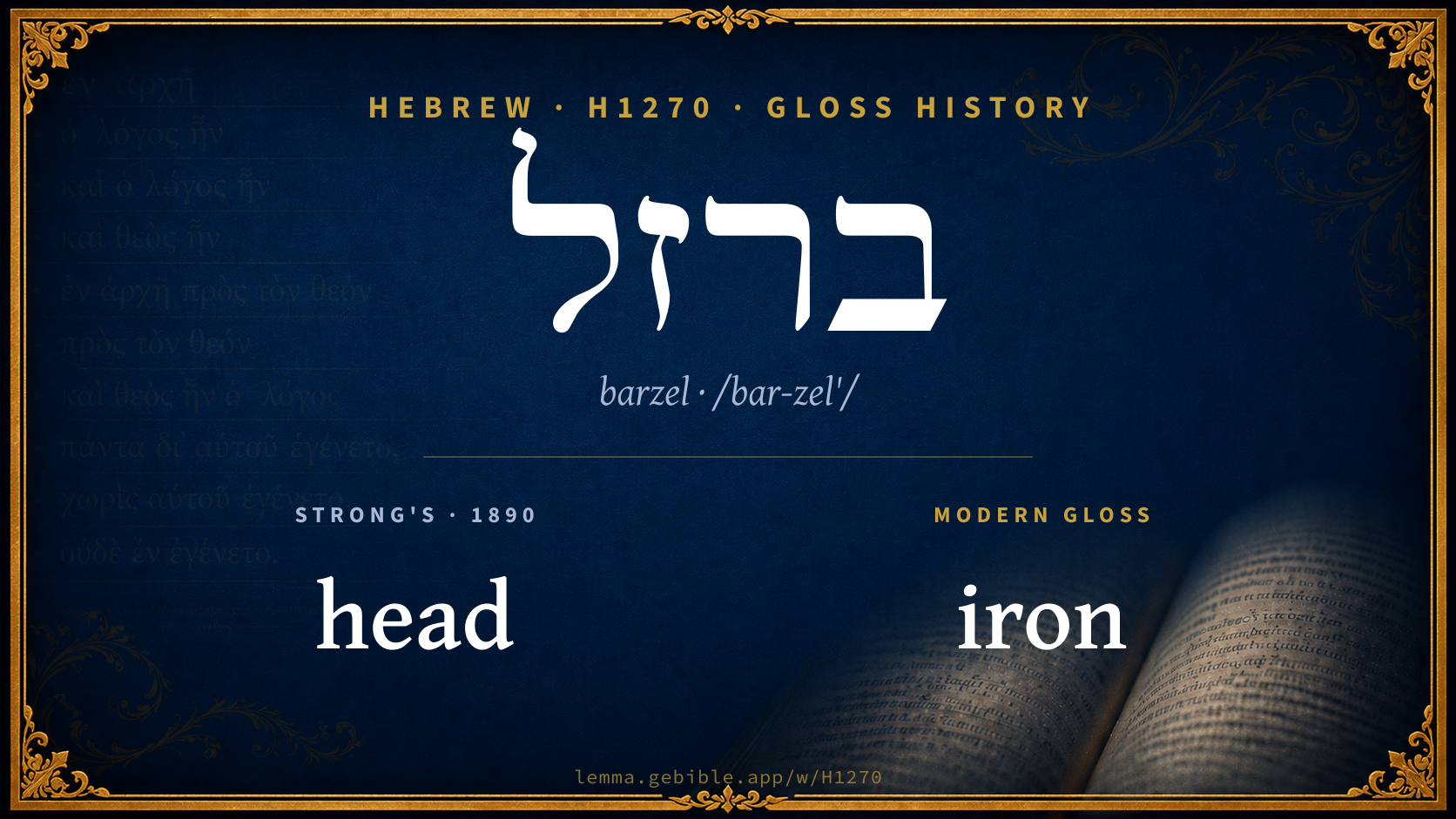
Gloss history
Strong's 1890 vs modern scholarship
About this word
Strong's H1270 catalogs a Hebrew word from the Hebrew Old Testament.
These counts are not copied from any lexicon or concordance. They are computed here, from the morphology-tagged Hebrew Old Testament. What Lemma adds →
- 70
- distinct verses
- The word appears in 70 distinct verses.
- 21 / 39
- OT books
- The word appears in 21 of 39 Old Testament books.
- #523
- by frequency
- Top 1000 most frequent Hebrew words (rank 523 of 8,640 Hebrew words by occurrence).
View all 70 occurrences in the concordance →
Most concentrated in
- Deuteronomy 8 verses 11%
- Jeremiah 7 verses 10%
- Joshua 6 verses 9%
By section of the Old Testament
By traditional corpus
Conventional, traditional groupings — biblical authorship is debated, so this is a traditional corpus grouping, not an authorship claim. Each share is this word’s portion of its verses in that division of the Hebrew canon. Each figure is a share of the word’s 70 distinct verses.
- Prophets (Nevi'im) 36 verses · 51%
- Writings (Ketuvim) 22 verses · 31%
- Torah (Pentateuch) 12 verses · 17%
How translations render this word
Counts come from each version’s own published word-to-Strong’s tagging or interlinear alignment — an approximate guide to how each version renders this word, not a word-level alignment the data otherwise carries. Because each total is that version’s own tagged count, the per-version totals vary from one another and need not match the appearance or distinct-verse counts above. These counts may also differ from a printed concordance because Lemma counts each distinctly tagged rendering and does not collapse phrase taggings into a single head-word total. This is a fixed set of word-tagged versions (KJV, ASV, BSB, ULT) and does not change with the reading translation you choose elsewhere. Each version’s license is shown beside its name below (and on Sources).
- King James Version: Iron 62×, Any iron 2×
- American Standard Version: Iron 61×
- Berean Standard Bible: Iron 59×, Axe 2×, Have iron 2×
- unfoldingWord Literal Text: Iron 70×, Iron tool 2×
King James Version Public Domain
Renders H1270 across 76 tagged occurrences — most commonly:
Plus 12 renderings that appear only once — usually multi-word phrases or single function words the recovered tagging swept in, not distinct renderings.
American Standard Version Public Domain
Renders H1270 across 75 tagged occurrences — most commonly:
Plus 14 renderings that appear only once — usually multi-word phrases or single function words the recovered tagging swept in, not distinct renderings.
Berean Standard Bible Public Domain
Renders H1270 across 73 tagged occurrences — most commonly:
Plus 10 renderings that appear only once — usually multi-word phrases or single function words the recovered tagging swept in, not distinct renderings. Not rendered by a distinct English word in 3 further occurrences.
unfoldingWord Literal Text CC BY-SA 4.0
Renders H1270 across 77 tagged occurrences — most commonly:
Plus 5 renderings that appear only once — usually multi-word phrases or single function words the recovered tagging swept in, not distinct renderings.
7 senses and sub-senses in the full BDB
What do BDB’s symbols mean?
BDB uses these scholarly abbreviations:
| Symbol | Meaning |
|---|---|
| 𝔊 | the Septuagint (the ancient Greek translation, LXX) |
| 𝔙 | the Vulgate (the Latin translation) |
| 𝔖 | the Syriac version (the Peshitta) |
| 𝔗 | the Targum (the Aramaic translation) |
| ψ | the Psalms |
| √ | root (the underlying root or stem) |
| ‖ | parallel passage (a synonymous or contrasted parallel) |
| † | the dagger: every passage where the word occurs is cited |
The 7 senses and sub-senses the full Brown-Driver-Briggs lexicon distinguishes for this word, in lexicon order (not ranked by frequency), with BDB’s own verbatim wording and sub-sense lettering. Shown in Hebrew script with BDB’s own scholarly abbreviations. The condensed entry is in the Lexicon Entry tab. See also the Forms in the corpus table below.
- 1. iron, lit.:
- a. iron-ore, stone containing iron, Dt 8:9; Jb 28:2; e.g. Deuteronomy 8:9
- b. as raw material (to be worked) Gn 4:22; 1 Ch 22:3, 14, 16; 29:2(×2), 7 2 Ch 2:6, 13; 24:12; Is 44:12; e.g. Genesis 4:22
- c. as article of commerce Ez 27:12, 19; e.g. Ezekiel 27:12
- d. as material of furniture, utensils, implements, etc., עֶרֶשׂ ב׳ Dt 3:11, רֶכֶב ב׳ Jos 17:16, 18; Ju 1:19, 4:3, 13, כְּלֵי ב׳ Jos 6:19, 24 cf. 1 K 6:7; Nu 35:16, עֵט־ב׳ Jb 19:24 & fig. Je 17:1, חֲרִצֵי הַבּ׳ 2 S 12:31 = 1 Ch 20:3, מַגְזְרוֹת הַבּ׳ 2 S 12:31 cutting instr. of iron, vid. Am 1:3, כַּבְלֵי ב׳ ψ 149:8 (‖ זִקִּים), נֵשֶׁק ב׳ Jb 20:24, קַרְנֵי ב׳ 1 K 22:11 = 2 Ch 18:10, קִיר ב׳ & מַחֲבַת ב׳ Ez 4:3; בְּרִיחֵי ב׳, i.e. of Babylon, ag. Cyrus Is 45:2; cf. 1 S 17:7 & Is 60:17(×2) (fig.) e.g. Deuteronomy 3:11
- 2. tool of iron Dt 27:5; Jos 8:31; Pr 27:17(×2) Ec 10:10 Is 10:34 (metaph.); head of an axe Dt 19:5 2 K 6:5, 6; so weapon 2 S 23:7; Jb 41:19; cf. also Nu 31:22; Jos 22:8 where iron as spoil of war. e.g. Deuteronomy 27:5
- 3. iron in fig. of unwatered earth Dt 28:23; of Egyptian bondage, כּוּר הַבּ׳ Dt 4:20; 1 K 8:51; Je 11:4; of oppression עֹל ב׳ Dt 28:48; Je 28:14 cf. v 13; of strength Je 15:12(×2); cf. ב׳ מִנְעָלֶיךָ Dt 33:25 & Mi 4:13 קֶרֶן ב׳; of prophet, firm through Yahweh’s might, עַמּוּד ב׳ Je 1:18; of distress, בְּרִיחֵי ב׳ ψ 107:16 cf. v 10 of judgments of י׳, & 105:18; שֵׁבֶט ב׳ ψ 2:9; of evildoers, Je 6:28; Ez 22:18, 20; simile of scorching sky Lv 26:19; מְטִיל ב׳ of bones of hippopotamus Jb 40:18; גִּיד ב׳ of obstinate neck of Isr. Is 48:4. e.g. Deuteronomy 28:23
Senses from the full Brown-Driver-Briggs lexicon (Brown, Driver, Briggs; Oxford 1906 — public domain), digitized via Sefaria, supplemented by the OpenScriptures HebrewLexicon (CC BY 4.0). Full attribution on Sources.
Word origin
n.m. Ez 27:19 iron (c. ל afform.; from piercing? NH id., Aramaic id., פַּרְזֶל, ܦܰܪܙܠܴܐ Ph. ברזל, Assyrian parzillu COTGloss, (Arabic فِرْزِلٌ fetter is loan-word))—always abs. ב׳ Gn 4:22 + 74 times (בַּרְזֶל֑ Gn 4:22 etc.);—
— Brown-Driver-Briggs (Oxford 1906, public domain), digitized via Sefaria, supplemented by the OpenScriptures HebrewLexicon (CC BY 4.0). See Sources.
Derived from ברזות (Birzôwth) (H1269) — Birzavith.
Jastrow Dictionary
A second Hebrew/Aramaic lexicon for comparison, covering Aramaic and post-biblical (Talmudic, Targumic, Midrashic) usage that the biblical-Hebrew BDB does not. Matched by lemma rather than by Strong’s number, so a lemma may carry more than one Jastrow headword (shown separately below), and the entries cover usage well beyond the Bible.
בַּזֵּל
- (Pa. of בזל, √בז, v. בְּזָא II) to scatter, to distribute by shaking (cmp. בְּדַר Pa. 2). Sabb. 66ᵇ וליבַּזּוּלֵיה וכ׳ Ms. M. a. oth. (ed. לברזוליה, לברזליה) let him shake it (the ant in the tube) to pieces and carry it off.
בַּרְזֶל
- iron, iron tool. Gen. R. s. 75 לובשי ב׳ clad in iron armor; a. fr.—צאן ב׳ flock sold to payment in terms under the condition that the young be divided until the payment in full has taken place. Bekh. II, 4, v. וָלָד.—(נכסי) עבדי צאן ב׳ mort-main, wife’s estate held by her husband, which, in case of her death or divorce, he must restore in specie, being responsible whith all his landed property for loss or deterioration. Yeb. VII, 1; a. fr.; v. נְכָסִים.
בַּרְזֶל ²
- Targ. I Kings XXII, 12; a. e.—Sabb. 66ᵇ קול ב׳ (Ms. M. קל פ׳). V. פַּרְזְלָא
A Dictionary of the Targumim, the Talmud Babli and Yerushalmi, and the Midrashic Literature (Marcus Jastrow; London, Luzac, 1903) — Public Domain. Digitized via Sefaria. Digitized via Sefaria. Full attribution on Sources.
Forms in the corpus
The 44 distinct written forms H1270 takes in the Hebrew Bible, most frequent first — each parse links to that state’s occurrences in the concordance. Hebrew forms include their vowel points and cantillation, so a single lemma takes many written forms.
| Form | Parsing | Example | Uses |
|---|---|---|---|
| בַּרְזֶל֙ | Noun, Common, Masculine, Singular, Absolute | Deuteronomy 28:48 | 7 |
| בַּרְזֶ֑ל | Noun, Common, Masculine, Singular, Absolute | 1 Samuel 17:7 | 6 |
| בַּרְזֶ֔ל | Noun, Common, Masculine, Singular, Absolute | Deuteronomy 3:11 | 4 |
| בַּרְזֶֽל | Noun, Common, Masculine, Singular, Absolute | Deuteronomy 27:5 | 4 |
| הַ/בַּרְזֶל֙ | Noun, Common, Masculine, Singular, Absolute | Deuteronomy 19:5 | 4 |
| הַ/בַּרְזֶ֖ל | Noun, Common, Masculine, Singular, Absolute | Amos 1:3 | 3 |
| בַרְזֶ֑ל | Noun, Common, Masculine, Singular, Absolute | 1 Kings 22:11 | 2 |
| בַרְזֶ֔ל | Noun, Common, Masculine, Singular, Absolute | Deuteronomy 8:9 | 2 |
| בַרְזֶ֖ל | Noun, Common, Masculine, Singular, Absolute | 2 Samuel 23:7 | 2 |
| בַּרְזֶ֖ל | Noun, Common, Masculine, Singular, Absolute | Jeremiah 17:1 | 2 |
| בַּרְזֶ֛ל | Noun, Common, Masculine, Singular, Absolute | Jeremiah 1:18 | 2 |
| בַּרְזֶ֥ל | Noun, Common, Masculine, Singular, Absolute | Deuteronomy 33:25 | 2 |
| הַ/בַּרְזֶ֗ל | Noun, Common, Masculine, Singular, Absolute | Ecclesiastes 10:10 | 2 |
| הַ/בַּרְזֶ֜ל | Noun, Common, Masculine, Singular, Absolute | 2 Samuel 12:31 | 2 |
| הַ/בַּרְזֶֽל | Noun, Common, Masculine, Singular, Absolute | 1 Kings 8:51 | 2 |
| וּ/בַרְזֶ֑ל | Noun, Common, Masculine, Singular, Absolute | Genesis 4:22 | 2 |
| בַרְזֶ֣ל | Noun, Common, Masculine, Singular, Absolute | Psalms 107:16 | 1 |
| בַרְזֶ֧ל | Noun, Common, Masculine, Singular, Absolute | Numbers 35:16 | 1 |
| בַרְזֶֽל | Noun, Common, Masculine, Singular, Absolute | Psalms 149:8 | 1 |
| בַרְזֶל֙ | Noun, Common, Masculine, Singular, Absolute | 2 Chronicles 24:12 | 1 |
| בְּ/בַרְזֶ֣ל | Noun, Common, Masculine, Singular, Absolute | Proverbs 27:17 | 1 |
| בַּ/בַּרְזֶ֑ל | Noun, Common, Masculine, Singular, Absolute | Isaiah 10:34 | 1 |
| בַּ/בַּרְזֶ֜ל | Noun, Common, Masculine, Singular, Absolute | 2 Chronicles 2:14 | 1 |
| בַּ֝רְזֶ֗ל | Noun, Common, Masculine, Singular, Absolute | Psalms 105:18 | 1 |
| בַּ֭רְזֶל | Noun, Common, Masculine, Singular, Absolute | Job 28:2 | 1 |
| בַּרְזֶ֗ל | Noun, Common, Masculine, Singular, Absolute | Joshua 17:16 | 1 |
| בַּרְזֶ֡ל | Noun, Common, Masculine, Singular, Absolute | Jeremiah 28:14 | 1 |
| בַּרְזֶ֣ל | Noun, Common, Masculine, Singular, Absolute | Proverbs 27:17 | 1 |
| בַּרְזֶ֤ל | Noun, Common, Masculine, Singular, Absolute | Ezekiel 27:19 | 1 |
| בַּרְזֶ֧ל | Noun, Common, Masculine, Singular, Absolute | Jeremiah 15:12 | 1 |
| הַ/בַּרְזֶ֔ל | Noun, Common, Masculine, Singular, Absolute | Numbers 31:22 | 1 |
| וְ/הַ/בַּרְזֶ֔ל | Noun, Common, Masculine, Singular, Absolute | Joshua 6:24 | 1 |
| וְ/לַ/בַּרְזֶ֖ל | Noun, Common, Masculine, Singular, Absolute | 1 Chronicles 22:16 | 1 |
| וְ/לַ/בַּרְזֶל֙ | Noun, Common, Masculine, Singular, Absolute | 1 Chronicles 22:14 | 1 |
| וּ/בְ/בַרְזֶ֛ל | Noun, Common, Masculine, Singular, Absolute | Joshua 22:8 | 1 |
| וּ/בַ/בַּרְזֶ֗ל | Noun, Common, Masculine, Singular, Absolute | 2 Chronicles 2:7 | 1 |
| וּ/בַרְזֶ֔ל | Noun, Common, Masculine, Singular, Absolute | Joshua 6:19 | 1 |
| וּ/בַרְזֶ֖ל | Noun, Common, Masculine, Singular, Absolute | 1 Chronicles 29:7 | 1 |
| וּ/בַרְזֶ֣ל | Noun, Common, Masculine, Singular, Absolute | 1 Chronicles 22:3 | 1 |
| וּ/בַרְזֶ֤ל | Noun, Common, Masculine, Singular, Absolute | Ezekiel 22:18 | 1 |
| וּ/בַרְזֶ֨ל | Noun, Common, Masculine, Singular, Absolute | Ezekiel 22:20 | 1 |
| וּ/בַרְזֶֽל | Noun, Common, Masculine, Singular, Absolute | Psalms 107:10 | 1 |
| כַּ/בַּרְזֶ֔ל | Noun, Common, Masculine, Singular, Absolute | Leviticus 26:19 | 1 |
| לַ/בַּרְזֶ֔ל | Noun, Common, Masculine, Singular, Absolute | 1 Chronicles 29:2 | 1 |
Same root — word family
Other BDB entries built from the same root as H1270, grouped by Strong’s listed origin. These share a root / origin per the lexicon — not necessarily a shared meaning. Each links to that word’s own entry.
Derives from
Derived from this word
Proper names from this root
People and places named from this root — a name, not an additional meaning of the word.
Compare all same-root words → 2 of the same-root words are proper names (people or places). They share a root, not necessarily a meaning.
Septuagint verse parallels
This word appears in 66 verses that also exist in the Greek Old Testament (Septuagint), out of the 70 Hebrew verses it occurs in. You can read those verses in Greek by switching the Old Testament edition to the Septuagint.
Read these verses in the Septuagint
- Genesis 4:22
- Leviticus 26:19
- Numbers 31:22
- Deuteronomy 3:11
- Joshua 6:19
- Judges 1:19
- 1 Samuel 17:7
- 2 Samuel 12:31
- 1 Kings 6:7
- 2 Kings 6:5
- 1 Chronicles 20:3
- 2 Chronicles 2:7
This is a verse-level parallel only — the same verses exist in both the Hebrew and Greek Old Testaments. No word-level Hebrew↔Greek correspondence is claimed: the data carries no such alignment, so no Greek word is shown as this Hebrew word’s translation. Coverage is not total — the Septuagint omits the deuterocanon and renumbers the Psalms, so some Hebrew verses have no direct Greek parallel.