
Ezekiel 22:18

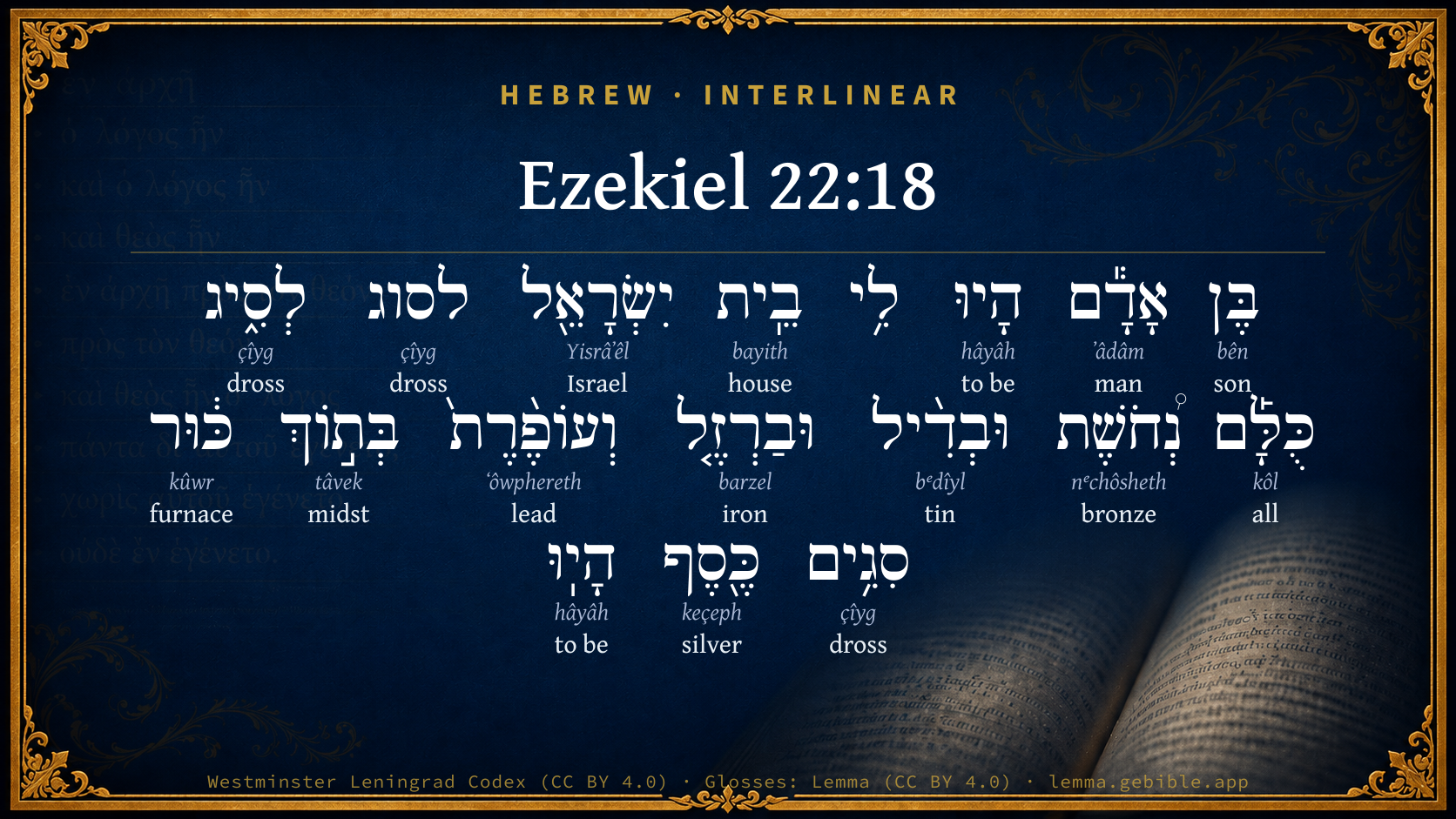
Hebrew (Westminster Leningrad Codex) Ezekiel 22:18 appears in the Hebrew Old Testament. The text above is from the Westminster Leningrad Codex. Each word links to its Strong’s number, a concise gloss, and parsing drawn from the Open Scriptures Hebrew Bible morphology. Click any word for its full Brown-Driver-Briggs (BDB) entry.
Download image
Cite this verse

Ezekiel 22:18 (World English Bible). Public Domain. Lemma interlinear Bible study tool, https://lemma.gebible.app/v/ezekiel/22/18.

Show BibTeX & RIS
BibTeX
RIS
English Translation
Son of man, the house of Israel is become dross to me: all of them are brass and tin and iron and lead, in the midst of the furnace; they are the dross of silver.
World English Bible · Public Domain
Download a study sheet

One document with this verse’s original text, its word-by-word gloss line, the meaning frame, cross-references with their text, attributed commentary, and full source and license credits — printable, and it pastes into notes with its structure intact.

This verse Autodidact and up

Study sheet (.html) Plain text (.txt)

A passage Seminary Student

Up to 50 verses in one chapter. A passage sheet keeps up to 6 commentary sources and 12 cross-references per verse, in the order this page ranks them, and says so on the sheet whenever that leaves anything out. Ask for a single verse and you get the Autodidact verse sheet above.

Everything on this page stays free to read, with no account — the sheet is a download of what is already on screen, not access to it.

Want to remove ads? Support Godless Engineer
Compare translations 3

The same verse in 3 English versions, stacked beneath the original-language interlinear above. Click any original word for its lexicon entry.

Each is an independent rendering of the whole verse — the interlinear is not word-aligned to these translations.

Highlighted words mark where these versions differ — a whole-verse word diff, not a word-by-word alignment.

  • World English Bible Public Domain
    Son of man, the house of Israel is become dross to me: all of them are brass and tin and iron and lead, in the midst of the furnace; they are the dross of silver.
  • King James Version Public Domain
    Son of man, the house of Israel is to me become dross: all they are brass, and tin, and iron, and lead, in the midst of the furnace; they are even the dross of silver.
  • unfoldingWord Literal Text CC BY-SA 4.0
    “Son of man, the house of Israel has become dross to me. All of them are the leftovers of bronze and tin, and iron and lead in the midst of you. They will be like the dross of silver in your furnace.

unfoldingWord Literal Text — © unfoldingWord, licensed CC BY-SA 4.0. Word-aligned USFM3 via Door43 (git.door43.org/unfoldingWord/en_ult).

Versions to compare (up to 4)

3 of 4 selected

Show all 18 translations

Every available English version of this verse, each an independent rendering of the whole verse.

  • World English Bible Public Domain
    Son of man, the house of Israel is become dross to me: all of them are brass and tin and iron and lead, in the midst of the furnace; they are the dross of silver.
  • Berean Standard Bible Public Domain
    “Son of man, the house of Israel has become dross to Me. All of them are copper, tin, iron, and lead inside the furnace; they are but the dross of silver.
  • Majority Standard Bible Public Domain
    “Son of man, the house of Israel has become dross to Me. All of them are copper, tin, iron, and lead inside the furnace; they are but the dross of silver.
  • King James Version Public Domain
    Son of man, the house of Israel is to me become dross: all they are brass, and tin, and iron, and lead, in the midst of the furnace; they are even the dross of silver.
  • American Standard Version (1901) Public Domain
    Son of man, the house of Israel is become dross unto me: all of them are brass and tin and iron and lead, in the midst of the furnace; they are the dross of silver.
  • Revised Version (1885) Public Domain
    Son of man, the house of Israel is become dross unto me: all of them are brass and tin and iron and lead, in the midst of the furnace; they are the dross of silver.
  • Geneva Bible (1599) Public Domain
    Sonne of man, the house of Israel is vnto me as drosse: all they are brasse, and tinne, and yron, and leade in the mids of the fornace: they are euen the drosse of siluer.
  • Douay-Rheims (1899) Public Domain
    Son of man, the house of Israel is become dress to me: all these are brass, and tin, and iron, and lead, in the midst of the furnace: they are become the dress of silver.
  • Young's Literal Translation Public Domain
    The house of Israel hath been to Me for dross, All of them `are' brass, and tin, and iron, and lead, In the midst of a furnace -- dross hath silver been,
  • Literal Standard Version CC BY-SA 4.0
    “Son of man, the house of Israel has been for dross to Me, || All of them [are] bronze, and tin, and iron, and lead, || In the midst of a furnace—silver has been dross,
  • Unlocked Literal Bible CC BY-SA 4.0
    “Son of man, the house of Israel has become dross to me. All of them are the leftovers of bronze and tin, and iron and lead in the midst of you. They will be like the dross of silver in your furnace.
  • unfoldingWord Literal Text CC BY-SA 4.0
    “Son of man, the house of Israel has become dross to me. All of them are the leftovers of bronze and tin, and iron and lead in the midst of you. They will be like the dross of silver in your furnace.
  • Darby Bible Public Domain
    Son of man, the house of Israel is become dross to me: they are all copper, and tin, and iron, and lead, in the midst of the furnace: they are become the dross of silver.
  • World Messianic Bible Public Domain
    “Son of man, the house of Israel has become dross to me. All of them are bronze, tin, iron, and lead in the middle of the furnace. They are the dross of silver.
  • Webster's Bible Public Domain
    Son of man, the house of Israel is to me become dross: all they are brass, and tin, and iron, and lead, in the midst of the furnace; they are even the dross of silver.
  • Free Bible Version CC BY-SA 4.0
    “Son of man, the people of Israel have ended up like the impurities left over from refining metal. They're all like copper, tin, iron, and lead in the furnace—they are just the impurities left from refining silver.
  • Bible in Basic English Public Domain
    Son of man, the children of Israel have become like the poorest sort of waste metal to me: they are all silver and brass and tin and iron and lead mixed with waste.
  • JPS Tanakh (1917) Public Domain
    'Son of man, the house of Israel is become dross unto Me; all of them are brass and tin and iron and lead, in the midst of the furnace; they are the dross of silver.

Literal Standard Version (2020), Covenant Press — licensed CC BY-SA 4.0. Text via the HelloAO Bible API (eBible.org). Unlocked Literal Bible (unfoldingWord) — licensed CC BY-SA 4.0. Text via the HelloAO Bible API (eBible.org). unfoldingWord Literal Text — © unfoldingWord, licensed CC BY-SA 4.0. Word-aligned USFM3 via Door43 (git.door43.org/unfoldingWord/en_ult). Free Bible Version, Dr. Jonathan Gallagher — licensed CC BY-SA 4.0. Text via the HelloAO Bible API (eBible.org).

Word by word

More ways to search: Search by grammar → Find every occurrence → Compare this word →

Practice this passage: Drill this verse → Learn its vocabulary →

וּבְדִ֨יל
bᵉdîyl
H913
“and · tin”
Conjunction + Noun, Common, Masculine, Singular, Absolute
Part of Speech
Conjunction + Noun
Type
Common
Gender
Masculine
Number
Singular
State
Absolute
Full BDB Definition

Origin: from H914

TWOT: 203c

alloy, tin, dross - of Israel (metaphorically)
  1. בֶּן bên H1121 “son of” Noun, Common, Masculine, Singular, Construct
  2. אָדָ֕ם ʼâdâm H120 “man” Noun, Common, Masculine, Singular, Absolute
  3. הָיוּ hâyâh H1961 “to be” Verb, Qal, Perfect, 3rd Person, Common, Plural
  4. בֵֽית bayith H1004 “house of” Noun, Common, Masculine, Singular, Construct
  5. יִשְׂרָאֵ֖ל Yisrâʼêl H3478 “Israel” Noun, Proper
  6. לסוג çîyg H5509 “to/for · dross” Preposition + Noun, Common, Masculine, Singular, Absolute
  7. לְסִ֑יג çîyg H5509 “to/for · dross” Preposition + Noun, Common, Masculine, Singular, Absolute
  8. כֻּלָּ֡ם kôl H3605 “all · their” Noun, Common, Masculine, Singular, Construct + Suffix, Personal, 3rd Person, Masculine, Plural
  9. נְ֠חֹשֶׁת nᵉchôsheth H5178 “bronze” Noun, Common, Feminine, Singular, Absolute
  10. וּבַרְזֶ֤ל barzel H1270 “and · iron” Conjunction + Noun, Common, Masculine, Singular, Absolute
  11. וְעוֹפֶ֨רֶת֙ ʻôwphereth H5777 “and · lead” Conjunction + Noun, Common, Feminine, Singular, Absolute
  12. בְּת֣וֹךְ tâvek H8432 “in/at · midst of” Preposition + Noun, Common, Masculine, Singular, Construct
  13. כּ֔וּר kûwr H3564 “furnace” Noun, Common, Masculine, Singular, Absolute
  14. סִגִ֥ים çîyg H5509 “dross” Noun, Common, Masculine, Plural, Absolute
  15. כֶּ֖סֶף keçeph H3701 “silver” Noun, Common, Masculine, Singular, Absolute
  16. הָיֽוּ hâyâh H1961 “to be” Verb, Qal, Perfect, 3rd Person, Common, Plural

About this verse

These counts appear in no published source. They are computed here, from the morphology-tagged text and Lemma’s own curated glosses. What Lemma adds →

18
words
14
distinct lemmas
Prophets
section

Notable vocabulary

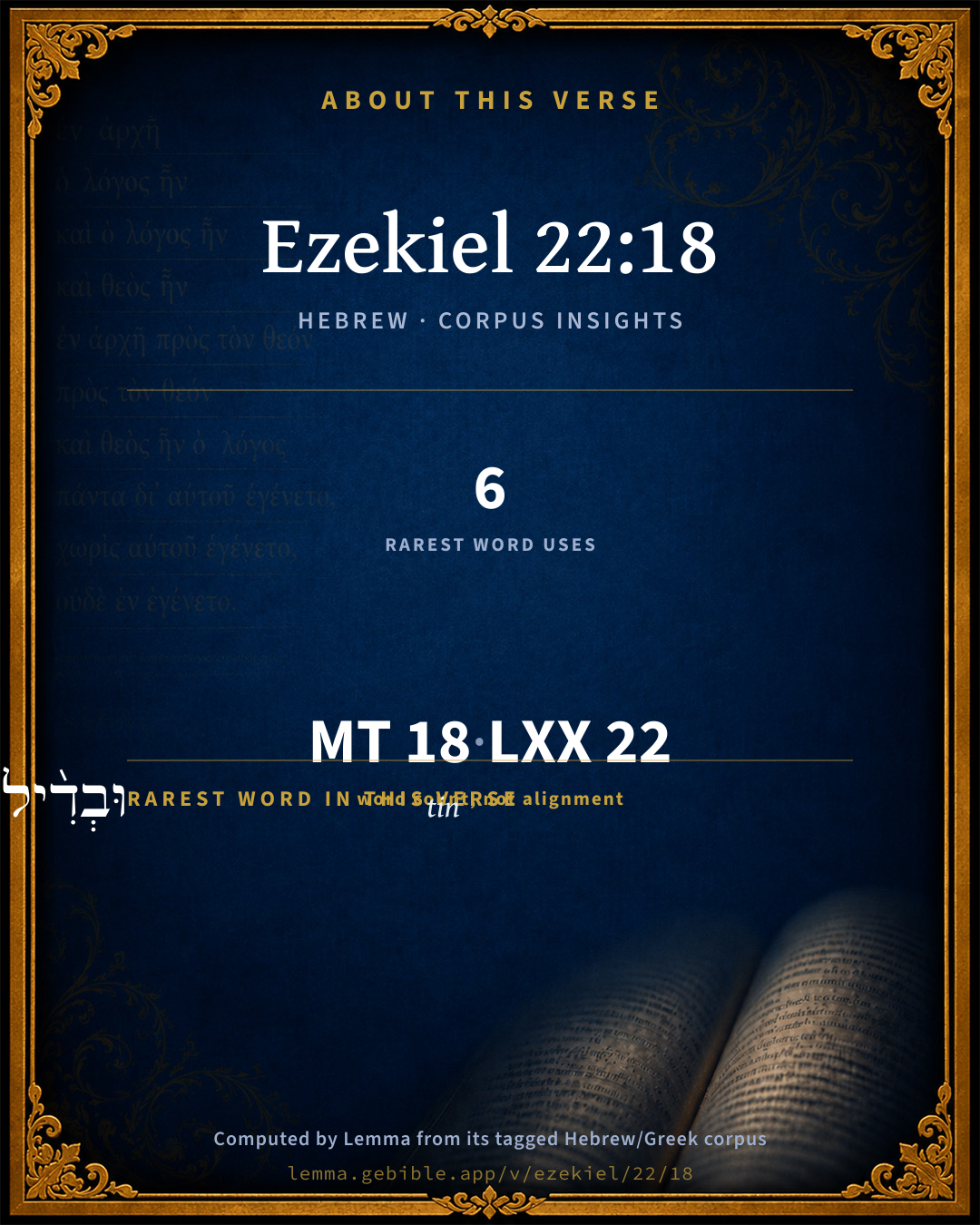
The rarest word here is וּבְדִ֨יל tin H913 — appearing just 6 times in the whole Hebrew Bible.

Shared distinctive vocabulary

וּבְדִ֨יל tin H913 occurs in 6 verses of the Hebrew Bible. Also found in:

Grammatical profile

  • 2 verbs
  • 15 nouns
  • 1 preposition

Verb forms

  • הָיוּ Qal · Perfect
  • הָיֽוּ Qal · Perfect

Repetition

Words recur within this verse — often emphatic in Hebrew:

  • לסוג dross H5509 ×3
  • הָיוּ to be H1961 ×2

Hebrew & Septuagint length

In English translation the verse runs 35 words from the Hebrew and 35 from the Septuagint (LXX English) — the same length.

A rough comparison of the two English renderings, which tokenize alike — not a word-level alignment.

Word counts can differ between the Hebrew and the Greek without any difference in meaning — e.g. the Hebrew direct-object marker אֵת has no separate Greek word, and Greek often adds the article ὁ.

In the original languages it is 18 Hebrew tokens and 22 Greek tokens — but the two are counted differently (Hebrew bundles its prefixes and suffixes into one token; the Greek is in lemma form), so that isn’t a like-for-like length.

Cross-references

10

Topical passages linked to Ezekiel 22:18 in the Treasury of Scripture Knowledge — connected by theme and wording, ordered by reader-vote popularity; previews shown in the World English Bible.

  • Psalms 119:119 You put away all the wicked of the earth like dross. Therefore I love your testimonies.
  • Isaiah 1:22 Your silver has become dross, Your wine mixed with water.
  • Isaiah 48:10 Behold, I have refined you, but not as silver; I have chosen you in the furnace of affliction.
  • Jeremiah 6:28–30 They are all grievous rebels, going about with slanders; they are brass and iron: they all of them deal corruptly.
  • Proverbs 17:3 The refining pot is for silver, and the furnace for gold, But Yahweh tests the hearts.
  • Isaiah 1:25 And I will turn my hand on you, Thoroughly purge away your dross, And will take away all your tin.
  • Isaiah 31:9 His rock shall pass away by reason of terror, and his princes shall be dismayed at the ensign, says Yahweh, whose fire is in Zion, and his furnace in Jerusalem.
  • Isaiah 48:4 Because I knew that you are obstinate, and your neck is an iron sinew, and your brow brass;
  • Lamentations 4:1–2 How is the gold become dim! [how] is the most pure gold changed! The stones of the sanctuary are poured out at the head of every street.
  • Ezekiel 22:20 As they gather silver and brass and iron and lead and tin into the midst of the furnace, to blow the fire on it, to melt it; so will I gather you in my anger and in my wrath, and I will lay you there, and melt you.

Cross-references courtesy of OpenBible.info (CC BY 4.0).

Hebrew and Greek witnesses Masoretic Hebrew ↔ Greek Septuagint

The same verse in the two great witnesses to the Old Testament, shown verse-for-verse.

These are two independent witnesses, not word-aligned to each other, and the Septuagint is shown in lemma (dictionary) form.

Hebrew Ezekiel 22:18 Masoretic · Westminster Leningrad Codex

בֶּן אָדָ֕ם הָיוּ לִ֥י בֵֽית יִשְׂרָאֵ֖ל לסוג לְסִ֑יג כֻּלָּ֡ם נְ֠חֹשֶׁת וּבְדִ֨יל וּבַרְזֶ֤ל וְעוֹפֶ֨רֶת֙ בְּת֣וֹךְ כּ֔וּר סִגִ֥ים כֶּ֖סֶף הָיֽוּ

Son of man, the house of Israel is become dross to me: all of them are brass and tin and iron and lead, in the midst of the furnace; they are the dross of silver.

World English Bible · Public Domain

Greek LXX Ezekiel 22:18 Septuagint · lemma form

υἱός ἄνθρωπος ἰδού γίγνομαι ἐγώ ὁ οἶκος ἰσραήλ ἀναμίγνυμι πᾶς χαλκοῦς καί σίδηρος καί κασσίτερος καί μόλιβος ἐν μέσος ἀργύριον ἀναμίγνυμι εἰμί

Son of man, behold, the house of Israel are all become to me as it were mixed with brass, and iron, and tin, and lead; they are mixed up in the midst of the silver.

LXX2012 (modern English Septuagint) · Public Domain

On this verse, John Gill's Exposition discusses the Septuagint’s reading. Read the note in Commentary ↓

Hebrew: Westminster Leningrad Codex (CC BY 4.0). Greek: Septuagint (public domain); English from LXX2012 (modern English Septuagint) (Public Domain). How the Septuagint differs from the Hebrew →

Targum (Aramaic paraphrase)

1

The Targum is the ancient Jewish Aramaic paraphrase of the Hebrew Scriptures — an interpretive translation, not the Hebrew text itself. Onkelos (literal) and Pseudo-Jonathan (expansive) render the Torah, and Jonathan the Prophets. Coverage is partial: where no permissively-licensed English translation exists for a verse, only the Aramaic is shown. This is verse-level text, not a word-by-word alignment to the Hebrew.

  1. Targum Jonathan Prophets (Joshua–Malachi)
    בַּר אָדָם הֲווֹ קֳדָמַי בֵּית יִשְׂרָאֵל לִפְסוּלָא כּוּלְהוֹן כְּמָא דִמְעָרַב נְחַשׁ וּבְעִיץ וּבַרְזֶל וַאֲבַר בְּגוֹ כוּרָא לִפְּסוֹלַת כַּסְפָּא הֲווֹ:

    (no public-domain English translation for this verse)

    Targum Jonathan — Aramaic: “Mikraot Gedolot” (public domain). English: “Sefaria Community Translation” (CC0 1.0 (public-domain dedication)); “London "Chaldee Paraphrase," 1871” (public domain). Text via Sefaria.

Commentary

Notes on Ezekiel 22:18 from classic Christian and Jewish commentators (each source and its license shown beneath its notes). The classic Christian expositions comment on the surrounding passage and are grouped to its opening verse, so a note may address several verses; the Jewish commentaries on the Tanakh (Rashi and others) are per-verse, so they appear only where the commentator wrote on this verse.

Lemma curates 59 commentaries, every one of them public domain or Creative Commons licensed, each selected and text-cleaned for this edition rather than reprinted as found. About our sources →

Trapp's Complete Commentary

John Trapp

Eze 22:18 Son of man, the house of Israel is to me become dross: all they [are] brass, and tin, and iron, and lead, in the midst of the furnace; they are [even] the dross of silver.

Ver. 18. The house of Israel is to me become dross.] Recrementum argenti; offal stuff. Silver they were once, but now nothing less. Haec ad nos quoque transferenda sunt. This is even our case; we are quite degenerate, and altogether unlike our zealous progenitors.

“ Heu! pietas ubi prisca! profana O tempora! Mundi

Faex, vesper, prope nox! O Mora! Christe veni. ”

All they are brass.] See on Isa 1:22.

John Trapp, A Commentary or Exposition upon All the Books of the Old and New Testament (1647–1656) — public domain. Text from a community e-Sword module.

The Biblical Illustrator

Joseph S. Exell

Eze_22:18

Son of man, the house of Israel is to me become dross.

Sins deteriorating power

Stand in fancy in one of the fights of the old civil war. The Royalists are fighting desperately, and are winning apace; but I hear a cry from the other side that Cromwells Ironsides are coming. Now we shall see some fighting. Oliver and his men are lions. But lo! I see that the fellows who come up hang fire, and are afraid to rush into the thick of the fight; surely these are not Cromwells Ironsides, and yonder captain is not old Nell? I do not believe it; it cannot be. Why, if they were what they profess to be, they would have broken the ranks of those perfumed cavaliers long ago, and have made them fly before them like chaff before the wind. So when I hear men say, Here is a body of Christians. What! those Christians? Those cowardly people, who hardly dare speak a word for Jesus! Those covetous people, who give a few cheese parings to His cause! Those inconsistent people, whom you would not know to be Christian professors if they did not label themselves! What! such beings followers of a crucified Saviour! The world sneers at such pretensions, and well it may. (C. H. Spurgeon.)

The Biblical Illustrator, edited by Joseph S. Exell (c. 1880s–1900s) — public domain. Text from a community e-Sword module.

Joseph Benson's Commentary

Eze 22:18-22. The house of Israel is to me become dross — “Their filthiness may be fitly compared to the mixture of dross and baser metals with the pure silver: and as that is purified by being melted in a furnace or crucible, so Jerusalem, when it is set on fire, shall be the furnace into which I will cast them and their wickedness to be consumed: compare Jer 6:28-30. God’s severe judgments are expressed by the furnace of affliction, (Isa 48:10,) and compared to a refiner’s fire, (Mal 3:2; Isa 1:25,) because they are designed to purge men from that dross and corruption which are too often the effect of ease and prosperity.” — Lowth. As they gather silver, so will I gather you — From all parts. I will, by a secret, overruling providence, bring you into Jerusalem, as into a furnace where you may be consumed. And I will blow upon you in the fire of my wrath — I will stir or blow up the fire of my wrath against you. God’s vengeance is often compared to fire, but here it was so in a literal sense, when both city and temple were consumed by fire, 2Ki 25:9.

Joseph Benson's Commentary on the Old and New Testaments (1811–1818) — public domain. Text from a community e-Sword module.

Whedon's Commentary on the Bible

Daniel D. Whedon

ISRAEL IN THE ASSYRIAN FURNACE, Eze_22:18-22.

In this new prophecy Israel is compared with the ore in a smelting furnace. This ore looks now perfectly worthless. Once it was good silver ore, but now it is only the “dross” of silver. That some silver is expected as the resultant of the fiery test is hinted here and clearly expressed elsewhere (Eze_22:15; Eze_18:27; compare 1Pe_1:7). Again and again the purpose of this punishment is declared to be, not the nation’s destruction, but its purification. Yet as the furnace is supposed to be set up “in the midst of Jerusalem” (Eze_22:19), it may be that only the Jerusalemites, who are elsewhere considered as hopelessly unrepentant, are thought of in this connection, and not the remnant purified in the Babylonian fires. (See notes Eze_24:1-14; Eze_9:8; Eze_11:16; Eze_11:21, etc.) For the use of this same figure by other prophets see Mal_3:2-3; Isa_1:22; Jer_6:30.

Daniel D. Whedon (gen. ed.), Commentary on the Old and New Testaments (1874–1909) — public domain. Text from a community e-Sword module.

Geneva Bible (1599)

Geneva Bible translators

Which before was most precious.

Geneva Bible (1599) marginal notes — public domain. Text via Bolls.life.

Jamieson, Fausset & Brown

Robert Jamieson, A. R. Fausset & David Brown

dross . . . brass--Israel has become a worthless compound of the dross of silver (implying not merely corruption, but degeneracy from good to bad, Isa 1:22, especially offensive) and of the baser metals. Hence the people must be thrown into the furnace of judgment, that the bad may be consumed, and the good separated (Jer 6:29-30).

Jamieson, Fausset & Brown — Commentary Critical and Explanatory on the Whole Bible (1871) — public domain (CC PDM 1.0). Text via the HelloAO Bible API.

Adam Clarke's Commentary

Verse 18. The house of Israel is to me become dross] They are all like base metal-brass, tin, iron, and lead alloyed together with silver. Ye must be put in the furnace, and subjected to the most intense fire, till your impurities are consumed away. No ordinary means will avail any thing; the most violent must be resorted to.

Adam Clarke's Commentary on the Bible (1810–1826) — public domain. Text from a community e-Sword/MySword module.

Ellicott's Commentary for English Readers

(18) Become dross.—The second prophecy (Eze_22:17-22) is occupied with a figure taken from the refining of silver, which is a favourite one with the prophets (see Isa_1:25; Jer_6:29; Zec_13:9; Mal_3:3). The peculiar appropriateness of this figure has been often noted in the fact that the completion of the process of refining silver in the furnace was determined by the parting of the floating dross and the reflection of the image of the refiner from its molten surface. This figure, while setting forth the punishment of Israel, shows clearly that this punishment was for the purpose of purification.

A Bible Commentary for English Readers, edited by Charles John Ellicott (1878–1897) — public domain. Text from a community e-Sword module.

The Cambridge Bible for Schools and Colleges

gen. ed. J. J. S. Perowne

18. dross of silver] In construction “silver” is in apposition with dross. For the figure cf. Isa_1:22; Isa_48:10; Jer_6:28-30; Mal_3:2-3.

The Cambridge Bible for Schools and Colleges (gen. ed. J. J. S. Perowne; Cambridge University Press, 1878–1918) — public domain. Text from a community e-Sword module.

John Gill's Exposition

Son of man, the house of Israel is to me become dross,.... Vile, despicable, useless, and unprofitable; to which the wicked of the earth are compared, Psa 119:119 and here the Lord's professing people, they differing nothing from them, being sadly degenerated; formerly they were as silver, and so they might be reckoned among themselves; but to God, who is omniscient, the searcher of the hearts and reins, who saw all their actions, and knew the spring of them, in his sight they were as dross:

all they are brass, and tin, and iron, and lead, in the midst of the furnace: or "crucible" (f); where they are put together, in order to be set in the furnace, and melted down. It is not usual to put so many different metals together for melting, but separately; but here it seems to intend a mixture of them all together; and so the Targum and Septuagint render it,

"all they as brass, &c. are mixed;''

several metals of the baser sort are here mentioned, by a gradation from the better to the worse; tin being not so good as brass, and iron of less value than either, and lead than any of them. Some think the different characters of the people are here described; impudent persons by "brass"; hypocrites by "tin"; cruel and savage ones by "iron"; and such as were sottish and stupid by "lead"; or, as others, covetous ones:

they are even the dross of silver; once they were like silver, precious and valuable, while they retained the true religion, and the worship of God, and behaved agreeably to their character in the performance of all good works, and were in outward flourishing circumstances; but now degenerated from the pure worship of God, and sunk into idolatry and wickedness, and become poor and miserable.

(f) "catinus", Junius and Tremellius, Polanus, Grotius, Cocceius, Starckius.

John Gill's Exposition of the Whole Bible (1746–1763) — public domain (CC PDM 1.0). Text via the HelloAO Bible API.

Haydock's Catholic Bible Commentary

Dross. Hebrew, "a mixture." Septuagint, "God will purify the silver," Isaias iv. 4.

George Leo Haydock (1774–1849), Haydock's Catholic Family Bible and Commentary, 1859 edition — public domain. Excludes Psalms (Douay-Rheims chapter numbering differs from Protestant) and Deuterocanonical books (Catholic canon only).

Matthew Poole's English Annotations

Not a few among many, but universally the whole house of Israel, the seed of him that was a prince with God, the covenant people of God, are strangely degenerate and corrupted, as if purer and richer metals should by worse and worse turn to dross.

All they, from the king to the peasant, the priests, and prophets, and people, are brass; impudent in sin;

and tin; hypocrites, and mixed as tin; and iron; hard, cruel, and oppressive as iron; and lead; stupid and senseless as lead. Though I rather think this particular accommodating these metals somewhat too curious, I judge the prophet chargeth them with a continued degeneracy from bad to worse, by this gradation.

In the midst of the furnace; the afflictions I have laid upon them have not bettered them, they retain their corruptions and vices. While they kept covenant, adhered to my law, kept my worship pure, and loved mercy, did justly, walked humbly with their God, they were as silver; now they are degenerated, and are but the

dross of silver, vile of price, and of little use.

Matthew Poole's English Annotations on the Holy Bible (1683–1685) — public domain. Text from a community e-Sword/MySword module.

The Pulpit Commentary

The house of Israel is to me become dross, etc. A new parable, based upon Isa_1:22, 23 and Jer_6:30, begins, and is carried out with considerable fullness. in Mal_3:2, 3 we have the same imagery. Baser metals have been mingled with the silver, and must be burnt out, but there is hope, as well as terror, in the parable. Men throw the mixed metals into the smelting-pot in order that the silver may be separated from the dross and come out pure. (comp. 1Pe_1:7) And this was to be the issue of the "fiery trial" through which Jerusalem and its inhabitants were to pass.

Vers. 18-22. Dross.

I THE NATURE OF THE DROSS. Israel is compared to dross. The nation should have been God"s precious metal, pure white silver. By sin it has become base metal.

1. Dross is an inferior substance. Characters are deteriorated by sin. Wickedness lowers the very nature of a man. We cannot commit sin and still keep our persons in primitive worth and dignity. We are either exalted or degraded by our deeds; they react upon our very being and assimilate it to themselves. Thus silver becomes dross; the man made in the image of God becomes a child of the devil. (Joh_8:44)

2. Dross may be of various kinds. There are brass, tin, iron, and lead in the furnace. Yet all are counted as dross. In human life there are various types of evil. Vice is more picturesque than virtue because it is more variegated. But one common stamp is on every evil coin the same diabolical effigy.

3. Dross is in the place of good metal. It is mixed with silver (Ver. 20). Moreover, it pretends to be the good metal. Brass would pass as gold, and tin as silver. Sin is generally hypocritical. It craves the honor of goodness. Wheat and tares grow together. Good and bad fishes come to land in one net. Society contains the good and the bad in close association.

II THE EVIL OF THE DROSS.

1. It is directly hurtful. Brass is poisonous. Tin is soft, and the vessel made with it will stand neither the heat nor the wear which silver is capable of enduring. All the base metals readily corrode, while the precious metals can be kept bright. The dross of bad character is poisonous, and a source of weakness and corrosion to society.

2. It is deceptive. Passing itself off as better metal, it succeeds in taking the place of honor that does not belong to it. Deceitful men worm their way into posts of dignity which they degrade by their evil character.

3. It is injurious to the good metal. The choice silver is lost in the dross when the various metals are amalgamated into one lump. Good men are injured by bad companions. The presence of wicked characters hinders the work of the good who are joined with them in a common enterprise.

III THE TREATMENT OF THE DROSS.

1. God deals with it. We cannot always detect its presence or distinguish between it and good metal. Both tares and wheat are to be let grow together until the harvest. (Mat_13:30) God knows the secrets of all hearts. The great Assayer will not be deceived by the most specious forgery.

2. God tries it in the furnace. Israel was to go into the furnace of affliction, that the dross might be detected. In her prosperity and confidence she listened to the prophets of smooth things, who flattered her into the notion that she was a choice nation of rare quality pure silver compared to the base metal of the Gentile world. The Captivity tried this beast. Not only was the land laid waste and the city of Jerusalem destroyed, but the mass of the Jewish nation proved itself unequal to cope with its difficulties, and, failing to retain its distinctive character, melted away into the neighboring nations, leaving only a remnant the true silver to carry on the Hebrew tradition and earn the right of restoration. Persecution would show how much worldly dross there is in the Church. (Mat_13:21) Trouble reveals the dross of individual souls.

The Pulpit Commentary (1880–1919), ed. H.D.M. Spence-Jones & Joseph S. Exell — public domain. Text from a community e-Sword module.

John Wesley's Explanatory Notes

Dross - Utterly degenerate, and base metal. The furnace - The afflictions I have laid upon them have not bettered them. The dross - While they loved mercy, did justly, walked humbly with their God, they were as silver; now they are but dross.

John Wesley, Explanatory Notes Upon the Whole Bible (1754–1765) — public domain. Text via the GEBible commentary corpus.

Rashi

Rabbi Shlomo Yitzchaki (Rashi)

dross A mixture of dross mixed in silver and gold, and it is necessary to smelt it in fire to refine it.

a furnace in which gold is refined.

Rashi on the Tanakh — English translations: “The Judaica Press complete Tanach with Rashi, translated by A. J. Rosenberg” (CC BY 4.0); “Pentateuch with Rashi's commentary by M. Rosenbaum and A.M. Silbermann, 1929-1934” (public domain); “The Metsudah Tanach series, Lakewood, N.J” (CC BY 4.0); and “The Book of Joshua, Metsudah Publications, 1997” (CC BY 4.0). Text via Sefaria.

Lesson kit

Teaching starters — assembled from the data on this page, not authored interpretation. Every prompt links to the verse data it draws on. Edit before teaching.

Ezekiel, in the Prophets, opens this verse with 18 words (14 distinct Hebrew lemmas). Its most distinctive word is bᵉdîyl (“tin”). A historical commentator’s framing appears above. Read the whole chapter for the surrounding context.

Discussion questions

  1. How does “tin” (bᵉdîyl) shape what this verse is saying?
  2. Numbers 31:22 shares the word «tin» with this verse. How do the two illuminate each other?
  3. “dross” occurs 3× in this one verse. What is the effect of the repetition?
  4. These translations render this verse differently; the difference is in the English rendering, not the original. What questions does that raise?
  5. The verb «הָיוּ» is Qal Perfect. How does its form color the action?
  6. Reading how Trapp's Complete Commentary and The Biblical Illustrator read this verse, where do the two commentators agree and where do they part?

Things to notice

Reading settings

Reading text

Shown beneath each verse's original-language words.

Old Testament
Old Testament edition

Read the OT as the Masoretic Hebrew (MT) or the Greek Septuagint (LXX).

English shown for the Greek Septuagint (in the Hebrew ↔ Greek comparison).

Comparing translations? Open the Compare panel on any verse page to stack up to four side by side.