
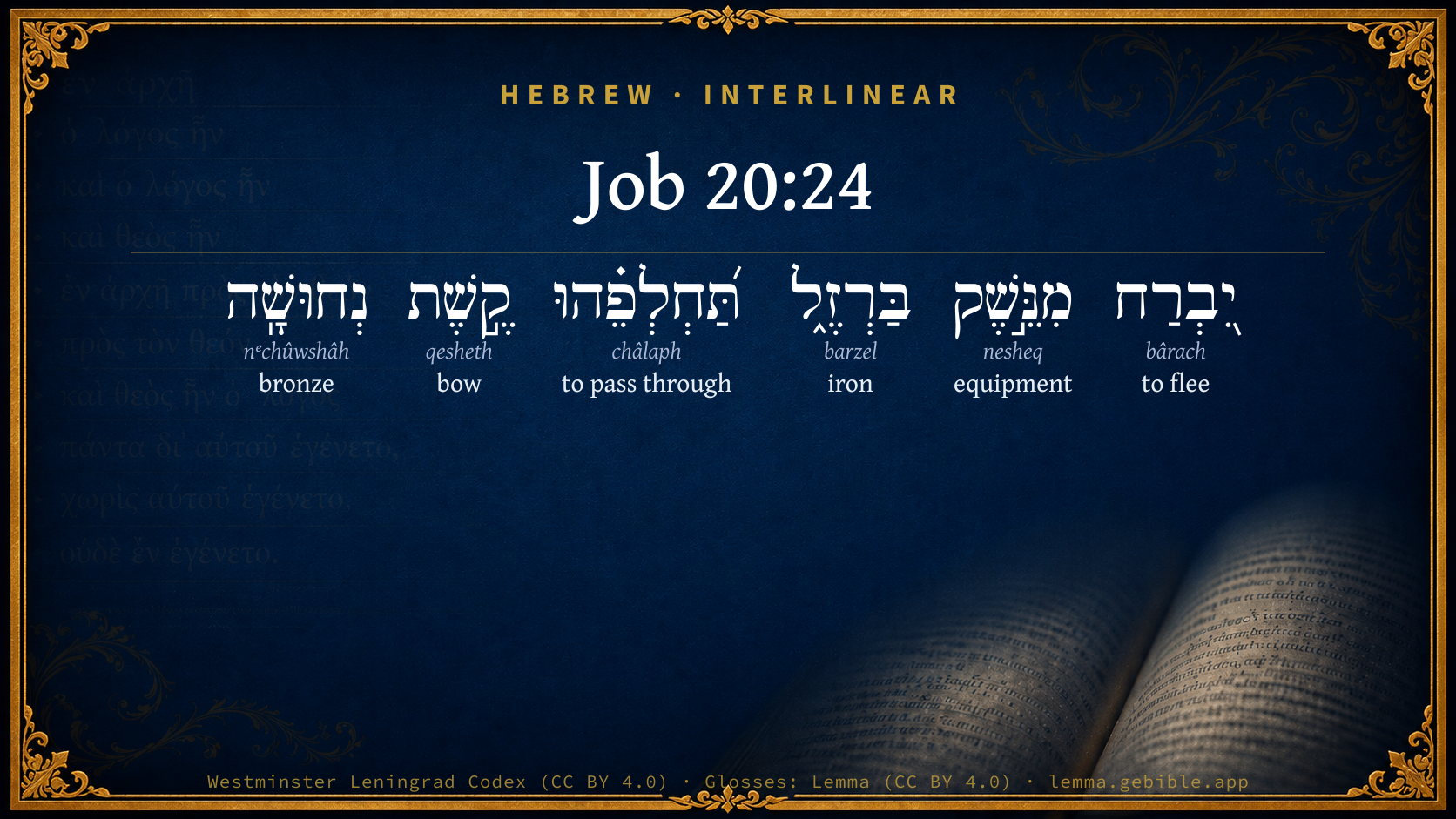
Job 20:24

Hebrew (Westminster Leningrad Codex) Job 20:24 appears in the Hebrew Old Testament. The text above is from the Westminster Leningrad Codex. Each word links to its Strong’s number, a concise gloss, and parsing drawn from the Open Scriptures Hebrew Bible morphology. Click any word for its full Brown-Driver-Briggs (BDB) entry.
Download image
Cite this verse

Job 20:24 (World English Bible). Public Domain. Lemma interlinear Bible study tool, https://lemma.gebible.app/v/job/20/24.

Show BibTeX & RIS
BibTeX
RIS
English Translation
He shall flee from the iron weapon. The bronze arrow shall strike him through.
World English Bible · Public Domain
Download a study sheet

One document with this verse’s original text, its word-by-word gloss line, the meaning frame, cross-references with their text, attributed commentary, and full source and license credits — printable, and it pastes into notes with its structure intact.

This verse Autodidact and up

Study sheet (.html) Plain text (.txt)

A passage Seminary Student

Up to 50 verses in one chapter. A passage sheet keeps up to 6 commentary sources and 12 cross-references per verse, in the order this page ranks them, and says so on the sheet whenever that leaves anything out. Ask for a single verse and you get the Autodidact verse sheet above.

Everything on this page stays free to read, with no account — the sheet is a download of what is already on screen, not access to it.

Want to remove ads? Support Godless Engineer
Compare translations 3

The same verse in 3 English versions, stacked beneath the original-language interlinear above. Click any original word for its lexicon entry.

Each is an independent rendering of the whole verse — the interlinear is not word-aligned to these translations.

Highlighted words mark where these versions differ — a whole-verse word diff, not a word-by-word alignment.

  • World English Bible Public Domain
    He shall flee from the iron weapon. The bronze arrow shall strike him through.
  • King James Version Public Domain
    He shall flee from the iron weapon, and the bow of steel shall strike him through.
  • unfoldingWord Literal Text CC BY-SA 4.0
    He flees from a weapon of iron, a bow of bronze pierces him.

unfoldingWord Literal Text — © unfoldingWord, licensed CC BY-SA 4.0. Word-aligned USFM3 via Door43 (git.door43.org/unfoldingWord/en_ult).

Versions to compare (up to 4)

3 of 4 selected

Show all 18 translations

Every available English version of this verse, each an independent rendering of the whole verse.

  • World English Bible Public Domain
    He shall flee from the iron weapon. The bronze arrow shall strike him through.
  • Berean Standard Bible Public Domain
    Though he flees from an iron weapon, a bronze-tipped arrow will pierce him.
  • Majority Standard Bible Public Domain
    Though he flees from an iron weapon, a bronze-tipped arrow will pierce him.
  • King James Version Public Domain
    He shall flee from the iron weapon, and the bow of steel shall strike him through.
  • American Standard Version (1901) Public Domain
    He shall flee from the iron weapon, And the bow of brass shall strike him through.
  • Revised Version (1885) Public Domain
    He shall flee from the iron weapon, and the bow of brass shall strike him through.
  • Geneva Bible (1599) Public Domain
    He shall flee from the yron weapons, and the bow of steele shall strike him through.
  • Douay-Rheims (1899) Public Domain
    He shall flee from weapons of iron, and shall fall upon a bow of brass.
  • Young's Literal Translation Public Domain
    He fleeth from an iron weapon, Pass through him doth a bow of brass.
  • Literal Standard Version CC BY-SA 4.0
    He flees from an iron weapon, || A bow of bronze passes through him.
  • Unlocked Literal Bible CC BY-SA 4.0
    Although that man will flee from the iron weapon, a bow of bronze will shoot him.
  • unfoldingWord Literal Text CC BY-SA 4.0
    He flees from a weapon of iron, a bow of bronze pierces him.
  • Darby Bible Public Domain
    If he have fled from the iron weapon, the bow of brass shall strike him through.
  • World Messianic Bible Public Domain
    He will flee from the iron weapon. The bronze arrow will strike him through.
  • Webster's Bible Public Domain
    He shall flee from the iron weapon, and the bow of steel shall strike him through.
  • Free Bible Version CC BY-SA 4.0
    As they flee to escape an iron weapon, a bronze arrow will strike them down.
  • Bible in Basic English Public Domain
    He may go in flight from the iron spear, but the arrow from the bow of brass will go through him;
  • JPS Tanakh (1917) Public Domain
    If he flee from the iron weapon, the bow of brass shall strike him through.

Literal Standard Version (2020), Covenant Press — licensed CC BY-SA 4.0. Text via the HelloAO Bible API (eBible.org). Unlocked Literal Bible (unfoldingWord) — licensed CC BY-SA 4.0. Text via the HelloAO Bible API (eBible.org). unfoldingWord Literal Text — © unfoldingWord, licensed CC BY-SA 4.0. Word-aligned USFM3 via Door43 (git.door43.org/unfoldingWord/en_ult). Free Bible Version, Dr. Jonathan Gallagher — licensed CC BY-SA 4.0. Text via the HelloAO Bible API (eBible.org).

Word by word

More ways to search: Search by grammar → Find every occurrence → Compare this word →

Practice this passage: Drill this verse → Learn its vocabulary →

About this verse

These counts appear in no published source. They are computed here, from the morphology-tagged text and Lemma’s own curated glosses. What Lemma adds →

6
words
6
distinct lemmas
Wisdom
section

Notable vocabulary

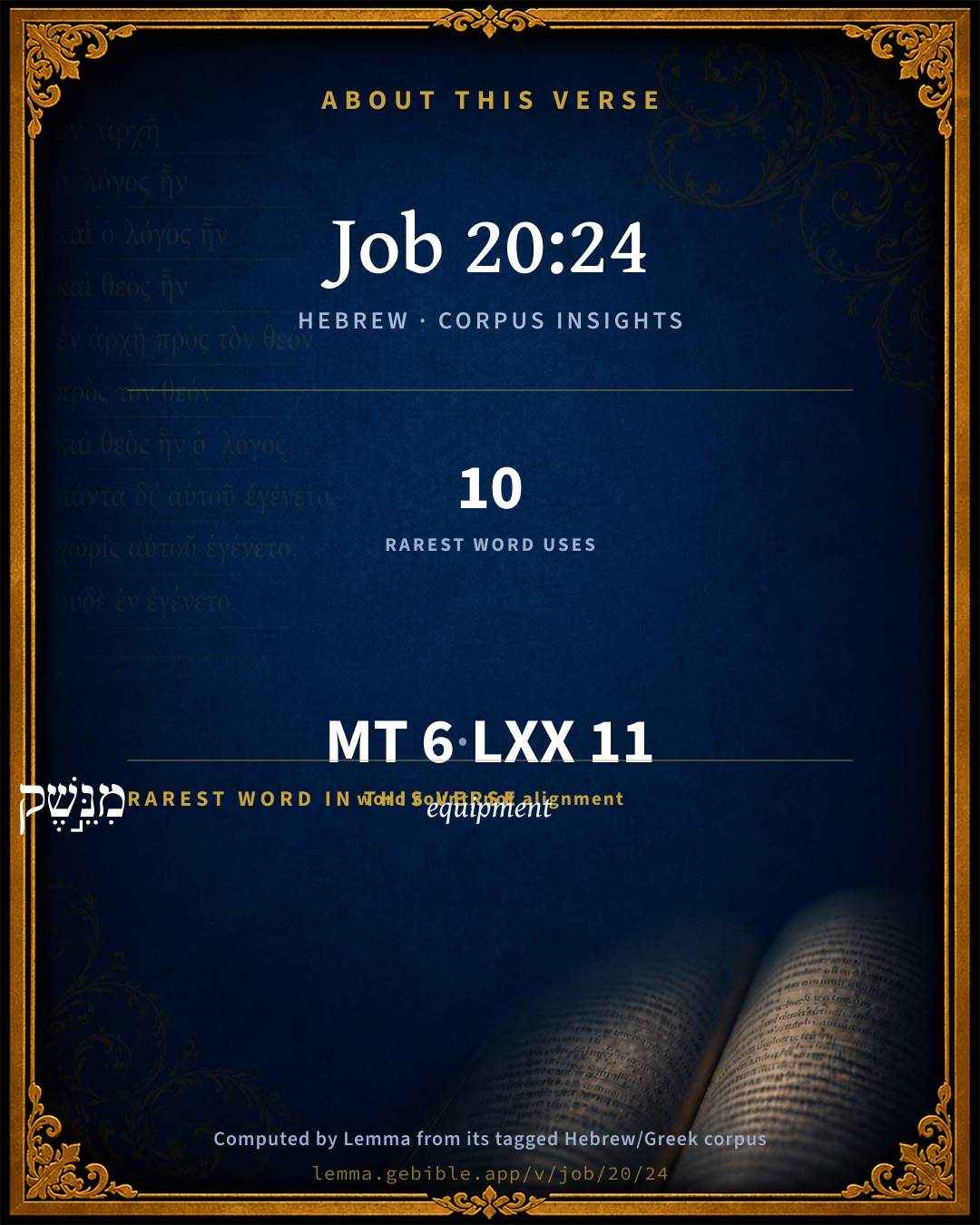
The rarest word here is מִנֵּ֣שֶׁק equipment H5402 — appearing just 10 times in the whole Hebrew Bible.

Shared distinctive vocabulary

מִנֵּ֣שֶׁק equipment H5402 occurs in 10 verses of the Hebrew Bible. Also found in:

Grammatical profile

  • 2 verbs
  • 4 nouns

Verb forms

  • יִ֭בְרַח Qal · Imperfect
  • תַּ֝חְלְפֵ֗הוּ Qal · Imperfect

Hebrew & Septuagint length

In English translation the verse runs 14 words from the Hebrew and 19 from the Septuagint (LXX English) — closely comparable.

A rough comparison of the two English renderings, which tokenize alike — not a word-level alignment.

Word counts can differ between the Hebrew and the Greek without any difference in meaning — e.g. the Hebrew direct-object marker אֵת has no separate Greek word, and Greek often adds the article ὁ.

In the original languages it is 6 Hebrew tokens and 11 Greek tokens — but the two are counted differently (Hebrew bundles its prefixes and suffixes into one token; the Greek is in lemma form), so that isn’t a like-for-like length.

Cross-references

7

Topical passages linked to Job 20:24 in the Treasury of Scripture Knowledge — connected by theme and wording, ordered by reader-vote popularity; previews shown in the World English Bible.

  • Isaiah 24:18 It shall happen, that he who flees from the noise of the fear shall fall into the pit; and he who comes up out of the midst of the pit shall be taken in the snare: for the windows on high are opened, and the foundations of the earth tremble.
  • Amos 5:19 As if a man fled from a lion, And a bear met him; Or he went into the house and leaned his hand on the wall, And a snake bit him.
  • 2 Samuel 22:35 He teaches my hands to war, So that my arms do bend a bow of brass.
  • 1 Kings 20:30 But the rest fled to Aphek, into the city; and the wall fell on twenty-seven thousand men who were left. Ben Hadad fled, and came into the city, into an inner chamber.
  • Proverbs 7:23 Until an arrow strikes through his liver, As a bird hurries to the snare, And doesn't know that it will cost his life.
  • Jeremiah 48:43–44 Fear, and the pit, and the snare, are on you, inhabitant of Moab, says Yahweh.
  • Amos 9:1–3 I saw the Lord standing beside the altar, and he said, "Strike the tops of the pillars, that the thresholds may shake; and break them in pieces on the head of all of them; and I will kill the last of them with the sword: there shall not one of them flee away, and there shall not one of them escape.

Cross-references courtesy of OpenBible.info (CC BY 4.0).

Hebrew and Greek witnesses Masoretic Hebrew ↔ Greek Septuagint

The same verse in the two great witnesses to the Old Testament, shown verse-for-verse.

These are two independent witnesses, not word-aligned to each other, and the Septuagint is shown in lemma (dictionary) form.

Hebrew Job 20:24 Masoretic · Westminster Leningrad Codex

יִ֭בְרַח מִנֵּ֣שֶׁק בַּרְזֶ֑ל תַּ֝חְלְפֵ֗הוּ קֶ֣שֶׁת נְחוּשָֽׁה

He shall flee from the iron weapon. The bronze arrow shall strike him through.

World English Bible · Public Domain

Greek LXX Job 20:24 Septuagint · lemma form

καί οὐ μή σώζω ἐκ χείρ σίδηρος τιτρώσκω αὐτός τόξον χαλκεῖον

And he shall by no means escape from the power of the sword; let the brazen bow wound him.

LXX2012 (modern English Septuagint) · Public Domain

On this verse, Albert Barnes' Notes on the Bible discusses the Septuagint’s reading. Read the note in Commentary ↓

Hebrew: Westminster Leningrad Codex (CC BY 4.0). Greek: Septuagint (public domain); English from LXX2012 (modern English Septuagint) (Public Domain). How the Septuagint differs from the Hebrew →

Commentary

Notes on Job 20:24 from classic Christian and Jewish commentators (each source and its license shown beneath its notes). The classic Christian expositions comment on the surrounding passage and are grouped to its opening verse, so a note may address several verses; the Jewish commentaries on the Tanakh (Rashi and others) are per-verse, so they appear only where the commentator wrote on this verse.

Lemma curates 59 commentaries, every one of them public domain or Creative Commons licensed, each selected and text-cleaned for this edition rather than reprinted as found. About our sources →

Trapp's Complete Commentary

John Trapp

Job 20:24 He shall flee from the iron weapon, [and] the bow of steel shall strike him through.

Ver. 24. He shall flee from the iron weapon] i.e. While he seeks to shun one mischief he shall fall into another; and when he thinks to run from death he runs to it. God, who can do what be will with his own bare hand, is here brought in, after the manner of men with sword and bow, to show that both at home and afar off he can tame his rebels. Neither boots it any man to stand out with God, or to seek to save himself by fight or flight; since he is that "King, against whom there is no rising up," Pro 30:31, and if he be angry, no other helps can relieve us. Brass and iron can fence me against an arrow or a sword, but if I were to be cast into a furnace of fire, it would help to torment me, if into a pit of water, to sink me. Now our God is a consuming fire, and his breath a stream of brimstone, Isa 30:33. "Submit yourselves therefore to God," Jas 4:7. Humble yourselves therefore under his mighty hand, and ho shall lift you up in due season, 1Pe 5:6. To run in to God is the way to escape him; as to close and get in with him that would strike you doth avoid the blow.

And the bow of steel shall strike him through] Or, shall change him; that is, kill him. Death is our great change, and to the wicked a dismal change; for they shall be killed with death, Rev 2:23. Then Balaam and his bribes, Balthasar and his bowls, Dives and his dishes, Herod and his harlots, the usurer and his bills, the merchant and his measures, &c., shall part asunder for ever. But that is not the worst of it. The word here used signifieth excision, or cutting off, and hence that of Bathsheba, Pro 31:8, Beni chaloph, children of destruction, answerable to that of our Saviour, Joh 17:12. A son or child of perdition, that is, a man devoted to utter destruction.

John Trapp, A Commentary or Exposition upon All the Books of the Old and New Testament (1647–1656) — public domain. Text from a community e-Sword module.

Joseph Benson's Commentary

Job 20:24-25. He shall flee from the iron weapon — That is, from the sword or spear; and so shall think himself out of danger. The bow of steel — Which is of great strength, and therefore sendeth forth the arrow with greater force; shall strike him through — Shall mortally wound him. He shall flee from one danger, but another, still greater, shall overtake him. It is drawn — Namely, the arrow which had entered into his body, and now is drawn out of it, either by himself or some other person. Yea, the glittering sword — Hebrew, וברק, ubarak, literally, the lightning, and thence a glittering weapon, the bright sword, or spear; as Deu 32:41. By this it is implied he was doubly wounded, first with the arrow, and then with the sword or spear: cometh out of his gall — Into which it had entered, and wherewith it was coloured. This shows that the wound was both deep and deadly, as wounds are in that part. It is probable he mentions this in reference to a similar expression of Job 16:13. Terrors are upon him — Namely, the terrors of death; because he perceives, by the tincture of his gall upon the weapon, that his wound is incurable. Or horrors of conscience, because he cannot live, and dare not die.

Joseph Benson's Commentary on the Old and New Testaments (1811–1818) — public domain. Text from a community e-Sword module.

Tyndale Open Study Notes

Tyndale Open Resources

20:24 The wicked cannot escape trouble (cp. Isa 24:17-18; Jer 15:2-3; Amos 5:19; 9:1-2). When they try to escape one threat, they fall victim to another.

Tyndale Open Study Notes — © Tyndale Open Resources, licensed CC BY-SA 4.0. Text via the HelloAO Bible API.

Jamieson, Fausset & Brown

Robert Jamieson, A. R. Fausset & David Brown

steel--rather, "brass." While the wicked flees from one danger, he falls into a greater one from an opposite quarter [UMBREIT].

Jamieson, Fausset & Brown — Commentary Critical and Explanatory on the Whole Bible (1871) — public domain (CC PDM 1.0). Text via the HelloAO Bible API.

Adam Clarke's Commentary

Verse 24. He shall flee from the iron weapon] Or, "Though he should flee from the iron armour, the brazen bow should strike him through." So that yf he fle the yron weapens, he shal be shott with the stele bow. - Coverdale. That is, he shall most certainly perish: all kinds of deaths await him.

Adam Clarke's Commentary on the Bible (1810–1826) — public domain. Text from a community e-Sword/MySword module.

Ellicott's Commentary for English Readers

(24) He shall flee from the iron weapon, and.—That is, if he escaped one mischance, another should overtake him.

A Bible Commentary for English Readers, edited by Charles John Ellicott (1878–1897) — public domain. Text from a community e-Sword module.

The Cambridge Bible for Schools and Colleges

gen. ed. J. J. S. Perowne

24. His inevitable destruction: seeking to escape one form of death he shall flee into another. The figure changes. The judgment of God is no more a rain from heaven, it is an attack on all hands of armed inexorable foes; cf. the same idea of inevitable destruction set forth under different figures, Amo_5:19. For bow of steel read bow of brass.

The Cambridge Bible for Schools and Colleges (gen. ed. J. J. S. Perowne; Cambridge University Press, 1878–1918) — public domain. Text from a community e-Sword module.

John Gill's Exposition

He shall flee from the iron weapon,.... The sword, for fear of being thrust through with it; the flaming sword of justice God sometimes threatens to take, and whet, and make use of against ungodly men; the sword of God, as Bar Tzemach observes, is hereby figuratively expressed; fleeing from it, or an attempt to flee from it, shows guilt in the conscience, danger, and a sense of it, and a fear of falling into it, and yet there is no escaping the hand of God, or fleeing from his presence:

and the bow of steel shall strike him through; that is, an arrow out of a bow, made of steel or brass, of which bows were formerly made, and reckoned the strongest and most forcible, see Psa 18:34; signifying, that if he should escape the dint of a weapon, a sword or spear used near at hand, yet, as he fled, he would be reached by one that strikes at a distance, an arrow shot from a bow; the sense is, that, if a wicked man escapes one judgment, another will be sure to follow him, and overtake him and destroy him, see Isa 24:17.

John Gill's Exposition of the Whole Bible (1746–1763) — public domain (CC PDM 1.0). Text via the HelloAO Bible API.

Albert Barnes' Notes on the Bible

He shall flee from the iron weapon - The sword, or the spear. That is, he shall be exposed to attacks, and shall flee in cowardice and alarm. Bands of robbers shall come suddenly upon him, and he shall have no safety except in flight. Pref. Lee explains this as meaning, “While he flees from the iron weapon, the brass bow shall pierre him through.” Probably the expression is proverbial, like that in Latin, Incidit in Scyllam cupiens vitare Charybdin.

The bow of steel shall strike him through - That is, the “arrow” from the bow of steel shall strike him down. Bows and arrows were commonly used in hunting and in war. To a considerable extent they are still employed in Persia, though the use has been somewhat superseded by the gun. “Bows” were made of various materials. The first were, undoubtedly, of wood. They were inlaid with horn, or ivory, or were made in part of metal. Sometimes, it would seem that the whole bow was made of metal, though it is supposed that the metal bow was not in general use. The “weight,” if nothing else, would be an objection to it. The word which is here rendered “steel” (נחוּשׁה nechûshâh), means properly “brass or copper” - but it is certain that brass or copper could never have been used to form the main part of the bow, as they are destitute of the elasticity which is necessary. Jerome renders it, et irruet in arcum aereum - “he rushes on the brazen bow.” So the Septuagint, τόξον χάλκειον toxon chalkeion. So the Chaldee, דכוכומא קשתא - “the bow of brass.” There is no certain proof that “steel” was then known - though “iron” is often mentioned. It is possible, however, that though the whole bow was not made of brass or copper, yet that such quantities of these metals were employed in constructing bows, that they might, without impropriety, be called bows of brass. The Oriental bow consists of three parts. The handle, or middle part - that on which the arrow rested - was straight, and might be made of wood, brass, copper, or any other strong substance. To this was affixed, at each end, pieces of horn, or of any other elastic substance, and, the string was applied to the ends of these horns. The straight piece might have been of brass, and so without impropriety it might be called a brass bow. It is not properly rendered “steel” at any rate, as the word used here is never employed to denote iron or steel.

Albert Barnes' Notes on the Bible (1834–1885) — public domain. Text from a community e-Sword/MySword module.

Haydock's Catholic Bible Commentary

Brass; of which metal the strongest bows were made. Protestants have, "steel:" (Haydock) but brass was used by the ancients for the same purpose. (Calmet) --- This proverb shews that those who endeavour to escape from men, fall into the hands of God. (Delrio. Adag. 9, t. ii.) Incidit in Scyllam cupiens vitare Charbydim. (Virgil) (Menochius)

George Leo Haydock (1774–1849), Haydock's Catholic Family Bible and Commentary, 1859 edition — public domain. Excludes Psalms (Douay-Rheims chapter numbering differs from Protestant) and Deuterocanonical books (Catholic canon only).

Matthew Poole's English Annotations

From the iron weapon, i.e. from the sword or spear; and so shall think himself out of danger.

The bow; an arrow shot out of a bow. A distant, place and unknown hand shall unexpectedly fall upon him; so that he shall only go from one danger to another.

Of steel; which is of great strength, and therefore sendeth forth the arrow with greater force. Compare Psa 18:34. Or, of brass, as the word properly signifies; which the ancients did so temper and harden, that their bows were commonly made of it.

Shall strike him through, i.e. mortally wound him.

Matthew Poole's English Annotations on the Holy Bible (1683–1685) — public domain. Text from a community e-Sword/MySword module.

Whedon's Commentary on the Bible

Daniel D. Whedon

24. Bow of steel — Not steel, but brass or copper. As bronze tools were used for engraving or sculpturing the rocks, and even in working the quarries, the ancient Egyptian must have possessed some lost art for tempering copper. Wilkinson found a chisel at Thebes with very little alloy; of 100 parts, 94.0 being copper, 5.9 tin, 0.1 iron, the point of which was intact, while the top was turned over by the blows it had received from the mallet. — Anc. Egypt, P.A., 2:158. The verse evidently contains a proverb similar to the classic Scylla and Charybdis. Compare Amo_5:19; Isa_24:18. The German would say, “He escapes from the smoke, but falls into the fire.” Nothing could escape him, and he can not escape his fate.

Daniel D. Whedon (gen. ed.), Commentary on the Old and New Testaments (1874–1909) — public domain. Text from a community e-Sword module.

The Pulpit Commentary

He shall flee from the iron weapon. This is no indication of the late authorship of Job. Iron was in use in Egypt at a very early date. A thin plate of it was found by Colonel Howard Vyse embedded in the masonry of the great pyramid; and iron implements and ornaments, iron spear-heads, iron sickles, iron gimlets, iron keys, iron bracelets, iron wire, have been found in the early tombs not infrequently (see the author"s "History of Ancient Egypt," vol. 1. p. 505). That they are not more common is accounted for by the rapid oxidization of iron by exposure to the air, and its rapid decay in the nitrous soil of Egypt. The inhabitants of South-Western Asia were at no time much behind the Egyptians in their knowledge of the useful arts: and iron appears as a well-known metal in the Jewish Scriptures from the time of the Exodus. (see Num_35:16 Deu_3:11 Deu_4:20 Deu_8:9 Deu_28:23Jo Deu 8:31) It is true that the principal weapons of war continued to be made ordinarily of bronze, both in South-Western Asia and in Egypt, till a comparatively late period; but Zophar may mean to assign to the slayer of the wicked man weapons of a superior character. And the bow of steel shall strike him through. It is uncertain whether steel was known in the ancient world. But, whether or no, "steel" is not meant here. The word used in the original is nehushtah, which undoubtedly means either "copper" or "bronze." As copper would be too soft a material for a bow, we may assume bronze to be intended. The bronze used in Egypt was extremely elastic, and there would have been little difficulty in fashioning bows of it. (on the existence of such bows, see 2Sa 26:5 Psa_18:34)

The Pulpit Commentary (1880–1919), ed. H.D.M. Spence-Jones & Joseph S. Exell — public domain. Text from a community e-Sword module.

John Wesley's Explanatory Notes

Flee - From the sword or spear; and so shall think himself out of danger.

John Wesley, Explanatory Notes Upon the Whole Bible (1754–1765) — public domain. Text via the GEBible commentary corpus.

Rashi

Rabbi Shlomo Yitzchaki (Rashi)

shall pierce him Heb. תַּחְלְפֵהוּ The arrows that the bow will shoot will pierce his body, going through from one side to the other. Another version: תַּחְלְפֵהוּ is like תַּחְליִפֵהוּ (sic), a copper bow shall confront him.

Rashi on the Tanakh — English translations: “The Judaica Press complete Tanach with Rashi, translated by A. J. Rosenberg” (CC BY 4.0); “Pentateuch with Rashi's commentary by M. Rosenbaum and A.M. Silbermann, 1929-1934” (public domain); “The Metsudah Tanach series, Lakewood, N.J” (CC BY 4.0); and “The Book of Joshua, Metsudah Publications, 1997” (CC BY 4.0). Text via Sefaria.

Lesson kit

Teaching starters — assembled from the data on this page, not authored interpretation. Every prompt links to the verse data it draws on. Edit before teaching.

Job, in the Wisdom, opens this verse with 6 words (6 distinct Hebrew lemmas). Its most distinctive word is nesheq (“equipment”). A historical commentator’s framing appears above. Read the whole chapter for the surrounding context.

Discussion questions

  1. What does “equipment” (nesheq) contribute to the verse as a whole?
  2. How does 1 Kings 10:25, which shares the word «equipment», read alongside this verse?
  3. These translations render this verse differently. What is at stake in choosing one wording over another?
  4. «יִ֭בְרַח» is a Qal Imperfect verb. How does that grammatical form shape the action described?
  5. Compare how Trapp's Complete Commentary and Joseph Benson's Commentary read this verse. Where do they agree or differ?

Things to notice

Reading settings

Reading text

Shown beneath each verse's original-language words.

Old Testament
Old Testament edition

Read the OT as the Masoretic Hebrew (MT) or the Greek Septuagint (LXX).

English shown for the Greek Septuagint (in the Hebrew ↔ Greek comparison).

Comparing translations? Open the Compare panel on any verse page to stack up to four side by side.