Jeremiah 28:13

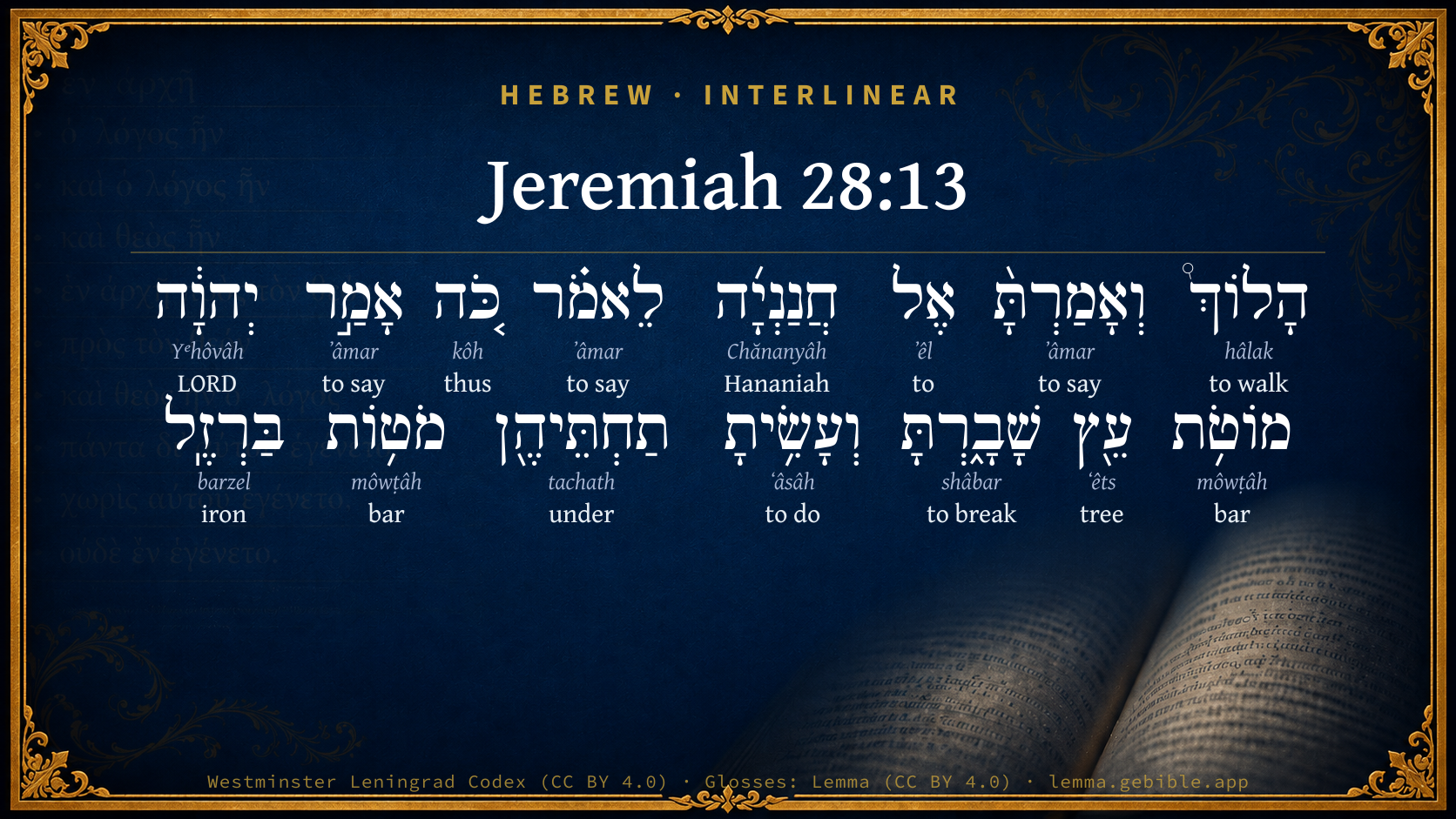
Hebrew (Westminster Leningrad Codex) Jeremiah 28:13 appears in the Hebrew Old Testament. The text above is from the Westminster Leningrad Codex. Each word links to its Strong’s number, a concise gloss, and parsing drawn from the Open Scriptures Hebrew Bible morphology. Click any word for its full Brown-Driver-Briggs (BDB) entry.
Download image
Cite this verse

Jeremiah 28:13 (World English Bible). Public Domain. Lemma interlinear Bible study tool, https://lemma.gebible.app/v/jeremiah/28/13.

Show BibTeX & RIS
BibTeX
RIS
English Translation
Go, and tell Hananiah, saying, Thus says Yahweh: You have broken the bars of wood; but you have made in their place bars of iron.
World English Bible · Public Domain
Download a study sheet

One document with this verse’s original text, its word-by-word gloss line, the meaning frame, cross-references with their text, attributed commentary, and full source and license credits — printable, and it pastes into notes with its structure intact.

This verse Autodidact and up

Study sheet (.html) Plain text (.txt)

A passage Seminary Student

Up to 50 verses in one chapter. A passage sheet keeps up to 6 commentary sources and 12 cross-references per verse, in the order this page ranks them, and says so on the sheet whenever that leaves anything out. Ask for a single verse and you get the Autodidact verse sheet above.

Everything on this page stays free to read, with no account — the sheet is a download of what is already on screen, not access to it.

Want to remove ads? Support Godless Engineer
Compare translations 3

The same verse in 3 English versions, stacked beneath the original-language interlinear above. Click any original word for its lexicon entry.

Each is an independent rendering of the whole verse — the interlinear is not word-aligned to these translations.

Highlighted words mark where these versions differ — a whole-verse word diff, not a word-by-word alignment.

  • World English Bible Public Domain
    Go, and tell Hananiah, saying, Thus says Yahweh: You have broken the bars of wood; but you have made in their place bars of iron.
  • King James Version Public Domain
    Go and tell Hananiah, saying, Thus saith the LORD; Thou hast broken the yokes of wood; but thou shalt make for them yokes of iron.
  • unfoldingWord Literal Text CC BY-SA 4.0
    “Go, and you shall say to Hananiah, saying, ‘Thus says Yahweh: You have broken yoke bars of wood, but you will make in their place yoke bars of iron.’

unfoldingWord Literal Text — © unfoldingWord, licensed CC BY-SA 4.0. Word-aligned USFM3 via Door43 (git.door43.org/unfoldingWord/en_ult).

Versions to compare (up to 4)

3 of 4 selected

Show all 18 translations

Every available English version of this verse, each an independent rendering of the whole verse.

  • World English Bible Public Domain
    Go, and tell Hananiah, saying, Thus says Yahweh: You have broken the bars of wood; but you have made in their place bars of iron.
  • Berean Standard Bible Public Domain
    “Go and tell Hananiah that this is what the LORD says: ‘You have broken a yoke of wood, but in its place you have fashioned a yoke of iron.’
  • Majority Standard Bible Public Domain
    “Go and tell Hananiah that this is what the LORD says: ‘You have broken a yoke of wood, but in its place you have fashioned a yoke of iron.’
  • King James Version Public Domain
    Go and tell Hananiah, saying, Thus saith the LORD; Thou hast broken the yokes of wood; but thou shalt make for them yokes of iron.
  • American Standard Version (1901) Public Domain
    Go, and tell Hananiah, saying, Thus saith Jehovah: Thou hast broken the bars of wood; but thou hast made in their stead bars of iron.
  • Revised Version (1885) Public Domain
    Go, and tell Hananiah, saying, Thus saith the LORD: Thou hast broken the bars of wood; but thou shalt make in their stead bars of iron.
  • Geneva Bible (1599) Public Domain
    Go, and tell Hananiah, saying, Thus sayth the Lord, Thou hast broken the yokes of wood, but thou shalt make for them yokes of yron.
  • Douay-Rheims (1899) Public Domain
    Go, and tell Hananias: Thus saith the Lord: Thou hast broken chains of wood, and thou shalt make for them chains of iron.
  • Young's Literal Translation Public Domain
    `Go, and thou hast spoken unto Hananiah, saying, Thus said Jehovah, Yokes of wood thou hast broken, and I have made instead of them yokes of iron;
  • Literal Standard Version CC BY-SA 4.0
    “Go, and you have spoken to Hananiah, saying, Thus said YHWH: You have broken yokes of wood, and I have made yokes of iron instead of them.
  • Unlocked Literal Bible CC BY-SA 4.0
    “Go and speak to Hananiah and say, 'Yahweh says this: You broke a yoke of wood, but I will make instead a yoke of iron.'
  • unfoldingWord Literal Text CC BY-SA 4.0
    “Go, and you shall say to Hananiah, saying, ‘Thus says Yahweh: You have broken yoke bars of wood, but you will make in their place yoke bars of iron.’
  • Darby Bible Public Domain
    Go and tell Hananiah, saying, Thus saith Jehovah: Thou hast broken the yokes of wood, and thou hast made in their place yokes of iron.
  • World Messianic Bible Public Domain
    “Go, and tell Hananiah, saying, ‘The LORD says, “You have broken the bars of wood, but you have made in their place bars of iron.”
  • Webster's Bible Public Domain
    Go and tell Hananiah, saying, Thus saith the LORD; Thou hast broken the yokes of wood; but thou shalt make for them yokes of iron.
  • Free Bible Version CC BY-SA 4.0
    “Go and tell Hananiah that this is what the Lord says: You may have broken a wooden yoke of wood, but you have replaced it with an iron yoke.
  • Bible in Basic English Public Domain
    Go and say to Hananiah, This is what the Lord has said: Yokes of wood have been broken by you, but in their place I will make yokes of iron.
  • JPS Tanakh (1917) Public Domain
    'Go, and tell Hananiah, saying: Thus saith the LORD: Thou hast broken the bars of wood; but thou shalt make in their stead bars of iron.

Literal Standard Version (2020), Covenant Press — licensed CC BY-SA 4.0. Text via the HelloAO Bible API (eBible.org). Unlocked Literal Bible (unfoldingWord) — licensed CC BY-SA 4.0. Text via the HelloAO Bible API (eBible.org). unfoldingWord Literal Text — © unfoldingWord, licensed CC BY-SA 4.0. Word-aligned USFM3 via Door43 (git.door43.org/unfoldingWord/en_ult). Free Bible Version, Dr. Jonathan Gallagher — licensed CC BY-SA 4.0. Text via the HelloAO Bible API (eBible.org).

Word by word

More ways to search: Search by grammar → Find every occurrence → Compare this word →

Practice this passage: Drill this verse → Learn its vocabulary →

מוֹטֹ֥ת
môwṭâh
H4133
“bars of”
Noun, Common, Feminine, Plural, Construct
Part of Speech
Noun
Type
Common
Gender
Feminine
Number
Plural
State
Construct
Full BDB Definition

Origin: from H4132

TWOT: 1158b

pole, bar of yoke - pole - bar of yoke - of oppression (figuratively)
  1. הָלוֹךְ֩ hâlak H1980 “to walk” Verb, Qal, Infinitive Absolute
  2. וְאָמַרְתָּ֨ ʼâmar H559 “and · to say” Conjunction + Verb, Qal, Sequential Perfect, 2nd Person, Masculine, Singular
  3. אֶל ʼêl H413 “to” Preposition
  4. חֲנַנְיָ֜ה Chănanyâh H2608 “Hananiah” Noun, Proper
  5. לֵאמֹ֗ר ʼâmar H559 “to say” Preposition + Verb, Qal, Infinitive Construct
  6. כֹּ֚ה kôh H3541 “thus” Adverb
  7. אָמַ֣ר ʼâmar H559 “to say” Verb, Qal, Perfect, 3rd Person, Masculine, Singular
  8. יְהוָ֔ה Yᵉhôvâh H3068 “LORD” Noun, Proper
  9. עֵ֖ץ ʻêts H6086 “tree” Noun, Common, Masculine, Singular, Absolute
  10. שָׁבָ֑רְתָּ shâbar H7665 “to break” Verb, Qal, Perfect, 2nd Person, Masculine, Singular
  11. וְעָשִׂ֥יתָ ʻâsâh H6213 “and · to do” Conjunction + Verb, Qal, Sequential Perfect, 2nd Person, Masculine, Singular
  12. תַחְתֵּיהֶ֖ן tachath H8478 “under · them” Preposition + Suffix, Personal, 3rd Person, Feminine, Plural
  13. מֹט֥וֹת môwṭâh H4133 “bars of” Noun, Common, Feminine, Plural, Construct
  14. בַּרְזֶֽל barzel H1270 “iron” Noun, Common, Masculine, Singular, Absolute

About this verse

These counts appear in no published source. They are computed here, from the morphology-tagged text and Lemma’s own curated glosses. What Lemma adds →

15
words
12
distinct lemmas
Prophets
section

Notable vocabulary

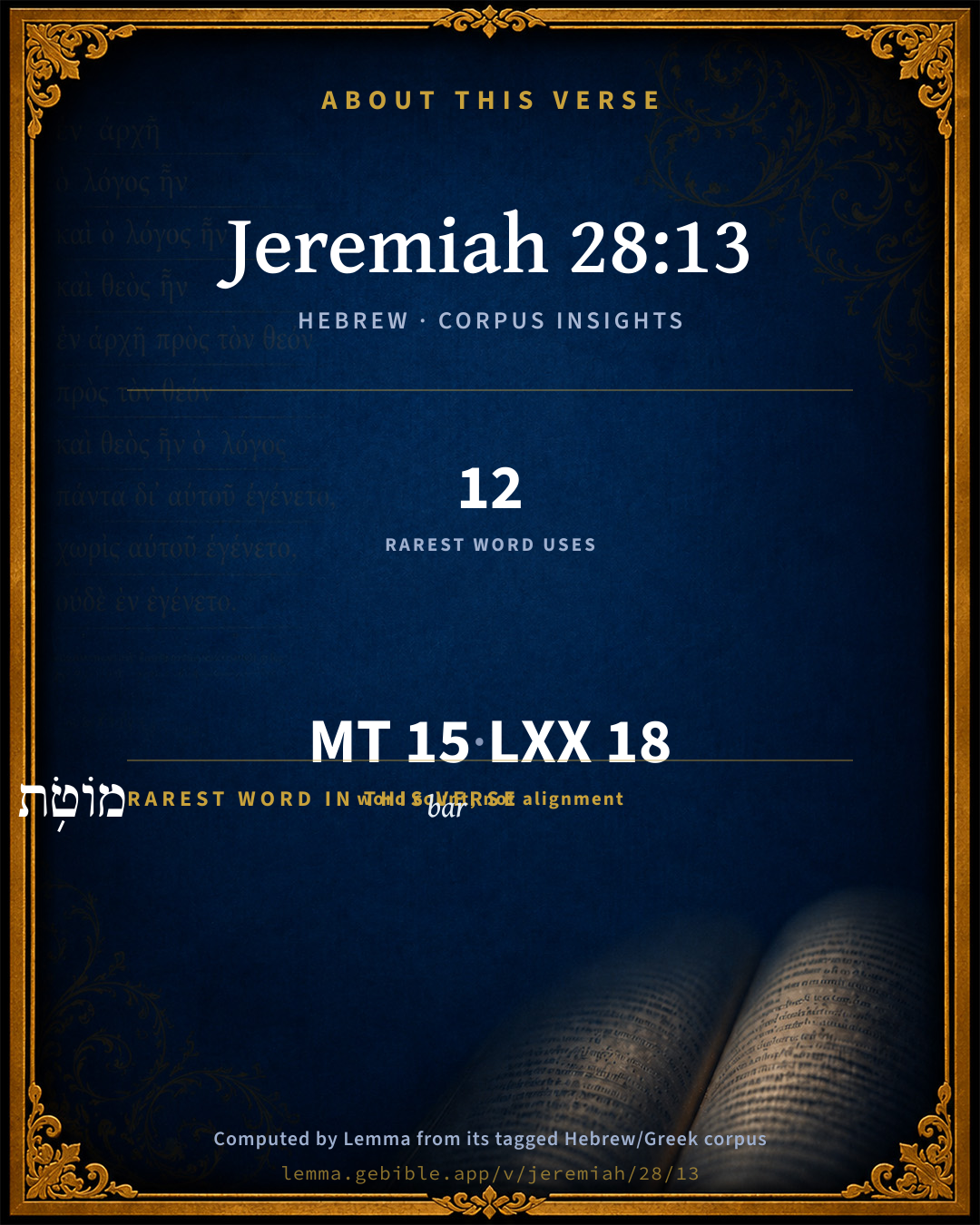
The rarest word here is מוֹטֹ֥ת bar H4133 — appearing just 12 times in the whole Hebrew Bible.

Shared distinctive vocabulary

מוֹטֹ֥ת bar H4133 occurs in 10 verses of the Hebrew Bible. Also found in:

Grammatical profile

  • 6 verbs
  • 6 nouns
  • 2 prepositions
  • 1 adverb

Verb forms

  • הָלוֹךְ֩ Qal · Infinitive Absolute
  • וְאָמַרְתָּ֨ Qal · Sequential Perfect
  • לֵאמֹ֗ר Qal · Infinitive Construct
  • אָמַ֣ר Qal · Perfect
  • שָׁבָ֑רְתָּ Qal · Perfect
  • וְעָשִׂ֥יתָ Qal · Sequential Perfect

Repetition

Words recur within this verse — often emphatic in Hebrew:

  • וְאָמַרְתָּ֨ to say H559 ×3
  • מוֹטֹ֥ת bar H4133 ×2

Hebrew & Septuagint length

In the original languages it is 15 Hebrew tokens and 18 Greek tokens — but the two are counted differently (Hebrew bundles its prefixes and suffixes into one token; the Greek is in lemma form), so that isn’t a like-for-like length.

Cross-references

3

Topical passages linked to Jeremiah 28:13 in the Treasury of Scripture Knowledge — connected by theme and wording, ordered by reader-vote popularity; previews shown in the World English Bible.

  • Psalms 149:8 To bind their kings with chains, And their nobles with fetters of iron;
  • Jeremiah 27:15 For I have not sent them, says Yahweh, but they prophesy falsely in my name; that I may drive you out, and that you may perish, you, and the prophets who prophesy to you.
  • Lamentations 2:14 Your prophets have seen for you false and foolish visions; They have not uncovered your iniquity, to bring back your captivity, But have seen for you false oracles and causes of banishment.

Cross-references courtesy of OpenBible.info (CC BY 4.0).

Hebrew and Greek witnesses Masoretic Hebrew ↔ Greek Septuagint

The same verse in the two great witnesses to the Old Testament, shown verse-for-verse.

These are two independent witnesses, not word-aligned to each other, and the Septuagint is shown in lemma (dictionary) form.

Hebrew Jeremiah 28:13 Masoretic · Westminster Leningrad Codex

הָלוֹךְ֩ וְאָמַרְתָּ֨ אֶל חֲנַנְיָ֜ה לֵאמֹ֗ר כֹּ֚ה אָמַ֣ר יְהוָ֔ה מוֹטֹ֥ת עֵ֖ץ שָׁבָ֑רְתָּ וְעָשִׂ֥יתָ תַחְתֵּיהֶ֖ן מֹט֥וֹת בַּרְזֶֽל

Go, and tell Hananiah, saying, Thus says Yahweh: You have broken the bars of wood; but you have made in their place bars of iron.

World English Bible · Public Domain

Greek LXX Structure differs

In the Septuagint, Jeremiah is about an eighth shorter than the Hebrew and arranges its material differently — the Oracles Against the Nations (Hebrew chapters 46–51) appear in the middle of the Greek book, after 25:13. Because the chapter and verse boundaries do not line up, a verse-for-verse comparison with the Hebrew is not shown.

A verse-for-verse comparison isn’t shown here because the chapters and verses don’t line up. Switch to the LXX edition with the MT / LXX toggle above to read the Greek directly.

On this verse, The Cambridge Bible for Schools and Colleges discusses the Septuagint’s reading. Read the note in Commentary ↓

Hebrew: Westminster Leningrad Codex (CC BY 4.0). Greek: Septuagint (public domain); English from a public-domain English Septuagint. How the Septuagint differs from the Hebrew →

Targum (Aramaic paraphrase)

1

The Targum is the ancient Jewish Aramaic paraphrase of the Hebrew Scriptures — an interpretive translation, not the Hebrew text itself. Onkelos (literal) and Pseudo-Jonathan (expansive) render the Torah, and Jonathan the Prophets. Coverage is partial: where no permissively-licensed English translation exists for a verse, only the Aramaic is shown. This is verse-level text, not a word-by-word alignment to the Hebrew.

  1. Targum Jonathan Prophets (Joshua–Malachi)
    אֱזֵיל וְתֵימַר לַחֲנַנְיָה לְמֵימָר כִּדְנַן אֲמַר יְיָ נִירִין דְאָע תְּבַרְתָּא וְתַעְבֵּיד חִילוּפֵיהוֹן נִירִין דְבַרְזֶל:

    (no public-domain English translation for this verse)

    Targum Jonathan — Aramaic: “Mikraot Gedolot” (public domain). English: “Sefaria Community Translation” (CC0 1.0 (public-domain dedication)); “London "Chaldee Paraphrase," 1871” (public domain). Text via Sefaria.

Commentary

Notes on Jeremiah 28:13 from classic Christian and Jewish commentators (each source and its license shown beneath its notes). The classic Christian expositions comment on the surrounding passage and are grouped to its opening verse, so a note may address several verses; the Jewish commentaries on the Tanakh (Rashi and others) are per-verse, so they appear only where the commentator wrote on this verse.

Lemma curates 59 commentaries, every one of them public domain or Creative Commons licensed, each selected and text-cleaned for this edition rather than reprinted as found. About our sources →

Trapp's Complete Commentary

John Trapp

Jer 28:13 Go and tell Hananiah, saying, Thus saith the LORD; Thou hast broken the yokes of wood; but thou shalt make for them yokes of iron.

Ver. 13. Thou hast broken the yokes of wood.] That were weaker and lighter;

“ Nunc graviora feres. ”

But thou shalt make for them yokes of iron.] Thou, Jeremiah shalt, for a type of a cruel, hard, and strong bondage. Bonfinius {a} writeth of the Hungarians, that they are not to be handled gently, or kindly dealt with, sed virga ferrea in obsequio continendos esse, but kept in order with a rod of iron. Such were these refractory Jews; but they had enough of it ere God had done with them.

{a} Hungar. rer. decad. 4, lib. ix.

John Trapp, A Commentary or Exposition upon All the Books of the Old and New Testament (1647–1656) — public domain. Text from a community e-Sword module.

The Biblical Illustrator

Joseph S. Exell

Jer_28:13

Thou hast broken the yokes of wood; but thou shalt make for them yokes of iron.

Yokes of wood and of iron

To throw off legitimate authority is to bind on a worse tyranny. Some kind of yoke every one of us must bend our necks to, and if we slip them out we do not thereby become independent, but simply bring upon ourselves a heavier pressure of a harder bondage.

I. We have the choice between the yoke of law and the iron yoke of lawlessness. Even a band of brigands, or a crew of pirates, must have some code. I have read somewhere that the cells in a honeycomb are circles squeezed by the pressure of the adjacent cells into the hexagonal shape which admits of contiguity. If they continued circles, there would be space and material lest, and no complete continuity. So, in like manner, you cannot keep five men together without some mutual limitations which are shaped into a law. Now, as long as a man keeps inside it he does not feel its pressure. A great many of us, for instance, who are in the main law-abiding people, do not ever remember that there is such a thing as restrictions upon our licence, or the obligation to perform certain duties; for we never think either of taking the licence or of shirking the duties. The yoke that is accepted ceases to press. Once let a man step outside, and what then? Why, then, he is an outlaw; and the rough side of the fence is turned outwards, and all possible terrors, which people within the boundary have nothing to do with, gather themselves together and frown down upon him. I need not remind you of how this same thesis--that we have to choose between the yoke of law and the iron yoke of lawlessness--is illustrated in the story of almost all violent revolutions. They run the same course. First the rising up of a nation against intolerable oppression, then revolution devours its own children, and the scum rises to the top of the boiling pot. Then comes, in the language of the picturesque historian of the French Revolution, the type of them all--then comes at the end the whiff of grapeshot and the despot. First the government of a mob, and then the tyranny of an emperor comes to the people that shake off the yoke of reasonable law.

II. We have to choose between the yoke of virtue and the iron yoke of vice. We are under a far more spiritual and searching law than that written in any statute-book, or administered by any Court. Every man carries within his own heart two things, and two persons; the court, the tribunal, the culprit, and the judge. And here, too, if law be not obeyed, the result is not liberty, but the slavery of lawlessness. A great philosopher once said that the two sublimest things in the universe were the moral law and the starry heavens. And that law I ought bends over us like the starry heavens with which he associated it. No man can escape from the pressure of duty, and on every man is laid, by his very make, the twofold obligation, first to look upwards and catch the behests of that solemn law of duty, and then to turn his eyes and his strength inwards and coerce or spur, as the case may be, the powers of his nature, and rule the kingdom within himself. Now, as long as a man lets the ruling parts of his nature guide the lower faculties, he feels comparatively no pressure from the yoke. But if he once allows beggars to ride on horseback whilst princes walk--sense and appetite and desire, and more or less refined forms of inclination to take the place which belongs only to conscience interpreting duty--then he has exchanged the easy yoke for one that is heavy indeed. What does a man do when, instead of loyally accepting the conditions of his nature, and bowing himself to serve the all-embracing law of duty, he sets up inclination of any sort in its place? What does he do? I will tell you. He unships the helm; he pitches compass and sextant overboard; he fires up the furnaces, and screws down the safety-valve, and says, Go ahead! And what will be the end of that, think you! Either an explosion or a crash upon a reef! and you may take your choice of which is the better kind of death--to be blown up or to go down.

III. We have the choice between the yoke of Christ and the iron yoke of godlessness. If you do not take Christ for your Teacher you are handed over either to the uncertainty of your own doubts or to pinning your faith to some man and enrolling yourself as a disciple who is prepared to swallow down whole whatsoever the rabbi may say, giving to him what you will not give to Jesus; or else you will sink back into utter indolence and carelessness about the whole matter; or else you will go and put your belief and your soul into the hands of a priest; or shut your eyes and open your mouth and take whatever tradition may choose to send you. The one refuge from all these, as I believe, is to go to Him and learn of Him, and take His yoke upon your shoulders. But, let me say further, it is better to obey Christs commandments than to set ourselves against them. For if we will take His will for our law, and meekly assume the yoke of loyal and loving obedience to Him, the door into an earthly paradise is thrown open to us. His yoke is easy, not because its prescriptions and provisions lower the standard of righteousness and morality, but because love becomes the motive, and it is always blessed to do that which the Beloved desires. When I will and I ought cover exactly the same ground, then there is no kind of pressure from the yoke. Christs yoke is easy because, too, He gives the power to obey His commandments. (A. Maclaren, D. D.)

The two yokes

I. Men must wear some yoke. In every stage of life--childhood, youth, manhood; and in every station of life--servants, masters, &c.

1. God has made and sustains us, and asks that we submit to His will

2. With our passions and propensities, if we break the yoke it is meet we should wear, and do not serve God, we at once bend our necks to another yoke and serve slavishly our own selves.

II. Christs yoke is an easy one to wear.

1. The yoke of Christ is a right one. Serve Jesus Christ, and it is found that the Christian law is perfection itself.

2. The yoke of Christ is framed in our interest. To believe in Christ is the highest wisdom; to repent of sin is the most delightful necessity; to follow after holiness is the most blissful pursuit; to become a servant of Christ is to be made a king and priest unto God.

3. Christ s yoke is not exacting. He, in His grace, always gives us of His bounty when He asks of us our duty.

4. It is an easy yoke. Never did a man wear it but he always loved to wear it.

5. The bright example of Christ makes the yoke pleasant to bear. He Himself has carried the very yoke we bear, and we have blessed fellowship with Him in this.

6. All who have borne Christs yoke have had grace given equal to the weight of the burden. Wolsey regretted that he had not served God with half the zeal he had served his king, but none has ever bewailed the zeal with which he followed Christ!

7. Christians who have borne this yoke always desire to get their children into it. Often men say, I do not want my sons to follow my trade, it is wearying, its pay is small, &c.

III. Those who refuse Christs easy yoke will have to wear a worse one.

1. Turning from the right road, from the cry of rectitude, because it threatens shame or loss, will entail vaster after-losses.

2. Backsliders, by putting off the yoke of Christianity, have not improved their condition.

3. They who refuse the Bible and follow tradition, Do these perverts of the true Christian religion get an easier yoke? No.; there are penances and mortifications, &c,

4. The self-righteous who attempt to work their own way to heaven. Self-righteousness is an iron yoke indeed.

5. Unbelievers, who will not believe the simple revelation of God, presently find themselves committed to systematic misbeliefs, which distract reason, oppress the heart, and trammel the conscience.

6. Lovers of pleasure. Pleasure often means lust, and gaiety means crime; and self-indulgence brings beggary and degradation, In the last tremendous day of Christs coming to judgment, the Christians yoke will be as a chain of gold about his neck; but sin, pleasure, will be as an iron yoke, a burden of enslaving woe. (C. H. Spurgeon.)

The Biblical Illustrator, edited by Joseph S. Exell (c. 1880s–1900s) — public domain. Text from a community e-Sword module.

MacLaren's Expositions of Holy Scripture

Alexander MacLaren

Jeremiah

YOKES OF WOOD AND IRON

Jer 28:13.

I suppose that I had better begin by a word of explanation as to the occasion of this saying. One king of Judah had already been carried off to Babylon, and the throne refilled by his brother, a puppet of the conquerors. This shadow of a king, with the bulk of the nation, was eager for revolt. Jeremiah had almost single-handed to stem the tide of the popular wish. He steadfastly preached submission, not so much to Nebuchadnezzar as to God, who had sent the invaders as chastisement. The lesson was a difficult one to learn, and the people hated the teacher. In the Jerusalem of Jeremiah’s day, as in other places and at other times, a love of country which is not blind to its faults and protests against a blatant militarism, was scoffed at as ‘unpatriotic,’ ‘playing into the hands of the enemy,’ ‘seeking peace at any price,’ whilst an insane eagerness to rush to arms without regard to resources or righteousness was called a ‘spirited foreign policy.’ So Jeremiah had plenty of enemies.

He had adopted a strange way of enforcing his counsel, which would be ridiculous to-day, but was natural and impressive then and there. He constantly for months went about with an ox-yoke on his neck, as a symbol of the submission which he advocated. One day, in the temple, before a public assembly, a certain Hananiah, a member of the opposite faction, made a fierce attack on the prophet and his teaching, and uttered a counter-prophecy to the effect that, in two years, the foreign invasion would be at an end, and all would be as it used to be. Our prophet answered very quietly, saying in effect, ‘I hope to God that it may be true; the event will show.’ And then Hananiah, encouraged by his meekness, proceeded to violence, tore the yoke off his shoulders and snapped it in two, reiterating his prophecy. Then Jeremiah went away home.

Soon after, the voice which he knew to be God’s, and not his own thoughts, spoke within him, and gave a much sharper answer. God declared, through Jeremiah, the plain truth that, for a tiny kingdom like Judah to perk itself up in the face of a world-conquering power like Babylon, could only bring down greater severity from the conqueror. And then he declared that Hananiah, for rebellion-not against Babylon, but against God, the true King of Israel-would be taken from the earth. He died in a couple of months.

My text forms the first word of this divine message. I have nothing more to do with its original application. It gives a picturesque setting to a very impressive and solemn truth; very familiar, no doubt, but none the less because of its familiarity needing to be dinned into people’s ears. It is that to throw off legitimate authority is to bind on a worse tyranny. To some kind of yoke all of us must bend our necks, and if we slip them out we do not thereby become independent, but simply bring upon ourselves a heavier pressure of a harder bondage. The remainder of my remarks will simply go to illustrate that principle in two or three cases of ascending importance. I begin at the bottom.

I. We have the choice between the yoke of law and the iron yoke of lawlessness.

We all know that society could not be held together without some kind of restraints upon what is done, and some stimulus to do what is apt to be neglected. Even a band of brigands, or a crew of pirates, must have some code. I have read somewhere that the cells in a honeycomb are circles squeezed by the pressure of the adjacent cells into the hexagonal shape which admits of contiguity. If they continued circles there would be space and material lost, and no complete continuity. So, in like manner, you cannot keep five men together without some mutual limitations which are shaped into a law. Now, as long as a man keeps inside it, he does not feel its pressure. A great many of us, for instance, who are in the main law-abiding people, do not ever remember that there is such a thing as restrictions upon our licence, or as obligations to perform certain duties; for we never think either of taking the licence or of shirking the duties. The yoke that is accepted ceases to press. Once let a man step outside, and what then? Why, then, he is an outlaw; and the rough side of the law is turned to him, and all possible terrors, which people within the boundary have nothing to do with, gather themselves together and frown down upon him. The sheep that stops inside the pasture is never torn by the barbed wires of the fence. If you think of the life of a criminal, with all its tricks and evasions, taking ‘every bush to be an officer,’ as Shakespeare says; or as the first of the brood who was the type of them all said, ‘Every man that seeth me shall kill me’: if you think of the sword that hangs over the head of every law-breaker, and which he knows is hanging by a hair; if you think of men in counting-houses who have manipulated the books of the firm, and who durst not be away from their desks for a day lest all should come to light; and if you think of the punishment that follows sooner or later, you will see that it is better to bear the light yoke of the law than the heavy yoke of crime. Some men buy their ruin very dearly.

So much for the individual. But there is another aspect of this same principle on which I venture to say a word, although it is only a word, in passing. I do not suppose that there are many of my hearers who are likely to commit overt breaches of the law. But there are a great many of us who are apt to neglect the obligations of citizenship. In a community like ours, laziness, fastidiousness, absorption in our own occupations, and a number of other more or less reputable reasons, tempt many to stand aloof from the plain imperative obligations of every citizen in a free country. Every man who thus neglects to do his part for the common weal does his part in handing over the rule of the community to the least worthy. You will find-as you see in some democratic countries to-day, where the cultivated classes, and the classes with the sternest morality, have withdrawn in disgust from the turmoil-the mob having the upper hand, the least worthy scrambling into high places, and the community suffering, and bearing a heavier yoke, by reason of the unwillingness of some to bear the yoke and do the duty of a citizen. Vice lifts up its head, morality is scouted, self-interest is pursued unblushingly, and the whole tone of public opinion is lowered. Christian men and women, remember that you are members of a community, and you bear the yoke of responsibility therefore; and if you do not discharge your obligation, then you will have a heavier burden still to bear.

I need not remind you, I suppose, of how this same thesis-that we have to choose between the yoke of law and the iron yoke of lawlessness-is illustrated in the story of almost all violent revolutions. They run the same course. First a nation rises up against intolerable oppression, then revolution devours its own children, and the scum rises to the top of the boiling pot. Then comes, in the language of the picturesque historian of the French Revolution, the type of them all-then comes at the end ‘the whiff of grapeshot’ and the despot. First the government of a mob, and then the tyranny of an emperor, crush the people that shake off the yoke of reasonable law. That is my first point.

II. Let me take a higher illustration;-we have to choose between the yoke of virtue and the iron yoke of vice.

We are under a far more spiritual and searching law than that written in any statute-book, or administered by any court. Every man carries within his own heart the court, the tribunal; the culprit and the judge. And here too, if law is not obeyed, the result is not liberty, but the slavery of lawlessness.

No man can ponder his own nature and make without feeling that on every fibre of him is stamped a great law which he is bound to obey, and that on every fibre of him is impressed the necessity of part of his nature coercing, restraining, or spurring other parts of it. For, if we take stock of ourselves, what do we find? The broad basis of the pyramid, as it were, is laid in the faculties nearest the earth, the appetites which are inseparable from our corporeal being, and these know nothing about right or wrong, but are utterly blind to such distinctions. Put a loaf before a hungry man, and his mouth waters, whether the loaf belongs to himself or whether it is inside a baker’s window.

Then above these, as the next course of the pyramid, there are other desires, sentiments, affections, and emotions, less grossly sensuous than those of which I have been speaking, but still equally certain to be excited by the presence of their appropriate object, without any consideration of whether law is broken or kept in securing of it. Above these, which are, so to speak, branded on their very foreheads with the iron of slavery, stand certain faculties which are as clearly anointed to rule as the others are intended to serve. There is reason or intelligence, which is evidently meant to be eyes to these blind instincts and emotions of desire, and there is what we call the power of will, that stands like an engine-driver with his hand upon the lever which will either stop the engine or accelerate its revolutions. It says to passions and desires ‘Go!’ and they go; and, alas! it sometimes says ‘Halt!’ and they will not halt. Then there is conscience, which brings to light for every man something higher than himself. A great philosopher once said that the two sublimest things in the universe were the moral law and the starry heavens; and that law ‘I ought’ bends over us like the starry heavens with which he associated it. No man can escape from the pressure of duty, and on every man is laid, by his very make, the twofold obligation, first to look upwards and catch the behests of that solemn law, and then to turn his eyes and his strength inwards and coerce or spur, as the case may be, the powers of his nature, and rule the kingdom within himself.

Now, as long as a man lets the ruling parts of his nature guide the lower faculties, he feels comparatively no pressure from the yoke. But, if he once allows beggars to ride on horseback whilst princes walk- sense and appetite and desire, and more or less refined forms of inclination, to take the place which belongs only to conscience interpreting duty-then he has exchanged the easy yoke for one that is heavy indeed.

What does a man do when, instead of loyally accepting the conditions of his nature, and bowing himself to serve the all-embracing and all-penetrating law of duty, he sets up inclination of any sort in its place? What does he do? I will tell you. He unships the helm; he flings compass and sextant overboard; he fires up the furnaces, and screws down the safety-valve, and says, ‘Go ahead!’ And what will be the end of that, think you? Either an explosion or a crash upon a reef; and you may take your choice of which is the better kind of death-to be blown up or to go down. Keep within the law of conscience, and let it govern all inclinations, and most of all the animal part of your nature; and you will feel little pressure, and no pain, from the yoke. Shake it off, and there is fulfilled in the disobedient man the threatening of my text, which rightly translated ought to be, ‘Thou hast broken the yokes of wood, and thou hast made instead of them yokes of iron.’

For do you think it will be easy to serve the base-born parts of your nature, when you set them on the throne and tell them to govern you? Did you never hear of such a thing as a man’s vices getting such a hold on him that, when his weakened will tried to shake them off, they laughed in his face and said, ‘Here we are still’? Did you never hear of that other solemn truth-and have you never experienced how true it is?-that no man can say, ‘I will let my inclination have its fling this once’? There are never ‘this onces.’ or very, very seldom. When you are glissading down a snowy Alpine slope, you cannot stop when you like, though you strike your alpenstock ever so deep into the powdery snow. If you have started, away you must go. God be thanked! the illustration does not altogether apply, for a man can stop if he will repent, but he cannot stop unless he does. Did you never hear that a teaspoonful of narcotic to-day will have to be a tablespoonful in a week or two, to produce the same effect? Are there not plenty of men who have said with all the force that a weakened will has left in it, ‘I will never touch a drop of drink again, as long as I live, God helping me’?-and they have gone down the street, and they have turned in, not at the first or the second public-house, but at the fourth or the fifth. Ah! brother, ‘they promised them liberty, but they are the servants of corruption.’ Fix this in your minds. ‘He that committeth sin is the slave of sin,’ of the sin that he commits. Do not put off the easy yoke of obedience to conscience and duty, or you will find that there is an iron one, with many a sharp point in its unpolished surface rubbing into your skin and wounding your shoulders. ‘It’s wiser to be good than bad. It’s safer to be meek than fierce.’ ‘Thou hast broken the yokes of wood’; it is not difficult to do that; ‘thou hast made instead of them yokes of iron.’ That is my second point.

III. Lastly, we have the choice between the yoke of Christ and the iron yoke of godlessness.

You may think that to be a very harsh saying, and much too vehement an antithesis. Let me vindicate it according to my own belief in a sentence or two. It seems to me that for civilised and cultivated Europe at this day, the choice lies between accepting Jesus Christ as the Revealer of God, or wandering away out into the wastes of uncertainty, or as they call it nowadays, agnosticism and doubt. I believe myself, and I venture to state it here-though there is not time to do more than state it-that no form of what is now called Theism, which does not accept the historic revelation of God in Jesus Christ as the ‘master-light of all our seeing,’ will ever be able to sustain itself permanently in the face of present currents of opinion. If you do not take Christ for your Teacher, you are handed over either to the uncertainty of your own doubts, or to pinning your faith to some man and enrolling yourself as a disciple who is prepared to swallow down whole whatsoever the rabbi may say, and so giving to him what you will not give to Jesus; or else you will sink back into utter indolence and carelessness about the whole matter; or else you will go and put your belief and your soul into the hands of a priest, and shut your eyes and open your mouth and take whatever tradition may choose to send you. The one refuge from all these, as I believe, is to go to Him and learn of Him, and so take His yoke upon your shoulders.

But, let me say further, it is better to obey Christ’s commandments than to set ourselves against them. For if we will take His will for our law, and meekly assume the yoke of loyal and loving obedience to Him, the door into an earthly paradise is thrown open to us. His yoke is easy, not because its prescriptions and provisions lower the standard of righteousness and morality, but because love becomes the motive; and it is always blessed to do that which the Beloved desires. When ‘I will’ and ‘I ought’ cover exactly the same ground, then there is no kind of pressure from the yoke. Christ’s yoke is easy because, too, He gives the power to obey His commandments. His burden is such a burden {as I think one of the old fathers puts it} as sails are to a ship or wings to a bird. They add to the weight, but they carry that which carries them. So Christ’s yoke bears the man that bears it. It is easy, too, because ‘in,’ and not only after or for, ‘keeping of it there is great reward’; seeing that He commands nothing which is not congruous with the highest good, and bringing along with it the purest blessing. Instead of that yoke, what has the world to offer, or what do we get to dominate us, if we cast off Christ? Self, the old anarch self, and that is misery. To be self-ruled is to be self-destroyed.

There is no need that I should remind you of how it is better to accept Christ’s providences than to kick against them. Sorrow to which we submit loses all its bitterness and much of its sadness. Kicking against the affliction makes its sharp point penetrate our limbs. The bird that will dash itself against the wires of its cage beats itself all bloody and torn. Let us take the providence and it ceases to be hard.

One last word;-we all carry an iron yoke upon our shoulders. For, hard as it is for us preachers to get our friends that listen to us to believe and realise it, ‘We all have sinned and come short of the glory of God.’ That yoke is on us all. And I, for my part, believe that no man by his own efforts can cast it off, but that the attempt to do so often brings greater strength to the sins that we seek to cast out, just as the more you mow the grass, the thicker and the stronger it grows. So I come with the great message which Jesus Christ Himself struck as the keynote and prelude of His whole ministry, when in the synagogue He said, ‘The Spirit of the Lord God is upon Me . . . to preach deliverance to the captives, and the opening of the prison to them that are bound.’ He, and He only, will break every yoke and let the oppressed go free. And then He addresses us, after He has done that, with the immortal words, the sweetness of whose sound, sweet as it is, is less than the sweetness of their sense: ‘Take My yoke upon you . . . and ye shall find rest to your souls.’ Oh, brother! will you not answer, ‘O Lord! truly I am Thy servant. Thou hast loosed my bonds, and thereby bound me for ever to wear Thy yoke’; as the slave clings to his ransomer, and delights to serve him all the days of his life?

Alexander MacLaren, Expositions of Holy Scripture (1904–1910) — public domain. Text from a community e-Sword module.

Jamieson, Fausset & Brown

Robert Jamieson, A. R. Fausset & David Brown

Thou hast broken . . . wood . . . thou shalt make . . . iron--Not here, "Thou hast broken . . . wood," and "I will make . . . iron" (compare Jer 28:16). The same false prophets who, by urging the Jews to rebel, had caused them to throw off the then comparatively easy yoke of Babylon, thereby brought on them a more severe yoke imposed by that city. "Yokes of iron," alluding to Deu 28:48. It is better to take up a light cross in our way, than to pull a heavier on our own heads. We may escape destroying providences by submitting to humbling providences. So, spiritually, contrast the "easy yoke" of Christ with the "yoke of bondage" of the law (Act 15:10; Gal 5:1).

Jamieson, Fausset & Brown — Commentary Critical and Explanatory on the Whole Bible (1871) — public domain (CC PDM 1.0). Text via the HelloAO Bible API.

Adam Clarke's Commentary

Verse 13. Yokes of iron.] Instead of Nebuchadnezzar's yoke being broken, this captivity shall be more severe than the preceding. All these nations shall have a yoke of iron on their neck. He shall subdue them, and take all their property, even the beasts of the field.

Adam Clarke's Commentary on the Bible (1810–1826) — public domain. Text from a community e-Sword/MySword module.

John Calvin's Commentaries

Now it is an abrupt sentence when he says, Go and speak to Hananiah, saying, Thus saith Jehovah, Thou hast broken the wooden bands; but make to thee iron bands; Jeremiah does not keep to the same point; for in the first clause he relates what he had been commanded to say to Hananiah; and in the second he relates what God had commanded him to do, even iron bands. But there is no obscurity as to the meaning; for doubtless the Prophet might have arranged his words thus, “Thou hast broken the bands from my neck; but God has commanded me to make new ones from iron.” Though Jeremiah, then, only tells us here that God commanded him to make iron bands, it may yet be easily concluded that when he spoke of wooden bands he at the same time added what he relates of iron bands, but in a different connection., Now follows the explanation, —

John Calvin's Commentaries (1540-1563) — public domain. Text from the Calvin Translation Society English edition (1840s-50s) via the Christian Classics Ethereal Library (ccel.org). Calvin's coverage is partial (roughly two-thirds of the Bible); uncommented books and verses are honest gaps, never fabricated. The 19th-century editor's footnotes and remarks are omitted so the notes are faithfully Calvin's own voice.

The Cambridge Bible for Schools and Colleges

gen. ed. J. J. S. Perowne

13. thou shalt make] LXX (better) I will make.

bars of iron] Hananiah’s act would only serve, by exciting the Jews to resistance, to render the servitude which they should undergo more harsh.

The Cambridge Bible for Schools and Colleges (gen. ed. J. J. S. Perowne; Cambridge University Press, 1878–1918) — public domain. Text from a community e-Sword module.

John Gill's Exposition

Go and tell Hananiah, saying, thus saith the Lord,.... Whose name he had abused; whose prophet he had ill treated; and whose prophecies he had contradicted, and the symbols of them had contumeliously used:

thou hast broken the yokes of wood: or, "bonds", or "the thongs" (q); with which the yokes of wood were bound and fastened, as Kimchi interprets it:

but thou shall make for them yokes of iron; not Hananiah, but Jeremiah; who should prophesy of a more severe bondage the nations should be brought into by Nebuchadnezzar, in direct contradiction to Hananiah's prophecy; instead of wooden yokes, they should have iron ones; which should lie heavier, and bear harder upon them, and which could not be broken nor taken off.

(q) "lora lignea", Junius & Tremellius.

John Gill's Exposition of the Whole Bible (1746–1763) — public domain (CC PDM 1.0). Text via the HelloAO Bible API.

Haydock's Catholic Bible Commentary

Iron. Deuteronomy xxviii. 48. The rashness of Hananias brought a heavier punishment on his admirers, which is the lot of all who follow heresiarchs. (Haydock)

George Leo Haydock (1774–1849), Haydock's Catholic Family Bible and Commentary, 1859 edition — public domain. Excludes Psalms (Douay-Rheims chapter numbering differs from Protestant) and Deuterocanonical books (Catholic canon only).

Matthew Poole's English Annotations

Jeremiah seeing the impudence of Hananiah, and that his further discourse with him would do no good, but it may be have caused more danger to himself, prophesying what was more ungrateful to the people than what the false prophet prophesied, and possibly desirous further to know the will of God, withdrew himself. Soon after God sends him back to the people and to Hananiah with this message, That he by his false prophecy had done the people no good, but much hurt, further incensed God against them, and provoked him to make their judgment heavier, giving them iron yokes instead of those of wood.

Matthew Poole's English Annotations on the Holy Bible (1683–1685) — public domain. Text from a community e-Sword/MySword module.

Whedon's Commentary on the Bible

Daniel D. Whedon

13. Yokes of wood — Representing the comparatively easy burden of dependency and tribute which the king of Babylon at first imposed.

Yokes of iron — Emblems of the bitter bondage of the near future, when their city and temple should be destroyed, and the body of the people carried into captivity. “It is better to take up a light cross in our way, than to pull a heavier one over our heads. We may escape destroying providences by submitting to humbling providences.”

Daniel D. Whedon (gen. ed.), Commentary on the Old and New Testaments (1874–1909) — public domain. Text from a community e-Sword module.

The Pulpit Commentary

The yokes of wood; rather, a yoke of wood. The word rendered in the Authorized Version" yokes" means properly "poles," two of which, with the "bands," composed a "yoke". (see on Jer_27:2) But thou shalt make; rather, but thou hast made. The sense in which Hananiah is said to have made "a yoke of iron" (we should render in the singular) comes out in ver. 14. The point is that there was a certain justification for Hananiah"s violent act, but not that which he supposed. Jeremiah"s wooden yoke was really an inadequate symbol; the prophet was too tender to his people. Thus God made the truth appear in still fuller brightness from the very perverseness of its enemy.

Vers. 13, 14. Yokes of iron.

Hananiah broke the wooden yoke which Jeremiah wore in token of the approaching servitude of the Jews. In return he was told that the real yoke of Babylon would be much more severe a yoke of iron.

I FACTS ARE MORE IMPORTANT THAN OPINIONS. If the rule of Babylon really would be as a yoke of iron, what was the use of circulating milder views of the future? We are too much inclined to judge of ideas by their fitness for our own previous notions, instead of testing them solely by their consistency with facts.

II THE FUTURE MAY BE WORSE THAN WE EXPECT. There are dreadful events in past history. May there not also be dreadful events in future experience? Life is not a harmless plaything, nor the earth a thornless garden. There are terrors, judgments, agonies, in this strange world of ours. Who knows what may be in the next? This much we should all know: God is not the easy, indulgent Being of lax principles that shallow optimists fancy him to be, but wisely firm as well as infinitely merciful where mercy can be justly exercised.

III NEGLECT OF TIMELY WARNING WILL INCREASE FUTURE SUFFERING. If the yoke of wood is broken, a yoke of iron shall be forged to take its place. The longer we delay hearkening to the warnings of God the worse must be our future punishment, because our sin is increasing while we remain impenitent; because to sin against light, against admonition, is to sin more plainly and willfully; and also because the rejection of a warning sent in mercy is itself an act of resistance to the will of God.

The Pulpit Commentary (1880–1919), ed. H.D.M. Spence-Jones & Joseph S. Exell — public domain. Text from a community e-Sword module.

John Wesley's Explanatory Notes

But - Thou hast further incensed God against them, and provoked him to make their judgment heavier.

John Wesley, Explanatory Notes Upon the Whole Bible (1754–1765) — public domain. Text via the GEBible commentary corpus.

Lesson kit

Teaching starters — assembled from the data on this page, not authored interpretation. Every prompt links to the verse data it draws on. Edit before teaching.

Jeremiah, in the Prophets, opens this verse with 15 words (12 distinct Hebrew lemmas). Its most distinctive word is môwṭâh (“bar”). A historical commentator’s framing appears above. Read the whole chapter for the surrounding context.

Discussion questions

  1. How does “bar” (môwṭâh) shape what this verse is saying?
  2. How does Leviticus 26:13, which shares the word «bar», read alongside this verse?
  3. What does the repetition of “to say” (3× in this one verse) do in this verse?
  4. These translations render this verse differently. What is at stake in choosing one wording over another?
  5. «הָלוֹךְ֩» is a Qal Infinitive Absolute verb. How does that grammatical form shape the action described?
  6. Compare how Trapp's Complete Commentary and The Biblical Illustrator read this verse. Where do they agree or differ?

Things to notice

Reading settings

Reading text

Shown beneath each verse's original-language words.

Old Testament
Old Testament edition

Read the OT as the Masoretic Hebrew (MT) or the Greek Septuagint (LXX).

English shown for the Greek Septuagint (in the Hebrew ↔ Greek comparison).

Comparing translations? Open the Compare panel on any verse page to stack up to four side by side.