
Isaiah 10:34

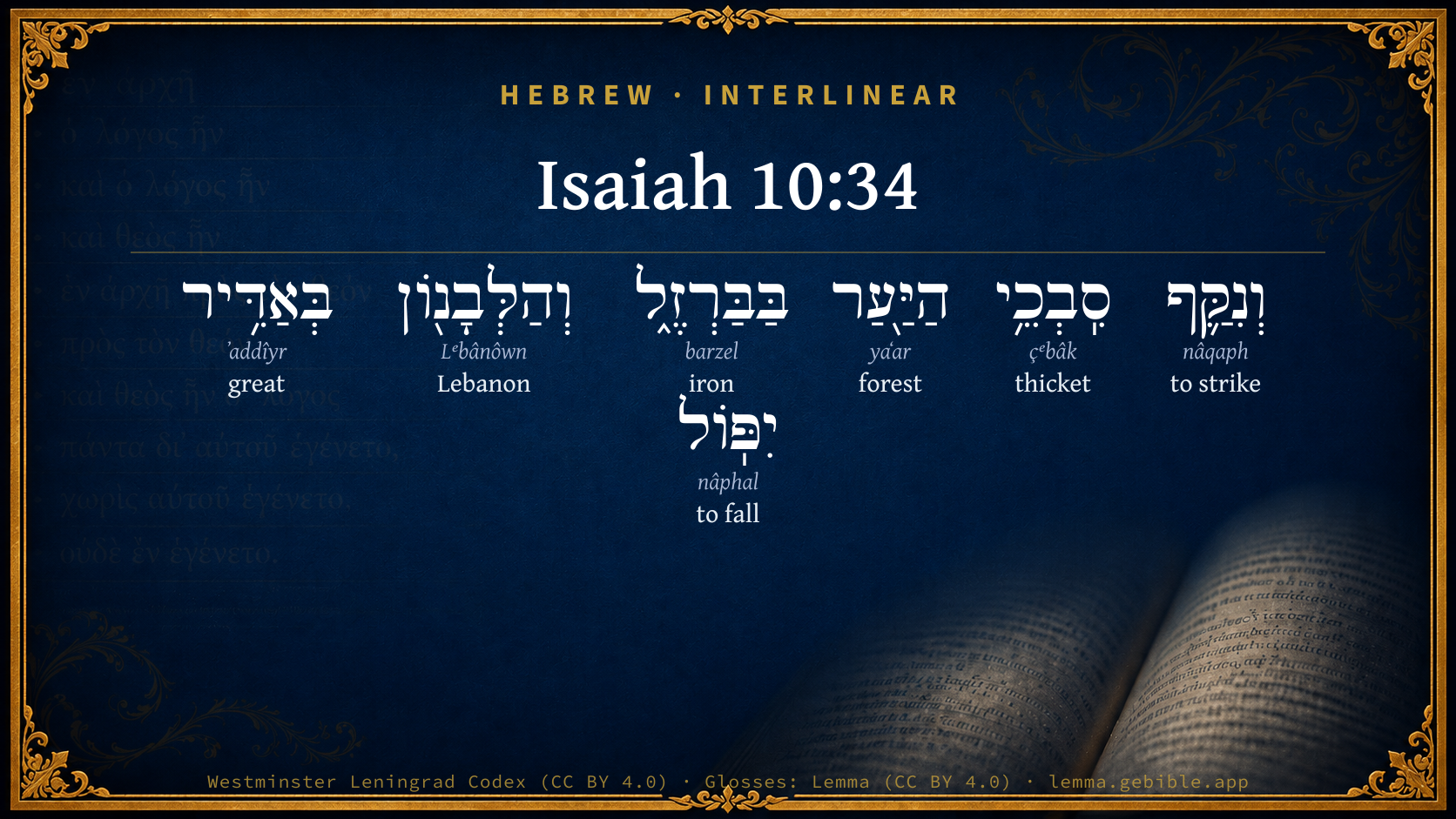
Hebrew (Westminster Leningrad Codex) Isaiah 10:34 appears in the Hebrew Old Testament. The text above is from the Westminster Leningrad Codex. Each word links to its Strong’s number, a concise gloss, and parsing drawn from the Open Scriptures Hebrew Bible morphology. Click any word for its full Brown-Driver-Briggs (BDB) entry.
Download image
Cite this verse

Isaiah 10:34 (World English Bible). Public Domain. Lemma interlinear Bible study tool, https://lemma.gebible.app/v/isaiah/10/34.

Show BibTeX & RIS
BibTeX
RIS
English Translation
He will cut down the thickets of the forest with iron, and Lebanon shall fall by a mighty one.
World English Bible · Public Domain
Download a study sheet

One document with this verse’s original text, its word-by-word gloss line, the meaning frame, cross-references with their text, attributed commentary, and full source and license credits — printable, and it pastes into notes with its structure intact.

This verse Autodidact and up

Study sheet (.html) Plain text (.txt)

A passage Seminary Student

Up to 50 verses in one chapter. A passage sheet keeps up to 6 commentary sources and 12 cross-references per verse, in the order this page ranks them, and says so on the sheet whenever that leaves anything out. Ask for a single verse and you get the Autodidact verse sheet above.

Everything on this page stays free to read, with no account — the sheet is a download of what is already on screen, not access to it.

Want to remove ads? Support Godless Engineer
Compare translations 3

The same verse in 3 English versions, stacked beneath the original-language interlinear above. Click any original word for its lexicon entry.

Each is an independent rendering of the whole verse — the interlinear is not word-aligned to these translations.

Highlighted words mark where these versions differ — a whole-verse word diff, not a word-by-word alignment.

  • World English Bible Public Domain
    He will cut down the thickets of the forest with iron, and Lebanon shall fall by a mighty one.
  • King James Version Public Domain
    And he shall cut down the thickets of the forest with iron, and Lebanon shall fall by a mighty one.
  • unfoldingWord Literal Text CC BY-SA 4.0
    And he will cut down the thickets of the forest with iron, and Lebanon will fall by the Mighty One.

unfoldingWord Literal Text — © unfoldingWord, licensed CC BY-SA 4.0. Word-aligned USFM3 via Door43 (git.door43.org/unfoldingWord/en_ult).

Versions to compare (up to 4)

3 of 4 selected

Show all 18 translations

Every available English version of this verse, each an independent rendering of the whole verse.

  • World English Bible Public Domain
    He will cut down the thickets of the forest with iron, and Lebanon shall fall by a mighty one.
  • Berean Standard Bible Public Domain
    He will clear the forest thickets with an axe, and Lebanon will fall before the Mighty One.
  • Majority Standard Bible Public Domain
    He will clear the forest thickets with an axe, and Lebanon will fall before the Mighty One.
  • King James Version Public Domain
    And he shall cut down the thickets of the forest with iron, and Lebanon shall fall by a mighty one.
  • American Standard Version (1901) Public Domain
    And he will cut down the thickets of the forest with iron, and Lebanon shall fall by a mighty one.
  • Revised Version (1885) Public Domain
    And he shall cut down the thickets of the forest with iron, and Lebanon shall fall by a mighty one.
  • Geneva Bible (1599) Public Domain
    And he shall cut away the thicke places of the forest with yron, and Lebanon shall haue a mightie fall.
  • Douay-Rheims (1899) Public Domain
    And the thickets of the forest shall be cut down with iron, and Libanus with its high ones shall fall.
  • Young's Literal Translation Public Domain
    And He hath gone round the thickets of the forest with iron, And Lebanon by a mighty one falleth!
  • Literal Standard Version CC BY-SA 4.0
    And He has gone around the thickets of the forest with iron, || And Lebanon falls by a mighty one!
  • Unlocked Literal Bible CC BY-SA 4.0
    He will chop down the thickets of the forest with an ax, and Lebanon in his majesty will fall.
  • unfoldingWord Literal Text CC BY-SA 4.0
    And he will cut down the thickets of the forest with iron, and Lebanon will fall by the Mighty One.
  • Darby Bible Public Domain
    and he shall make clearings in the thickets of the forest with iron; and Lebanon shall fall by a mighty one.
  • World Messianic Bible Public Domain
    He will cut down the thickets of the forest with iron, and Lebanon will fall by the Mighty One.
  • Webster's Bible Public Domain
    And he shall cut down the thickets of the forests with iron, and Lebanon shall fall by a mighty one.
  • Free Bible Version CC BY-SA 4.0
    He will cut down the thick forest with an ax, and Lebanon will fall at the hand of the Mighty One.
  • Bible in Basic English Public Domain
    And he is cutting down the thick places of the wood with an axe, and Lebanon with its tall trees is coming down.
  • JPS Tanakh (1917) Public Domain
    And He shall cut down the thickets of the forest with iron, and Lebanon shall fall by a mighty one.

Literal Standard Version (2020), Covenant Press — licensed CC BY-SA 4.0. Text via the HelloAO Bible API (eBible.org). Unlocked Literal Bible (unfoldingWord) — licensed CC BY-SA 4.0. Text via the HelloAO Bible API (eBible.org). unfoldingWord Literal Text — © unfoldingWord, licensed CC BY-SA 4.0. Word-aligned USFM3 via Door43 (git.door43.org/unfoldingWord/en_ult). Free Bible Version, Dr. Jonathan Gallagher — licensed CC BY-SA 4.0. Text via the HelloAO Bible API (eBible.org).

Word by word

More ways to search: Search by grammar → Find every occurrence → Compare this word →

Practice this passage: Drill this verse → Learn its vocabulary →

About this verse

These counts appear in no published source. They are computed here, from the morphology-tagged text and Lemma’s own curated glosses. What Lemma adds →

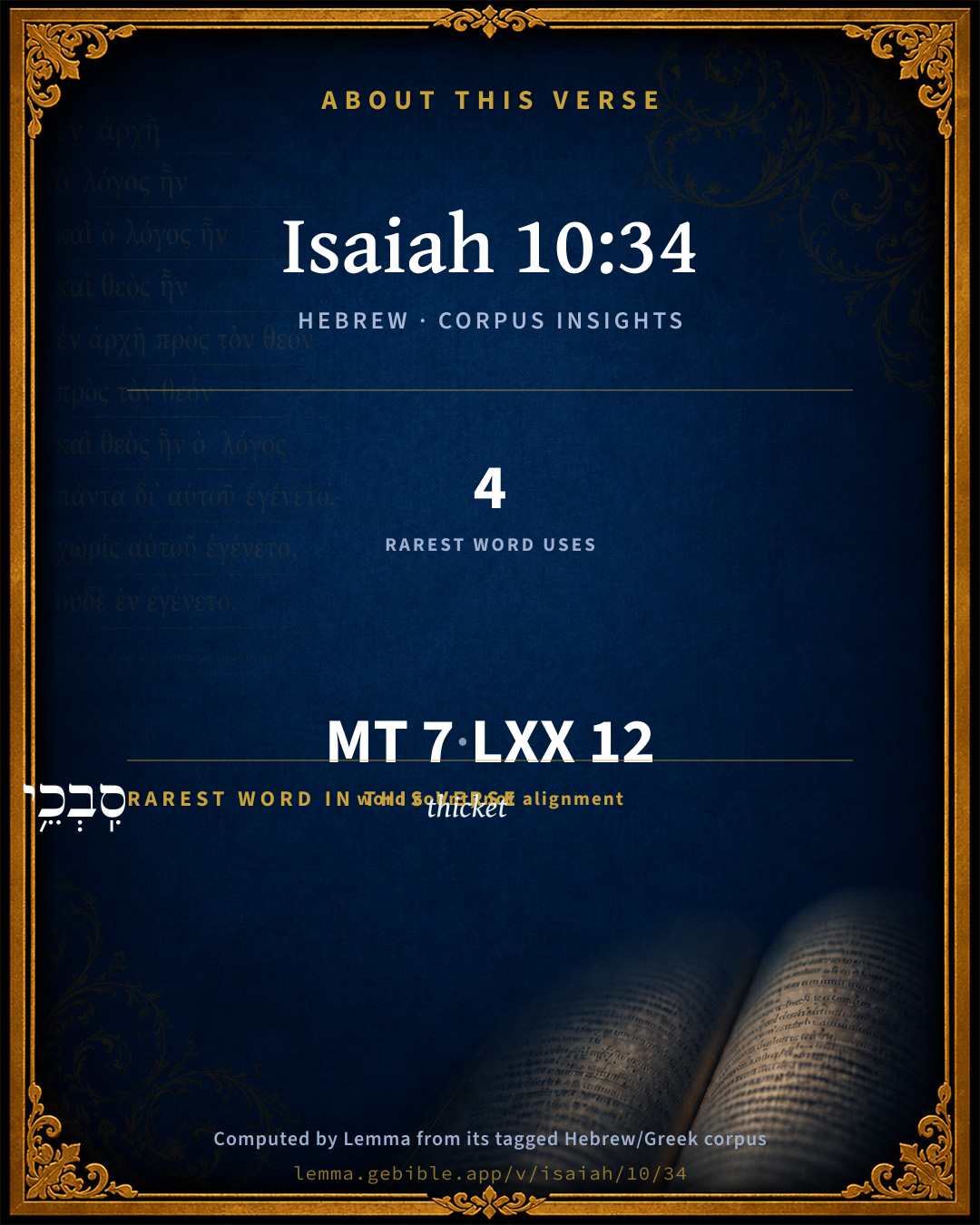
7
words
7
distinct lemmas
Prophets
section

Notable vocabulary

The rarest word here is סִֽבְכֵ֥י thicket H5442 — appearing just 4 times in the whole Hebrew Bible.

Shared distinctive vocabulary

סִֽבְכֵ֥י thicket H5442 occurs in 4 verses of the Hebrew Bible. Also found in:

Grammatical profile

  • 2 verbs
  • 4 nouns
  • 1 adjective

Verb forms

  • וְנִקַּ֛ף Piel · Sequential Perfect
  • יִפּֽוֹל Qal · Imperfect

Hebrew & Septuagint length

In English translation the verse runs 19 words from the Hebrew and 18 from the Septuagint (LXX English) — closely comparable.

A rough comparison of the two English renderings, which tokenize alike — not a word-level alignment.

Word counts can differ between the Hebrew and the Greek without any difference in meaning — e.g. the Hebrew direct-object marker אֵת has no separate Greek word, and Greek often adds the article ὁ.

In the original languages it is 7 Hebrew tokens and 12 Greek tokens — but the two are counted differently (Hebrew bundles its prefixes and suffixes into one token; the Greek is in lemma form), so that isn’t a like-for-like length.

Cross-references

16

Topical passages linked to Isaiah 10:34 in the Treasury of Scripture Knowledge — connected by theme and wording, ordered by reader-vote popularity; previews shown in the World English Bible.

  • Isaiah 37:24 By your servants have you defied the Lord, and have said, With the multitude of my chariots am I come up to the height of the mountains, to the innermost parts of Lebanon; and I will cut down the tall cedars of it, and the choice fir trees of it; and I will enter into its farthest height, the forest of its fruitful field;
  • Psalms 103:20 Praise Yahweh, you angels of his, Who are mighty in strength, who fulfill his word, Obeying the voice of his word.
  • Isaiah 10:18 He will consume the glory of his forest, and of his fruitful field, both soul and body: and it shall be as when a standard-bearer faints.
  • Isaiah 31:8 The Assyrian shall fall by the sword, not of man; and the sword, not of men, shall devour him; and he shall flee from the sword, and his young men shall become subject to forced labor.
  • Isaiah 37:36 The angel of Yahweh went forth, and struck in the camp of the Assyrians one hundred and eighty-five thousand; and when men arose early in the morning, behold, these were all dead bodies.
  • Jeremiah 22:7 I will prepare destroyers against you, everyone with his weapons; and they shall cut down your choice cedars, and cast them into the fire.
  • Jeremiah 46:22–23 The sound of it shall go like the serpent; for they shall march with an army, and come against her with axes, as wood cutters.
  • Jeremiah 48:2 The praise of Moab is no more; in Heshbon they have devised evil against her: Come, and let us cut her off from being a nation. You also, Madmen, shall be brought to silence: the sword shall pursue you.
  • Daniel 4:13–14 I saw in the visions of my head on my bed, and, behold, a watcher and a holy one came down from the sky.
  • Daniel 4:23 Whereas the king saw a watcher and a holy one coming down from the sky, and saying, Hew down the tree, and destroy it; nevertheless leave the stump of the roots of it in the earth, even with a band of iron and brass, in the tender grass of the field, and let it be wet with the dew of the sky: and let his portion be with the animals of the field, until seven times pass over him;
  • Nahum 1:12 Thus says Yahweh: "Though they be in full strength, and likewise many, even so they will be cut down, and he shall pass away. Though I have afflicted you, I will afflict you no more.
  • Zechariah 11:1–2 Open your doors, Lebanon, That the fire may devour your cedars.
  • 2 Thessalonians 1:7 and to give relief to you that are afflicted with us, when the Lord Jesus is revealed from heaven with his mighty angels in flaming fire,
  • 2 Peter 2:11 whereas angels, though greater in might and power, don't bring a railing judgment against them before the Lord.
  • Revelation 10:1 I saw a mighty angel coming down out of the sky, clothed with a cloud. A rainbow was on his head. His face was like the sun, and his feet like pillars of fire.
  • Revelation 18:21 A mighty angel took up a stone like a great millstone and cast it into the sea, saying, "Thus with violence will Babylon, the great city, be thrown down, and will be found no more at all.

Cross-references courtesy of OpenBible.info (CC BY 4.0).

Hebrew and Greek witnesses Masoretic Hebrew ↔ Greek Septuagint

The same verse in the two great witnesses to the Old Testament, shown verse-for-verse.

These are two independent witnesses, not word-aligned to each other, and the Septuagint is shown in lemma (dictionary) form.

Hebrew Isaiah 10:34 Masoretic · Westminster Leningrad Codex

וְנִקַּ֛ף סִֽבְכֵ֥י הַיַּ֖עַר בַּבַּרְזֶ֑ל וְהַלְּבָנ֖וֹן בְּאַדִּ֥יר יִפּֽוֹל

He will cut down the thickets of the forest with iron, and Lebanon shall fall by a mighty one.

World English Bible · Public Domain

Greek LXX Isaiah 10:34 Septuagint · lemma form

καί πίπτω ὁ ὑψηλός μάχαιρα ὁ δέ λίβανος σύν ὁ ὑψηλός πίπτω

and the lofty ones shall fall by the sword, and the Libanus shall fall with his lofty ones.

LXX2012 (modern English Septuagint) · Public Domain

Hebrew: Westminster Leningrad Codex (CC BY 4.0). Greek: Septuagint (public domain); English from LXX2012 (modern English Septuagint) (Public Domain). How the Septuagint differs from the Hebrew →

Targum (Aramaic paraphrase)

1

The Targum is the ancient Jewish Aramaic paraphrase of the Hebrew Scriptures — an interpretive translation, not the Hebrew text itself. Onkelos (literal) and Pseudo-Jonathan (expansive) render the Torah, and Jonathan the Prophets. Coverage is partial: where no permissively-licensed English translation exists for a verse, only the Aramaic is shown. This is verse-level text, not a word-by-word alignment to the Hebrew.

  1. Targum Jonathan Prophets (Joshua–Malachi)
    וְיִקְטֵיל גִבָּרֵי מַשִׁרְיָתֵיהּ דְמִתְגַבְּרִין כְּבַרְזְלָא וְעָבְדֵי קְרָבָא עַל אַרְעָא דְיִשְׂרָאֵל יִתְרְמוּן:

    And He shall slay the mighty men of his camp, who are strong as iron. And those that make war upon the earth shall be cast down.

    Targum Jonathan — Aramaic: “Mikraot Gedolot” (public domain). English: “Sefaria Community Translation” (CC0 1.0 (public-domain dedication)); “London "Chaldee Paraphrase," 1871” (public domain). Text via Sefaria.

Commentary

Notes on Isaiah 10:34 from classic Christian and Jewish commentators (each source and its license shown beneath its notes). The classic Christian expositions comment on the surrounding passage and are grouped to its opening verse, so a note may address several verses; the Jewish commentaries on the Tanakh (Rashi and others) are per-verse, so they appear only where the commentator wrote on this verse.

Lemma curates 59 commentaries, every one of them public domain or Creative Commons licensed, each selected and text-cleaned for this edition rather than reprinted as found. About our sources →

Trapp's Complete Commentary

John Trapp

Isa 10:34 And he shall cut down the thickets of the forest with iron, and Lebanon shall fall by a mighty one.

Ver. 34. By a mighty one.] {a} That is, by an angel. {Isa 37:36 Psa 78:25; Psa 89:5-6}

{a} Per magnificum.

John Trapp, A Commentary or Exposition upon All the Books of the Old and New Testament (1647–1656) — public domain. Text from a community e-Sword module.

Jamieson, Fausset & Brown

Robert Jamieson, A. R. Fausset & David Brown

This verse and Isa 10:33 describe the sudden arrest and overthrow of Sennacherib in the height of his success; Isa 10:18-19; Eze 31:3, Eze 31:14, &c., contain the same image; "Lebanon" and its forest are the Assyrian army; the "iron" axe that fells the forest refers to the stroke which destroyed the one hundred and eighty-five thousand Assyrians (Kg2 19:35). The "Mighty One" is Jehovah (Isa 10:21; Isa 9:6).

From the local and temporary national deliverance the prophet passes by the law of suggestion in an easy transition to the end of all prophecy--the everlasting deliverance under Messiah's reign, not merely His first coming, but chiefly His second coming. The language and illustrations are still drawn from the temporary national subject, with which he began, but the glories described pertain to Messiah's reign. Hezekiah cannot, as some think, be the subject; for he was already come, whereas the "stem of Jesse" was yet future ("shall come") (compare Mic 4:11, &c.; Mic 5:1-2; Jer 23:5-6; Jer 33:15-16; Rom 15:12).

Next: Isaiah Chapter 11

Jamieson, Fausset & Brown — Commentary Critical and Explanatory on the Whole Bible (1871) — public domain (CC PDM 1.0). Text via the HelloAO Bible API.

Adam Clarke's Commentary

Verse 34. Lebanon shall fall by a mighty one] באדיר beaddir, the angel of the Lord, who smote them, Kimchi. And so Vitringa understands it. Others translate, "The high cedars of Lebanon shall fall:" but the king of Assyria is the person who shall be overthrown.

Adam Clarke's Commentary on the Bible (1810–1826) — public domain. Text from a community e-Sword/MySword module.

Albert Barnes' Notes on the Bible

And he shall cut down the thickets of the forest - The army of the Assyrians, described here as a thick, dense forest; compare Isa 10:18-19.

With iron - As a forest is cut down with an axe, so the prophet uses this phrase here, to keep up and carry out the figure. The army was destroyed with the pestilence 2Ki 19:35; but it fell as certainly as a forest falls before the axe.

And Lebanon - Lebanon is here evidently descriptive of the army of the Assyrian, retaining the idea of a beautiful and magnificent forest. Thus, in Eze 31:3, it is said, ‘the king of the Assyrians was a cedar of Lebanon with fair branches.’ Lebanon is usually applied to the Jews as descriptive of them (Jer 22:6, Jer 22:23; Zec 10:10; 11: l), but it is evidently applied here to the Assyrian army; and the sense is, that that army should be soon and certainly destroyed, and that, therefore, the inhabitants of Jerusalem had no cause of alarm; see the notes at Isa. 37.

Albert Barnes' Notes on the Bible (1834–1885) — public domain. Text from a community e-Sword/MySword module.

Matthew Poole's English Annotations

With iron; or, as with iron, as the trees of the forest are cut down by instruments of iron.

And Lebanon; or, his Lebanon, the pronoun being oft understood in the Hebrew text; the Assyrian army, which being before compared to a forest or wood, and being called his Carmel in the Hebrew text, Isa 10:18, may very fitly, upon the same ground, be called his Lebanon here; especially considering that the king of Assyria is called a cedar of Lebanon, Eze 31:3.

By a mighty one; by a mighty angel, Isa 37:36.

Matthew Poole's English Annotations on the Holy Bible (1683–1685) — public domain. Text from a community e-Sword/MySword module.

The Pulpit Commentary

He shall cut down; or, one shall eat down; Jehovah being, no doubt, intended. Lebanon. (comp. Eze_31:3, "Behold, the Assyrian was a cedar in Lebanon Here the comparison is enlarged, and Assyria appears as Lebanon itself with all its cedar woods. By a mighty one; rather, a glorious one. (comp. Isa_33:21, where the word here used adir is an epithet of Jehovah)

The Pulpit Commentary (1880–1919), ed. H.D.M. Spence-Jones & Joseph S. Exell — public domain. Text from a community e-Sword module.

John Wesley's Explanatory Notes

Iron - Or, as with iron, as the trees of the forest are cut down with instruments of iron. Lebanon - Or, his Lebanon, the Assyrian army, which being before compared to a forest, and being called his Carmel in the Hebrew text, ver. 18, may very fitly upon the same ground, be called his Lebanon here.

John Wesley, Explanatory Notes Upon the Whole Bible (1754–1765) — public domain. Text via the GEBible commentary corpus.

J. A. Alexander on Isaiah

Joseph Addison Alexander

“And He (Jehovah) shall cut down (or away) the thickets of the forest (the Assyrian army) with iron, (i.e., with an instrument of iron, as an axe), and this Lebanon (this wooded mountain, this enormous forest, still referring to the host of the Assyrians) with (or by) a mighty one.” It is clear that the iron of this verse and the fire of v. 17 denote one and the same thing, both implying that the forest was to perish, not by slow decay, but by sudden violence, which shows the absurdity of giving a specific sense to all the particulars in such a picture. Thus the thickets are probably mentioned only to complete the picture of a forest totally destroyed. The general figure of a forest is made more specific by referring to Lebanon, a mountain celebrated for its woods.

Joseph Addison Alexander, The Prophecies of Isaiah (1846–1847; New York: Scribner, 1870–1878) — public domain. Text from a community e-Sword module.

Rashi

Rabbi Shlomo Yitzchaki (Rashi)

And...shall be cut off Heb. וְנִקַּף. This, too, is an expression of cutting, as (ibid.) “Like one who cuts off olives (כְּנֹקֶף).” וְנִקַּף is in the passive voice.

the thickets of the forests The prominent branches, symbolizing the heroes.

and the Lebanon The thickness of his forest and his stately forest. They are the multitudes of his armies.

shall fall through a mighty one Through an angel they shall fall. Alternatively, through a mighty one, in the merit of Hezekiah who is the mighty one and the rulers of Israel, as it is said (Jer. 30:21): “And their leader shall be of themselves.”

Rashi on the Tanakh — English translations: “The Judaica Press complete Tanach with Rashi, translated by A. J. Rosenberg” (CC BY 4.0); “Pentateuch with Rashi's commentary by M. Rosenbaum and A.M. Silbermann, 1929-1934” (public domain); “The Metsudah Tanach series, Lakewood, N.J” (CC BY 4.0); and “The Book of Joshua, Metsudah Publications, 1997” (CC BY 4.0). Text via Sefaria.

Ibn Ezra

Rabbi Abraham ibn Ezra

ונקף And he shall cut down.

סבכי The trees that are thick with branches.

בברזל With the axe, that is, by means of the angel.

And Lebanon, etc. The princes, that are compared with the trees of the Lebanon, shall fall. בברזל אדיר ═ באדיר By a mighty axe; ברזל is to be supplied from the preceding בברזל with the axe.

Ibn Ezra on the Tanakh — English translations: “Sefaria Community Translation” (CC0 1.0 (public-domain dedication)); “Yalkut, Sifsei Chachomim Chumash, Metsudah Publications, 2009” (CC BY 4.0); and “Commentary of Ibn Ezra on Isaiah - trans. by M. Friedlander, 1873” (public domain). Text via Sefaria.

Lesson kit

Teaching starters — assembled from the data on this page, not authored interpretation. Every prompt links to the verse data it draws on. Edit before teaching.

Isaiah, in the Prophets, opens this verse with 7 words (7 distinct Hebrew lemmas). Its most distinctive word is çᵉbâk (“thicket”). A historical commentator’s framing appears above. Read the whole chapter for the surrounding context.

Discussion questions

  1. The word çᵉbâk carries the sense “thicket.” How does it shape the verse?
  2. How does Genesis 22:13, which shares the word «thicket», read alongside this verse?
  3. These translations render this verse differently. What is at stake in choosing one wording over another?
  4. «וְנִקַּ֛ף» is a Piel Sequential Perfect verb. How does that grammatical form shape the action described?
  5. Compare how Trapp's Complete Commentary and Jamieson, Fausset & Brown read this verse. Where do they agree or differ?

Things to notice

Reading settings

Reading text

Shown beneath each verse's original-language words.

Old Testament
Old Testament edition

Read the OT as the Masoretic Hebrew (MT) or the Greek Septuagint (LXX).

English shown for the Greek Septuagint (in the Hebrew ↔ Greek comparison).

Comparing translations? Open the Compare panel on any verse page to stack up to four side by side.