
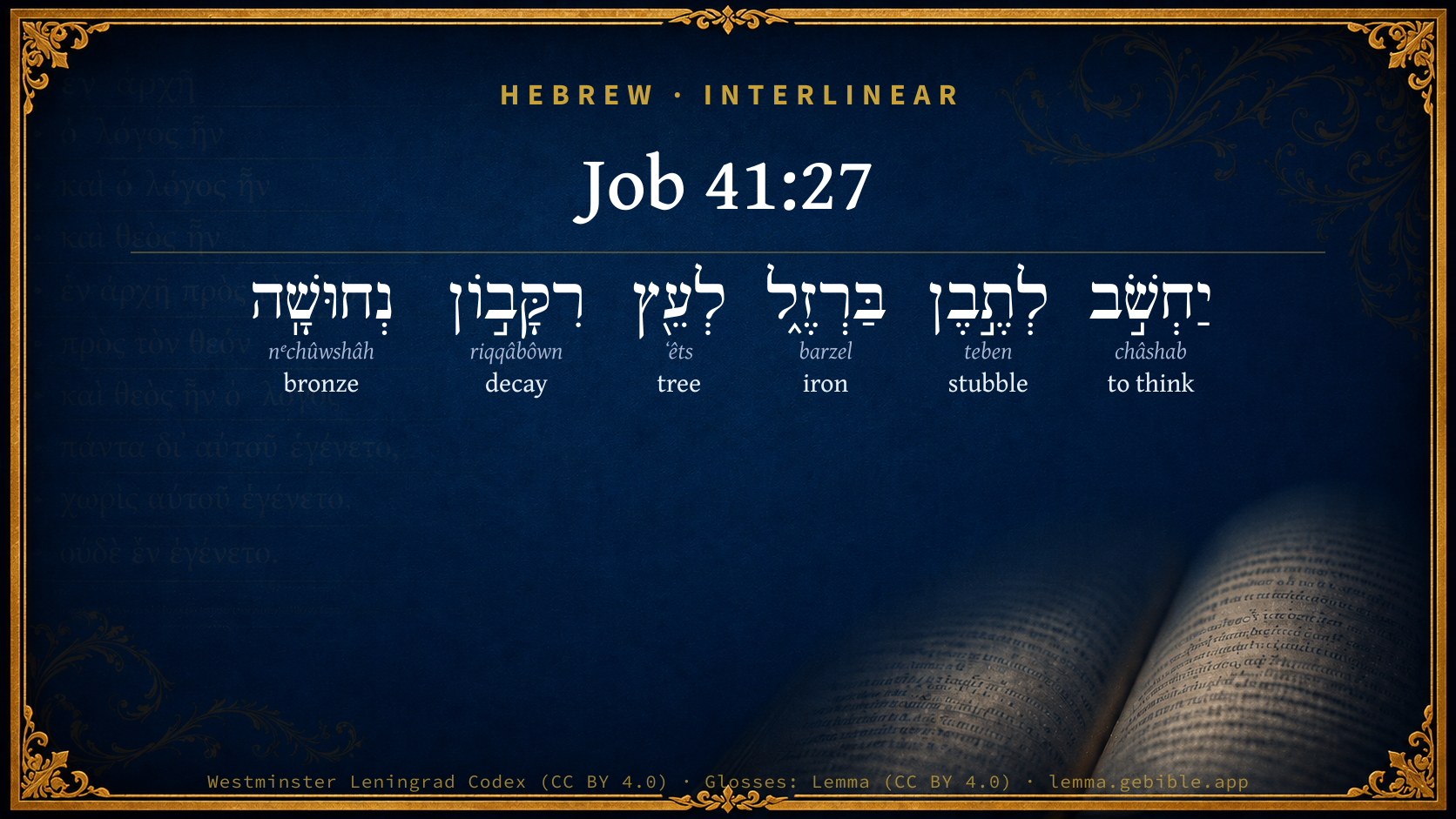
Job 41:27

Hebrew (Westminster Leningrad Codex) Job 41:27 appears in the Hebrew Old Testament. The text above is from the Westminster Leningrad Codex. Each word links to its Strong’s number, a concise gloss, and parsing drawn from the Open Scriptures Hebrew Bible morphology. Click any word for its full Brown-Driver-Briggs (BDB) entry.
Download image
Cite this verse

Job 41:27 (World English Bible). Public Domain. Lemma interlinear Bible study tool, https://lemma.gebible.app/v/job/41/27.

Show BibTeX & RIS
BibTeX
RIS
English Translation
He counts iron as straw; And brass as rotten wood.
World English Bible · Public Domain
Highlights
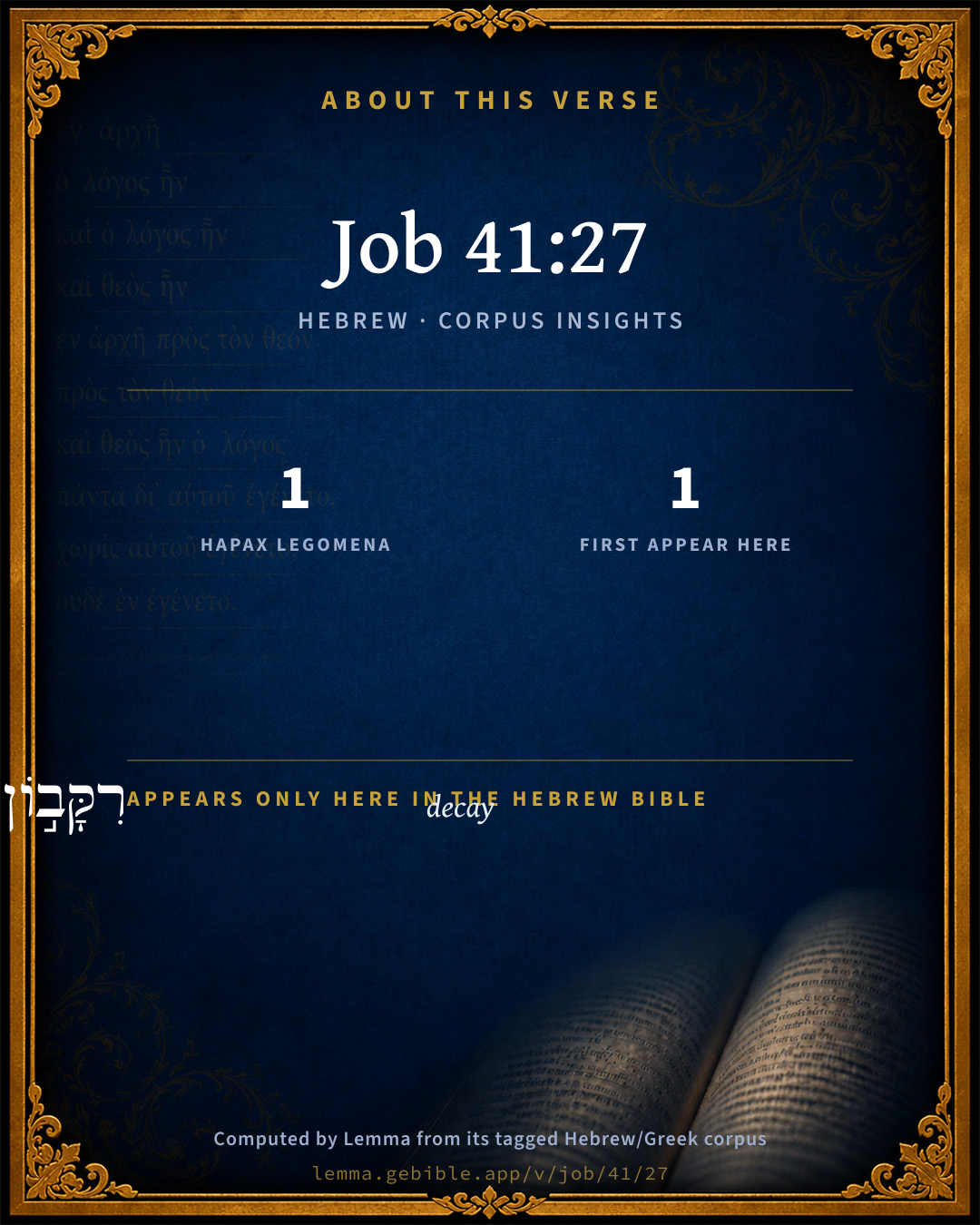
  • 1 hapax legomenon — only here in the Hebrew Bible
  • 1 first appearance in the Hebrew Bible
Full analysis ↓
Download a study sheet

One document with this verse’s original text, its word-by-word gloss line, the meaning frame, cross-references with their text, attributed commentary, and full source and license credits — printable, and it pastes into notes with its structure intact.

This verse Autodidact and up

Study sheet (.html) Plain text (.txt)

A passage Seminary Student

Up to 50 verses in one chapter. A passage sheet keeps up to 6 commentary sources and 12 cross-references per verse, in the order this page ranks them, and says so on the sheet whenever that leaves anything out. Ask for a single verse and you get the Autodidact verse sheet above.

Everything on this page stays free to read, with no account — the sheet is a download of what is already on screen, not access to it.

Want to remove ads? Support Godless Engineer
Compare translations 3

The same verse in 3 English versions, stacked beneath the original-language interlinear above. Click any original word for its lexicon entry.

Each is an independent rendering of the whole verse — the interlinear is not word-aligned to these translations.

Highlighted words mark where these versions differ — a whole-verse word diff, not a word-by-word alignment.

  • World English Bible Public Domain
    He counts iron as straw; And brass as rotten wood.
  • King James Version Public Domain
    He esteemeth iron as straw, and brass as rotten wood.
  • unfoldingWord Literal Text CC BY-SA 4.0
    It regards iron as straw, bronze as rotten wood.

unfoldingWord Literal Text — © unfoldingWord, licensed CC BY-SA 4.0. Word-aligned USFM3 via Door43 (git.door43.org/unfoldingWord/en_ult).

Versions to compare (up to 4)

3 of 4 selected

Show all 14 translations

Every available English version of this verse, each an independent rendering of the whole verse.

  • World English Bible Public Domain
    He counts iron as straw; And brass as rotten wood.
  • Berean Standard Bible Public Domain
    He regards iron as straw and bronze as rotten wood.
  • Majority Standard Bible Public Domain
    He regards iron as straw and bronze as rotten wood.
  • King James Version Public Domain
    He esteemeth iron as straw, and brass as rotten wood.
  • American Standard Version (1901) Public Domain
    He counteth iron as straw, `And' brass as rotten wood.
  • Revised Version (1885) Public Domain
    He counteth iron as straw, and brass as rotten wood.
  • Young's Literal Translation Public Domain
    He reckoneth iron as straw, brass as rotten wood.
  • Literal Standard Version CC BY-SA 4.0
    He reckons iron as straw, bronze as rotten wood.
  • Unlocked Literal Bible CC BY-SA 4.0
    He thinks of iron as if it were straw, and of bronze as if it were rotten wood.
  • unfoldingWord Literal Text CC BY-SA 4.0
    It regards iron as straw, bronze as rotten wood.
  • Darby Bible Public Domain
    He esteemeth iron as straw, bronze as rotten wood.
  • World Messianic Bible Public Domain
    He counts iron as straw, and bronze as rotten wood.
  • Free Bible Version CC BY-SA 4.0
    It brushes aside iron like straw, and bronze like rotten wood.
  • JPS Tanakh (1917) Public Domain
    (41-19) He esteemeth iron as straw, and brass as rotten wood.

Literal Standard Version (2020), Covenant Press — licensed CC BY-SA 4.0. Text via the HelloAO Bible API (eBible.org). Unlocked Literal Bible (unfoldingWord) — licensed CC BY-SA 4.0. Text via the HelloAO Bible API (eBible.org). unfoldingWord Literal Text — © unfoldingWord, licensed CC BY-SA 4.0. Word-aligned USFM3 via Door43 (git.door43.org/unfoldingWord/en_ult). Free Bible Version, Dr. Jonathan Gallagher — licensed CC BY-SA 4.0. Text via the HelloAO Bible API (eBible.org).

Word by word

More ways to search: Search by grammar → Find every occurrence → Compare this word →

Practice this passage: Drill this verse → Learn its vocabulary →

About this verse

These counts appear in no published source. They are computed here, from the morphology-tagged text and Lemma’s own curated glosses. What Lemma adds →

6
words
6
distinct lemmas
Wisdom
section

Notable vocabulary

1 hapax legomenon — a word that appears only here in the entire Hebrew Bible:

  • רִקָּב֣וֹן decay H7539

First appearance in Scripture

This word makes its first canonical appearance in the Hebrew Bible here:

  • רִקָּב֣וֹן decay H7539

Shared distinctive vocabulary

נְחוּשָֽׁה bronze H5154 occurs in 10 verses of the Hebrew Bible. Also found in:

Grammatical profile

  • 1 verb
  • 5 nouns

Verb forms

  • יַחְשֹׁ֣ב Qal · Imperfect
Hebrew and Greek witnesses Masoretic Hebrew ↔ Greek Septuagint

The same verse in the two great witnesses to the Old Testament, shown verse-for-verse.

These are two independent witnesses, not word-aligned to each other, and the Septuagint is shown in lemma (dictionary) form.

Hebrew Job 41:27 Masoretic · Westminster Leningrad Codex

יַחְשֹׁ֣ב לְתֶ֣בֶן בַּרְזֶ֑ל לְעֵ֖ץ רִקָּב֣וֹן נְחוּשָֽׁה

He counts iron as straw; And brass as rotten wood.

World English Bible · Public Domain

Hebrew: Westminster Leningrad Codex (CC BY 4.0). Greek: Septuagint (public domain); English from a public-domain English Septuagint. How the Septuagint differs from the Hebrew →

Commentary

Notes on Job 41:27 from classic Christian and Jewish commentators (each source and its license shown beneath its notes). The classic Christian expositions comment on the surrounding passage and are grouped to its opening verse, so a note may address several verses; the Jewish commentaries on the Tanakh (Rashi and others) are per-verse, so they appear only where the commentator wrote on this verse.

Lemma curates 59 commentaries, every one of them public domain or Creative Commons licensed, each selected and text-cleaned for this edition rather than reprinted as found. About our sources →

Trapp's Complete Commentary

John Trapp

Job 41:27 He esteemeth iron as straw, [and] brass as rotten wood.

Ver. 27. He esteemeth iron as straw, and brass as rotten wood] He makes nothing of anything that shall be done against him. Bears and lions may be wounded with hunting weapons; other fishes with eel spears, and the like: not so the whale, or not so easily.

John Trapp, A Commentary or Exposition upon All the Books of the Old and New Testament (1647–1656) — public domain. Text from a community e-Sword module.

Joseph Benson's Commentary

Job 41:27-28. He esteemeth iron as straw, and brass as rotten wood — He neither fears, nor feels, the blows of the one more than of the other. The arrow cannot make him flee — Hebrew, the son of the bow, as it is elsewhere called, the son of the quiver, Lam 3:13; the quiver being, as it were, the mother, or womb, that bears it, and the bow as the father that begets it, or sendeth it forth. Sling-stones — Great stones cast out of slings, which have a great force and efficacy, 2Ch 26:14; are turned with him into stubble — Hurt him no more than a blow with a little stubble. Heath renders this clause, He throweth about sling-stones like stubble; and Houbigant, Sling-stones are no more to him than stubble. An extraordinary instance of the strength of a crocodile is related by Maillet. “I saw one,” says he, “twelve feet long, which had not eaten any thing for thirty-five days, having had its mouth tied close during that interval, which, from a single blow from its tail, overturned five or six men together, with a bale of coffee, as easily as I could overturn six men at a game of draughts.” What force then must one of twenty feet long have in its full strength, and not weakened by such a fast? Thevenot also speaks of one that he had stripped of his skin, and says, that “it was so strong, though but eight feet in length, that after they had turned him upon his back, and four persons stood upon him with both their feet, while they were cutting open his belly, he moved himself with so much force as to throw them off with violence.” See Maillet’s Description of Egypt, page 33, and Thevenot, part 2. page 72.

Joseph Benson's Commentary on the Old and New Testaments (1811–1818) — public domain. Text from a community e-Sword module.

Jamieson, Fausset & Brown

Robert Jamieson, A. R. Fausset & David Brown

iron . . . brass--namely, weapons.

Jamieson, Fausset & Brown — Commentary Critical and Explanatory on the Whole Bible (1871) — public domain (CC PDM 1.0). Text via the HelloAO Bible API.

John Gill's Exposition

The arrow cannot make him flee,.... The skin of the crocodile is so hard, as Peter Martyr says, that it cannot be pierced with arrows, as before observed; therefore it is not afraid of them, nor will flee from them;

slingstones are turned with him into stubble; are no more regarded by him than if stubble was cast at him; not only stones out of a sling, but out of an engine; and such is the hardness of the skin of the crocodile, that, as Isidore says (e), the strokes of the strongest stones are rebounded by it, yea, even it is said to withstand against musket shot (f).

(e) Origin. l. 12. c. 6. (f) Mandelsloe in Harris's Voyages, &c. vol. 1. p. 759.

John Gill's Exposition of the Whole Bible (1746–1763) — public domain (CC PDM 1.0). Text via the HelloAO Bible API.

Albert Barnes' Notes on the Bible

He esteemeth iron as straw - He regards instruments made of iron and brass as if they were straw or rotten wood. That is, they make no impression on him. This will agree better with the crocodile than any other animal. So hard is his skin, that a musket-ball will not penetrate it; see numerous quotations proving the hardness of the skin of the crooodile, in Bochart.

Albert Barnes' Notes on the Bible (1834–1885) — public domain. Text from a community e-Sword/MySword module.

Matthew Poole's English Annotations

He neither fears nor feels the blows of the one more than of the other.

Matthew Poole's English Annotations on the Holy Bible (1683–1685) — public domain. Text from a community e-Sword/MySword module.

Whedon's Commentary on the Bible

Daniel D. Whedon

27. He esteemeth iron as straw — An expression some suppose to refer to the enormous power of the crocodile’s snap. Kitto cites a case which occurred in Ceylon, in which an enraged alligator bit the barrel of a gun completely in two. On the contrary, the text describes the crocodile’s contemptuous disregard of the missiles employed by the ancients in their assaults upon him.

Daniel D. Whedon (gen. ed.), Commentary on the Old and New Testaments (1874–1909) — public domain. Text from a community e-Sword module.

The Pulpit Commentary

He esteemeth iron as straw, and brass (rather, bronze) as rotten wood. Even the hardest metals are useless against the crocodile. Moderns observe that even firearms are of little avail against him. The back and tail, at any rate, resist musket-balls (Bochart); and a rifle-bullet will glance aside if it strikes one of the scales (Tristram); see ver. 15.

The Pulpit Commentary (1880–1919), ed. H.D.M. Spence-Jones & Joseph S. Exell — public domain. Text from a community e-Sword module.

Lesson kit

Teaching starters — assembled from the data on this page, not authored interpretation. Every prompt links to the verse data it draws on. Edit before teaching.

Job, in the Wisdom, opens this verse with 6 words (6 distinct Hebrew lemmas). Its most distinctive word is riqqâbôwn (“decay”). A historical commentator’s framing appears above. Read the whole chapter for the surrounding context.

Discussion questions

  1. The word riqqâbôwn carries the sense “decay.” How does it shape the verse?
  2. 1 word here appears nowhere else in the Hebrew Bible. Why might the author reach for such rare wording?
  3. This is the first place “decay” appears in Scripture (first appears here). What does its debut here establish?
  4. How does Leviticus 26:19, which shares the word «bronze», read alongside this verse?
  5. These translations render this verse differently. What is at stake in choosing one wording over another?
  6. «יַחְשֹׁ֣ב» is a Qal Imperfect verb. How does that grammatical form shape the action described?
  7. Compare how Trapp's Complete Commentary and Joseph Benson's Commentary read this verse. Where do they agree or differ?

Things to notice

  • 1 word in this verse appears nowhere else in the Hebrew Bible.
  • 1 word makes its first canonical appearance in Scripture here.
  • These translations choose different wording for 5 words in this verse.
  • 6 distinct Hebrew lemmas span 6 words in this verse.

Reading settings

Reading text

Shown beneath each verse's original-language words.

Old Testament
Old Testament edition

Read the OT as the Masoretic Hebrew (MT) or the Greek Septuagint (LXX).

English shown for the Greek Septuagint (in the Hebrew ↔ Greek comparison).

Comparing translations? Open the Compare panel on any verse page to stack up to four side by side.