Ezekiel 27:19

Hebrew (Westminster Leningrad Codex) Ezekiel 27:19 appears in the Hebrew Old Testament. The text above is from the Westminster Leningrad Codex. Each word links to its Strong’s number, a concise gloss, and parsing drawn from the Open Scriptures Hebrew Bible morphology. Click any word for its full Brown-Driver-Briggs (BDB) entry.
Download image
Cite this verse

Ezekiel 27:19 (World English Bible). Public Domain. Lemma interlinear Bible study tool, https://lemma.gebible.app/v/ezekiel/27/19.

Show BibTeX & RIS
BibTeX
RIS
English Translation
Vedan and Javan traded with yarn for your wares: bright iron, cassia, and calamus, were among your merchandise.
World English Bible · Public Domain
Highlights
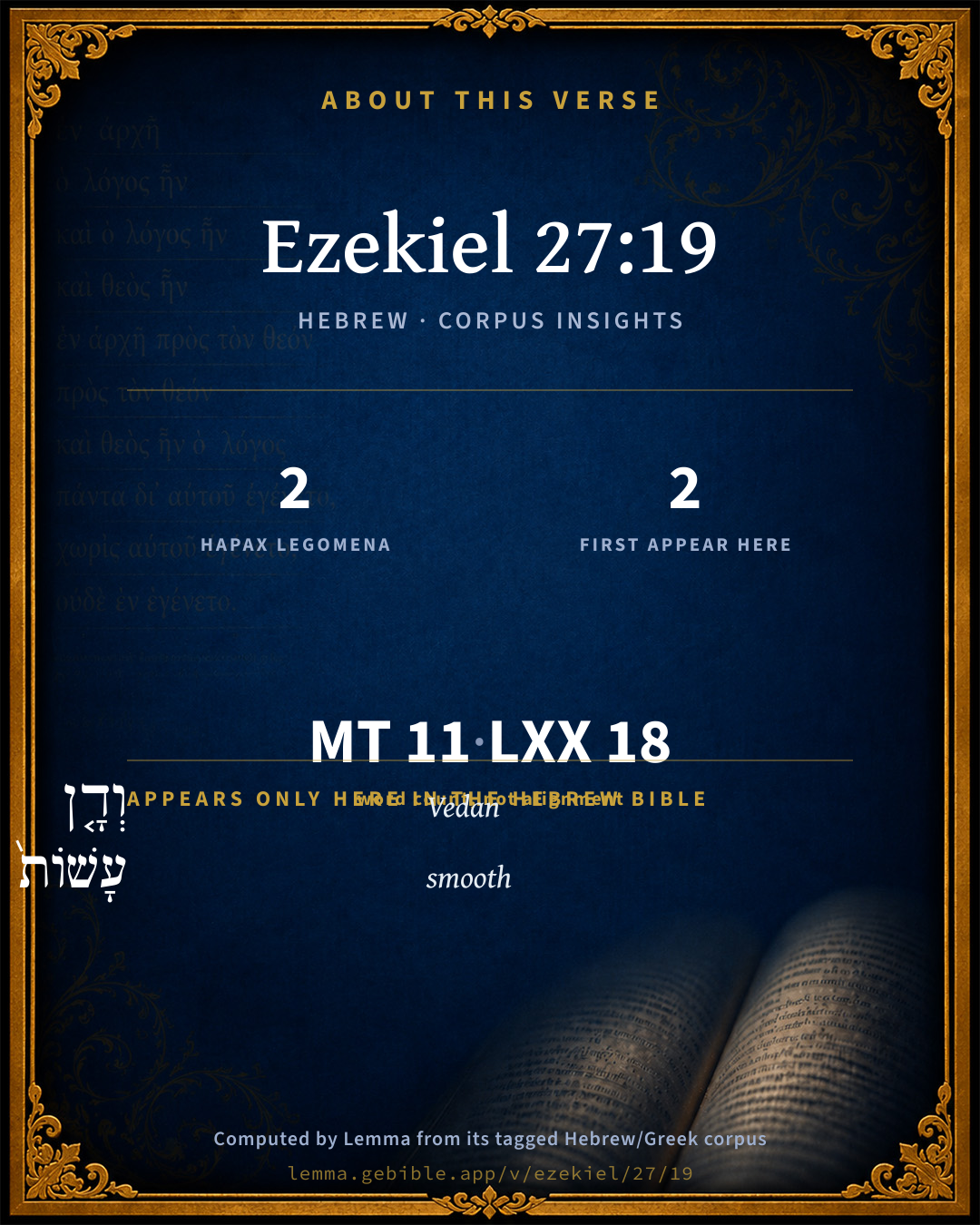
  • 2 hapax legomena — only here in the Hebrew Bible
  • 2 first appearances in the Hebrew Bible
Full analysis ↓
Download a study sheet

One document with this verse’s original text, its word-by-word gloss line, the meaning frame, cross-references with their text, attributed commentary, and full source and license credits — printable, and it pastes into notes with its structure intact.

This verse Autodidact and up

Study sheet (.html) Plain text (.txt)

A passage Seminary Student

Up to 50 verses in one chapter. A passage sheet keeps up to 6 commentary sources and 12 cross-references per verse, in the order this page ranks them, and says so on the sheet whenever that leaves anything out. Ask for a single verse and you get the Autodidact verse sheet above.

Everything on this page stays free to read, with no account — the sheet is a download of what is already on screen, not access to it.

Want to remove ads? Support Godless Engineer
Compare translations 3

The same verse in 3 English versions, stacked beneath the original-language interlinear above. Click any original word for its lexicon entry.

Each is an independent rendering of the whole verse — the interlinear is not word-aligned to these translations.

Highlighted words mark where these versions differ — a whole-verse word diff, not a word-by-word alignment.

  • World English Bible Public Domain
    Vedan and Javan traded with yarn for your wares: bright iron, cassia, and calamus, were among your merchandise.
  • King James Version Public Domain
    Dan also and Javan going to and fro occupied in thy fairs: bright iron, cassia, and calamus, were in thy market.
  • unfoldingWord Literal Text CC BY-SA 4.0
    Dan and Javan from Izal provided you with merchandise of wrought iron, cinnamon, and calamus. This became merchandise for you.

unfoldingWord Literal Text — © unfoldingWord, licensed CC BY-SA 4.0. Word-aligned USFM3 via Door43 (git.door43.org/unfoldingWord/en_ult).

Versions to compare (up to 4)

3 of 4 selected

Show all 18 translations

Every available English version of this verse, each an independent rendering of the whole verse.

  • World English Bible Public Domain
    Vedan and Javan traded with yarn for your wares: bright iron, cassia, and calamus, were among your merchandise.
  • Berean Standard Bible Public Domain
    and casks of wine from Izal for your wares. Wrought iron, cassia, and sweet cane were exchanged for your merchandise.
  • Majority Standard Bible Public Domain
    and casks of wine from Izal for your wares. Wrought iron, cassia, and sweet cane were exchanged for your merchandise.
  • King James Version Public Domain
    Dan also and Javan going to and fro occupied in thy fairs: bright iron, cassia, and calamus, were in thy market.
  • American Standard Version (1901) Public Domain
    Vedan and Javan traded with yarn for thy wares: bright iron, cassia, and calamus, were among thy merchandise.
  • Revised Version (1885) Public Domain
    Vedan and Javan traded with yarn for thy wares: bright iron, cassia, and calamus, were among thy merchandise.
  • Geneva Bible (1599) Public Domain
    They of Dan also and of Iauan, going to and from, occupied in thy faires: yron woorke, cassia and calamus were among thy marchandise.
  • Douay-Rheims (1899) Public Domain
    Dan, and Greece, and Mosel have set forth in thy marts wrought iron: stacte, and calamus were in thy market.
  • Young's Literal Translation Public Domain
    Vedan and Javan go about with thy remnants, They have given shining iron, cassia, and cane, In thy merchandise it hath been.
  • Literal Standard Version CC BY-SA 4.0
    Dan and Javan go about with your wares, || They have given shining iron, cassia, and cane, || It has been in your merchandise.
  • Unlocked Literal Bible CC BY-SA 4.0
    Dan and Javan from Izal provided you with merchandise of wrought iron, cinnamon, and calamus. This became merchandise for you.
  • unfoldingWord Literal Text CC BY-SA 4.0
    Dan and Javan from Izal provided you with merchandise of wrought iron, cinnamon, and calamus. This became merchandise for you.
  • Darby Bible Public Domain
    Vedan and Javan of Uzal traded in thy markets: wrought iron, cassia, and calamus were in thy traffic.
  • World Messianic Bible Public Domain
    “‘“Vedan and Javan traded with yarn for your wares; wrought iron, cassia, and calamus were among your merchandise.
  • Webster's Bible Public Domain
    Dan also and Javan going to and fro occupied in thy fairs: bright iron, cassia, and calamus, were in thy market.
  • Free Bible Version CC BY-SA 4.0
    Vedan and Javan from Izal bought your goods using wrought iron, cassia, and sweet calamus.
  • Bible in Basic English Public Domain
    ... for your goods: they gave polished iron and spices for your goods.
  • JPS Tanakh (1917) Public Domain
    Vedan and Javan traded with yarn for thy wares; massive iron, cassia, and calamus, were among thy merchandise.

Literal Standard Version (2020), Covenant Press — licensed CC BY-SA 4.0. Text via the HelloAO Bible API (eBible.org). Unlocked Literal Bible (unfoldingWord) — licensed CC BY-SA 4.0. Text via the HelloAO Bible API (eBible.org). unfoldingWord Literal Text — © unfoldingWord, licensed CC BY-SA 4.0. Word-aligned USFM3 via Door43 (git.door43.org/unfoldingWord/en_ult). Free Bible Version, Dr. Jonathan Gallagher — licensed CC BY-SA 4.0. Text via the HelloAO Bible API (eBible.org).

Word by word

More ways to search: Search by grammar → Find every occurrence → Compare this word →

Practice this passage: Drill this verse → Learn its vocabulary →

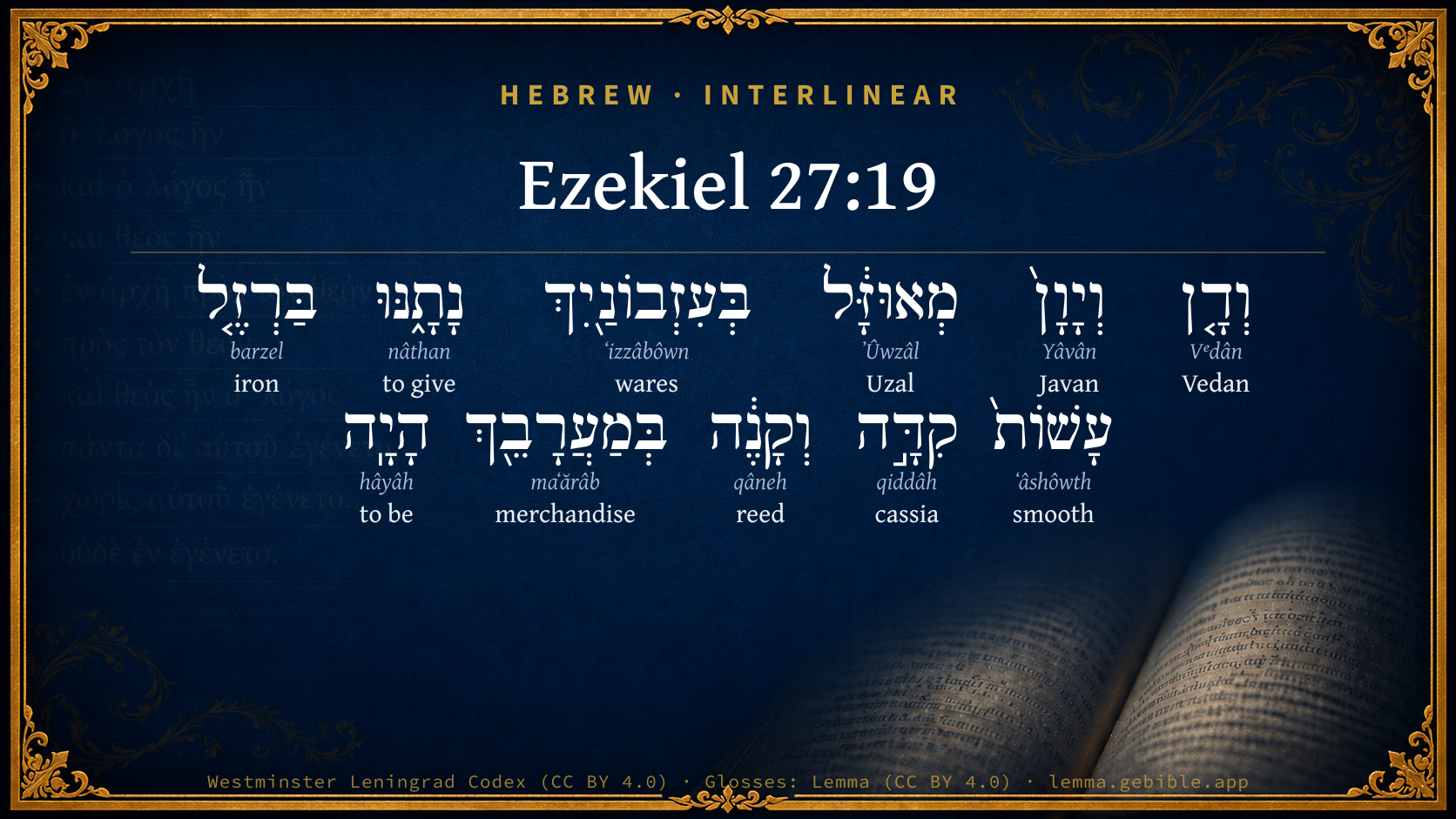
וְדָ֤ן
Vᵉdân
H2051
“Vedan”
Noun, Proper
Part of Speech
Noun
Type
Proper
Full BDB Definition

Origin: perhaps for H5730

TWOT: None

Vedan = "and Dan" - a place, site uncertain, perhaps near Medina in Arabia - may simply be read 'even Dan'
  1. וְיָוָן֙ Yâvân H3120 “and · Javan” Conjunction + Noun, Proper
  2. מְאוּזָּ֔ל ʼÛwzâl H187 “from · Uzal” Preposition + Noun, Proper
  3. בְּעִזְבוֹנַ֖יִךְ ʻizzâbôwn H5801 “in/at · wares · your” Preposition + Noun, Common, Masculine, Plural, Construct + Suffix, Personal, 2nd Person, Feminine, Singular
  4. נָתָ֑נּוּ nâthan H5414 “to give” Verb, Qal, Perfect, 3rd Person, Common, Plural
  5. בַּרְזֶ֤ל barzel H1270 “iron” Noun, Common, Masculine, Singular, Absolute
  6. עָשׁוֹת֙ ʻâshôwth H6219 “smooth” Adjective, Adjective, Masculine, Singular, Absolute
  7. קִדָּ֣ה qiddâh H6916 “cassia” Noun, Common, Feminine, Singular, Absolute
  8. וְקָנֶ֔ה qâneh H7070 “and · reed” Conjunction + Noun, Common, Masculine, Singular, Absolute
  9. בְּמַעֲרָבֵ֖ךְ maʻărâb H4627 “in/at · merchandise · your” Preposition + Noun, Common, Masculine, Singular, Construct + Suffix, Personal, 2nd Person, Feminine, Singular
  10. הָיָֽה hâyâh H1961 “to be” Verb, Qal, Perfect, 3rd Person, Masculine, Singular

About this verse

These counts appear in no published source. They are computed here, from the morphology-tagged text and Lemma’s own curated glosses. What Lemma adds →

11
words
11
distinct lemmas
Prophets
section

Notable vocabulary

2 hapax legomena — words that appear only here in the entire Hebrew Bible:

  • וְדָ֤ן Vedan H2051
  • עָשׁוֹת֙ smooth H6219

First appearance in Scripture

These words make their first canonical appearance in the Hebrew Bible here:

  • וְדָ֤ן Vedan H2051
  • עָשׁוֹת֙ smooth H6219

Shared distinctive vocabulary

קִדָּ֣ה cassia H6916 occurs in 2 verses of the Hebrew Bible. Also found in:

Grammatical profile

  • 2 verbs
  • 8 nouns
  • 1 adjective

Verb forms

  • נָתָ֑נּוּ Qal · Perfect
  • הָיָֽה Qal · Perfect

Hebrew & Septuagint length

In English translation the verse runs 18 words from the Hebrew and 17 from the Septuagint (LXX English) — closely comparable.

A rough comparison of the two English renderings, which tokenize alike — not a word-level alignment.

Word counts can differ between the Hebrew and the Greek without any difference in meaning — e.g. the Hebrew direct-object marker אֵת has no separate Greek word, and Greek often adds the article ὁ.

In the original languages it is 11 Hebrew tokens and 18 Greek tokens — but the two are counted differently (Hebrew bundles its prefixes and suffixes into one token; the Greek is in lemma form), so that isn’t a like-for-like length.

Cross-references

4

Topical passages linked to Ezekiel 27:19 in the Treasury of Scripture Knowledge — connected by theme and wording, ordered by reader-vote popularity; previews shown in the World English Bible.

  • Exodus 30:23–24 "Also take fine spices: of liquid myrrh, five hundred shekels; and of fragrant cinnamon half as much, even two hundred and fifty; and of fragrant cane, two hundred and fifty;
  • Judges 18:29 They called the name of the city Dan, after the name of Dan their father, who was born to Israel: however the name of the city was Laish at the first.
  • Psalms 45:8 All your garments smell like myrrh, aloes, and cassia. Out of ivory palaces stringed instruments have made you glad.
  • Song of Solomon 4:13–14 Your shoots are an orchard of pomegranates, with precious fruits: Henna with spikenard plants,

Cross-references courtesy of OpenBible.info (CC BY 4.0).

Hebrew and Greek witnesses Masoretic Hebrew ↔ Greek Septuagint

The same verse in the two great witnesses to the Old Testament, shown verse-for-verse.

These are two independent witnesses, not word-aligned to each other, and the Septuagint is shown in lemma (dictionary) form.

Hebrew Ezekiel 27:19 Masoretic · Westminster Leningrad Codex

וְדָ֤ן וְיָוָן֙ מְאוּזָּ֔ל בְּעִזְבוֹנַ֖יִךְ נָתָ֑נּוּ בַּרְזֶ֤ל עָשׁוֹת֙ קִדָּ֣ה וְקָנֶ֔ה בְּמַעֲרָבֵ֖ךְ הָיָֽה

Vedan and Javan traded with yarn for your wares: bright iron, cassia, and calamus, were among your merchandise.

World English Bible · Public Domain

Greek LXX Ezekiel 27:19 Septuagint · lemma form

καί οἶνος εἰς ὁ ἀγορά σύ δίδωμι ἐκ ασηλ σίδηρος ἐργάζομαι καί τροχός ἐν ὁ συμμικτός σύ εἰμί

Out of Asel came wrought iron, and there is the sound of wheels among your trading population.

LXX2012 (modern English Septuagint) · Public Domain

On this verse, The Cambridge Bible for Schools and Colleges discusses the Septuagint’s reading. Read the note in Commentary ↓

Hebrew: Westminster Leningrad Codex (CC BY 4.0). Greek: Septuagint (public domain); English from LXX2012 (modern English Septuagint) (Public Domain). How the Septuagint differs from the Hebrew →

Targum (Aramaic paraphrase)

1

The Targum is the ancient Jewish Aramaic paraphrase of the Hebrew Scriptures — an interpretive translation, not the Hebrew text itself. Onkelos (literal) and Pseudo-Jonathan (expansive) render the Torah, and Jonathan the Prophets. Coverage is partial: where no permissively-licensed English translation exists for a verse, only the Aramaic is shown. This is verse-level text, not a word-by-word alignment to the Hebrew.

  1. Targum Jonathan Prophets (Joshua–Malachi)
    וְדָן וְיָוָן בְּשִׁירִין סְחוֹרְתִּיךְ מַיְתָן בְּעַרְקִין דְבַרְזֶל קִדָה וּקְנֵה בֹּשֶׁם בַּחֲנוּתַיִךְ יְהָבוּ:

    (no public-domain English translation for this verse)

    Targum Jonathan — Aramaic: “Mikraot Gedolot” (public domain). English: “Sefaria Community Translation” (CC0 1.0 (public-domain dedication)); “London "Chaldee Paraphrase," 1871” (public domain). Text via Sefaria.

Commentary

Notes on Ezekiel 27:19 from classic Christian and Jewish commentators (each source and its license shown beneath its notes). The classic Christian expositions comment on the surrounding passage and are grouped to its opening verse, so a note may address several verses; the Jewish commentaries on the Tanakh (Rashi and others) are per-verse, so they appear only where the commentator wrote on this verse.

Lemma curates 59 commentaries, every one of them public domain or Creative Commons licensed, each selected and text-cleaned for this edition rather than reprinted as found. About our sources →

The Cambridge Bible for Schools and Colleges

gen. ed. J. J. S. Perowne

19. Dan also and Javan] This is certainly incorrect; none of the verses begins with and or also, and any reference to Dan is out of the question. The word rendered “going to and fro” was translated by Ges. “spun,” i.e. yarn (and so R.V.): Wedan and Javan brought as thy wares yarn. The word is more probably a proper name and to be rendered from Uzal. Uzal (Gen_10:27) is supposed to be identical with San‘âa, the capital of Yemen in S. Arabia. LXX. omits wedan and for Javan reads “wine” (a similar word). The text is probably in disorder. In all other cases the phrase “brought as thy wares” ends the verse, and possibly the first words of Eze_27:19 should be attached to Eze_27:18. So LXX. which reads Eze_27:19, “from Uzal (Azel) came wrought-iron” &c. Corn. follows LXX., supplying all the words after Helbon out of the Assyrian wine lists: wine of Helbon and Zimin and Arnaban they brought to thy market. From Uzal came wrought iron &c. As the verse stands it may read: “Wedan and Javan of Uzal furnished thy wares; bright iron, cassia and calamus were among thy goods”—though the most serious objections occur to the rendering. The “bright iron” may refer to sword blades, for which Yemen was famous. The calamus or sweet cane (Jer_6:20; Isa_43:24) supplied one of the ingredients of the holy oil for anointing the priests (Exo_30:23-24), and so did the cassia.

The Cambridge Bible for Schools and Colleges (gen. ed. J. J. S. Perowne; Cambridge University Press, 1878–1918) — public domain. Text from a community e-Sword module.

Trapp's Complete Commentary

John Trapp

Eze 27:19 Dan also and Javan going to and fro occupied in thy fairs: bright iron, cassia, and calamus, were in thy market.

Ver. 19. Dan also.] Anciently called Laish. {Jdg 18:29} Javan, or the Grecians, were great travellers. {a}

Going to and fro.] Discursatory.

“ Impiger extremos currit mercator ad Indos. ”

- Horat.

{See Trapp on "Psa 38:11"}

{a} Graecus vagabundus. - Vatab.

John Trapp, A Commentary or Exposition upon All the Books of the Old and New Testament (1647–1656) — public domain. Text from a community e-Sword module.

Tyndale Open Study Notes

Tyndale Open Resources

27:19 Greeks from Uzal: Uzal may have been a town in the foothills of Anatolia. • Cassia and calamus were expensive perfumes.

Tyndale Open Study Notes — © Tyndale Open Resources, licensed CC BY-SA 4.0. Text via the HelloAO Bible API.

Jamieson, Fausset & Brown

Robert Jamieson, A. R. Fausset & David Brown

Dan also--None of the other places enumerated commence with the copula ("also"; Hebrew, ve). Moreover, the products specified, "cassia, calamus," apply rather to places in Arabia. Therefore, FAIRBAIRN translates, "Vedan"; perhaps the modern Aden, near the straits of Bab-el-man-deb. GROTIUS refers it to Dana, mentioned by PTOLEMY.

Javan--not the Greeks of Europe or Asia Minor, but of a Greek settlement in Arabia.

going to and fro--rather, as Hebrew admits, "from Uzal." This is added to "Javan," to mark which Javan is meant (Gen 10:27). The metropolis of Arabia Felix, or Yemen; called also Sanaa [BOCHART]. English Version gives a good sense, thus: All peoples, whether near as the Israelite "Dan," or far as the Greeks or "Javan," who were wont to "go to and fro" from their love of traffic, frequented thy marts, bringing bright iron, &c., these products not being necessarily represented as those of Dan or Javan.

bright iron--Yemen is still famed for its sword blades.

calamus--aromatic cane.

Jamieson, Fausset & Brown — Commentary Critical and Explanatory on the Whole Bible (1871) — public domain (CC PDM 1.0). Text via the HelloAO Bible API.

Adam Clarke's Commentary

Verse 19. Dan also and Javan] It is probable that both these words mean some of the Grecian islands.

Going to and fro] They both took and brought-imported and exported: but מאוזל meuzal, from uzal, may be a proper name. What place is signified I cannot tell, unless it be Azal, a name, according to Kamoos, of the capital of Arabia Felix.

Adam Clarke's Commentary on the Bible (1810–1826) — public domain. Text from a community e-Sword/MySword module.

Ellicott's Commentary for English Readers

(19) Dan also and Javan.—This is the only instance in this enumeration in which the name of a people is introduced with a conjunction. Besides this structural difficulty, there seems no appropriateness in the name Dan, a tribe of Israel long since carried into captivity. The city Dan was of quite too little prominence to be mentioned here. It is probable, therefore, that what our translators have taken for the conjunction is really a part of the name Vedan, a place in Arabia not elsewhere mentioned, but which some suppose to be Aden. Javan does not here stand for Greece, but for an Arabian place or tribe, which there is reason to think is Yemen.

Going to and fro.—The margin is better, Menzal, or rather—the first letter being a preposition—front Uzal, the ancient Sanaa, afterwards the capital of Yemen. Yemen was famous for its sword-blades, which may be meant by the bright (literally, wrought) iron, and also for its spices brought from India.

A Bible Commentary for English Readers, edited by Charles John Ellicott (1878–1897) — public domain. Text from a community e-Sword module.

John Gill's Exposition

Dedan was thy merchant in precious cloths for chariots. Or, "cloths of freedom" (u); such as freemen and even nobles wore; and yet so extravagant were the Tyrians, that they bought these to line or cover their chariots with; this is different from the Dedan in Eze 27:15, and is either Dedan in Edom or Idumea, Jer 49:8, or in Arabia, the inhabitants of which descended from Dedan, a grandson of Abraham, Gen 25:3, which agrees with the following.

(u) "pannis libertatis", Vatablus, Piscator; "ingenuorem", Junius & Tremellius. So Ben Melech, and R. Sol. Urbin. Ohel Moed, fol. 30. 2.

John Gill's Exposition of the Whole Bible (1746–1763) — public domain (CC PDM 1.0). Text via the HelloAO Bible API.

Haydock's Catholic Bible Commentary

Dan: the citizens of Peneas, the tribe of Dan was in captivity. Grotius places these nations in Zeilan, (Calmet) or Ceylon. (Haydock)

George Leo Haydock (1774–1849), Haydock's Catholic Family Bible and Commentary, 1859 edition — public domain. Excludes Psalms (Douay-Rheims chapter numbering differs from Protestant) and Deuterocanonical books (Catholic canon only).

Matthew Poole's English Annotations

If it were the tribe of Dan, it must be understood of a time before the captivity of the ten tribes; but there is a learned man tells us of Dana a city of Taprobana, or the island Zeilan mentioned by Ptolemy, and this learned man will have this meant.

Javan; not Javan or Greece, saith that learned man, but another Javan in the isle Meroe in remote parts of Egypt, where is a principal town Uzal, or Asel, from whence these merchants came, and therefore styled Javan of Uzal, or Jayan Meuzal. And if the cassia or calamus, mentioned in the verse, were the wares brought in by the Danites and Javanites, I should go as far as Meroe and Taprobana to send them; but if the cassia and calamus were brought up at Tyre, I would believe they lived nearer, that they were Grecian pedlars, or in a northern dialect merchants, that bought them, and were meant in the text.

Bright iron; polished, as we see now an art, which so much betters the common sort of iron, and refines it, that it is of great value.

Cassia and calamus are sweet drugs.

Matthew Poole's English Annotations on the Holy Bible (1683–1685) — public domain. Text from a community e-Sword/MySword module.

Whedon's Commentary on the Bible

Daniel D. Whedon

19. Dan… and Javan… fairs — R.V. reads, “Vedan and Javan traded with yarn for thy wares.” For Javan see note Eze_27:13. Kautzsch renders “Wedan and Javan of Uzal [Gen_10:27] furnished thy wares.” Uzal would be identified with Sana in Arabia. There are iron mines in central Arabia (Doughty), and the steel of Sana is still held in high repute; but according to this interpretation the “Javan” seems out of place. MacPherson (Hastings’s Dictionary of the Bible, 1898) identifies this with the Dedan of Eze_27:15, which he believes to be the same mentioned Eze_25:13; but this makes this place too conspicuous among the countries bringing tribute to Tyre. The text is very difficult, but Halevy seems to have offered the best suggestion. He changes one letter and identifies Dan with Rodan (Revue Semitique, April, 1894. Compare note Eze_27:15). This would join Rhodes and Cyprus (Eze_27:13) or Rhodes and the Greeks of Asia Minor as traders with Tyre.

Bright iron — R.V., margin, “wrought iron.” Rhodes was famous from ancient times for its artificers, its ships, and its arms. At this very period the isles of Greece were capturing from Phoenicia the commerce of the world. (See Introduction to Daniel, III, 2.) Halevy believes the words translated bright… cassia, and calamus are technical terms for iron in the triple form of cakes (pig iron), flexible plates, and bars (Journal Asiatique and Revue Semitique).

Daniel D. Whedon (gen. ed.), Commentary on the Old and New Testaments (1874–1909) — public domain. Text from a community e-Sword module.

The Pulpit Commentary

Dan also; Hebrew, Vedan. The Authorized Version, following the Vulgate, takes the first syllable as the common conjunction "and;" but no other verse in the chapter begins in this way, and the Revised Version is probably right in giving the Hebrew word as its stands. Dan, it may be added, was hardly likely to have been singled out of all the tribes after the mention of Judah and Israel, especially as it had shared in the exile of the ten tribes. Smend identifies it with Waddan, between Mecca and Medina, or with Aden. Javan, too. already named in Ver. 13, can scarcely here be Greece, though it may possibly refer to Greek traders. It also has been identified conjecturally with an Arabian city. The words, going to and fro, have been rendered "from Uzal", (Gen_10:27) the ancient name of the capital of Yemen, in Arabia; or, as in the Revised Version, with yarn. The bright iron describes the steel used for sword-blades, for which Yemen was famous. Cassia (Exo_30:24; Psa_45:8) and calamus (Exo_30:23; Son_4:14) both belong to the class of perfumes for which Arabia was famous. It is probably the Acorns fragraas, the "sweet cane" of Isa_43:24; Jer_6:20.

The Pulpit Commentary (1880–1919), ed. H.D.M. Spence-Jones & Joseph S. Exell — public domain. Text from a community e-Sword module.

John Wesley's Explanatory Notes

Javan - In the isle of Meroe, in Egypt.

John Wesley, Explanatory Notes Upon the Whole Bible (1754–1765) — public domain. Text via the GEBible commentary corpus.

unfoldingWord translationNotes

Door43 World Missions Community

Connecting Statement:

Yahweh continues giving Ezekiel his message to Tyre.

General Information:

The words "you" and "your" in these verses refer to Tyre.

Dan ... Javan ... Izal ... Dedan ... Arabia ... Kedar

These are names of places. (See: How to Translate Names)

Dan and Javan

This is a metonym for the people of Dan and Javan. AT: "The people of Dan and Javan" (See: Metonymy)

wrought iron

a form of iron that can be shaped with a hammer

cinnamon

This is a type of spice that comes from the bark of a tree. "Cassia" is another name for this spice. (See: Translate Unknowns)

calamus

a type of grass that people used as perfume and for medicine (See: Translate Unknowns)

Dedan was

This is a metonym for the people of Dedan. AT: "The people of Dedan were" (See: Metonymy)

saddle blankets

A saddle blanket is a piece of cloth that people place on a horse beneath a saddle or seat.

Arabia

This is a metonym for the people of Arabia. AT: "The people of Arabia" or "The Arabians" (See: Metonymy)

translationWords

Dan

Arabia

chief

lamb

ewe

goat

unfoldingWord translationNotes — © Distant Shores Media and the Door43 World Missions Community, licensed CC BY-SA 4.0. Source: git.door43.org/Door43/en_tn.

Rashi

Rabbi Shlomo Yitzchaki (Rashi)

Vedan and Javan They are states.

spun silk [Heb. מְאוּזָל,] spun silk thread.

iron wrought into ingots [Heb. עָשּׁוֹת,] made like ingots (עֲשָּׁשִּׁיוֹת) mas(s)es or mas(s)iz in Old French, ingots, massive, and that is iron of Cush.

Rashi on the Tanakh — English translations: “The Judaica Press complete Tanach with Rashi, translated by A. J. Rosenberg” (CC BY 4.0); “Pentateuch with Rashi's commentary by M. Rosenbaum and A.M. Silbermann, 1929-1934” (public domain); “The Metsudah Tanach series, Lakewood, N.J” (CC BY 4.0); and “The Book of Joshua, Metsudah Publications, 1997” (CC BY 4.0). Text via Sefaria.

Lesson kit

Teaching starters — assembled from the data on this page, not authored interpretation. Every prompt links to the verse data it draws on. Edit before teaching.

Ezekiel, in the Prophets, opens this verse with 11 words (11 distinct Hebrew lemmas). Its most distinctive word is Vᵉdân (“Vedan”). A historical commentator’s framing appears above. Read the whole chapter for the surrounding context.

Discussion questions

  1. What does “Vedan” (Vᵉdân) contribute to the verse as a whole?
  2. This verse holds 2 words here found nowhere else in the Hebrew Bible. What might the rare words draw attention to?
  3. 2 words here appear for the first time in Scripture. What is being introduced at this debut?
  4. Exodus 30:24 shares the word «cassia» with this verse. How do the two illuminate each other?
  5. The translations on this page render this verse differently — a whole-verse word diff, not a word-by-word alignment. What might account for the different wordings?
  6. The verb «נָתָ֑נּוּ» is Qal Perfect. How does its form color the action?
  7. Reading how The Cambridge Bible for Schools and Colleges and Trapp's Complete Commentary read this verse, where do the two commentators agree and where do they part?

Things to notice

Reading settings

Reading text

Shown beneath each verse's original-language words.

Old Testament
Old Testament edition

Read the OT as the Masoretic Hebrew (MT) or the Greek Septuagint (LXX).

English shown for the Greek Septuagint (in the Hebrew ↔ Greek comparison).

Comparing translations? Open the Compare panel on any verse page to stack up to four side by side.