
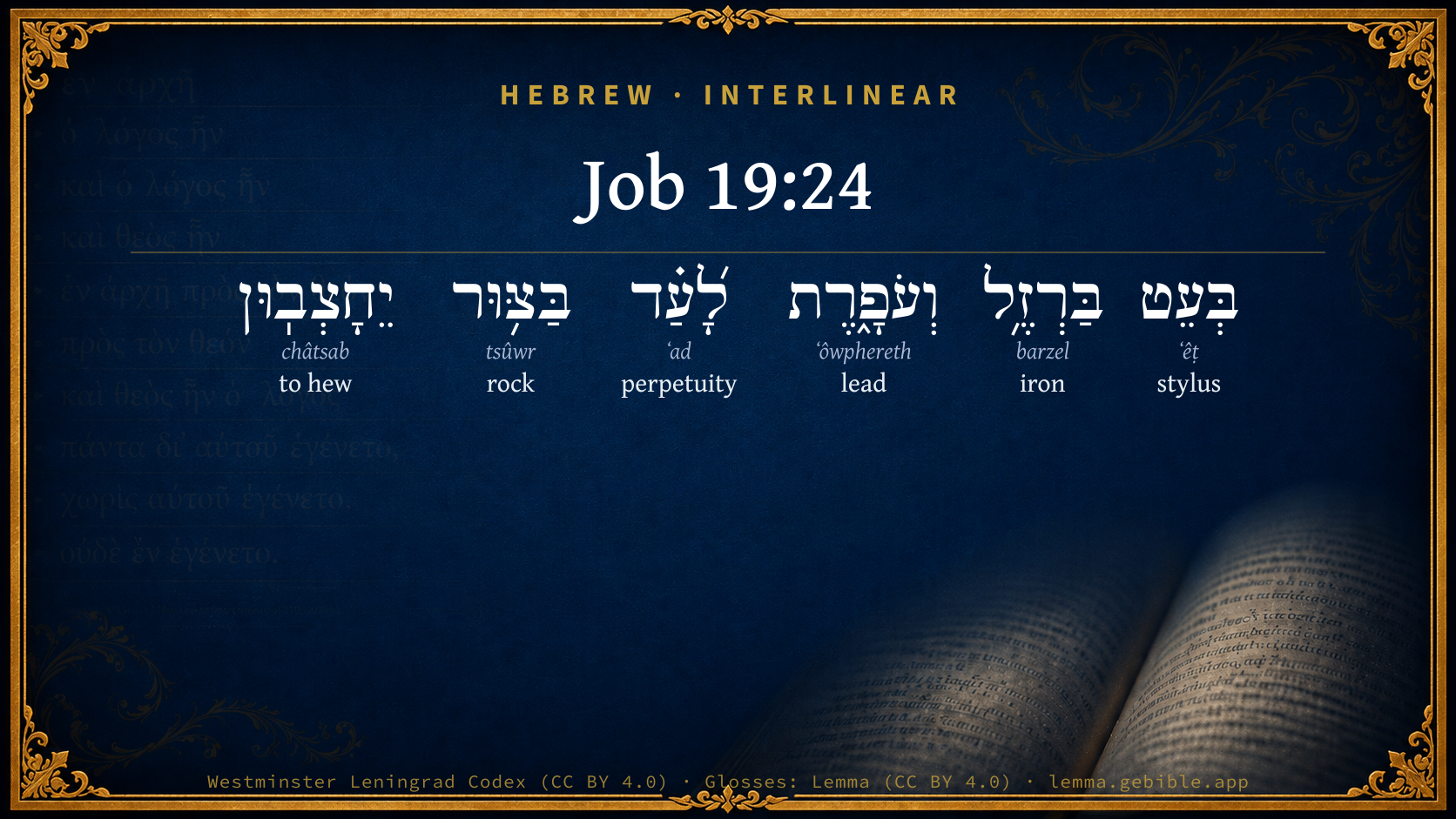
Job 19:24

Hebrew (Westminster Leningrad Codex) Job 19:24 appears in the Hebrew Old Testament. The text above is from the Westminster Leningrad Codex. Each word links to its Strong’s number, a concise gloss, and parsing drawn from the Open Scriptures Hebrew Bible morphology. Click any word for its full Brown-Driver-Briggs (BDB) entry.
Download image
Cite this verse

Job 19:24 (World English Bible). Public Domain. Lemma interlinear Bible study tool, https://lemma.gebible.app/v/job/19/24.

Show BibTeX & RIS
BibTeX
RIS
English Translation
That with an iron pen and lead They were engraved in the rock forever!
World English Bible · Public Domain
Highlights
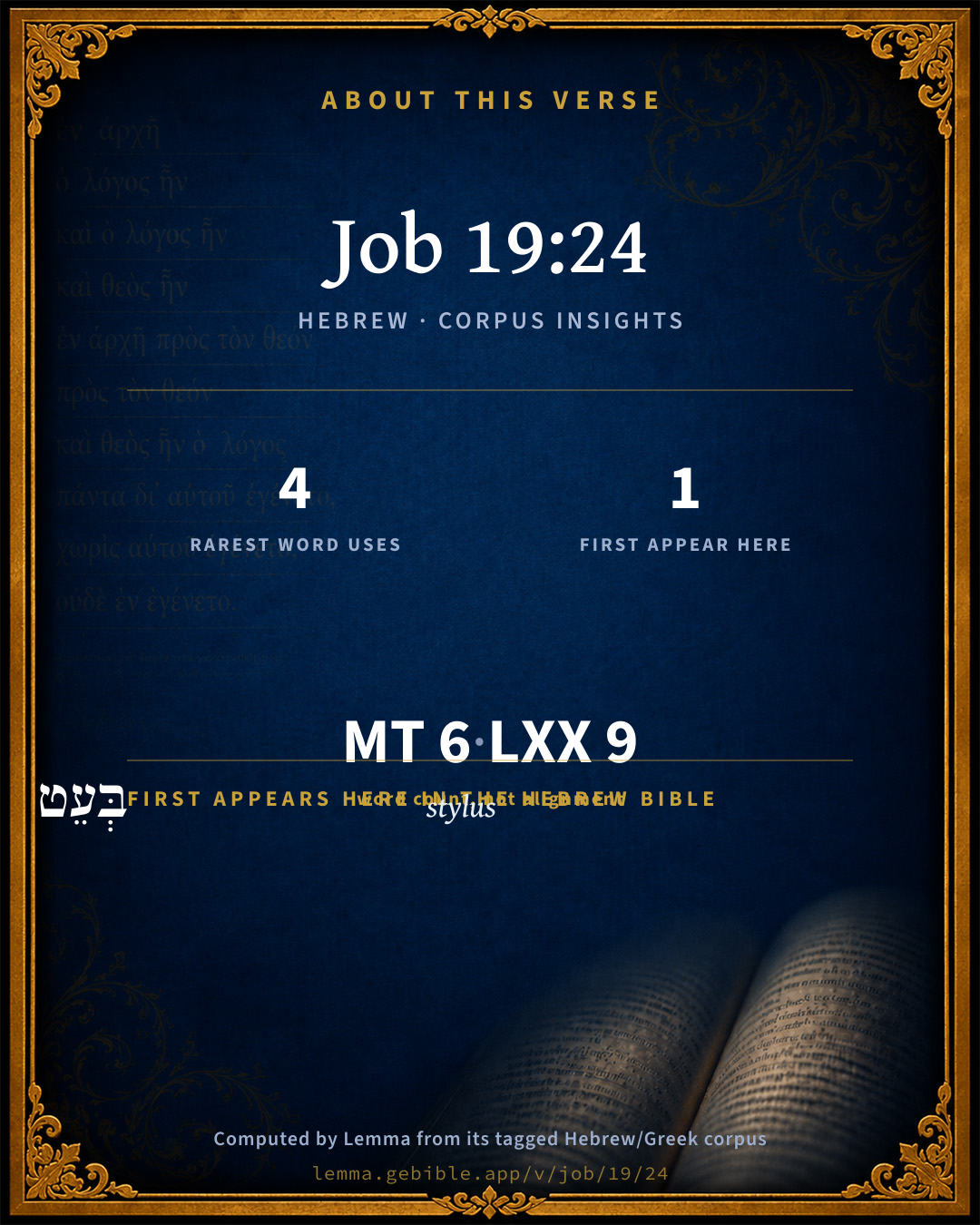
  • 1 first appearance in the Hebrew Bible
Full analysis ↓
Download a study sheet

One document with this verse’s original text, its word-by-word gloss line, the meaning frame, cross-references with their text, attributed commentary, and full source and license credits — printable, and it pastes into notes with its structure intact.

This verse Autodidact and up

Study sheet (.html) Plain text (.txt)

A passage Seminary Student

Up to 50 verses in one chapter. A passage sheet keeps up to 6 commentary sources and 12 cross-references per verse, in the order this page ranks them, and says so on the sheet whenever that leaves anything out. Ask for a single verse and you get the Autodidact verse sheet above.

Everything on this page stays free to read, with no account — the sheet is a download of what is already on screen, not access to it.

Want to remove ads? Support Godless Engineer
Compare translations 3

The same verse in 3 English versions, stacked beneath the original-language interlinear above. Click any original word for its lexicon entry.

Each is an independent rendering of the whole verse — the interlinear is not word-aligned to these translations.

Highlighted words mark where these versions differ — a whole-verse word diff, not a word-by-word alignment.

  • World English Bible Public Domain
    That with an iron pen and lead They were engraved in the rock forever!
  • King James Version Public Domain
    That they were graven with an iron pen and lead in the rock for ever!
  • unfoldingWord Literal Text CC BY-SA 4.0
    With a stylus of iron and lead may they be engraved on a rock forever!

unfoldingWord Literal Text — © unfoldingWord, licensed CC BY-SA 4.0. Word-aligned USFM3 via Door43 (git.door43.org/unfoldingWord/en_ult).

Versions to compare (up to 4)

3 of 4 selected

Show all 18 translations

Every available English version of this verse, each an independent rendering of the whole verse.

  • World English Bible Public Domain
    That with an iron pen and lead They were engraved in the rock forever!
  • Berean Standard Bible Public Domain
    by an iron stylus on lead, or chiseled in stone forever.
  • Majority Standard Bible Public Domain
    by an iron stylus on lead, or chiseled in stone forever.
  • King James Version Public Domain
    That they were graven with an iron pen and lead in the rock for ever!
  • American Standard Version (1901) Public Domain
    That with an iron pen and lead They were graven in the rock for ever!
  • Revised Version (1885) Public Domain
    That with an iron pen and lead they were graven in the rock for ever!
  • Geneva Bible (1599) Public Domain
    And grauen with an yron pen in lead, or in stone for euer!
  • Douay-Rheims (1899) Public Domain
    With an iron pen and in a plate of lead, or else be graven with an instrument in flint stone.
  • Young's Literal Translation Public Domain
    With a pen of iron and lead -- For ever in a rock they may be hewn.
  • Literal Standard Version CC BY-SA 4.0
    With a pen of iron and lead—They may be hewn in a rock forever.
  • Unlocked Literal Bible CC BY-SA 4.0
    Oh, that with an iron pen and lead they were engraved in the rock forever!
  • unfoldingWord Literal Text CC BY-SA 4.0
    With a stylus of iron and lead may they be engraved on a rock forever!
  • Darby Bible Public Domain
    That with an iron style and lead they were graven in the rock for ever!
  • World Messianic Bible Public Domain
    That with an iron pen and lead they were engraved in the rock forever!
  • Webster's Bible Public Domain
    That they were graven with an iron pen in lead, in the rock for ever!
  • Free Bible Version CC BY-SA 4.0
    or engraved with an iron pen and molten lead in the rock forever.
  • Bible in Basic English Public Domain
    And with an iron pen and lead be cut into the rock for ever!
  • JPS Tanakh (1917) Public Domain
    That with an iron pen and lead they were graven in the rock for ever!

Literal Standard Version (2020), Covenant Press — licensed CC BY-SA 4.0. Text via the HelloAO Bible API (eBible.org). Unlocked Literal Bible (unfoldingWord) — licensed CC BY-SA 4.0. Text via the HelloAO Bible API (eBible.org). unfoldingWord Literal Text — © unfoldingWord, licensed CC BY-SA 4.0. Word-aligned USFM3 via Door43 (git.door43.org/unfoldingWord/en_ult). Free Bible Version, Dr. Jonathan Gallagher — licensed CC BY-SA 4.0. Text via the HelloAO Bible API (eBible.org).

Word by word

More ways to search: Search by grammar → Find every occurrence → Compare this word →

Practice this passage: Drill this verse → Learn its vocabulary →

About this verse

These counts appear in no published source. They are computed here, from the morphology-tagged text and Lemma’s own curated glosses. What Lemma adds →

6
words
6
distinct lemmas
Wisdom
section

Notable vocabulary

The rarest word here is בְּעֵט stylus H5842 — appearing just 4 times in the whole Hebrew Bible.

First appearance in Scripture

This word makes its first canonical appearance in the Hebrew Bible here:

  • בְּעֵט stylus H5842

Shared distinctive vocabulary

בְּעֵט stylus H5842 occurs in 4 verses of the Hebrew Bible. Also found in:

Grammatical profile

  • 1 verb
  • 5 nouns

Verb forms

  • יֵחָצְבֽוּן Niphal · Imperfect

Hebrew & Septuagint length

In English translation the verse runs 14 words from the Hebrew and 11 from the Septuagint (LXX English) — closely comparable.

A rough comparison of the two English renderings, which tokenize alike — not a word-level alignment.

Word counts can differ between the Hebrew and the Greek without any difference in meaning — e.g. the Hebrew direct-object marker אֵת has no separate Greek word, and Greek often adds the article ὁ.

In the original languages it is 6 Hebrew tokens and 9 Greek tokens — but the two are counted differently (Hebrew bundles its prefixes and suffixes into one token; the Greek is in lemma form), so that isn’t a like-for-like length.

Cross-references

6

Topical passages linked to Job 19:24 in the Treasury of Scripture Knowledge — connected by theme and wording, ordered by reader-vote popularity; previews shown in the World English Bible.

  • Jeremiah 17:1 The sin of Judah is written with a pen of iron, [and] with the point of a diamond: it is engraved on the tablet of their heart, and on the horns of your altars;
  • Exodus 28:11–12 With the work of an engraver in stone, like the engravings of a signet, shall you engrave the two stones, according to the names of the children of Israel: you shall make them to be enclosed in settings of gold.
  • Exodus 28:21 The stones shall be according to the names of the children of Israel, twelve, according to their names; like the engravings of a signet, everyone according to his name, they shall be for the twelve tribes.
  • Exodus 32:16 The tablets were the work of God, and the writing was the writing of God, engraved on the tables.
  • Deuteronomy 27:2–3 It shall be on the day when you shall pass over the Jordan to the land which Yahweh your God gives you, that you shall set yourself up great stones, and plaster them with plaster:
  • Deuteronomy 27:8 You shall write on the stones all the words of this law very plainly.

Cross-references courtesy of OpenBible.info (CC BY 4.0).

Hebrew and Greek witnesses Masoretic Hebrew ↔ Greek Septuagint

The same verse in the two great witnesses to the Old Testament, shown verse-for-verse.

These are two independent witnesses, not word-aligned to each other, and the Septuagint is shown in lemma (dictionary) form.

Hebrew Job 19:24 Masoretic · Westminster Leningrad Codex

בְּעֵט בַּרְזֶ֥ל וְעֹפָ֑רֶת לָ֝עַ֗ד בַּצּ֥וּר יֵחָצְבֽוּן

That with an iron pen and lead They were engraved in the rock forever!

World English Bible · Public Domain

Greek LXX Job 19:24 Septuagint · lemma form

ἐν γραφεῖον σιδηροῦς καί μόλιβος ἤ ἐν πέτρα ἐνγλύφω

with an iron pen and lead, or graven in the rocks!

LXX2012 (modern English Septuagint) · Public Domain

On this verse, Haydock's Catholic Bible Commentary discusses the Septuagint’s reading. Read the note in Commentary ↓

Hebrew: Westminster Leningrad Codex (CC BY 4.0). Greek: Septuagint (public domain); English from LXX2012 (modern English Septuagint) (Public Domain). How the Septuagint differs from the Hebrew →

Commentary

Notes on Job 19:24 from classic Christian and Jewish commentators (each source and its license shown beneath its notes). The classic Christian expositions comment on the surrounding passage and are grouped to its opening verse, so a note may address several verses; the Jewish commentaries on the Tanakh (Rashi and others) are per-verse, so they appear only where the commentator wrote on this verse.

Lemma curates 59 commentaries, every one of them public domain or Creative Commons licensed, each selected and text-cleaned for this edition rather than reprinted as found. About our sources →

Trapp's Complete Commentary

John Trapp

Job 19:24 That they were graven with an iron pen and lead in the rock for ever!

Ver. 24. That they were graven with an iron pen, &c.] That my words were not only scripta sed sculpta, written, but graven in a rock, as the laws of various nations were cut in brass or marble; and as monuments and epitaphs are graven on tombs for remembrance of those that are dead.

And lead] Plumbo per sulcos infuso, saith Junius, the cuts of the letters in marble being filled with lead, that they might be the more legible and durable.

In the rock] In marble cut out of the rock. Golden words they are indeed that here follow, and well worthy to be written in letters of gold. In the Life of Zisca (that warlike Bohemian) it is recorded, that in the famous monastery called the king’s court, a mile from Prague, in the walls thereof the whole Bible was most exquisitely engraven in letters of gold (Clarke’s Lives).

For ever!] To last longer than the world lasteth. Those bloody tyrants of the primitive times made account they had made sure work in rooting out true religion, when they sounded the triumph beforehand, and engraved the victory upon pillars of marble in these bubbles of words: Nomine Christianorum deleto qui Remp. evertebant, &c. The name of the Christians I have erased who … But Christ shall reign, and the Church shall stand upon his right hand as a queen in gold of Ophir, Psa 45:9, when all earthly greatness shall lie in the dust. "Thy throne, O God, is for ever and ever," Psa 45:6; and there shall be a new sucession of saints to all perpetuity. Psa 72:17, "His name shall endure for ever; his name shall be continued (Heb. childed) as long as the sun," as long as the world, as long as the word of our God, which, according to Job’s wish here, shall stand for ever, Isa 40:8. But what meaneth the Vulgate translation here by this insignificant word Celte? Celte vox est nihili (Merc.). And why should Hugo seek to solve the matter, by telling us that celtis is a tool wherewith letters or pictures are cut in the flint? Whereupon, Vide, quaeso, mi Lector, saith Brentius, See, I pray thee, good reader, how oddly they interpret Scripture that lack learning; for neither is celte such a tool, nor can it be celte for certe, since the Hebrew word lagnad doth not signify surely, but for ever.

John Trapp, A Commentary or Exposition upon All the Books of the Old and New Testament (1647–1656) — public domain. Text from a community e-Sword module.

Geneva Bible (1599)

Geneva Bible translators

He protesteth that notwithstanding his sore passions his religion is perfect: and that he is not a blasphemer as they judged him.

Geneva Bible (1599) marginal notes — public domain. Text via Bolls.life.

Jamieson, Fausset & Brown

Robert Jamieson, A. R. Fausset & David Brown

pen--graver.

lead--poured into the engraven characters, to make them better seen [UMBREIT]. Not on leaden plates; for it was "in the rock" that they were engraved. Perhaps it was the hammer that was of "lead," as sculptors find more delicate incisions are made by it, than by a harder hammer. FOSTER (One Primeval Language) has shown that the inscriptions on the rocks in Wady-Mokatta, along Israel's route through the desert, record the journeys of that people, as Cosmas Indicopleustes asserted, A.D. 535.

for ever--as long as the rock lasts.

Jamieson, Fausset & Brown — Commentary Critical and Explanatory on the Whole Bible (1871) — public domain (CC PDM 1.0). Text via the HelloAO Bible API.

Adam Clarke's Commentary

Verse 24. Iron pen and lead] Some suppose that the meaning of this place is this: the iron pen is the chisel by which the letters were to be deeply cut in the stone or rock; and the lead was melted into those cavities in order to preserve the engraving distinct. But this is not so natural a supposition as what is stated above; that Job refers to the different kinds of writing or perpetuating public events, used in his time: and the quotations from Pliny and Pausanias confirm the opinion already expressed.

Adam Clarke's Commentary on the Bible (1810–1826) — public domain. Text from a community e-Sword/MySword module.

The Cambridge Bible for Schools and Colleges

gen. ed. J. J. S. Perowne

24. In Job_19:23 Job longed that his words were written. But ordinary writing is perishable. And now he desires that his words were hewn in indelible characters upon the rock. The “lead” was probably run into the traces cut in the stone. It need not be said that “the rock” like “the book” means merely rock, and not any particular rock.

The Cambridge Bible for Schools and Colleges (gen. ed. J. J. S. Perowne; Cambridge University Press, 1878–1918) — public domain. Text from a community e-Sword module.

John Gill's Exposition

For I know,.... The particle which is sometimes rendered by the copulative "and", by an adversative "but", and sometimes as a causal particle "for", should not be rendered here by either; but as an explanative, "to wit", or "namely", as it is by Noldius (y); in connection with the preceding words; in which Job wishes some words of his were written in a book, or engrossed on sheets of lead, or were cut out on some rock, and particularly were engraved on his tombstone; "namely", these following, "I know that my Redeemer liveth", &c. and to this agrees Broughton, "how that my Redeemer liveth"; let these be the words written, engraved, and cut out there: by my Redeemer, he means not any mere man that should rise up and vindicate him; for the account of his then living, and of his standing on the earth in the latter day, will not agree with such an one; nor God the Father, to whom the character of a Redeemer is seldom or ever given, nor did he ever appear or stand on earth, nor was his shape seen at any time, Joh 5:37; but the Son of God, the Lord Jesus Christ, who is our "Goel", the word here used, our near kinsman, and so our Redeemer, to whom the right of redemption belonged; and who was spoken of by all the holy prophets, from the beginning of the world, as the Redeemer of his people, who should redeem them from all their sins; from the law, its curses and condemnation; from Satan, and his principalities and powers; from death and hell, and everlasting destruction; and that by giving himself a ransom for them; all which was known in the times of Job, Job 33:24; and known by him, who speaks of him as living; he then existed not only as a divine Person, as he did from all eternity, but in his office capacity as Mediator, and under the character of a Redeemer; for the virtue of his future redemption reached to all the ages before it, from the foundation of the world; besides, the epithet "living" points at him as the "living God", as he is, Heb 3:12; and so equal to the work of redemption, and able to redeem, and mighty to save; of whom it is said, not that he has lived, or shall live, but "liveth"; ever lives; and so an expression of the eternity of Christ, who is from everlasting to everlasting, the same today, yesterday, and for ever; and who, though he died in human nature, yet is alive, and lives for evermore; he has life in and of himself, as he is God over all blessed for ever; and has life in him for all his people, as Mediator; and is the author of spiritual life in them, and the donor of eternal life to them; and because he lives, they shall live also. Now Job had an interest in him as the living Redeemer, and knew he had, which is the greatest blessing that can be enjoyed; an interest in Christ is of infinitely more worth than the whole world, and the knowledge of it exceeds all others; this knowledge was not merely speculative, nor only approbational and fiducial, though such Job had, Job 13:15; but the knowledge of assurance of interest; to know Christ as a Redeemer of men, and not our Redeemer, is of no avail; the devils know him to be a Redeemer, but not theirs: men may have an interest in Christ, and as yet not know it; interest is before knowledge; it is neither knowledge nor faith that gives interest, but God of his grace gives both interest and knowledge: and such a knowledge as here expressed is a peculiar favour; it is owing to an understanding given to know him that is true, and that we are in him that is true; and to the spirit of wisdom and revelation, in the knowledge of Christ, and to the testimony which he bears; and such knowledge will support under the greatest afflictions and sorest trials; under the ill usage of friends, and the loss of nearest and dearest relations, and in the views of death and eternity; all which was Job's case:

and that he shall stand at the latter day upon the earth; appear in the world in human nature; be the seed of the woman, and born of one, be made flesh, and dwell among men, and converse with them, as Jesus did; who stood upon the land of Judea, and walked through Galilee, and went about doing good to the bodies and souls of men; and this was in the last days, and at the end of the world, Heb 1:1; as a pledge of this there were frequent appearances of the son of God in an human form to the patriarchs; nor need it seem strange that Job, though not an Israelite, had knowledge of the incarnation of Christ, when it is said to (z) be the opinion of the Indian Brahmans that God often appeared in the form and habit of some great men, and conversed among men; and that Wistnavius, whom, they say, is the second Person of the triune God, had already assumed a body nine times, and sometimes also an human one; and that the same will once more be made by him; and Confucius, the Chinese philosopher (a), left it in writing, that the Word would be made flesh, and foresaw the year when it would be: or, "he shall rise the last out of the earth" (b); and so it may respect his resurrection from the dead; he was brought to the dust of death, and was laid in the grave, and buried, in the earth, and was raised out of it; and whose resurrection is of the greatest moment and importance, the justification, regeneration, and resurrection of his people depending on it: but this is not to be understood as if he was the last that should rise from the dead; for he is the firstfruits of them that sleep, and the firstborn from the dead, the first that rose to an immortal life; but that he who, as to his divine nature, is the first and the last; or that, in his state of humiliation, is the last, the meanest, and most abject of men (c); or rather, who, as the public and federal head of his people, is "the last Adam", Co1 15:45; and who did rise as such for their justification, which makes the article of his resurrection an unspeakable benefit: or, "he shall stand over the earth in the latter day" (d) in the last times of all, in the close of time, at the end of the world, at his appearing and kingdom, when he shall come to judge the quick and dead; those that will be alive, and those that will be raised from the dead, who will meet him in the air over the earth, and shall be for ever with him; and even then "he shall stand upon the earth"; for it is expressly said, that when he shall come, and all the saints with him, "his feet shall stand on the mount of Olives", Zac 14:4; or, "he shall stand against the earth at the latter days" (e); in the resurrection morn, and shall exercise his authority over it, and command the earth and sea to give up their dead; and when at his all commanding voice the dead shall come out of their graves, as Lazarus came out of his, he shall stand then upon the dust of the earth, and tread upon it as a triumphant Conqueror, having subdued all his enemies, and now the last enemy, death, is destroyed by the resurrection of the dead: what a glorious and enlarged view had Job of the blessed Redeemer!

(y) "nempe ego", Nold. Ebr. Concord. Partic. p. 696. No. 1750. (z) Huet. Alnetan. Quaest. l. 2. c. 13. p. 234. (a) Martin. Sinic. Hist. l. 4. p. 131. (b) "qui postremus ex palvere (terra) surget", Nold. ib. (c) "Novissimus", i.e. "miserrimus et abjectus", Bolducius; "sic ultimus miserorum", Ciceron. Orat. pro Flacco 24. (d) "Supra pulverem", Cocceius, Schultens. (e) "Adhibebit suam vim pulveri", Tigurine version.

John Gill's Exposition of the Whole Bible (1746–1763) — public domain (CC PDM 1.0). Text via the HelloAO Bible API.

Albert Barnes' Notes on the Bible

That they were graven - Cut in, or sculptured - as is done on stones. That they might become thus a permanent record.

With an iron pen - A stylus, or an engraving tool - for so the word (עט ‛êṭ) means. The instrument formerly used for writing or engraying was a small, sharp-pointed piece of iron or steel, that was employed to mark on lead or stone - somewhat in the form of small graying tools now. When the writing was on wax, the instrument was made with a flat head, that it could be obliterated by pressing it on or passing it over the wax.

The reason why Job mentions the iron pen here is, that he wished a perment record. He did not desire one made with paint or chalk, but one which would convey his sentiments down to future times.

And lead - That is, either engraved on lead, or more probably with lead. It was customary to cut the letters deep in stone, and then to fill fill them up with lead, so that the record became more permanent. This I take to be the meaning here. The Hebrew will scarcely allow of the supposition that Job meant that the records should be made on plates of lead - though such plates were used early, but perhaps not until after the time of Job.

In the rock - It was common, at an early period, to make inscriptions on the smooth surface of a rock. Perhaps the first thai were made were on stones, which were placed as way marks, or monuments over the dead - as we now make such inscriptions on grave-stones. Then it became common to record any memorable transaction - as a battle - on stones or rocks; and perhaps, also, sententious and apothegmatical remarks were recorded in this manner, to admonish travelers, or to transmit them to posterity. Numerous inscriptions of this kind are found by travelers in the East, on tombs, and on rocks in the desert. All that can be appropriate here is a notice of such early inscriptions of that kind in Arabia, as would render it probable that they existed in the time of Job, or such as indicate great antiquity. Happily we are at no loss for such inscriptions on rocks in the country where Job lived.

The Wady Mokatta, the cliffs of which bear these inscriptions, is a valley entering Wady Sheikh, and bordering the upper regions of the Sinai mountains. It extends for about three hours’ march, and in most places its rocks present abrupt cliffs, twenty or thirty feet high. From these cliffs large masses have separated, and lie at the bottom of the valley. The cliffs and rocks are thickly covered with inscriptions, which are continued at intervals of a few hundred paces only, for at least the distance of two hours and a half. Burckhardt, in his travels from Akaba to Cairo, by Mount Sinai, observed many inscriptions on the rocks, part of which he has copied. See his Travels in Syria, Lond. Ed. pp. 506, 581, 582, 606, 613, 614. Pococke, who also visited the regions of Mount Sinai in 1777, has given a description of the inscriptions which he saw on the rocks at Mount Sinai. Vol. i. 148, be says,” There are on many of the rocks, both near these mountains and in the road, a great many inscriptions in an ancient character; many of them I copied, and observed that most of them were not cut, but stained, making the granite of a lighter color, and where the stone had scaled, I could see the stain had sunk into the stone.”

Numerous specimens of these inscriptions may be seen in Pococke, vol. i. p. 148. These inscriptions were also observed by Robinson and Smith, and are described by them in Biblical Researches, vol. i. 108, 118, 119, 123, 161, 167. They are first mentioned by Cosmas, about 535 a.d. He supposed them to be the work of the ancient Hebrews, and says that certain Jews, who had read them, explained them to him as noting “the journey of such an one, out of such a tribe, in such a year and month.” They have also been noticed by many early travelers, as Neitzschitz, p. 149; Moncongs, i. p. 245; and also by Niebuhr in his Reisebeschr. i. p. 250. The copies of them given by Pococke and Niebuhr are said to be very imperfect; those by Seetzen are better, and those made by Burckhardt are tolerably accurate. Rob. Bib. Research. i. 553. A large number of them have been copied and published by Mr. Grey, in the Transactions of the Royal Society of Literature, vol. iii. pt. 1, Lond. 1832; consisting of one hundred and seventy-seven in the unknown character, nine in Greek, and one in Latin. These inscriptions, which so long excited the curiosity of travelers, have been recently deciphered (in the year 1839) by Professor Beer, of the University of Leipzig. He had turned his attention to them in the year 1833, but without success.

In the year 1839 his attention was again turned to them, and after several months of the most persevering application, he succeeded in making out the alphabet, and was enabled to read all the inscriptions which have been copied, with a good degree of accuracy. According to the results of this examination, the characters of the Sinaitic inscriptions belong to a distinct and independent alphabet. Some of the letters are wholly unique; the others have more or less affinity with the Palmyrene, and particularly with the Estrangelo and the Cufic. They are written from right to left. The contempts of the inscriptions, so far as examined, consist only of proper names, preceded by a word which is usually שׁלם shâlôm, peace, though occasionally some other word is used. In one or two instances the name is followed by a sentence which has not yet been deciphered. The names are those common in Arabic. It is a remarkable fact that not one Jewish or Christian name has been found.

The question, as to the writers of these inscriptions, receives very little light from their contents. A word at the end of some of them may be so read as to affirm that they were pilgrims, and this opinion Professor Beer adopts; but this is not certain. That the writers were Christians, seems apparent from many of the crosses connected with the inscriptions. The age, also, of the inscriptions, receives no light from their conents, as no date has yet been read. Beer supposes that the greater part of them could not have been written earlier than the fourth century. Little light, therefore, is cast upon the question who wrote them; what was their design; in what age they were written, or who were the pilgrims who wrote them. See Rob. Bib. Research. i. 552-556. That there were such records in the time of Job, is probable.

Albert Barnes' Notes on the Bible (1834–1885) — public domain. Text from a community e-Sword/MySword module.

Haydock's Catholic Bible Commentary

In a. Hebrew, "lead, in the rock for ever." (Protestants) Septuagint have, "for ever," after book, (ver. 23) and subjoins, "with a writing instrument of iron and (or) lead, or be engraven on the rocks for a memorial." Grabe insinuates that before there was only, "and on lead, or be engraven on the rocks." (Haydock) --- Instrument, (celte) means "a chisel," (Haydock) like cœlum from cœlo: " I engrave." (Pineda) --- St. Jerome, (ad Pam.) and the late editor of his works, retain this word, as the older editions of St. Gregory did; (Calmet) though certe, "surely," has been inserted instead, from several manuscripts by the Benedictines. (Haydock) --- Ancient manuscripts and Latin Bibles have more generally the latter word. But the received editions are supported by many manuscripts (Calmet) and the Septuagint Greek: eggluthenai, expresses as much. Celtis est, Greek:gluthaion. (Amama). (Casaub. in Atheneus vii. 20. p. 556.) --- An inscription, in Dalmatia, has the same sense: Neque hic atramentum vel papyrus aut membrana ulla adhuc; sed malleolo et celte literatus silex. "Here as yet was neither ink, nor paper, nor any parchments; but a flint stone was lettered with a mallet and a chisel.." The former modes of writing were not, in effect, invented by the days of Job. (Calmet) --- But it was long very usual to make use of lead. (Pineda) --- What he desired to have written in such durable characters, (Haydock) was the following sentence, in proof of his unshaken confidence in God, and as a refutation of his friends, who accused him of despair and blasphemy, (Calmet) as also the whole history of his conflict. His desire has been granted. (Tirinus)

George Leo Haydock (1774–1849), Haydock's Catholic Family Bible and Commentary, 1859 edition — public domain. Excludes Psalms (Douay-Rheims chapter numbering differs from Protestant) and Deuterocanonical books (Catholic canon only).

Matthew Poole's English Annotations

An iron pen; of which also there is mention Jer 17:1.

And lead; or, or lead; or, with lead; the particle and being oft so used, as Gen 4:20; Exo 1:6; Jer 22:7. For this lead may be either,

1. The writing pen, which might be either of iron or of lead; for though lead be of itself too soft, yet there was an art of tempering lead with other metals to such a degree of hardness that it could pierce into a rock; as they did-also temper brass, so that they could make bows and swords of it. Or,

2. The writing table; for the ancients did use to write divers things in lead, as is well known. Or,

3. The writing ink, as I may call it; for they used to grave the letters in a stone with an iron tool, and then to fill up the cuts or furrows made in the stone with lead, that the words might be more plainly seen and read.

Matthew Poole's English Annotations on the Holy Bible (1683–1685) — public domain. Text from a community e-Sword/MySword module.

Whedon's Commentary on the Bible

Daniel D. Whedon

24. Since ink, parchment, and metal may perish, Job desires that the momentous truth he is about to utter may be chiseled into the rock; and, that the characters may be forever legible, he would have them filled in with lead. A gradation of thought is intended, as Holemann has indicated — first the writing, then the inscribing in a book, and last the chiseling into the rock forever. Rocks abound in the East bearing inscriptions not only of historical events, but of legal precepts, prayers, etc. While no one knows that the wish of Job was ever fulfilled, his precious thoughts stand recorded upon the rock of heavenly truth. Generation after generation have gazed with wondering and trusting hearts upon these imperishable lines, and thus shall it be so long as rocks and mountains stand.

THE INSCRIPTION — JOB’S CONFESSION OF FAITH.

Such is its momentousness that we give the Hebrew with a literal translation, and in the reverse order, as in the original: —

חי| גאלי| ידעתי| ואני

living (is) | my Redeemer | I know | And

יקום| עפר-על| ואחרון

shall stand | on the dust | the last.

And זאת-נקפו| עורי| ואחר

this they destroy | my skin. | And after

אלוה| אחזה| ומבשׁרי

God | I shall see. | And from my flesh

לי| אחזה| אני| אשׂר

for myself | I shall see. | I, | Whom,

זר- ולא| ראו| ועיני

and not another | behold, | And my eyes

בחקי| כליתי| כלו

within me | my reins. | Are consumed

Daniel D. Whedon (gen. ed.), Commentary on the Old and New Testaments (1874–1909) — public domain. Text from a community e-Sword module.

The Pulpit Commentary

That they were graven with an iron pen and lead in the rock for ever! A peculiar kind of rock-inscription, of which, so far as I know, no specimens remain, appears to be here alluded to. Job wished the characters of his record to be cut deep into the rock with an iron chisel, and the incision made to be then filled up with lead (compare the mediaeval "brasses").

The Pulpit Commentary (1880–1919), ed. H.D.M. Spence-Jones & Joseph S. Exell — public domain. Text from a community e-Sword module.

John Wesley's Explanatory Notes

Lead - Anciently they used to grave the letters in a stone with an iron tool, and then to fill up the cuts with lead, that the words might be more plainly seen.

John Wesley, Explanatory Notes Upon the Whole Bible (1754–1765) — public domain. Text via the GEBible commentary corpus.

Rashi

Rabbi Shlomo Yitzchaki (Rashi)

With an iron pen they should be inscribed in the rock, and afterwards they run lead over them to give the letters a black appearance, to make them recognizable. This is the practice of those who inscribe on stone. It cannot be explained to mean a lead pen because lead is soft in comparison with stone.

Rashi on the Tanakh — English translations: “The Judaica Press complete Tanach with Rashi, translated by A. J. Rosenberg” (CC BY 4.0); “Pentateuch with Rashi's commentary by M. Rosenbaum and A.M. Silbermann, 1929-1934” (public domain); “The Metsudah Tanach series, Lakewood, N.J” (CC BY 4.0); and “The Book of Joshua, Metsudah Publications, 1997” (CC BY 4.0). Text via Sefaria.

Lesson kit

Teaching starters — assembled from the data on this page, not authored interpretation. Every prompt links to the verse data it draws on. Edit before teaching.

Job, in the Wisdom, opens this verse with 6 words (6 distinct Hebrew lemmas). Its most distinctive word is ʻêṭ (“stylus”). A historical commentator’s framing appears above. Read the whole chapter for the surrounding context.

Discussion questions

  1. What does “stylus” (ʻêṭ) contribute to the verse as a whole?
  2. This is the first place “stylus” appears in Scripture (first appears here). What does its debut here establish?
  3. How does Psalms 45:1, which shares the word «stylus», read alongside this verse?
  4. These translations render this verse differently; the difference is in the English rendering, not the original. What questions does that raise?
  5. «יֵחָצְבֽוּן» is a Niphal Imperfect verb. How does that grammatical form shape the action described?
  6. Compare how Trapp's Complete Commentary and Geneva Bible (1599) read this verse. Where do they agree or differ?

Things to notice

Reading settings

Reading text

Shown beneath each verse's original-language words.

Old Testament
Old Testament edition

Read the OT as the Masoretic Hebrew (MT) or the Greek Septuagint (LXX).

English shown for the Greek Septuagint (in the Hebrew ↔ Greek comparison).

Comparing translations? Open the Compare panel on any verse page to stack up to four side by side.